Frank Horvat at the Baths of Caracalla, until January 10, 2027
In short. The Frank Horvat exhibition is open at the Baths of Caracalla, Viale delle Terme di Caracalla 52, 00153 Rome, from September 11, 2026 to January 10, 2027, closed on Monday.
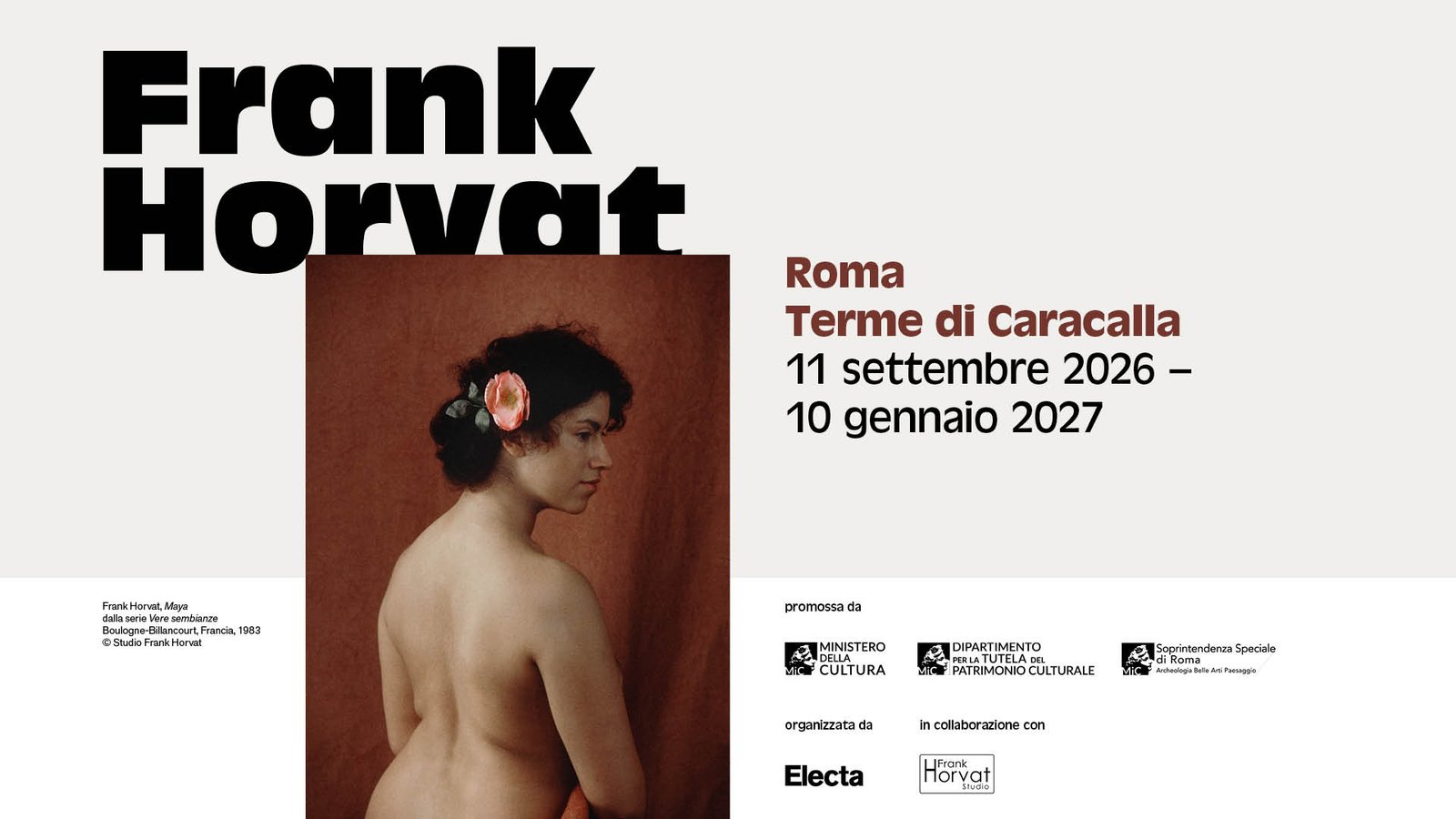
The Frank Horvat exhibition is open at the Baths of Caracalla, Viale delle Terme di Caracalla 52, 00153 Rome, from September 11, 2026 to January 10, 2027, closed on Monday. The hours follow those of the archaeological site and get shorter with the autumn: from 9:00 to 19:00 until September 30 (last entry at 18:00), from 9:00 to 18:30 from October 1 to the end of October (last entry at 17:30), from 9:00 to 16:30 from the end of October to January 10 (last entry at 15:30). By public transport you get off at the Circo Massimo stop of metro line B or at the Porta Metronia stop of metro line C. Tram 3 and buses 75, 628 and 760 also reach the Circo Massimo stop. The ticket given by the Special Superintendency of Rome costs €10 full price and €4 reduced, with reductions and free admission according to current regulations. Tickets are named and are bought on the Ministry of Culture's official ticketing portal indicated by the Superintendency, from the official app, or at the ticket offices and automatic kiosks at the entrance, which accept only electronic payments.
72 photographs inside the ruins of one of the best-preserved imperial buildings of antiquity: that is the Special Superintendency of Rome's bet for the autumn of 2026, and it's a bet won before you even walk in. Frank Horvat spent 70 years taking photography out of the enclosures in which others wanted to lock it: fashion outside the studio, reportage inside fashion, the portrait in competition with painting, the landscape as the reading of a book. Placing him among the palaestras and vaulted rooms built for Caracalla means asking him to stand up to the comparison with immense walls and with 18 centuries of history. He holds up. Whoever enters for the Baths comes out with Horvat in their eyes, whoever enters for Horvat discovers that the Baths are an open-air museum that is visited too little in Rome.
Exhibitions inside archaeological sites carry a precise risk: becoming a pretext, a few panels leaned against the ruins to fill the dead season. Here the risk is avoided by a clear curatorial choice, which divides the route into three chapters and places them in different rooms of the complex. The result is a visit that makes you walk, change light and scale, look at photography the way you look at architecture. It's the best way to see both.
Frank Horvat at the Baths of Caracalla: what you see
The Frank Horvat exhibition at the Baths of Caracalla brings together 72 images divided into three sections, set up in one of the palaestras and in the vaulted rooms of the complex, from September 11, 2026 to January 10, 2027. The title is simply the photographer's name, and the choice already says a lot: no winking subtitles, no poster formulas, an author and his work.
72 photographs in three chapters
The route is organized in three areas. The first collects the portraits devoted to the female universe and is housed in one of the two large palaestras of the Baths, with a closer look at the photo shoots that Horvat did at the Galleria L'Obelisco at the invitation of Irene Brin and Gaspero del Corso. The second is again devoted to women, with the color series Vere sembianze, and finds its place in the vaulted rooms. The third is entirely devoted to the cycle Goethe in Sicilia, made in the early 1980s. Three cores, three registers, three ways of understanding photography: and all three signed by the same hand.
Who promoted and curated the exhibition
The exhibition is promoted by the Special Superintendency of Archaeology, Fine Arts and Landscape of Rome, which manages the Baths, with organization by Electa. The curation is entrusted to Studio Frank Horvat, represented by Fiammetta Horvat and Mathilde Oudin, and to Nunzio Giustozzi. The exhibition's official press release can be read on the site of the Special Superintendency of Rome, and the Studio has published its English version with some images of the installation on the official site of Studio Frank Horvat.
The Electa catalog
The volume that accompanies the exhibition is published by Electa and follows the three sections of the route. It contains writings by Horvat himself and opens with a remembrance by the photographer Ferdinando Scianna. It's a detail that counts: a great photographer remembering a colleague always says something critics don't see. For those who leave the exhibition wanting to go deeper, the catalog is the right choice: Horvat wrote about photography with the same lucidity with which he photographed, and reading him helps you understand the images more than any caption.
Frank Horvat's women in the palaestra of the Baths
The first section of the Frank Horvat exhibition occupies one of the two palaestras of the Baths of Caracalla and is devoted to female portraits, from the models of fashion shoots to the women met in reportage around the world. It is the largest section and the one the public recognizes right away, because it contains the fashion images that made Horvat famous between the 1950s and the 1960s.
Portraits of real women
Horvat himself called this strand portraits of real women. The sense of the definition is understood by looking at the photographs one after another: the models of the fashion magazine shoots are often caught in everyday life, on the street, in the metro, in the crowd, with only natural light and a Leica in hand. Next to them are the women photographed in reportage from Pakistan to India, from Brazil to Senegal, from Egypt to Japan. The comparison is intentional, and it works: the Parisian model and the woman met in a village in South Asia receive the same gaze, the same attention to character before the dress.
The invitation from the Galleria L'Obelisco
The Roman focus of the section concerns the photo shoots Horvat did at the Galleria L'Obelisco, at the invitation of Irene Brin and Gaspero del Corso. For those who know postwar Rome, these two names are enough to evoke an era in which art, fashion and cinema met in the same salons. The photographs speak for themselves, and tell about that city with the lightness of someone passing through as a curious guest.
Rome in the early 1960s
A core of images comes from the shoots taken in Rome in the early 1960s for Harper's Bazaar, with celebrated models of the era in the company of figures of culture and cinema such as Alberto Moravia and Marcello Mastroianni. The Studio's official chronology places precisely in the years 1961 and 1962 the start of Horvat's collaboration with Glamour and with Harper's Bazaar, right after leaving the Magnum agency. Seeing these photographs a few kilometers from the places where they were taken, inside a monument that that Rome knew well as the summer stage of the Opera, has a particular flavor.
The first photograph, Lugano 1945
Among the images released with the exhibition is also a portrait titled Elena, taken in Lugano in 1945, when Horvat was 17. It's a youthful photograph, prior to any professional assignment, and its presence in the exhibition says a lot about the curators' approach: the female portrait is a thread running through the whole of Horvat's life, from the boy refugee in Switzerland to the established photographer of Paris.
Vere sembianze: Frank Horvat competes with painting
The second section of the Frank Horvat exhibition is devoted to the series Vere sembianze (in French Vraies semblances), a cycle of color female portraits begun in the 1980s and installed in the vaulted rooms of the Baths of Caracalla. Here Horvat measures photography against the great tradition of the painted portrait.
The dialogue with the great portraitists
In the images of Vere sembianze the models take poses, lights and atmospheres that recall celebrated portraits in the history of art, from Raphael to Leonardo, from Velázquez to Ingres. The point, though, is not the quotation, and whoever expects the game of the painting redone in costume will be thrown off. Horvat works on light, tones and surfaces. The women he photographs remain contemporary women, with recognizable faces and characters, and the reference to painting is a tension more than a copy. Among the photographs released with the exhibition are Maya and Sandrine, both dated 1983 and taken in Boulogne-Billancourt.
Why exactly under the vaults
The choice to place Vere sembianze in the vaulted rooms is the most successful of the installation. The brick vaults of the Baths create an enclosed space, with a lower and more controlled light than the palaestras, and the color portraits find there the same intimacy they would have in a chapel or in a gallery of old paintings. The advice is to slow down right here: these are images that ask for time, and the place helps give it to them.
Goethe in Sicilia: Frank Horvat's photographic journey
The third section of the Frank Horvat exhibition presents the cycle Goethe in Sicilia, made in 1981 at the invitation of a Palermo publisher: about 20 black-and-white photographs that retrace the places Goethe visited during his Italian Journey. It is the quietest section and, for those who love landscape, the most beautiful.
In the footsteps of the Italian Journey
Horvat approaches Sicily with Goethe's book in hand, and discovers a deep harmony with the German writer's Romantic gaze. The images dwell on the Greek temples, on the island's landscapes, on the Baroque and Rococo architecture, on popular traditions. There's no postcard folklore: there's a mature photographer measuring himself against a classic text and returning its essence with the means of photography.
A question of perspective
For this cycle Horvat used a wide-angle shift lens, a tool that lets you correct the convergence of vertical lines and obtain a uniform and controlled perspective. It's the technique of architectural photographers, and in his hands it becomes a way to render Sicily's historical stratification without deforming it. Whoever looks at these images after walking among the walls of the Baths will notice the kinship: Roman ruins and Sicilian temples, Grand Tour and archaeology, travel as the formation of the eye.
Who Frank Horvat was: the biography
Frank Horvat was born on April 28, 1928 in Abbazia, then in Italy and today Opatija in Croatia, and died on October 21, 2020, at 92, having worked to the very end. In between are 70 years of photography that cross photojournalism, fashion, advertising, landscape, portraiture, digital experimentation and writing. The chronology that follows comes from the Studio's official site and from the Superintendency's press release.
From Abbazia to Lugano
Francesco Horvat is born to Jewish parents of Central European origin, both doctors. In 1938 the racial laws strike the Jews in Italy. In 1939 his father flees to Hungary, where he survives the war thanks to false documents, while his mother takes refuge in Switzerland with the two children. Between 1939 and 1945 Francesco attends middle school and then high school in Lugano. It's there that he trades his stamp collection for a 35 millimeter Retinamat: his first camera. In 1945 he moves to Zurich.
Milan, Brera and advertising
In 1947 he enrolls at the Accademia di Belle Arti di Brera in Milan, but soon drops out. The following year he joins a small advertising agency, where he is given commercial jobs and then a few photographs. He buys a Rolleicord 6x6. In 1949 he visits his father, who emigrated to Israel, and makes his first reportage. In 1951 comes the first publication, in black and white and in color, in the Milanese weekly Epoca, still signed Franco Horvat.
The meeting with Cartier-Bresson
Also in 1951, in Paris, Horvat meets Henri Cartier-Bresson, who advises him to buy a Leica and to go to the Louvre to look at the paintings of Poussin. The Superintendency's press release also recalls the meeting with Robert Capa, and the influence both had on his style. In the same year Horvat photographs Charles de Beistegui's famous ball in Venice for Point de Vue and receives his first assignment from the Swiss magazine Die Woche. According to the text by Christian Caujolle published by the Studio, it was Cartier-Bresson who convinced him to adopt the Leica and to leave for India.
Pakistan, India and London
Between 1952 and 1954 Horvat travels in Pakistan and India, sending photographs to Die Woche and to several agencies in Paris, Munich, London and New York. His reports appear in Paris-Match, Picture Post, Life and many other publications. In 1954, after a trip to Israel and Jordan, he moves to London under contract with the American agency Black Star, and adopts the name Frank. In 1955 one of his images taken in Pakistan enters the exhibition The Family of Man at the MoMA in New York. In the same year he settles in Paris.
Paris and fashion with the Leica
The Paris years are those of the turning point. In 1956 he does reportage on Paris at night and his first work for the magazine Réalités, and photographs the city a lot with the telephoto lens. In 1957 his images of Paris appear in the magazine Camera and are shown at the first Venice photography Biennale. In the same year begins the collaboration with Jacques Moutin, art director of Jardin des Modes, who credits him with the merit of the fashion photographs taken with the Leica. In 1958 come Jours de France and Elle. It's the moment when Horvat takes the models into the street, to the races, into the metro, and changes the language of fashion photography.
Magnum, Vogue, Harper's Bazaar
In 1959 Horvat publishes in Elle, Jardin des Modes, Jours de France and does for Réalités reports on Paris, on the suburbs, on London and on the Belgian Borinage. In 1960 he begins working for Vogue UK, which brings him international fame in fashion circles, and becomes an associate of the Magnum agency. He leaves it between 1961 and 1962, when he begins working for Glamour and Harper's Bazaar. Between 1962 and 1963 he does for the German magazine Revue a report on 12 great cities of the world.
The years of research
From the mid-1960s, with the crisis of the illustrated press that was already hitting photographers, Horvat tries the path of video, illustration and cinema, with little luck. In 1970 he buys an isolated house in the Haut Var, which he calls La Véronique. In 1976 he travels the world photographing trees, his first color project, made with the printer Michel Fresson. In 1982 he starts the series New York Up and Down and buys a computer. From 1983 he collaborates with the weekly supplement of the Frankfurter Allgemeine Zeitung.
Entre vues and the collection
In the mid-1980s, struck by an eye illness, Horvat also devotes himself to writing and interviews the photographers he loves: among others Édouard Boubat, Robert Doisneau, Mario Giacomelli, Josef Koudelka, Don McCullin, Sarah Moon, Helmut Newton, Marc Riboud, Jeanloup Sieff and Joel-Peter Witkin. This is how the book Entre vues was born. In the same period he starts a personal collection of photographs, built by exchange with colleagues, which will come to number nearly 500 prints.
Digital before the others
Between 1989 and 1990 Horvat works with digital images and with Photoshop, on projects like Bestiario, and uses digital tools to illustrate Ovid's Metamorphoses. He is among the very first famous photographers to do so. In 1992 he joins the editorial board of the Taiwanese magazine Photographers International. In 1999 he keeps a daily photographic diary to bid farewell to the end of the millennium.
The last years
In 2003, after a period of convalescence in the Var, he starts the project La Véronique. In 2007 he begins Eye at the Fingertips, which he will carry on to the end. In 2012 he creates his tablet app, Horvatland, and between 2009 and 2020 he self-publishes the series of his white books. He dies on October 21, 2020, the same day his last book arrives in bookstores, Side Walk, devoted to color photographs of New York, many of them previously unpublished.
Givenchy's Hat, Frank Horvat's most famous photograph
The image chosen for the exhibition's cover is Givenchy's Hat, taken for Jardin des Modes in Paris in 1958. The text by Christian Caujolle published by the Studio describes it like this: at the Longchamp racecourse, a model of supreme elegance surrounded by gentlemen in gray top hats, whose gazes are hidden by the binoculars with which they should be following the race. It is a very elegant photograph full of irony, and according to Caujolle himself it became so famous as to be almost annoying to its author.
The paradox is instructive. Horvat never considered himself a fashion photographer, and rejected any label except that of photographer. The Caracalla exhibition knows it, and uses the Longchamp photo as a doorway, not as a summary. Inside, the visitor finds fashion, of course, but also reportage, color, painting, Goethe. Whoever stops at the cover misses the best part.
The Baths of Caracalla: the venue of the exhibition
The Baths of Caracalla were inaugurated in 216 AD by the emperor Caracalla and remain one of the best-preserved imperial buildings of antiquity, because no later construction has absorbed them. They are located on the Little Aventine, along the initial stretch of Via Appia, about 400 meters from the ancient Porta Capena.
Built in five years
The Superintendency recalls that the complex was built in only five years in the southern part of the city, on three descending terraces, served by an aqueduct built for the purpose, the Antoniniano, and reached by a new road, Via Nova. The patron was Marcus Aurelius Antoninus Bassianus, called Caracalla, son of Septimius Severus. The emperor inaugurated the building in 216, but the construction site continued after his death, which occurred in 217, and was completed by the last emperors of the dynasty, Elagabalus and Alexander Severus. The brick stamps date the construction between 212 and 216. The ancient name was Thermae Antoninianae, from the emperor's official name.
How they were laid out
The Baths follow the typical scheme of the great imperial baths: a vast rectangular enclosure that encloses a central block. In the enclosure were two symmetrical libraries on the south side, the latrines, the cisterns, and the spaces for strolling, meditation, study. The central block was reserved for the baths, arranged on a single axis: calidarium, tepidarium, frigidarium and natatio, the pool, the only uncovered room. On the east and west sides, symmetrical, the two large palaestras with the changing rooms. Above the palaestras an upper floor intended for activities such as hair removal and massages. The enclosure measures 337 meters by 328, the central body 220 by 114. The circular calidarium had a diameter of 34 meters.
The palaestras, where the exhibition is set up
Each of the two palaestras has a central courtyard of about 50 meters by 20, once closed on three sides by a portico with columns in giallo antico. On the inner side the portico opened into a hemicycle that gave access to the frigidarium. On the opposite side a large apsed room probably served for indoor exercise. Above the porticoes ran wide corridors paved with mosaic. It is in one of these spaces that the first section of Horvat's exhibition is found: photographs of bodies and faces inside the building that the Romans had built for the body.
The underground and the Mithraeum
Beneath the Baths runs a hidden world. The underground, preserved for about two kilometers, was a maze of carriage-wide tunnels where hundreds of slaves and skilled workers labored: there were the timber storerooms, the furnaces and boilers of the heating system, the water system, a mill and the Mithraeum. The latter is one of the largest preserved in Rome, and the fossa sanguinis used for initiation rites can still be recognized there. The Superintendency links it to the closeness of the Severan family, originally from Leptis Magna in Africa, to the Eastern cults.
The Domus of Vigna Guidi
Since 2022, at the end of an important restoration, the Domus of Vigna Guidi has also been part of the visit route, a house predating the Baths discovered between 1858 and 1869 by the honorary inspector Giovan Battista Guidi, then covered over and excavated again starting in 1970. Its frescoes, detached and restored, include a shrine in which the Egyptian deities Anubis, Isis and perhaps Osiris are depicted facing Jupiter, Juno and Minerva: a unique case. The Domus is visited with the regular ticket, but to protect the frescoes it stays closed on days of heavy attendance such as the first Sunday of the month.
Caracalla and photography: a season of exhibitions
The Frank Horvat exhibition fits into a precise line: in recent years the Baths of Caracalla have hosted several contemporary art projects and above all photography. Before Horvat, those who passed through here were Molti by Antonio Biasiucci, Letizia Battaglia. Senza fine, the group show Narciso. La fotografia allo specchio and the documentary work of Armin Linke.
It's a cultural policy I share. The great Roman archaeological sites live off an international public that comes for the ruins and leaves without having seen anything else. Bringing a photography exhibition into the Baths means offering the visitor a second reason to enter, and the Roman a reason to come back. The risk, as I said, is the pretext. With Horvat the risk isn't there, because his work has a real relationship with the ancient: the painting of the past in Vere sembianze, the temples and the Grand Tour in Goethe in Sicilia, Poussin at the Louvre as Cartier-Bresson's first piece of advice.
A curiosity about Frank Horvat at the Baths of Caracalla, until January 10, 2027
The photographer who exhibits today at the Baths of Caracalla under the name Frank Horvat was called something else for the first years of his career. On his birth record he was Francesco, and under the name Franco Horvat he signed in 1951 his first published photographs, in the Milanese weekly Epoca. The name Frank came only in 1954, when he moved to London under contract with the American agency Black Star: a name for the Anglo-Saxon market for a photographer who from that moment worked mostly for international magazines.
There's another curiosity that says everything about the man. His first camera, a 35 millimeter Retinamat, Horvat didn't buy: he got it in Lugano, as a teenager, by trading it for his stamp collection. A boy who was a refugee in Switzerland with his mother and brother, his father hidden in Hungary with false documents, who gives up a collection to have an instrument in his hands. 70 years later, that boy's photographs are exhibited in the palaestras of a Roman emperor.
A third curiosity, for those who love details. The exhibition brings back to Rome images born in Rome itself: the Harper's Bazaar shoots of the early 1960s, with Moravia and Mastroianni beside the models, and the work tied to Irene Brin and Gaspero del Corso's Galleria L'Obelisco. Horvat knew Rome the way fashion photographers of those years knew it, that is, as an open-air set. The Baths, which in those same years hosted the great Opera evenings every summer, were part of that set.
Something nobody tells you about Frank Horvat at the Baths of Caracalla, until January 10, 2027
The exhibition closes 30 minutes before the archaeological site, and this changes everything in the winter months. The Superintendency writes it clearly on the Baths page: to visit the exhibition it's best to arrive at least an hour before closing, and the exhibition rooms close to the public half an hour before the rest of the complex. From the end of October to January 10 the Baths are open from 9:00 to 16:30 with last entry at 15:30: this means the exhibition, in practice, has to be seen by 16:00, and whoever enters at the last useful moment risks seeing the Baths and missing Horvat, or vice versa.
There's a second detail almost nobody points out: the tickets for the archaeological area are named. You don't buy them for a friend to pass on at the last minute, and there are no additional services such as guided tours or priority lanes sold by the Superintendency. The Superintendency itself declines any responsibility for purchases on channels other than the official one. Whoever finds online skip-the-line offers for the Baths is buying something the site doesn't provide.
Third practical detail: at the ticket offices and the kiosks at the entrance you pay only with electronic cards, no cash. And inside the site you can't bring in glass bottles or blunt objects. These are trivial rules, but on a December day with the minutes counted they make the difference between a quiet visit and an argument at the gate.
My advice for visiting Frank Horvat at the Baths of Caracalla, until January 10, 2027
The advice is simple: go in the morning, on a weekday, and visit the exhibition before the rest of the Baths. The Baths open at 9:00 every day except Monday, and the first hours are the ones with the fewest people and the cleanest light. Start with the palaestra with the female portraits, continue into the vaulted rooms with Vere sembianze, finish with Goethe in Sicilia. Then, with Horvat in your eyes, tour the complex.
Why this order? Because Horvat's photographs teach you to look, and the Baths gain from it. After seeing how Horvat uses a wide-angle shift lens to keep the columns of a Sicilian temple straight, you'll look at the walls of the calidarium differently. After seeing his models move through the crowd, you'll more easily imagine the palaestras full of people exercising, chatting, strolling. Doing the opposite, that is, arriving at the exhibition tired after an hour of ruins, is the most common mistake at sites that host temporary exhibitions.
Second piece of advice, for those short on time: avoid the first Sunday of the month if you also want to see the Domus of Vigna Guidi, which stays closed on days of heavy attendance. And if you come in late autumn, remember that the Domus too closes before the site. An hour and a half for the exhibition and another hour for the Baths is the sensible minimum. Two and a half or three hours is the right measure for those who want to take things slowly.
Another well-known fact, yet one rarely mentioned
Many know that the Farnese Bull was found at the Baths of Caracalla. Few remember how much of the Baths ended up elsewhere, scattered across Italy. During the pontificate of Paul III, in the 16th century, the excavations yielded the three gigantic sculptures of the Farnese collection, the Bull, the Hercules and the Flora, which through inheritance matters then took the road to Naples and today are in the National Archaeological Museum. From the frigidarium come, according to a tradition still debated by scholars, the two granite basins reused for the fountains of Piazza Farnese.
And there's more. The last granite column left intact in the natatio was removed in 1563 and given by Pope Pius IV to the first grand duke of Tuscany, Cosimo I de' Medici, who had it raised in the center of Piazza Santa Trinita in Florence: it's the Column of Justice, which Florentines see every day without knowing it comes from a Roman pool. The great mosaic with 28 figures of athletes, discovered in 1824 in the hemicycle of one of the palaestras, is today in the Vatican Museums.
For centuries the Baths were also a quarry: marbles, metals, architraves and columns ended up in new buildings. The Cathedral of Pisa and the Basilica of Santa Maria in Trastevere contain architectural elements taken from here. Visiting the Baths therefore means seeing what remains after centuries of plundering. And what remains is still enough to take your breath away.
The right photo to take at Frank Horvat at the Baths of Caracalla, until January 10, 2027
The right photo, at the Baths of Caracalla, is the one that renders the scale: a small human figure against the walls of the palaestras or the calidarium. It's a lesson that comes from Horvat: his work is full of people caught inside spaces larger than themselves: the models in the crowd, the gentlemen of Longchamp, the visitors to the Sicilian temples.
The best spot is the courtyard of the palaestra: stand in a corner, let the columns and walls fill the frame and wait for someone to cross the space. In the morning hours and in the winter afternoon, when the sun is low, the raking light sculpts the brick and the shadows stretch across the floors. A second shot not to neglect is the floor mosaics, photographed from above: they are perfect geometries for an abstract image.
For photographs inside the exhibition, follow the instructions of the gallery staff. And one piece of advice: before photographing the photographs, look at them. A Horvat image rephotographed with a phone is worth nothing. An image of the Baths made after looking at Horvat can be worth quite a lot.
Some important events that happened here in history
In 216 AD Caracalla inaugurated the Baths, which were the most imposing in Rome until the opening of Diocletian's in 306. In the following centuries they were restored several times, above all by Constantine, and again by Aurelian, Diocletian, Theodosius and finally by the Gothic king Theodoric. In the 5th century Polemius Silvius cited them among the seven wonders of Rome. In 537, during the Gothic War, the king of the Goths Vitiges cut the aqueducts while besieging Rome, and the Baths stopped functioning.
From then on the complex was abandoned and reused: the central part as a xenodochium, that is, a hospice for pilgrims, the area around as a cemetery, then everything as farmland and vineyard. In the 16th century, under Paul III, the excavations began that brought the Farnese sculptures to light. In 1563 the column of the natatio left for Florence. In 1824 Count Egidio di Velo discovered the mosaics of the athletes. Between 1858 and 1869 Giovan Battista Guidi found the domus that today bears his name. In 1901 and 1912 the underground was cleared, and the work continued in the following years up to the discovery of the Mithraeum.
The 20th century brought spectacle. From 1937 the central part of the Baths hosted the summer season of the Opera di Roma, interrupted only during the war and from 1993 to 2003, when the site was restored and cleared of fixed structures. Since then the performances take place in a less delicate area, with an audience reduced to 3,500 seats from the traditional 8,000. Between 1947 and 1951 the area hosted the Rome Grand Prix car race four times. In 1960, at the Games of the 17th Olympiad, the Baths were the venue for the gymnastics events. On July 7, 1990 the first Three Tenors concert was held there. In 2009 the L'Aquila earthquake caused slight damage. In 2022 the Domus of Vigna Guidi reopened. In 2024, after about 1,500 years, water returned to flow in a new pool of water at the entrance.
Who has passed through Frank Horvat at the Baths of Caracalla, until January 10, 2027
Through the Baths of Caracalla have passed emperors, kings, popes, singers and Olympic athletes. The first name is that of the patron, Caracalla, who inaugurated the complex in 216. After him Elagabalus and Alexander Severus, who completed the outer enclosure, and Constantine, who restored it. The Gothic king Theodoric had work carried out there at the beginning of the 6th century. A few decades later another Gothic king, Vitiges, decreed its end by cutting the aqueducts.
In the 16th century the men of Pope Paul III Farnese dug there, and Pope Pius IV had its last intact column removed to give it to Cosimo I de' Medici. In the 19th century the archaeologists arrived: Count Egidio di Velo, Luigi Canina, who worked in the frigidarium, and Giovan Battista Guidi. In the 20th century the Baths became a stage: the great voices of the Opera di Roma in summer, the athletes of the 1960 Olympics, the drivers of the postwar Grand Prix.
On the evening of July 7, 1990 José Carreras, Plácido Domingo and Luciano Pavarotti sang here together for the first time, conducted by Zubin Mehta. The historical archive of the Teatro dell'Opera preserves the program: it opened with the overture of Verdi's Vespri siciliani and closed with Nessun dorma sung by Pavarotti, with arias from Tosca, Andrea Chénier, L'Arlesiana in between and Neapolitan songs like Core 'ngrato and Torna a Surriento. In recent years, finally, the photographs of Letizia Battaglia, Antonio Biasiucci and Armin Linke have passed through here. Now it's Frank Horvat's turn, who joins them six years after his death.
Hours of the Frank Horvat exhibition at the Baths of Caracalla
The Frank Horvat exhibition follows the hours of the Baths of Caracalla: open Tuesday to Sunday, closed Monday, with hours that shrink in three steps between September and January. The exhibition rooms close half an hour before the archaeological site.
Until September 30
From 9:00 to 19:00, last entry at 18:00. It's the period with the widest window, and for those who can it's the best moment for a long visit that also includes the Domus of Vigna Guidi.
From October 1 to the end of October
From 9:00 to 18:30, last entry at 17:30. On October days the late afternoon light on the Baths is splendid, but remember that the exhibition closes 30 minutes before the site: entering at 17:30 means having barely half an hour for Horvat.
From the end of October to January 10
From 9:00 to 16:30, last entry at 15:30. The change of hours falls in the last week of October. On Sunday, October 25 it's best to show up by 15:30 anyway. In midwinter the days are short and the visit should be scheduled in the morning or right after lunch.
Holidays
The Superintendency lists among the Baths' holiday openings November 1, November 4, December 8, December 26, January 1 and January 6, with the hours of ordinary openings. December 25 does not appear in the list of holiday openings, and Monday remains a closing day. The Baths' phone number given by the Superintendency for information is 348 7964477.
Tickets for Frank Horvat at the Baths of Caracalla
The ticket given by the Special Superintendency of Rome for the Frank Horvat exhibition at the Baths of Caracalla costs €10 full price and €4 reduced, with reductions and free admission according to current regulations. Sales have been open since September 2, 2026.
Where to buy them
Tickets for the archaeological area are named and are bought on the official ticketing portal of the state museums of the Ministry of Culture, reachable from the official page of the Baths of Caracalla, through the official app of the same portal, or on site, at the ticket offices and automatic kiosks at the entrance. On site you pay only with electronic cards.
Reductions and free admission
The reductions and free admissions are those provided by national regulations for state cultural sites. Among the special openings the Superintendency notes March 8 with free admission for women, the Museums Night and the European Heritage Days, but these are dates outside the exhibition period. December 3, International Day of Persons with Disabilities, falls instead within the period and appears among the Baths' special openings.
No skip-the-line
The Superintendency specifies that additional services such as guided tours or skip-the-line are not provided, and declines any responsibility for purchases made on sales channels other than the official one. It's an indication to take literally: the right channel is one, and it costs less than any alternative.
How to get to the Baths of Caracalla for the Frank Horvat exhibition
The Baths of Caracalla, at Viale delle Terme di Caracalla 52, are reached by metro line B at the Circo Massimo stop, by metro line C at the Porta Metronia stop, by tram 3 and by buses 75, 628 and 760 at the Circo Massimo stop. These are the directions published by the Superintendency.
By metro
The simplest solution for those arriving from the center or from Termini station is line B to Circo Massimo. Leaving the station, you follow the broad, tree-lined Viale delle Terme di Caracalla to the entrance of the site: a walk of a few minutes alongside greenery. Those arriving from San Giovanni or from the eastern outskirts can use line C and get off at Porta Metronia, on the Celian side.
By tram and bus
Tram 3 stops at Circo Massimo, a short distance from the entrance. Buses 75, 628 and 760 also stop at Circo Massimo. As always in Rome, it's best to check the route in real time before leaving, especially on holidays.
By car
Viale delle Terme di Caracalla is one of the great arteries connecting the center and Via Cristoforo Colombo, and you get there easily by car. The problem, as always in this area, is parking: it's never guaranteed, and the time lost looking for a spot comes at the expense of the visit, which in winter has the clock against it. Public transport remains the most sensible choice.
On foot
For those already in the area, the Baths are a nice walk from the Circus Maximus, from the Colosseum or from the Aventine. From Piazza della Mouth of Truth, skirting the Circus Maximus, you get there in about 20 minutes of easy walking.
How to organize the visit to the Frank Horvat exhibition
For the Frank Horvat exhibition at the Baths of Caracalla you need at least an hour and a half, two and a half hours if you also want to see the rest of the complex without hurrying. The Superintendency advises arriving at least an hour before closing.
How much time you need
72 photographs aren't many, but they are spread across different rooms far from each other, and the beauty of the exhibition is precisely the walk between one section and the next. Allow an hour for the three sections, half an hour for the Domus of Vigna Guidi, and the time you have left for the Baths. Those who also want the Mithraeum and the underground should find out about the specific openings, which follow their own calendars.
The visit app
The Superintendency notes a free application, Roma X-PAND, available for iOS and Android, which accompanies the visitor at the Baths with descriptions of the different rooms. Download it at home, before leaving: inside an archaeological site the connection is never a sure thing.
What to bring
Comfortable shoes, because the site is large and the routes are partly outdoors. An extra jacket in the cold months: the Baths are exposed to the wind and the vaulted rooms hold the humidity. A payment card, because cash isn't accepted at the ticket offices. And no glass bottles, forbidden inside the site.
Accessibility and visits with children
The Baths of Caracalla are listed as an accessible site on the Superintendency's official page, and the Frank Horvat exhibition is set up inside the complex's visit route.
Accessibility
The complex is large and partly outdoors, with routes that are mostly level in the central area. For specific mobility needs it's best to contact the venue directly at the number given by the Superintendency before the visit, so as to know the most suitable routes and the accessibility of the individual exhibition rooms.
With children
A photography exhibition inside an archaeological site can work well with children, as long as you don't turn it into a lesson. With families this method works: first the Baths, told as a big sports and wellness center of 18 centuries ago, with a pool, palaestras and an underground where slaves worked. Then the exhibition, turned into a game. In the Goethe section you look for the temples. In Vere sembianze you try to guess which famous painting a photograph resembles. Free admission for minors follows the regulations in force for state cultural sites.
What to see around the Baths of Caracalla
The Baths of Caracalla are located between the Aventine, the Caelian and the start of Via Appia, in one of the greenest and least crowded areas of the historic center. A half day here can include the exhibition, the Baths and a walk in the surroundings.
The Aventine
A few minutes' walk away rises the Aventine, the quietest hill in Rome: the Orange Garden, the basilica of Santa Sabina, the famous keyhole of the Knights of Malta. A complete guide to the hill is in our page Aventine: what to see.
San Saba and Santa Balbina
On the Little Aventine, right behind the Baths, is the basilica of San Saba. Not far away, also on the Little Aventine, is the church of Santa Balbina, which deserves a stop for those who love early Christian churches away from the big crowds.
The Circus Maximus
Leaving the Baths toward the metro you skirt the Circus Maximus, the great valley between the Palatine and the Aventine where chariot races were run. In autumn and winter it's a place to cross on foot, with the Palatine as the backdrop.
Via Appia
In the opposite direction, Viale delle Terme di Caracalla leads toward Porta San Sebastiano and the start of the Appia Antica. It's another day, but those who love archaeology can think of linking the Baths to the Villa of the Quintilii, which in the past formed with the Baths and the tomb of Cecilia Metella a single state museum circuit.
More photography in Rome in autumn
Those who leave the Baths wanting more photography will find in Trastevere À Rome la nuit, the photographs of Hervé Gloaguen at the Museo di Roma in Trastevere: a French photographer, another generation, another idea of Rome. Seeing them in the same week makes for a nice comparison.
Where to eat near the Baths of Caracalla
Around the Baths of Caracalla there are no restaurants inside the green perimeter of the site, but the nearby areas offer choices for every budget. There are three sensible directions.
The first is San Saba, on the Little Aventine behind the Baths: a residential neighborhood with a few trattorias and neighborhood bars, frequented mostly by those who live there. The second is Testaccio, reachable by tram or with a walk past the Aventine: it's the neighborhood of traditional Roman cooking, with trattorias, pizzerias and the covered market, and for a lunch after the exhibition it's the safest choice. The third is the Caelian, on the opposite side, with more intimate places between San Giovanni and the Colosseum.
A practical tip: in the winter months, with last entry at 15:30, it's best to do the exhibition in the morning and have lunch afterward, or have an early lunch and show up at the Baths by 14:00. Whoever does the opposite, a long lunch and then the Baths at 15:30, ends up seeing half of what they paid for.
Rome between September and January: the exhibition period
The Frank Horvat exhibition spans four very different months of Roman life. September and October are the best months to visit open-air sites: the days are still long and the summer heat has passed. From November the light shortens, the rains arrive and the Baths empty of big groups: it's the moment when a site like this is best enjoyed, with the silence and the low light that makes the brick stand out.
December brings the holidays, and with the holidays Romans out and about in the city and visitors from elsewhere. The Baths are not among the places most stormed in the Christmas period, and a visit to the exhibition between Christmas and the Epiphany can be a smart alternative to the lines at the big museums. On January 6, the feast of the Epiphany, the Baths stay open with ordinary hours. January 10, a Sunday, is the last day to see the exhibition.
Those who come from outside Rome can combine the exhibition with a day in ancient southern Rome: morning at the Baths, lunch in Testaccio, afternoon on the Aventine or at the Circus Maximus. It's an itinerary that works in every season.
Frequently asked questions about Frank Horvat at the Baths of Caracalla
Until when is the Frank Horvat exhibition open at the Baths of Caracalla?
The Frank Horvat exhibition at the Baths of Caracalla is open from September 11, 2026 to January 10, 2027. On Monday the Baths are closed. The hours change with the seasons: from 9:00 to 19:00 until September 30, from 9:00 to 18:30 in October, from 9:00 to 16:30 from the end of October to the closing, with last entry an hour before.
How much does the ticket for the Frank Horvat exhibition at Caracalla cost?
The ticket for the Frank Horvat exhibition at the Baths of Caracalla costs €10 full price and €4 reduced, according to the indications of the Special Superintendency of Rome. Reductions and free admission follow the regulations in force for state cultural sites. Tickets are named and are bought on the official portal indicated by the Superintendency or at the ticket offices on site.
How many photographs are in the Frank Horvat exhibition?
The Frank Horvat exhibition at the Baths of Caracalla presents 72 images divided into three sections: the female portraits in the palaestra, with the focus on the shoots tied to the Galleria L'Obelisco. The color series Vere sembianze in the vaulted rooms. The black-and-white cycle Goethe in Sicilia, made in 1981.
How do you get to the Baths of Caracalla by public transport?
The Baths of Caracalla, at Viale delle Terme di Caracalla 52, are reached by metro line B at the Circo Massimo stop or by metro line C at the Porta Metronia stop. Tram 3 and buses 75, 628 and 760 also arrive at the Circo Massimo stop. From metro line B to the entrance it's a few minutes on foot along the avenue.
Can you buy tickets for the Baths of Caracalla on site?
Yes, at the Baths of Caracalla tickets can also be bought at the entrance, at the ticket offices and automatic kiosks, but only with electronic payment. Alternatively they are bought on the official portal indicated by the Superintendency and on its app. The Superintendency specifies that skip-the-line services or paid guided tours are not provided.
Who curated the Frank Horvat exhibition at the Baths of Caracalla?
The Frank Horvat exhibition at the Baths of Caracalla is curated by Studio Frank Horvat, in the persons of Fiammetta Horvat and Mathilde Oudin, and by Nunzio Giustozzi. It is promoted by the Special Superintendency of Rome and organized by Electa, which also publishes the catalog with writings by Horvat and a remembrance by Ferdinando Scianna.
How much time do you need to visit the Horvat exhibition and the Baths?
For the Frank Horvat exhibition and the Baths of Caracalla you need at least an hour and a half, better two and a half hours. The Superintendency advises arriving at least an hour before closing, because the exhibition rooms close 30 minutes before the archaeological site. In winter this means entering by 15:00.
Who was Frank Horvat?
Frank Horvat was a photographer born in Abbazia, today Opatija, in 1928 and died in 2020 at 92. Raised in Lugano, trained in Milan, in Paris from 1955, he was a photojournalist in Pakistan and India, a Magnum associate, a fashion photographer for Jardin des Modes, Elle, Vogue and Harper's Bazaar, and among the first to experiment with digital photography.
Final advice on Frank Horvat at Caracalla
Go early, not in January. Not because the exhibition gets worse with time, but because October still gives long afternoons and a light that does justice both to the Baths and to Horvat's black and white, and because in December the short days force a visit with the clock in hand. Choose a Tuesday or Wednesday morning, enter at 9:00, start from the palaestra and leave the rest of the complex for later. And if you have to choose a single section to slow down on, choose Goethe in Sicilia: it's about 20 photographs, and they are worth the trip on their own.
Article written by the editorial team of Tour Leader Pro, contact them for Private/Corporate/VIP Tours and Experiences.
Planning a trip to Rome? The English-language guides for visiting the city are on ItalyPlanner.com.