Auditorium Antonianum
In short. Auditorium Antonianum is the congress center and hall for concerts, conferences and shows located at number 1 Viale Manzoni, in Rome, in the stretch that separates the Esquilino from San Giovanni.
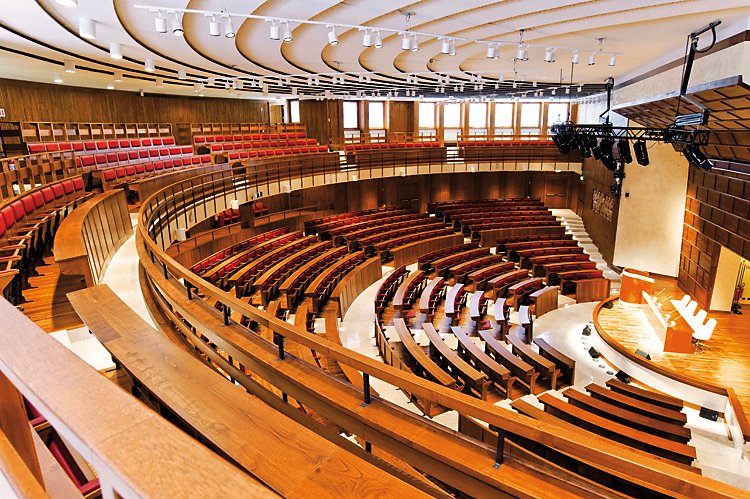
Auditorium Antonianum is the congress center and hall for concerts, conferences and shows located at number 1 Viale Manzoni, in Rome, in the stretch that separates the Esquilino from San Giovanni. The facility belongs to the Pontificia Università Antonianum, the pontifical university of the Order of Friars Minor, which stands on the same block with its entrance on Via Merulana, and it shares its history, its name and in part its spaces. The name itself, Antonianum, refers to St. Anthony of Padua, one of the most venerated saints of the Franciscan tradition, and recurs both in the university and in the congress hall that carries its brand in every official communication. It is not a municipal theater or a city auditorium on the model of the one in Ostia or the Nuvola at EUR: it is a private hall run by a religious order, open to anyone who rents the space for a medical congress, a corporate convention, a concert or a conference, and for this reason its calendar changes constantly and always has to be checked on the official website before organizing a visit. The neighborhood around it, between Piazza Vittorio, Via Merulana and the Basilica of San Giovanni in Laterano, is one of the most layered in Rome, and whoever comes here for an event finds historic markets, underground archaeological remains and one of the four major papal basilicas a short walk away. On the same stretch of Via Merulana, a few hundred meters away, stands also the Teatro Brancaccio, which with its music and theater programming completes the picture of an area lived in more by residents and professionals on business trips than by the mass tourism concentrated around the Colosseum or Piazza di Spagna.
The information gathered here always distinguishes stable data, the address, the dimensions of the halls, the historical dates, from information that changes constantly, such as the events calendar, to be always checked on the official website before booking attendance at a specific event.
Where the Auditorium Antonianum is and how to get there
The address is Viale Manzoni 1, 00185 Rome, in the Esquilino district, right at the border with the Monti district and the San Giovanni neighborhood. Viale Manzoni is the axis that connects Piazza Vittorio Emanuele II to Piazzale Appio and the Basilica of San Giovanni in Laterano, and the Auditorium is on the side that looks toward the historic center, in a building that shares the street front with the seat of the Pontificia Università Antonianum.
By subway and bus
The most direct way to get there is subway Line A, Manzoni stop, a few minutes on foot from the entrance. It is the same line that serves San Giovanni, Colosseo and Termini, so whoever arrives from any area served by Line A reaches the Auditorium without changes. On the surface several city bus lines run along Viale Manzoni and Via Merulana, useful above all for those coming from Termini or the Esquilino who don't want to face the subway stairs with bags or congress material.
By car and parking
Those who arrive by car should keep in mind that the area falls within the limited traffic zone of the extended historic center and that free parking spaces along Viale Manzoni are scarce during weekday daytime hours. The most practical solution for someone attending a congress of several hours is paid parking in Piazza Vittorio or San Giovanni area, always checking the ZTL hours before leaving the car, because the rules change between day and evening and between the school period and the summer period. Anyone organizing a corporate event with many participants arriving by car would do well to ask the Auditorium's office in advance about partner solutions, when available: the facility in fact keeps agreements with private garages in the immediate vicinity, designed precisely for those who arrive by car for a congress of several hours and don't want to move on foot with heavy material or sample cases.
Useful distances
The Colosseum is about one kilometer away, a walk of 10 or 12 minutes along Via Labicana or through the Colle Oppio park. Roma Termini station is a little over a kilometer in the opposite direction. Someone coming from outside Rome for a one-day conference can therefore comfortably stay in the Termini area and reach the Auditorium on foot or with a short subway ride.
From the airports and the station
From Fiumicino the fastest connection to Termini is the Leonardo Express, with trains every half hour and a travel time of a little over half an hour. From Termini the Auditorium is then reached in a few minutes by subway Line A or by a quarter-hour walk along Via Giovanni Giolitti and Via Emanuele Filiberto. From Ciampino, closer as the crow flies but served by road connections, it's best to take a direct bus to Termini or a taxi, the simplest solution for those arriving on a tight schedule between a flight and the start of a congress.
What the Auditorium Antonianum really is: a congress center, not a public theater
The point that generates the most confusion needs to be cleared up right away. Auditorium Antonianum is not a cultural institution funded by the City or the State, and it has no stable programming of its own like the Auditorium Parco della Musica or the historic theaters of the center. It is an event hospitality facility, owned by the Pontificia Università Antonianum and run as a congress center: whoever wants to organize a conference, a convention, a press conference or a concert there rents the hall, with all the technical and logistical services included. The programming that a visitor finds, from time to time, is therefore that of whoever has booked the space: a medical-scientific congress one week, a corporate event the next, a classical music concert or a cultural presentation on yet another date.
This hybrid nature, halfway between congress hall and concert hall, is also the reason the Auditorium appears as much on portals dedicated to corporate meetings as in the calendars of Rome concerts. It is not a flaw, it is its identity: a hall designed with concert-level acoustics, which in practice is used above all for congresses, seminars and conferences, because that is the market that supports its running costs during the year.
The comparison that helps place it concerns Rome's other large halls. The Auditorium Parco della Musica, in the Flaminio district, is a public institution with a stable concert season, run by a foundation with a program announced months in advance. The Teatro Brancaccio, a few hundred meters from the Antonianum along Via Merulana, is a commercial theater with a program of drama, music and cabaret open at the box office. Auditorium Antonianum sits on a different level from both: it doesn't sell tickets for a season of its own, but rents the space to whoever organizes an event, be it a cardiology congress, the convention of a pharmaceutical company or, more rarely, a concert open to the public. Understanding this difference avoids the most common mistake, looking online for a box office or a stable program that simply does not exist.
The link with the Pontificia Università Antonianum and the Friars Minor
The Pontificia Università Antonianum is the pontifical university of the Friars Minor, the religious order founded by St. Francis of Assisi. The construction of the present seat, on Via Merulana, began in 1884 and the institution opened its doors in 1890, in a block of the Esquilino a step from the basilica of St. John Lateran. In 1933 the Congregation of Seminaries and Universities granted the institute the faculty to confer academic degrees, and on June 14, 1938 Pope Pius XI conferred the pontifical title on it. Since then the Antonianum has trained friars, scholars of theology and Franciscanism and religious from all over the world, and the Auditorium that stands beside the university shares its name and in large part its mission: to make available a public and functional space, owned by a religious order but open to all, in the heart of Rome.
The halls of the Auditorium Antonianum: capacities and features
The main hall, the one that gives its name to the whole complex, occupies about 800 square meters entirely covered in wavy chestnut wood staves, a solution designed to guarantee high-level acoustics and to eliminate reverberation almost entirely. There are 572 seats, divided between 460 in the stalls and 112 in the gallery. The armchairs, in walnut and upholstered in leather, date from the original fit-out of the 1950s and were kept as a distinctive feature of the hall instead of being replaced with anonymous furnishings. The stage measures 57 square meters and is equipped with a complete technical system: a 24-channel audio mixer, wireless and lectern microphones, 16 loudspeakers, a motorized 16:9 screen up to 650 by 487 centimeters, a 20,000-lumen laser video projector and three motorized cameras for filming. Alongside the hall are two foyers, dressing rooms for artists or speakers, lounge areas and a press room linked by live audio and video to the stage.
The smaller rooms: San Francesco, Jacopone da Todi, San Bernardino da Siena
Besides the large hall, the Auditorium Antonianum offers four smaller spaces, designed for meetings, parallel sessions of a congress or events of contained size. The Sala San Francesco, the largest of the smaller ones, measures about 130 square meters and holds between 90 and 100 people. The Jacopone da Todi and San Bernardino da Siena rooms are twins in size, about 100 square meters each, with a capacity of 60 people. The Sala Stampa, finally, is the smallest of the spaces, 32 square meters for a dozen or 20 people, designed for press points and conferences live with the main hall through the internal audio-video link. All the spaces are equipped with up-to-date audio-video systems and on-site technical assistance, which makes the congress center suitable as much for a small seminar as for an event with hundreds of participants spread across several rooms at the same time.
Catering and services for whoever organizes an event
Inside the facility operates the in-house restaurant, which covers the whole span of the congress day, from the opening coffee break to the light lunch between one session and the next to the evening working dinner, with menus customizable according to the number of participants and the dietary needs of the group. The catering service also works for large numbers, with catering formulas designed for multi-day congresses, and accepts bookings from outside guests too who are not attending an event in progress. Alongside this is an in-house staff that handles the IT and logistical side of the set-up, from printing promotional materials to managing the common areas, up to coordinating any photo services during the event: a package designed for those who organize a congress from outside Rome and don't want to manage every single supplier on their own.
For those who need to stay overnight, the facility keeps agreements with four-star hotels, bed and breakfasts and other accommodation in the vicinity, a not secondary detail for anyone organizing a congress of two or three days with participants arriving from outside the region or abroad who wants to offer discounted rates without having to negotiate hotel by hotel.
The combination of these services, in-house catering, dedicated technical support, partner parking and discounted accommodation, explains why professional associations and congress organizing companies come back here edition after edition for their regular events: it is not only the hall that makes the difference, but the possibility of entrusting the whole chain of the event to a single contact, from the morning coffee break to the closing dinner, without having to coordinate different suppliers scattered around the city.
A curiosity about the Auditorium Antonianum
Whoever enters the large hall for the first time almost always notices the same thing: the silence is unnatural. There is none of the echo typical of large halls in stone or concrete, and voices, even unamplified ones, arrive clearly all the way to the back of the gallery. It is the effect of the wavy chestnut staves that cover every wall and every ceiling, a technical solution that in the 1950s was anything but a given and that today remains one of the features most appreciated by the musicians and sound technicians who work here. The curiosity, little known to those who frequent the Auditorium only for a corporate congress, is that the same acoustics designed for speech and for chamber music make the hall particularly suitable for recordings too: those who have worked there say that the background noise, in the absence of an audience, is almost absent, a rare quality in a noisy city like Rome.
A second detail that escapes most: the original walnut and leather armchairs, installed when the hall was fitted out in the 1950s, have never been entirely replaced. In a Roman congress center where the general trend is to redo furnishings and finishes every 10 or 15 years to keep up with hotel standards, the choice to preserve the historic seating says a lot about the character of the institution that runs the space: a religious order that thinks in the long term, not in seasonal fashions.
There is finally a third curiosity, more technical, concerning the size of the hall relative to its original function. 800 square meters and 572 seats place the Auditorium in an intermediate size band between the large public halls of Rome, able to hold thousands of spectators, and the small conservatory auditoriums designed for a restricted audience. This middle way is probably the reason the facility works well both for a medium-size congress, which rarely exceeds a thousand participants if the smaller rooms used in parallel are counted too, and for a chamber concert, which in a hall that was too large would lose acoustic intimacy.
The Pontificia Università Antonianum, the Franciscans and the Esquilino
To understand the Auditorium you have to take a step back to the decision, in 1883, of the Minister General of the Order of Friars Minor to give the Franciscan family a new Roman academic college. The aim was to train religious prepared in the theological and philosophical disciplines, and the seat was built starting in 1884 right in this stretch of the Esquilino, then an urban periphery of the historic center that had just become the capital of Italy, a block from the basilica of San Giovanni in Laterano, the cathedral of Rome and the seat of the pope as bishop of the city. The institute opened in 1890 and in the following decades grew until it obtained, in 1933, the faculty to confer academic degrees and, in 1938, the title of pontifical university from Pope Pius XI.
Today the Pontificia Università Antonianum trains students from all continents, largely religious of the Order of Friars Minor but also lay people enrolled in the courses of theology, philosophy and canon law tied to Franciscan thought. The Auditorium that stands next to the university was originally born for the institution's own needs, general chapters of the order, academic conferences, ceremonies, and over time opened to the outside public as a congress center proper, keeping however a close link with the Franciscan community that administers it and that still defines its sober, functional character without display.
An international community in the heart of the Esquilino
Anyone strolling absentmindedly along Viale Manzoni can hardly imagine that behind the university's facade a community of religious and scholars from dozens of different countries moves every day, often on their first Roman experiences and dealing with a new language and a new city. It is a trait that the Antonianum shares with other pontifical universities in the capital, but here it takes on particular weight because the Order of Friars Minor is present in a widespread way on all continents, and Rome remains the point where the peripheral branches of the order periodically come back to confront the mother house. The Auditorium, in this sense, often works as a place of synthesis of this international exchange, hosting chapters, assemblies and training meetings that rarely appear in city news but that carry a very high specific weight for the order.
One thing nobody tells you about the Auditorium Antonianum
Nobody writes it on the portals that list Rome's congress venues, so I write it here: booking the Auditorium Antonianum does not mean renting a neutral space like just any exhibition center. It is a hall that belongs to a religious order and that coexists, on the same block, with the daily life of a pontifical university made of classrooms, library, refectory and a community of friars. This translates into practical rules that anyone organizing an event does well to know before signing the contract: stricter opening and closing hours than a commercial congress center, particular attention to the content of the events that are hosted, and set-up and teardown times agreed with the office, not negotiable at the last minute as happens elsewhere.
The second thing few people know concerns the acoustics. A hall built to host academic conferences and religious ceremonies, with a wooden lining designed to carry the human voice without a microphone to the last row, lends itself very well also to live unamplified music, string quartets, piano recitals, chamber choirs. Those who organize classical music series in Rome have known this for a long time and use the Auditorium precisely for this reason, while the general public continues to associate the name almost only with medical congresses and corporate conventions.
A third thing, less fascinating but very concrete for anyone organizing events in this part of Rome: booking in time is almost always necessary. The combination of significant capacity, a price generally more accessible than other congress centers in the historic center and a strategic position near Termini makes the Auditorium a recurring choice for communications companies, professional orders and scientific associations that organize fixed annual events. Whoever moves at the last moment risks finding the best dates already taken, especially in the months of April, May, October and November, when the Roman congress season is most intense, with companies specialized in organizing medical-scientific and corporate events blocking entire weeks well in advance to secure the large hall for already established annual events.
The advice I give you for visiting the Auditorium Antonianum
The most useful advice concerns practical organization, because here it is not a matter of visiting a monument open every day but of attending a specific event. First of all, always check the actual program of the day by contacting the Auditorium's office directly or looking up the specific event you are interested in, because the calendar depends entirely on whoever has booked the hall and changes constantly: there is no fixed season to consult as for a public theater.
If you are attending a multi-day congress, the advice is to choose accommodation in the area between Termini and Piazza Vittorio, because from there the Auditorium can be reached on foot or with one subway stop, and the same area offers a very high concentration of inexpensive and multiethnic restaurants for lunch breaks, as well as direct connections to Fiumicino airport via the Leonardo Express from Termini. If instead you are coming for an evening concert, set aside time for a walk at sunset toward the Basilica of San Giovanni in Laterano, a few minutes from the entrance: the contrast between the sober architecture of the congress center and the monumental facade of the cathedral of Rome is one of the reasons it is worth arriving a bit early instead of rushing in at the last minute.
One last piece of advice, aimed more at those who organize than at those who attend: before signing for a date, always ask to see the empty hall, with the work lights on, not just the photographs on the website. It is a step that many congress centers discourage for reasons of time, but that here the office grants willingly, and that lets you assess precisely the real acoustics, the layout of the seats in the gallery and the logistics of access to the stage, all elements that a professional photo inevitably tends to simplify.
Another well-known fact, yet rarely mentioned
That the Esquilino is one of the most multiethnic districts of Rome everyone knows, thanks above all to the fame of Piazza Vittorio and of the Nuovo Mercato Esquilino. What tends to be forgotten is that the same district, a few hundred meters away, has hosted for over a century one of the most international Catholic academic institutions in the city: the Pontificia Università Antonianum welcomes religious and scholars from dozens of different countries, exactly as the Esquilino market welcomes goods and communities from all over the world. The neighborhood around the Auditorium therefore tells two different forms of Roman internationality, the commercial and popular one of the market and the academic and religious one of the Franciscan university, which live side by side a walk apart without almost ever crossing in the tourist narrative of the city.
A second element little cited concerns the urban setting. Viale Manzoni was laid out in the 19th century as one of the axes of the post-unification master plan, designed to connect Termini station to the Basilica of San Giovanni in Laterano through a neighborhood then in the midst of building expansion. The Antonianum, built in precisely those years, is therefore not a building dropped into a preexisting historical context, but an integral part of the 19th-century transformation of the Esquilino, grown together with the neighborhood and not before it.
A third fact little cited concerns the relationship between the Antonianum and the other religious institutions that dot this stretch of the city. Within a kilometer of Viale Manzoni are concentrated, besides the Basilica of San Giovanni in Laterano, also the Lateran Apostolic Palace and several seats of religious orders and congregations that in the 19th and 20th centuries chose the Esquilino and the San Giovanni area to establish their Roman seats. It is not an isolated case, but a recognizable urban phenomenon: the closeness to the cathedral of Rome, together with the availability of land still free after the annexation of the city to the Kingdom of Italy in 1870, made this area one of the favorites of the religious orders seeking a Roman seat in the same decades in which the Antonianum was born.
The right photo to take at the Auditorium Antonianum
The most effective shot is not the sober facade on Viale Manzoni, which from an architectural point of view doesn't tell much to someone who doesn't already know the history of the place. It is the framing from inside the large hall, taken from the back of the gallery toward the stage, when the stage lights are on and the chestnut stave lining reflects the warm light over the whole surface of the walls: in that photo you immediately read why the acoustics of this hall are considered so fine, and the wavy lines of the wood create a geometric pattern that in a well-exposed photograph turns out surprisingly elegant for a space born with entirely functional aims.
If instead you are interested in the urban context more than the interior of the hall, the photo to take is at the intersection of Viale Manzoni and Via Merulana, with the silhouette of the Basilica of San Giovanni in Laterano closing the perspective in the distance: it is the image that best tells the position of the Auditorium, set between a busy 19th-century axis and one of the most sacred places of Catholic Christianity. Work preferably in late morning or late afternoon, when the raking light along the avenue lengthens the shadows of the buildings and makes readable the sequence of street fronts that characterizes this stretch of the Esquilino.
A third option, reserved for those who actually attend an event and have access to the stage, is the photo from the stage toward the empty stalls, before the start or after the end of a congress: from that perspective you appreciate together the depth of the hall, the curve of the gallery and the symmetry of the lighting system, a point of view that very few occasional visitors get to experience and that conveys better than any other image the real scale of the space.
Some important events that took place here in history
The first chapter of the history is the birth of the institution itself, between 1884 and 1890, when the Order of Friars Minor decided to equip itself with a Roman academic seat worthy of its tradition of theological and philosophical studies. The recognition of the faculty to confer academic degrees in 1933 and the conferral of the pontifical title by Pope Pius XI on June 14, 1938 mark the Antonianum's passage from an internal college of the order to an academic institution fully recognized by the Holy See, a path that in the span of half a century transformed a religious project into a pontifical university in every respect.
In the middle of this path falls an event that concerns the order as a whole more than the single building, but that left a direct mark on the identity of the Antonianum: the celebrations for the anniversary of the death of St. Anthony of Padua, patron of the university, which in 1981 and 1982 brought the attention of the universal Church back to the figure of the saint and, as a consequence, to the Roman institution that bears his name. It is in that context that the visit of John Paul II in January 1982 fits, not an isolated episode but the culminating moment of a cycle of celebrations that had involved the whole Order of Friars Minor.
The Antonianum complex, of which the Auditorium is part, received over the course of the 20th century the visit of more than one pontiff. On January 16, 1982 John Paul II visited the university for the conclusion of the celebrations of the 750th anniversary of the death of St. Anthony of Padua and the opening of those of the 800th anniversary of the birth of St. Francis of Assisi, speaking in the hall named for Maria Santissima Assunta to faculty and students on the importance of Christian hope in academic research. A plaque at the entrance to the same hall already recalled then the earlier visit of Paul VI, in 1975. These are episodes that place the Antonianum, and the congress hall that bears its name, within the recent history of the Catholic Church and the Franciscan Order, not only within the Roman circuit of corporate events.
More recently, from September 3 to 7, 2025 the Auditorium Antonianum hosted the proceedings of the 26th International Marian Mariological Congress, one of the periodic scientific events of world Catholic Mariology, confirming how the hall continues to be chosen for academic and religious events of international importance alongside its ordinary activity as a congress center.
Alongside these specific episodes, the more continuous history of the Auditorium is made of hundreds of medical-scientific congresses that in recent decades have chosen this hall to present clinical studies, update professional guidelines and bring together specialists from all over Italy. It is a history less tellable by single dates, but it is the one that has made the Auditorium Antonianum a familiar name for generations of Roman doctors, pharmacists and health workers, often more familiar than it is to the occasional tourist who passes along Viale Manzoni without knowing what hides behind that sober facade.
Who passed through the Auditorium Antonianum
In the history of the Pontificia Università Antonianum, of which the Auditorium is an integral part, two popes have passed through on official visits: Paul VI in 1975 and John Paul II on January 16, 1982, the latter on the occasion of the celebrations for St. Anthony of Padua and St. Francis of Assisi. These are presences that testify to the role of the university, and of the attached congress space, as a reference point for the Order of Friars Minor worldwide.
Alongside the leaders of the Church, generations of friars minor, theologians, philosophers and scholars of Franciscanism from every continent have passed through the Auditorium, coming to Rome to complete their academic training or to take part in general chapters, conferences and scientific congresses such as the Mariological one of September 2025. To these is added the more heterogeneous public of medical-scientific congresses and corporate events that occupy a large part of the hall's ordinary calendar: health professionals, international speakers, managers and event organizers who use the Auditorium for its capacity, its acoustics and its central position, without necessarily knowing anything about the religious and academic history of the building that hosts them.
Among the musicians and performers who have played in the main hall, at chamber concerts, recitals and album presentations, the constant is the search for natural acoustics, with no need for heavy amplification. That’s why chamber ensembles and polyphonic choirs come back to this stage from time to time, even when their main activity takes place in the city’s big public halls. There is no complete public archive of all the artists who have performed at the Antonianum over the decades, so it’s more accurate to speak of a recurring presence of the Roman chamber music world than of a closed list of names.
What happens inside the Auditorium: from congresses to music
The largest part of the Auditorium Antonianum calendar is taken up by congress-type events: medical and scientific conferences, corporate meetings, training courses, institutional presentations and press conferences, helped by the technical equipment of the main hall and the option of using the four smaller rooms in parallel for separate sessions. This is the market that pays for running the space, and it’s why the Auditorium shows up more often on portals specialized in corporate event venues than in show calendars.
Alongside this prevailing activity, the hall also hosts musical and cultural events, in particular chamber ensembles, choirs, piano recitals and book presentations that take advantage of the acoustics of the main hall. There is no fixed, announced concert season like that of an opera house or a music foundation, so anyone looking for a specific concert has to check case by case, through the portals that collect Rome events or directly on the Auditorium’s website, to find out if on that date the hall is taken by a musical event or by a congress.
A third strand, less visible but just as constant, covers the religious and academic life of the Order of Friars Minor: provincial chapters, general assemblies, opening ceremonies of the academic year, ongoing training meetings for friars on mission outside Italy. These events rarely appear on the portals aimed at the outside public, because they are reserved for the order’s community, but historically they are the reason this space was conceived, even before it became a congress center open to the Roman events market.
When to go to Auditorium Antonianum and when to avoid it
For a congress venue of this kind, there is no better or worse time of year in absolute terms. Everything depends on the specific event you want to attend. That said, the calendar of the big medical and academic congresses tends to be concentrated in the spring and fall months, from March to June and from September to November, while in August, as in most Roman congress venues, activity slows down noticeably for the summer vacation. Anyone organizing an event who wants more available dates can therefore find easier conditions in midsummer, while anyone attending a specific conference as an outsider simply has to follow the calendar of that event.
The days of the week matter too. Like most Roman congress centers tied to the corporate and academic world, the Auditorium Antonianum sees most of its activity concentrated from Monday to Friday, with the weekend more often reserved for ceremonies, religious events or occasional concerts. If you’re looking for an event on a Saturday or Sunday, check more carefully, because availability on those days depends on bookings that are less frequent than on weekdays.
Accessibility
The venue is accessible to people with disabilities both on the stage and in the stalls, with routes designed to allow barrier-free entry and use of the hall. Anyone with specific needs does well to tell the Auditorium’s office or the organizers of the event they’re attending in advance, so as to get confirmation of the reserved seats and the routes available on the day. The same goes for those arriving with hearing or vision needs. Since the venue was originally designed for public speaking more than for entertainment shows, the natural acoustics of the main hall still help anyone following a talk without optimal amplification, but for assistive listening devices or other forms of support it’s always best to check availability with the organizers of the specific event, since the equipment can vary depending on who has rented the hall.
What’s around Auditorium Antonianum
The neighborhood around the Auditorium is full of places worth a stop before or after an event. A few minutes’ walk away is the basilica of St. John Lateran, the cathedral of Rome and one of the four major papal basilicas, with its medieval cloister and the Lateran baptistery. In the opposite direction, toward Piazza Vittorio, you’ll find the Nuovo Mercato Esquilino, one of the most multiethnic covered markets in the city, and the Porta Alchemica, the mysterious 17th-century portal tied to the legends of Roman alchemy, which stands inside the gardens of the square.
A little farther on, toward Via Labicana, you reach the underground basilica of Porta Maggiore, one of the most curious and least crowded archaeological sites in Rome, and from there, continuing on, you get in a few minutes to the Colosseum complex and the Domus Aurea, Nero’s underground palace, reopened to the public with guided visit routes. Both fit easily into a free half day before or after a one-day congress. Anyone with more time can walk up to the basilica of Santa Maria Maggiore, another of the major papal basilicas, reachable on foot in about 20 minutes along Via Merulana, the straight axis that connects San Giovanni in Laterano to Santa Maria Maggiore across the whole Esquilino district.
Along the same stretch of Via Merulana, a few minutes on foot away, you’ll also find the Teatro Brancaccio, with its program of music and drama, and the nearby Palazzo Brancaccio, the last great noble palace built in Rome before the end of the 19th century, now home to the National Museum of Oriental Art. Anyone attending a multi-day congress at the Auditorium with a free evening will find, close at hand, a cultural and entertainment offering that goes well beyond the strictly tourist area of the Colosseum.
Anyone who prefers to stay with Roman archaeology rather than the religious and ecclesiastical side will find, toward the Celio, the basilica of Saints John and Paul with the Roman houses beneath it and, not far away, the Roman houses of the Celio, a complex of ancient dwellings preserved below the level of the basilica itself. It’s another example of how, in this part of Rome between the Esquilino and the Celio, the layering of Roman, medieval and modern eras is the rule rather than the exception.
Quick questions about Auditorium Antonianum
Where exactly is Auditorium Antonianum?
At Viale Manzoni 1, in Rome, in the Esquilino district, next to the seat of the Pontifical University Antonianum and a short distance from the basilica of San Giovanni in Laterano.
How do you get there by metro?
Take line A to the Manzoni stop, a few minutes on foot from the entrance.
How many seats does the main hall have?
572 seats, 460 in the stalls and 112 in the gallery, in a hall of about 800 square meters lined with chestnut wood.
What other rooms are there besides the main one?
Four smaller rooms: San Francesco, for up to 100 people, Jacopone da Todi and San Bernardino da Siena, 60 people each, and a press room for a dozen or 20 people, linked by audio and video to the stage of the main hall.
Is Auditorium Antonianum a public theater?
No. It’s a private congress center, owned by the Pontifical University Antonianum and run by the Order of Friars Minor, rented out from time to time for congresses, corporate events, conferences and concerts.
Can you see concerts at Auditorium Antonianum?
Yes, the hall periodically hosts classical and chamber music concerts, choirs and recitals, but it has no fixed concert season: the calendar has to be checked event by event.
What’s the link with Saint Francis of Assisi?
The Auditorium takes its name from the Pontifical University Antonianum, the pontifical university of the Order of Friars Minor founded by Saint Francis, whose seat on Via Merulana was built between 1884 and 1890.
Who has visited the Antonianum in the past?
Among the best-known visits are those of Pope Paul VI in 1975 and Pope John Paul II on January 16, 1982, on the occasion of the celebrations for Saint Anthony of Padua and Saint Francis of Assisi.
Is it suitable for a medical and scientific congress?
Yes, it’s one of the most frequent uses of the hall, which has complete audio and video systems, smaller rooms for parallel sessions and dedicated technical services.
Is there dedicated parking?
No parking reserved for visitors is indicated. The area falls within the limited traffic zone of the wider historic center, and it’s best to check the ZTL hours in advance or rely on a paid car park in Piazza Vittorio or San Giovanni area.
Is it accessible to people with disabilities?
Yes, the main hall is accessible both on the stage and in the stalls, with routes designed for barrier-free entry.
How far is it from the Colosseum?
About one kilometer, reachable on foot in 10 or 12 minutes along Via Labicana or through the Colle Oppio park.
What can you visit nearby before or after an event?
The basilica of San Giovanni in Laterano, the Nuovo Mercato Esquilino, the Porta Alchemica of Piazza Vittorio, the underground basilica of Porta Maggiore and, a little farther on, the Colosseum, the Domus Aurea and the basilica of Santa Maria Maggiore.
Is there a restaurant on site?
Yes, a restaurant that covers coffee breaks, light lunches and working dinners, with customizable menus and the option of catering for large groups. It also takes reservations from people who aren’t attending an event in the building.
Are there arrangements for lodging for congress participants?
Yes, the venue keeps agreements with four-star hotels, bed and breakfasts and other accommodation in the immediate vicinity, useful above all for multi-day congresses with participants arriving from outside Rome.
What’s the difference between Auditorium Antonianum and Auditorium Parco della Musica?
They are two different venues in nature and management. The Auditorium Parco della Musica, in the Flaminio district, is a public institution with an announced concert season and its own box office. The Auditorium Antonianum is a private congress center of the Order of Friars Minor, with no fixed program, rented out from time to time for congresses, corporate events and occasional concerts.
What is the Congresso Mariologico Mariano Internazionale held here?
One of the periodic scientific gatherings of Catholic Mariology worldwide. Its 26th edition took place at the Auditorium Antonianum from September 3 to 7, 2025.
Can you book the Auditorium for a private event?
Yes, the main hall and the smaller rooms can be rented for congresses, conventions, presentations and ceremonies, after contacting the venue’s office directly about date availability and financial terms.
What’s the relationship between the Auditorium and the Teatro Brancaccio?
They are two distinct and independent venues, both located along Via Merulana a short distance from each other. The Auditorium Antonianum is a congress center tied to the Pontifical University Antonianum, while the Teatro Brancaccio is a commercial theater with its own program of music and drama, open at the box office.
Are guided visits held inside the Auditorium?
It isn’t a museum venue with public opening hours. Access is tied to attending a specific event organized in the hall, not to an independent tourist visit.
In our view, the Auditorium Antonianum remains one of the best-made congress spaces in central Rome precisely because it doesn’t try to be anything other than what it is: a functional place, with rare quality acoustics and a sober management, set in a neighborhood that offers much more than the Auditorium’s name suggests. Anyone who comes only for a congress and manages to carve out half an hour for a walk toward San Giovanni in Laterano or toward the Esquilino market takes home much more than a day of work. It’s a hall that asks to be looked for, because it doesn’t impose itself on the eye of people passing along Viale Manzoni, but it amply rewards anyone who takes the time to get to know it, both for work and for discovering the neighborhood around it.
Frequently asked questions about Auditorium Antonianum
Where is Auditorium Antonianum?
Auditorium Antonianum is at Viale Manzoni 1, in the Esquilino district of Rome, close to the border with the Monti district and the San Giovanni neighborhood, a short distance from the basilica of San Giovanni in Laterano. Viale Manzoni connects Piazza Vittorio Emanuele II to Piazzale Appio.
Is Auditorium Antonianum a public theater?
No, Auditorium Antonianum is not a cultural institution funded by the City or the State and has no regular program of its own like the big Roman auditoriums. It’s an events venue, owned by the Pontifical University Antonianum and run as a congress center.
How many seats does the main hall of Auditorium Antonianum have?
The main hall of Auditorium Antonianum has 572 seats, 460 in the stalls and 112 in the gallery, in a space of about 800 square meters entirely lined with wavy chestnut wood slats, a solution designed to guarantee high-level acoustics.
Can you visit Auditorium Antonianum?
Auditorium Antonianum isn’t visited like a monument open every day, but is attended by taking part in a specific event. Before planning a visit, check the actual program of the day by contacting the Auditorium’s office directly, because the calendar depends on who has booked the hall.
What kind of events does Auditorium Antonianum host?
The largest part of the Auditorium Antonianum calendar is taken up by congress events: medical and scientific conferences, corporate meetings, training courses, institutional presentations and press conferences, helped by the technical equipment of the main hall and the option of using four smaller rooms in parallel.
How do you get to Auditorium Antonianum by metro?
Auditorium Antonianum is reached by metro line A, Manzoni stop, a few minutes on foot from the entrance, in a central position that easily connects the Esquilino to the rest of the historic center of Rome.
Who has visited Auditorium Antonianum in the past?
In the history of the Pontifical University Antonianum, of which Auditorium Antonianum is an integral part, two popes have come on official visits: Paul VI in 1975 and John Paul II on January 16, 1982, the latter on the occasion of the celebrations for Saint Anthony of Padua and Saint Francis of Assisi.
Article written by the editorial team of TourLeaderPro, contact them for Private/Corporate/V.I.P. Tours and Experiences. For an event organized in the San Giovanni and Esquilino area, with a licensed tour guide, start from the TourLeaderPro contact page. Tour operators building itineraries or events in central Rome will find the consulting service in the section dedicated to tour operators.
Planning a trip to Rome? The English guides for visiting the city are on ItalyPlanner.com. For those who want to organize their days around the historic center there is the guide to the best day trips from Rome, while those looking for practical information about the city will also find useful the guide to the free beaches in Italy, to round out the stay with a day out of town.
Contact Information
Viale Manzoni, 1
Roma Roma Città, Roma Città