Arianna Porcelli Safonov, Odiario at Teatro Ambra Jovinelli, November 7 and 8, 2026
In short. Arianna Porcelli Safonov brings Odiario to Teatro Ambra Jovinelli in Rome, at Via Guglielmo Pepe 43, in the Esquiline district, for two performances: Saturday, November 7, 2026, at 19:30 and Sunday, November 8, 2026, at 17:00.

Arianna Porcelli Safonov brings Odiario to Teatro Ambra Jovinelli in Rome, at Via Guglielmo Pepe 43, in the Esquiline district, for two performances: Saturday, November 7, 2026, at 19:30 and Sunday, November 8, 2026, at 17:00. The show is written and performed by her, produced by Milagros and distributed by Terry Chegia. The theater is a few minutes' walk from the Vittorio Emanuele stop on Metro A and a short distance from Termini station, where Lines A and B cross. Prices are published on the official website of Teatro Ambra Jovinelli, where tickets are sold through the presale network authorized by the theater, and the theater's box office remains the reference for information and accessibility.
Language: performed in Italian. No English version or English surtitles are announced.
Odiario at the Ambra Jovinelli: dates, times and format
Odiario is Arianna Porcelli Safonov's new satirical monologue, on stage at the Ambra Jovinelli on Saturday, November 7, at 19:30 and Sunday, November 8, at 17:00. Two weekend times, designed for those who want to go out early and have dinner afterward.
Just a microphone
The theater presents Odiario as a show in a new form for the author: no lectern, no set, just a microphone. Those who know her earlier shows, often built as readings of written texts, will find a format closer to pure comic monologue, in which words carry everything and the body on stage is the only visual element.
An independent production
The show is by and with Arianna Porcelli Safonov, produced by Milagros and distributed by Terry Chegia. It's the typical model of Italian auteur comedy in recent years: an artist who writes her own texts, tours them in theaters and builds a loyal audience online too.
The title
Odiario combines odio, hate, and diario, diary. It's a wordplay that already tells you the shape of the show: a daily list of the things society asks us to love, buy and practice, which the author puts under the lens of sarcasm.
What Arianna Porcelli Safonov's Odiario is about
Odiario reviews the customs of contemporary society: the theater's official page lists gender identity, mindfulness, war, artificial intelligence, pet therapy, therapy in general, electric cars, relationships, language, mass media, inclusion and exclusivity.
A cabinet of wonders in reverse
The official description presents the show as an inventory of the things we should hate and are instead pushed to buy: wellness fads, communication buzzwords, solutions sold as a cure-all. It's a catalog turned upside down, in which every entry is a collective tic observed closely until it becomes ridiculous.
Provocation as a method
The theater insists on one point: provocation should be understood in its etymological sense, pro-vocare, to call out. Odiario takes the buttoned-up gaze of public opinion and walks it among uncomfortable perspectives, even on topics considered untouchable. Laughter is the tool, and the goal, according to the description, is to restore the balance of common sense.
Who it's for
It's a show for adults, made of words, reasoning and irony on current issues. Those who love social satire and aren't afraid to see their own convictions questioned will find plenty to get their teeth into. Those looking for an hour of light, frictionless comedy should know that here friction is the point.
Who Arianna Porcelli Safonov is: biography
Arianna Porcelli Safonov is an author and performer of satirical monologues, from Rome, with a degree in Literature and Philosophy specializing in the history of customs. She tours her texts between Italy and Switzerland with more than 50 dates a year.
Roman by mistake
The biography published by the theater opens with a joke: she is Roman but by mistake, because her father's family arrived in Italy in 1917, and that's where the problems began. It's the tone of all her writing: self-mocking, precise, with a touch of ferocity aimed first of all at herself.
From New York and Madrid to writing
Before the stage there were 10 years of work organizing international events, with periods living in New York and Madrid. In 2010 she left that profession to devote herself to writing. It's a transition that explains a lot about her texts: those who have worked inside the world of events, presentations and marketing know its language, and know how to take it apart.
Books
For Fazi Editore she published Fottuta Campagna in 2016 and Storie di Matti in 2017. She has written unpublished stories for il Fatto Quotidiano, for the Touring Club and for the literary magazine Superlunaria. Since 2020 she has written a satirical column in the monthly Terranuova, where she looks at organic living and mindfulness through the filter of paradox.
The shows
She stages her theater texts alone, with a few ongoing projects: Fiabafobia, Alimentire, devoted to the work of Michael Pollan, the American writer who made food a political issue, and Gli sforzi inutili con cui la vita imita l'arte, devoted to contemporary art. For 2025 the official biography announces Picchiamoci, a monologue against the violence of humankind.
Festivals, university, television
Since 2021 she has worked with the Festival della Bellezza, for which she writes new texts: for 2025 the biography lists Sussidiario Mistico at the Castello Sforzesco in Milan, on the crisis of education in Italy, and a monologue at the Roman Theater of Verona on mythology applied to today's excesses. She has given original talks at four TEDx editions. From 2018 to 2022 she taught a course at the University of Pavia on improvisation techniques applied to management. In 2020 she wrote and hosted the TV format Scappo dalla città for LaEffe, inspired by her choice to live in the Apennines.
Online
Her monologues went viral on the web, despite herself, as the official biography points out. Many audience members come to the theater after discovering her in a shared video, and find in the hall an author more complex than a few-minute clip.
Tickets for Odiario at the Ambra Jovinelli
Tickets for Odiario are sold from the official Teatro Ambra Jovinelli website, which links to the authorized presale network, and prices by section are shown at the time of purchase.
Which performance to choose
Saturday at 19:30 is the time for those who want to leave the theater in time for a Roman-style dinner, without staying out late. Sunday at 17:00 is the time for those coming from out of town or who prefer an afternoon at the theater and a quiet evening. Both performances feature the same show.
Where to sit
In a monologue with only a microphone, contact with the performer is everything. The orchestra is the most natural choice, though the two galleries are still close to the stage, in a hall of about 800 seats.
Teatro Ambra Jovinelli, home of Roman comedy
Teatro Ambra Jovinelli was inaugurated on March 3, 1909, by the impresario Giuseppe Jovinelli from Caserta and is the only Roman theater built in the Art Nouveau style. Since 2001 it has been one of the city's leading venues for comedy and auteur theater.
The Art Nouveau building
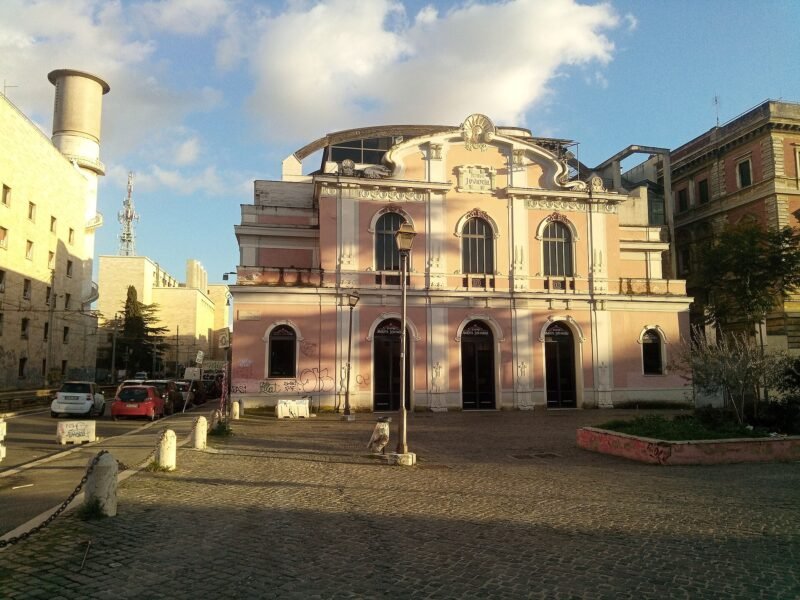
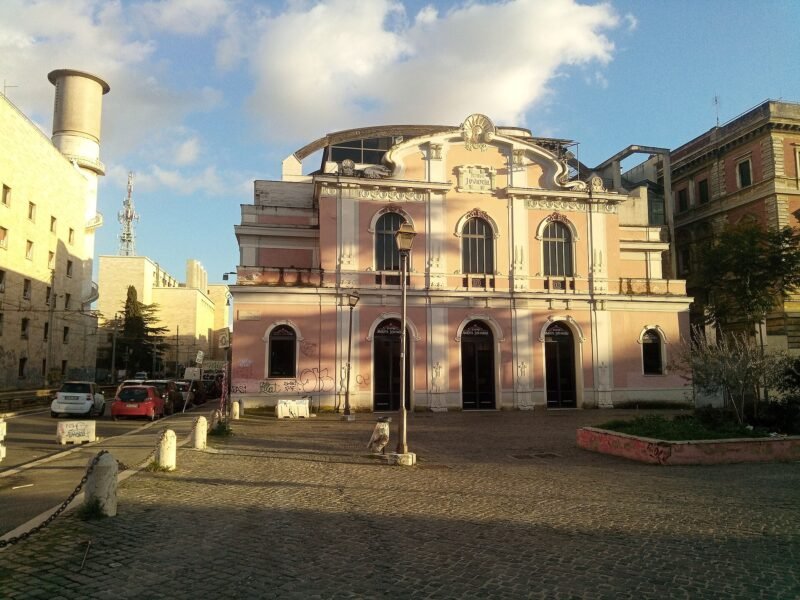
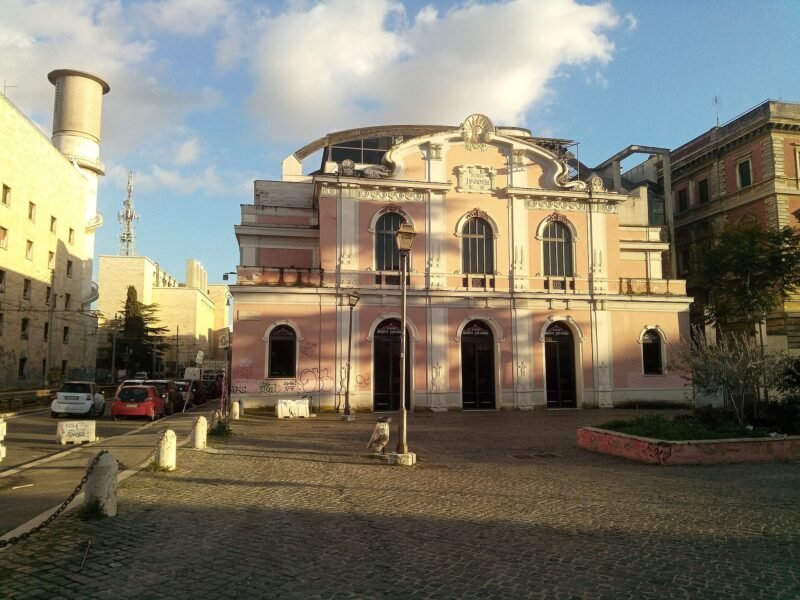
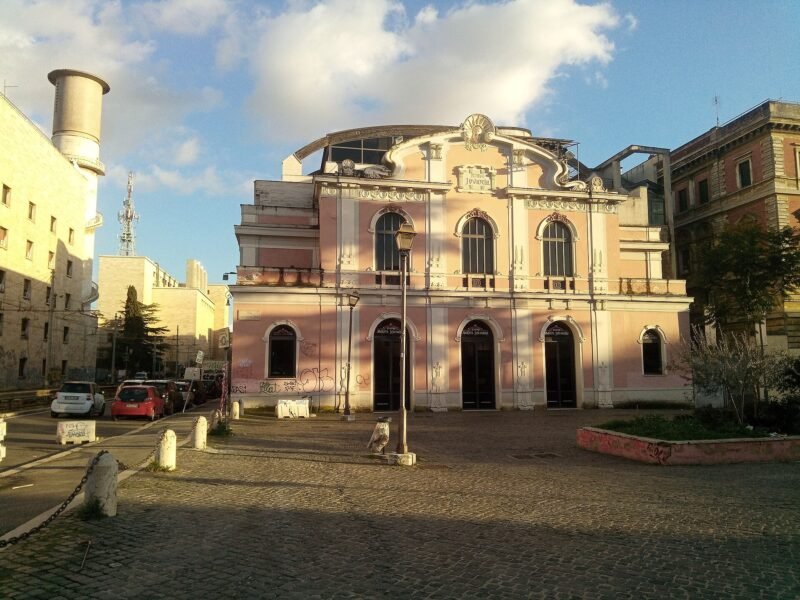
The design, which passed through the hands of Pietro Chiodelli and Giacomo Radiconcini, was completed by Ulderico Bencivenga from 1907. The facade has two stories with wide openings, an arched crown, stucco pilasters with floral decorations and, in the center of the entablature, a shell with a human face. The original horseshoe-shaped hall had about 1,000 seats and was lit entirely by electricity, a rare modernity for the time.
From variety to film
Before World War I the Jovinelli was one of the capital's most important variety theaters. Then came competition from film, avanspettacolo, and the regime's restrictions on dialect theater and satire. In the 1950s the hall became a cinema-variety house with the name Ambra Jovinelli, and in the 1970s it showed adult films.
The fire and the rebirth
On April 29, 1982, a fire caused by a technical fault destroyed the interior. The theater closed, was sold in 1990 and remained abandoned. In July 1996 a group of artists and intellectuals occupied it to draw attention back to its fate, and in 1997 the facade was listed by the Ministry. The restoration ended in November 2000, and on January 25, 2001, the Ambra Jovinelli reopened as a comedy theater, with Serena Dandini as artistic director.
The hall today
The restoration kept the exterior and tripled the interior volume. The hall was raised by five meters and no longer opens directly onto the street, and below it are the Piccolo Jovinelli, the bar and other spaces. The original slender cast-iron columns support the two galleries, for about 800 seats. Since December 2010 the artistic director has been Fabrizia Pompilio. For contacts and programming, see our page on Teatro Ambra Jovinelli.
A curious fact about Arianna Porcelli Safonov, Odiario at Teatro Ambra Jovinelli, November 7 and 8, 2026
The first curious fact concerns the title, and the way it talks to the history of the hall. Odiario merges two words into one, odio and diario, and the theater's name too was born from a deliberate merger. When, in the 1950s, the old Jovinelli became a cinema-variety house, the owners looked for a word starting with A, so that the venue would appear near the top of the alphabetical movie listings published in the newspapers. That's how Ambra Jovinelli was born: a name built to be found, as today a title is built to be remembered.
The second curious fact is in the author's biography. Arianna Porcelli Safonov graduated in Literature and Philosophy specializing in the history of customs: by training she studies exactly what she then puts on stage, the customs of society. Odiario is, literally, an essay on the history of contemporary customs, written with the tools of satire instead of those of academia.
The third is a coincidence of times. Saturday at 19:30 and Sunday at 17:00 are not the classic times of Roman drama, which usually starts at 21:00. They are variety show times, the genre the theater was built for in 1909: a short show, an evening that continues outside. More than a century later, the formula comes in handy again.
Social satire: the tradition Odiario belongs to
Odiario belongs to the tradition of social satire, a genre with deep roots in Rome that the Ambra Jovinelli has hosted since its founding.
From variety to monologue
At the Ambra Jovinelli, in 1910, Ettore Petrolini signed the contract that launched him: his comedy was made of parodies of social tics, fashions and middle-class language. Today's monologue, with a single performer and a microphone, is a distant descendant of those numbers: the form changes, the eye trained on collective behavior remains.
Satire and today's audience
The difference is in the target. Petrolini mocked the power and rhetoric of his time, while Odiario takes aim at the buzzwords of wellness, communication and consumption, the habits of the very audience in the hall. It's a satire that doesn't let you laugh only at others.
Something nobody tells you about Arianna Porcelli Safonov, Odiario at Teatro Ambra Jovinelli, November 7 and 8, 2026
What few people say is that Odiario is not a comfortable show, and doesn't want to be. The list of topics published by the theater includes subjects on which public debate today is heated and often polarized: gender identity, war, inclusion, language, therapy. Arianna Porcelli Safonov tackles them with sarcasm, looking for the uncomfortable angles even of the most cherished and untouchable topics, as the description says. Whoever goes in should know they might laugh at something they believe in, and that this is precisely the game of the show.
The second thing is that the video audience is not the theater audience. The author's monologues circulate online in clips of a few minutes, and many know her that way. In the hall the pace is different: an hour of show builds an argument, with internal references, pauses, accelerations. Those expecting a sequence of shareable jokes find instead a text that asks for attention, and that pays off in the end.
The third thing is practical. After the restoration the Ambra Jovinelli hall is five meters above the street: you go in, you go up, you reach the orchestra. If you have difficulty with stairs or accessibility needs, call the theater before buying, at 06 83082620 or 06 83082884, to arrange entry.
My advice for seeing Arianna Porcelli Safonov, Odiario at Teatro Ambra Jovinelli, November 7 and 8, 2026
The advice is to come to Odiario without having seen too many clips online. The videos in circulation are the author's calling card, but they are built for another medium, and they risk spoiling the surprise. On stage the satire works by accumulation: one entry in the inventory sets up the next, and the best laugh comes when the audience recognizes itself in a habit described a moment earlier.
Then choose the performance according to the evening you want to spend. On Saturday at 19:30 the show ends in time for dinner in the Esquiline or Monti, with the discussion continuing at the table, and in our view it's the time best suited to this show, because Odiario is the kind of show people talk about afterward. Sunday at 17:00 is the right time for those coming from outside Rome or who prefer an afternoon at the theater followed by a walk in Piazza Vittorio.
Finally, the seat. With only a microphone on stage, closeness matters more than centrality: a front row in the orchestra, even on the side, is better than a central seat at the back. In an Art Nouveau hall of about 800 seats, though, you can see and hear well almost everywhere.
And one last suggestion: bring the curiosity to read afterward. Arianna Porcelli Safonov's books published by Fazi, Fottuta Campagna and Storie di Matti, are the natural complement to the show, for those who want to find the same voice on the page.
How to get to Teatro Ambra Jovinelli
Teatro Ambra Jovinelli is at Via Guglielmo Pepe 43, in the Esquiline district, a short distance from Piazza Vittorio Emanuele II and Termini station: it's one of the Roman theaters best served by public transport.
By metro
The nearest stop is Vittorio Emanuele, on Line A: once out in Piazza Vittorio, Via Guglielmo Pepe is a few minutes' walk away. Alternatively you get off at Termini, where Lines A and B cross, and walk across the Esquiline.
By train
Those arriving on regional trains ending at Roma Laziali, next to Termini, have the station closest to the theater. For the Sunday performance at 17:00 it's the most convenient solution for those coming from out of town.
By car
The Esquiline is a dense, busy neighborhood, and street parking is rare. If you arrive by car, leave it in a parking garage around Termini and continue on foot.
On foot from the center
From Santa Maria Maggiore to the theater it's a little more than 10 minutes on foot, going down Via Carlo Alberto toward Piazza Vittorio.
Another well-known fact, yet seldom mentioned
It's well known that the Ambra Jovinelli is the home of Roman comedy. Less often remembered is how close it came to disappearing. On April 29, 1982, a fire destroyed the interior, and the theater closed, was sold in 1990 and remained abandoned for years, its Art Nouveau facade shut on Via Guglielmo Pepe. It was an occupation, in July 1996, that rekindled attention: a group of artists and intellectuals entered the building to demand that it become a theater again. The following year the Ministry listed the facade, and only in January 2001, after the restoration, did the hall reopen with Serena Dandini as artistic director.
The second known but seldom told fact concerns the variety of genres the stage has hosted. In the 1940s and 1950s, besides shows, the Jovinelli hosted boxing matches, with the ring set up in the theater and crowds of fans. Variety, avanspettacolo, boxing, film, comic theater, contemporary drama: in a little over a century this stage has changed its skin several times.
Odiario, a show with only a microphone, is in a way the barest form this stage has ever seen: no set, no acts, no ring. Just a voice and a hall that listens, as in the early variety evenings, when the audience came to hear someone talk about themselves.
The neighborhood around the Ambra Jovinelli: the Esquiline
The Esquiline is the district stretching between Termini, Santa Maria Maggiore and Porta Maggiore, with the late 19th-century buildings around Piazza Vittorio Emanuele II. It's one of Rome's most multiethnic neighborhoods.
Piazza Vittorio
The square is surrounded by 19th-century arcades. In the gardens at the center is the Porta Alchemica, the Magic Door, with its enigmatic inscriptions: a 10-minute stop worth the detour, especially on Sunday afternoon before the show.
The market
A few steps from the theater is the Nuovo Mercato Esquilino, with spices, vegetables and products from half the world. It's a daytime market: if you're in the area on Saturday morning, drop by.
Santa Maria Maggiore and Porta Maggiore
At the top of the climb is the basilica of Santa Maria Maggiore, with the Esquiline obelisk in the square at the back. To the east you reach Porta Maggiore, the great arch of the ancient aqueducts.
The right photo to take at Arianna Porcelli Safonov, Odiario at Teatro Ambra Jovinelli, November 7 and 8, 2026
No photos during the show: in a monologue, the glow of a lit screen distracts the performer and the hall more than in any other genre. The right photo is taken outside, and it's the theater's Art Nouveau facade on Via Guglielmo Pepe. It's the only Roman theater in this style, and it deserves a careful shot: two stories with wide openings, the arched crown, the stucco pilasters with floral decorations and, in the center of the entablature, the shell with the human face, a detail almost nobody notices.
With the Saturday performance at 19:30 the right light is on arrival, around 19:00, when the facade is lit and the street is already dark: in November the sun sets early. With the Sunday performance at 17:00 you can shoot in the last daylight, before going in, and then again on the way out with the lights on.
The advice is a shot from the opposite sidewalk, wide enough to include the whole facade, and then a tight detail of the shell. If you want a second photo of the neighborhood, walk down to Piazza Vittorio and photograph the Porta Alchemica in the gardens: two images that tell the Esquiline between Art Nouveau and mystery.
Where to eat before or after Odiario
With the 19:30 start on Saturday you can have dinner comfortably after the show, and with the Sunday performance at 17:00 dinner comes at the end of the afternoon, at a relaxed pace.
World cuisines in the Esquiline
The district is the right place to eat Chinese, Indian, Bangladeshi, Ethiopian or Middle Eastern food at modest prices. The streets around Piazza Vittorio are full of places of this kind, many open until late.
Roman cuisine
For a classic trattoria, head up toward Santa Maria Maggiore or move on to Monti, a quarter of an hour's walk away, where the choice of osterias and trattorias is wide. On Saturday night it's best to book.
Some important events that happened here
The history of the Ambra Jovinelli can be read in dates. On March 3, 1909, the theater opened with Raffaele Viviani and his sister Luisella, called by Giuseppe Jovinelli for the opening night. In 1910 Ettore Petrolini signed the contract that launched him. Between 1919 and 1921 Totò made his debut and became the audience's favorite. In the 1940s and 1950s the hall also hosted boxing matches, with the ring set up in the theater.
In the 1950s came the transformation into a cinema-variety house, with the new name, and in the 1970s the hall became an adult movie theater. On April 29, 1982, a fire destroyed the interior. In July 1996 the artists' occupation rekindled interest, in 1997 the ministerial listing protected the facade, and on January 25, 2001, the theater reopened with Serena Dandini as artistic director. On December 26, 2010, after a year and a half of closure, the current management began, with Fabrizia Pompilio as artistic director.
In a little over a century this stage has hosted variety, avanspettacolo, boxing, film, comic theater and contemporary drama. The 2026/2027 season continues this mix: this autumn saw Lapocalisse by Makkox and Valerio Aprea and Non hanno un dubbio by Luca Bizzarri, two different ways of satirizing current affairs. Odiario adds a female voice and a precise target: customs, more than politics.
Accessibility, age and practical information
After the restoration the Ambra Jovinelli hall is five meters above the street: if you have accessibility needs, contact the theater before buying at 06 83082620 or 06 83082884.
Age
Odiario is a satire for adults, on topics such as war, identity, therapy and the media. High school students who follow current affairs and love a debate may enjoy it, while for younger kids it's not very suitable, because of its themes and its entirely verbal pace.
Punctuality
In a monologue, coming in once the show has started disturbs the performer and the hall. Arrive 15 or 20 minutes early, leave your coat and take your seat calmly.
November in Rome
In early November evenings in Rome are cool and darkness comes early. A warm jacket and, if the sky looks uncertain, an umbrella are enough for the walk from Piazza Vittorio.
Who has passed through Arianna Porcelli Safonov, Odiario at Teatro Ambra Jovinelli, November 7 and 8, 2026
The stage of the Ambra Jovinelli has seen more than a century of Italian comedy. In the first season, with the Jovinelli family, there were Raffaele Viviani, Ettore Petrolini, Gustavo De Marco and Totò, then Gennaro Pasquariello, Armando Gill, Romolo Balzani, Claudio Villa, the De Rege brothers, Nino Taranto, Fiorenzo Fiorentini, Anna Campori, Tecla Scarano, Franco Franchi and Ciccio Ingrassia, Rita Pavone, Alberto Sordi, Fanfulla, Franco Califano and Lino Banfi.
After the 2001 reopening came Ascanio Celestini, Marco Paolini, Lillo and Greg, Francesca Reggiani, Neri Marcorè, Valerio Mastandrea, Sabina and Corrado Guzzanti, Vincenzo Salemme, Lella Costa, Moni Ovadia, Silvio Orlando, Paolo Rossi and Nicola Piovani. Under Fabrizia Pompilio's management the program has hosted Stefano Accorsi, Ferzan Özpetek, Massimo Ranieri, Virginia Raffaele, Pierfrancesco Favino, Paola Cortellesi, Elio Germano, Filippo Timi and the works of Mattia Torre, the author the hall is most closely tied to.
In this history female comedians have had an important place, from Anna Campori and Tecla Scarano in the variety years to Sabina Guzzanti, Lella Costa, Francesca Reggiani and Virginia Raffaele in recent ones. The hall itself was reborn in 2001 under the artistic direction of a woman, Serena Dandini, and for more than 15 years it has been directed by Fabrizia Pompilio. Arianna Porcelli Safonov fits into this line with a monologue that owes more to writing than to impersonation: an author who writes books and columns, and who brings the page to the stage with a single microphone.
FAQ about Odiario at the Ambra Jovinelli
When is Arianna Porcelli Safonov's Odiario on stage in Rome?
Arianna Porcelli Safonov's Odiario is on stage at Teatro Ambra Jovinelli in Rome on Saturday, November 7, 2026, at 19:30 and Sunday, November 8, 2026, at 17:00. These are the only two Rome performances listed by the theater for this show.
Where is Teatro Ambra Jovinelli?
Teatro Ambra Jovinelli is at Via Guglielmo Pepe 43, in the Esquiline district, a few minutes' walk from the Vittorio Emanuele stop on Metro A and a short distance from Termini station. It's one of the Roman theaters best served by public transport.
How do you buy tickets for Odiario?
Tickets for Odiario are sold from the show page on the official Teatro Ambra Jovinelli website, which links to the authorized presale network. Prices by section are shown at the time of purchase, and for information contact the theater's box office.
What is Odiario about?
Odiario is a satirical monologue on contemporary customs: the theater's description lists topics such as mindfulness, artificial intelligence, pet therapy, electric cars, relationships, language, the media, inclusion, war and gender identity. On stage Arianna Porcelli Safonov has only a microphone, with no lectern or set.
Is Odiario suitable for teenagers?
Odiario is meant for an adult audience: it's a satire made of words and reasoning on current issues, some of them delicate. It may interest high school students who follow public debate, while for children it's not very suitable.
Who is Arianna Porcelli Safonov?
Arianna Porcelli Safonov is an author and performer of satirical monologues, from Rome, with a degree in Literature and Philosophy. With Fazi she has published Fottuta Campagna and Storie di Matti, she writes a column in the monthly Terranuova, works with the Festival della Bellezza and tours her shows between Italy and Switzerland.
Is Teatro Ambra Jovinelli accessible?
The Teatro Ambra Jovinelli hall is five meters above street level after the 2000 restoration. If you have accessibility needs, contact the theater before buying at 06 83082620 or 06 83082884.
The final word on Odiario
Odiario is, in our view, a show to choose for what it asks of the audience, even before what it offers: attention, a willingness to laugh at your own habits too, a desire to discuss afterward. Arianna Porcelli Safonov brings to the Ambra Jovinelli a written, cultured satire, built on a degree in the history of customs and on 15 years of pages and stages. The advice is the Saturday performance at 19:30, a front row in the orchestra and dinner in the Esquiline right after, to continue at the table the inventory of things sold to us as a cure-all. In the hall where Petrolini took apart the tics of the middle class of his time, a single microphone is enough to take apart those of ours.
Article written by the editorial team of Tour Leader Pro, contact them for Private/Corporate/V.I.P. Tours and Experiences.
Planning a trip to Rome? The English-language guides for visiting the city are on ItalyPlanner.com.
Contact Information
Nearby
 Teatro Ambra Jovinelli100 m
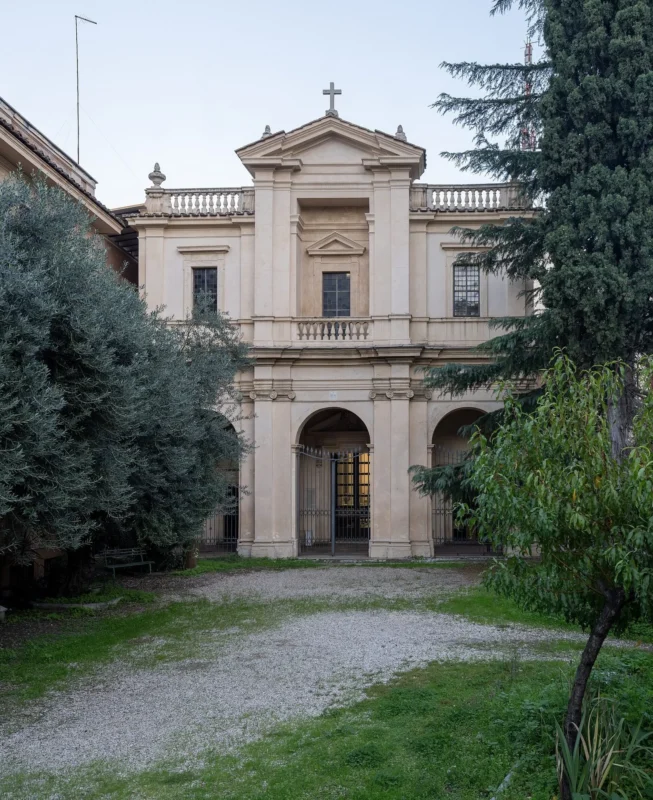
- Santa Bibiana100 m
- Nuovo Mercato Esquilino100 m
- Underdog’s200 m
- La Conventicola degli Ultramoderni200 m
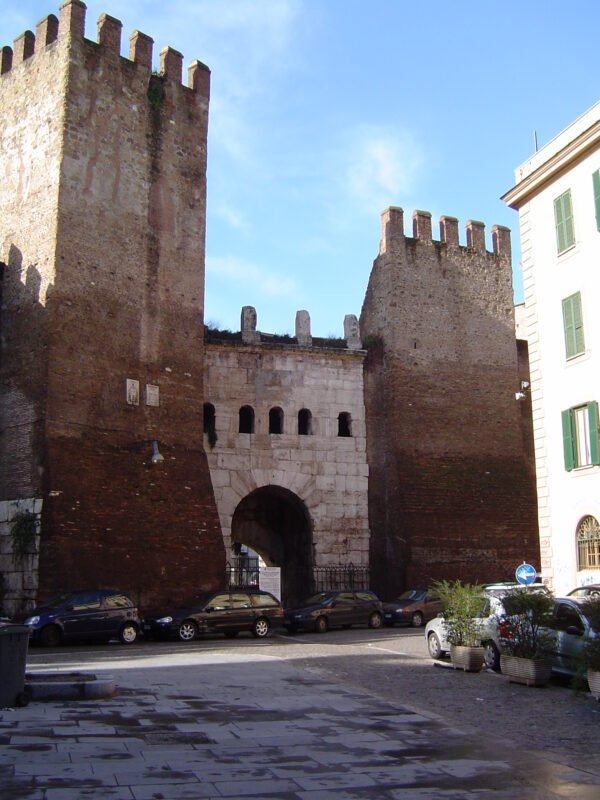
- Porta Tiburtina300 m


Upcoming events nearby
- La cosa giusta with Dino Abbrescia and Massimo De Lorenzo at the Ambra Jovinelli, January 13-24, 2027100 m
- Le nostre donne with Luca Bizzarri at Teatro Ambra Jovinelli, March 10 to 21, 2027100 m
- Incendi with Frédérique Loliée and Filippo Dini at Ambra Jovinelli, January 27 to February 7, 2027100 m
- Andrea Scanzi, Ora o mai più at Ambra Jovinelli, March 23, 2027100 m
You might also like
- Marco Goldin, Monet. Una vita a colori at Teatro Brancaccio, November 23, 2026
- Arriva Lucilla at Teatro Brancaccio, November 22, 2026
- The Prince of Egypt the Musical at Teatro Brancaccio, October 29 to November 15, 2026
- Goecke / Robbins / Bausch at Teatro dell’Opera di Roma, from October 27 to November 8, 2026
- Mahler’s Third Symphony by John Neumeier at Teatro dell’Opera di Roma, February 4 to 10, 2027
- The Rake’s Progress at Teatro dell’Opera di Roma, November 27 to December 5, 2026