Andy Warhol Forever Love at the Vaccheria, until March 28, 2027
In short. Andy Warhol Forever Love is open at the Vaccheria, La Casa della Pop Art, at Via Giovanni L'Eltore 35-37, 00144 Rome (Torrino, Municipio IX), from September 11, 2026 to March 28, 2027.
Andy Warhol Forever Love is open at the Vaccheria, La Casa della Pop Art, at Via Giovanni L'Eltore 35-37, 00144 Rome (Torrino, Municipio IX), from September 11, 2026 to March 28, 2027. The hours are asymmetrical and need to be read carefully: Tuesday to Thursday from 9:00 to 13:00, Friday to Sunday from 9:00 to 19:00, closed Monday. By public transport you take metro line B to EUR Palasport or EUR Fermi, the two closest stations, about 2 kilometers as the crow flies from the farmhouse. From there you continue by surface bus or taxi, and it's best to set the route on an up-to-date route planner before leaving home. Prices are published on the venue's official site, where you'll also find how to buy tickets. For information the Vaccheria answers at 06 69612221 and at lavaccheria.mun09@comune.roma.it.
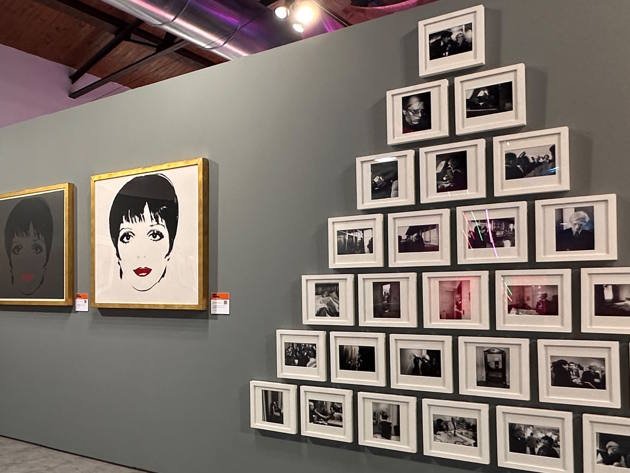
Warhol in south Rome, in a restored former stable between the Torrino and EUR: put that way it sounds like a joke, and yet it's one of the smartest exhibitions of the Roman autumn, because it doesn't claim to explain Warhol to those who think they already know him, but tells his story through the eyes of those who spent time with him. The curator, Gianfranco Rosini, met the artist in Rome in 1975. The photographs on view are by Dino Pedriali, who was Warhol's main assistant. The rest is firsthand material: letters, studies, stencils, books, objects. Whoever is looking for the big museum retrospective will find that elsewhere. Whoever wants to understand how the man behind the Marilyn worked and who he talked to will find something to sink their teeth into here.
A simple rule: exhibitions on the outskirts are better to visit, because only those who chose them get there. The Vaccheria doesn't have the crowds of Via del Corso, and for an exhibition made of documents and small formats, that's an enormous advantage. Below you'll find everything you need: what you see, who curated it, how the farmhouse is laid out, how to get there, what to see nearby and how to fit the visit into a sensible day.
Andy Warhol Forever Love in brief: dates, hours and venue
The exhibition runs for more than six months, from September 11, 2026 to March 28, 2027, and is visited at the exhibition venue that Municipio IX runs on Via Giovanni L'Eltore. It's not an event to chase at the last minute: there's plenty of time to choose the right day, and it's precisely the choice of day that makes the difference, as you'll see further on.
Dates and hours of Andy Warhol Forever Love
Public opening is given as September 11, 2026. The closing is set for March 28, 2027, which falls on a Sunday. The Vaccheria's week is split into two halves. From Tuesday to Thursday you can enter only in the morning, from 9:00 to 13:00. From Friday to Sunday the hours extend to 19:00, always opening at 9:00. On Monday the venue is closed. For those who work, then, the useful windows are Friday afternoon and the weekend. For those free in the morning, the middle days of the week are the quietest.
Where the Vaccheria is
The address is Via Giovanni L'Eltore 35-37, postal code 00144. The mapping places the farmhouse in the Torrino area, inside Municipio IX, south of the EUR neighborhood. The City's tourism portal describes it as a space born in the southern quadrant of the city, a short distance from Fuksas's Nuvola and the Rationalist architecture of EUR. As the crow flies, the Laghetto dell'EUR is about one kilometer and 800 meters away, the Nuvola a little over two kilometers, the Colosseo Quadrato about two and a half kilometers.
Tickets and information
The ticket price and any discounts are published on the Vaccheria's official site, on the page devoted to the exhibition: that's where it's best to check before setting out, also to find out if you need to book on the busiest days. For practical questions the venue has a phone number, 06 69612221, and an email address of the Municipio, lavaccheria.mun09@comune.roma.it. The exhibition's listing is also published on the official tourism portal of Roma Capitale.
What you see in Andy Warhol Forever Love
The route brings together 51 works by Warhol, more than 60 documents on his life, 37 works by Pop artists close to his world and 28 original photographs by Dino Pedriali. To this are added a reinterpretation of a detail of Paolo Uccello's Saint George and the Dragon, personal documents, correspondence, studies, stencils, working materials and a video work. It's a dense exhibition, built by accumulation, and it should be taken slowly.
The official presentation defines it as a retrospective that tells the story of the symbol artist of Pop Art in an immersive and unpublished route among creativity, art and the intimate dimension. Take away the press-release emphasis and the word that counts is the last one: intimate. The thread is not the chronology of the famous series, but the personal relationship between Warhol and the people who knew, photographed, portrayed and wrote to him.
The 51 works by Andy Warhol
The core is made of 51 works by the artist. The presentation names some of them, and it's from these that it's best to start to get your bearings: the portraits of Regina Schrecker, Liza Minnelli, Marilyn Monroe, Joseph Beuys and Man Ray, the Campbell's Soup, the Dollar Sign, the heart-shaped Candy Box, the Kiku. These are the coordinates of a universe that goes from the supermarket to the society salon, from coins to the Japanese flower.
The portraits: from Marilyn to Joseph Beuys
The group of portraits is the most interesting for how it's composed. Marilyn Monroe is the image everyone expects, and it's right that she's there. Next to her, though, are two figures who tell a less obvious Warhol, two artists portrayed by an artist: Joseph Beuys and Man Ray. Liza Minnelli brings the world of entertainment into the room, Regina Schrecker that of fashion. Lined up, these faces draw the network of relationships in which Warhol moved, and the exhibition is right to insist on this: the portrait, for him, was first of all a relationship.
The icons: the soup, the dollar, the heart, the flowers
The Campbell's Soup and the Dollar Sign are, for the general public, the most recognizable images of the group: everyday merchandise and money, treated as subjects worthy of a painting. The heart-shaped Candy Box is the most affectionate of the group and, probably, the one that gives the exhibition its sentimental title. The Kiku, the chrysanthemums, close the circle with a floral theme. The advice is to look at them up close, because in person the print, the color and the small irregularities say much more than reproductions.
The 37 works by Pop artists
The exhibition places next to Warhol 37 works by great Pop artists close to his world. The presentation doesn't publish the complete list, and so you won't find it here: you discover it in the room, and it's one of the pleasures of the visit. The choice not to isolate Warhol makes sense. Pop was not the gesture of a loner, but a shared climate, and seeing the protagonist surrounded by his fellow travelers helps you understand what set him apart from them.
Documents, letters and working materials
More than 60 documents accompany the works. Among them is the correspondence with figures like Mick Jagger, Truman Capote and Elizabeth Taylor: a musician, a writer and an actress, three different worlds that converged in the same address book. Then there are studies, stencils and artistic materials, that is, the tools with which the images were built. For those who teach or study art history this is the most valuable part: the stencil explains seriality better than any caption.
The video work on the female universe
The route includes a video work titled Female beauty, Warhol e l'universo femminile, curated by Giuliano Gasparotti and Francesco Mazzei, with original music by Maestro Furio Valitutti, produced for KIF Italia. It comes after so many works on paper and canvas and works as a pause: sitting for a few minutes helps put in order what you've seen.
Gianfranco Rosini, the curator who met Andy Warhol in Rome
The curator of Andy Warhol Forever Love is Gianfranco Rosini, who met Warhol in Rome in 1975 and established a bond with the artist and his world. The exhibition, according to the official presentation, comes precisely from this personal and privileged testimony. It's the key to reading the whole route.
Rome, 1975
The year of the meeting is 1975 and the place is Rome. There's no need to add details that the sources don't give: this is enough to understand the angle. The story doesn't start from the American myth, but from Italy. It's a sideways point of view, and that's why it's worth it. A city like Rome, used for centuries to seeing foreign artists pass through, has kept the memory of Warhol above all through those who met him in person, and this exhibition is the proof.
An exhibition built like a memory
When an exhibition comes from a direct relationship, the risk is hagiography. The advantage is access to materials that otherwise wouldn't be seen. Here the advantage weighs more. The books, objects and memories cited by the presentation are the connective tissue between one work and another. It's worth reading the captions of the documents with the same attention you give to the paintings: the real story of the exhibition is written there.
The photographs of Dino Pedriali, Warhol's main assistant
On view are 28 original photographs by Dino Pedriali, who was Warhol's main assistant. The images retrace the fundamental moments of the artist's Italian and European experience, and they are the section that more than any other justifies the trip to south Rome.
The gaze of someone who was beside him
A photograph taken by someone who works beside the artist has a different temperature from that of a news photographer. There's no distance of reportage, there's the familiarity of someone who knows when to raise the camera and when not to. Pedriali's 28 original prints should be looked at that way: as the visual diary of a collaborator, not as a fan's album.
Warhol in Italy and in Europe
The declared theme of the series is Warhol's Italian and European experience. It's a chapter the general public knows little about, crushed as it is by the American myth. Seeing it documented with original images, in a Roman venue, has its own logic: the exhibition brings home a part of the story that happened here. Those who come with teenagers can use this very section to explain that even icons travel, work, form relationships far from the place where they became famous.
Warhol and Paolo Uccello: Saint George and the Dragon
On the route is displayed a reinterpretation of a detail of Saint George and the Dragon, presented as a tribute to Paolo Uccello. The presentation places it in a dialogue between past and contemporary, and calls it extraordinary: a press-release adjective, but the comparison truly deserves attention.
Why the Renaissance in a Pop exhibition
Putting a tribute to Paolo Uccello inside a retrospective of the symbol artist of Pop Art seems a gamble, and it's instead one of the most stimulating ideas on the route. On one side the image built by hand, piece by piece. On the other the one born from the stencil and from repetition. Two opposite ways of thinking about the image, which the isolated detail forces you to compare. The practical advice is to stop in front of this work after seeing the stencils: the contrast between construction and reproduction becomes evident.
A detail, not the whole painting
The choice of the detail is significant. Cutting out a fragment of a famous work and enlarging it is a typically Pop gesture, which takes away the image's narrative context and turns it into a sign. Whoever has the complete painting in mind will immediately recognize the knight or the dragon. Whoever doesn't know it will see only shapes and colors. Both readings are legitimate, and that's the beauty of it.
A curiosity about Andy Warhol Forever Love at the Vaccheria, until March 28, 2027
The most instructive curiosity concerns the way this farmhouse became a public asset. The historic farmhouse that today houses the Vaccheria was ceded to Roma Capitale following the agreements of the EUR Castellaccio Urban Planning Program, as compensation for two areas of great environmental, natural and archaeological value: the Pratone delle Valli and the Parco Volusia. Put another way, the city obtained this building in exchange for something, and that something was two green lungs.
There's a geographic detail that makes the story even more Roman. According to OpenStreetMap mapping, the Parco Volusia is in Municipio XV, that is, on the other side of the city, in the northern quadrant. The urban planning compensation, then, tied together two points of Rome very far from each other: a green area in the north and an agricultural farmhouse in the south. It's the kind of administrative mechanism nobody tells visitors about and which instead explains a lot about how contemporary Rome was built, where culture often arrives as a counterpart to a construction operation.
The very name of the building is a curiosity in itself. Vaccheria means a stable for cows, and the City's portal confirms that the central body of the farmhouse was once occupied by stables. Today, in those more than 1,500 square meters of net surface, there are the glass cases and the works. That the artist of canned soup, the bard of mass production, should have arrived right here has an irony that Warhol would have been the first to appreciate: peasant civilization becoming the container of consumer civilization.
Finally the subtitle, La Casa della Pop Art, which accompanies the venue's name even in its listing on the City's tourism portal, regardless of this exhibition. Warhol, in this sense, is playing at home.
The Vaccheria, the Casa della Pop Art of Municipio IX
The Vaccheria is a restored historic farmhouse of almost 1,800 square meters, run by Municipio IX of Roma Capitale. The City's tourism portal presents it as a new hub devoted to art and culture, meant to become a reference point for Romans and tourists in the southern quadrant of the city.
From stable to exhibition space
A long restoration and redevelopment work has turned the agricultural building into a place of gathering, sociability and culture. It's a story Rome knows well: farmhouses, barns and stables that the expanding city surrounded and that, instead of being demolished, became libraries, civic centers, exhibition halls. In the case of the Vaccheria the reuse was particularly radical, because the main body, the one of the stables, became the exhibition heart.
How the farmhouse is laid out
The complex is divided into three parts. There is a large central body, once occupied by the stables, with more than 1,500 square meters of net surface, which houses the glass cases and the common spaces: a conference room, a refreshment area and a bookshop. Then there is a smaller two-story building, where the offices and management are. Finally an added body intended for workshops and related services, along with the technical area on the roof. For the visitor the thing that counts is the first: the exhibition takes place in a large continuous space, long and orderly, where the works can breathe.
The archaeological finds of south Rome
Few people know it, but the Vaccheria is more than a room for temporary exhibitions. Its spaces also house the archaeological finds recovered in the area of south Rome. It's a detail that changes the perception of the place: the same building that today hosts Warhol keeps the material traces of the territory it stands in.
Who runs the Vaccheria
The venue is run by Municipio IX, and you can tell from the contacts too: the phone is 06 69612221, the email is an institutional address of the City. The venue's ordinary hours coincide with those of the exhibition: Tuesday to Thursday from 9:00 to 13:00, Friday, Saturday and Sunday from 9:00 to 19:00, closed Monday. The Vaccheria also has an official Instagram profile and Facebook page, useful for following any meetings and guided tours.
Something nobody tells you about Andy Warhol Forever Love at the Vaccheria, until March 28, 2027
What almost nobody points out is the schedule. From Tuesday to Thursday the Vaccheria closes at 13:00. Not at 18:00, not at 19:00: at one in the afternoon. Anyone who reads the flyer distractedly and decides to drop by on a Wednesday afternoon after work finds the gate closed, and from south Rome going back for nothing is a small tragedy of traffic and time. The weekday afternoon, here, simply doesn't exist.
The practical consequence is that the exhibition has two different audiences. On the middle days of the week, in the morning, come schools, retirees, enthusiasts with free time, and the atmosphere is intimate. From Friday to Sunday the window extends to 19:00 and the audience widens to families and workers. If your goal is to read the documents calmly, choose a Tuesday or Thursday morning and arrive at the 9:00 opening: four hours is more than enough. If instead you want to combine the exhibition with a walk through EUR, Saturday is the right day, because you have the whole afternoon ahead.
There's a second aspect few people consider. The exhibition is made in large part of papers: letters, documents, studies, stencils, photographs. These are objects that call for closeness and silence, and that are hard to read when there are 10 people in front of the case. It's one more reason to avoid peak weekend hours and not to treat the visit as a quick stop between two commitments. The third thing, finally, concerns Monday, given as the closing day: whoever plans a trip on a holiday long weekend would do well to ask the venue if extraordinary openings are planned, without taking them for granted.
How to get to the Vaccheria for Andy Warhol Forever Love
The Vaccheria is at Via Giovanni L'Eltore 35-37, in a residential area of the Torrino, about 2 kilometers as the crow flies south of the EUR Palasport and EUR Fermi stations of metro line B. It's not a venue around the corner for those who live in the center, and it's best to organize ahead.
By metro: line B
The two stations of line B closest to the farmhouse are EUR Palasport and EUR Fermi, both on Viale America. The distance as the crow flies from each is about 2 kilometers, which on foot becomes a bit more because of the street layout. Those who like to walk can do it, crossing the neighborhood. Those short on time or traveling with children and older people will do better to continue with a surface vehicle.
By bus
From the stations of metro line B the farmhouse is reached on the surface. Lines and stops can change over the course of the season, and for this reason the safest advice is to set the route to Via Giovanni L'Eltore on a route planner updated the same day, entering the arrival time. Keep in mind the 13:00 closing from Tuesday to Thursday when you work out the timing.
By taxi
For a group of three or four people the taxi from the metro station is the most comfortable solution: a few minutes of road and you get off in front of the farmhouse. Those arriving from Fiumicino, from the center or from Termini can ask to be taken directly to the address, giving the street number and the name of the venue.
By car
Via Giovanni L'Eltore is a residential street. Those arriving by car should count on street parking in the streets of the area, respecting the signs, and ask the venue, when booking or by phone, if there are particular instructions for visitors.
My advice for visiting Andy Warhol Forever Love at the Vaccheria, until March 28, 2027
The advice is clear-cut: don't go in the last weeks, or else go in the very last one, but for a precise reason. Exhibitions that last months always have a final peak, when those who put it off realize only a few days are left. For a venue with reduced hours like the Vaccheria, that peak is concentrated in a few weekend afternoons, and an exhibition of documents suffers from it. If you can, go between October and February, on a Tuesday or Thursday at 9:00, and you'll enjoy it all in peace.
If instead you want to make the visit a memorable day, aim for the last weekend, Saturday March 27 or Sunday March 28, 2027, and before or after go down to the Laghetto dell'EUR. The reason is botanical. On the Passeggiata del Giappone, designed by Raffaele de Vico, there are the Sakura, the cherry trees donated by the city of Tokyo, and according to the City's tourism portal the bloom, the Hanami, usually falls between mid-March and early April. The exhibition's closing therefore coincides with the window of the cherry blossoms. Warhol in the morning, the pink of the Sakura in the afternoon: I don't know a better pairing in south Rome.
One last note on method. Go in with an idea of a route: first the portraits and the icons, to warm up the eye. Then Pedriali's photographs, which give the context. Finally the documents and the stencils, calmly. Keep the video work for last, as a closing. It's the recommended order, and it works for those visiting alone too.
How to organize the visit to Andy Warhol Forever Love
To see Andy Warhol Forever Love properly you need between an hour and a half and two and a half hours, depending on how much you read. Adding the trip and a walk through EUR, the visit comfortably takes half a day.
How much time you need
The works are 51 by Warhol and 37 by other Pop artists, the photographs 28, the documents more than 60. Whoever looks only at the paintings gets by in an hour. Whoever reads the letters and studies the stencils takes at least double. On the days with a 13:00 closing it's best to get in by 10:30 so you don't have to rush.
The best day
For quiet, Tuesday, Wednesday and Thursday morning. To combine the exhibition with the neighborhood, Friday afternoon or Saturday. Sunday is convenient but it's the day of families, and if the weather is nice the whole green area of EUR fills up.
In a group and with a guide
An exhibition of documents is the ideal ground for an accompanied visit, because the value of a letter or a stencil depends on who explains it to you. For school groups, associations and companies it's best to contact the venue in advance to check availability and booking arrangements. Those who want a tailored route, perhaps combined with the architecture of EUR, can turn to Tour Leader Pro.
With children
Warhol is one of the few 20th-century artists that children recognize right away. The canned soup, the dollar sign, the heart-shaped box of chocolates: these are images that speak even to a six-year-old. The trick is not to expect them to read the documents, but to have them play with the icons: find the heart, count the soups, look for the flower. After the exhibition, the Laghetto dell'EUR has a play area equipped for children and a bike path, and the Luneur Park is the oldest amusement park in Italy, reopened in 2016 after modernization work.
What to bring
Not much: comfortable shoes if you plan to walk to EUR, an ID if you're entitled to discounts, and a charged phone battery for the trip back. Ask the staff at the entrance if photographs are allowed and in which sections: in exhibitions with loans and archive materials the rules can vary from room to room.
Another well-known fact, yet one rarely mentioned
Everyone knows that EUR is the neighborhood of travertine and of the symbols of the Fascist regime. Less often remembered is why it exists: it was designed to host the Esposizione Universale Romana of 1942, which was never held because of the outbreak of the Second World War. The original project, with a pentagonal plan on the model of ideal cities, was developed by a group of architects coordinated by Marcello Piacentini, and called for large buildings serving the exposition, services and direct connections that would mark the city's expansion toward the sea.
The little-cited fact is that much of what we see today was completed after the war, and in part for another great event. The Palazzo della Civiltà Italiana, the Colosseo Quadrato, was begun in 1938. Work stopped in 1943 and the building was finished in the postwar period. The Laghetto, planned in Piacentini's original project, was completed only on the occasion of the Rome Olympics of 1960. The Palazzo dello Sport was designed in 1956 precisely with the Games in mind. The Luneur too, born in 1953 for the Agricultural Fair, became permanent with the 17th Olympiad.
Put another way, the EUR you visit on leaving the Vaccheria is the result of two overlapping projects: the Fascist exposition that was never inaugurated and the Olympic Rome of 1960. Keeping this in mind changes how you look: the same architectures that were born as regime scenery became, 20 years later, the backdrop of Italian modernity in the boom years. Cinema, from Rossellini to Antonioni, from Fellini to Greenaway, has often used them as a backdrop, and the Colosseo Quadrato appears in Rome, Open City, in L'eclisse, in Otto e mezzo and in The Belly of an Architect.
What to see around the Vaccheria: EUR a short walk away
Less than 3 kilometers from the Vaccheria is one of the most architecturally coherent neighborhoods in Europe. Whoever makes the effort to get here for Warhol has every reason to devote a couple of hours to EUR, which after all is the real urban context of the exhibition.
The Colosseo Quadrato
The Palazzo della Civiltà Italiana, for Romans the Colosseo Quadrato, is the architectural icon of 20th-century Rome. It takes from its ancestor the tight sequence of arches, repeated 216 times across the four identical elevations, and is a travertine mass about 68 meters high. It was designed by Giovanni Guerrini, Ernesto La Padula and Mario Romano, chosen by a jury chaired by Marcello Piacentini. Under the arcades of the first order are 28 marble statues representing human arts and activities, and at the sides of the stairways the groups of the Dioscuri. At the top runs the famous inscription about a people of poets, of artists, of heroes and of navigators. Today it is the seat of the Maison Fendi and opens to the public on the occasion of events and exhibitions.
Fuksas's Nuvola
The Nuvola is the Roma Convention Center designed by Studio Fuksas in 2008, awarded in London in 2012 with the Royal Institute of British Architects' Best Building Site recognition. It is made up of three parts: the Teca, a large steel structure with a double glass facade. The Nuvola proper, which houses the auditorium and the halls. The Lama, an independent hotel with more than 400 rooms. The overall capacity exceeds 8,000 seats. From December 4 to 8, 2026 it hosts Più libri più liberi, and book lovers can combine the two visits.
The Laghetto and the Passeggiata del Giappone
The Laghetto dell'EUR is an artificial basin one kilometer long, between 60 and 130 meters wide, with a surface of 85,120 square meters and a depth between 2 and 4 meters. Around it are oaks, poplars, magnolias, olive trees and maples. The Passeggiata del Giappone, designed by Raffaele de Vico, is the one with the cherry trees donated by Tokyo. Among the facilities noted by the City are a bike path and a play area equipped for children.
The Giardino delle Cascate
Also by de Vico is the Giardino delle Cascate, about 42,000 square meters inaugurated on June 29, 1961: leaps and jets of water, cliffs, natural stones and plants, with a layout of classical symmetry. Over the central waterfall passes the pedestrian bridge Hashi, with a glass floor. The waterfalls also have a practical function, because they oxygenate the waters of the lake. After a long renovation the garden was reopened to the public in May 2017.
The Luneur Park
The Luneur, on Via delle Tre Fontane, is the oldest amusement park in Italy. Born in 1953, closed in 2008 for works, it reopened in 2016 on more than 60,000 square meters with 21 attractions, including the Ferris wheel with 28 colorful gondolas, the Brucomela and the carousel with horses. Hours and calendar change with the seasons and should be checked on the park's site.
The Basilica of Saints Peter and Paul
On the highest point of the neighborhood stands the Basilica of Saints Peter and Paul, with a hemispherical dome 32 meters in diameter. It is one of the most successful examples of sacred architecture in modern Rome, and from its stairway you can read the layout of the neighborhood well.
The Museo delle Civiltà and the Marconi Obelisk
Over Piazza Guglielmo Marconi rises Arturo Dazzi's obelisk dedicated to the physicist. Beside it, the buildings of the Museum of Civilizations, which brings together more than 2 million works and documents from prehistory to the contemporary age over about 50,000 square meters between halls and storerooms. After Warhol's Pop, a leap into prehistory and folk arts is a counterpoint I recommend.
The Palazzo dei Congressi and the Palazzo dello Sport
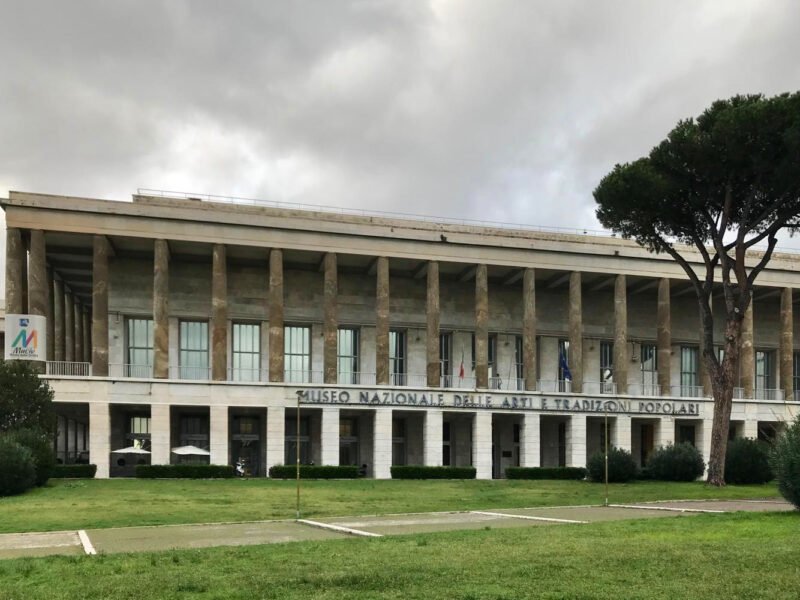
On the other side of Via Cristoforo Colombo, in a position symmetrical to the Colosseo Quadrato, is the Palazzo dei Congressi by Adalberto Libera, designed at the end of the 1930s. A little farther on is the Palazzo dello Sport, designed in 1956 for the 1960 Olympics, which gives its name to the EUR Palasport station of metro line B.
The right photo to take at Andy Warhol Forever Love at the Vaccheria, until March 28, 2027
Inside the exhibition the right photo depends on the venue's rules, which you should ask about at the entrance: there are loans, original photographs and archive documents, and not everything can be shot. If photos are allowed, it's better to avoid the frontal shot of the famous painting, which exists on the internet already in a thousand copies better than yours, and look instead for the relationship between the works and the place. A Campbell's Soup seen inside the long nave of a former stable is an image that tells this exhibition and no other.
Another idea is to work on the materials: a stencil, a letter, a Pedriali photograph next to the finished work. It's the photo that explains the process, and it's the one I'd use in a classroom or in a presentation. Watch out for reflections on the glass cases: it's enough to move half a step to the side and lower the phone slightly.
Outside, the right photo is found in EUR, and it changes with the season. In autumn and winter the raking afternoon light on the arcades of the Colosseo Quadrato draws the repetition of the arches like a Warhol silkscreen: 216 identical openings, a serial image carved in travertine. It's the shot that ties the exhibition to the neighborhood, and I recommend it to those looking for meaning and not just a postcard. In the last part of the exhibition, if the bloom comes early, the photo is on the Passeggiata del Giappone, with the Tokyo cherry trees over the water of the Laghetto. And if you find yourself at the Giardino delle Cascate, the Hashi bridge with its glass floor offers an unusual point of view on the central waterfall.
Where to eat near the Vaccheria
The Vaccheria farmhouse includes a refreshment area in the central body. To know if it's operating on the days of your visit, it's best to ask the venue. For a real meal, the offer is found mostly in the EUR neighborhood, which the City's portal describes as rich in bars and restaurants, from the aperitivo to gastronomic specialties.
In EUR, at lunch
EUR is a residential neighborhood and home to many public and private offices, and this shapes the offer: on weekdays lunch-break formulas prevail, on the weekend the longer lunches. I recommend choosing after the exhibition, while walking: EUR lends itself to it.
With children
If the day continues at the Luneur, the park has many refreshment points inside, from hamburgers to pizza, from pasta to salad to ice cream. It's the simplest solution for those with small children who don't want to move again.
A picnic at the Laghetto
On nice autumn days and in early spring the Parco Centrale del Lago is the most pleasant alternative: you buy something to go and eat on the lawn, looking at the water. At the end of March, under the cherry trees, it's almost a ritual.
Some important events that happened here in history
The documented history of the Vaccheria is that of an agricultural building that became a public asset. The first decisive step is the cession of the farmhouse to Roma Capitale as part of the agreements of the EUR Castellaccio Urban Planning Program: the farmhouse entered the city's holdings as compensation for the Pratone delle Valli and the Parco Volusia, two areas of environmental, natural and archaeological importance. The second step is the restoration, a long redevelopment work that turned the stables into a place of gathering, sociability and culture. The third is the assignment of its management to Municipio IX, which made it its own exhibition venue.
There is also a fact that gives the building additional depth: in its almost 1,800 square meters the archaeological finds recovered in the area of south Rome have found a home. The farmhouse, put another way, has also become the place where the territory preserves its own material memory, and it's an event no less important than the exhibitions that follow one another there.
Widening the view to the neighborhood that surrounds the Vaccheria, the events multiply. In the nearby neighborhood the project of the 1942 Universal Exposition was born, never inaugurated because of the war. The construction sites of the Colosseo Quadrato, begun in 1938, stopped in 1943 and resumed in the postwar period. In 1953 the future Luneur opened for the Agricultural Fair. With the 1960 Olympics the Laghetto was completed and the amusement park became permanent. On June 29, 1961 the Giardino delle Cascate was inaugurated. In 2012 the Nuvola project received in London the prize of the Royal Institute of British Architects. And on September 11, 2026, in this farmhouse, the retrospective Andy Warhol Forever Love opened to the public, bringing to south Rome an account of the artist born from a Roman meeting in 1975.
Accessibility and services at the Vaccheria
The Vaccheria farmhouse has, according to the official description, common spaces such as a conference room, a refreshment area and a bookshop in the central body. For information on physical accessibility, that is, entrance, routes, restrooms and assistance for people with motor or sensory disabilities, the most sensible thing to do is to call the venue, at 06 69612221, or write to lavaccheria.mun09@comune.roma.it before the visit, stating your needs.
The tourism portal of Roma Capitale maintains a dedicated section, Roma accessibile, which gathers general information on services in the city. For those who move in a wheelchair the most delicate stretch is the last one, from the metro to the farmhouse: in that case a taxi or a dedicated transport service greatly reduces the effort. A notice of a few days lets the venue get organized, and makes a difference.
Who has passed through Andy Warhol Forever Love at the Vaccheria, until March 28, 2027
The first name is the curator's, Gianfranco Rosini, who met Warhol in Rome in 1975 and built this exhibition from that relationship. The second is Dino Pedriali, Warhol's main assistant, who passes through the Vaccheria with 28 original photographs on the fundamental moments of the artist's Italian and European experience. Alongside them work Giuliano Gasparotti and Francesco Mazzei, authors of the video work Female beauty, and Maestro Furio Valitutti, who signed its original music for KIF Italia.
Then there are the presences that arrive through the works and the papers, and it's a list that few Roman venues can claim at the same time. Marilyn Monroe, Liza Minnelli, Joseph Beuys, Man Ray and Regina Schrecker enter the room as subjects of Warhol's portraits. Mick Jagger, Truman Capote and Elizabeth Taylor get here through correspondence with the artist. Paolo Uccello is present with the reinterpretation of his Saint George and the Dragon, which leaps over five centuries with a single detail. And there are the 37 works by the great Pop artists close to Warhol's world, whose names you discover in the room.
Before all of them, naturally, the animals for which it was built passed through this building: the name Vaccheria reminds every visitor of it. And after the redevelopment the archaeological finds of south Rome pass through it, kept in the farmhouse. From a stable to a room where Marilyn looks at Beuys: it's a path that, thinking about it, seems written on purpose for Warhol.
Andy Warhol Forever Love and the season's other exhibitions
The autumn and winter of 2026 in Rome offer a small itinerary for those who love the art of the second half of the 20th century. From October 6, 2026 to April 11, 2027 the Museo di Roma at Palazzo Braschi hosts an exhibition on Keith Haring, and from November 18, 2026 to April 4, 2027 the Galleria Nazionale d'Arte Moderna presents Marina Abramović. Three exhibitions, three different neighborhoods, and a common thread: artists who changed the relationship between work and audience.
An itinerary in three stops
It's best to start with the Vaccheria, which by location is the most inconvenient and so should be scheduled first, perhaps on a Saturday with the afternoon free for EUR. Haring at Palazzo Braschi fits easily into a day in the center, between Piazza Navona and the Pantheon. Abramović at the Galleria Nazionale pairs well with Villa Borghese. Seen in this order, they tell three ways of being inside one's own time.
Where Warhol stands
Among the three, Warhol is the one who turned the reproduced image into an artistic language. Andy Warhol Forever Love doesn't celebrate him as a brand, but shows him in his environment of relationships, and for this reason it's the right exhibition to see first: it gives the coordinates for reading the others too.
Rome between September and March: when to go
Andy Warhol Forever Love crosses three Roman seasons, from the end of summer to the start of spring. Each has its own character, and the choice of month also changes the visit to the surrounding neighborhood.
Autumn
September and October are the most pleasant months to combine the exhibition with a long walk through EUR. The days are still long and the Laghetto is busy but not crowded.
Winter
From November to February the days get shorter and the advice is to go in the morning, even on the weekend. The Luneur, among its seasonal events, offers Christmas villages, and December at the Nuvola brings Più libri più liberi: a day that puts together Warhol and the book fair has a coherence of its own.
Early spring
March is the month of the closing, on the 28th, and of the Hanami on the Passeggiata del Giappone, which usually begins in mid-month. It's the most photogenic period, but also the one in which the exhibition risks being busiest. Whoever chooses it should go early in the morning.
Frequently asked questions about Andy Warhol Forever Love
Until when is the Andy Warhol Forever Love exhibition open in Rome?
Andy Warhol Forever Love is open at the Vaccheria until March 28, 2027, which falls on a Sunday. Public opening is given as September 11, 2026. On Monday the venue is closed, and from Tuesday to Thursday you can enter only in the morning: anyone who wants to go in the last weeks must keep this in mind so as not to find it closed.
What are the Vaccheria's hours for the Warhol exhibition?
The Vaccheria is open for Andy Warhol Forever Love Tuesday to Thursday from 9:00 to 13:00 and Friday to Sunday from 9:00 to 19:00. Monday is a closing day. On the days with a 13:00 closing it's best to get in by 10:30 to have time to read the documents too.
Where is the Vaccheria and how do you get there?
The Vaccheria is at Via Giovanni L'Eltore 35-37, 00144 Rome, in the Torrino area, Municipio IX. The closest metro line B stations are EUR Palasport and EUR Fermi, about 2 kilometers as the crow flies. From there you continue by surface bus, on foot or by taxi.
How much does the Andy Warhol Forever Love ticket cost?
The price of the Andy Warhol Forever Love ticket and any discounts are published on the Vaccheria's official site, on the exhibition page, where the ways of buying are also indicated. For information you can call the venue at 06 69612221 or write to lavaccheria.mun09@comune.roma.it.
Which Warhol works are in the exhibition?
Andy Warhol Forever Love displays 51 works by Warhol, including the portraits of Marilyn Monroe, Liza Minnelli, Joseph Beuys, Man Ray and Regina Schrecker, the Campbell's Soup, the Dollar Sign, the heart-shaped Candy Box and the Kiku. The route is completed by 37 works by Pop artists, more than 60 documents and 28 original photographs by Dino Pedriali.
Who curated the Warhol exhibition at the Vaccheria?
The Andy Warhol Forever Love exhibition is curated by Gianfranco Rosini, who met Warhol in Rome in 1975 and established a bond with the artist and his world. The route comes from this personal testimony and includes works, photographs, objects, books, letters and memories tied to the artist.
Is the Warhol exhibition suitable for children?
Andy Warhol Forever Love is suitable for children too, because many Warhol images, like the canned soup, the dollar sign and the heart-shaped box, are recognizable at first glance. The documents interest adults more. After the visit, the Laghetto dell'EUR has an equipped play area and the Luneur Park is a few kilometers away.
How much time do you need to visit Andy Warhol Forever Love?
For Andy Warhol Forever Love you need to allow between an hour and a half and two and a half hours, depending on how much you read of the letters and documents. With the trip and a walk through EUR the visit takes half a day. Saturday lets you combine the exhibition with the neighborhood without rushing.
Final advice on Andy Warhol Forever Love
Go on a Tuesday or a Thursday at 9:00, with two hours ahead of you and no appointment afterward. Look at the icons, but stop at Pedriali's photographs and at the letters: that's where the exhibition says something you won't find elsewhere. Then, if you have time, step out and reach the Colosseo Quadrato: after seeing Warhol, you won't look at those 216 identical arches in the same way. If you really must go on the weekend, choose the last one of March and close the day under the cherry trees of the Laghetto.
Article written by the editorial team of Tour Leader Pro, contact them for Private/Corporate/VIP Tours and Experiences.
Planning a trip to Rome? The English-language guides for visiting the city are on ItalyPlanner.com.
Contact Information
Nearby
Upcoming events nearby
 Madame, Disincanto Tour in Rome, Atlantico, December 5, 2026400 m
- Litfiba in Concert in Rome at Atlantico Live, December 2, 2026400 m
- Ariete at Atlantico Live in Rome: Club Tour 2026, November 7, 2026400 m
- Mobrici at Atlantico in Rome: 10 years of Avete ragione tutti, November 20 and 21, 2026400 m
You might also like
- Marialba Russo. Immagini della Madonna dell’Arco (After) at MUCIV, September 24 to November 20, 2026
- Edoardo Leo at Palazzo dello Sport in Rome, Ti racconto una storia, May 7, 2027
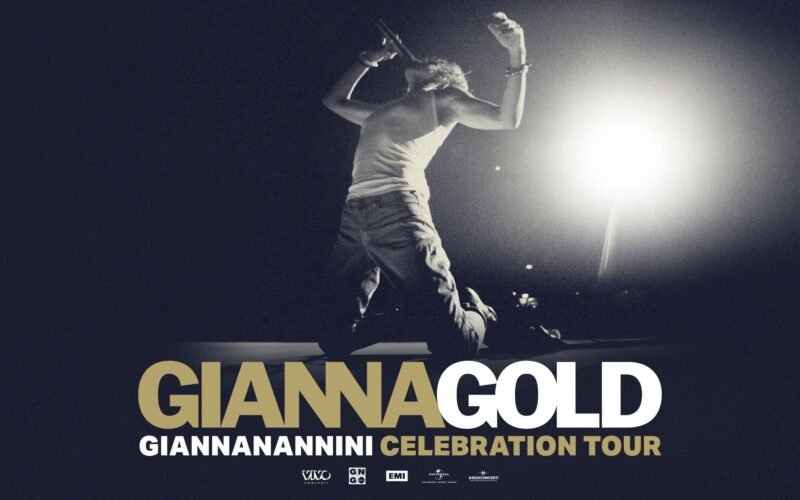
- Gianna Nannini at Palazzo dello Sport in Rome: March 31, 2027
- Massimo Pericolo at Palazzo dello Sport in Rome, March 23, 2027
- Gabry Ponte Circotron at Palazzo dello Sport in Rome, March 13, 2027
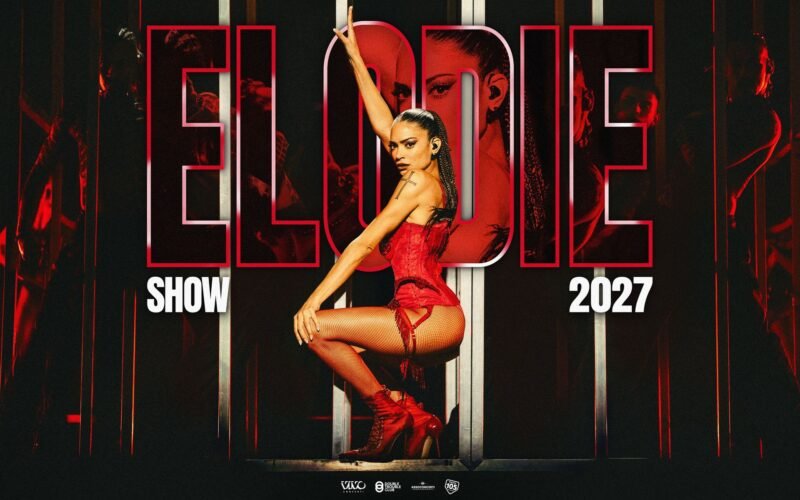
- Elodie at Palazzo dello Sport in Rome, April 29, 2027