Lian Club
In short. There's a spot on the Tiber, in Rome, where for about 10 years people danced on the water.
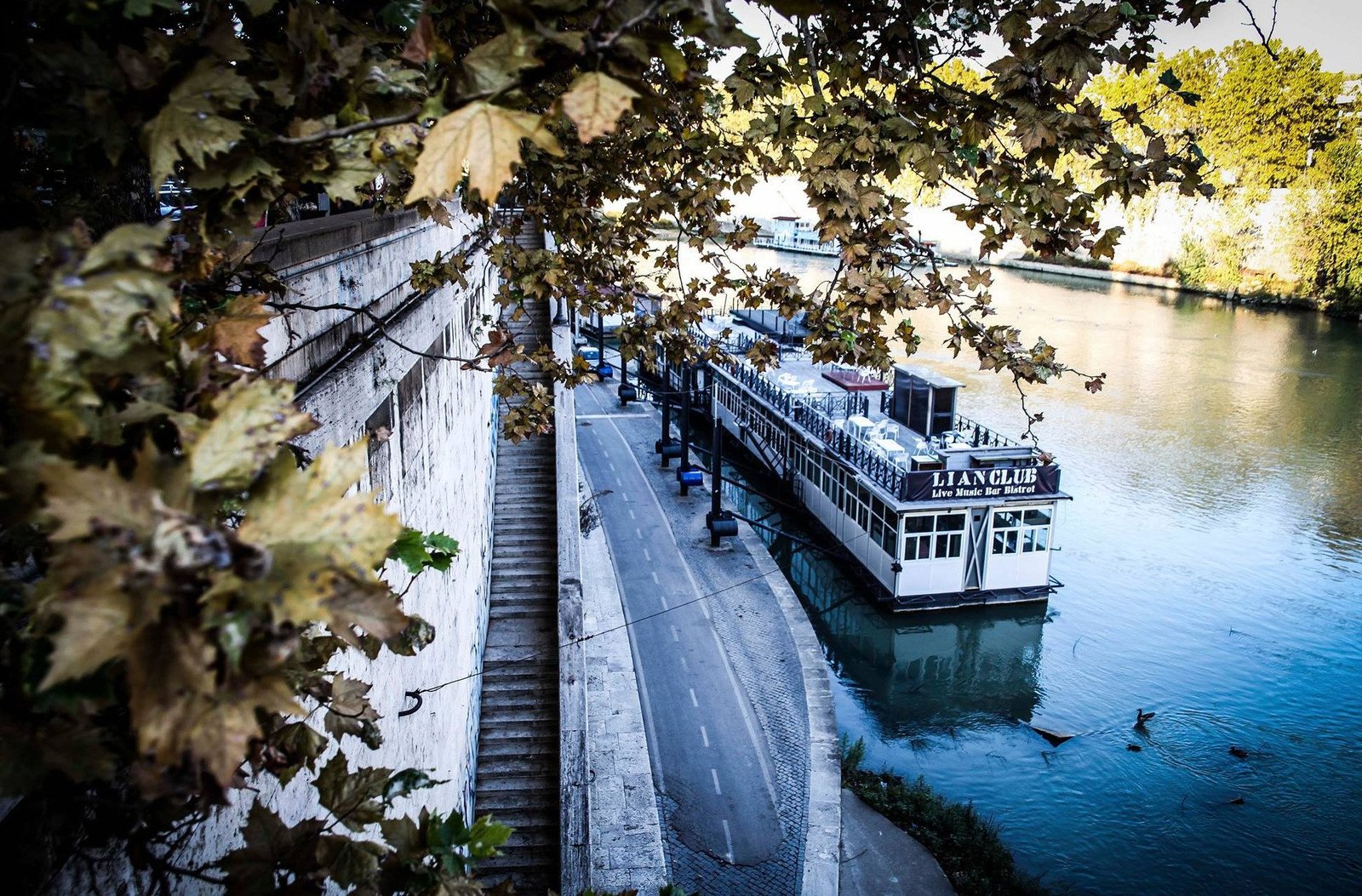
There's a spot on the Tiber, in Rome, where for about 10 years people danced on the water. Not on a terrace overlooking the water, not on a quay next to the water: right on top of it, with the river flowing under the floor and the floor that, if you stop for a moment and close your eyes, barely moves. The spot is Lungotevere dei Mellini, number 7, in the Prati district, a few dozen meters from Ponte Cavour. The venue that occupied that piece of river was called Lian Club, and it was a moored barge with a kitchen, a bar and above all a room for live concerts and DJ sets.
I'll tell you about this place with a premise of method, because the premise explains the tone of everything else. The barge at Lungotevere dei Mellini had a long and well-documented history, which ends in the autumn of 2024. The owners said goodbye to the audience with a short message, four words that went around Rome's phones, and then the name of the venue reappeared elsewhere, in another quadrant of the city, far from the river. So when I talk about what happened here, I'm talking about a closed chapter, and when I give you a tip, the tip concerns the place, the riverbank, the walk, the view, the bend of the river under Ponte Cavour, which are all still there and aren't going anywhere.
It's not a fallback choice. The piece of Rome where this barge was moored is one of the densest and least talked about in the city: a tree-lined lungotevere built over a gigantic urban wound, an embankment wall as tall as a small apartment building, an Umbertine bridge in travertine, a courthouse that has been debated for a century, a district born from nothing in 40 years, a river that Rome used for 25 centuries and then stopped looking at. Anyone who comes down here for an aperitif and then looks up realizes they're surrounded by an amount of history that no sign tells.
What you'll find below is a long guide: where exactly you are, what the venue was and how a barge like this worked from a practical point of view, what has happened on this bank in the last 150 years, what photograph you take home, how to get there, how to get home safely and what there is to see within a short walk. At the end I leave you the address and the source everything starts from.
Where you really are
The address is Lungotevere dei Mellini 7, Roma. Lungotevere dei Mellini is the stretch of embankment connecting Via Vittoria Colonna to Piazza della Libertà, on the right bank of the river, inside the Prati district. The name comes from the Mellini, or Millini, family, a Roman house that had properties in the Monti district and in Piazza Navona, and the naming of the street dates back to a resolution of July 20, 1887, that is, to the years when this part of the city was literally being invented.
To orient yourself without a map, use the two fixed points. The first is Ponte Cavour, which from Lungotevere dei Mellini crosses the river and comes out exactly at Piazza del Porto di Ripetta, on the other bank, inside the Campo Marzio district. The second is Piazza Cavour, which stays behind you, toward the inside of the district, with the enormous silhouette of the Palazzo di Giustizia visible from half of Rome. If you have the bridge on your left and the embankment wall on your right, you're walking toward Piazza della Libertà and the Ministry of the Navy. If you have them the other way around, you're heading toward Via Vittoria Colonna, Ponte Umberto I and the bend that leads to Castel Sant'Angelo.
What strikes people arriving for the first time is the elevation. The lungotevere runs high, above the embankment wall, with its plane trees in a row and traffic that never stops. The river instead runs below, 12 or 13 meters lower, on a wide quay that is closed in many stretches, open in others, and in still others occupied by moorings and piers. To get to the water you have to go down, and going down in Rome almost always means a ramp or a travertine staircase, often narrow, often damp, almost always invisible from above. This is why a great many Romans pass every day over the heads of venues, clubs and piers without suspecting they exist.
The Lian's barge was exactly this: a floating structure moored to the quay, below street level, a stone's throw from the arch of Ponte Cavour. From above you saw a roof and a few lights. From below you saw a real venue, with glass walls, the entrance gangway and the river passing a meter from the edge.
What the structure was
It wasn't a little boat with four tables. It was a floating complex of serious size, around 600 square meters, spread over several connected bodies: an indoor part with the stage, where concerts and DJ sets were held, a panoramic veranda with glass walls on the river, an upper terrace that in the good season became the main space, a restaurant area and a cocktail bar, plus the service rooms and the kitchen, which occupied a float separate from the others.
The music program was the reason for the place's existence and covered a wide range: jazz, rhythm and blues, singer-songwriter music, record nights, live shows by small and medium ensembles. It wasn't a club for big numbers and couldn't be: on a floating structure capacity is a physical constraint even before an administrative one, and the consequence is that the evenings had a human scale, with the stage a few meters from the audience and the feeling, very rare in Rome, of being inside a room and not inside a warehouse.
The space was also used for private parties, graduations, birthdays, presentations. And it's a detail worth keeping in mind when you think about the economics of these places: a venue on the river lives off public nights in summer and private events all year round, and without the second leg the first doesn't hold.
Why a venue floats and how it stays put
Here comes the part that almost nobody explains, and which is the most interesting from a technical point of view. A barge moored on the Tiber is not a ship and not a building: it's something in between that has to solve two problems together, floating and not moving.
Flotation is entrusted to watertight tanks placed under and around the structure. In the case of this barge the external tanks were 15, and the number comes from the public statements of the venue's management after a 2023 incident that I'll tell you about further on. 15 sealed air chambers supporting a weight distributed unevenly: the kitchen weighs more than the hall, the bar weighs more than the terrace, people all move together to the side from which the bridge is best seen. Whoever designs a structure like this has to account for a load that continuously changes position, something that never happens to a masonry building.
The mooring is the other half of the problem. The Tiber in Rome is not a lake: it has an average flow at the mouth of around 324 cubic meters per second, it has significant winter floods and summer lows, and downstream of every bridge the water accelerates and forms eddies. A moored structure must be able to rise and fall with the river level, staying attached to the quay, without tearing out the fittings and without putting the access gangways under tension. This is why the moorings of Roman barges are articulated systems, with bollards, cables, fenders and connections that allow ample vertical movement and limit horizontal movement.
The third variable is the one nobody sees: the material the river carries. After heavy rain the Tiber brings down logs, branches, plastic, sometimes pieces of pier. All that material piles up against the bridge piers and against everything it finds on its way, including the sides of moored structures. It's a lateral load that grows on its own, day after day, and has to be removed by hand. Whoever runs a floating venue in Rome spends more time than you'd imagine thinking about these things, and much less time than you'd imagine thinking about the cocktail list.
The river under your feet
To really understand where you are you have to go back to a precise date: the night between December 28 and 29, 1870. Rome had been the capital of Italy for only a few months, the Tiber swelled for days and flooded the city up to 17.22 meters above the hydrometric zero, a level that at the time was the second in all recorded history. The water entered the Pantheon, Via del Corso, Piazza Navona, the warehouses, the cellars, the stables. The new capital of the Kingdom presented itself to the world with barges sailing in the streets of the center.
The political reaction was immediate and overwhelming. An ancient debate reopened, one that had involved Caesar and then Augustus, who had appointed a commission of 700 experts and then limited himself to having the riverbed cleaned by establishing a dedicated magistracy, the curatores alvei et riparum Tiberis, an office Agrippa held for life. In 1870 the proposals were of every kind, including that of Giuseppe Garibaldi, who argued for diverting the course of the river. On September 23 the commission did not approve Garibaldi's plan but the conservative one of the engineer Raffaele Canevari, which provided for embanking the course from Ponte Milvio to the basilica of San Paolo fuori le Mura, removing the ruins, digging out the bottom of the riverbed and stabilizing the width of the river at 100 meters.
At the end of 1876 the government awarded the contract for the first lot. The works lasted 25 years and changed Rome more than any other 19th-century intervention. The embankment walls were born, the vertical travertine slopes that still today separate the city from its river. The lungoteveri were born, the through roads that run above the walls. The river ports, the little stairways, the mills, the houses that went down to the water disappeared forever, the scenes that Ettore Roesler Franz had painted in his watercolors of vanished Rome in exactly the same years, with the awareness of someone who knows he is painting a doomed world.
The Porto di Ripetta, which was the great landing of the Campo Marzio, was never rebuilt. You can see where it was: on the opposite side of Ponte Cavour, on the other bank, where the piazza still bears its name today. The proof that the system worked came in 1900, when a new flood exceeded 16 meters and the city, this time, stayed dry.
The consequence of that choice is the landscape in front of you. The embankment walls saved Rome from floods and took the river away from it: they made the Tiber something you cross and not something you inhabit. This is why every structure that manages to stay down there, on the water, at quay level, has always had a particular flavor in Rome. It's not just a venue with a view: it's a small act of reconquest of an elevation the city had abandoned.
Barges, lighters and towing: a very long tradition
The barge as an object is not an invention of nightlife. For centuries, in Rome, the word indicated the transport lighter. With the progressive silting of the river, ships could no longer sail up to the emporium below present-day Testaccio, and so goods and passengers arrived by the method of towing: the lighters were hauled from the bank, and the motive power was oxen, replaced in the mid-19th century by steam tugs dragging three or four lighters in a row.
All kinds of things sailed on the Tiber: sailing boats that took three days to come down from Orte to Rome, fishermen's little boats, small ferry boats to cross from one bank to the other. This last detail says it all about the Rome of the time: until the fall of the Papal State the city's bridges over the Tiber were only five, namely Ponte Mollo, the Ponte di Castello, Ponte Sisto and the two bridges of the Tiber Island. Five bridges for a whole city. The boatmen did the rest.
When river traffic ended, the floating structures didn't disappear: they changed jobs. They became clubs, headquarters of sports associations, restaurants, dance halls, nightclubs. The Roman bank has hosted for decades a small fleet of this kind, with different stories and uneven fortunes, and the Roman summer of the last 40 years has made it a recurring ingredient. The Lian belonged to this family, and was one of the most visible examples, for its position and its program.
A curiosity about Lian Club
The curiosity I like best concerns the word barge in the singular, which in this case is a simplification. What we all called the Lian's barge was not a single float: it was several floats side by side and connected, with different functions. One housed the kitchen, the others the hall, the bar, the terrace. It's a technical detail that nobody notices as long as everything goes well, and that suddenly becomes central when something goes wrong: in May 2023, when one of the floating bodies tilted onto its side, what tilted was precisely the kitchen float, and the structure could be separated from the others and secured on its own.
The second curiosity is linguistic, and concerns Romans' relationship with their river. In Rome people almost never say on the Tiber: they say under the bridge, they say at the lungotevere, they say down at the river. The river is always one level lower, a vertical elsewhere. A venue that manages to make you say I'm going on the river instead of I'm going to the river performs a small mental operation worth as much as a renovation: it moves you in elevation, and convinces you that that elevation is livable.
The third curiosity is the kind that makes you smile. Lungotevere dei Mellini, today very elegant and bourgeois, occupies a piece of land that for centuries was a marsh. The Prati district was born on what ancient sources called the Horti Domitii, the gardens of Domitia, wife of Domitian, which were later called Prata Neronis, Nero's meadows, and then again, in the Middle Ages, Prata Sancti Petri. Until at least 1883 there were cultivated fields, pastures, reed beds and marshes here, with a few farmhouses scattered toward Monte Mario, and the area was known as Pianella di Prati or Prati di Castello, in reference to Castel Sant'Angelo. Put another way: a century and a half ago, where the traffic of Ponte Cavour passes today, there were reeds and mosquitoes.
Fourth curiosity, the one that conveys well the speed with which this part of Rome was built. The Prati district is the 22nd and most recent rione of the city, and was officially established only on August 20, 1921. The street names were chosen on purpose: figures from republican and imperial Rome, Latin generals and writers, heroes of the Risorgimento. No saints, or almost none. It was an explicit way of marking the territory of the new secular State right under the windows of the Vatican, and it's the reason why in this district you walk among Via Cicerone, Via Ovidio, Via Marcantonio Colonna and Piazza Cavour, and not among the streets of saints that dot the rest of the center.
Something nobody tells you about Lian Club
That the river chapter is over. In November 2024 the owners announced the closure of the venue on the barge with a dry message posted on social media, after 10 years of activity along the Tiber. Under that message hundreds of comments piled up from people remembering nights, concerts, birthdays. Many asked why, and the management's answer was that it was too complicated to explain there. A few weeks later a new opening of the brand was announced in another area of Rome, toward Talenti and upper Montesacro, on Via Nomentana, with a farmhouse featuring large indoor spaces and a garden for the warm season.
The reason I tell you right away, and not at the end, is practical: if you search for the name and read an address, you might find two different ones depending on the source you consult, and you might show up on the lungotevere expecting an evening out. The bank is beautiful and the walk is worth the trip anyway, but live music, today, on that stretch of water is not there. Before putting anything linked to this name in your calendar, it's worth checking address and program directly with the venue.
The second thing nobody tells you concerns the structural fragility of this type of business, and it applies to all of Rome's floating venues, not just one. On May 11, 2023 the barge moored at Lungotevere dei Mellini partially sank while the staff was preparing the evening. The venue was closed to the public, only the workers were inside, and the only personal consequence was an employee falling through a hatch because of the tilt. The River Police, the Local Police of Roma Capitale and the Fire Department intervened, and the restaurant area was separated from the other floats and placed under seizure.
The venue's management publicly clarified what had happened: water had penetrated one of the 15 external tanks that, together with the moorings and other measures, ensure stability and buoyancy for the barges. The venue's director, Lisa Maisto, made a point of specifying that the structure had never risked sinking and that water had never entered the interior. After the works the venue reopened on June 9, 2023, with the restaurant, the summer terrace and the usual program, and the forced closure was also used for some beautification work.
The affair, however, fit into a broader picture. In the summer of 2023 the Rome prosecutor's office, coordinated by deputy prosecutor Giovanni Conzo, ordered a series of inspections of the Tiber's floating structures. Officers of the River Squad, together with the Fire Department, the Roma Capitale Police and the Coast Guard, seized five structures within a few months, all considered irregular or dangerous, on the hypothesis of the crime of negligent endangerment. Among them, besides the restaurant area at Lungotevere dei Mellini, there was also the floating club of the railway workers' recreation association, moored a little upstream, at Lungotevere Arnaldo da Brescia, and some barges used for tourist crossings. The structures stayed moored but could not carry out public activity until the necessary safety measures were adopted.
The third thing nobody tells you is more general and works as a key to reading all of Rome's nightlife on the river: here the infrastructure is almost always older than the activity it hosts. The quays are 19th-century, the slipways and ramps too, the utilities were often added in later periods and in a non-organic way. A structure on the water has to deal with the hydraulic authority, with the Harbor Master, with the City, with the Superintendency and with the Civil Engineering Corps, and each of these bodies has its own idea of what that float is. The result is a world in which beautiful things are always a bit precarious, and in which the public only notices when they close.
The fourth thing, finally, concerns noise, and it's counterintuitive. A venue on the river, below street level, is acoustically protected upward by the embankment wall, which works as a barrier, but it's exposed along the axis of the river, where sound runs over the water for hundreds of meters without meeting obstacles. It's a physics that anyone who has lived near a river knows well, and it's the reason why the nighttime programming of Roman floating venues has always been a delicate matter in relations with the residents of the banks.
The advice I give you for visiting Lian Club
The main advice is just one and always holds, for any address associated with this name: check first. Call, write, check the venue's official channels, and ask three things together, namely where the business is today, if the night you're interested in is confirmed and what time it really opens. They are three one-minute questions that save you a trip and a disappointment. It holds all the more for a name that has changed location and for a piece of the city where old addresses stay in circulation for years on third-party sites.
The second piece of advice concerns the lungotevere itself, and it's the one you take home anyway. This stretch of bank should be walked, not crossed by car. Start from Ponte Cavour, take the sidewalk on the river side and walk north, toward Piazza della Libertà and then toward Ponte Matteotti: you have the plane trees over your head, the embankment wall on your right, the profile of Prati's Umbertine buildings behind you and, when you turn around, the dome of St. Peter's lining up with the river. It's just under 20 minutes and it's worth a museum visit.
The third piece of advice concerns the hour. This stretch of the Tiber has two different moments and both work. The first is late winter afternoon, between four and five, when the light comes in low from the west, passes under the arches of the bridges and lights up the travertine with a color that looks like no other. The second is the summer evening, when the temperature above the water drops a few degrees compared with the street and the lungotevere becomes usable even after a 40-degree day. Anyone who knows Rome knows that the temperature difference between street level and quay level, in August, is one of the few consolations available.
The fourth piece of advice is an invitation to go down. Where the access ramps to the quay are open and passable, go down. The perspective from below completely overturns the perception of the city: the bridges become enormous, the embankment wall becomes a cliff, the traffic noise fades, and the people above disappear from view. Not all descents are always practicable, because they depend on works, floods and seasons, so the rule is simple: if you find the gate open and the quay dry and clean, take advantage. If you find water, mud or bars, let it go without insisting.
How to get there
By metro the reference stop is Lepanto, on line A, which is a short, flat walk away: take Via Ezio or Via Marcantonio Colonna toward the river and in 10 minutes you're on the lungotevere. Still on line A, the Flaminio stop leaves you on the other side of the river, at Piazzale Flaminio, and from there you go down along the lungotevere on the left bank to Ponte Cavour. Spagna station is another option, with a slightly longer walk through Campo Marzio, which is however pleasant.
By bus the main hub is Piazza Cavour, served by several lines connecting the historic center, Prati and the Vatican. From Piazza Cavour to the river it's two minutes on foot. From the other bank, the Lungotevere in Augusta stop leaves you right next to the Ara Pacis and the Mausoleum of Augustus, and from there you just cross Ponte Cavour.
On foot from the center it's closer than Romans' mental map suggests. From Piazza del Popolo it's about 15 minutes, from Piazza Navona about 20, from Castel Sant'Angelo a little over 10 walking along the bank. It's one of the few stretches of lungotevere where the sidewalk is wide and continuous, so the walk is comfortable even in the evening.
By bicycle the stretch is easy, but it's worth distinguishing. Up above, on the lungotevere, you're in the middle of traffic and the lanes are narrow: it takes attention. Below, on the quay, where the Tiber bike path is open and in good condition, it's a whole different experience, because you pedal without intersections for kilometers. The bike path along the river is one of the few continuous cycling axes in Rome and connects a surprising number of points in the city, but it suffers from floods and works, so the state of the surface has to be checked each time.
By car, the advice is not to. Parking in this area is an exercise in patience and luck, the limited traffic zone of the historic center is a stone's throw away on the other bank, and the paid parking lots in the Prati district fill up early. If you really must, consider the outer park-and-ride lots and the last stretch by public transport.
What to bring and how to dress
It's colder on the river. It's a rule that is always underestimated in Rome and that makes itself felt on spring or autumn evenings: the air above the water is damper, the draft follows the axis of the river and the perceived temperature drops a few degrees compared with 100 meters farther back, inside the district. A light jacket in your bag, even in May, saves you from spending the second part of the evening thinking about the cold instead of the music.
Comfortable, closed shoes. The access gangways to the floating structures, the ramps that go down from the street and the quays have irregular surfaces, high steps, metal stretches that become slippery in the evening with the damp. It's not a context for thin heels, and anyone who has tried knows it.
Insect repellent in summer. The river attracts mosquitoes, and on the Roman banks from June to September the issue is real. A small bottle in your pocket changes the quality of the evening more than you'd think.
Cash and ID. Many Roman venues accept cards without problems, but membership cards, subscription entries and small purchases at the counter sometimes go more smoothly with cash, and for any form of membership you need an ID.
The return, which is the part least planned
An evening on the river ends late by definition, and the return is the part that is usually improvised. It's worth doing the opposite and deciding it before leaving home.
Rome's metro closes early compared with nightlife hours, with an extension on weekend nights that still doesn't cover all hours. The night surface network exists, works and is much more extensive than Romans themselves believe: the night lines pass through the big hubs, including Termini, and connect quadrants that are served by the metro during the day. Looking at the route of the night line that concerns you while you're still at home, calmly, is the simplest way to avoid finding yourself at 3 a.m. looking for a solution.
If you travel by car, the person who drives is the person who doesn't drink, and on this there is no discussion or room for negotiation: the traffic code is strict and, long before the code, there's the fact that the lungotevere is a fast through road, with blind curves, embankment walls on one side and cyclists and pedestrians on the other. Agreeing beforehand on who drives, at the start of the evening and not at the end, is the simplest thing in the world and solves everything.
If you walk back, stay on the lit sidewalks of the lungotevere and on the inner routes of the district, which at night are quiet and frequented. Avoid climbing back along closed or dark stretches of the quay: it's not a question of fear, it's that the ramps have irregular steps and not all of them are lit.
A detail that applies to anyone going out in the evening: plain water, the tap water, the water from the nasoni, is the best thing you can do at 3 in the morning, together with a sandwich. Rome has public fountains everywhere and on the lungotevere you find more than one. Drinking water during the evening, and not only at the end, completely changes how you wake up the next day.
Another well-known fact, yet rarely cited
That Rome turned its back on its river, and did so in writing, with a signed project and a public contract.
Everyone knows the embankment walls are 19th-century. What is rarely mentioned is the anthropological scope of that choice. Before 1876 the Tiber was the productive center of the city: there were floating mills grinding grain using the current, there were ports, there were tanneries, boatmen, fishermen, washerwomen, the landing places of the lighters, public summer baths. The river was noisy, dirty, alive and full of trades. After the embankment walls all this was swept away within a generation, and the river became a tidy channel with two roads above it.
The choice was rational and, it must be said, it worked: Rome has not had floods like the 1870 one again, and the 1900 flood, which exceeded 16 meters, showed that the walls were doing their job. The last great flood dates to December 1937, after which the hydraulic works were further expanded. But the urbanistic price was enormous, and it can be seen with the naked eye: no European city of this importance has such a distant relationship with its main watercourse. In Paris you go down onto the Seine, in London the Thames has built-up and walkable banks, in Lyon the two rivers are part of the urban design. In Rome the Tiber is a ditch 12 meters deep that you cross and don't inhabit.
The little-cited fact, therefore, is this: every time someone in Rome opens a venue, a club or a kiosk at river level, they are doing something historically anomalous. It's not a matter of fashion, it's a matter of elevation. The barge at Lungotevere dei Mellini belonged to this category of small reconquests, and its recent history, between incidents, inspections and closure, tells very well how hard it is to keep such a parenthesis open.
There's then a second well-known fact that deserves to be put better. In summer Rome pours onto the river, and has done so in an organized way for decades. The summer event occupying the quays between Ponte Sublicio and Ponte Sisto is by now a fixed appointment on the city calendar, with kiosks, small markets, arenas and concerts set up under the embankment walls: you can find it documented on these pages too, in the listing for Lungo il Tevere Roma. Note the difference between that model and the floating one: the event occupies the quay, that is land, and is temporary. The barge occupies the water, that is the river, and is permanent. The first model is easier to authorize and more fragile over time, the second is rarer and more complicated in every respect.
Third element rarely said: the Tiber has its own seasonality that conditions everything. In winter the flow grows, the river rises, the water turns brown and fast, debris piles up against the bridge piers and the quays flood regularly. In summer the level drops, the current slows, the gravel banks appear and the river becomes almost still. Any activity at water level lives inside this rhythm, opens when the river allows and closes when the river decides. It's not a metaphor: it's the reason why venues on the Tiber almost always have a short and intense season, concentrated between late spring and early autumn.
The right photo to take at Lian Club
The photograph this address gives you is not the photograph of the venue: it's the photograph of the elevation. I'll explain what I mean and how it's built, because it's one of the most beautiful and least beaten shots in the center of Rome.
The first image to look for is the reverse shot from below. If you can get to quay level, below street level, point the lens toward the arch of Ponte Cavour and include in the frame three elements on three different planes: the water in the foreground, with reflections and debris drawing lines of current. The travertine arch at mid-field, which cuts the image horizontally. The sky and the crowns of the plane trees in the background. The bridge, designed by Angelo Vescovali and built between 1896 and 1901, has five masonry arches faced with travertine, is 20 meters wide and about 110 long. They are numbers you feel entirely from below, because the mass of the structure comes down on you.
The second image is the most classic and the most effective, and is taken from above. Stand at the parapet of Lungotevere dei Mellini, look upstream or downstream depending on the light, and look for the alignment between the parapet, the row of plane trees and the profile of the buildings on the other bank. If you choose the right direction, southwest, the dome of St. Peter's enters the frame, which from this stretch of river is seen in an unusual position, wedged between the trees and the rooftops. It's one of those shots that seem constructed and are simply the result of the lungotevere's 19th-century geometry.
The third image is nocturnal and requires a support. Rest the camera or phone on the travertine parapet, which is wide and stable, and work with a long exposure: the water becomes a smooth surface, the streetlamp lights stretch into vertical lines and the traffic on the bridge leaves continuous trails. Without a tripod the parapet is the best ally you have, and in Rome the lungotevere parapets are made for it, even though nobody designed them with photographs in mind.
The light, hour by hour
Early in the morning the light comes from the east, so it lights up the right bank, that is Prati's, and leaves the Campo Marzio bank in shadow. It's the best moment to photograph the facades of the lungotevere buildings and the warm color of the travertine of Ponte Cavour.
At midday, in summer, the light is vertical and the contrast between the embankment wall in shadow and the lit water becomes hard to manage. If you can choose, skip this time slot or work it in black and white, where strong contrast stops being a problem and becomes a language.
Sunset is the golden moment, and not only for the color. Looking downstream the sun sets right in the direction of the river, and for about 10 minutes the surface of the water becomes an orange sheet crossed by the black silhouettes of the bridges. If you move 50 meters toward Ponte Umberto I, at the same moment you have Castel Sant'Angelo taking on color in the background: it's one of the most photographed views in Rome and from this stretch of lungotevere you get it without the crowd that's on the bridge.
Late at night the lungotevere empties, the streetlamps light up the travertine and the river becomes completely black. It's the moment when the lights of a venue at water level, when there were any, made the difference in a frame: a warm patch below street level, signaling a life that you didn't suspect from above.
Three mistakes to avoid
The first mistake is photographing the bridge only head-on. Ponte Cavour seen frontally is a horizontal line and nothing more. Seen at three quarters, with the arches in perspective overlapping, it becomes a three-dimensional structure with depth and rhythm. 20 steps of movement are enough to completely change the image.
The second mistake is forgetting the reflections. The Tiber is never a perfect mirror, but with the slow current of summer it returns elongated, vibrating shapes that are worth more than the reflected subject. Composing with half the frame given to the water is almost always a good idea.
The third mistake is shooting without looking around. On this lungotevere runners, cyclists, scooters and buses pass at close range, and the sidewalk, however wide, remains an urban sidewalk. The best photograph is the one you take while watching where you put your feet.
Some important events that happened here in history
This piece of riverbank has a surprisingly dense historical calendar. I put it in chronological order, because read in sequence it tells the whole story of modern Rome.
The first event is the flood of December 1870. The Tiber exceeded 17 meters, flooded the historic center and overturned the political agenda of the newly proclaimed capital. Everything you see today on these banks comes from that disaster.
The second is from 1876, when the government awarded the contract for the first lot of the embankment works, based on Raffaele Canevari's conservative project. The construction sites lasted 25 years and rewrote the geography of the river inside the city, with the width of the riverbed set at 100 meters and the continuous embankment from Ponte Milvio to San Paolo fuori le Mura.
The third is from 1878, with the construction of the temporary Ripetta footbridge, a light link used to cross the river right at this point, pending a real bridge. Before that footbridge, an iron bridge had been built at the Porto di Ripetta on the initiative of Francesco Saverio de Merode, the owner of much of the land in Prati, who needed to connect his area to the center in order to build on it. Without that crossing, the Prati district would not have been born when it was.
The fourth event is from 1883, the year Prati enters the city master plan and real construction begins. Until then there were meadows, marshes and reed beds here. Within a generation there will be a grid of streets, six-story buildings, shops and offices.
The fifth is July 20, 1887, the date of the resolution that establishes and names Lungotevere dei Mellini. It looks like a bureaucratic detail, and instead it's the moment this address begins to exist on paper.
The sixth is March 14, 1889, with the laying of the first stone of the Palazzo di Giustizia in Piazza Cavour, in the presence of the sovereigns Umberto and Margherita, of the minister of grace and justice Giuseppe Zanardelli, who had insistently wanted the building, and of the mayor Alessandro Guiccioli. The date was chosen on purpose because it was the king's birthday.
The seventh is May 25, 1901, the day of the inauguration of Ponte Cavour, named after Camillo Benso, Count of Cavour. The bridge replaced the temporary footbridge and permanently connected the new district to Campo Marzio. From that day Lungotevere dei Mellini stops being a periphery facing the center and becomes part of the center.
The eighth event is from 1900, and counts as a counterproof: a flood exceeded 16 meters and the city did not flood. The embankment walls had worked, and the model was confirmed.
The ninth is January 11, 1911, with the inauguration of the Palazzo di Giustizia in the presence of Victor Emmanuel III, 22 years after the start of the works. The building, the work of the Perugia-born architect Guglielmo Calderini, had been scaled down during construction because the alluvial ground could not support the original project, which provided for one more floor across the whole footprint. The controversies over costs and size led in 1912 to a parliamentary inquiry, and from there comes the nickname that everyone still uses today.
The 10th is August 20, 1921, the date of the official establishment of the Prati district, the 22nd and last rione of Rome.
The 11th is December 1937, the last great flood of the Tiber in Rome, which prompted a further expansion of the hydraulic works already under way since 1936.
The 12th is a tradition more than a single event, and concerns Ponte Cavour itself: since the postwar period, every January 1, swimmers dive into the Tiber from the parapet of the bridge. It's a popular ritual repeated every year in front of a small crowd and a row of cameras, with a jump of several meters from the parapet. Nobody should imitate it: those who do it are trained people, assisted, with river rescue present, and the Tiber in January does not forgive.
The 13th directly concerns this address and is May 11, 2023, when the kitchen float of the venue moored at number 7 tilted and partially sank, prompting the intervention of the River Police, the Fire Department and the Local Police, the seizure of the restaurant area and a citywide discussion on the condition of floating structures.
The 14th is June 9, 2023, the day of the reopening after the works, with the restaurant, the summer terrace and the music program active again.
The 15th is the summer of 2023, with the Rome prosecutor's office's campaign of inspections on the Tiber's floating structures and five seizures within a few months, all validated, in a framework of safety-related charges.
The 16th, finally, is November 2024, when the owners announced the closure of the venue on the barge after 10 years of activity, and December 2024, with the announcement of a new opening of the brand in another area of the city.
Who has been through Lian Club
First the honest answer: the people who made this place are thousands and almost none of them has a well-known name. A club of 600 square meters open for 10 years with an almost daily program sees tens of thousands of attendances pass through, and most are Romans from Prati and the nearby neighborhoods, university students, groups of colleagues after the office, couples on a first date, families at dinner before the concert, tourists who had read somewhere that in Rome you could dance on the water.
Then there are the musicians. The program covered jazz, rhythm and blues and singer-songwriter music, that is three worlds that in Rome have a deep and continuous local scene: this means ensembles of four or five players, singers with their own repertoires, groups that rehearse in rehearsal rooms and play in clubs, DJs who build nights for an audience they know by name. I won't give you lists and I won't throw random names at you: when someone tells you precisely who played in a venue like this 10 years ago, they are almost always improvising. The right way to say it is another: the live Roman scene of that decade passed through here, the scene of mid-sized venues, the one that doesn't reach the arenas and that keeps a city's musical life going.
Then there are the people who made the machine run, and a few names stay on record. The venue's director, Lisa Maisto, is the person who spoke publicly in 2023 after the incident, explained the technical dynamics, announced the reopening and took on the responsibility of reassuring the public. In a trade where the name on the door is almost always that of the brand and never that of the people who work, it is right to remember her.
There are the workers, who on the day of the tilt were on board preparing the evening, and one of them ended up in a hatch with no serious consequences. There are the crews of the Tiber and Inland Waters River Squad, the Fire Department and the Local Police officers who intervened that evening and on all the other similar occasions. Anyone who frequents the Roman river at night meets these people more often than you'd imagine, and generally meets them when something goes wrong.
And who has passed by this stretch of river, over the centuries
Widening the view from the barge to the bank, the list becomes remarkable and all documented.
The boatmen and the towing crews passed through here, with the oxen hauling the lighters along the bank and then, from the mid-19th century, the steam tugs dragging three or four at a time. This is a vanished trade that for centuries supplied Rome with grain, wine, timber and marble.
Ettore Roesler Franz passed through here, the painter who between 1878 and 1896 painted the series of watercolors of vanished Rome, stubbornly documenting the banks that the embankment walls were erasing. Looking today at those panels and then leaning over the lungotevere parapet is an exercise I recommend to anyone who wants to understand what that construction site was.
Giuseppe Garibaldi passed through here, at least with a proposal and a project, who in the debate after the 1870 flood supported the idea of diverting the course of the river, taking up a hypothesis dating back to Caesar. The commission preferred Canevari's conservative project, and the Tiber stayed where it was.
Raffaele Canevari passed through here, the engineer who materially drew the river Rome we know, and the sovereigns, ministers and mayors who on March 14, 1889 laid the first stone of the Palazzo di Giustizia 200 meters from this bank.
Guglielmo Calderini passed through here, the Perugia-born architect of the Palazzaccio, who had to give up a whole floor of his project because the alluvial ground could not support it, and who felt like a defeated man under the weight of the criticism. The most famous remains that of Lionello Venturi, who defined the building as a mass of travertine in the grip of tetanus. Beware of a legend that still circulates: it is often said that Calderini took his own life because of the criticism he received, but the chronicles of the time report nothing of the sort, and the episode must be considered an urban legend.
In a certain sense a Roman girl of the second century AD also passed through here. During the excavations for the foundations of the Palazzo di Giustizia several sarcophagi came to light, and in one of them, next to the skeleton of a young woman, a finely made articulated ivory doll was found. The name engraved was Crepereia Tryphaena, and today the doll is on display at Centrale Montemartini. It is one of the most moving finds of 19th-century Rome, and it happened a few steps from here.
And then, every January 1 since the postwar period, the divers of Ponte Cavour have passed through here, turning an Umbertine bridge into a diving board for 10 seconds a year in front of half the city.
What's around, within a walk
One of the reasons this address worked well as a meeting point is its position: you're on the river, but you're also inside the center. I leave you a reasoned tour, with walking distances, because it's worth arriving early and wandering a bit before settling in.
Two minutes away you have Piazza Cavour and the Palace of Justice, one of the most debated buildings in Italy: enormous, covered in travertine and statues, with the bronze quadriga on top and a front on the river that in the evening, lit up, has a theatrical effect. The Waldensian church also faces the same piazza, which in the most secular district of Rome is not an ironic detail but a logical consequence.
Five minutes away, crossing Ponte Cavour, you're at the Porto di Ripetta and so at the Ara Pacis and the Mausoleum of Augustus, that is at the heart of Augustan Campo Marzio. The contrast is sharp: from the 19th-century bank of Prati you pass in 10 minutes to the first century BC.
10 minutes downstream, walking along the river, you reach Castel Sant'Angelo, which from Lungotevere dei Mellini is already seen in profile and which in the evening is one of the most photogenic monuments in the city. From there, if you continue, you enter Vatican City and St. Peter's Basilica, which from Lungotevere dei Mellini are a walk of just under 20 minutes.
15 minutes toward the historic center there are Piazza del Popolo and the climb to the Pincio, with the terrace looking over the city from above and gathering half of Rome at sunset. A little farther on begins Villa Borghese, which is the simplest way to extend an afternoon without taking transport.
20 minutes upstream, still along the river, you meet Ponte della Musica and the Flaminio quadrant, with MAXXI and the Auditorium Parco della Musica. It's the right direction if after the walk you want an evening with a program, because there the live season covers practically the whole year.
If instead you want to stay on the river theme, the two places to put on your list are the Tiber Island, the only urban island of the Tiber, with its history of temple of Aesculapius and millennial hospital, and Milvian Bridge, upstream, where the river is wider and the banks are lower. Between the two, the whole central stretch of the Tiber reads as a single story that begins with a ford and ends with 12 meters of embankment wall.
For eating and drinking, the Prati district is one of the most reliable areas of the center, with a very high density of venues along Via Cola di Rienzo and in the inner side streets, and with the advantage of a largely resident clientele, which keeps standards high and prices low compared with the more touristy streets across the river. If you're looking for the opposite, that is the neighborhood market and neighborhood food, the Nuovo Mercato Testaccio is a handful of stops away and is another Rome, much more working-class and much older in spirit.
When to come
From May to September this stretch of river is at its peak: the days are long, the quays are more passable, the city moves its evening life outdoors and the lungotevere becomes a place of continuous passage until night. August is quieter, with many venues closed and the city half empty, but the river remains and the light, in those weeks, is the most beautiful of the year.
From October to April the river changes character: it rises, runs, turns the color of earth. The walk remains beautiful and is done with a jacket, but quay level should be considered inaccessible for a good part of the winter. The clear days of January and February, after the tramontana wind, however, give the best visibility of all, with the dome of St. Peter's looking 300 meters away and the colors of the travertine becoming crystal clear.
Three things to know before planning the evening
The first is that Roman nightlife starts late. An aperitif at seven is normal, a dinner at nine is normal, a concert starting at 11 is perfectly normal. If you come from a city where things end at 10, it's best to recalibrate your schedule.
The second is that on the river the schedules are even more elastic, because they depend on the weather. A night of heavy rain or wind changes the plans of any outdoor structure, and last-minute communication happens on the venue's social channels, not elsewhere.
The third is that Rome's beautiful places fill up by word of mouth and empty the same way. If an evening really interests you, booking and showing up early remain the two moves that always work, even in venues that on paper don't take reservations.
Frequently asked questions about Lian Club
Where was Lian Club?
Lian Club was at Lungotevere dei Mellini 7, on the stretch of Tiber embankment connecting Via Vittoria Colonna to Piazza della Libertà, on the right bank of the river, inside the Prati district. The venue occupied a barge moored along the quay, below street level.
Is Lian Club still open?
No, Lian Club on the Tiber barge has closed: in November 2024 the owners announced the closure with a message on social media, after 10 years of activity along the river. The file doesn't report a current business with the same name at another address, so it's best to check the official channels before considering it an active venue.
What was Lian Club really?
Lian Club was not a single float but several floats side by side and connected to each other, with different functions: one housed the kitchen, the others the hall, the bar and the terrace. It was a club of about 600 square meters with an almost daily program, much frequented by Romans from Prati and the nearby neighborhoods.
Why did Lian Club close?
According to the message released by the management on social media in November 2024, the venue on the barge had become too complicated to sustain, without the available file reporting any further precise economic or bureaucratic details on the decision.
How do you get to Lungotevere dei Mellini by public transport?
The file does not specify bus or metro lines to reach Lungotevere dei Mellini, an address that in any case is inside the Prati district, a few minutes on foot from Piazza Cavour and the Palazzo di Giustizia, and therefore easily reachable from the center of Rome on foot or by bicycle.
What should you do before looking for a venue linked to the name Lian?
For any address associated today with the name Lian, the advice is to check first: call, write or check the venue's official channels to find out where the business is today, if the night of interest is confirmed and what time it really opens, given that the Tiber chapter closed in 2024.
Summary and where to go next
Lungotevere dei Mellini 7 is an address worth knowing even now that the barge with the kitchen, the bar and the club no longer holds nights. It's the point where Rome, for about 10 years, managed to go down below street level and stay on the water, inside a river the city had learned to avoid. Around you there is a bridge from 1901, a district invented from nothing in 40 years, a courthouse that has been debated for a century, an embankment wall that saved the historic center from floods and took away its daily relationship with the water. Not bad for a street number.
If the topic interests you and you want to build a real itinerary on it, widening the view from the single address to the whole city, there are two useful tools. The first is TourLeaderPro, designed for those who organize visits and groups and need to keep timing, distances, bookings and surprises together without going crazy. The second is ItalyPlanner, which serves to line up the days of a trip to Italy realistically, with the real distances and the real hours, avoiding the impossible programs that are written at a desk and fall apart at the first delay. For an evening on the Tiber and a walk in Prati you need neither of the two, but if that evening is part of a week in Rome, or of a longer trip, things change quite a lot.
One last piece of advice, which applies to the river and to the whole city: walk slowly, go down when you can, look up often and get home safely, by public transport or with someone who drives sober. Rome at night, especially down here, lets itself be looked at better than it lets itself be crossed in a hurry.
Lian Club
Lungotevere dei Mellini, 7
Rome
Contact Information
Lungotevere dei Mellini , 7
Roma Roma Città, Roma Città