Arca dei Camaleonti – Civitella San Paolo
In short. The Arca dei Camaleonti wildlife park is in the località of Pacciano, in the territory of Civitella San Paolo, in the province of Rome, about 40 kilometers from the capital going up the Tiber valley toward the Sabina.
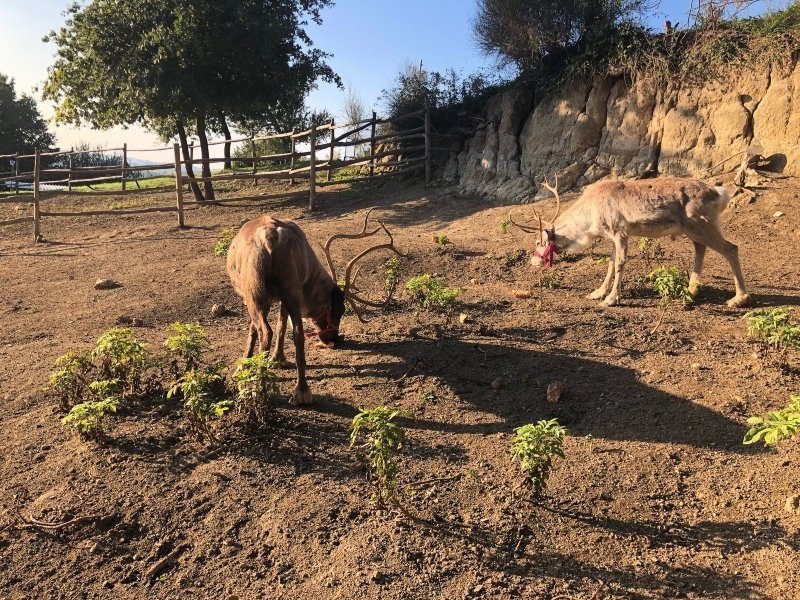
The Arca dei Camaleonti wildlife park is in the località of Pacciano, in the territory of Civitella San Paolo, in the province of Rome, about 40 kilometers from the capital going up the Tiber valley toward the Sabina. The facility's official website states that it is open all year and that booking is required for every package: you phone or write to 375.504.36.94, WhatsApp included, or send an email to arcadeicamaleonti@gmail.com, and the date and time are agreed at that moment. The price list published by the park is €12 for the adult visit alone, €8 for children from 2 to 10 years old, free entry under 24 months and €5 for visitors with disabilities. The packages with food start at €20 for the kids' menu and €28 for the lunch aperitif version, and go up to €37 and €38 for the adult menus, zero-kilometer, vegetarian, for celiacs and summer. Eating meals brought from outside is forbidden inside the park: if the idea is to stay for lunch, you book the package with food together with the visit. You get there by car, and it's the reasonable choice: the location is in the countryside, public transport to Civitella San Paolo doesn't run at day-trip frequencies, and it's best to have the precise directions given to you by phone when you set the visit.
The name is misleading, and it's worth clarifying right away. The Arca dei Camaleonti is not an educational farm with four rabbits and a donkey, nor an agriturismo that added an enclosure to entertain the clients' children. It is a real wildlife park, with more than 100 specimens among mammals, birds, reptiles, amphibians and invertebrates, many of which arrived here for a precise reason: they had been seized by law enforcement or were left without a home after a circus was dismantled. This changes the nature of the visit. Those who go in thinking of a walk among the cages come out, if they listen, with a different idea of what it means to keep an exotic animal and of how much it costs, in money and in expertise, to fix someone else's mistakes.

What the Arca dei Camaleonti really is
A private wildlife park, small in size, run by a family and built around a playful-educational idea that the founders openly declare. The facility grew out of two brothers' love for animals and nature: first a small farm, then the willingness to take in animals that nobody else wanted, difficult species, expensive to keep, complicated to manage. From there the leap. Anyone who has worked with animals knows it's the riskiest step of all: accepting a confiscated specimen means committing to its entire life, which for a tortoise or an Amazon parrot can mean decades.
The philosophy of the house is direct contact. The routes are interactive, many animals can be approached and in some cases touched under the supervision of the staff, and the stated result is that fear, which in children is almost always a reflex learned from adults, melts away. The sensory dimension counts as much as the informational one: you look, you listen, you smell, you touch when it's allowed. The staff accompany the tour telling the biology and behavior of the species, and this is the point at which the park stands out from the ordinary provincial zoo.
Our opinion: places like this stand or fall on the quality of whoever guides you, and here the guide is the product. Going without listening to the staff, running from one enclosure to the next to photograph everything in 40 minutes, means throwing away the price of the ticket. Take your time, ask uncomfortable questions about where the animals come from, and you'll see that they answer you.
Where it is and how to get to the Arca dei Camaleonti
The location and the geographic context
Pacciano is a rural località of the comune of Civitella San Paolo, in the strip of countryside that separates Via Tiberina from the course of the Tiber. We are in the lower Tiber valley, north of Rome, in a landscape of low hills cultivated with olive trees and grain, with the profile of Monte Soratte serving as a visual reference across the whole western horizon. Civitella San Paolo has just over 2,000 inhabitants and its highest point, Monte Cucolo, reaches 288 meters: it isn't a mountain, it's that barely rolling countryside that the Romans of the 17th and 18th centuries called the campagna romana and that today you cross without noticing.
How to get to the Arca dei Camaleonti by car
The car is the practical means. From Rome you go north along the line of the Tiber valley, exit in the area between Civitella San Paolo and the neighboring comuni, and cover the last stretch on secondary country roads, where GPS navigators sometimes suggest dirt shortcuts that are best ignored. The operating advice is elementary: when you book, ask the staff which exit and which road to use and write it down. It's worth more than any generic map, because signage in country locations is what it is.
When it's best to visit the Arca dei Camaleonti
Spring and early autumn, without hesitation. From mid-March to the end of May and from mid-September to the end of October the animals are active, the ground is dry, the light is good for photographs and the heat doesn't force reptiles and mammals to lie in the shade for hours. July and August in the early afternoon are the absolute worst time: the Tiber valley holds the muggy heat, and a wildlife park under the sun at 3 p.m. is a guaranteed disappointment for everyone, animals included. In winter you can go, the park is open all year, but you go dressed seriously and accepting that some species will be less visible.
How much a visit to the Arca dei Camaleonti costs
The price list for the visit alone
The park publishes two distinct price lists. The first concerns the visit alone: €12 for the adult, €8 for the child between 2 and 10 years old, free entry for children from 0 to 23 months, €5 for people with disabilities. These are fair figures for what they offer, and I say so with knowledge of the matter: a wildlife park pays for veterinarians, specialized feed, heating of the terrariums and permits, and 100 specimens of mixed species cost far more than the visitor imagines when looking at a pen of goats.
The packages with food at the Arca dei Camaleonti
The second price list combines admission and lunch. The zero-kilometer adult menu costs €38, the same as the vegetarian and summer versions. The version for celiacs is €37. The lunch aperitif package is €28. The kids' menu, reserved for the 2-10 age group, is €20. The difference from the visit alone is substantial and should be weighed for what it is: you are booking a whole day, not an admission. If instead the plan is to arrive, do the tour and leave, the €12 package is more than enough.
How to book the Arca dei Camaleonti
Booking is required, for every package. You call or write to 375.504.36.94, WhatsApp too, or send an email to arcadeicamaleonti@gmail.com, and in that conversation you set the day, the time and the package. The park makes a booking page available on its website, where the options are distinguished between admission with visit and food and admission with the visit alone. The precise hours of the day do not appear in writing on the site: they are agreed during booking, and in any case it's the only way, since without booking you don't get in.
The animals of the Arca dei Camaleonti, group by group
More than 100 specimens, distributed among mammals, birds, reptiles, amphibians and invertebrates. The list that follows reflects the population declared by the park: in a facility that takes in seizures and dismissals the makeup changes over time, because new guests arrive and old ones age, so the list should be read as the physiognomy of the collection, not as an unchanging inventory.
The South American mammals of the Arca dei Camaleonti
The Patagonian hare, or mara, is probably the animal that surprises visitors the most: it has a rodent's muzzle, the hind legs of a small deer and a run that recalls that of a roe deer. It is not a hare, it is a caviomorph rodent related to the guinea pig, and watching it is the best way to explain to a child what evolutionary convergence means, that is, two very distant species taking on the same shape because they live the same life. Next to it the park hosts the Peruvian guinea pig, the chinchilla with its fur of some 50 hairs per follicle, and the prairie dogs, North American rodents that dig underground towns and communicate with a repertoire of calls so elaborate that it has become a reference in studies of animal communication.
Small carnivores, mustelids and viverrids
The meerkat is the declared star of the Arca dei Camaleonti, and it is so for a behavioral reason: it lives in social groups with sentinels in turn, and the upright posture with which it scans the horizon is irresistible to watch. The park also hosts American skunks, the famous animals with the defensive anal gland, ferrets, genets and a civet. Genet and civet deserve a long stop: they are viverrids, a family that is almost never seen in Italy and that the general public regularly confuses with felines because of the tapered muzzle and the spots. They are instead a branch of their own within the carnivore group, older and more primitive, and the common genet has a fascinating Mediterranean story, because its presence in southwestern Europe is traced by the most credited hypothesis to ancient introductions from North Africa.
The farm at the Arca dei Camaleonti
The farm part exists and it is the one that wins over the little ones: Tibetan goats, Ouessant sheep, Cameroon sheep, zebu, Vietnamese pot-bellied piglets, ponies, donkeys, rabbits, African hedgehogs. Ouessant sheep have a charm all their own: they are the smallest sheep breed in the world, native to the little Breton island of Ouessant, and an adult ram barely reaches half a meter at the withers. The zebu, with its muscular hump and developed dewlap, is instead an Indian bovine adapted to the heat: keeping it next to a Breton sheep of nine kilograms is a lesson in comparative animal husbandry that no book conveys as effectively.
The large herbivores
Dromedary, llama, reindeer, ostrich and emu. These are the pieces the children tell about at home in the evening, and they are also the ones that best explain the park's vocation, because a dromedary or a reindeer in a countryside in Lazio doesn't get there by chance: behind each there is almost always a story of a traveling show that ended or of a private captivity that became unsustainable. The emu and the ostrich, the two great ratites, allow an immediate comparison between Australia and Africa: size, number of toes, color of the eggs. Emu eggs are green, almost black, and weigh around 600 grams: few visitors know it and nobody forgets it.

Water birds and farmyard birds
Ducks, geese, ornamental hens, peacocks, pheasants, guinea fowl, doves, and then the waders: storks, crowned cranes, sacred ibis. The crowned crane is the most elegant animal in the entire park and its golden tuft of stiff feathers has no equal among African birds. The sacred ibis should be looked at with the eyes of an art historian before those of a naturalist: it is the bird of Thoth in ancient Egypt, the one that appears on reliefs with the curved beak, and in the Egyptian necropolises mummies of it have been found by the hundreds of thousands. Anyone who knows the Roman museums has already met it without knowing, because Egyptian iconography has circulated in Rome for 2,000 years.
The nocturnal raptors of the Arca dei Camaleonti
This is the section that raises the quality of the collection. Snowy owl, Eurasian eagle-owl, Indian eagle-owl, long-eared owl, Harris's hawk, barn owl, Indian wood owl, bakkamoena, little owl, white-faced scops owl. These are 10 species of strigiformes plus one diurnal raptor, and it is not a list for a provincial park. The Eurasian eagle-owl is the largest nocturnal raptor on the continent, with a wingspan that exceeds 1.60 meters. The snowy owl is the exact opposite, a very white, diurnal Arctic animal, used to the midnight sun. The Harris's hawk is instead the only raptor that hunts in a group with coordinated tactics, which is why it has become the favorite raptor of falconers around half the world. Watching them up close, with someone explaining the structure of the facial disc and the asymmetry of the ear openings that lets a barn owl locate a mouse in total darkness, is worth the ticket on its own.
The kookaburra and the Australian guests
The kookaburra is the bird that laughs. Technically it is a large Australian terrestrial kingfisher, and its cascading call is what the movies used for decades as the sound of the tropical jungle, applying it to African and Amazonian forests where the kookaburra has never set foot. It is one of the funniest historical fakes in film sound, and in front of its aviary it tells very well.
Reptiles, amphibians and the question of the name
Pythons, plated lizards, pogonas, water dragons, tortoises, frogs, salamanders. Pogonas, that is, Australian bearded dragons, are today among the most widespread reptiles in home terrariums, and precisely for that reason they are also among those that most often end up abandoned when the owner discovers that they need ultraviolet lamps, thermal gradients and a 10-year commitment. The Asian water dragon has the same problem and in addition grows to one meter, tail included. The plated lizards, African armored lizards, are less known and more interesting: they have osteoderms, that is, bony plates inside the skin, a real armor. As for the chameleon of the name, it is the symbol animal of the facility: a reptile that changes color to communicate mood and temperature, much more than to camouflage itself, and that has a ballistic tongue able to shoot out to a length greater than its body in a fraction of a second.
The invertebrates of the Arca dei Camaleonti
Tarantula, Egyptian scarabs, leaf insect, stick insects, giant African snails of the genus Achatina. These are the guests that the public snubs and that instead carry the best educational workshops. The leaf insect is the absolute champion of cryptic mimicry: it doesn't imitate a leaf generically, it imitates a leaf with gnawed margins and necrotic spots, and certain species sway as they walk to simulate the wind. The Egyptian scarab, the dung beetle that the ancients identified with Khepri and the rising sun, closes the cultural circle with the ibis in the next aviary: two animals that the Roman visitor has already seen carved on an obelisk without ever having seen them alive.
Where the animals of the Arca dei Camaleonti come from
This is the chapter that makes this park different from the others and that the public often ignores. A substantial part of the specimens comes from seizures by law enforcement and from the dismantling of circuses. Behind these two formulas there are two worlds. The first is that of the trade and irregular keeping of exotic fauna: animals bought lightly, kept in inadequate conditions, then confiscated. The second is that of the traveling shows that close or that give up performances with animals, leaving elderly specimens, often unsuited to any reintroduction into the wild because they were born in captivity and lack survival behaviors.
Whoever takes in these animals assumes a permanent burden. A dromedary can live 40 years, a land tortoise even longer, an Amazon parrot easily exceeds 50. Accepting one means guaranteeing it feed, specialized veterinary care, heated shelters and space for decades, with nobody reimbursing anything. That's why, when the family that runs the park says they said yes to animals that nobody else wanted, it is not a turn of phrase: it is an accounting description.
On this point the judgment is clear. The educational value of the Arca dei Camaleonti is not in the number of species, which is nonetheless high: it is in the fact that every enclosure tells a human mistake that has been remedied. If you bring kids, this is the thread to follow, far more than counting the animals seen.
How the Arca dei Camaleonti began
At the origin there are two brothers and a small farm. The passion for animals and nature leads first to keeping a few domestic species, then to taking in specimens that nobody wanted elsewhere: particular animals, complicated to manage, expensive to keep. Over time the farm changes nature and becomes a structured playful-educational project, with a staff, a visiting route and a program for schools.
The key to interpretation that the founders declare is the therapeutic power of contact with nature and with animals. It isn't a brochure formula: anyone who works with pet therapy knows that mediated interaction with an animal measurably lowers perceived stress, and anyone who accompanies school groups sees the difference between a class inside a classroom and the same class in front of an enclosure. Here the idea is declared and consistent: to encourage direct contact in order to stimulate conscious and responsible behavior toward oneself and toward others, and to set in motion the sensory and imaginative dimension of both the child and the adult.
There is also an explicit territorial vocation. The park works on knowledge of local flora and fauna and on the agro-pastoral traditions of the Tiber valley, which in this strip between Castelnuovo di Porto and the Sabina have had an enormous economic weight for centuries. Transhumance, olive growing, sheep farming: it is the real background of these hills, and a park that puts Cameroon sheep and Indian zebu inside it performs a cultural operation subtler than it seems, because it forces you to ask what is native and what was imported, and when.
How the guided visit to the Arca dei Camaleonti works
The visit is accompanied. The staff takes charge of the group, tells the history of the park and leads along the route, stopping at the individual habitats. The routes are declaredly interactive: many animals can be approached and, where it is planned and safe, touched. This is where all the value of the day is decided, because the difference between a wildlife park and a collection of cages is exactly the voice of the person guiding.
Fears melt away at this step. Wariness of reptiles and insects, in children, is almost always inherited: the adult takes a step back in front of the python and the child registers the signal. Reversing that automatic reaction, by putting the animal in their hands with the mediation of a competent operator, produces a lasting effect. And it works on adults too, who are often the most frightened of the group and don't admit it.
The second effect is corrective. Children arrive with an idea of animals filtered by cartoons and advertising, where beasts talk, smile and never die. Touching an African hedgehog, seeing the skin of a pogona, understanding how much an eagle-owl really weighs, dismantles that narrative and replaces it with a perception of the fragility of living beings that stays with them for years. It is the part of the work that the operators claim the most, and it is also the one that justifies the price of the ticket.
Professional advice: ask explicitly, when booking, if specific moments with the raptors are planned for the day you have chosen. They are the minutes that groups remember the most and that deserve to be scheduled, not left to chance.

The Arca dei Camaleonti with children
It is one of the soundest destinations in northern Lazio for a day out as a family, and I say so comparing it with the alternatives. The Bioparco di Roma (Rome Zoo) is bigger and more institutional. Zoomarine plays on an amusement-park register. The Museo Civico di Zoologia works on collections and not on live animals. The Arca dei Camaleonti occupies a different niche: small scale, close contact, a direct relationship with whoever manages the animals. For a child between four and 12 it is the formula that works best, because the attention threshold holds and nobody gets lost in a big plaza.
What to bring: closed shoes, no exceptions, because you walk on packed earth and grass. A hat in summer and a waterproof jacket in the shoulder seasons. A change of clothes for the little ones. What to avoid: food from home, which the rules forbid eating inside, and the idea of letting children run free among the enclosures, which in a wildlife park is never a good idea either for them or for the animals.
The older brother of this experience are the educational farms of the area, such as Il Girotondo degli Animali and C'era una volta: similar register, very different wildlife content. If your children have already done the round of the farms and are starting to get bored, here they find 10 species of nocturnal raptors and a dromedary, and the boredom passes.
The school projects of the Arca dei Camaleonti
The facility works a great deal with schools and does so on two tracks. The first brings the animals into the classrooms, with routes spread over several meetings. The program called A tutt'Arca includes seven meetings in class, each built around an animal and accompanied by an activity workbook. The one called Batti il 5 includes five, with animal-assisted education and related exercises. The third, Tutti in gita, is the visit to the park in the half-day or full-day format. The programs are differentiated for nurseries, preschools and primary classes, from first to fifth grade.
The second track is that of school gardens: the park collaborates with schools on creating gardens in the school yards, a step that teaches pupils in a concrete way how plants, herbs and food products grow. Anyone who has tried to explain to a city child where a carrot comes from knows how much that gesture is worth more than 20 pages of a textbook.
The classes that have passed through here have observed up close the biology of animals that are rarely seen elsewhere: Patagonian hares, Tibetan goats, Egyptian scarabs, leaf insects, giant snails, snowy owls. The park also offers school trips with buses and guides to several destinations and residential school camps of two to four days including transfers, overnight stays, meals, guides, admissions and insurance. The costs of these programs are not published and should be requested from the facility.

Food and parties at the Arca dei Camaleonti
Inside the park there is an equipped area with tables, benches and play equipment for children, and a zero-kilometer food service with the option of grilling. The lunch packages are those on the price list: zero-kilometer adult menu, vegetarian, for celiacs, summer, the lunch aperitif version and the kids' menu. The ban on eating meals brought from outside is written in plain words by the park, so a picnic with a cooler bag doesn't work here: either you book the food service, or you have lunch outside the facility.
Sunday is the natural day for the long package. You arrive in the morning, do the route with the staff, eat, and in the afternoon the children stay in the play area while the adults catch their breath. It is a real countryside day, without lines and without the traffic of a mass destination, and this kind of rhythm works better than any tight tour.
The park also organizes birthday parties and events in close contact with the animals, in addition to guided visits and school trips. It is a use of the facility worth considering for anyone looking for a birthday different from the usual hall: the educational content remains, and the operators keep telling the life of the animals even during the party, stitching together the scientific and the recreational parts.
Civitella San Paolo, the town around the Arca dei Camaleonti
The comune that hosts the park is small, just over 2,000 inhabitants, and its name tells two overlapping stories. The first part comes from the Latin Civitatula, that is, small city, the diminutive used in the Middle Ages to indicate minor fortified centers. The second part, San Paolo, refers to the place's dependence on the monastery of San Paolo fuori le Mura: in the bull of Pope Gregory VII of 1081 the center appears as Civitas de Colonis, and the monastic affiliation is documented. Local tradition holds that the original population included refugees from ancient Capena fleeing the barbarian invasions. It is a plausible and very widespread reading, but it remains a tradition, not a proven fact.
The castle and the churches of Civitella San Paolo
The old core preserves a medieval castle with three concentric walls, which correspond to as many phases of expansion. It is the most legible way there is to understand, by walking, how a fortified village of the Roman countryside grew. The church of San Giacomo Maggiore is documented from the 13th century. The church of San Lorenzo stands on the remains of a Roman villa and is dated to the 10th or 11th century, and it is the point where the continuity between ancient settlement and medieval settlement can be touched by hand. In 1934 the monastery of Santa Scolastica was built, which hosts Benedictine nuns: the Benedictine thread, in this corner of the Tiber valley, has never been interrupted in 1,000 years.
The festivals and flavors of Civitella San Paolo
The patron saint is Saint James the Apostle and is celebrated on July 25. The most characteristic occasion, though, is the Festa dei Canestri, on May 1, with baskets decorated with flowers and the traditional bread flavored with anise. At the table two things are worth seeking out: the cacione, a chestnut sweet, and the anise braid. Administratively the comune is part of the Unione Valle del Tevere e Soratte, and in papal times, between 1816 and 1870, it belonged to the Comarca of Rome.

What to see near the Arca dei Camaleonti
A day at the park pairs well with a second stop, because this strip of territory is among the least trodden and most interesting in Lazio. A few kilometers away rises Monte Soratte, the isolated mountain that Horace cites in the ninth ode of the first book and that Byron takes up in the fourth canto of Childe Harold: a limestone relief that emerges from the plain like an island, with rock hermitages and 20th-century military tunnels.
On the other bank of the river opens the Tevere Farfa Nature Reserve, the first protected area established in Lazio, a wetland environment where thousands of water birds spend the winter. After a morning among raptors in aviaries, seeing herons and grebes living free on Lake Nazzano is the perfect counterpoint. Going up the course of the Farfa you reach the Farfa Gorges and then the Abbey of Farfa, one of the great imperial monasteries of early medieval Europe.
Toward Rome you find Castelnuovo di Porto with its fortress, the Veio Park with the Etruscan necropolises and rock-cut roads, and farther down the valley the Parco della Marcigliana. On the Sabina side there remain Fara in Sabina, Poggio Mirteto and Monterotondo. Those looking for another facility with animals in a natural setting can look at the Parco Natura La Selvotta.
A curiosity about Arca dei Camaleonti - Civitella San Paolo
The chameleon that gives the park its name is, from the point of view of physiology, one of the most misunderstood animals on the planet. The idea that it changes color to blend into the background is a simplification that has circulated since antiquity and that research has dismantled: the color change serves above all to communicate, that is, to signal aggression, submission, readiness to mate, and to regulate body temperature by absorbing or rejecting solar radiation. Camouflage is a side effect, not the main function.
The mechanism is even more curious. The color is not produced only by pigments: under the skin there are cells containing lattices of nanocrystals, and by changing the distance between these crystals the animal changes the wavelength of the reflected light. It is structural color, the same physics that makes the wings of certain butterflies blue, not paint. A chameleon, in practice, retunes its own optical reflections the way an instrument is tuned.
Add the eyes, which rotate independently of one another covering almost the entire spherical field of view, and the ballistic tongue, which shoots out in a few hundredths of a second reaching a length greater than that of the body thanks to an elastic spring mechanism and not a simple muscle. Choosing this animal as the emblem of a park that takes in seized beasts has a precise irony of its own: the chameleon is the symbol of adaptation, and adapting to a new life is exactly what the former circus dromedary and the abandoned pogona do here. The name, for once, is not an advertising ornament.
Something nobody tells you about Arca dei Camaleonti - Civitella San Paolo
That you don't get in without having booked, and that the ban on bringing lunch from home is real and enforced. They seem like bureaucratic details and yet they are the two pieces of information that ruin the most days. A family that leaves Rome on Sunday morning with a cooler bag in the trunk, convinced of finding a free-entry park with a lawn for a picnic, arrives and discovers two things at once: that entry has to be arranged in advance and that outside meals are not eaten inside. The remedy is trivial, a phone call to 375.504.36.94 a few days before, but you have to know it.
The second little-known piece of information concerns the legal and economic nature of the facility. Many visitors arrive thinking of a shelter funded by someone, a kind of public pound for exotic animals. It is not so: it is a private business that sustains itself with tickets, with food service, with parties and with school programs. Every confiscated specimen that enters here is maintained with the revenue of the business. Understanding this changes the way you look at the price of the ticket, which stops being the cost of entertainment and becomes the share that keeps the system standing.
Third thing, which nobody ever writes and which holds for all small wildlife parks: the quality of the visit depends on the number of people present. In a group of 10 you ask questions and you touch. In a group of 60 you look at the back of your neighbor's head. When you phone, ask how many visitors are expected in that time slot. Nobody takes offense and the answer guides the choice of the day better than any review.
The advice I give you for visiting Arca dei Camaleonti - Civitella San Paolo
Book the first morning turn, in spring or autumn, and allow three full hours. The reasons are three and all of them biological. The first: mammals and birds are active in the cool hours and slow down in the early afternoon, so what you see in the morning is simply better. The second: the nocturnal raptors, which here are the star of the collection, sleep at midday with their heads under their wings, and a sleeping eagle-owl is a modest experience. The third: the morning light in the Tiber valley is clear and lateral, and for photographing it is worth double the vertical light of noon.
Second piece of advice, less obvious: go with a question in your pocket. Not the classic what is it called, but where does this specimen come from and why did it end up here. The staff know the individual stories of the animals and gladly tell them to those who show they really want them, while to those who pass by distracted they give the standard tour. It is the difference between taking home an afternoon outdoors and taking home some 10 true stories.
Third: closed shoes and no strong perfumes on you, especially if you hope for close contact with the raptors or the small mammals. Animals react to intense smells far more than we think, and a careful operator will keep you at a distance. Fourth, for those bringing small children: the 0-23 month group gets in free, but a one-year-old in a wildlife park tires out in 90 minutes. Better the plain €12-per-adult visit than the long package with lunch, which pays off far more from four years old up. Don't be tempted by the complete package just because it seems convenient.
Another well-known fact, yet rarely cited
That Lazio hides, between the Tiber and the Sabina, a density of protected nature that almost no Roman knows, and that the Arca dei Camaleonti stands exactly inside that system. A few kilometers from the park, on the bend of the river between Nazzano and Torrita Tiberina, lies the Tevere Farfa Nature Reserve, which has a precise institutional record: it is the first nature reserve established in the Lazio Region. The basin formed by the dam on the Tiber created a marshy environment that hosts one of the most important concentrations of water birdlife in central Italy.
The well-known and rarely cited fact is therefore this: whoever visits a wildlife park in this area is not making an isolated excursion inside an anonymous countryside, but entering a real ecological corridor, where the animals in aviaries and those living free belong to the same discussion. Seeing a sacred ibis in the enclosure and then, 20 minutes of driving farther on, a gray heron on a reed bed, closes an argument that nobody ever closes at school.
There is also a second face, less reassuring. The sacred ibis itself, an African species introduced into Europe by escapes from zoological parks, has naturalized in some wetlands of the continent, becoming a case of invasive non-native species discussed by ornithologists. Keeping the specimens in controlled facilities is therefore also an act of environmental responsibility, not just an exhibit. It is a topic that serious wildlife parks address openly, and that is worth asking the operators about while you are in front of the aviary.
The right photo to take at Arca dei Camaleonti - Civitella San Paolo
The frontal portrait of a nocturnal raptor, taken with morning light and without flash. It is the photograph that this park gives and that almost no other place north of Rome can give you with the same ease. The facial disc of a barn owl or an eagle-owl, framed tight, returns a symmetry that the public instinctively associates with a human face, and it is the reason these images always work. The flash is forbidden by common sense even before the rules: it blinds an animal adapted to dim light and ruins the moment for everyone.
The settings I recommend: a shutter speed fast enough to freeze the movement of the head, which in strigiformes is sudden, a wide aperture to separate the subject from the background of the netting, and focus on the nearer eye. If you shoot with your phone, move closer instead of using the digital zoom, and shoot when the animal is turned toward you, not at three-quarters: the strength of the image is all in the frontality.
The second photograph to take home is environmental and tells the place better than any close-up: the meerkat upright in sentinel position, with the Tiber countryside and the silhouette of Monte Soratte in the background. An animal from the Kalahari in front of a mountain that Horace looked at under snow: the juxtaposition is perfectly absurd and sums up the nature of this park. The third, for those who come with children, is the moment of guided contact, hands on an animal's back and the gaze of the operator keeping watch. Always ask before photographing the staff, which is basic courtesy.
Some important events that took place here in history
The first documented event of this territory has a date and a document: 1081, when in the bull of Pope Gregory VII the place name Civitas de Colonis appears. It is not a scholarly detail. That bull certifies that the place belonged to the holdings of the monastery of San Paolo fuori le Mura, that is, that these hills above the Tiber were land of a very powerful Roman abbey. The second part of the comune's name comes from there, and it has lasted nine and a half centuries.
Even earlier, according to tradition, the settlement gathers the refugees from ancient Capena, the Faliscan center destroyed in the convulsive phases of the barbarian invasions. It is a reconstruction established in local memory that must however be taken for what it is, a tradition. The material fact that does hold up is archaeological: the church of San Lorenzo, dated to the 10th or 11th century, was built on the remains of a Roman villa, and this says that the occupation of the land here has been continuous since the imperial age.
The medieval castle, with its three concentric walls, records at least three moments of growth of the village, each corresponding to a phase of expansion of the defenses: these are events written in stone instead of in chronicles, and they can be read by walking. The church of San Giacomo Maggiore is documented from the 13th century.
Between 1816 and 1870 the comune was part of the Comarca of Rome, the district of the Papal State that gravitated directly on the capital: an administrative detail that explains why this strip of countryside has always looked to Rome and not to Rieti. In 1934 the monastery of Santa Scolastica was built, still inhabited by Benedictine nuns: 900 years after the bull of Gregory VII, the rule of Saint Benedict returns to the same hills.
As for the park, its history is recent and is measured in another way: every seizure taken in and every dismantled circus that left an animal here is a private event that doesn't make the newspapers and yet changes a life. There are dozens of episodes of this kind, and lined up they tell of the two decades in which Italy changed its mind about animals in traveling shows.
Who has passed through Arca dei Camaleonti - Civitella San Paolo
Whoever expects a list of celebrities will be disappointed, and that is a merit. Every year hundreds of school groups come through here, from nurseries to fifth grade, accompanied by the teachers who chose the in-class programs or the trip to the park. Families from the Tiber valley and from northern Rome come through. Groups that book a party come through. And above all there pass through the law enforcement officers who deliver the seized animals and the circus operators who close their business: they are the visitors who have left the deepest mark, because each of their visits added a permanent guest to the collection.
On the territory, instead, the illustrious names are there and it's worth recalling them, because it is the same land. Pope Gregory VII, the pontiff of Canossa, puts the name of the place in writing in 1081. The Benedictines of San Paolo fuori le Mura administer its lands for centuries, and the Benedictines are the true constant of this valley, from Farfa on down. Since 1934 the Benedictine nuns of Santa Scolastica have lived there.
On a larger scale, those who have crossed this strip of the Tiber valley are a crowd of centuries: the transhumance shepherds who came down from the Sabina, the pilgrims headed to Rome along the routes that ran beside the river, the armies that went up toward Etruria. And Monte Soratte, which can be seen from the park, was looked at and cited by Horace in the ninth ode of the first book and by Byron in the fourth canto of Childe Harold: neither of them visited a wildlife park, but both set down on the page the same horizon you will see while the meerkat stands sentinel.
Accessibility and practical rules of the Arca dei Camaleonti
The park's price list includes a rate dedicated to visitors with disabilities, set at €5, a sign that hospitality is planned and organized. The terrain, however, is that of a country park, with a natural surface and changes in level: those who use a wheelchair or have mobility difficulties should mention the situation when booking, so that the staff can set up the route accordingly. It is the only serious way to approach the question in an outdoor facility.
The house rules are few and clear: booking required, ban on consuming meals brought from outside, respect for nature and for the park's rules. To these are added the common-sense rules of any facility with animals: don't feed them on your own initiative, don't put your hands into the enclosures, don't shout, follow the operators' instructions when they offer direct contact. The animals of this park have already had a complicated life before arriving here. They deserve polite visitors.
Quick questions about Arca dei Camaleonti - Civitella San Paolo
Where exactly is the Arca dei Camaleonti?
In the località of Pacciano, in the comune of Civitella San Paolo, province of Rome, in the Tiber valley about 40 kilometers from the capital. Detailed directions are requested from the facility at the booking stage.
How much is a ticket to the Arca dei Camaleonti?
The park's price list gives €12 for the adult visit alone, €8 for children from 2 to 10 years, free entry from 0 to 23 months and €5 for visitors with disabilities. The rates should be confirmed at the time of booking.
Do you need to book to visit the Arca dei Camaleonti?
Yes, booking is required for all packages. You book at 375.504.36.94, also via WhatsApp, or by writing to arcadeicamaleonti@gmail.com.
Is the Arca dei Camaleonti open all year?
The park declares it is open throughout the year. Day and time are agreed at the time of booking, which remains indispensable in any case.
How much does lunch at the Arca dei Camaleonti cost?
The packages with food start at €20 for the kids' menu for ages 2-10 and €28 for the lunch aperitif version. The zero-kilometer, vegetarian and summer adult menus are listed at €38, the one for celiacs at €37.
Can you bring lunch from home?
No. The rules expressly forbid consuming meals brought from outside inside the park. Those who want to stay for lunch book one of the packages with food.
How many animals does the Arca dei Camaleonti host?
More than 100 specimens among mammals, birds, reptiles, amphibians and invertebrates, many coming from law enforcement seizures or from the dismantling of circuses.
What are the most unusual animals to see?
The nocturnal raptors are the strong point, with snowy owl, Eurasian eagle-owl, Indian eagle-owl, barn owl, Indian wood owl, bakkamoena, white-faced scops owl and the kookaburra. Among the mammals, the meerkats, Patagonian hares, genets, civet, dromedary, llama and reindeer stand out.
Can you touch the animals at the Arca dei Camaleonti?
The routes are interactive and several animals can be approached and touched safely, always under the supervision of the staff and only where the operators allow it.
Is the Arca dei Camaleonti suitable for small children?
Yes, with a practical recommendation: under three years old the attention threshold is short and the plain visit is better than the whole day. Entry is free up to 23 months.
How long does the visit last?
The park does not publish a standard duration. To do the route calmly and listen to the staff, allow at least a couple of hours, more if you also book the food service.
Can you get to the Arca dei Camaleonti by public transport?
The location is rural and public connections do not run at frequencies suitable for an outing. The car remains the realistic solution.
Is the Arca dei Camaleonti wheelchair accessible?
There is a dedicated rate of €5 for visitors with disabilities. The surface is natural, so it's best to report your needs at the time of booking so that the route is organized accordingly.
Can you take photographs?
Yes, and it's worth doing. Avoid the flash in front of the nocturnal raptors and any animal in dim light, and ask permission before photographing the staff.
Does the Arca dei Camaleonti organize birthday parties?
Yes, the park offers parties and events organized in close contact with the animals, with the operators continuing to tell the life of the species even during the party.
What projects does the Arca dei Camaleonti offer to schools?
In-class programs with animals spread over five or seven meetings, half-day or full-day visits to the park, school trips and residential school camps of two to four days, differentiated for nurseries, preschool and primary.
Does the park bring animals to schools?
Yes, it is one of the two lines of work with schools. The other is the creation of gardens in the grounds of school facilities.
What is the difference between the Arca dei Camaleonti and an educational farm?
The educational farm works on domestic animals and the agricultural cycle. Here the domestic component exists, but the core is wildlife and exotic, with raptors, reptiles and mammals coming from seizures and from circuses.
What is the best time to visit the Arca dei Camaleonti?
Spring and autumn, with the morning turn. In summer the early afternoon is the worst time, for visitors and for animals.
What can you see near the Arca dei Camaleonti?
Monte Soratte, the Tevere Farfa Nature Reserve on the bend at Nazzano, the Gole del Farfa and the Abbey of Farfa, the village of Civitella San Paolo with its three-walled castle, Castelnuovo di Porto and the Parco di Veio.
What is the town called and why?
Civitella San Paolo: the first part comes from the Latin Civitatula, small city. The second from the monastery of San Paolo fuori le Mura, on which the place depended, as attested by the bull of Gregory VII of 1081.
Can you visit the Arca dei Camaleonti with a dog?
In a park that hosts more than 100 animals, many of them coming from stressful situations, the presence of a dog must be agreed in advance with the facility. Ask before leaving.
Plainly put: it is one of the most honest places you can take a child within an hour of Rome. It doesn't promise a show, it doesn't sell prepackaged emotions, and it has the courage to say where the animals it shows come from. Go early on a Sunday morning in April, book a few days ahead, and ask whoever guides you for the story of the dromedary. That answer is worth more than the ticket.
Frequently asked questions about Arca dei Camaleonti, Civitella San Paolo
How much is a ticket to the Arca dei Camaleonti
The price list for the visit alone to the Arca dei Camaleonti gives €12 for the adult, €8 for the child between 2 and 10 years old, free entry for children from 0 to 23 months and €5 for people with disabilities. The park also publishes distinct price lists that include lunch.
Where is the Arca dei Camaleonti and how far is it from Rome
The Arca dei Camaleonti is in the località of Pacciano, in the comune of Civitella San Paolo, in the province of Rome, in the lower Tiber valley about 40 kilometers from the capital, with Monte Soratte serving as a visual reference on the horizon.
Can you bring a packed lunch to the Arca dei Camaleonti
No, the ban on consuming meals brought from outside is written in plain words by the park. Inside the Arca dei Camaleonti there is an equipped area with tables and play equipment for children and a zero-kilometer food service, with adult, vegetarian and celiac menus and a kids' menu.
Is the Arca dei Camaleonti suitable for children
Yes, the Arca dei Camaleonti is one of the soundest destinations in northern Lazio for a day out as a family, with declaredly interactive routes where many animals can be approached and, where planned and safe, touched. The park also organizes projects dedicated to schools, with in-class meetings accompanied by activity workbooks.
Is the Arca dei Camaleonti wheelchair accessible
The park includes a rate dedicated to visitors with disabilities, set at €5, a sign that hospitality is organized, but the terrain is that of a country park, with a natural surface and changes in level. Those who use a wheelchair must report it at the booking stage, so the staff can set up the route accordingly.
Where do the animals of the Arca dei Camaleonti come from
A substantial part of the more than 100 specimens hosted at the Arca dei Camaleonti comes from law enforcement seizures and from the dismantling of circuses: animals bought lightly and kept in inadequate conditions, then confiscated, or fauna that came from dismantled traveling shows.
What is the best time of day to visit the Arca dei Camaleonti
It's best to book the first morning turn, in spring or autumn, and allow three full hours. The mammals and birds of the Arca dei Camaleonti are active in the cool hours and slow down in the early afternoon, while the nocturnal raptors, one of the collection's strong points, sleep at midday.
Those organizing a day for a group or a company in this part of Lazio can rely on professionals: the network of TourLeaderPro for tourism services in Rome also works on out-of-town experiences, and the page dedicated to professional tour guiding explains how managing a group on the road works. For those traveling in English who want to get a grip on Rome before branching out to the surroundings, there are the guide to the best things to do in Rome and the three-day itinerary in the city.
Article written by the editorial team of TourLeaderPro, contact them for Private/Corporate/V.I.P. Tours and Experiences.
Planning a trip to Rome? The English-language guides for visiting the city are on ItalyPlanner.com.