Published on · updated on
Some links on this page are affiliate links: if you book through them, Estate Romana receives a small commission, at no extra cost to you.
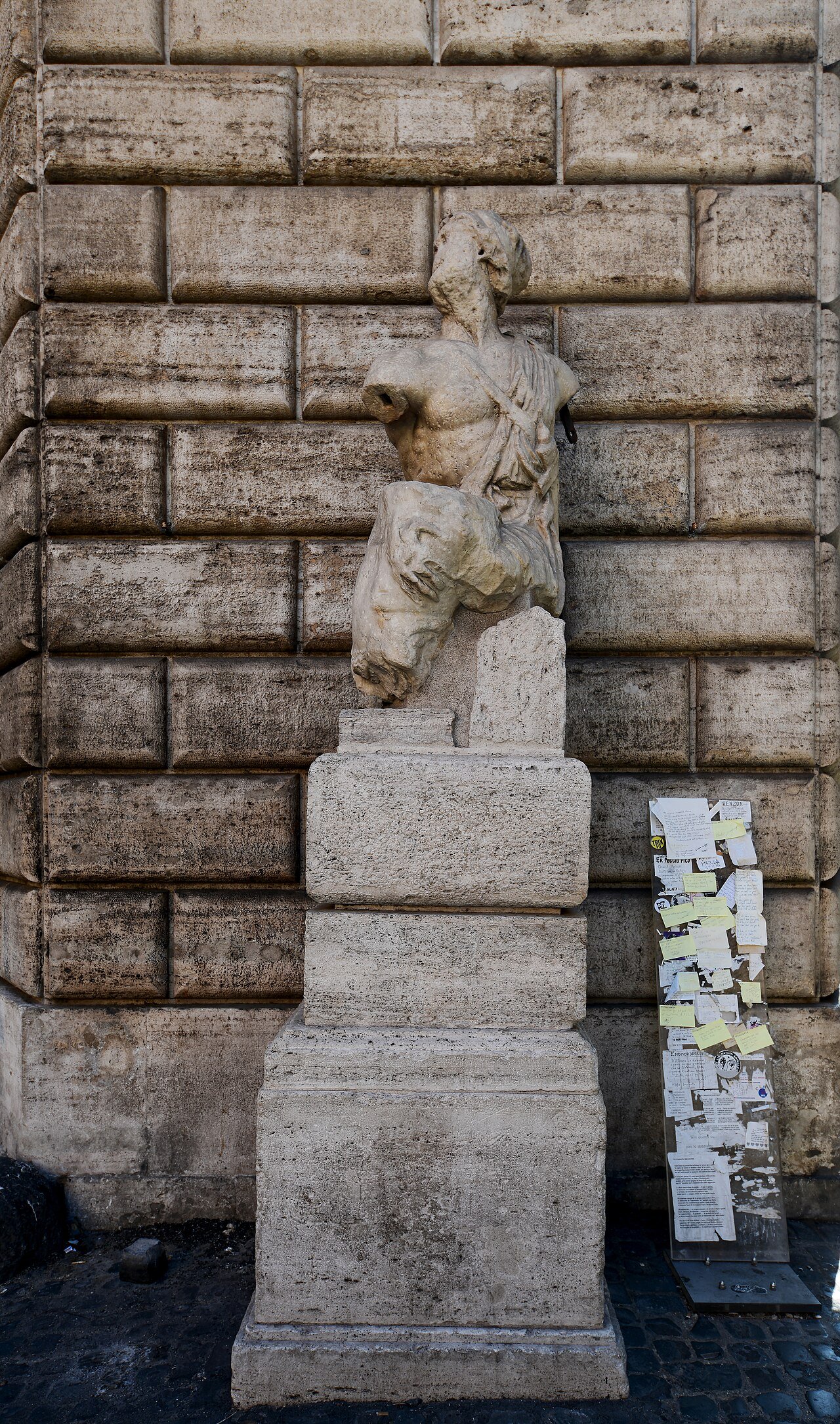
In Rome, for almost five centuries, the fiercest criticism of power was signed by nobody. It was written by “Pasquino.” At night someone would stick a sheet of paper on the mutilated torso of an ancient statue behind Piazza Navona, and the next morning half the city was laughing at the pope, the cardinals, the nephews who had grown rich. It was the satire of people who couldn’t speak, and it worked so well that Pasquino gave Italian a word: pasquinata.
This is not the usual list of the six talking statues: for that, with the walking route step by step, see our page on the talking statues of Rome. Here we tell how pasquinades began, the jokes that have come down to us, who answered Pasquino and where to go today to hear the voice of Rome, still.
Data checked on October 17, 2026 against the Turismo Roma pages (the Roma Capitale portal) on the talking statues, the Capitoline Museums pages on Marforio, and the studies and articles cited at the bottom. Where the sources disagree, we say so.
Pasquinades in brief
- What: anonymous satirical sheets, in verse or prose, stuck at night on Rome’s “talking” statues to criticize popes, cardinals and the powerful.
- When: the tradition gains strength from 1501, when Cardinal Oliviero Carafa had the statue of Pasquino set up at the corner of his palace. Pasquinades continue, in different forms, to this day.
- Who speaks: six statues, the “Congress of the Witty” (often also called the Congrega): Pasquino, Marforio, Madama Lucrezia, the Abate Luigi, the Facchino and the Babuino.
- Where: Pasquino is in the little square of the same name next to Piazza Navona, at the corner of Palazzo Braschi. Five statues out of six can be seen for free in the street, while Marforio is in the courtyard of Palazzo Nuovo at the Capitoline Museums.
- Good to know: next to Pasquino there is now a board for messages, so the restored statue is no longer covered in glue. Check the state of the board on the spot.
How did pasquinades begin?
It all starts with a battered piece of marble. The statue we call Pasquino is a fragment of an ancient group: Menelaus holding up the body of Patroclus, a Roman copy of a Greek original. Armless, with a worn-down face, in 1501 it was set up by Cardinal Oliviero Carafa at the corner of the palace where he lived, in the old Piazza di Parione, where Palazzo Braschi stands today. The Carafa coat of arms is still there, on the base.
Every year, on April 25, the feast of Saint Mark, the statue was “dressed” as an ancient god and the scholars hung epigrams in Latin on it: a cultured game, almost academic. Little by little, it was the common people who took over that showcase. Latin verses gave way to jokes in the vernacular, then in Romanesco, ever sharper and always anonymous. The first printed collections of the pieces for Pasquino came out as early as the first years of the 1500s.
Where the name comes from, nobody knows for sure. The traditions speak of a local craftsman, a tailor, barber or innkeeper, famous for his sharp tongue, or of a grammar teacher whose pupils supposedly stuck up the first sheets. None of these stories has a document behind it: that’s the beauty of Roman legends.
What are the most famous pasquinades?
The most celebrated is in Latin and targets the family of Pope Urban VIII, Maffeo Barberini: “Quod non fecerunt barbari, fecerunt Barberini”, what the barbarians didn’t do, the Barberini did. The reason is documented: in 1625 the pope had the bronzes removed from the portico of the Pantheon
to melt them down, largely for the cannons of Castel Sant’Angelo. Who wrote the line, on the other hand, nobody knows: tradition puts it in Pasquino’s mouth, and some scholars even doubt that it was born in the street. It’s worth telling it this way, with its aura of mystery.
During the French occupation of the late 1700s a dialogue made the rounds that became proverbial: Marforio asks if it’s true that the French are all thieves, and Pasquino answers “Not all, but Bona parte.” The wordplay on Napoleon is perfect, but here too the author and the exact date are not documented: take it as the Rome of those days told it to itself.
What is certain, instead, is the joke of Madama Lucrezia. In 1799, in the last days of the Roman Republic, the big bust in Piazza San Marco fell to the ground. The next morning someone had stuck a sign on it: “I can’t stand to see any more.” A statue fed up with what was happening around it: hard to find a better summary of those years.
How did the dialogue between Pasquino and Marforio work?
Pasquino didn’t talk alone. His favorite partner was Marforio, a large bearded reclining deity with a shell in his hand, today most probably identified as Oceanus. Someone would stick a question on Marforio, someone else would answer on Pasquino, on the other side of the center: a back and forth that the city followed like a serial. The name Marforio, according to one hypothesis, comes from Martis Forum, the forum of Mars near which the statue was found, and according to another, from a Marfoli family that owned property in the area.
Marforio got around quite a bit: from the Forum he was taken to Piazza San Marco at the end of the 1500s, then to the Capitoline Hill, where in the mid-1600s he ended up in the courtyard of Palazzo Nuovo. You can still find him there, at the center of a fountain, restored in 2012-2013. To see him you have to go into the Capitoline Museums: you can also get the ticket online, for example on Tiqets or on Viator. If you prefer a guide, you’ll find the guided visit of the Capitoline Museums on GetYourGuide. Since February 1, 2026, residents of Rome and the Metropolitan City get in free.
And the other “wits”: who were they and what did they say?
According to the Roma Capitale portal, the historic core was four statues, Pasquino, Marforio, Madama Lucrezia and the Abate Luigi. The Facchino and the Babuino, which decorate two fountains, were supposedly added later. Each has its own character.
- Madama Lucrezia, in Piazza San Marco between Palazzo Venezia and the Basilica of San Marco, is the only woman of the group: a Roman bust about 3 meters tall, probably Isis or one of her priestesses. The name comes, according to tradition, from Lucrezia d’Alagno, the favorite of King Alfonso of Aragon. On May 1, between the 1800s and the 1900s, the “ballo dei guitti” (the ham actors’ dance) was held around her, with necklaces of garlic and chili pepper.
- The Abate Luigi, in Piazza Vidoni next to Sant’Andrea della Valle, is a late-Roman figure in a toga, without a head. It takes its name from a witty sacristan of the nearby church of the Sudario. On the base there is an inscription that begins with “I was a citizen of ancient Rome.” His head has been stolen or smashed several times, the last in 2013: since then it has been decided to leave him as he is.
- The Facchino, in Via Lata, is the only one that is not ancient: a 1500s water seller with his keg, from a design attributed to Jacopino del Conte. The face is ruined because, the story goes, the people saw Martin Luther in it and threw stones at it.
- The Babuino, in Via del Babuino next to Sant’Atanasio dei Greci, is a reclining Silenus so ugly that he was compared to a monkey. He gave the street its name, and his satires, the “babuinate,” came to rival Pasquino.
How did the popes react?
Badly, as you’d expect. The story goes that Pope Adrian VI wanted to have Pasquino thrown into the Tiber and that someone talked him out of it: from the river, they told him, he would croak even louder, like frogs. Other popes tried punishments: Benedict XIII went as far as threatening death for the authors of the satires. Nobody managed to silence the statue. Pasquino outlived them all, and maybe that is his best joke.
Does Pasquino still talk today?
Yes. After the restoration finished between 2009 and 2010, a board for leaving messages was placed next to the statue, so as to stop covering the marble with glue and tape. It hasn’t always worked: as late as 2021 the statue was plastered with sheets of paper. What you’ll find depends on the day and on the news: jokes about politics, about traffic, about the Rome of today. Reading them is one of the funniest ways to understand what the city thinks.
The practical advice is simple: go on foot, early in the morning or in the evening, when Piazza Navona is quieter. From Piazza Navona it’s just 2 minutes. If you like having someone tell the street stories while you walk, on GetYourGuide there is a walking tour between the Pantheon and Piazza Navona on secrets, scandals and street stories. And right above Pasquino, in the Museo di Roma at Palazzo Braschi, you’ll find paintings and objects from the Rome of the popes in which pasquinades were born.
Frequently asked questions
What is a pasquinade?
It’s a short, anonymous, biting satire against power, named after the statue of Pasquino, where Romans stuck it. Today the word is used for any anonymous satirical writing.
How many talking statues are there in Rome?
Six: Pasquino, Marforio, Madama Lucrezia, the Abate Luigi, the Facchino and the Babuino. Together they form the so-called Congress of the Witty. The full walking route is on our dedicated page.
Can you see them for free?
Five out of six, yes, because they are in the street: Pasquino, Madama Lucrezia, the Abate Luigi, the Facchino and the Babuino. Marforio is in the courtyard of Palazzo Nuovo at the Capitoline Museums, and to see him you need the museum ticket.
Can you still leave a message for Pasquino?
Yes, on the board next to the statue. Don’t stick anything on the marble: it was restored precisely because of the damage caused by glue and tape.
Who wrote “Quod non fecerunt barbari, fecerunt Barberini”?
Nobody knows. Tradition attributes it to Pasquino, that is, to an anonymous author, and links it to the melting down of the Pantheon’s bronzes ordered by Urban VIII in 1625. The fact is documented. The author is not.
Who wrote this and from what sources
The text comes from the editorial team of Tour Leader Pro, the Rome-based outfit that designs itineraries, visits and cultural events across Rome and Lazio. The main sources are the Turismo Roma (Roma Capitale) pages on the talking statues and on the individual statues, the Capitoline Museums pages on the restoration of Marforio, the JSTOR Daily article on the talking statues and the 2021 Artribune article on Pasquino, all consulted on October 17, 2026. Where the sources disagree, we say so in the text. Let us know what you find changed.
If you’re putting together a few days in Rome around these stories, you can add the places to your trip plan and see them day by day on the map. For a multi-day itinerary across Rome and the rest of Italy, a useful resource is Italy Planner.