Scarlet by Emanuela Mastria at blowart contemporary space, October 8, 2026 to January 17, 2027
In short. Scarlet is the red porcelain installation by Emanuela Mastria, curated by Roberta Melasecca, which on Thursday, October 8, 2026 at 18:00 opens the exhibition season of blowart contemporary space, Via dei Savorelli 34a, Rome, in the Aurelio neighborhood.
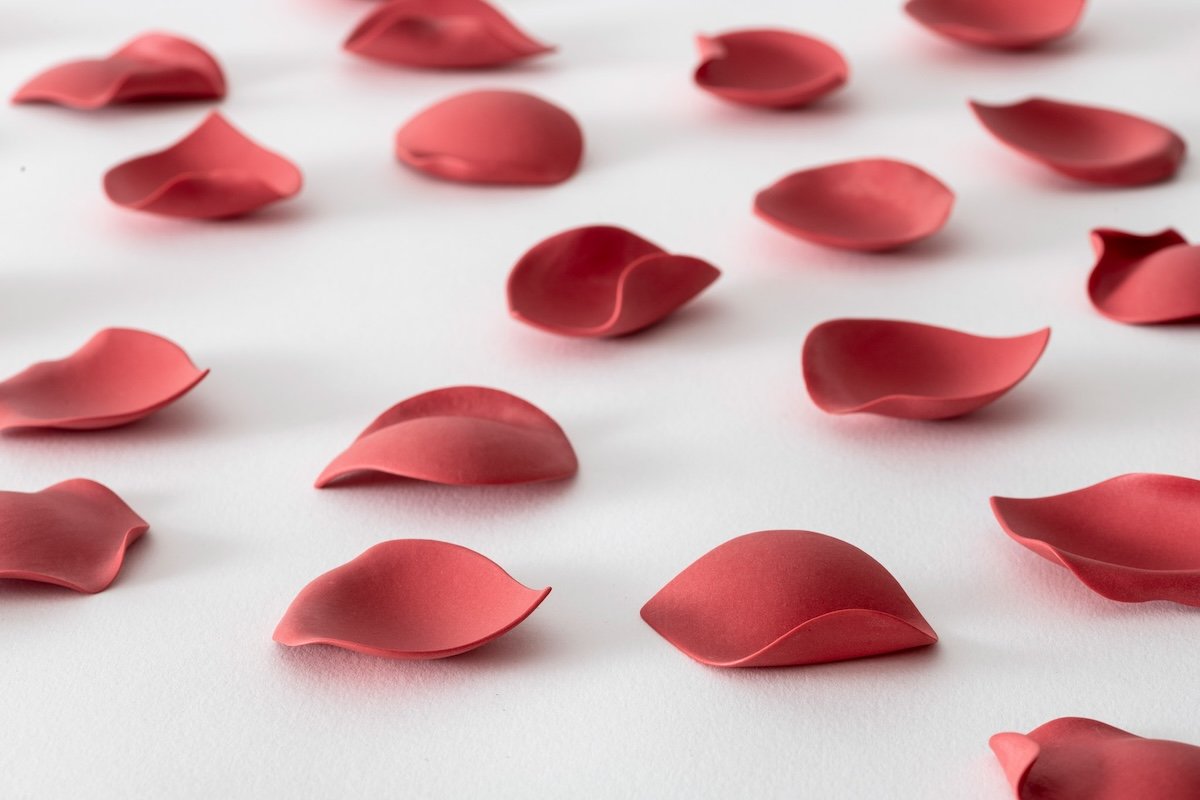
Scarlet is the red porcelain installation by Emanuela Mastria, curated by Roberta Melasecca, which on Thursday, October 8, 2026 at 18:00 opens the exhibition season of blowart contemporary space, Via dei Savorelli 34a, Rome, in the Aurelio neighborhood. It stays on view until January 17, 2027. After the opening the exhibition is visited by appointment, by calling 349 4945612. For the Giornata del Contemporaneo on Saturday, October 10 the space opens to the public, and during Rome Art Week, from October 19 to 25, there will be in-depth sessions with days and hours that the space will announce. The official press release does not give an admission ticket. The contacts are the number already mentioned and the address associazioneblowart@gmail.com. For public transport it's best to set the route toward Via dei Savorelli on the official ATAC calculator.
Scarlet by Emanuela Mastria, the exhibition in brief
Scarlet is a solo show built on a single wall: about 200 scarlet porcelain petals, scattered by Emanuela Mastria on the white wall of blowart.
The work
The artist makes a site-specific installation, that is, conceived for that space and that wall. The petals number about 200, modeled one by one and fixed so that they graze the wall at a single point at a time, with a gesture that the curator calls intrinsically conscious.
The duration
The installation stays in the room from October 8, 2026 to January 17, 2027: more than three months, a long time that runs through the autumn, the end-of-year holidays and the start of the new year.
The dates to note
Three moments stand out: the opening on Thursday, October 8 at 18:00, the opening for the Giornata del Contemporaneo on Saturday, October 10 and the in-depth sessions during Rome Art Week, from October 19 to 25. For the rest of the period the visit is arranged by phone.
The red inside the porcelain
Emanuela Mastria usually works white porcelain. For Scarlet the porcelain is red, and the color is inside the clay body itself.
A technical choice
It is not a surface painted or glazed after firing. The red, writes the curator Roberta Melasecca, is in the clay body: each petal is red to the heart of the material. It is a detail that changes the way of looking at the work, because the color is not a skin but the very substance of the petal.
Why scarlet
In the critical text accompanying the exhibition, scarlet is described as the first color that newborns recognize when they open their eyes on the world: essence and life, primal breath. Scarlet, the text goes on, is also a woman's name.
The reds of civic memory
The red the curator evokes is that of the red shoes and the red benches. That of the red roses that go with the slogan We want bread and roses too. That of the red strawberries embroidered on Desdemona's handkerchief. Red, the text concludes, is matter that takes shape from hands and thought.
Kindness and resistance: a relay of words
Scarlet is conceived as the beginning of a path: the installation starts from two words, kindness and resistance, and wants to set off a relay of words that will continue with blowart's later exhibitions.
What is being discussed
According to the press release, the relay serves to explore the system that ties people to the ecosystem they are part of, the ways in which habitats and communities are modified, the relationships that are established within them. These are themes that the space considers particularly urgent.
An undefined structure
The curator's text insists on one point: Scarlet has an undefined structure, and for this very reason it outlines a new human, urban and social grammar. The work generates an independent place and leaves room for the words and reflections of those who look at it. The text closes with a direct invitation to the public: the floor is yours, then.
Art like poetry
The text also contains a reflection on the language of art: like poetry, art does not mediate anything, because of its deliberately indeterminate essence. For this reason, writes Melasecca, art allows itself to speak and the viewer has the chance to engage and discuss, as well as to look.
Who is Emanuela Mastria
Emanuela Mastria is a visual artist born in Rome, where she lives and works, and she has chosen porcelain as her preferred material.
Her training
After finishing art high school, in 2013 she graduated in Letters and Philosophy at Roma Tre University. Between 2012 and 2015 she studied ceramics at the Scuola d'Arte Nicola Zabaglia in Rome, and it is there that she chooses porcelain to make it the voice of contemporary messages and visions. To deepen the techniques she then attends specialized workshops.
The language
Her work focuses above all on site-specific installations in porcelain. Less often she makes watercolor paintings. The recurring sign is a fragile and precious material used to speak of civic themes.
Desdemona's handkerchief
Among her best-known projects is Il fazzoletto di Desdemona, exhibited in 2021 in the Biblioteca Vallicelliana: 100 white porcelain handkerchiefs, each dedicated to a woman victim of femicide, with the initials written in red. The reference is to Desdemona, the female protagonist of Shakespeare's Othello, and to the red strawberries embroidered on her handkerchief.
Ectoderma and the group shows
In 2023 she presented Ectoderma at the Biblioteca Carminella in Rome. She has taken part in more than 40 group shows, in exhibition spaces and museums such as the Museo Civico di Zoologia in Rome, the MACRO, the Museum of Civilizations, the Galleria Gallerati, Villa Sciarra, the MAAM, the Museo della Ceramica della Tuscia in Viterbo, the Palazzo delle Esposizioni in Faenza and the Museo del Bijou in Casalmaggiore.
Collections and prizes
Her works have entered the collections of the Museo del Bijou in Casalmaggiore, of Cittadellarte Fondazione Pistoletto in Biella and of the MAAM in Rome. In 2013 she won the first prize of the school section of Forme e colori della terra di Tuscia, in Viterbo, with the work Driope, and the third design competition Raffa&Là, in Rome, with Yakamoz. In 2018 the first prize of Il Sapere delle mani at the Museo del Fiume in Nazzano with Ginkgo. In 2025 the Nice & Fair Talent Prize of Paratissima Kosmos in Moncalieri with Bianca Flut.
Who Scarlet is for
Scarlet is an exhibition that speaks to different audiences, even to those who don't usually go to contemporary art galleries.
For those who love ceramics
Those interested in ceramics find in Scarlet an uncommon use of porcelain: colored in the clay body, modeled in small, repeated forms, mounted on the wall like a drawing in space. It is a way of working the material that is far from the functional object and close to installation.
For those who follow civic themes
Those who know Emanuela Mastria's work on femicide, starting with Il fazzoletto di Desdemona, find again in Scarlet the same red and the same way of turning a symbol into matter. The tone, however, is different: here the starting point is two positive words, kindness and resistance.
For those who live in the neighborhood
blowart says it wants to build local networks and small communities. For those who live in Aurelio, a space for contemporary art a few steps from home is a rare opportunity in a mostly residential neighborhood, and the by-appointment formula allows you to drop by calmly even several times over the months.
The curator Roberta Melasecca
Roberta Melasecca curates the exhibition and is the artistic director of blowart contemporary space, home of the cultural association blowart.
Curating and press office
Her name is familiar to those who follow contemporary art in Rome: with her communication agency she handles the press office for many exhibitions in the city, and through the blowart association she promotes exhibition projects of her own. With Scarlet she opens the season of a new space, which she directs in person.
The critical text
The text accompanying Scarlet is signed by the curator and has a tone more poetic than academic: a series of short sentences, built on the repetition of the word red, that lead the visitor into the installation.
blowart contemporary space, the new space in Aurelio
blowart contemporary space is a new space for the contemporary at Via dei Savorelli 34a, in the Aurelio neighborhood, home of the cultural association blowart.
The idea of the space
The press release describes blowart as a place born from the desire to build local networks and generate small collaborating and resistant communities, in the conviction that art is a powerful tool of dialogue and critical thinking.
A place to stop
The space presents itself as a place where you can stop, breathe, talk, discuss, study, read, meet, tell about art and tell about yourself, share time and meet people, ideas and projects. Scarlet is the exhibition that inaugurates this vocation.
Visits by appointment
Outside the special days the exhibition is visited by appointment at 349 4945612. It is the typical formula of independent spaces: it takes an extra phone call, but guarantees a calm visit, often with the chance to talk with whoever curated the exhibition.
The Aurelio neighborhood
Aurelio is the 13th quartiere of Rome, indicated as Q. XIII, born among the first 15 in 1911 and officially established in 1921. It takes its name from Via Aurelia.
Where it is
The neighborhood is in the western area of the city, right up against the Leonine Walls and the Aurelian Walls. It borders the Trionfale neighborhood and Vatican City to the north, the Borgo and Trastevere rioni to the east, and the Gianicolense to the south.
Villas and churches
In the territory of the neighborhood are Villa Carpegna and Villa Abamelek, the Pineto Regional Urban Park and many churches, including San Pio V, San Gregorio VII and Santa Maria delle Grazie alle Fornaci. Among the archaeological sites the encyclopedia mentions the catacomb of Calepodius, Porta Cavalleggeri and Porta San Pancrazio.
The streets of the cardinals
A curiosity of the neighborhood is its street naming: because of the proximity to the Vatican, most of the streets are dedicated to popes and cardinals. In the northern part, instead, the streets recall jurists, and in the northwest men of letters and humanists.
How to get to blowart contemporary space
blowart contemporary space is at Via dei Savorelli 34a, in the Aurelio neighborhood, Municipio XIII, postal code 00165.
By public transport
To choose lines and stops, the most reliable reference is the official ATAC route calculator, which shows up-to-date connections to Via dei Savorelli. It's best to check it before leaving, especially for the 18:00 opening.
By car
Aurelio is a residential neighborhood: in the evening hours street parking may take a few laps. Anyone arriving by car does well to allow a margin of time.
Before leaving
Since the exhibition is visited by appointment, the first step is the phone call to 349 4945612: you set the time and ask for confirmation of the address and the entrance.
A curiosity about Scarlet by Emanuela Mastria at blowart contemporary space, October 8, 2026 to January 17, 2027
The curiosity of Scarlet is in the number. The porcelain petals are about 200, and 200 is also, in Emanuela Mastria's work, double the handkerchiefs of the project Il fazzoletto di Desdemona, which were 100. There is no declared link between the two figures in the official texts, but the reference between the two works is explicit, because the critical text of Scarlet cites precisely the red strawberries of the handkerchief dedicated to Desdemona.
The second detail concerns the name. Scarlet in English means the scarlet red, but it is also a female given name: the curator plays on this double reading, and the installation becomes at once a color and a woman.
Finally there is a technical curiosity. Porcelain is a material that tradition associates with white, with purity, with the set table. Coloring it in the clay body, and not on the surface, means giving up the decorative gesture for a color that belongs to the material. In our view it is the choice that gives the work its strength: the red can't be scratched off.
One thing nobody tells you about Scarlet by Emanuela Mastria at blowart contemporary space, October 8, 2026 to January 17, 2027
What is rarely said about exhibitions by appointment is that they are an opportunity, not an obstacle. Whoever phones to set up the visit to Scarlet usually gets something the big museums don't offer: the chance to see the work alone, or nearly, and to talk about it with whoever works in the space.
Then there is a matter of light. An installation of 200 red petals on a white wall changes a lot according to the hour and the lighting: the shadows each petal casts on the wall are part of the work, because every element grazes the wall at a single point and stays suspended. Setting the appointment at different times of the day can give you two different experiences.
One last practical note: on the hours of the Giornata del Contemporaneo on October 10 the official sources don't agree. The text of the press release gives an opening from 10:00 to 13:00 and from 16:00 to 19:00. The information sheet at the end of the same press release gives only the 16:00 to 19:00 slot. The advice is to choose the afternoon, which appears in both versions, or to phone beforehand.
The advice I give you for visiting Scarlet by Emanuela Mastria at blowart contemporary space, October 8, 2026 to January 17, 2027
My advice is to go to Scarlet twice. The first time at the opening on Thursday, October 8 at 18:00, when the space opens its season and you can meet the artist and the curator. The second at a quieter moment, by appointment, to stand in front of the wall calmly and look at the petals one by one.
Those with little time can aim for the week of Rome Art Week, from October 19 to 25, when blowart offers in-depth sessions on the installation. Days and hours, the press release announces, will be communicated shortly: it's best to keep an eye on the space's official channels.
A suggestion on how to look: Scarlet is conceived as the start of a relay of words, beginning with kindness and resistance. It is worth arriving with a word of your own to leave, ideally, to the conversation. It is the spirit in which the curator's text closes, handing the floor to the public.
Another well-known fact, yet rarely cited
That Desdemona's handkerchief plays a decisive role in Shakespeare's Othello is a fact known to anyone who knows the tragedy. Less often remembered is the detail of the red strawberries that decorate it, also cited in the critical text of Scarlet. Emanuela Mastria starts from that detail for her best-known project, Il fazzoletto di Desdemona: 100 white porcelain handkerchiefs, one for every woman victim of femicide, with the initials written in red.
The text of Scarlet takes up those red strawberries and puts them next to other symbols of civic red: the red shoes, the red benches and the red roses of the slogan We want bread and roses too.
In our view this is the thread that makes Scarlet more than a decorative installation. The petals are beautiful, but the red carries a precise story with it. Whoever visits the exhibition after reading these lines looks at it with different eyes.
The right photo to take at Scarlet by Emanuela Mastria at blowart contemporary space, October 8, 2026 to January 17, 2027
The right photo of Scarlet is taken in two steps. The first shot is the overall one: the whole white wall, with the 200 red petals distributed over the surface. It is the image that conveys the composition and the relationship between the color and the empty space.
The second shot is a detail. Moving closer, you catch the way each petal grazes the wall at a single point and casts a small shadow. A close-up photo, with raking light, shows the surface of the porcelain and the red which, being in the clay body, does not have the uniform shine of a glaze.
The official images of the exhibition released with the press kit are by the photographer Giorgio Benni: looking at them before the visit helps you understand which shots show the work to best advantage. Before publishing your own photos, as always in exhibition spaces, it's best to ask the staff if there are particular instructions.
Some important events that happened here in history
blowart contemporary space is a new space, and the first event of its exhibition history is precisely Scarlet, which opens the season on October 8, 2026. The exhibition then takes part in the 22nd Giornata del Contemporaneo on October 10, 2026 and in Rome Art Week from October 19 to 25.
The neighborhood that hosts the space has a longer history. Aurelio was born among the first 15 quartieri of Rome in 1911 and was officially established in 1921, taking its name from Via Aurelia, one of the great consular roads. In its territory the encyclopedia mentions the catacomb of Calepodius, among the oldest places in the area, and the gates of the walls that bound it: Porta Cavalleggeri, along the Leonine Walls, and Porta San Pancrazio.
The history of the neighborhood is marked by its closeness to the Vatican, to the point that the street naming is largely dedicated to popes and cardinals. Among the historic villas, Villa Carpegna and Villa Abamelek stand out. Over time the neighborhood has hosted institutions such as the Pontifical Institute of Sacred Music, in the teaching seat linked to the parish of San Pio V, and hospital facilities such as the Istituto Dermopatico dell'Immacolata and the Ospedale San Carlo di Nancy.
Who has passed through Scarlet by Emanuela Mastria at blowart contemporary space, October 8, 2026 to January 17, 2027
The first name is the artist's, Emanuela Mastria, who made the installation directly on the wall of the space. With her, the curator Roberta Melasecca, artistic director of blowart, and the photographer Giorgio Benni, author of the exhibition's official images.
Before arriving at Via dei Savorelli, Emanuela Mastria's works have passed through important places of the city: the Biblioteca Vallicelliana, which in 2021 hosted Il fazzoletto di Desdemona. The Biblioteca Carminella, home of Ectoderma in 2023. The MACRO, the Museo delle Civiltà, Villa Sciarra, the MAAM and the Museo Civico di Zoologia for the group shows. Outside Rome her work has passed through the Museo della Ceramica della Tuscia in Viterbo, the Palazzo delle Esposizioni in Faenza, the Museo del Bijou in Casalmaggiore and Cittadellarte Fondazione Pistoletto in Biella, which keep some of her works.
During the months of opening, the visitors of the Giornata del Contemporaneo and of Rome Art Week will pass through blowart. It is the community the space says it wants to build: small, collaborating and, to use its words, resistant.
What is around blowart
The Aurelio neighborhood borders some of the most visited places in Rome.
The Vatican
To the northeast the neighborhood borders Vatican City: St. Peter's Basilica and the Vatican Museums are the nearest landmarks for those who want to pair a classic visit with a contemporary exhibition.
The villas
In the territory of the neighborhood are Villa Carpegna and the Pineto Regional Urban Park, green areas used mostly by people who live in the area.
The gates of the walls
On the edges of the neighborhood are Porta Cavalleggeri and Porta San Pancrazio, two historic gates into the city cited among the archaeological sites of Aurelio.
Where to eat near Via dei Savorelli
Aurelio is a residential neighborhood, and the eating offering is that of a lived-in area rather than a tourist one.
After the opening
The 18:00 opening ends at aperitivo time: on the main streets of the neighborhood there are local bars and cafes.
A neighborhood dinner
For dinner you find trattorie and pizzerias frequented by residents, with prices generally lower than in the areas right next to the Vatican. On Friday and Saturday evenings it's best to book.
Toward Borgo and Prati
Those who prefer a wider choice can move toward Borgo and Prati, on the other side of the Leonine Walls.
Practical information and accessibility
The rules for visiting Scarlet are few and clear.
When
Opening Thursday, October 8, 2026 at 18:00. From the next day and until January 17, 2027, visits by appointment at 349 4945612. Saturday, October 10 opening for the Giornata del Contemporaneo, with the afternoon hours from 16:00 to 19:00 given in both versions of the press release.
Admission
The press release does not give an admission ticket. For any doubt the contacts are the space's number and the address associazioneblowart@gmail.com.
Accessibility
Information on the space's accessibility is not published in the press release: anyone with specific needs can ask when booking.
With children
An installation of red petals may intrigue even the youngest, who must however be held by the hand: porcelain is fragile and the petals graze the wall at a single point.
How to organize the visit to Scarlet
Scarlet is seen in a short time, but the visit needs preparing, because the space works by appointment.
The phone call
The first step is to call 349 4945612, the same number given for contact with the curator. By phone you agree on day and time. It's best to say how many people will be there, because an independent space works better with small visits.
How much time you need
The installation is on a single wall: to look at it carefully 20 minutes are enough, which become more if you take the chance to talk about the work and about the blowart project. Those who want to read the critical text before going in will find the full press release on the press office's website.
Pairing another visit
The exhibition stays open until January 17, 2027: those coming from outside the neighborhood can pair it, in the same half day, with a visit in the Vatican area, which borders Aurelio, or with another autumn exhibition. In the weeks of December the visit fits well with pre-Christmas walks in the center.
The richest days
For those who prefer not to book, the occasions are two: the afternoon of October 10 for the Giornata del Contemporaneo and the days of Rome Art Week, from October 19 to 25, when the program of in-depth sessions turns the visit into a moment of discussion.
The autumn of contemporary art in Rome
Scarlet fits into a dense calendar. On October 10 the Giornata del Contemporaneo 2026 opens museums and spaces across Italy. From October 19 to 25 Rome Art Week brings the public to galleries, foundations and artists' studios. Anyone visiting blowart on those days can build an itinerary that touches independent spaces and major institutions, such as the MACRO.
Frequently asked questions about Scarlet by Emanuela Mastria
When does Scarlet by Emanuela Mastria open?
Scarlet by Emanuela Mastria opens on Thursday, October 8, 2026 at 18:00 at blowart contemporary space, at Via dei Savorelli 34a in Rome. The exhibition, curated by Roberta Melasecca, stays on view until January 17, 2027.
How do you visit Scarlet after the opening?
After the opening Scarlet is visited by appointment, by calling 349 4945612. The openings to the public without booking indicated by the press release are the Giornata del Contemporaneo on October 10 and the in-depth sessions of Rome Art Week, from October 19 to 25, with hours to be announced.
How much does admission to the exhibition cost?
The official press release for Scarlet does not give an admission ticket. For confirmation it's best to ask when booking, at 349 4945612 or at the address associazioneblowart@gmail.com.
What is the installation Scarlet?
Scarlet is a site-specific installation of about 200 red porcelain petals, with the color in the clay body, distributed by Emanuela Mastria on a single white wall of blowart. It starts from two words, kindness and resistance, and sets off a relay of reflections.
Who is Emanuela Mastria?
Emanuela Mastria is a Roman artist who works mainly with porcelain in site-specific installations. She graduated in Letters and Philosophy at Roma Tre and studied ceramics at the Scuola d'Arte Nicola Zabaglia. She is the author of the project Il fazzoletto di Desdemona, exhibited at the Biblioteca Vallicelliana in 2021.
What hours does the exhibition have on October 10?
For the Giornata del Contemporaneo on October 10 blowart opens Scarlet to the public, but the two parts of the press release don't match: one gives 10:00 to 13:00 and 16:00 to 19:00, the other only 16:00 to 19:00. The afternoon slot, from 16:00 to 19:00, is given in both.
Where is blowart contemporary space?
blowart contemporary space is at Via dei Savorelli 34a, in the Aurelio neighborhood, west of the Vatican. It is the home of the cultural association blowart, directed by Roberta Melasecca. For public transport the reference is the ATAC route calculator.
Final advice on Scarlet by Emanuela Mastria
Scarlet is an exhibition made of a single wall, and for this very reason it asks for attention. In our view it is worth the visit for two reasons: the red in the clay body of the porcelain, which turns a material associated with white into a civic color, and the chance to see a work in a new space, with the time to really look at it. The advice is to phone, set the appointment and arrive with a word to add to the relay that the artist began with kindness and resistance.
Article written by the editorial team of Tour Leader Pro, contact them for Private/Corporate/V.I.P. Tours and Experiences.
Planning a trip to Rome? The English-language guides for visiting the city are on ItalyPlanner.com.