Monte Rufeno Nature Reserve
In short. The Monte Rufeno Nature Reserve covers 2,893 hectares in the municipality of Acquapendente, province of Viterbo, in the far north of Lazio, where the region touches Umbria and Tuscany.
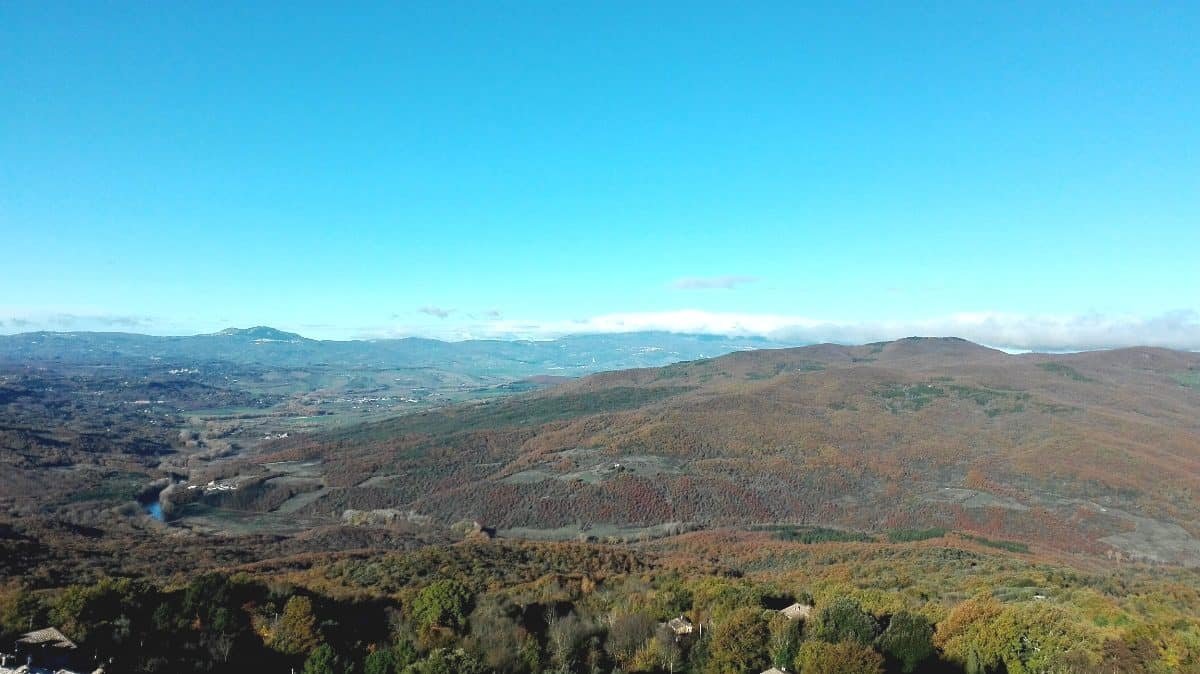
The Monte Rufeno Nature Reserve covers 2,893 hectares in the municipality of Acquapendente, province of Viterbo, in the far north of Lazio, where the region touches Umbria and Tuscany. The offices and information point of the managing body are in Acquapendente, at Piazza Santa Maria Maddalena 1, in the former Franciscan convent overlooking the historic center, open Monday to Friday from 9:00 to 13:00, telephone 0763 733442, email address info@monterufeno.it. Entry to the reserve is free: there is no ticket office, no turnstile, and you don't need to book to walk the trails. You pay only for the facilities inside, and the amounts are modest: the Museo del Fiore, at Casale Giardino above Torre Alfina, charges €4 for a full ticket and €3 reduced, with combined tickets at €11 and €14 that include the Bosco del Sasseto and the Museo Civico of Acquapendente. From Rome you get there in about two hours via the Cassia, the SS2 state road, or via the A1 motorway with the exit at Orvieto and about 15 kilometers of provincial road. The useful train station is Orvieto, on the Florence-Rome line, also served by Intercity trains. The best period is spring, between April and June, when the lilies and orchids bloom. The second best is October, for the color of the Turkey oaks and for the mushrooms.
Anyone planning a wide loop in northern Tuscia will find, on the page of Lazio's tourist attractions, the overall picture in which this reserve fits, between Lake Bolsena and the Paglia valley.
Where the Monte Rufeno Nature Reserve is and how to get there
The reserve extends north-northeast of the municipal seat, in a band of territory that descends from the watershed ridge down to the Paglia river. It's a border position in the literal sense: a few kilometers farther on begin the province of Siena and that of Terni. This explains many things, from the residents' dialect to the cooking, and above all explains why for centuries these woods were a land of passage, of transhumance and of escapes.
By car to the Monte Rufeno Nature Reserve
The main road is the Cassia. From Rome you head north, run along Lake Bolsena on its eastern side passing through Montefiascone and Bolsena, and after Acquapendente the SS2 state road enters literally inside the protected territory: the stretch that climbs toward the Tuscan border cuts through the reserve and hosts one of the information points, the Torre Julia de Jacopo, telephone 0763 733642. If you come from the north or you're in a hurry, take the A1 and get off at Orvieto: from there you go up the Paglia valley and in 20 minutes you're at your destination. From Viterbo it's about 50 kilometers of northern Cassia, from Rome a good 120. Inside the reserve, motor vehicle traffic is banned on almost all the internal roads: you leave the car at the trailheads, and this is exactly the reason why the silence here is real and not advertising.
By train and bus to Monte Rufeno
There is no railway station in Acquapendente. The reference stop is Orvieto, on the Florence-Rome line, and from the station you continue with regional line buses. Updated routes and timetables can be found on the website of Cotral, which runs suburban transport in Lazio. I'll say something uncomfortable right away, because it's better to know it beforehand: without a car this reserve is hard to visit. The coaches serve the towns, not the trailheads, and between Acquapendente and Torre Alfina there are eight kilometers that on foot become a hike of their own. If you arrive by train, plan for a rental in Orvieto or a stay inside the protected territory, so the walks start from your front door.
The information point and offices of the Monte Rufeno Nature Reserve
The offices occupy the first floor of a Franciscan convent whose origins date back to the 13th century, in Piazza Santa Maria Maddalena in Acquapendente. On the ground floor of the same building is the picture gallery section of the Museo Civico. It's worth stopping by before heading into the woods: here you pick up the trail maps, ask if any stretch is closed because of a landslide or a fallen tree, and book guided visits. The reserve's toll-free number is 800 411834. The protected area's official website is that of the regional system, parchilazio.it, where the regulations and route sheets are published.
What the Monte Rufeno Nature Reserve really is
The reserve was born with Lazio regional law number 66 of September 19, 1983 and its management is entrusted to the Municipality of Acquapendente, an uncommon case in Italy, where regional protected areas almost always end up in the hands of dedicated bodies. That administrative choice produced a visible effect: the reserve is perceived by the people of Acquapendente as their own, not as a restriction imposed from above.
The numbers help in understanding the proportions. The highest elevation is 774 meters, at the Greppe della Maddalena. The lowest is 235 meters, on the banks of the Paglia river. 400 meters of overall elevation difference over almost 3,000 hectares means a gentle territory, made of rounded ridges and narrow ravines, not of walls and crests. The substrate is sedimentary, sandstone and clay, and it works: landslides are an ordinary phenomenon, the network of ditches is very dense, and after heavy rain some fords become impassable for a couple of days.
The Monte Rufeno Nature Reserve within the Natura 2000 network
On a perimeter slightly wider than that of the reserve, the European Union has recognized five distinct protection areas: the middle course of the Paglia river, the Bosco del Sasseto, Monte Rufeno, the Acquachiara ditch and the Valle del Fossatello. The codes of the sites of Community interest that directly concern the area are IT6010005 and IT6010006. This is not bureaucracy: that recognition binds to habitat conservation and has brought funding for species monitoring. The striking figure, released by the managing body, is the share of animal biodiversity: about 30 percent of Italian animal species and 54 percent of those present in Lazio are documented within these boundaries. For a territory only a little larger than a peripheral neighborhood of Rome, it is a remarkable concentration.
Why Monte Rufeno became a reserve
At the start of the 1980s the situation was this: almost 3,000 hectares of publicly owned woods, a heritage of abandoned rural buildings, an extensive agricultural and forestry system that had died out within a generation. The Lazio Region and the Municipality of Acquapendente decided to protect the whole instead of leaving it to speculation or decay. The naturalistic studies that came later proved that choice right, bringing out a reservoir of biodiversity that nobody, in 1983, had yet measured. It's one of the rare cases in which an administrative measure anticipated science instead of chasing it.
The oak forest, tree by tree
The dominant cover is oak. Mostly Turkey oak, then downy oak on the warmer, drier slopes, and in between plots of pine planted in different periods for reforestation. The species that deserves attention is the Hungarian oak, Quercus frainetto, an oak with broad, deeply lobed leaves, rare in Lazio and tied to acidic soils: those with a trained eye recognize it by the apical buds with persistent stipules, a detail that no other large Italian Quercus shows so well.
The reason for the present richness is paradoxical and must be said plainly: this forest is beautiful because it was left in peace. The reduced human intervention of the last 40 years has allowed the forest structure to become more complex, to develop overlapping layers of vegetation, to accumulate dead wood on the ground. Dead wood is the hostel of the wood-eating insects, which in turn are the canteen of woodpeckers and nocturnal raptors. A forest that is too clean is a poor forest: here, luckily, they never cleaned it too much.
The ban on motor traffic and the lack of heavy infrastructure did the rest. You walk, you cycle, you ride horses, and the only noise that accompanies you is that of water in the ditches and of acorns falling in autumn.

The rare flora of the Monte Rufeno Nature Reserve
The plant species recorded in the reserve's territory exceed a thousand. Not all deserve a trip, but many do. Those who arrive in May with a botanical guide in their pocket hit the jackpot. Those who arrive in August see green and nothing else.
The Etruscan santolina, the symbol plant of Monte Rufeno
Santolina etrusca is a small aromatic shrub with silvery gray leaves and yellow flower heads, endemic to a very restricted area between Lazio and Tuscany. It grows on arid outcrops and gravel beds, where competition from tall grasses is weak. It's the reason botanists have known this corner of Tuscia since long before there was a reserve to protect it. Rub a leaf between your fingers and smell it: the resinous scent is unmistakable, and it will stay on you for an hour.
The lilies and narcissi of Monte Rufeno
The red lily, Lilium bulbiferum subspecies croceum, blooms between June and July in the clearings and at the edges of the woods: a bright orange that from a distance looks like a misprint in the green. The martagon lily, Lilium martagon, is more discreet and rarer, with pink spotted petals folded backward to form the turban that gave it its name. Among the narcissi you find Narcissus poeticus, the one with the coral-red center, and Narcissus tazetta, with multiple, highly fragrant flowers, which opens earlier, between February and March. Picking them is forbidden, and it would be silly anyway: they last a day in your hand and 10 years in the meadow.
The wild orchids and other rarities
Among the reserve's wild orchids the most cited is Ophrys insectifera, the fly orchid, which imitates the look and smell of a female insect to get pollinated by deceived males. It's one of the most elegant cases of sexual mimicry in European botany, and it can be observed in May in the grassy clearings. Completing the picture are the plum iris, Iris graminea, whose flowers really smell of ripe plum, the Florentine crabapple, Malus florentina, a very rare woody species with a fragmented distribution, the burning bush, Dictamnus albus, which on sultry evenings emits flammable essential oils, and the heather, Calluna vulgaris, an acidophilic shrub that here finds one of its southern limits in Lazio.
The fauna of the woods and ditches
Seeing wild animals takes patience and inconvenient hours. The golden rule is trivial and nobody applies it: go out at dawn, walk slowly, keep quiet. Those who set out at 11:00 with a chatting group will see bark and clouds.
The porcupine, the mammal you find first
Hystrix cristata is a large nocturnal rodent endemic to central and southern Italy, probably arrived in ancient times from North Africa. In the reserve it is common, and the easiest proof is the black and white quills it loses along the trails and at the entrance to its burrows, often dug under roots or inside old dry-stone walls of farmhouses. Direct sightings happen at night, with the flashlight held low. By day you find the traces. A quill picked up from the ground is a legitimate souvenir, unlike a flower.
Wild boars, fallow deer and roe deer in the Monte Rufeno Nature Reserve
The wild boar, Sus scrofa, is everywhere and leaves unmistakable signatures: rootings that turn over the undergrowth, muddy wallows, mud rubbed on trunks at shoulder height. The fallow deer, Dama dama, and the roe deer, Capreolus capreolus, are present with small populations distributed mainly in the more interior and quiet portions. The roe deer gives itself away with a dry bark, like a cough, that startles those who don't expect it. The fallow deer, when present, is seen at dusk at the edges of clearings, and the adult male carries palmate antlers that can't be mistaken for those of any other Italian ungulate.
Pine martens, stone martens, polecats, badgers and foxes
The reserve's mustelids are shy predators, almost exclusively nocturnal: the pine marten, Martes martes, tied to mature forest. The stone marten, Martes foina, more adaptable and able to frequent ruins and farmhouses. The polecat, Mustela putorius, tied to wet environments along the ditches. They are very hard to see, but not impossible to read: droppings left in plain view on stones to mark territory, remains of meals, prints in the mud. The badger, Meles meles, omnivorous and tireless builder, digs tunnel systems used by successive generations. The red fox, Vulpes vulpes, is the most adaptable animal of the peninsula and here frequents the woods, the cultivated fields and the surroundings of buildings alike.
The wolf and the pond turtle, the health indicators of Monte Rufeno
In the protected area the wolf, Canis lupus, and the European pond turtle, Emys orbicularis, are documented. They are two very different species that say the same thing: the food chain is complete at the top, and the wetlands have not been destroyed. Emys is sometimes observed in the morning on a log emerging in a pool, motionless, warming up. At the slightest vibration it slides into the water and disappears. Its decline in Italy depends mainly on the disappearance of ponds and on competition from exotic turtles released from home aquariums. Of the wolf, realistically, you will see at most a print or hear a story: that's how it should be.
The birds of the Monte Rufeno Nature Reserve
The coexistence of woods, hedges, clearings and watercourses produces a rich bird community. Among the woodland passerines the Dartford warbler, Sylvia undata, has been recorded, a small long-tailed, red-eyed insectivore, threatened with extinction in Lazio and tied to low scrub. In the oaks the wood pigeon, Columba palumbus, moves in flocks, resident and nesting, taking off with an impressive roar of wings. Along streams with clean running water lives the white-throated dipper, Cinclus cinclus, the only European passerine that walks on the submerged bed looking for larvae: if you see it, that stream is in good health. Completing the picture are the tits of the genus Parus, the shrikes of the genus Lanius, which impale their prey on thorns like in a pantry, and many diurnal and nocturnal raptors.
The reptiles and the viper chapter
In late spring and summer reptiles warm up in the sun on stones and on open stretches of the trails. Among them is the asp viper, Vipera aspis, which deserves an honest word. It is a very useful predator in containing rodents, bites almost exclusively in defense when stepped on or grabbed, and in the vast majority of cases tries to flee. Closed boots, a stick that precedes your step in tall grass, hands away from crevices in the rocks: with these three rules the risk becomes negligible. Being terrified is useless, ignoring it is foolish.
The trails of the Monte Rufeno Nature Reserve
The marked network counts a good 15 or so routes, among hiking, cycling and horseback, with difficulty ranging from easy to medium. There are no mountaineering routes or exposed passages: the level of effort depends on length and surface, which after rains becomes heavy. Updated maps can be picked up at the Acquapendente information point or at the Torre Julia de Jacopo on the Cassia.
The Acquachiara trail
It's the most cited route and the most suitable for a first time: about eight kilometers following the Acquachiara ditch, one of the five protected areas of the Natura 2000 network. You walk for a long time on the valley floor, with easy fords, alders and willows along the water, and excellent chances of meeting ungulate tracks in the mud of the banks. It's also the stretch where to look for the white-throated dipper. To be avoided in the 48 hours following a major storm.
The Monte Rufeno hiking trail
It bears the name of the relief and climbs toward the highest elevations of the area, those that come close to 730 meters. The panorama that opens in the exposed spots explains the geography better than any map: to the south the Lake Bolsena basin, to the north the Paglia valley and the profile of Orvieto on its rock, to the west the first Siena hills. On tramontana days, when the air is clear, you can make out the outlines of Monte Amiata.
The Scialimata and the Fiore trail
The Scialimata route connects to the Fiore nature trail, the one that starts from the Museo del Fiore and serves as a reasoned introduction to the local botany: panels, thematic stops, an old water mill along the route. It's the right combination for a morning with children or for those who want to understand what they see instead of just walking.
Falconeria, Fonte and Montepereto
Three minor and less frequented routes, bearing names tied to the area's ancient place names. These are the trails to choose in August and on long weekends, when the Acquachiara gathers families and groups: here you walk for hours without meeting anyone. The surface is more irregular and the signage must be followed carefully, because some forestry service branches can be misleading.
By bicycle and on horseback in the Monte Rufeno Nature Reserve
Part of the network is open to mountain bikes and horses. The forestry dirt roads, closed to motor traffic, offer kilometers of passable track with moderate slopes. The practical advice: wide, knobby tires, because on wet clay narrow wheels become sleds. For horseback trekking there are local businesses that organize guided rides, and it's best to contact them in advance through the reserve's information point.
The Brigands' Trail, from Monte Rufeno to the Selva del Lamone
A long-distance route connects the Monte Rufeno Nature Reserve to the other great protected area of northern Tuscia, the Selva del Lamone, across the border territory between Lazio, Tuscany and Umbria. It's the Brigands' Trail, a loop divided into stages that takes several days and that follows the routes really used in the 19th century by the bands that took advantage of the proximity of state borders: once an administrative line was crossed, the gendarmes of the other side could not pursue. Post-unification brigandage had in this band one of its most active theaters, and the most famous of those figures, Domenico Tiburzi, operated in the Maremma of Lazio between the Lamone and the coast. Those who want a taste without committing to a multi-day trek can walk the initial stretch as a day hike. Those with time and legs will find an itinerary of great breadth, and can compare it with the other long-distance walk of the central Apennines, the Brigands' Way between Lazio and Abruzzo, which is a different thing and should be chosen knowingly.
The abandoned farmhouses and the landscape of work
Inside the protected perimeter there is a rural building heritage of dozens of farmhouses, scattered clusters that until 50 years ago housed the families of farmers and woodcutters. When the extensive agricultural and forestry system died out, these buildings were left empty. The reserve has progressively restored a part of them, assigning them to hospitality, environmental education and services: among the best known are Casale Felceto and Casale Giardino, which hosts the Museo del Fiore.
This is the trait that distinguishes Monte Rufeno from many protected areas conceived as empty sanctuaries. Here the landscape is declaredly the product of centuries of human labor, and the protection includes the dry-stone walls, the threshing floors, the springs, the ovens, the old charcoal-burning sites. Walking you meet stone thresholds with engraved dates, cisterns, remains of enclosures. Look at them carefully: they tell of an economy that vanished in a single generation, and they are the reason why bats, little owls and stone martens find here shelters that wouldn't exist in pure forest.
The Museo del Fiore, the educational heart of the Monte Rufeno Nature Reserve
At Casale Giardino, a little over two kilometers above the village of Torre Alfina, is the Museo del Fiore, a natural history museum dedicated to flowers and their relationships with insects, animals and humans. It is part of the RESINA museum system and also works as the reserve's environmental education center.
The sections of the Museo del Fiore
The interior route is divided into thematic sections. The first deals with the world of flowers and insects: shapes, colors, attraction strategies, the mechanism of pollination told without childish simplifications. Next comes the section on ecological relationships, with a diorama of the forest, an herbarium with pull-out cards that visitors can handle and an educational beehive. The third part concerns flowers and humans, and its protagonists are the Pugnaloni, the large mosaics of petals and leaves built every year in Acquapendente and Torre Alfina. There are multimedia stations, a screening room, a space for the youngest and a workshop. The formula declared by the museum is that playing is learning, and in this specific case it really works.
Planta Sonorum and the nature trail
The recent addition is called Planta Sonorum: a multisensory workshop that translates into sound the electrical signals of plants, drawing on studies of plant neurobiology. The museum presents it as a journey in which plants become melody, and the definition is less promotional than it seems, because what you hear comes from sensors applied to living specimens. Outside, the Fiore nature trail accompanies you among the seasonal blooms and leads to an old water mill: half an hour of walking that is worth as much as the indoor visit.
Hours and tickets of the Museo del Fiore
The calendar is seasonal and it's worth keeping in mind before setting out. From January to March the museum is open Saturdays, Sundays and holidays from 11:00 to 16:00, closed on January 1. From April to June it is open Friday to Sunday and on holidays, from 10:00 to 13:00 and from 14:00 to 18:00. From July to September Friday to Sunday and on holidays, with continuous hours from 10:30 to 18:00. From October to December again Saturdays, Sundays and holidays from 11:00 to 16:00, closed on December 25. The full ticket costs €4, the reduced one €3: entitled to the reduced rate are adults over 65, children between 7 and 14 years old, groups of at least 20 people, school classes and university groups, holders of the local museum system card and some agreements. Entry is free for residents of Acquapendente and for children up to six years old. There are two combined tickets: Bosco del Sasseto with the Museo Civico at €11 instead of €14, and Bosco del Sasseto with the Museo del Fiore and Planta Sonorum at €14 instead of €17. Groups of more than 20 people must be announced at least seven days in advance. Contacts: telephone and messaging at 388 8568841, email info@museodelfiore.it, website museodelfiore.it. The seasonal hours change from year to year: a check on the official website before getting in the car avoids a disappointment.

The astronomical observatory and the darkest sky in Lazio
In the upper part of the area, in an early 20th-century building that has been adapted, there is an astronomical observatory set up in the mid-2000s. The reason it ended up here and not elsewhere concerns a resource that no longer exists in Rome: darkness. The absence of public lighting over almost 3,000 hectares, the distance from large towns and the elevation produce a night sky of a quality that is rare in Lazio, where the Milky Way can be seen with the naked eye for a good part of the year.
The evening openings are organized for groups and by appointment, with calendars that follow the lunar phases and astronomical events, and they must be arranged with the reserve. The advice is to look for an evening close to the new moon, because the full moon wipes out the nebulae better than any streetlamp. Bring a jacket even in July: at 700 meters, after midnight, you feel it.
The Bosco del Sasseto, next to the Monte Rufeno Nature Reserve
Right by the village of Torre Alfina opens the Bosco del Sasseto, a natural monument of 61 hectares protected since 2006. Its character depends on geology: the soil is strewn with lava boulders from an ancient volcanic system, and among those blocks covered in moss and ferns grow more than 30 tree species, beech, elm, sycamore maple, holm oak, manna ash, with specimens over 25 meters tall and a meter in diameter. The coexistence of beech and holm oak at such low elevations is a botanical anomaly explained by the damp, cool microclimate held by the rocks.
At the center of the woods stands the neo-Gothic mausoleum of Edoardo Cahen, a banker who bought the Torre Alfina estate in 1880 and who has rested inside it since 1894. The visit is allowed only with a licensed guide, departing from the village of Torre Alfina, and booking is mandatory. It isn't a bureaucratic limitation: the ground is irregular, the boulders are slippery and the preservation of the undergrowth depends on limiting passage. Among all the things to visit in this corner of Tuscia, if I had to choose just one for someone with half a day, I would choose this one.
The Paglia river and the Mulino del Subissone
The Paglia marks the lower limit of the protected territory, at an elevation of 235 meters, and it is an Apennine river with an irregular regime, capable of huge flows after the autumn rains and of almost dry gravel beds in August. Its middle course is one of the five Natura 2000 sites recognized in the area, and its gravels host pioneer plant communities, among which the Etruscan santolina finds a place. Along the minor tributaries hydraulic works of great interest survive: the Mulino del Subissone, with its waterfall and historic bridge, is the best known and the most photographed. The evidence of the ancient use of water, here, is worth as much as that of the woods.
A curiosity about the Monte Rufeno Nature Reserve
The curiosity concerns a number that looks like a typo: within the boundaries of this reserve about 30 percent of Italian animal species and 54 percent of those recorded in Lazio are documented. On 2,893 hectares. To get an idea of the proportions: the territory of the municipality of Rome is almost 50 times larger, and doesn't come anywhere near those percentages.
The explanation isn't magic, it's geography. Monte Rufeno lies exactly where three different biogeographic regions meet: the Volsinian volcanic area to the south, with its acidic soils and the mild climate of the lake. The Umbrian-Tuscan Apennines to the east, with their beech woods and mountain fauna. The inland Maremma to the west, Mediterranean and arid. Each environment pushes its own species to the limit of its tolerance, and here the three limits overlap. The result is that in the same afternoon you can cross an almost central European Turkey oak forest, a slope of Mediterranean holm oak and a pioneer river gravel bed, walking for four kilometers.
To this is added the variable that nobody puts in brochures: abandonment. The collapse of mountain agriculture in the 1960s freed thousands of hectares from human pressure just as, in the rest of Italy, the plains were being paved over. Monte Rufeno benefited from the demographic disaster of the countryside. It's an uncomfortable thought, and an honest one: this biological richness is the child of the poverty of those who left.
Something nobody tells you about the Monte Rufeno Nature Reserve
Nobody will tell you that here the real problem isn't finding the trails, but getting to them in decent shape. The internal roads are closed to motor vehicles, the road signs leading to the trailheads are discreet but not redundant, and satellite navigators, faced with certain forestry dirt roads, suggest routes that exist on the map and in reality are closed by a barrier. It's the most common reason for arriving late. The countermeasure is trivial: stop at the Acquapendente information point or at the Torre Julia de Jacopo on the Cassia, take the paper map and have the right parking spot marked in pen.
The second thing nobody says concerns water. This is not a dry reserve: the network of ditches is very dense and the clay substrate doesn't absorb. After a serious storm the fords of the Acquachiara become serious too, the ground turns into a slurry that makes every step tiring and the downhill stretches become dangerous with smooth soles. In autumn and winter, waterproof boots are not a whim: they are the difference between a good day and an early return.
Third piece of little-known information: the facilities inside don't follow the reserve's calendar, which is always open, but their own calendars, seasonal and limited to weekends for a good part of the year. Whoever arrives on a Wednesday in March finds the woods free and all the museums closed. Planning the visit for Friday, Saturday or Sunday is the choice that maximizes what you take home.
The advice I give you for visiting the Monte Rufeno Nature Reserve
The advice is to reverse the order in which almost everyone approaches this place. Most visitors arrive, pick a trail at random, walk for two hours, don't recognize anything they see and conclude that it was a forest like many others. Do the opposite: start from the Museo del Fiore, give it a real hour and a half, walk the nature trail outside, and only then enter the big forest. You'll leave the museum able to tell a Turkey oak from a downy oak, recognizing an ophrys and understanding what you went to look for. The difference in satisfaction is enormous and it costs €4.
Second piece of advice, on time. A single day isn't enough to do justice to this territory, but it's the format in which almost everyone visits it. If you have one day, the program that works is this: early morning on the Acquachiara trail, lunch in Acquapendente or at one of the agriturismi inside, afternoon at the Museo del Fiore and guided visit to the Bosco del Sasseto departing from Torre Alfina, booked days before. If you have two days, sleep inside the protected territory and add the high Monte Rufeno trail and an evening at the astronomical observatory.
Third, the blunt opinion. The guided visit to the Bosco del Sasseto is worth every cent and every minute of waiting to book. Self-guided walks on the minor routes are worth it only if you already have some naturalistic background. Anyone who comes here expecting spectacular panoramas will be disappointed, because this landscape is gentle, enclosed, made of details. Anyone who comes for the silence, for the flowers and for the night sky will come back.
Another well-known fact, yet rarely cited
Everyone writes that the reserve was born in 1983. Almost nobody dwells on who manages it: the Municipality of Acquapendente. In Italy regional protected areas are almost always entrusted to autonomous park bodies, with governing boards, directors and separate budgets. Not here: management has been municipal from the start, and the reserve's office is a municipal office housed in a 13th-century Franciscan convent in Piazza Santa Maria Maddalena.
The practical consequences are profound and visible. The first is that the reserve's staff personally know the landowners, the hunters, the farmers and the agriturismo managers: conflicts are resolved by talking, not with appeals. The second is that environmental education has become a stable municipal function, with a continuity few parks can claim, and the Museo del Fiore was born from there. The third is that the Municipality used the reserve as a lever for local development, restoring the abandoned farmhouses and turning them into accommodation: an operation that elsewhere has been opposed in the name of an integralist protection and here has been claimed as a political choice.
There is also the flip side, and it would be dishonest not to mention it: municipal management makes the protected area sensitive to electoral cycles and to the finances of a town of just over 5,000 inhabitants. Livelier seasons and wearier ones have alternated. But the model, overall, has held for over 40 years, which is more than can be said of quite a few park bodies built with far greater means.
The right photo to take at the Monte Rufeno Nature Reserve
The photograph that tells this place better than any other isn't a panorama: it's a backlit shot in the undergrowth of the Bosco del Sasseto, with the moss-covered lava boulders in the foreground and the crowns filtering the light into green beams. You need a clear morning, better after a damp night, and you need patience to wait for the sun to clear the ridge and enter between the trunks. The phone manages. A wide-angle lens and a light tripod make the difference, because in the Sasseto there is always little light and exposure times get longer.
The second photograph, the one nobody takes and that is nonetheless worth it, is the neo-Gothic mausoleum of Edoardo Cahen seen from below among the ferns, with the spire rising out of the green. It's an image that throws you off: a 19th-century tomb out of a Gothic novel in the middle of a forest of beeches and holm oaks, 300 kilometers from the Alps.
The third, for those who stay the night, is the sky. With the camera on a tripod, a fast lens, a 30-second exposure and the sensitivity pushed up, from the high clearings of the Monte Rufeno Nature Reserve you take home the Milky Way with a sharpness that in central Lazio is by now impossible. Choose a moonless night, move away even just 200 meters from any streetlamp, give your eyes 20 minutes to adapt before shooting. A practical warning: flowers are photographed from the trail, without trampling the meadow around, and nests are not photographed at all.
Some important events that happened here in history
The first event that marked this territory is not a battle but a route: the passage of Via Francigena. Acquapendente is one of the historic stops of the way that brought pilgrims from northern Europe to Rome, cited in the itinerary of Archbishop Sigeric at the end of the 10th century. For centuries, those who came down from the Tuscan pass crossed precisely this band of hills: the springs, the fords on the Paglia and the hospices along the road were the infrastructure of a continuous traffic of people, goods and news.
The second event is from 1166, and concerns Acquapendente more than the reserve, but it explains the Museo del Fiore. Local tradition tells of a prodigy linked to an image of the Madonna, the blooming of a dry cherry tree, interpreted as a sign of the revolt against Frederick Barbarossa. From that episode descends the Festa dei Pugnaloni, celebrated on the third Sunday of May with the large pictures of petals and leaves carried in procession. It's tradition, not documented chronicle, and should be taken for what it is: a founding tale that has generated an artistic practice alive for centuries.
The third chapter is the brigandage of the 1800s. The condition of triple border between the Papal State, the Grand Duchy of Tuscany and, after Unification, the new provinces of the Kingdom, made these woods an ideal refuge. The bands moved along routes that are now hiking itineraries, and the memory of those events is the reason the long-distance trail toward the Lamone bears the name of the brigands.
The fourth is 1880, when the banker Edoardo Cahen bought the Torre Alfina estate. His family transformed the castle and made the Sasseto a romantic park with trails, clearings and the neo-Gothic mausoleum where Edoardo has rested since 1894. It's the only moment when great European finance left a physical mark on these woods.
The fifth event is the end of a world: between the 1950s and 1960s, the families of the farmhouses leave the mountain and the agricultural and forestry system dies out. There remain 34 empty rural clusters and thousands of hectares without shepherds or charcoal burners anymore.
The sixth is September 19, 1983, when regional law number 66 establishes the Monte Rufeno Nature Reserve and entrusts management to the Municipality. The seventh, less showy but decisive, is the European recognition: the designation of the Natura 2000 network sites, with codes IT6010005 and IT6010006, and the proposal as a site of Community interest put forward in 2005. The eighth is 2006, the year in which the Bosco del Sasseto obtains the status of natural monument.
Who has been through the Monte Rufeno Nature Reserve
The first documented name to cross this land is that of Sigeric, Archbishop of Canterbury, who in 990 returned from Rome to England noting down the stages of the journey: Acquapendente appears in his list as a stop on the way. After him, for five centuries, tens of thousands of anonymous pilgrims, merchants and armies passed through, because the Francigena was the road, not a road.
In 1166 the resistance of Acquapendente against the men of Frederick Barbarossa places this territory inside the conflict between the Swabian emperor and the Italian communes: the emperor passed several times along the Cassia route in his descents toward Rome, and Acquapendente paid dearly for its side.
In the 1800s the brigands arrive, who are not local color but people with names and trials. The best known figure of that season in northern Tuscia is Domenico Tiburzi, active between the Maremma of Lazio and the border woods, killed in 1896: his story has fed the popular literature that still gives its name to the trails of this area.
In 1880 Edoardo Cahen appears, a member of a family of bankers of Antwerp and Parisian origin, who buys the Torre Alfina estate and makes it a stately residence. With him come architects, gardeners and guests from European high society at the end of the century: the mausoleum in the Bosco del Sasseto, built to a design by the architect Giuseppe Parini, is the surviving document of that passage.
In the 1900s a category of people passes through here who are less famous and more important for today's landscape: botanists. The collecting campaigns that recorded the Etruscan santolina and the other endemics of the Paglia valley made this area known to specialists long before tourism, and they are the scientific reason why in 1983 someone thought it was worth protecting.
Today, finally, the contemporary pilgrims of the Francigena pass through here, walking up or down with a backpack and the pilgrim credential, and the hikers of the Brigands' Trail. The continuity between the bishop of the 10th century and today's walker, on this stretch, is less rhetorical than it seems: the road is the same.

When to go to the Monte Rufeno Nature Reserve
From mid-April to the end of June the reserve is at its best: the orchids bloom, then the lilies, the forest is a tender green, the birds sing to mark their territories and the heat doesn't bite yet. If I had to name just two weeks, I'd say the second half of May, which also has the advantage of the Festa dei Pugnaloni in Acquapendente.
Autumn is the second season, and in some ways the most beautiful: the color of the Turkey oaks between the end of October and mid-November, the mists in the ravines in the morning, the roaring and movement of the ungulates, the mushrooms. Watch the surface of the trails, which after rains becomes demanding.
Summer is the weakest season. July and August bring heat, closed-in vegetation and little visible wildlife in the middle hours of the day. The first hours of the morning remain excellent, and so do the evenings at the astronomical observatory, which in that period has the busiest calendar. Winter is for few and for the convinced: bare woods, absolute silence, tracks on the damp earth readable like a written page, and the near certainty of meeting nobody. In December and January the facilities open only on weekends.
The Monte Rufeno Nature Reserve with children
This is one of the places in Lazio where bringing children really makes sense, on two conditions: choosing the right route and stopping at the museum. The Museo del Fiore has a play area, a workshop, an educational beehive, an herbarium that can be handled and multimedia stations designed for the youngest. The outdoor nature trail is short, flat for most of its route, and leads to an old mill, which for an eight-year-old is worth as much as a castle.
For the walk in the woods, the shortened version of the Acquachiara works well: you follow the water, ford easy rivulets, look for prints in the mud. A suggestion that always works: give each child a task, counting the different kinds of leaves, finding a porcupine quill, recognizing a bird's song. The Bosco del Sasseto, with the guided visit, enchants children more than any theme park, provided they have trained legs, because the ground is irregular and the boulders are slippery. The stroller, in the Sasseto, should be left in the car.
Accessibility, services and rules to respect
The reserve makes available audio guides, video guides with sign language interpretation and an interactive cartography with satellite navigation: tools useful also for those who walk alone. The trails, however, are natural paths with irregular surfaces, fords and sloping stretches, and cannot be traveled in a wheelchair except for short flat portions. Specific accessibility needs should be arranged in advance with the Acquapendente information point, which knows the real state of the routes season by season.
The rules are few and strict: ban on motor vehicles on the internal roads, ban on picking flowers and protected plants, ban on lighting fires, dogs on a leash, trash carried back down. Mushroom picking is subject to regional and municipal regulations, so it should be checked beforehand with the Municipality of Acquapendente. There are no refreshment points along the trails: water, food and a flashlight are brought from home. Phone coverage is patchy in the ravines.
What to see around the Monte Rufeno Nature Reserve
The village of Torre Alfina, with its castle and narrow streets, is the natural base for the Sasseto and for the Museo del Fiore. Acquapendente deserves a stop for the basilica of the Santo Sepolcro, which holds a Romanesque crypt and a reproduction of the Holy Sepulchre of Jerusalem, and for the Museo Civico in the former Franciscan convent.
Heading south you reach in half an hour Lake Bolsena and the village of Bolsena, with the basilica of Santa Cristina and the memory of the Eucharistic miracle of 1263. On the other shore of the lake line up Gradoli, Grotte di Castro and Montefiascone, which from the Rocca dei Papi offers the best panorama over the whole volcanic basin.
To the east, beyond the regional border, Orvieto with its cathedral and the Well of St. Patrick is 20 minutes away by car. To the southwest you enter the wildest Tuscia: Farnese and the Selva del Lamone, then Tuscania with its Romanesque basilicas. Not far remain Civita di Bagnoregio, the village suspended over the badlands, and Celleno, the ghost village abandoned because of landslides. Those with a week who want to really understand Tuscia can add Viterbo with the medieval San Pellegrino quarter and the Palace of the Popes.
Frequently asked questions about the Monte Rufeno Nature Reserve
How much does it cost to enter the Monte Rufeno Nature Reserve?
Access to the Monte Rufeno Nature Reserve and its trails is free, with no ticket office. You pay only for the facilities inside, such as the Museo del Fiore, €4 full price and €3 reduced, and the guided visit to the Bosco del Sasseto, also available as a combined ticket.
Do you need to book to visit the Monte Rufeno Nature Reserve?
To walk the trails of the Monte Rufeno Nature Reserve you don't need to book. The Bosco del Sasseto, a natural monument next to the reserve, is instead visited exclusively with a licensed guide and by reservation, because its fragile character requires controlled supervision.
Where is the Monte Rufeno Nature Reserve?
The Monte Rufeno Nature Reserve extends north-northeast of the municipality of Acquapendente, in the province of Viterbo, up to the border with Tuscany and Umbria, descending from the watershed ridge down to the Paglia river. Management, a rare case in Italy for regional protected areas, is entrusted directly to the Municipality of Acquapendente.
Is the Monte Rufeno Nature Reserve suitable for children?
The Monte Rufeno Nature Reserve is one of the places in Lazio where bringing children makes sense, on two conditions: choosing the right route and stopping at the Museo del Fiore, which has a play area, a workshop and an educational beehive. The outdoor nature trail is short, largely flat, and leads to an old mill.
Is the Monte Rufeno Nature Reserve wheelchair accessible?
The trails of the Monte Rufeno Nature Reserve are natural paths with irregular surfaces, fords and sloping stretches, not passable in a wheelchair except for short flat portions. The reserve nonetheless provides audio guides, video guides with sign language interpretation and an interactive cartography, and specific needs should be arranged in advance.
What animals can you see at the Monte Rufeno Nature Reserve?
In the Monte Rufeno Nature Reserve about 30 percent of Italian animal species and 54 percent of those recorded in Lazio are documented, on an area of 2,893 hectares. Among the mammals easiest to meet is the porcupine, a large nocturnal rodent endemic to central and southern Italy, but seeing it requires going out at dawn and walking in silence.
What is the best time to visit the Monte Rufeno Nature Reserve?
The best time for the Monte Rufeno Nature Reserve runs from mid-April to the end of June, when the orchids bloom and then the lilies, the forest is a tender green and the heat doesn't bite yet. If you choose just one window, the second half of May also has the advantage of the local Festa dei Pugnaloni in Acquapendente.
What is there to see near the Monte Rufeno Nature Reserve?
Near the Monte Rufeno Nature Reserve is the village of Torre Alfina, with its castle, the natural base for the Bosco del Sasseto and for the Museo del Fiore. Acquapendente deserves a stop for the basilica of the Santo Sepolcro, with its Romanesque crypt, and heading south you reach Lake Bolsena in half an hour.
Guided visits, guides and groups
The Bosco del Sasseto is visited exclusively with a licensed guide and by reservation. In the reserve proper, being accompanied is optional, but it changes the day. A naturalist who recognizes an ophrys, tells a roe deer's bark from a dog's, and knows where the white-throated dipper goes to hunt shows you a forest that doesn't exist when you're alone. For organized groups, school classes and company outings the professional reference is the network of tour guides at TourLeaderPro, which works in Rome and Lazio and builds tailor-made itineraries also outside the classic circuits. For team outings and corporate programs there is a section dedicated to team building experiences, while those who organize trips on behalf of others find the operational services on the page dedicated to Rome and surroundings.
For foreign visitors, who come here mainly along the Francigena and from the agriturismo farmhouses, the English guides to Lazio and to day excursions outside Rome are collected in the ItalyPlanner guide to Lazio and in the section dedicated to day trips, which also includes Orvieto, the most convenient gateway to this corner of Tuscia.
Quick questions about the Monte Rufeno Nature Reserve
How much does it cost to enter the Monte Rufeno Nature Reserve?
Nothing. Access to the protected area and the trails is free, with no ticket office. You pay only for the facilities: the Museo del Fiore, €4 full price and €3 reduced, and the guided visit to the Bosco del Sasseto, also available as a combined ticket.
Do you need to book to visit the Monte Rufeno Nature Reserve?
Not to walk the trails. You do need to book for the Bosco del Sasseto, which is visited only with a guide, for the evenings at the astronomical observatory and for groups of at least 20 people at the Museo del Fiore, with seven days' notice.
How big is the Monte Rufeno Nature Reserve?
The protected area is 2,893 hectares, all in the municipality of Acquapendente, in the province of Viterbo. The highest elevation is 774 meters, at the Greppe della Maddalena, the lowest 235 meters on the Paglia river.
When was the reserve established?
With Lazio regional law number 66 of September 19, 1983. Management is entrusted to the Municipality of Acquapendente.
How do you get to the Monte Rufeno Nature Reserve from Rome?
By car via the Cassia, SS2 state road, in about two hours, or via the A1 motorway with the exit at Orvieto. By train you get off at Orvieto, on the Florence-Rome line, and continue with regional buses or a rental car.
Can you visit the Monte Rufeno Nature Reserve without a car?
You can, but it's inconvenient. Line buses serve the towns and not the trailheads, and between Acquapendente and Torre Alfina there are about eight kilometers. Those who arrive by train should make their base inside the protected territory or rent a vehicle in Orvieto.
How long does the visit last?
The Acquachiara trail takes half a day, about eight kilometers. The Museo del Fiore with the nature trail takes an hour and a half or two. A full day allows you to combine a walk, the museum and the Sasseto. To see the area properly you need two days.
What is the best time to go to Monte Rufeno?
From mid-April to the end of June for the blooms, with the second half of May as the peak. Autumn, between the end of October and mid-November, is the second season for colors and wildlife. Midsummer is the weakest phase, except for the astronomical evenings.
Can you bring dogs to the Monte Rufeno Nature Reserve?
Yes, on a leash. It's a serious condition: ungulates, porcupines and ground-nesting birds live here, and a free dog does damage even without bad intentions. For the guided visit to the Bosco del Sasseto, ask when booking.
Is the Monte Rufeno Nature Reserve suitable for children?
Very. The Museo del Fiore has a workshop, play area and educational beehive, the outdoor nature trail is short and reaches an old mill, and the shortened version of the Acquachiara is easy to tackle. In the Sasseto the ground is irregular and the stroller should be left in the car.
Is it wheelchair accessible?
The trails are natural paths with irregular surfaces and fords, so in general no, except for short flat stretches. The reserve provides audio guides, video guides with sign language and an interactive cartography. Specific needs should be arranged in advance with the Acquapendente information point.
Are there bars or refreshment points inside the reserve?
Not along the trails. Water, food and a flashlight are brought from home. Refreshment options are in Acquapendente, in Torre Alfina and in the agriturismi set up in the area's farmhouses.
Can you pick flowers or mushrooms?
Flowers and protected plants are not picked, period. Mushroom picking is regulated by regional and municipal rules and should be checked with the Municipality of Acquapendente before going out with the basket.
What animals do you see at the Monte Rufeno Nature Reserve?
With patience and the right hours: wild boar, roe deer, fallow deer, fox, badger, porcupine, and among the birds wood pigeon, tits, shrikes, diurnal and nocturnal raptors, the white-throated dipper along the streams. Wolf, pine marten, stone marten and polecat are present but are almost always read only through their tracks.
Are there vipers in the Monte Rufeno Nature Reserve?
Yes, the asp viper is present as in all of central Italy. It bites in defense and above all tries to flee. Closed boots, a stick that precedes your step in tall grass and hands away from crevices in the rocks reduce the risk to a negligible level.
What is the difference between the Monte Rufeno Nature Reserve and the Bosco del Sasseto?
They are two distinct, neighboring entities. The reserve is a regional protected area of 2,893 hectares established in 1983, with free access. The Sasseto is a natural monument of 61 hectares recognized in 2006, visitable only with a guide and by reservation, famous for its lava boulders, monumental trees and the mausoleum of Edoardo Cahen.
Is the Museo del Fiore open every day?
No. The calendar is seasonal and for a good part of the year opening is limited to Saturdays, Sundays and holidays, with Fridays added from April to September. Those who arrive on a weekday out of season find the woods free and the museum closed: it's best to check the hours on the official website before leaving.
Can you go by mountain bike or on horseback?
Yes, part of the route network is open to bicycles and horses, on forestry dirt roads closed to motor traffic. You need wide, knobby tires, because on wet clay narrow wheels don't hold.
Where do you sleep near the Monte Rufeno Nature Reserve?
Inside the area there are rural farmhouses restored and turned into accommodation, and other facilities are in Acquapendente, in Torre Alfina and in the villages of Lake Bolsena. Sleeping inside the protected territory is the choice that allows dawn outings and evenings in the dark.
Can you see the starry sky well?
Very well. The absence of public lighting over almost 3,000 hectares makes this one of the darkest skies in Lazio, and on moonless nights the Milky Way can be made out with the naked eye. The internal astronomical observatory organizes evenings by appointment.
How far in advance should you book the visit to the Sasseto?
On spring weekends and long holiday weekends the slots sell out quickly: booking one or two weeks ahead is prudent. Out of season and on weekdays availability is wider, but openings are less frequent.
Can the Brigands' Trail be done in a day?
No, in its entirety it is a long-distance itinerary divided into several stages between Monte Rufeno and the Selva del Lamone. You can walk a single stretch as a day hike, starting from the reserve's territory.
One last thing. Monte Rufeno is not a place you conquer: it's a place you frequent. The first time you go home with the feeling of having seen a nice forest and little more. The second you begin to recognize something. By the third you understand why botanists were already coming here a century ago. If you have just one day, spend it well and without hurry, giving the middle hour to the museum instead of a walk under the sun. And if you can choose, choose a moonless night and stay late: the sky, here, is the thing you'll miss most when you return to the city.
Article written by the editorial team of TourLeaderPro, contact them for Private/Corporate/V.I.P. Tours and Experiences.
Planning a trip to Rome? The English guides for visiting the city are on ItalyPlanner.com.