Lungo la Linea C, urban walks from Mirti to the Colosseum, September 20 to November 14, 2026
In short. Lungo la Linea C is a series of five free urban walks, organized by Ottavo Colle APS with Roma Capitale's Department for the Outskirts, that follows metro line C from Mirti to the Colosseum between September 20 and November 14, 2026.
Lungo la Linea C is a series of five free urban walks, organized by Ottavo Colle APS with Roma Capitale's Department for the Outskirts, that follows metro line C from Mirti to the Colosseum between September 20 and November 14, 2026. The first three stages, Sunday, September 20 in Mirti, Friday, October 9 in Grotte Celoni (Villaggio Breda) and Saturday, October 24 in Torre Spaccata, have already taken place. Still to come are Saturday, November 7 in Pigneto and Saturday, November 14 at the Colosseum, always from 10:00 to 12:00. The meeting point is in front of the metro C stop that gives the stage its name: you get there by line C itself, and for the Colosseum also by metro B. The association's pages list the contribution as free and participation as free for those under 18. Booking is mandatory, with a maximum of 35 participants per walk, by writing to prenotazioniottavocolle@gmail.com or filling out the sign-up form on Ottavo Colle's official website.
Language: performed in Italian. No English version or English surtitles are announced.
Those who know Rome only from the historic center have the chance here to turn the telescope around: take the driverless train east and get off where people usually pass without looking. In our view, for those who live in the city it's one of the smartest ways to spend five autumn mornings.
Lungo la Linea C at a glance: dates, times, meeting point, booking
Five walks, each two hours long, from 10:00 to 12:00, at as many metro C stops: Mirti, Grotte Celoni, Torre Spaccata, Pigneto, Colosseo.
The full calendar of the walks
The calendar published by Roma Capitale is this: Sunday, September 20, 2026 in Mirti, Friday, October 9, 2026 in Grotte Celoni, Saturday, October 24, 2026 in Torre Spaccata, Saturday, November 7, 2026 in Pigneto, Saturday, November 14, 2026 at the Colosseum. All stages have the same time, from 10:00 to 12:00. The first three dates have already passed. The last two are open for booking.
The meeting point
Ottavo Colle meets participants in front of the individual metro stops, and from there you walk through the neighborhoods while their social and urban evolution is described. The exact starting address is confirmed by the association in the booking confirmation email: it's worth reading it carefully, because some stations have several exits.
How much it costs
The pages for the individual stages on Ottavo Colle's website list the contribution as free, with free participation for those under 18. The presentation of the first stage mentions a reduced cost compared with the association's other walks: for its regular events Ottavo Colle asks for an annual membership card of 5 euros plus a contribution of 15 euros. When it confirms, the association communicates the final conditions.
How to book
Booking is mandatory. Roma Capitale gives the address prenotazioniottavocolle@gmail.com, and on the association's website there's a sign-up request form with first name, last name, email and number of participants. Requests must be sent within 48 hours of the start of the walk, and sending one doesn't mean a guaranteed spot: only the confirmation email counts.
Minimum and maximum numbers
Each walk takes a maximum of 35 people. If the minimum of 15 sign-ups isn't reached within the previous 48 hours, the walk is canceled and the cancellation is communicated by email.
What Lungo la Linea C is: an urban journey between center and outskirts
Lungo la Linea C: un viaggio urbano tra centro e periferie is a project by Ottavo Colle APS included in the initiatives of Roma Capitale's Department for the Outskirts, which uses metro line C as a thread for getting to know the areas it crosses.
The idea: the metro as an itinerary
Roma Capitale's presentation puts it simply: use the new metro line to get around and, at the same time, to get to know and tell the story of the neighborhoods it touches. The Mirti-Colosseo route thus becomes an itinerary through the history of Rome and its transformations: from the archaeological and monumental area of the center to the neighborhoods built in the 20th century, from the city of reconstruction and urban expansion to the outskirts.
Reversing the direction of travel
The project wants to change the point of view on the relationship between center and outskirts. Usually the metro is the way people from distant neighborhoods reach the center. Here it also becomes a route in the opposite direction, taking residents and visitors to discover the communities, the stories and the widespread heritage of the city. It's a polycentric Rome, where the outskirts aren't the end of the journey but can become its destination.
What happens during the two hours
Each walk, according to the program, is an opportunity to explore the neighborhood's urban history, architecture, archaeology, social transformations and community experiences. Ottavo Colle calls its outings pedagogical walks: you walk together and discuss, more than listen to a lecture.
A cultural and social infrastructure
The phrase the Department chose to describe the project is precise: the metro as transport infrastructure and, at the same time, cultural and social infrastructure, able to connect different parts of the city. People who live in Grotte Celoni and people who live in Monti ride the same train. The walk tries to make them meet outside the car too.
The five stages of Lungo la Linea C, one by one
The five stops chosen cover almost the entire operating line: from the eastern outskirts of Mirti and Grotte Celoni to the temporary terminus of Colosseo Fori Imperiali.
Mirti and Centocelle, Sunday, September 20 (already held)
The first stage took place at Mirti station, which the presentation places in the eastern outskirts. Ottavo Colle dedicated it to the Centocelle neighborhood, meeting at Piazza dei Mirti stop. For those who had missed it, the association offered another walk in Centocelle in October, on Sunday the 11th, as part of a different project dedicated to churches on the outskirts.
Grotte Celoni and Villaggio Breda, Friday, October 9 (already held)
The second stage went to Villaggio Breda, meeting at the Grotte Celoni stop. From here, the association explains, you walk to discover the neighborhood in the style of its pedagogical walks. It was the only weekday date in the series: a Friday morning, suited to those with the day off or who work shifts.
Torre Spaccata, Saturday, October 24 (already held)
The third stage took place in Torre Spaccata, meeting at the stop of the same name. Between Torre Spaccata and Alessandrino is one of the points where the line's trains can reverse direction in case of breakdowns or other needs.
Pigneto, Saturday, November 7
The fourth stage is in Pigneto, the Municipio V neighborhood between Via Prenestina and Via Casilina. The metro C station is at the intersection with Via del Pigneto. Here, once work on the new Roma Pigneto railway station is finished, it will be possible to transfer to the FL1 and FL3 regional trains.
Colosseo, Saturday, November 14
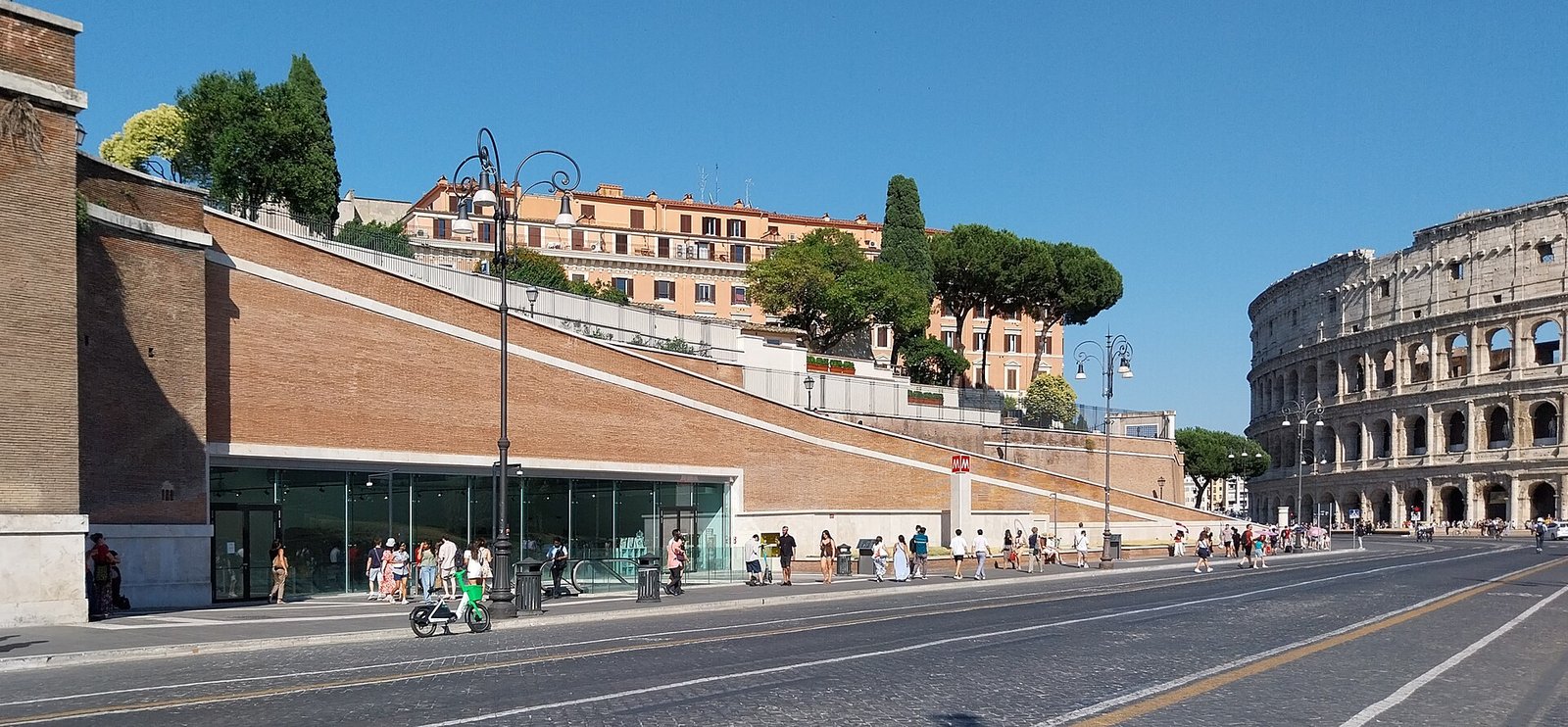
The last stage is at the Colosseum, with a declared focus on the new Colosseo Fori Imperiali station, which the program calls a symbolic place where contemporary infrastructure meets archaeological heritage. The station opened on December 16, 2025 and is today the line's temporary terminus.
Rome's metro line C: the numbers
Line C is the third line of the Rome metro, marked in green: it connects Colosseo to Monte Compatri Pantano with 24 stations over 21.2 kilometers, and it's the longest driverless metro in Italy.
The route
The line crosses the southeastern part of the city. The outer terminus, Monte Compatri Pantano, is in the municipality of Monte Compatri. Two stations are transfer points: San Giovanni with line A and Colosseo with line B. The average distance between stations is 883 meters and the travel time for the entire line is 38 minutes.
Driverless trains
It's the fourth Italian metro, after Turin's, Milan's M5 and the Brescia metro, to use automatic trains with no staff on board, with doors separating the platform from the tracks. It's also the only heavy automatic metro in Italy. The trains, of the MC100 series built by AnsaldoBreda (now Hitachi Rail), have six cars, are just over 109 meters long and carry 1204 passengers.
Frequency and service hours
Trains run every 9 minutes, even though the power supply is sized for one train every 110 seconds. From Sunday to Thursday service starts at 5:30 and the last trains leave the termini at 23:30. On Friday and Saturday service is extended until 1:30.
Barrier-free
All stations on the line are free of architectural barriers and have automatic ticket machines. On board there are spaces for bicycles, next-stop announcements and information screens.
How many people use it
In 2024 the line carried 16,622,503 passengers, about 45,400 a day. The previous peak was in 2019, with more than 18.7 million. The collapse in 2020 and 2021 and the recovery that followed tell the recent story of the city better than many essays.
The history of line C, from 1992 to the Colosseo terminus
The path that led to line C began in 1992 with law 211 on rapid mass transit systems. The first section, from Pantano to Parco di Centocelle, opened on November 9, 2014.
The project and the tender
In December 2001 the line entered the first Strategic Infrastructure Program. In December 2004 CIPE approved the Fundamental Route and the adoption of full automation. In 2005 Roma Metropolitane published the tender, won by the Metro C consortium, made up of Astaldi, Vianini Lavori, Ansaldo Trasporti Sistemi Ferroviari and two cooperatives.
Archaeology that changes plans
The first sites for archaeological surveys opened in May 2006. The discovery of Roman-era structures in Largo di Torre Argentina led to the Argentina station being removed from the project. In October 2008, during excavations in Piazza Venezia, an imperial-era building identified as Hadrian's Athenaeum came to light.
Openings in stages
The Pantano-Parco di Centocelle section opened on November 9, 2014. The section to Lodi was inaugurated on June 29, 2015. San Giovanni arrived on May 12, 2018. On December 16, 2025 Porta Metronia and Colosseo were inaugurated, the latter becoming the temporary terminus.
The old Pantano railway
In July 2008 the Pantano-Giardinetti section of the former Roma Laziali-Pantano concession railway was closed, so that the surface route of the new line could run on its bed. The outer stops, from Grotte Celoni to Torrenova, therefore run where the old Casilina train used to pass.
Construction toward the north
Work continues. Construction sites for Venezia station opened on June 22, 2023. On February 25, 2026 construction began on the Venezia-Mazzini section, 3.9 kilometers long with four stations, and on July 23, 2026 on the Mazzini-Farnesina section. As of July 2026, seven stations are under construction, including a second transfer point with line A at Ottaviano.
Who organizes it: Ottavo Colle APS and Irene Ranaldi
Ottavo Colle is a Roman social promotion association founded by urban sociologist Irene Ranaldi, which for 11 years has organized walks in the city's outskirts.
An urban sociologist at the helm
Irene Ranaldi, according to the association's presentation, comes from Franco Ferrarotti's school of sociology and has worked in this profession for 25 years. 11 years ago she founded Ottavo Colle, which presents itself as a pioneering association in Rome in the rediscovery of local tourism.
Polyphonic seminars, not fact-cramming tours
The association describes its walks as small polyphonic seminars: the city is explored through the social sciences, architecture, fiction, poetry and street art. It also claims a critical look at tourism, highlighting its distortions, starting with gentrification and touristification.
The other autumn dates
In Ottavo Colle's calendar, alongside the line C stages, October featured a walk toward the birth of an ecomuseum of industrial archaeology in the Testaccio-Ostiense area (October 3), a special opening of Monte Testaccio (October 10) and two stages of the Chiese Periferiche project, in Centocelle (October 11) and Corviale (October 18).
General conditions
For regular walks in Rome the association asks for an annual membership card of 5 euros plus a contribution of 15 euros. People with disabilities and a companion pay 10 euros including the card, and there are agreements with some categories. Those under 18 take part for free. For the line C stages, as mentioned, the pages list the contribution as free.
Pigneto, the fourth stop of Lungo la Linea C
Pigneto is a neighborhood in Municipio V, in the triangle between Via Prenestina, Via Casilina and Via di Acqua Bullicante, starting from Porta Maggiore.
The name and the origins
The name comes from the pines of the Caballini family, linked to Villa Serventi. The place name is recorded from the 17th century, while the residential core formed after 1870. In Piazza Caballini, between 1886 and 1891, there was a depot for horse-drawn trams, electrified in 1904.
The factories and the war
The neighborhood's history is an industrial one: the Pantanella, Serono from 1909, the viscose factory on Via Prenestina active from 1923 to 1954, the former SNIA. The 1943 and 1944 bombings hit the area hard, with 50 Atac employees among the victims.
The neighborhood of cinema
Pigneto is one of the best-loved sets of Italian cinema: Rome, Open City (Via Montecuccoli), Accattone from 1961, Bellissima, Il ferroviere, Una vita difficile, Un borghese piccolo piccolo, Audace colpo dei soliti ignoti, even Fantozzi. The L'Aquila movie theater, confiscated in 1996, reopened in 2015, the same year Via del Pigneto was pedestrianized.
Our pages on the neighborhood
For those who want to come back to Pigneto at another time, there are pages on Officina Pigneto between Biblioteca Mameli and Nuovo Cinema Aquila, on the Pigneto Comedy Fest and on Quartiere Vino Pigneto. A little farther on, toward the center, is Porta Maggiore.
Colosseo Fori Imperiali, the last stop of Lungo la Linea C
Colosseo Fori Imperiali station, inaugurated on December 16, 2025, is the current terminus of line C and the transfer point with line B.
A station under the archaeology
The Porta Metronia-Colosseo section was dug with 6.70-meter boring machines instead of the 10:10-meter ones originally planned under the so-called Rome model, which called for oversized tunnels under the archaeological layers so that access shafts and exits could be moved in case of important finds. In the Porta Metronia area, in 2015, a 2nd-century AD barracks was found, whose remains are being dismantled and put back at their original depth.
The amphitheater overhead
At the exit is the Colosseum, the Flavian Amphitheater, begun by Vespasian between AD 70 and 72 and inaugurated by Titus in 80 with 100 days of games. Next to it are the Roman Forum, the Palatine and the Domus Aurea, and along Via dei Fori Imperiali the Museo dei Fori Imperiali at Trajan's Markets.
Park hours in November
Those who want to extend the morning of November 14 with a visit should know that since October 25 the Colosseum opens at 8:30, with last entry at 15:30 and closing at 16:30. For the Colosseum, online booking of the time slot is mandatory and the ticket is in the holder's name.
San Giovanni, the first archaeo-station
Two stops before the terminus is San Giovanni, which was the first archaeo-station of the Rome metro: a route with display cases, panels and a timeline that takes passengers from the atrium to the platforms, with gold jewelry, coins, pottery and mollusk shells. Above it is the Basilica of San Giovanni in Laterano.
How to get to the stages of Lungo la Linea C
For each stage of Lungo la Linea C the natural way to get there is metro C: the meeting point is in front of the stop that gives the walk its name.
From the center to Grotte Celoni and Torre Spaccata
From the center you take line C at Colosseo or San Giovanni (where line A also arrives) toward Monte Compatri Pantano. Grotte Celoni is one of the outer stops, above ground on Via Casilina, in Municipio VI. Torre Spaccata is closer, past Alessandrino. The entire line, from one terminus to the other, takes 38 minutes.
To Pigneto
Line C's Pigneto stop is at the intersection with Via del Pigneto, and a little farther on is Malatesta. The neighborhood is also served by the tram on Via Prenestina and by the Ponte Casilino and Sant'Elena stops of the Termini-Centocelle railway.
To the Colosseum
The Colosseum is served by metro B (Colosseo stop) and metro C (Colosseo Fori Imperiali), by buses 51, 75, 81, 85, 87 and 118 and by tram 3.
Transport tickets
All line C stations have automatic ticket machines where you can buy tickets and top up Metrebus passes. For combinations other than those listed it's best to use ATAC's route planner.
How to prepare for a Lungo la Linea C walk
Two hours on foot through the neighborhoods, starting at 10:00: you need comfortable shoes, an umbrella in autumn and the booking confirmation at hand.
Arriving early
The group leaves from the stop, and some stations have several exits. My advice is to arrive 10 minutes early and read the confirmation email to know which exit the association indicates.
What to bring
Water, a notebook, a light jacket. Ottavo Colle's walks are conversations: questions are welcome.
With children
Those under 18 take part for free. Two hours of walking and listening are a lot for the little ones. For middle and high school kids, on the other hand, they're a lesson in urban geography that no book can replace.
Accessibility of the Lungo la Linea C walks
All line C stations are free of architectural barriers: getting to the meeting point is easy even in a wheelchair.
The walking route
The route through the neighborhoods isn't described in detail. Sidewalks, crossings and changes in level vary from one area to another. Those with specific needs would do well to mention them in the message on the sign-up form.
Conditions for people with disabilities
For regular walks Ottavo Colle charges people with disabilities and a companion a fee of 10 euros including the membership card. For the line C stages the pages list the contribution as free.
Where to eat after Lungo la Linea C
The walks end at noon, the right time to have lunch in the neighborhood you've just discovered.
Staying in the neighborhood
The point of the project is to shift the gaze toward the outskirts: having lunch in Torre Spaccata or Villaggio Breda, instead of going back to the center, is the most consistent way to end the morning. The neighborhood guides are usually the first to tell you where to eat well.
In Pigneto
Via del Pigneto has been pedestrian since 2015 and is the street lined with the neighborhood's restaurants and bars. At noon on Saturday finding a table is usually easier than in the evening.
At the Colosseum
Around the Colosseum the options are designed for visitors. Moving a few streets away from the square helps you find quieter tables.
The Roman outskirts crossed by Lungo la Linea C
Line C connects the Monte Compatri Pantano terminus, outside the municipality of Rome, with the archaeological center, crossing the southeastern part of the city along the Casilina axis.
Via Casilina as a backbone
The outer section runs above ground on Via Casilina, where the old railway to Pantano used to pass. The line's depot and workshop is in Graniti, on Via Casilina, and covers 217,000 square meters, with the operations center.
The station names
Reading the sequence of stops is already a journey: Torre Gaia, Torre Angela, Torrenova, Giardinetti, Torre Maura, Torre Spaccata, Alessandrino, Parco di Centocelle, Mirti, Gardenie, Teano, Malatesta, Pigneto, Lodi. They are names of towers, of flowers, of streets: each one points to a different piece of the city.
The outskirts aren't just one place
Villaggio Breda isn't Torre Spaccata, which isn't Pigneto. The project insists on exactly this: each stop is a gateway to an area with its own history, its own associations, its own social transformations.
More pages on eastern Rome
Along the same route, for those who want to keep exploring, there are pages on the Mausoleum of Sant'Elena and on the Casilino Urban Fest.
A curious fact about Lungo la Linea C, urban walks from Mirti to the Colosseum, September 20 to November 14, 2026
The most beautiful curious fact concerns the project's name and the place that isn't there: Argentina station. In the original plan, line C was supposed to have a stop at Largo di Torre Argentina, in the historic center. During the archaeological surveys, which began in May 2006, Roman-era building remains emerged, and the station was canceled. A few years later, in October 2008, the excavations in Piazza Venezia brought to light an imperial-era building identified as Hadrian's Athenaeum, the school of the philosophers. The metro you take today to go and discover the outskirts is therefore also the metro that has made the most archaeological discoveries beneath Rome, up to the 2nd-century barracks found at Porta Metronia in 2015. Not everyone realizes that the same boring machine that digs under the Forums has its depot in Graniti, on Via Casilina, on an area of 217,000 square meters with workshops, management and the operations center. The line is a single body: the brain is in the outskirts, the head reaches the Colosseum. Ottavo Colle's walks, which start from Mirti and end right at Colosseo Fori Imperiali station, follow exactly this design, and in our view they make it visible better than any map.
Something nobody tells you about Lungo la Linea C, urban walks from Mirti to the Colosseum, September 20 to November 14, 2026
What nobody says is that these walks can be canceled. Ottavo Colle's rules require a minimum of 15 sign-ups within the 48 hours before the walk: if that number isn't reached, the date is canceled and notice arrives by email. At the same time the cap is 35 participants, set by Roma Capitale. The useful window is narrow, and the practical advice is to book early and convince a couple of friends: you help the walk go ahead and you're sure of your spot. Then there's a second detail that people miss: sending the form isn't a booking. Only the association's confirmation email counts, and it also contains the exact starting address. Anyone who shows up at the stop without a confirmation risks not finding the group, especially at stations with several exits. Finally, a calendar matter: the Grotte Celoni stage fell on a Friday morning, the others on weekends. For those who work, October 9 was the hardest one to fit in. For retirees or students, it was perhaps the most relaxed, because on Friday mornings the neighborhoods have their daily life, without the weekend rhythm. In our view it was exactly the one to choose.
My advice for Lungo la Linea C, urban walks from Mirti to the Colosseum, September 20 to November 14, 2026
My advice is to make the trip twice. The first time with the group, in the morning, following Ottavo Colle's guides for the scheduled two hours. The second time on your own, on another day, taking line C from one terminus to the other without getting off: 38 minutes of travel from Colosseo to Monte Compatri Pantano, 24 stations, part in tunnels and part above ground on Via Casilina. Sitting at the front, where the driverless trains have a viewing window onto the tracks, you see the city change in density, height and color. It's the best way to put in order what the walks tell in pieces. A second piece of advice concerns the future: the outer stages of Grotte Celoni and Torre Spaccata have already taken place, but if Ottavo Colle offers the series again, it's worth choosing one of those. Pigneto and the Colosseum are places you can also get to know on your own, with many guides and plenty of literature. Villaggio Breda and Torre Spaccata rarely appear in itineraries, and hearing their story from people who have studied them for years is a rare opportunity. Third: bring a question with you. Ottavo Colle's walks are designed as seminars, and the best part comes when someone from the neighborhood joins in.
Another well-known fact, yet not often mentioned
Everyone knows metro C is late. Few remember by how much and at what cost. In 2010 the mayor announced the completion of the Monte Compatri Pantano-San Giovanni section by the end of 2013, of San Giovanni-Fori Imperiali by 2016 and of the entire line up to Mazzini by 2018, two years behind the original schedule. The first section opened in November 2014, San Giovanni in May 2018, the Colosseum in December 2025. The planned cost for the fundamental section between Pantano and Mazzini was 3 billion 739 million euros. At the end of the works, the section from Pantano to the Colosseum alone cost 3 billion 790 million. For Venezia station, excavation included, 755 million are planned, for the Venezia-Mazzini section 2.2 billion, plus 890 million to reach Farnesina. Costs are split between the State, Roma Capitale and the Lazio Region: 70, 18 and 12 percent, except for the San Giovanni-Alessandrino section, funded 70 percent by the State and 30 by Roma Capitale. These are numbers that cause debate, and rightly so. But walking in Torre Spaccata with a station a few steps away helps you understand what was bought with that money: a line that for the first time puts the eastern outskirts half an hour from the Colosseum.
The right photo to take at Lungo la Linea C, urban walks from Mirti to the Colosseum, September 20 to November 14, 2026
The right photo is taken inside the train. Line C trains are driverless, with no driver's cab, and have a viewing window onto the tracks: sitting at the front, you can photograph the tunnel opening up ahead like a long perspective. The best moment is the exit into the open, on the outer section along Via Casilina, when the morning light suddenly floods the car. A second photo should be taken at Colosseo Fori Imperiali, the station that the project's program calls a symbolic place where contemporary infrastructure meets archaeological heritage: going up the escalators toward the exit, the frame with the mass of the amphitheater appearing at the top is the visual summary of the whole series. The third photo is of the signs: the sequence of station names on the route board, from Monte Compatri Pantano to Colosseo, with Torre Gaia, Torre Angela, Giardinetti, Gardenie, Mirti. One precaution: during the walks you meet people from the neighborhood, courtyards, homes. Always ask before photographing someone, and remember that the project is about communities, not stage sets. The best photo of the outskirts, in our view, is the one where the people who live there have chosen to be in it.
Some important events that happened here in history
The history of line C, for those who walk it stop by stop, is made of precise dates. On November 9, 2014 the first section opened, from Pantano to Parco di Centocelle, after pre-operation began on December 15, 2013. The news reports recall that the first train stopped for 11 minutes because of a breakdown. On June 29, 2015 the line reached Lodi, passing through Mirti, Gardenie, Teano, Malatesta and Pigneto. On May 12, 2018 San Giovanni opened, with the transfer to line A and the city's first archaeo-station. On December 16, 2025 Porta Metronia and Colosseo Fori Imperiali were inaugurated, the latter becoming the temporary terminus and the transfer point with line B. In 2026 work continues northward: on January 14 the agreement between Roma Capitale and Webuild for the section up to Farnesina was signed, on February 25 construction began on the Venezia-Mazzini section and on July 23 on the Mazzini-Farnesina section. Above the tracks, meanwhile, history is older: at the Colosseum, whose site was once occupied by Nero's lake of the Domus Aurea, and in Pigneto, where in 1943 and 1944 the bombings hit the working-class neighborhoods and killed 50 Atac employees. The walks hold these two times together.
Who has passed through Lungo la Linea C, urban walks from Mirti to the Colosseum, September 20 to November 14, 2026
Line C has mostly carried passengers: 16.6 million in 2024, about 45,400 a day, people going to work, to school, to the hospital. But the neighborhoods it crosses also have illustrious guests. Through Pigneto passed the great Italian cinema: the crews of Rome, Open City, shot partly in Via Montecuccoli, and of Accattone, in 1961, and then the sets of Bellissima, Il ferroviere, Una vita difficile, Un borghese piccolo piccolo, Audace colpo dei soliti ignoti, even Fantozzi. At the Colosseum, where the line ends, the list is endless: Titus, who inaugurated the amphitheater in 80 with 100 days of games, Benvenuto Cellini, who wrote that he practiced necromancy there, Goethe, who in 1787 left a famous description of it by night, Ignatius of Loyola, Philip Neri and Camillus de Lellis, linked to the church of Santa Maria della Pietà al Colosseo. Along the project's route also passes Irene Ranaldi, an urban sociologist trained in Franco Ferrarotti's school, who for 11 years has led Ottavo Colle through the Roman outskirts. Among the most awaited passengers, finally, there's you: the project works only if the train also fills up in the opposite direction.
Private tours along line C
The project's walks are for groups of up to 35 people and on fixed dates. Those looking for a private itinerary, for a company, a school or a group of friends, can contact Tour Leader Pro, which organizes tailor-made tours and experiences in Rome.
Frequently asked questions about Lungo la Linea C
When are the Lungo la Linea C walks?
Lungo la Linea C includes five walks, all from 10:00 to 12:00: Sunday, September 20, 2026 in Mirti, Friday, October 9 in Grotte Celoni and Saturday, October 24 in Torre Spaccata (already held), Saturday, November 7 in Pigneto and Saturday, November 14 at the Colosseum. The calendar is published by Roma Capitale and by the Ottavo Colle association.
Are the Lungo la Linea C walks free?
The stage pages for Lungo la Linea C on Ottavo Colle's website list the contribution as free, and those under 18 always take part for free. The presentation of the first stage mentions a reduced cost compared with the association's regular walks: the final conditions arrive with the confirmation email.
How do you book Lungo la Linea C?
For Lungo la Linea C booking is mandatory: you write to prenotazioniottavocolle@gmail.com or fill out the sign-up form on the stage page of Ottavo Colle's website, within 48 hours of the start. Your spot is guaranteed only after the association's confirmation email.
Where do you meet for Lungo la Linea C?
The meeting point for Lungo la Linea C is in front of the metro C stop that gives the stage its name: Grotte Celoni, Torre Spaccata, Pigneto, Colosseo Fori Imperiali. The exact starting address is confirmed by Ottavo Colle in the booking confirmation email.
How many people can take part in Lungo la Linea C?
Each Lungo la Linea C walk takes a maximum of 35 participants. A minimum of 15 sign-ups within the previous 48 hours is also required: if it isn't reached, the walk is canceled and the association communicates this by email.
Who organizes Lungo la Linea C?
Lungo la Linea C is a project by Ottavo Colle APS, a social promotion association founded 11 years ago by urban sociologist Irene Ranaldi, as part of the initiatives of Roma Capitale's Department for the Outskirts, which supported the project with a grant.
Are the line C stations accessible?
All metro C stations, where the Lungo la Linea C walks start, are free of architectural barriers. The walking route through the neighborhoods changes from stage to stage: those with specific needs can mention them in the sign-up form.
How long is the metro C ride from the Colosseum to Grotte Celoni?
The entire line C, from Colosseo to Monte Compatri Pantano, takes about 38 minutes. Grotte Celoni is one of the last stops to the east, so from the center you need just over half an hour. For the outer stages it's best to leave with some margin.
My final advice on Lungo la Linea C
My advice is to book the Pigneto stage right away, arrive 10 minutes early and, for once, leave the Colosseum for last. Rome is better understood from the east.
Article written by the editorial team of Tour Leader Pro, contact them for Private/Corporate/V.I.P. Tours and Experiences.
Planning a trip to Rome? English guides for visiting the city are on ItalyPlanner.com.
Contact Information
Upcoming events nearby
 Tramonto Occidentale at Cubolibro: residency showcase with blind and low-vision people, Nov 18, 20261.1 km
- Il medico dei pazzi by Eduardo Scarpetta with Gianfelice Imparato at Teatro Tor Bella Monaca1.3 km
- 80 centesimi by Compagnia Il Milione at Teatro Tor Bella Monaca, November 5-7, 20261.3 km
- Haiku26, a free workshop in Tor Bella Monaca1.3 km

You might also like
- Giuseppe Cederna on Gianni Rodari
- RCC One Stand Up at Maison Rosé, November 22
- Qui vivremo bene by Dopolavoro Stadera and Argot Produzioni at Centrale Preneste Teatro, November 13, 2026
- Mangia! by Anna Piscopo (Bam Teatro)
- Strega Bistrega by Ruotalibera Teatro at Centrale Preneste Teatro
- Periferie Umane (Human Suburbs), final performance at Teatro Sala Vignoli, Nov 21 and 22, 2026