Bocchignano (RI)
In short. Bocchignano is a hamlet of the municipality of Montopoli di Sabina, in the province of Rieti, about 55-60 kilometers from Rome.
Bocchignano is a hamlet of the municipality of Montopoli di Sabina, in the province of Rieti, about 55-60 kilometers from Rome. The village is an inhabited town, so it has no ticket, no opening hours and no closing day: you enter on foot through the gate, free of charge, at any hour of the year. By car from Rome you take the A1 motorway toward Florence, exit at Fiano Romano (or at Ponzano Romano-Soratte, further north) and continue on state road 313 Ternana and then on the provincial roads of the Bassa Sabina. The Mirtense (SP 42) passes about two kilometers south of the town, and the Tancia road (SP 46), which links Poggio Mirteto to Rieti, runs through it. From the motorway toll booth it is about 23 kilometers, from Poggio Mirteto about eight and a half, from the municipal seat Montopoli four kilometers of road. Travel time from the center of Rome: an hour and a quarter without traffic, up to two hours at rush hour. By train you take the regional line FL1 (Orte-Fiumicino Aeroporto, with stops at Roma Tiburtina, Ostiense and Trastevere) to the Poggio Mirteto station, which is on the valley floor about eight kilometers from the village. From there a Cotral bus on the Poggio Mirteto-Rieti line and a city line of the local service pass through Bocchignano and stop at the junction on the provincial road, about 100 meters from the gate. The schedules change every year and must be checked before leaving on the Cotral website and on the channels of the Municipality of Montopoli di Sabina. You park in the wide spots outside the walls, along the access road. The churches open only for services or on request to the parish. For the village alone, two hours are enough. To do it well, half a day together with the Abbey of Farfa.
Whoever wants to place the town in its territory starts from the page on the province of Rieti and from the one on Fara in Sabina, the two reference points from which one reasons about the whole Tiber Sabina. Whoever arrives from abroad and reads English will find the guide to the abbey that made the history of this hill at ItalyPlanner, Farfa Abbey guide.
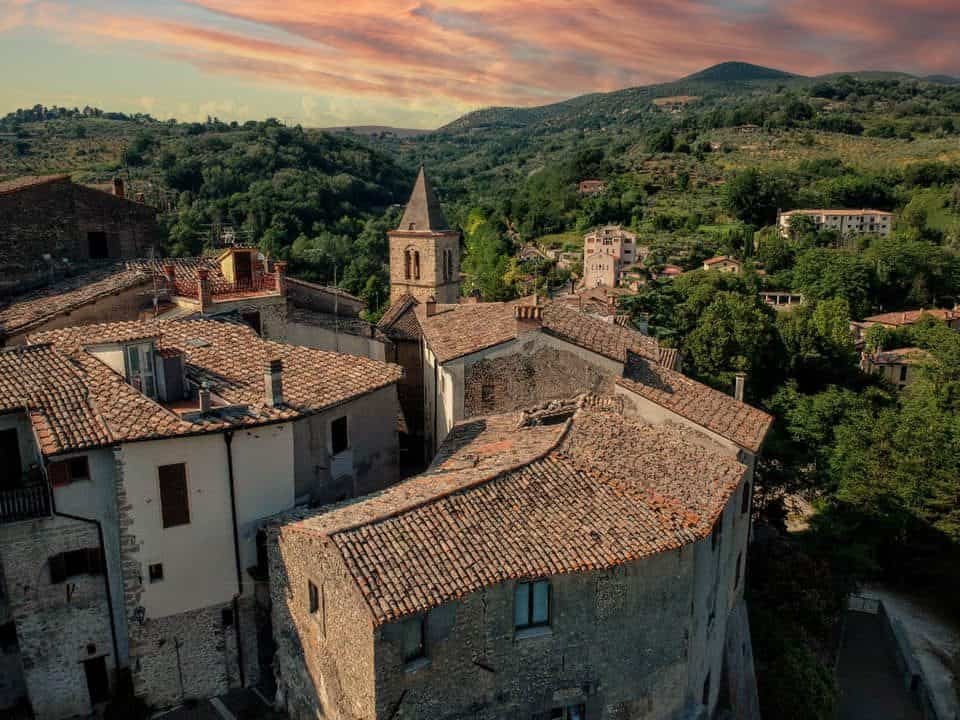
How to get to Bocchignano from Rome: car, train, bus and bicycle
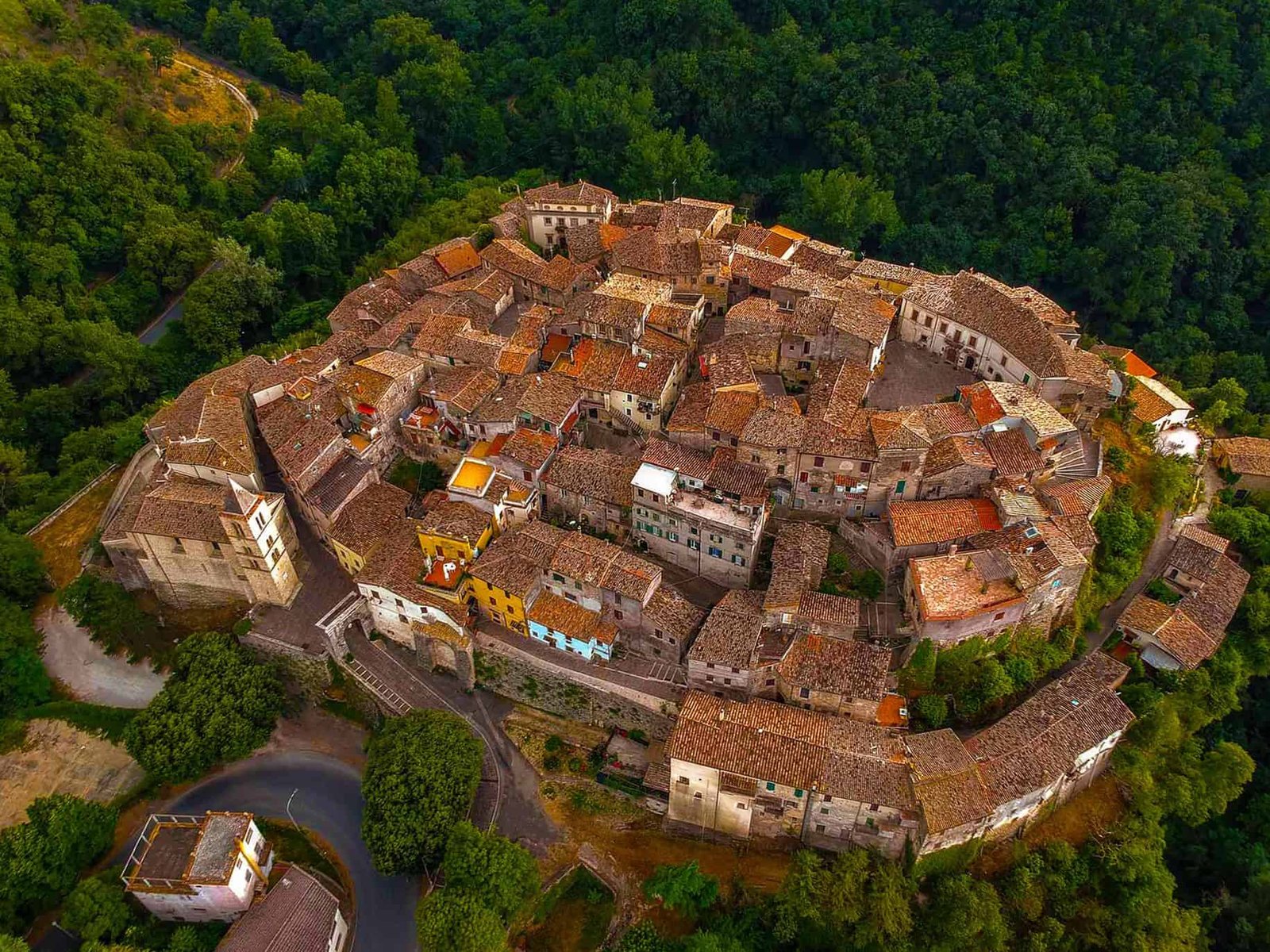
There are villages that announce themselves from afar and villages that hide until the last bend. Bocchignano belongs to the second kind. It stands on a spur at the confluence of three streams, surrounded by olive groves, and to really see it you have to arrive right on top of it: until that moment the landscape tells only of soft hills, rows of olive trees, scattered farmhouses, a cypress or two placed there as a marker. Then the road turns, the flank of the hill opens, and a curtain of houses appears that is both wall and dwellings, with the bell tower and the gate closing the front the way the fronts of towns that had to defend themselves were once closed. At that moment you realize you are in front of something different from a simple hamlet: you are in front of an inhabited castle, one of the oldest documented in the Sabina.
By car: the Autosole, the Ternana and the provincial roads of the Bassa Sabina
Let's start with logistics, because here logistics is not bureaucracy: it's the first part of the experience. From Rome the main road is the A1 Milan-Naples motorway heading north, the one people in Rome simply call the Autosole. The most convenient exit is Fiano Romano, the first real gateway to the Sabina for those coming from the capital. Whoever prefers to avoid the busiest stretch of the Ternana can continue to Ponzano Romano-Soratte and come down toward the Tiber from the north. From there on you leave the motorway rhythm and enter another logic of travel: state road 313 Ternana goes up the Tiber valley toward Poggio Mirteto and toward the upper Sabina, and from it you exit onto the Mirtense, provincial road 42, which runs a couple of kilometers from the town, or onto the Tancia road, provincial road 46, which joins Poggio Mirteto to Rieti passing right under the walls of Bocchignano. From the motorway toll booth to the village it is a good 20 or so kilometers, all of it hills.
One thing holds for the whole area: the signs are there, but they are discreet. Don't expect the redundant tourist signage of certain areas of central Italy, with the village logo repeated every 300 meters. Here the sign is brown, small, often placed at an intersection that looks secondary and is instead the right one. Taking the wrong turn on the way up to Bocchignano is no tragedy: you get to know three roads instead of one, you see Montopoli from below, you cross olive groves that weren't on the program. But whoever has a schedule to keep should set the navigation on Bocchignano and not on Montopoli di Sabina, because the municipal seat and the hamlet are two distinct points: one kilometer as the crow flies, four kilometers of curves by road, a ring road that links them by circling the two hills.
The calculation of times, in normal conditions, is this: from northern Rome, that is from the area of the Grande Raccordo Anulare at the level of the Salaria or the Flaminia, you arrive in a little over an hour. From the center of Rome, at the hours when the ring road breathes, it takes an hour and a quarter, an hour and a half. At rush hour on Friday afternoon or on the Sunday return, add 30 or 40 minutes without argument: the A1 between northern Rome and Fiano is one of the busiest stretches in Italy and gives no discounts to anyone. In the Sabina the rule is to leave early: at 8 in the morning the stretch flows, at 11 it starts to suffer.
By train and bus: the FL1 to Poggio Mirteto and the last stretch uphill
Whoever has no car or doesn't want to use it still has a way, and it's less complicated than you might think. Bocchignano has no station of its own. The reference station is Poggio Mirteto, on the FL1 railway line, the one that links Orte to Fiumicino Airport passing through the urban stations of Rome: Tiburtina, Ostiense, Trastevere. It is a regional metropolitan service line, with trains every half hour in the main time bands on weekdays and more sparse on holidays, but it's a real line, not a forgotten track. From Roma Tiburtina to Poggio Mirteto the trip takes roughly 50 minutes, and that alone should make you reflect on how close the Sabina is compared to the idea people have of it.
The delicate point is the last stretch. The Poggio Mirteto station is on the valley floor, near the Tiber. Bocchignano is on the hill, eight and a half kilometers away. Between the two there is an elevation difference and there are kilometers that are not covered on foot lightly, especially in summer. Road links exist and there are two: the Cotral suburban line that climbs from Poggio Mirteto toward Rieti along the Tancia and passes through Bocchignano, and a city line run by the local bus service that joins Poggio Mirteto to the nearby towns, Bocchignano included. To reach the bus terminal from the station you first go up to Poggio Mirteto town. Both buses stop at the junction on the provincial road, because inside the town there is no room to maneuver, and from the junction to the gate you walk about 100 meters, 200 at most. The runs are designed for commuters and students: very frequent in the early morning hours and late afternoon on weekdays, very sparse in the middle of the day and on weekends. Whoever chooses the train should check the schedules the day before on the official channels of Cotral and of the Municipality of Montopoli di Sabina, and bear in mind that the evening return might be the real constraint of the program. Alternatively, many visitors use the train to the station and then a hired car with driver or a local taxi for the last stretch. It's a solution that works, provided you book it in advance and don't improvise it at the station exit, because here there is no line of cars waiting as at Termini. Whoever prefers to have the day organized, with a guide who knows the roads and the real times of the Sabina, will find the tourist accompaniment service of TourLeaderPro.
By bicycle: the Tiber Sabina is slow cycling terrain
One last possibility, the best for those with time, is the bicycle. The Tiber Sabina is slow cycling terrain: secondary roads with little traffic, regular climbs that are never inhuman, descents that give back in a few minutes what you earned in half an hour. From the Poggio Mirteto station you can ride up toward the hill towns on a demanding route but within reach of those with trained legs, and the reward is that panorama over the Tiber valley that no car window will ever give back in the same way. Whoever decides to do it should bring water: there are drinking fountains, but not every 100 meters, and in the hot months the sun on the Sabina is no joke. The Farfa stream, which runs under the hill of Bocchignano, offers shade and coolness to those who want to extend the ride toward the valley floor.
Parking and shoes: the two things that decide the day at Bocchignano
Let's talk about parking, which in walled villages is always the most concrete topic. Bocchignano is a built-up area of medieval layout, which means narrow alleys, arches, stairways, spaces calibrated to the pace of a person and the load of a mule, not to the bulk of an SUV. The golden rule is very simple and holds for all of central Italy: leave the car outside the walls and enter on foot. There are parking spaces in the area outside the village, along the access road and in the wide spots that open before the gate. They aren't multistory car parks, they're wide spots: on ordinary days you find a place without problems, on feast days you have to be patient and arrive early. If everything is taken, don't give in to the temptation to squeeze into the alleys: you risk having to back up for 200 meters with a stone wall 10 centimeters from your mirror, and I assure you that it's not the memory you want to take home.
On shoes I don't compromise. You need soles with grip. The ground of the village is largely stone and cobble, in some places polished by centuries of footsteps, and with the morning damp or after rain it becomes treacherously slippery. You don't need trekking gear, you need a comfortable shoe with a sole that bites. Flip-flops and heels here are not a style choice: they are a technical error.
How much time you need to visit Bocchignano
It depends on the kind of traveler you are. If you're interested in the historic core, the gate, the curtain of walls, the church of San Giovanni Battista, a full tour of the alleys and a stop at the viewpoint, two hours are enough and well spent. Whoever wants to do things the way they should be done in the Sabina, that is slowly, should count half a day: you walk the village, you sit, you talk to whoever you meet, you go out to look at the valley, you come back in from the other side, you discover that the alley that looked closed leads to a lookout you hadn't seen. And if you place it in a wider itinerary, as is almost always best, Bocchignano becomes one of the stops of a full day that includes the Abbey of Farfa and perhaps a second village in the area.
When to go to Bocchignano: the four seasons of the Sabina
The Sabina has four well-distinct seasons and each changes the character of the place. Spring is the season of clear light and very green hills, with tall grass among the olive trees and the days getting longer. It's probably the best period of all. Autumn is the season of the oil, when the countryside really works, the olive mills start their engines and the air of the area has that unmistakable smell of freshly crushed olives: whoever is interested in the productive and gastronomic side should come then. Winter is the season of the feast and of silence, with short days, low raking light that draws the stones better than any other, and with the popular polenta event, which I talk about further on. Summer brings the patron saint: San Giovanni Battista is celebrated on June 24, and the evenings of July and August are magnificent, with the air drying out and the valley lighting up with distant lights. The middle hours, on the other hand, are to be avoided.
Services, phone and maps: what to expect in a town of a few hundred inhabitants
A practical tip worth gold: don't count on services as you would in a city. In a village of this size the open businesses are few and the hours follow the real life of the town, not the needs of tourism. The bar may close in the afternoon, the small grocery may do a single shift, the restaurant may work only by reservation out of season. It's not a defect: it's the mathematical consequence of a settlement where residents number a few hundred. The countermove is simple: eat before or after in one of the better-equipped centers in the area, Poggio Mirteto above all, or phone before leaving to check the openings, or bring what you need for an outdoor lunch. On the other hand, when you find something open, you find something authentic.
Last practical point, and not a minor one: phone coverage. In town it works, in the surrounding valleys and on certain roads among the olive trees it becomes capricious. Whoever relies on navigation should download the offline map of the area before leaving. It's the kind of precaution that seems excessive until you find yourself at a fork with no signal, the sun going down and nobody to ask. For those who arrive from abroad and are building a trip in Lazio without knowing the real distances, the advice is to reason in time and not in kilometers: 60 kilometers from Rome here is not 30 minutes, it's a good hour, because the last stretch is all hills. An overview of day trips from the capital, with the times that really apply, is on the page Rome day trips by ItalyPlanner.
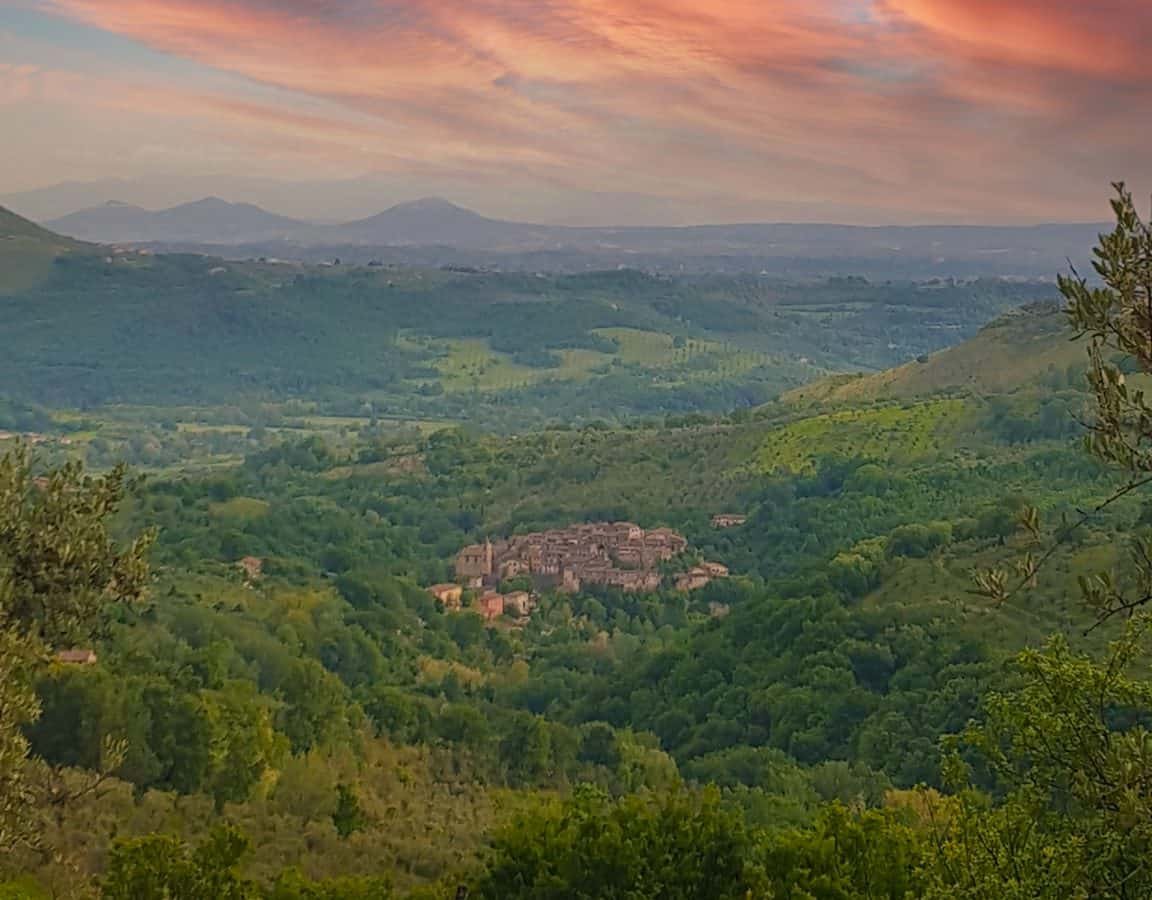
Bocchignano, an inhabited castle: a thousand years of history between Farfa, the popes and the Orsini
To understand Bocchignano you have to stop looking at it as a town and start looking at it as a defensive machine that has kept being inhabited. It's not an academic nuance: it's the key that explains why the houses are attached one to another, why the outer walls have no large windows toward the valley, why you enter through a gate and not a square, why the alleys are so narrow they look like corridors. Every urban planning choice that looks scenic today was, at the origin, a choice of survival. And unlike so many Sabine castles that merely evoke a generic past, Bocchignano has a written chronology, with precise dates, because its history passed through the richest archive of the Italian Middle Ages.
The name of Bocchignano: the buccina, the goddess Vacuna or a certain Voconius
In the medieval records the town appears as Buccinianum or Vacunianum, and from these two spellings descend three etymologies that scholars have been disputing for two centuries. The first derives the name from the buccina, the Roman military trumpet, and ties it to the tradition of a Roman camp or fortification on the spur. The second links it to Vacuna, the Sabine deity of woods and waters, to whom a temple would have been dedicated in the area: the Sabina is full of place names that recall her. The third, the most prosaic and for me the most probable, traces it back to a landowner named Voconius, mentioned in an inscription found near the town: the place names in -anum of central Italy are almost always names of rustic estates that bear the name of the owner, and Bocchignano would fall within the rule. None of the three hypotheses is documented beyond all doubt. All three say the same thing, namely that people already lived here before the castle.
Rome before the castle: the Nonii, the Sosii, the Villa dei Casoni and the bridge over the Farfa
The territory of Bocchignano began to be stably inhabited from the 2nd century BC, when the Roman senatorial families divided up the Sabine hills into villas and agricultural estates. For the Augustan age the inscriptions record the Nonii and the Sosii, two gentes who had interests in the area. The material traces of that period are outside the walls, and whoever has patience finds them: the remains of the so-called Villa dei Casoni, the ruins along the Farfa stream where the concrete piers of a Roman bridge survive, the Fonte Varrone on the road that descends toward Granica, a name that alone evokes the most Sabine of the Latin writers, that Marcus Terentius Varro who had a house in Rieti and who wrote about agriculture. None of this is turned into a museum, none of it is marked with panels. It's country archaeology, to be read with a trained eye and with respect for private property. The same local tradition holds that the church of Santa Maria in Pantano, now vanished, stood on the site of a temple of Jupiter: a hypothesis, not a document, but consistent with a hill inhabited for 2,000 years.
September 939: Teodoranda, Ingebaldo and the donation to the Abbey of Farfa
The first certain proof of the existence of the castle dates to September 939, when part of it was ceded to the Abbey of Farfa. The document is kept in the great collection compiled by the monk Gregorio da Catino between the 11th and 12th century, the Regesto di Farfa, and local tradition also gives the names of the donors: Teodoranda and her husband Ingebaldo, count of the Sabina, who would have ceded to the monks two thirds of the castrum of Buccinianum. It's a date that deserves to be weighed: in 939 most of the walled villages that are visited today in central Italy did not yet exist, and the phenomenon that historians call incastellamento, that is the transfer of populations from the open valley-floor villas to the fortified hilltop settlements, had only just begun. Bocchignano is one of the earliest documented examples in the Sabina, and this makes it, in the eyes of those who study the Middle Ages, much more interesting than its size.
It's worth explaining what incastellamento was, because it is the key to everything you see within these walls. The term indicates the process, developed above all between the 10th and 11th centuries, by which the populations scattered in the countryside of central Italy abandoned open settlements to concentrate in fortified nuclei on the hills. It was not a fashion, it was a necessity: the weakening of public power after the decline of the Carolingian order, the Saracen and Hungarian raids that went up the rivers, the chronic insecurity of the routes of communication made the open villa indefensible and made the castle convenient. Lay lords and great ecclesiastical bodies took the initiative, promoted the transfer of communities to the hills, guaranteed protection in exchange for obligations. In a few decades the landscape of central Italy changed form forever, and the form it took then is still, to a very large extent, the one you see today.
The Sabina is one of the most studied laboratories of this process, and it is so for a very fortunate reason: here there exists written documentation of extraordinary richness. The great protagonist is the Abbey of Farfa, a very powerful imperial monastery that in the Middle Ages controlled an immense landed estate, extending well beyond the borders of the Sabina. The monks of Farfa did not limit themselves to owning land: they recorded it. Donations, exchanges, emphyteuses, papal and imperial confirmations, disputes, boundaries: everything was copied and preserved. From this practice came the Regesto, and the Regesto is the reason why, in the Sabina, the events of tiny towns can be reconstructed with a level of detail that is unthinkable elsewhere. For a village like Bocchignano this means having behind it not a legend but an archive.
July 18, 1014: the Crescenzi, abbot Ugo and the castle that surrenders from thirst
The relationship between the Sabine castles and Farfa was complex and never linear, and Bocchignano shows it right away. At the beginning of the 11th century the Roman family of the Crescenzi, which in those years dominated the politics of Rome and was reaching its hands into the Sabina, seized the castle. The abbot Ugo I, the great reformer of Farfa, asked for its return, and the matter went all the way to the pope. Benedict VIII, who belonged to the rival family of the counts of Tusculum and had every interest in cutting the Crescenzi down to size, intervened personally and besieged the castle. Bocchignano resisted as long as it could, then surrendered for lack of water on July 18, 1014. A date this precise, for a town of this size, is a rare luxury. And it says something that whoever visits the village should keep in mind: the weak point of a rocky spur is always water. The three rings of walls could stop men. Thirst could not be stopped.
1153-1154: the free commune that never was
In the middle of the 12th century the inhabitants of Bocchignano attempted what so many communities of central Italy were attempting in the same decades: to give themselves an autonomous organization, a free commune, escaping the lordship of the abbey. The insurrection of 1153-1154 was repressed. It's a minor episode in the great history of the Italian communes, but it is significant because it shows that even in a castrum of a few hundred souls the ideas circulated that in Rome, in the same years, animated the reborn Senate and the preaching of Arnold of Brescia. The Sabina was not a sleepy periphery.
1235: Viterbo burns the castle on the orders of Gregory IX
In 1235 the army of the city of Viterbo, on the orders of Pope Gregory IX, besieged Bocchignano, burned it and destroyed it. The 1230s and 1240s were for the Sabina a period of continuous war between the papacy, the Roman barons and the cities allied with one or the other: the neighboring seat, Montopoli, was sacked in its turn by order of the same pope in 1243, and some local chronicles place the fall of Bocchignano in that year too, occupied by Roman troops. Be it 1235 or 1243, or two distinct episodes eight years apart, the result was the same: the castle of the 10th century ceased to exist in its original form. What you visit today is largely the later reconstruction.
Processo Rossi, Matteuccio and Giovanni da Fogliano: the rebirth of Bocchignano
At the beginning of the 14th century the nobleman Processo Rossi began the reconstruction of the village, continued by his son Matteuccio, whom local memory recalls as a wise and enlightened lord. At the end of the century the abbot Arnaldo d'Albiac brought the castle back under the direct control of the abbey, after a period in which it had been held by the Sant'Eustachio, one of the most active Roman baronial families in the Sabina. The 15th century brought new conflicts with neighboring Fara in Sabina and new sackings, until the castle was bought by Giovanni da Fogliano, who rebuilt the destroyed buildings and raised, or remade from the foundations, the church of San Giovanni, dedicated to the saint whose name he bore. It is to this passage that the 15th-century dating of the parish church is owed, while the bell tower, with its mullioned windows on three levels, seems to belong to an older phase, from the 13th century. In 1482 the territory passed to the Orsini, the family that in those decades was putting together its Sabine lordship around Montopoli, Fara and the castles of the Farfa.
1589: Sixtus V strips the barons of power and Bocchignano becomes land of the Church
In 1589 Pope Sixtus V, the pontiff who reorganized the Papal States with a heavy hand, took power from the local nobility and Bocchignano remained solely under the direct government of the Church. The gate of the village, with its inscription recalling Clement VIII, the Aldobrandini pope elected in 1592, is the monument of this new phase: no longer the castle of a baron, but the walled land of a community governed from Rome. Between the 17th and 18th centuries the notable families of the town, first of all the Guadagni, built or remade the palaces that still occupy the upper part of the settlement, and in the mid-18th century tradition brings to Bocchignano, as a guest of the Guadagni themselves, the great Franciscan preacher Saint Leonard of Port Maurice.
1853-1880: 27 years as a municipality, then the Depretis decree
In 1853, in the last years of the Papal States, Bocchignano obtained the dignity of an autonomous municipality. It kept it for 27 years, through the unification of Italy, until in 1880 a decree signed by the prime minister Agostino Depretis suppressed it and merged it into the municipality of Montopoli di Sabina. Those who live here say it without ambiguity: you are from Bocchignano before you are from Montopoli. This campanilismo, which to the distracted visitor may seem like folklore, is in reality the living residue of a history in which every castrum was an autonomous community, with its own statutes, its own saints, its own rules, and of a municipal autonomy lost less than 150 years ago. Administrative unification is recent, the identity is very ancient.
1943-1944: don Igino Renzi and the 30 people of Bocchignano saved
The last dramatic chapter in the history of the village is that of the Second World War. During the German occupation the parish priest of Bocchignano, don Igino Renzi, was the official chaplain of one of the partisan formations active in the territory. When the local Nazi command accused 30 inhabitants of the town of having killed three German soldiers, it was he who intervened and saved their lives. The Tiber valley was a strategic corridor, the bombings hit the railway and road junctions of the valley floor, and the hill towns knew the passage of troops, of displaced people and of those in hiding. In a community of a few hundred people, 30 men are an entire generation: without that priest, Bocchignano today would be a different town. It's a page that is alive in local memories and that rarely ends up in the guides.
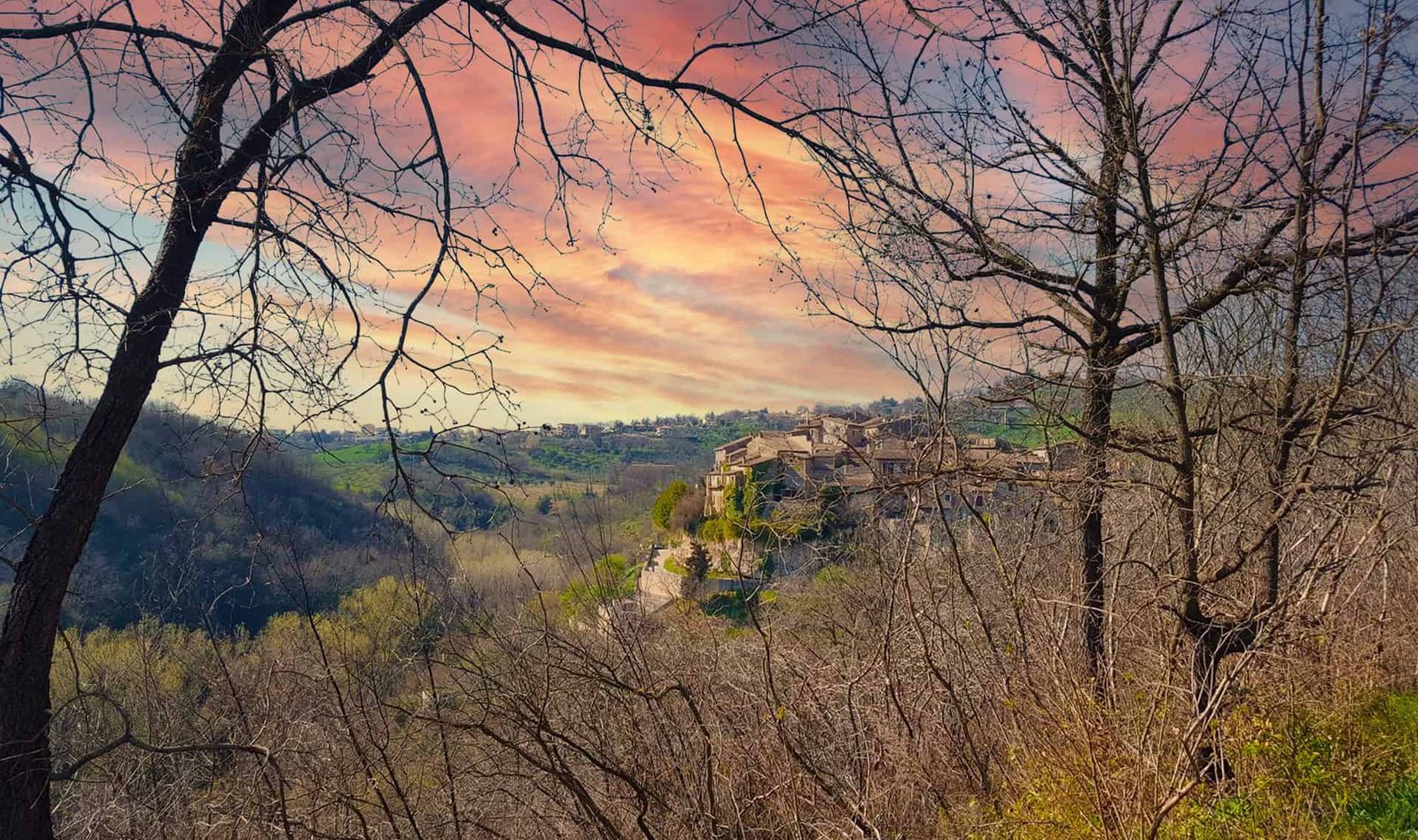
The visit to Bocchignano place by place: gate, walls, churches and palaces
At Bocchignano there is no marked route, and further on I explain why that is a stroke of luck. But a reasonable order of visit exists, and it's the one dictated by the very shape of the castle: from the outside to the gate, from the gate to the Burgu, from the Burgu to the church square, from the church to the palaces of the upper part, and finally outside the walls, toward the minor places that local tradition calls by dialect names and that no tourist map shows.
The three rings of walls and the gate of Clement VIII
The circuit of walls is the element that strikes those who arrive for the first time most, and the reason is that it isn't an isolated ruin but a system still readable as a whole. Tradition speaks of three concentric rings, with a single entrance defended by a drawbridge. Of that triple defense what is read today is above all the outer curtain, where the perimeter wall and the wall of the dwellings coincide: the houses of the first ring were themselves the defense, with blind lower floors toward the outside and openings facing inward. It's the same logic found in dozens of Sabine and Lazio castles, but here the legibility is excellent because the fabric has not been overturned by modern building expansions leaning against the walls.
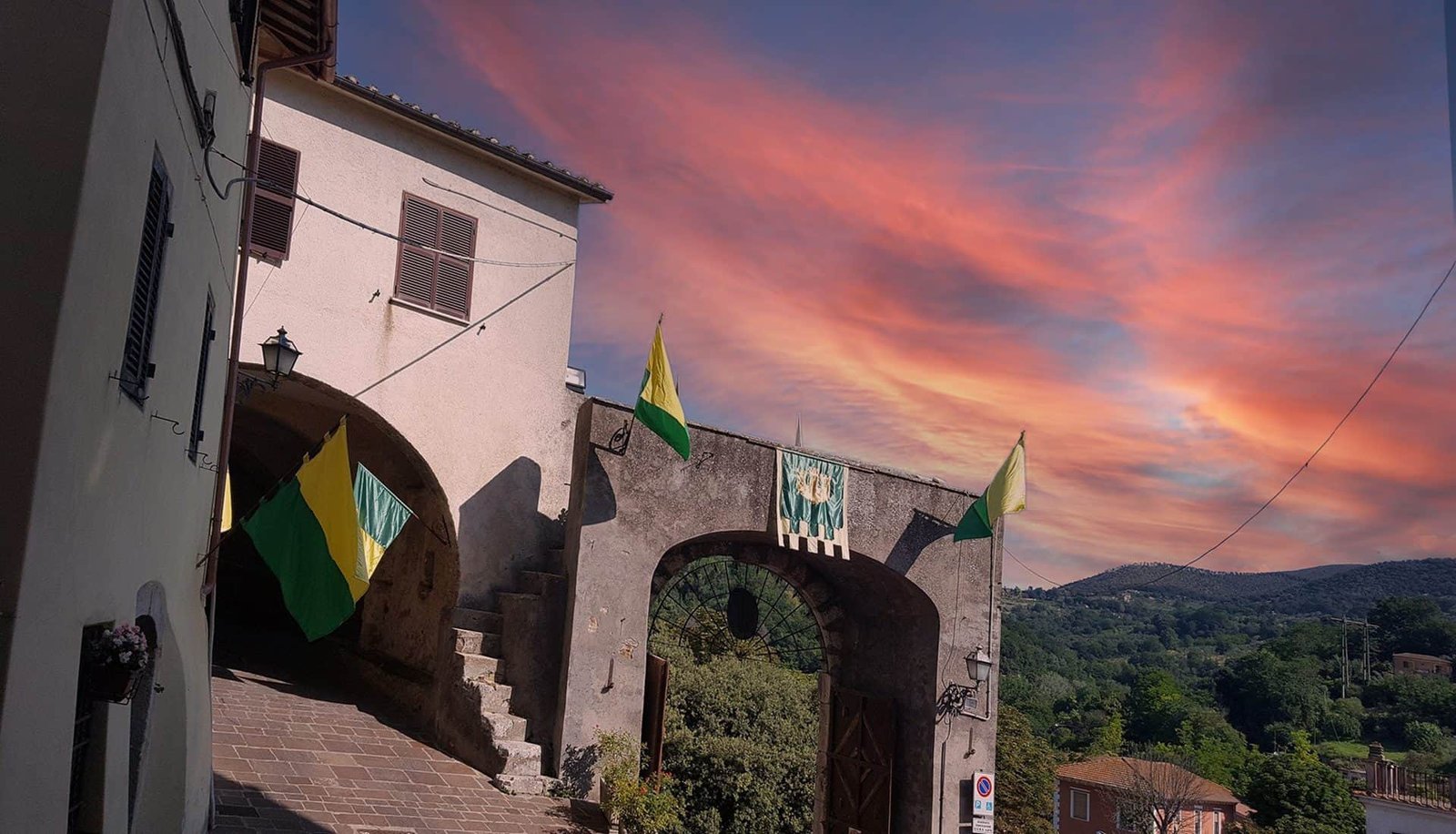
The gate deserves a long stop. In its present form it is a work of the late 16th century, with a Latin inscription recalling how it was built at public expense by the will of Pope Clement VIII: the words aere publico and the name of the pontiff can still be read on the stone, and they are the signature of the phase in which the village, taken from the barons by Sixtus V, became land administered directly by the Church. Before that gate there was another, medieval, with the drawbridge of which tradition keeps the memory. Passing through it is a physical and mental passage: outside is open countryside, inside is protected space. Notice the temperature jump, which in summer is very evident: you go from direct sun to the deep shade of the arch and the temperature drops suddenly. Notice the sound: outside the wind and distant engines, inside the echo of footsteps on the paving. Notice the light: the alleys are designed to be shady, and this makes them cool in summer and sheltered in winter. It's not decorative chance, it's bioclimatic design ante litteram done with the only tools available at the time, that is orientation, the mass of the walls and the width of the spaces.
The Burgu and the alleys of Bocchignano: reading the houses like a geological wall
Inside the walls the organization of the settlement follows the classic scheme of the Sabine castra: a main route that links the gate to the highest point, where the major defensive apparatus and the church stood, and a network of secondary alleys, often uphill, often stepped, which distribute access to the dwellings. The place name Burgu, which the people of Bocchignano still use, says by itself what idea of itself the town had: a borgo, that is a nucleus of houses tight within a defense, and that medieval fabric can still be read very well. The houses are tall and narrow, developed vertically because horizontal space was precious and limited by the circuit. Many entrances are raised above street level, reached by external stone stairways: below was the cellar or the stable, above the dwelling. This vertical layering of functions is one of the signatures of rural building in central Italy and at Bocchignano it can still be read perfectly.
The material is the local limestone, cut into irregular blocks and laid with poor mortar. Over time many facades have been plastered, others not, still others have lost the plaster leaving the masonry texture in view: walking around you can read the building history of the town the way you read a geological wall, recognizing the phases, the infills of old openings, the walled-up arches, the reused stones. Whoever has an eye for these things has a lot of fun at Bocchignano. Look in particular for the lintels with incised dates and the buttress arches that span the alleys: they are the points where the town recorded its own earthquakes and its own reconstructions.
The church of San Giovanni Battista in piazza della Pollarola
The parish church of Bocchignano stands on the square that the people of Bocchignano call della Pollarola, in the upper part of the village, and is dedicated to San Giovanni Battista, patron of the town, celebrated on June 24. The building has a two-stage history: the layout dates to the 13th century, as the bell tower shows, but the church was rebuilt in the 15th century by Giovanni da Fogliano, the lord who put the castle back on its feet after the sackings, and then completely reworked in the following centuries. Inside are preserved frescoes and furnishings that deserve a look, but the opening hours follow the religious services and the availability of whoever keeps the keys: whoever has a specific interest in the interior should ask beforehand at the parish or the Municipality. In some publications the church appears as San Giovanni Evangelista. The parish title and the feast of June 24 point to the Baptist.
The bell tower with mullioned windows and the mystery of the six triple enclosures
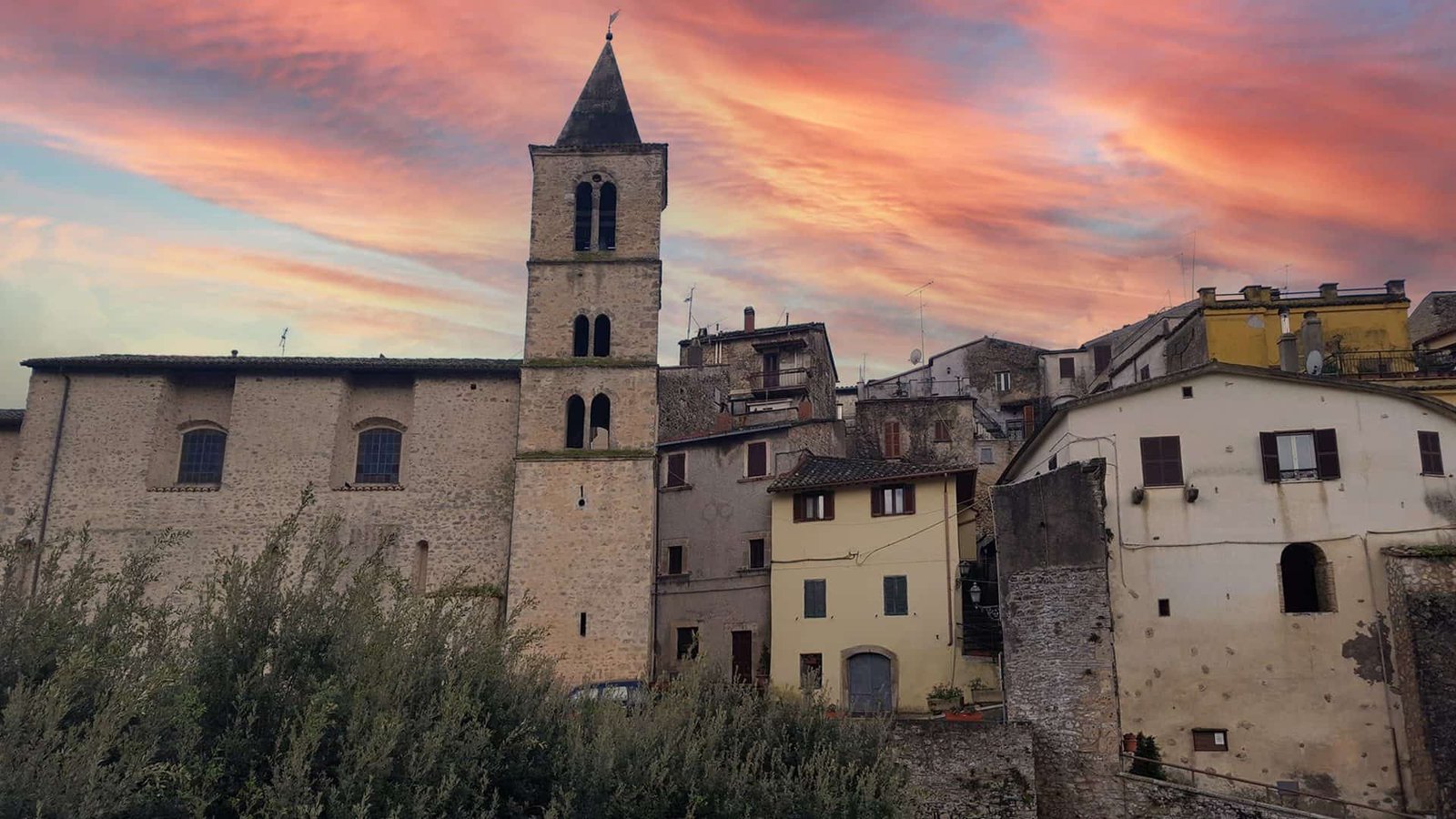
The bell tower is the best-preserved medieval element of the whole complex: a tower with three tiers of mullioned windows, to which the spire was added at a later time without erasing its 13th-century character. But the real curiosity of the church is outside, on the ground and on the stones. Around the building you can count six engravings of the Triple Enclosure symbol, three concentric squares joined by median segments: one on the marble threshold of a door, others on the stone seats, one on the arch that leads toward the center of the town. The symbol is one of the most discussed in minor European archaeology: for some it's simply the board of the game of nine men's morris, incised by those who waited sitting down. For others it's an apotropaic sign or a mark tied to medieval building sites. In the Sabina it recurs in several centers, and at Bocchignano the concentration is high. The fact that the village was defended, according to tradition, by three concentric rings of walls makes the coincidence at least curious. The most convincing hypothesis is the game: six nine men's morris boards around a church tell of centuries of men sitting in the sun waiting for Mass. But let everyone choose their own explanation in front of the stones.
Palazzo Guadagni and the castle of the Tre Torrette
The Palazzo del Capitano Guadagni is the most important civil building in Bocchignano: sober forms, Renaissance layout, a piano nobile and, higher up, the servants' floor, following the scheme of the provincial palaces of the Papal States. It was rebuilt in the 18th century and restored in recent times by the ambassador Mario Bondioli, who recovered the piano nobile and the cellars. Local tradition holds that the palace occupies the site of the castle of the Tre Torrette, a 12th-century fortification built by the will of Rome in order to keep the nearby Montopoli under control. It's a hypothesis, not a verified archaeological fact, but it explains well the position of the building in the upper and most defended part of the settlement. The Guadagni family is also the one that, according to tradition, hosted Saint Leonard of Port Maurice in the mid-18th century during his visits to the town.
San Sebastiano, Santa Maria in Pantano, San Pietro Martire and Santa Maria dei Carozzi
Besides the parish church, the religious history of Bocchignano has left traces in at least four other buildings, and all four tell what happens to the churches of a town that is emptying out. The church of San Sebastiano is today a nursing home: the saint protector against the plague, invoked in the centuries when epidemics came up the Tiber, has given way to care for the elderly, which in a village like this is the most necessary social activity. The church of Santa Maria in Pantano, the one that tradition has rising on the site of an ancient temple of Jupiter, has vanished and its site is today a public garden: sitting there means sitting on 2,000 years of worship. The church of San Pietro Martire is private property and cannot be visited. The church of Santa Maria dei Carozzi, formerly dedicated to Sant'Andrea in Scorticariis, keeps in its double name the memory of a vanished farming district. None of these is an attraction in the tourist sense of the term. Together they are the map of the devotion and the toil of a community.
Outside the walls: o sassu cche cresce, the Fonte Varrone, the grotta della Santaccia and the Farfa stream
Whoever has time and legs should leave the village and look for the places that the people of Bocchignano call by their own names. In via delle Cellugne is o sassu cche cresce, the growing stone, a boulder that popular tradition holds to be slowly increasing in volume. Geologically it's an outcrop around which the surrounding ground erodes, so the stone doesn't grow but the soil drops, but the village explanation is more beautiful and nobody disputes it. Toward Granica is the Fonte Varrone, with its Latin name. There is the grotta della Santaccia, a cavity tied to popular devotions whose origin is hard to reconstruct. There are the ruins of Santa Maria in Turano, in open countryside. There are the hills with their names, Cerretinu, Elcido, Pianòzze, Capannacce, Colle Paradiso, Colle Pulcino, and the Villa Marini. And there is, beneath it all, the Farfa stream, the watercourse that gives its name to the abbey and that here keeps the concrete piers of a Roman bridge: the water that in 1014 was missing for the besieged flows a few minutes from the walls, but below, out of reach of those shut inside.
The viewpoint over the Tiber valley
From the top of the village the gaze descends toward the Tiber valley. It's a panorama that changes completely depending on light and season. On clear winter mornings the valley is sharp all the way to the mountains that close it, and you can make out the outlines of the hill towns on the opposite slope, with Soratte standing alone to the southwest. On damp spring and autumn days the valley floor fills with fog and the villages emerge like islands: it's the show photographers chase and that, when it happens, repays any alarm clock. On summer evenings the valley lights up and the distant noise of the motorway becomes a barely perceptible hum, a discreet reminder that Rome is around the corner.
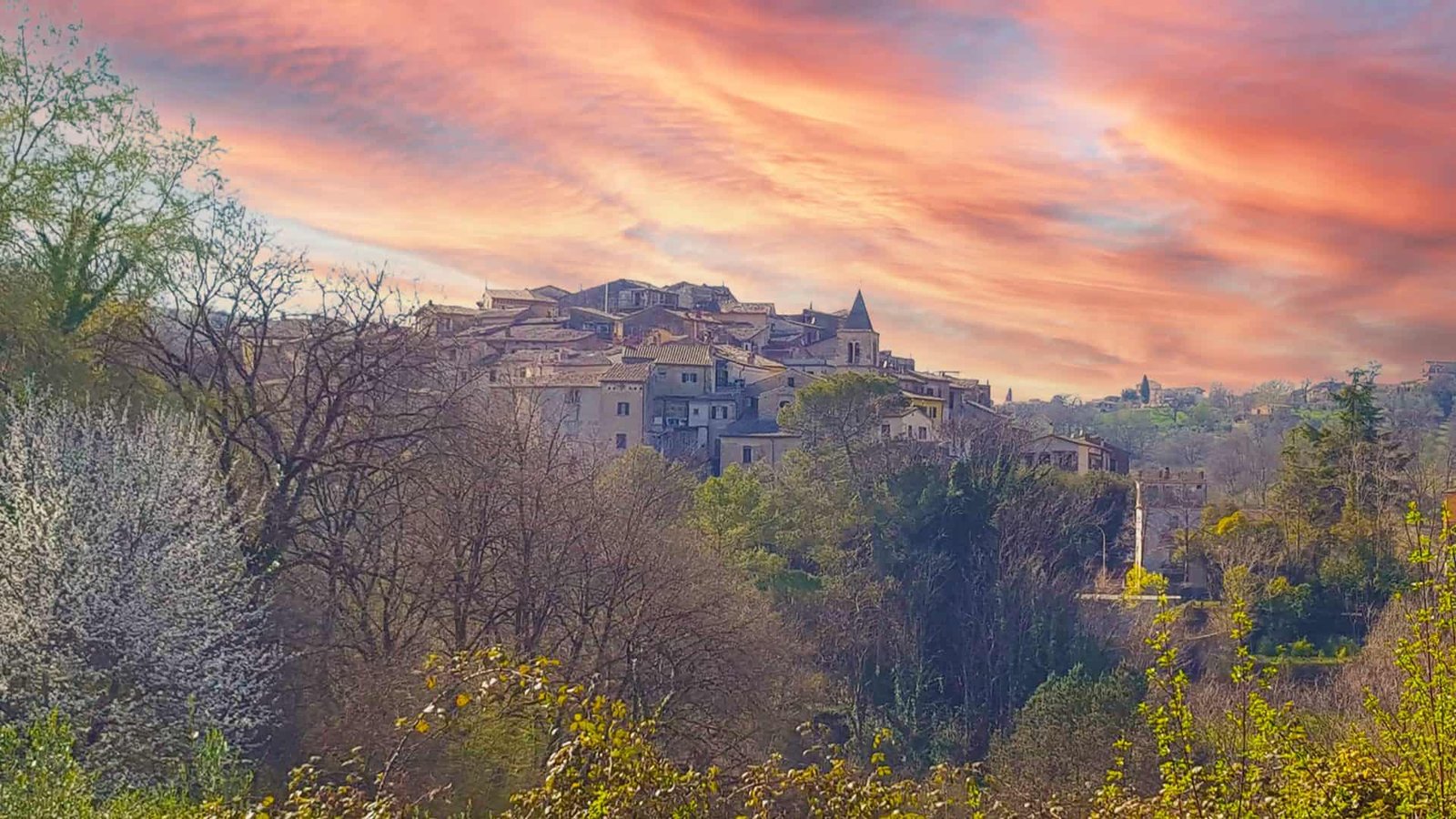
A curiosity about Bocchignano (RI)
If I had to choose one thing to tell about this place to someone who has never been, I would choose something that isn't in the guides and that you understand only by staying: here the feast people care about most doesn't fall in summer, doesn't celebrate a product of excellence, isn't designed for tourists. It falls in the cold season, celebrates the poorest dish there is, and serves to hold together a community that in the 20th century risked disappearing. It's the polenta, eaten on the spianatoia, and around it you can tell everything you need to know about Bocchignano: its economy, its history, its character, its way of resisting. But it's not the only curiosity this hill carries with it. There are at least three others worth lining up.
Winter polenta: why a feast is born from poverty and not from abundance
Italian food festivals almost all have the same scheme: they celebrate the local product at its peak, between late spring and autumn, with good weather, outdoor tables, tourists around. The Sabina of Montopoli does the opposite. Its polenta festival, which has passed 20 editions, falls in winter, usually in December, when the countryside is still, the days are short, the wind runs through the alleys and no sane tourist would plan a hill trip. The date and exact place of the festival change from year to year and must be checked on the channels of the Municipality of Montopoli di Sabina and of the Pro Loco before getting in the car. And it's exactly this contradiction that makes it interesting.
Polenta is the food of winter by definition. It's the dish you make when there's nothing else, when the pantry is at its minimum and you have to fill the stomach with what you have: corn flour, water, fire, time. There's no noble ingredient, no sophisticated technique, nothing that could become a status symbol. There's only the pot, the ladle and the patience to stir until the mass pulls away from the sides. For generations, in the countryside of central Italy, polenta was a daily food and not a Sunday dish. It was associated with toil, with straitened means, in certain periods even with pellagra, the nutritional deficiency disease that struck those who lived on polenta alone. Making a feast of it means making a precise choice: saying that that history, with all its hardness, belongs to the community and is not to be removed.
In local tradition polenta is not served on a single plate. It's poured onto the spianatoia, the large wooden board, and seasoned on top, and around the board people arrange themselves in a circle, each eating from their own portion from the edge toward the center. It's a gesture with an enormous symbolic power: nobody has a plate of their own, everyone eats from the same surface, the portion isn't measured but negotiated by the rhythm at which each advances. I know of no more literal representation of the concept of community. And it's not a staging invented for tourism: it's the way people have eaten in these houses for centuries, offered again once a year so that it isn't lost.
The seasoning changes from family to family and from town to town: the long-cooked sausage sauce is the version that gives its name to the Montopoli festival, in other variants salt cod appears, spare ribs, or simply new oil and pecorino. And it's here that the winter feast meets the other great theme of Bocchignano: oil. The feast falls in a period when the oil of the just-concluded harvest is new, green, pungent, at the peak of its aromatic expression. A thread of that oil on hot polenta is one of those elementary combinations that explain more than a thousand pages of food and wine writing why Italian cooking works: two ingredients, no technique, memorable result.
The logistics of the feast deserve a mention because they affect the visit. Winter village festivals are concentrated in a few hours, usually on Sunday, and involve an enormous part of the resident population: those who cook, those who serve, those who set up, those who take down. The practical advice is to arrive early: in small villages space is limited, parking fills up fast and the lines grow. And dress seriously: on the hills, in December, after sunset, the cold is not an opinion.
There is one last aspect that I find the most significant of all. A winter feast doesn't attract mass tourism and doesn't generate economic spin-off comparable to that of a summer festival. If the community keeps doing it, and doing it in that season, it's because its primary purpose isn't economic: it's to hold people together at the time of year when the town is emptiest and most fragile. It's an act of social maintenance. Whoever comes from outside is welcome, but is a guest of something that would exist anyway. This, for me, is the difference between a true festival and an event.
A town that is twice a child: the double bond of Bocchignano with Montopoli and with Farfa
The second curiosity is one of identity and concerns a condition that Bocchignano has lived for centuries: that of belonging to two different systems at the same time. On one side the administrative belonging to Montopoli di Sabina, of which it has been a hamlet since the Depretis decree of 1880. On the other the historical, cultural and originally also patrimonial belonging to the world gravitating around the Abbey of Farfa, to which two thirds of the castle were donated as early as 939.
The bond with Farfa is the oldest and the deepest. The monastery, in the period of its greatest power, was not simply a place of prayer: it was the major economic and political body of the Sabina, with a landed estate that included castles, churches, lands, mills, rights. Its influence shaped human settlement across the whole area: it was the abbey that promoted or governed the concentration of populations in the castra, it was the abbey that regulated relations with the farmers, it was the abbey that mediated with outside powers, and it was abbot Ugo I, in 1014, who called in the pope in person to take Bocchignano back from the Crescenzi. A town like this was born within this system and carried its imprint even long after the system had weakened: still at the end of the 14th century abbot Arnaldo d'Albiac was bringing it back under the control of the monastery.
The bond with Montopoli is more recent but more concrete in daily life. The town hall, the services, the school, the registry office, the decisions on public works are all there, four kilometers away by road. The two things coexist with a certain tension, and the tension can be felt. It happens that locals, asked where they live, answer "in Bocchignano" and only afterward, with a hesitation, add "municipality of Montopoli". The order of the words is never random, and history justifies it: between 1853 and 1880 Bocchignano was a municipality in its own right, with its own mayor, and the memory of those 27 years has never been fully filed away. The tradition of the castle of the Tre Torrette, built in the 12th century to keep an eye on Montopoli itself, adds a medieval root to the campanilismo.
This double bond has a practical consequence that the visitor should know: information on Bocchignano is often found under the heading Montopoli di Sabina, while information on the historical context is found under the heading Farfa. Whoever looks for the village in isolation risks finding little. Whoever looks for it as part of the two systems to which it belongs finds a lot. It's a small trick of method that holds for dozens of Italian hamlets and that makes the difference between an informed visit and a random stroll.
I'll add an observation about the best way to visit. Precisely because Bocchignano is a node in a network, seeing it within the network enhances it. An itinerary that touches Farfa, the abbey village with its shops and its particular silence, and then climbs to Bocchignano, restores exactly the historical relationship between the two places: the monastery in the hollow, the castle on the hill. Add Castelnuovo di Farfa, which carries the same dependence in its name, and you will have a route that explains itself.
The town that emptied out and has started to fill up again
The third curiosity is demographic, and seems dry only until you look at it closely. Bocchignano, like almost all the hill villages of central Italy, went through severe depopulation in the 20th century. The reasons are known and repetitive: hill farming, laborious and hard to mechanize, stopped guaranteeing a competitive income. The closeness to Rome offered work, services and modern homes. The generations born after the war came down to the valley and then to the city. Within a few decades houses that had hosted large families closed, the alleys lost their children, the town school lost its pupils. The church of San Sebastiano turned into a nursing home is the exact symbol of this passage: where people once prayed to escape the plague, the elderly who remain are now cared for.
The interesting detail is what happened afterward. Unlike many inner areas of the South or of the deep Apennines, where depopulation was without return, the villages of the Sabina have benefited from an unrepeatable position: they are close enough to Rome to allow commuting, with the FL1 eight kilometers away and the motorway 20, and far enough to remain economically accessible. The result is a partial but real repopulation, made of three different components.
The first is the return of the original families, or rather of their descendants, who have renovated the grandparents' house and use it on weekends and in the summer months. The second is the arrival of Romans who sought an alternative to the city: professionals who work remotely, young families who chose space and quiet while accepting the cost of the move. The third, smaller in number but culturally significant, is that of foreigners, in particular from northern Europe, who have bought property in the area attracted by the landscape, the climate and the closeness to the capital. The restoration of Palazzo Guadagni by an ambassador is the luxury version of a phenomenon that at Bocchignano can be seen at every scale.
This mix produces visible effects if you know what to look at. Restored facades next to closed ones. New light-wood window frames next to faded shutters. Mailboxes with non-local surnames. Cars with foreign plates parked outside the walls. Houses with a well-kept garden next to ones with tall grass on the windowsill. None of these things is scenic, all together they tell of a transition in progress.
Repopulation brings problems that nobody solves easily. The first is seasonality: a town full in August and empty in February can't sustain a bar, a shop, a clinic. The second is the risk of museumification: if the houses get new windows again but nobody lives inside for 11 months a year, the village is restored but not alive. The third is cost: residential demand pushes prices above what a young local can afford, with the paradox of a town that repopulates by expelling its own children. These are dynamics observed across the whole hill belt around Rome and that anyone who visits these places continuously sees at work.
The conclusion, for those who ask if it's worth visiting places like this, is this: the fragility of Bocchignano is not a defect of the destination, it is its content. You visit a place that has gone through a century of emptying and is trying to get back on its feet. Whoever goes with the spirit of an attractions consumer will understand nothing and will be bored in 20 minutes. Whoever goes with the spirit of someone who wants to understand how the Italy of small towns really works will have material for hours.
Oil as identity: why the Sabina DOP is worth more than a monument
The fourth curiosity concerns what everyone sees and almost nobody looks at: the olive trees. Around Bocchignano stretches a silvery sea that covers the slopes as far as the eye can see, and that sea is the real economic and cultural infrastructure of the place. The Sabina is one of the cradles of Italian olive growing, with a tradition documented since antiquity, when Varro and Columella wrote about it, and with groves that in some cases count plants of centuries-old age, authentic plant monuments. The Municipality of Montopoli lists among its resources oil, wine, honey and cheeses, and the order is not random.
The European recognition of the extra virgin olive oil Sabina DOP was one of the first in Italy for the sector, and this says a lot about the solidity of the local supply chain. The DOP is not a marketing label: it is a specification that establishes the production zone, the permitted cultivars, the agronomic practices, the timing and methods of harvest and milling, the analytical parameters and the organoleptic characteristics of the finished product. In practice it is a contract between a territory and whoever buys, with controls guaranteeing it. For a hill area with high production costs and low yields, certification is the tool that allows it to compete not on price, where you always lose, but on quality and identity.
The sensory profile of Sabine oil tends toward balance: medium fruitiness, vegetal notes, a bitterness and a pungency that are present but composed, without the aggressive peaks of certain southern productions and without the extreme delicacy of others. It's a table oil in the fullest sense of the term, which accompanies without overpowering and which gives its best raw. On a bruschetta of country bread, on a legume soup, on boiled greens, on that polenta we were talking about, the difference between an oil like this and an anonymous supermarket extra virgin is the kind you can feel even if you're not an expert.
The oil calendar is a work calendar. The harvest begins in autumn and is concentrated between October and December, with early or late starts tied to the course of the season. Whoever visits in that period finds the countryside in full activity: nets spread under the trees, mechanical beaters, stacked crates, tractors on the dirt roads. And finds the olive mills in operation, which is perhaps the strongest sensory experience the Sabina can offer. The smell of freshly crushed olives resembles nothing else: it's grassy, bitter, intensely green, and fills the air of the whole valley floor. Many farms in the area welcome visitors in this period, often by appointment, and watching a milling cycle changes forever the way you look at a bottle of oil.
A practical tip on buying, since it's the most frequent question. Buy at the farm or in a local shop, not in the first souvenir store. Ask for the vintage, ask for the crushing date, ask for the cultivars. A serious producer answers willingly and precisely. Whoever dodges the question is saying something. Prefer dark bottles or tins, because light and heat are the enemies of oil. And don't buy the year's supply: extra virgin doesn't improve with age, it gives its best in the first months and should be consumed within the vintage. Whoever offers old oil as prized is telling a fairy tale.
Whoever wants to build a visit that puts together the village and the oil supply chain should think in terms of an area itinerary more than an isolated stop: a route that includes an olive mill, a fortified town and a center with services works much better than three unconnected visits. A private experience of this kind, with olive mill, village and lunch at the farm, is exactly the kind of tailor-made day that can be requested from TourLeaderPro for small groups. Because in the end the point is this: at Bocchignano the most important monument isn't inside the walls, it's all around, and it has leaves.
Something nobody tells you about Bocchignano (RI)
I come to the part that usually isn't in the guides, because it requires saying things that aren't good advertising. There are three truths about Bocchignano that nobody highlights and that are instead the ones that determine if the visit will be successful or disappointing. They concern time, emptiness and the way this place is told. I'll take them one by one, with no discounts, because I believe an informed traveler is always a happier traveler.
There is no visiting route in Bocchignano, and this is the real content
The first thing nobody says is that at Bocchignano there is no structured tourist itinerary. There's no ticket, no entrance, no numbered circuit with panels explaining what you're looking at, no information point open with continuous hours, no route that takes you by the hand and leads from stop one to stop seven. You go up, you park, you pass through the gate of Clement VIII and you're inside. Then you decide on your own.
This condition, for some visitors, is a serious problem. Those used to art cities where everything is signposted, explained, lit and ordered in sequence feel disoriented: they wander for 20 minutes, don't find the main monument, conclude there's nothing and leave. It happens often, in dozens of villages. The implicit question is always the same: where's the thing to see?
The answer is that the thing to see is the whole, not an object inside the whole. The value of a preserved medieval castrum isn't in an isolated building but in the structure: the relationship between the gate and the hill, between the curtain wall and the houses, between the main route and the secondary alleys, between the built and the olive grove, between the 13th-century bell tower and the 15th-century church that grew up beside it. No panel can point to it because it can't be located in a spot. You have to reconstruct it by walking.
And it's precisely for this reason that the lack of a route, once understood, becomes the greatest merit of the place. In a village equipped for tourism you follow the trail that someone else has drawn, and the experience is, strictly speaking, someone else's experience. Not here. Here you choose where to wander, you take the wrong alley, you turn back, you find by chance a lookout that was on no list, you stop where you want. The visit is your own in the literal sense of the term. It's a kind of freedom that contemporary tourism offers less and less often, and that once tasted becomes addictive.
There is, though, a price to pay, and it is the work of preparation. Without a guided route you need a minimum of context, otherwise you look without seeing. That's why I insist so much on the few notions of the previous chapters: incastellamento, the Regesto of Farfa, the donation of 939, the siege of 1014, the gate of Clement VIII, the triple enclosures around the church, the economy of oil. Nothing else is needed. With those keys in your pocket, every wall you meet begins to speak. Without them, it remains a wall. The difference between a visitor who gets bored and one who gets enthusiastic, in places like this, isn't in the place: it's in the preparation. It's the reason it's worth reading something before leaving, be it the guide to the province of Rieti on ItalyPlanner or any serious reading on the Middle Ages of central Italy.
A practical corollary. Since there is no official route, there is no official schedule either: the village is always open, because it's a town. You can get there at dawn, in the evening, on Ferragosto, on January 1. Churches and closed spaces follow their own hours, often tied to religious services or to the availability of whoever holds the keys, so whoever has a specific interest in an interior should ask beforehand at the parish or the Municipality. But the village itself, its structure, its panorama, its alleys, are available always and for free. In an age when entering anywhere requires a time-slot reservation, this is a form of luxury that is underrated.
The emptiness is real, and it is the most honest thing about Bocchignano
The second thing nobody says is that, at many times of the year, Bocchignano is empty. Not sparsely visited: empty. You can cross the whole village on a weekday afternoon in February and meet three people. You may find the bar closed, the square deserted, half the houses with shutters pulled to. And whoever isn't prepared for this can feel an unpleasant, almost melancholy sensation.
It is instead, in our judgment, the most precious thing the place has to offer, and it's worth explaining why. The emptiness of hill villages is not a stage set: it's the readable result of a historical process that has affected a third of Italian territory. Every closed shutter corresponds to a family that went down to Rome in the 1960s. Every house for sale corresponds to an inheritance divided among siblings who live in three different cities. Every closed school corresponds to a demographic threshold not reached. Walking in a half-empty village means walking inside a statistic, with the difference that here the statistic has windows and roofs.
At the same time, the emptiness coexists with a vitality that shows up intermittently. The town that in February counts a few dozen visible presences fills up in August, when the children and grandchildren come back. It fills up on June 24 for the patron saint. It fills up on the days of the polenta. It fills up on Sunday when the Romans arrive with their loaded cars. This alternation produces a phenomenon seen across the whole hill belt around the capital: towns with two populations, one resident and permanent, ever older and ever smaller, and one floating and seasonal, younger and larger in number but present for a few weeks a year. The two populations live together, know each other, sometimes look at each other with mutual mistrust, often collaborate. The winter feast is one of the few moments when the community inside calls to gather the one outside too.
The economic paradox is brutal and is the real knot of the future of these places. Extreme seasonality makes it impossible to sustain stable commercial services. A bar that works three months a year doesn't cover the costs of the other nine. A food shop with 40 regular customers doesn't hold up. A restaurant that fills only on Sunday doesn't hire staff. The result is that services close, and the closing of services makes permanent residence less attractive, which reduces the residents further: a vicious circle that no public grant has yet managed to break in a structural way.
The countermeasures that work, where they work, are three and I name them because the attentive visitor recognizes them. The first is slow and distributed tourism: walking, cycling, short but repeated stays, which bring people on weekdays and out of season instead of concentrating everything in August. The second is the quality agricultural supply chain: the DOP oil, small producers, olive mill visits, which generate income tied to the territory and not relocatable. The third is new residency, that is those who choose to live permanently in the hills working remotely, a phenomenon that has grown a lot in recent years and that in the Sabina, thanks to the railway and the motorway, has more solid foundations than elsewhere.
What can a visitor concretely do about all this? Small things but not nothing. Buy something in the town instead of at the highway rest stop. Eat at a local business instead of bringing everything from home when possible. Come on a Wednesday instead of a Sunday. Come back in November instead of only in August. They aren't heroic gestures, they're choices of allocation that, multiplied, make the difference between a town that has a bar and one that no longer does. Whoever visits villages with this awareness stops being a tourist and becomes something more useful.
The wrong story: why the rhetoric of the borgo does damage at Bocchignano too
The third thing nobody says concerns the way places like this are told, and here I have to be critical even toward a part of the world in which I work. For at least 15 years there has existed in Italy a rhetoric of the borgo that has produced real benefits, bringing attention back to forgotten territories, but that has also produced a worn-out vocabulary and a series of distorted expectations. The enchanted village, suspended time, the corner out of the world, the dive into the past, the authentic dimension: these are formulas found identical applied to towns profoundly different from each other, and over time they have stopped meaning anything. Even the Municipality's website, when it speaks of Bocchignano, resorts to the word jewel: I understand it, but I would prefer the date 939.
The main damage of this rhetoric is that it creates an expectation that the real place cannot satisfy. Whoever arrives convinced they are entering a postcard collides with the reality of a normal town, with antennas on the roofs, dumpsters, scaffolding on the house being renovated, the badly parked car, the noise of the brush cutter. And feels betrayed. But the betrayal isn't the town's: it's the story that was told of it. An inhabited village is not a set. If it were, it would be dead.
The second damage is subtler and concerns the replacement of information with emotion. Describing a place as magical says nothing. Describing it as a castrum documented from 939, born of the process of incastellamento promoted in the orbit of a great monastery, besieged by one pope in 1014 and burned by another in 1235, with a preserved circuit of walls, a late 16th-century gate and an economy historically founded on olive growing, says a great deal and moreover is verifiable. The first language produces a like, the second produces an understanding. Our preference is clear.
The third damage is uniformity. When every village is told with the same five words, all villages become interchangeable, and at that point you might as well go to the most photogenic and nearest one. It's exactly what is happening: a handful of famous villages receive flows they can't manage, while hundreds of equally interesting towns remain invisible. The Sabina is a textbook case. Casperia has the fame and deserves it. Farfa has the abbey and attracts. But Montebuono, Toffia, Castelnuovo di Farfa, Roccantica, Poggio Catino and Bocchignano itself stay off the radar despite having, each one, something specific to say.
How do you get out of this trap? With a simple rule that I apply to myself every time I talk about a place: say specific things. Not that the village is enchanting, but that the gate bears the name of Clement VIII and that the wall of the houses of the first ring coincides with the circuit. Not that the cooking is genuine, but that polenta is served on the spianatoia and seasoned with sausage sauce and the new oil of November. Not that the landscape takes your breath away, but that from the west side you see the Tiber valley with Soratte in the distance and that on damp mornings the valley floor fills with fog and the towns emerge like islands. Specificity is the only known antidote to homogenization, and it has the side advantage of being useful: the reader, with a specific piece of information, can decide if that place is for them.
The advice I give you for visiting Bocchignano (RI)
The main piece of advice is only one and I say it without beating around the bush: don't come to Bocchignano with an hour of time. Not because there is a lot to see in a quantitative sense, but because what there is to understand requires a slowness that an hour doesn't allow. A walled village of this size can be walked physically in 20 minutes. Whoever stops there goes home with four photographs and the feeling of having wasted time. Whoever gives it half a day goes home with something different, which is hard to explain to those who haven't been but which anyone who frequents these places recognizes at once.
The second piece of advice concerns the hour, and is worth the trip. Arrive early or arrive late. The middle hours of the day, in a stone village exposed to the sun, are the worst in every respect: the light is flat and vertical, the colors fade, the heat discourages stopping, the town is indoors and the alleys are deserted in the bad sense of the word. The early morning hours, instead, are those in which the village behaves like a real town: the roller shutters go up, someone sweeps in front of their house, voices bounce between the walls, the light comes raking into the arches and draws the stones. Late afternoon has the same merit with the added advantage of the panorama, because it's in the last hour before sunset that the Tiber valley becomes a show.
Third tip: enter through the gate on foot. It seems obvious, it isn't. Many visitors drive around the village looking for a convenient access, enter through a side gap, park as close as possible and miss the fundamental gesture of the visit. The gate of a medieval castle isn't an architectural detail, it's a narrative device: it's the point where outside becomes inside. Passing through it on foot, in silence, looking up at the arch and the inscription of Clement VIII, is the only way to understand what it meant to be protected by those stones. Leave the car outside, do your 200 meters, enter the way people used to enter.
Fourth tip, and here I become didactic because it's needed: do two rounds, not one. Do the first round fast, without stopping, without photographing, just to take the measure of the place and understand how it's organized: where it climbs, where it descends, where it opens out, where it ends. Do the second round very slowly, retracing your steps, entering the side alleys you ignored on the first round, climbing the little stairways that looked private and often aren't. It's on the second round that you see things: the lintel with an incised date, the walled-up arch that reveals an ancient opening, the courtyard that opens behind a covered passage, the triple enclosures incised on the seats around the church, the cat looking out of the only open window of an otherwise closed house. The first round is reconnaissance, the second is the visit.
Fifth tip: talk to someone. In a village of a few hundred inhabitants, the best information isn't on a panel but inside people. There's no tourist office open all day, no guide waiting, but there is almost always someone sitting outside, or at the bar, or busy fixing something. Whoever greets politely and asks a specific question, in most cases gets a long, detailed answer, sincerely glad to have been asked. The questions that work best, from experience, are the concrete ones: where the valley is best seen from, when the polenta is made, where to buy the good oil, where the growing stone is, what was in that building. Generic questions like "what is there to see" get generic answers, because they put the other person in an awkward spot. Precise questions open doors, sometimes literally: that's how you get into the church out of hours.
Sixth tip, one of method: don't come only here. Bocchignano gives its best as a stop on a Sabine day, not as a sole destination. The combination I recommend most often, and which holds up very well even with children or with people not in training, is this: morning at the Abbey of Farfa, with the monastic complex and the village of shops around it. Lunch in the area without hurry. Early afternoon at Bocchignano for the fortified village and the circuit of walls. Late afternoon at Fara in Sabina for the sunset from the viewpoint, which is one of the widest in all of inner Lazio. With this sequence you see the monastery, the castle and the terrace, that is the three faces of the same territory, without ever driving more than 20 minutes between one stop and the next.
Whoever has two days, and in the Sabina two days are an investment I warmly recommend, should add Casperia, which is the most celebrated pedestrian village in the area and deserves the fame, and Roccantica, which is wilder and more vertical. Or go down toward Montebuono and Toffia, which tell the minor and more intimate variant of the same settlement model, or go back up the Tancia toward Poggio Catino and Torri in Sabina. Whoever prefers to have someone else calculate the real times and distances, with a guide who knows the Sabina, will find the service on the page of tourist accompaniment by TourLeaderPro.
Seventh tip, on eating. In a village of this size the dining offer is limited and variable. The strategy that works is twofold: whoever wants to eat in town should phone the day before and check opening and availability, because out of season many businesses work by reservation. Whoever doesn't want to be tied down should plan lunch in a better-equipped center in the area and use Bocchignano for the visit part. The third option, the most pleasant, is a well-made packed lunch: bread, pecorino, cured meats and oil bought in a local shop, consumed on a bench with the valley in front of you. It costs little, requires no reservations and stays in the memory more than many restaurants.
Eighth tip, on equipment. Shoes with a lugged sole, repeated on purpose because it's the point where people go wrong most often. Water, because the fountains exist but not everywhere. One more layer than the thermometer at home suggests, because in the hills the wind changes the perception and in the shade of the alleys the temperature drops quite a bit. Cash, because in some small businesses electronic payment may not work because of line problems. A charged battery and a map downloaded offline, because the signal is patchy. They're banalities, but they're the banalities that ruin or save a day.
Ninth tip, and it concerns attitude. In a village inhabited by a few hundred people, the visitor is a guest inside someone else's home. The alleys are public streets, but the windows that overlook them are bedrooms, and the courtyards you glimpse are private spaces. Noise bounces: a loud conversation in an alley is heard in 10 houses. The drone, for those who have one, should be used with respect for the rules and for common sense, and not at 8 in the morning over the rooftops. Photographs of people are taken after asking. These are things that seem pedantic when written and that instead make the difference between a visitor remembered with pleasure and one remembered with annoyance.
Tenth and last tip, the most important and the least practical: give yourselves at least 20 quiet minutes. Find a spot where the wall opens onto the valley, sit down, and do nothing. Don't look at your phone, don't check the map, don't plan the next stop. Look at the valley and listen. This is where the thing happens that makes it worth climbing all the way up here, and it's not something you can put on a list of attractions. Whoever gets this comes back to Sabina for years. Whoever doesn't comes once, says it was nice, and goes elsewhere. There's no judgment in that: it's simply an observation that some places give back in proportion to what you give them, and Bocchignano is one of those.
Another Well-Known Fact, Yet Rarely Cited
Everyone in the area knows that Bocchignano is a hamlet of Montopoli. Almost no one remembers that for 27 years it wasn't. In 1853, under Pius IX, in the last years of the Papal States, the village obtained the status of an autonomous municipality: a council, a mayor, a budget, an archive of its own. So it lived through 1860, when Sabina was annexed to the Kingdom of Italy together with Umbria, and the first 20 years of the unified state, until in 1880 a decree signed by Prime Minister Agostino Depretis ordered its suppression and merger into Montopoli. The government of the Historical Left was rationalizing the Kingdom's administrative map, and the micro-municipalities of a few hundred inhabitants were the first to pay. Bocchignano, which had been denied the era of the communes a first time in 1153 with the repression of the revolt against Farfa, saw it taken away a second time with a signature in Rome. This is the well-known yet rarely cited fact: the hamlet we visit today is, legally, a former municipality, and the local pride you breathe in these alleys isn't folklore but the memory of an autonomy lost twice.
There's a second fact, even more visible and even less explained: the triple enclosures carved around the church of San Giovanni Battista. Anyone who sits on the stone seats of the square has them under their hands, and almost no one notices them. There are six, three concentric squares joined by midlines, drawn on the marble threshold of a door, on the seats, on the arch leading toward the center. The same mark appears on churches, cloisters and castles across half of Europe, and its interpretation swings between the oldest board game known, nine men's morris, and a symbol with a protective or ritual value. In Sabina the mark is common, but six examples around a single church are a notable concentration. The fact that local tradition speaks of three concentric rings of walls defending the castle adds to the mystery a coincidence that no one has yet explained convincingly. With some caution: they are probably game boards, and they are certainly the sign that in front of this church, for centuries, people had time to spend. In a village that is emptying out today, those carvings are the most concrete trace of when it was full.
The Right Photo to Take in Bocchignano (RI)
A premise that applies to all walled villages and that applies doubly in Bocchignano: the right photo is not the one of the village, it's the one of the relationship between the village and the hill. The subject isn't the gate, isn't the tower, isn't the alley with geraniums: it's the relationship between a compact built mass and a sea of olive trees surrounding it. Whoever focuses on that relationship has taken a photograph that tells the story of Bocchignano. Whoever sticks to the cute details has taken a photograph that could be of 300 other places.
The First Shot: Bocchignano from the Road Going Up
The first shot, the one I recommend to everyone, is taken from the outside, on the approach, from the road going up. Before entering the village, stop at one of the points where the road widens and the hill can be seen in full. From there the village looks like what it is: a continuous curtain of houses resting on the spur between the three streams, with the line of the walls closing the front, the bell tower with its double-arched windows poking up above the roofs, and the olive trees climbing almost to touch the foundations. Use a medium-long focal length to compress the planes and make the olive trees look denser, or a moderate wide angle to include the sky and the movement of the clouds. The best moment is the first hour after dawn or the last before sunset, when the light comes from the side and the volume of the houses stands out from the background. At noon the same shot is flat and washed out: it's not the photographer's fault, it's the light.
The Second Shot: The Gate of Clement VIII from Inside
The second shot is the gate, and it's the most classic. The problem with this photo is that almost everyone gets it wrong in the same way: they stand in front, centered, and photograph the arch as if it were an isolated monument. The result is correct and uninteresting. The version that works exploits the light contrast: position yourselves inside the passage, in the shade, and shoot toward the outside, letting the arch act as a dark frame for the lit landscape. It's an elementary effect, almost banal, and it's extremely powerful, because it reproduces exactly the perceptual experience of someone passing through that threshold. If you have a camera that lets you control the exposure, expose for the outside and let the arch become a silhouette. If you use a phone, tap on the bright area to lock the metering there. Before leaving, take a detail of the papal inscription, with the raking light bringing the letters out of the stone.
The Third Shot: The Uphill Alley and the Blade of Light
The third shot is the uphill alley. Bocchignano has several, narrow, stepped, with close stone walls and buttress arches spanning the passage. They are excellent subjects because they have very strong perspective lines that carry the eye into the depth. Two tips: put something at the end of the alley, a backdrop, a door, a stairway, a human figure, otherwise the perspective runs toward nothing and the photo remains a geometry exercise. And look for the moment when a sunbeam enters edgewise between two buildings, because that blade of light on an otherwise shaded wall is the difference between a photo of an alley and a memorable photo. In walled villages this condition lasts a few minutes and moves during the day: whoever is patient finds it, whoever passes in a hurry doesn't.
The Fourth Shot: The Tiber Valley with a Piece of Wall in the Foreground
The fourth shot, the cover shot, is the panorama over the Tiber valley with a piece of wall in the foreground. The pure panorama, with no reference points, is almost always disappointing in photography: the human eye compensates for the distance, the lens doesn't, and the result is a strip of squashed hills. The solution is to include a nearby element that gives scale and depth: a corner of wall, an olive branch, a railing, a stone. This way the photo gains three planes, foreground, middle ground and background, and conveys the feeling of height you get standing there. Whoever is lucky enough to find a day with fog on the valley floor, typical of damp autumn and spring mornings, has the image of the year in hand: villages emerging from the white, with the profile of Soratte floating to the southwest, are a spectacle this area gives generously to those who get up early.
The Fifth Shot: The Olive Grove Seen from Inside
The fifth shot is the one almost no one takes and it's the most honest: the olive grove seen from inside. Not from above, not as a backdrop, but entering the structure of the field, with the twisted trunks in the foreground, the rows receding, the worked soil below. It's the photo that tells the real economy of the place. The century-old trees have sculptural trunks, hollow, twisted, often more expressive than any architecture. In the morning's side light the leaves turn their silvery side and the whole field changes color. An obvious but necessary recommendation: olive groves are private property and they are workplaces. Photograph from the roadside or from public paths, don't enter the fields, don't touch the nets laid out during the harvest, don't get in the way of the vehicles.
The Sixth Shot: The Triple Enclosures and the Speaking Stones
I'll add a sixth that in Bocchignano is a must: the detail. The carvings of the triple enclosure on the seats and on the threshold around the church of San Giovanni Battista are photographed in raking light, early in the morning or at sunset, when the shadow fills the grooves and the design of the three concentric squares emerges from the stone. At noon they disappear. The same goes for the dated lintels, for the double-arched windows of the bell tower, for the reused stones set into the facades. These are the photographs that, once you're back home, explain the place better than any panorama.
Seasonal Light and a Few Technical Notes for Photographing Bocchignano
On seasonal light it's worth being precise, because it's the variable that changes the most. In winter the sun is low all day, which means good light for many more hours than in summer, long shadows, sculpted stone, often clear skies after cold fronts: paradoxically, the best season for photography. In spring the countryside is very green and the contrast between the green of the grass, the silver of the olive trees and the ocher of the stones is the most beautiful color combination of the whole year. In summer the useful hours shrink to two early in the morning and two in the evening, but the sunset light on the valley is warm in a way no filter imitates. In autumn comes the fog, come the olive mills, comes the golden, oblique light: if I had to choose a single season for photographing Sabina, I'd choose November.
A few technical notes for those who shoot with a phone, which is now the majority. First: clean the lens, because the film of fingerprints is the number one cause of milky photos in backlight. Second: use wide-angle mode sparingly, because in narrow alleys it distorts verticals and turns walls into funnels. Third: lock exposure and focus with a long press, especially in situations of strong contrast between shade and sun. Fourth: avoid digital zoom, get closer with your feet. Fifth: shoot more than half of your photos vertically if they're destined for social media, but keep at least one horizontal version of every important shot, because that's the one used for everything else.
For those with an interchangeable-lens camera, the ideal setup for a village like this is a moderate wide angle for the alleys and the insides of the gates, and a short telephoto for details and for compressing the planes over the valley. The tripod is only for those who intend to shoot at blue hour or at night, and in that case it can deliver the best image of the whole trip: the yellow lights of the street lamps on the stones, the sky still blue, the valley dotted with distant lights. It's a photograph that requires 20 minutes of waiting and gives back a great deal.
A closing thought that's worth more than any technical tip. In an inhabited village, the most beautiful photograph is almost always the one that contains a trace of life: laundry hanging, the bicycle leaning against a wall, the door ajar, the straw chair outside the doorway, the elderly man walking at the end of the alley. But that trace belongs to someone. Photographing people without asking, in a village where everyone knows each other, is a gesture that gets noticed and that weighs. Asking costs 10 seconds and in most cases produces a yes, often accompanied by a conversation worth more than the photo. And if the no comes, it has to be accepted without argument: it's the visitor who has entered their home, not the other way around.
Anyone building a photographic itinerary through Sabina should know that the sequence that works best in a single day is dawn at Fara in Sabina for the wide panorama, morning at Farfa for the architecture and details, afternoon at Bocchignano for the walls and alleys, sunset at a high point over the valley. With four stops and very little road you cover all the visual registers this territory offers.
Some Important Events That Happened Here in History
For a village of a few hundred inhabitants, Bocchignano has a surprisingly dense chronology, and the reason is always the same: the proximity to Farfa, which recorded everything, and the position on one of the routes into Sabina from Rome. Here are the documented facts, with their degree of certainty.
September 939: The Donation to Farfa
It's the documentary birth date of the village: a part of the castrum of Buccinianum is handed over to the Abbey of Farfa. The document is in the Regesto farfense, the collection by Gregorio da Catino. Local tradition attributes the act to Teodoranda and her husband Ingebaldo, count of Sabina, and speaks of two thirds of the castle. Documented: the year and the donation. Tradition: the names and the share.
July 18, 1014: The Siege by Pope Benedict VIII
The castle, occupied by the Crescentii, is besieged by the pope in person at the request of Abbot Hugh I and surrenders for lack of water. It's the most striking episode in the history of Bocchignano: a pontiff under the walls of a Sabine village, over a question of monastic property that was also, and above all, a settling of scores between the Tusculans and the Crescentii for control of Rome. Documented, with the date of the day.
1153-1154: The Communal Revolt
The inhabitants try to give themselves a free commune. The uprising is suppressed. Documented.
1235: Viterbo Destroys the Castle
On the orders of Gregory IX, the army of Viterbo besieges, burns and destroys Bocchignano. Some local sources place the occupation by Roman troops in 1243, the same year as the sack of Montopoli. Two episodes or a single badly dated one, the 13th century was the century of destruction. Documented: the event. Uncertain: the exact date.
Early 14th Century: Processo and Matteuccio Rossi Rebuild
The rebuilding of the village after the 13th-century destructions is the work of the Rossi, father and son. At the end of the century Abbot Arnaldo d'Albiac brings the castle back under Farfa after the interlude of the Sant'Eustachio. Scholarly tradition, consistent with the Farfa sources.
15th Century: Giovanni da Fogliano and the Church of San Giovanni
After conflicts with Fara in Sabina and new sackings, Giovanni da Fogliano buys the castle, rebuilds the buildings and raises the church dedicated to his saint. In 1482 the territory passes to the Orsini. Documented: the passage to the Orsini. Tradition: the rest.
1589: Sixtus V and the End of Baronial Power
Sixtus V strips the local nobility of power. Bocchignano remains solely under the Papal States, and a few years later the gate of the village is rebuilt at public expense under the name of Clement VIII. Documented by the inscription.
Mid-18th Century: The Visits of Saint Leonard of Port Maurice
According to tradition, the great Franciscan preacher, a guest of the Guadagni family, came to Bocchignano several times and performed miracles there. Tradition, not document.
1853 and 1880: A Municipality for 27 Years
Bocchignano becomes an autonomous municipality in 1853 and is suppressed and merged into Montopoli by the Depretis decree in 1880. Documented.
1943-1944: Don Igino Renzi Saves 30 People of Bocchignano
The parish priest, chaplain of a partisan formation, saves the lives of 30 inhabitants accused by the German command of having killed three soldiers. Documented in local memory and in publications on the Resistance in Sabina. It's the event that, for those who live there, counts more than all the others put together.
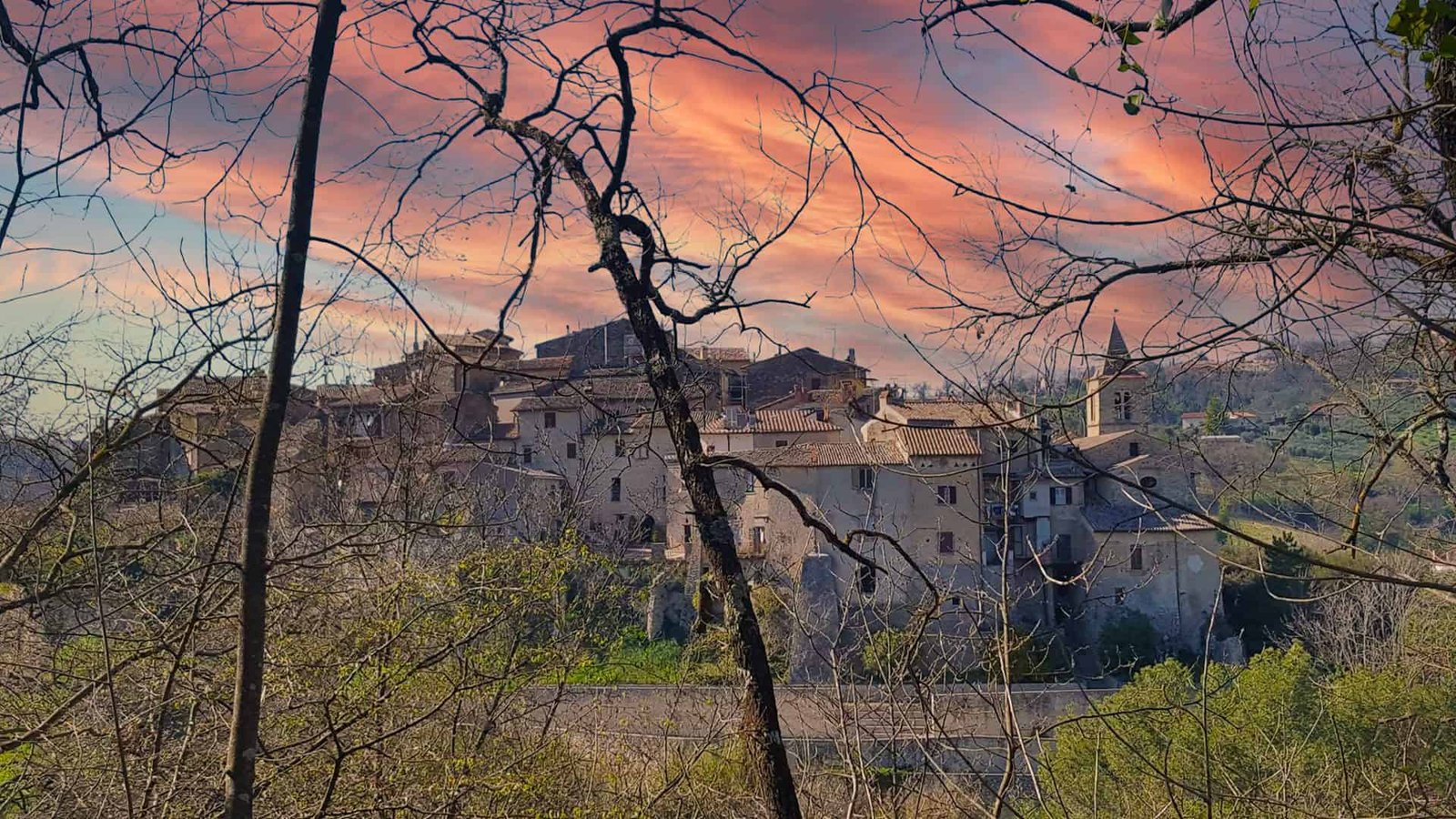
Who Has Passed Through Bocchignano (RI)
It has to be said right away, because it's the premise that makes everything else interesting: Bocchignano is not a place of big names in the tourist sense of the term. There are no plaques recalling the stay of the famous poet, no rooms where the sovereign slept. And yet, looking at the records, this hill has seen a pope with an army, one of the most powerful families of Rome, a saint, a prime minister with a pen, and a parish priest who saved 30 men. Whoever looks for celebrity as a guarantee of interest has to look harder here, and is rewarded.
The Monks of Farfa and the Faceless Notary
Let's start with the first and most important: the monks of Farfa. For centuries, the men of the abbey were the most constant outside presence in these lands. They didn't come to visit, they came for work: to check boundaries, to collect rents, to renew grant contracts, to settle disputes between farmers, to record donations. Every time one of them climbed a hill like this one, he left a document behind, and those documents flowed into the Regesto compiled by Gregorio da Catino, the collection that today allows historians to reconstruct the social fabric of medieval Sabina with very rare precision. The first historical figure to pass through here, if we want to put it that way, is a faceless monastic notary who wrote a parchment in September 939. And that parchment has reached us while the names of so many powerful people have dissolved.
Benedict VIII, Abbot Hugh and the Crescentii
In 1014 under these walls stood Pope Benedict VIII, Theophylact of the counts of Tusculum, elected two years earlier against an antipope backed by the Crescentii themselves. With him, or behind him, Abbot Hugh I of Farfa, one of the great monastic reformers of the 11th century, who in those same years had the tower of Montopoli built that still bears his name, the Torre Ugonesca. Against them the Crescentii, the family that had dominated Rome in the previous century. The siege of Bocchignano was one match of this Roman war played away from home, in Sabina, and it was won by thirst.
Gregory IX's Viterbesi, the Rossi, the Sant'Eustachio, the Orsini
Then there are the lords and their men-at-arms. In 1235 the militias of Viterbo, in the service of Gregory IX, came in through the gate and burned the village. In the 14th century the Rossi, Processo and Matteuccio, rebuilt it. The Sant'Eustachio, Roman barons, held it until Abbot Arnaldo d'Albiac took it back. In the 15th century Giovanni da Fogliano bought it and left the church there. From 1482 the Orsini, lords of Montopoli and of half of Sabina, made it a piece of their state, until Sixtus V closed the game in 1589. Every change of rule meant a cavalcade along these roads, a garrison coming in through the gate, an act of submission signed in the square. The walls we photograph today because they're beautiful were built and maintained because those passages were concrete and dangerous. A fortified village isn't fortified for aesthetics.
Saint Leonard of Port Maurice, Guest of the Guadagni
In the mid-18th century, according to tradition, Saint Leonard of Port Maurice passed through Bocchignano, the Ligurian Franciscan who was the greatest popular preacher of his century, the man who spread the practice of the Way of the Cross throughout Italy and who in 1750 planted its 14 stations inside the Colosseum. Tradition has him as a guest several times of the Guadagni family, in the palace that still dominates the upper part of the village, and attributes to him miracles performed in the village. That a preacher who filled the squares of Rome and Florence climbed all the way up here says how much provincial notable families counted in the 18th-century Papal States: they were the ones who brought saints to the villages.
Oil Merchants, Grand Tour Travelers, Scholars with Notebooks
In the early modern age the most regular passage was that of merchants and carriers. Sabina produced oil, and the oil had to go down to Rome. The routes of this trade were the hill roads down to the Tiber and then the river itself, which for centuries was the main logistical artery of central Italy. Loaded boats went up and down, the river ports of the valley floor sorted goods, and the modest but constant wealth of the olive-growing villages passed through there. Whoever looks at the valley from Bocchignano today sees a quiet agricultural landscape. Whoever looks at it knowing this sees a commercial corridor.
Between the 18th and 19th centuries came the foreign travelers. The Grand Tour brought thousands of aristocrats, artists, scholars and dilettantes from Northern Europe to Italy. Their main routes went through Rome, Naples, Florence, Venice, but the Roman countryside and the mountains surrounding it exerted a very deep fascination on many of them. Painters and draftsmen traveled the valleys around the capital looking for ruins, landscapes, folk costumes and that light that would make the fortune of 19th-century landscape painting. Sabina, less beaten than the Castelli Romani and Tivoli, was nonetheless crossed and described. There is no record that any of them stopped inside these very walls, but villages like this were exactly the kind of subject they were looking for: a stone castle on a hill of olive trees, with the mountains in the background.
Then there are the scholars and antiquarians, figures forgotten today but decisive. In 1828 Giuseppe Marocco published in Rome his Monumenti dello Stato Pontificio, going through Sabina too village by village, and his work is still one of the sources from which the information on Bocchignano starts. In the 20th century the Touring Club's Red Guide devoted its lines to the village, and in 2015 the Passeggiate sabine by Gianfranco Trovato, printed in Poggio Mirteto, gathered the minute place names, the names of the hills, the growing stone, the Varro spring. They passed through here with their notebooks, noted what they saw, and saved information that would have been lost with the next generation.
Don Igino Renzi, the Evacuees, the Emigrants
The 20th century brought passages of a different and more painful nature. The war crossed these territories: the Tiber valley was a strategic corridor, bombings hit rail and road junctions on the valley floor, and the hill villages saw the transit of troops, evacuees and people in hiding. Families fleeing the bombed cities arrived in the houses of these villages, because the countryside offered shelter and, above all, food. And in the midst of all this there was don Igino Renzi, the parish priest chaplain of the partisans, who when the Germans accused 30 men of the village of the death of three soldiers managed to save them all. If Bocchignano has a hero, it's him, and he has no statue.
Right after came the most massive passage of all, and it was a passage out: emigration. From the 1950s to the 1970s, tens of thousands of people left the hill villages of inland Lazio. Some went abroad, many more simply went down to Rome, which was close and growing at a dizzying pace. Whoever passed through Bocchignano in that period did so with a suitcase and in the opposite direction from today's visitors. This is the story that changed the village more than any medieval siege: it emptied the houses, closed the shops, interrupted the transmission of trades.
Those Who Return, Those Who Arrive, Those Who Keep It Open
In recent decades the flow has partly reversed, and new passages have appeared. There are the descendants of emigrants, who return in summer to reopen their grandparents' house and who often speak Italian with an accent that gives away where they grew up. There are the weekend Romans, who have bought and renovated and who bring to the village an intermittent but real life. There are the resident foreigners, mostly Northern Europeans, attracted by the climate, the landscape and the closeness to Rome, and there is an ambassador, Mario Bondioli, who restored Palazzo Guadagni. And there are the walkers and cyclists, who cross these hills along routes linking the abbey to the castles and who represent the form of tourism most compatible with the fragility of these places.
Finally there is a category of passage worth naming because it's the one that holds everything up: the volunteers of the local associations. These are the people who organize the patron saint's festival and the polenta, who keep the church open when a group arrives, who clean the trails, who print the flyer, who go and get the chairs and then bring them back. They appear in no chronicle and have no plaque. But if today a visitor can climb up to Bocchignano and find a living village instead of a ruin, the credit is almost entirely theirs. In all the minor villages of Italy the real cultural ruling class is this, and it's made up of a few dozen people per village, often not very young, who do for free what elsewhere the municipal departments do.
This is, at bottom, the reason I find places without celebrities more fascinating than places with the famous plaque. Where there's no big name, the mechanism is easier to see: how a community settles, defends itself, produces, empties out, resists, reinvents itself. Bocchignano tells this story in a particularly readable way, and tells it together with its hill neighbors, from Poggio Mirteto to Toffia, from Casperia to Roccantica. Anyone who wants to fit this kind of reading of the territory into an organized trip for a group, a company or an extended family will find the group trip organization service of TourLeaderPro.
The Landscape Around Bocchignano: Olive Trees, Tiber Valley and Silence
Then there's the landscape, which is the second half of the story. The hill on which the village stands is surrounded by olive groves, and it's not a decorative detail: it has been the economy of the place for at least two millennia. Sabina is one of the oldest olive-growing areas of Italy, with a tradition that goes back to Roman times and that the Latin writers on agriculture knew well. Varro, who gives his name to a spring below the village, was one of them. The hilly relief, the drainage of the soils, the exposure, the temperature swing between day and night create ideal conditions for the olive tree, and the centuries have selected the cultivars that adapted best.
The contemporary result of this very long story is Sabina DOP extra virgin oil, a product that has obtained European recognition and that represents one of the least noisy and most solid excellences of Lazio. The landscape seen from the walls of Bocchignano isn't a natural landscape, it's an agrarian landscape built by humans plant after plant, terrace after terrace, generation after generation. The olive trees you see are monuments as much as the walls. At the foot of the hill, where the three streams meet, the broadleaf woods take over again and offer, according to the municipality, pleasant walks in every season. The riparian vegetation of the Farfa, with its poplars and willows, is the green line you can recognize from above even in high summer.
The Network of Villages Around Bocchignano
The network of surrounding villages completes the picture. Within a few kilometers are towns that tell variants of the same story: Toffia with its spindle-shaped layout and its concentric little streets, Castelnuovo di Farfa with its direct and declared link to the abbey, Fara in Sabina with its profile dominating the valley, Montopoli with the Torre Ugonesca of Abbot Hugh, the Renaissance Porta Romana and the Orsini palace, that is, the stones of the same protagonists who made the history of Bocchignano. Seeing more than one on the same day isn't repetitive. It's the best way to understand how much each community has worked out in its own way a common pattern.
The Silence of Bocchignano
Finally there's a dimension that touches anyone who climbs up here with a minimum of sensitivity: the silence. Not absolute silence, which doesn't exist in nature, but a background silence against which single, recognizable sounds stand out. A door closing. A dog. The voices of two people talking in an alley three cross streets away that you hear as if they were next to you, because the stone reflects the sound. The wind in the olive trees, which has a dry, metallic rustle, very different from that of the broadleaf woods. Whoever arrives from Rome takes a few minutes to settle in, then notices that the ear has recalibrated and that it hears things it no longer heard in the city. It's one of the most beautiful side effects of a visit to Sabina, and no guide lists it because it can't be photographed.
Whoever wants to deepen the historical and landscape picture of the whole region before leaving will find an overview in English in the ItalyPlanner Lazio guide, where the logic is not that of the ranking of the most beautiful villages but that of understanding territories. And this, for a place like Bocchignano, makes all the difference in the world: because whoever compares it with the most celebrated postcard villages comes away disappointed, whoever understands it for what it is comes away won over.
What to See Around Bocchignano Within 10 Minutes by Road
Within a 10-minute drive, or an hour on foot for those with legs, there are four places that complete the visit. Montopoli di Sabina, the municipal seat, four kilometers away: the Torre Ugonesca built around the year 1000 by Abbot Hugh I, the Porta Romana or Maggiore in Renaissance forms, the Orsini palace next to the gate, the octagonal fountain with the lions on the town hall square, and the memory of the humanist Pietro Oddi, who was born there in the 15th century. Poggio Mirteto, 8.5 kilometers away, with the square, the cathedral, the services, the station and the Carnevalone. The Abbey of Farfa, the monastery to which Bocchignano was donated in 939, with the basilica, the cloister, the library and the village of workshops around it: it's the stop that gives meaning to all the rest and should be seen first, not after. And the Farfa stream, below the hill, with the remains of the Roman bridge and the riparian vegetation that in summer is the only cool place in the area. Anyone with an extra afternoon should add the Tiber-Farfa reserve, on the valley floor, where the stream flows into the river among reed beds and herons.
What to Eat in Bocchignano and Sabina
The cooking of this part of Sabina is hill cooking, poor in raw materials and rich in technique: what is produced close at hand, cooked for a long time. The Sabina DOP oil is the foundation of everything and should be tasted raw, on toasted bread, before anything else. The polenta, served on the pastry board and dressed with sausage sauce, is the dish of the winter festival and, outside the festivals, of a few trattorias in the area in the cold months. The municipality of Montopoli lists among the products of the territory, besides oil, wine, honey and cheeses: the pecorino cheeses of Sabina, fresh or aged, are bought in the shops of Poggio Mirteto and at the farms scattered among the olive groves. In the trattorias of the Tiber Sabina you find handmade fettuccine and gnocchi, abbacchio, coratella, legume soups and field greens sautéed with new oil. The names of the places change from year to year and I don't give them. The rule that always holds is to call first, because in Bocchignano and the nearby villages being open off-season is never a given.
Bocchignano with Children and Accessibility
With children Bocchignano works better than you'd think, as long as you tell it as a castle and not as a village: the gate with the vanished drawbridge, the three rings of walls, the siege of the pope that ended in thirst, the growing stone, the game of nine men's morris carved on the stones around the church, to be found and counted up to six. These are narrative hooks that keep a seven-year-old attentive for an hour, and at the end you go down to the stream to cool off. The stepped alleys aren't suited to strollers: you need a baby carrier. For the same reason the village isn't accessible to wheelchair users beyond the gate area and the first stretch: steep slopes, steps, uneven paving. The panorama over the valley, though, can be enjoyed from the outside road too, with the car close by, and the gate of Clement VIII is reached on the flat from the parking widenings. There are no signposted public restrooms: you use those of the bar, when it's open, or you plan the stop in Poggio Mirteto.
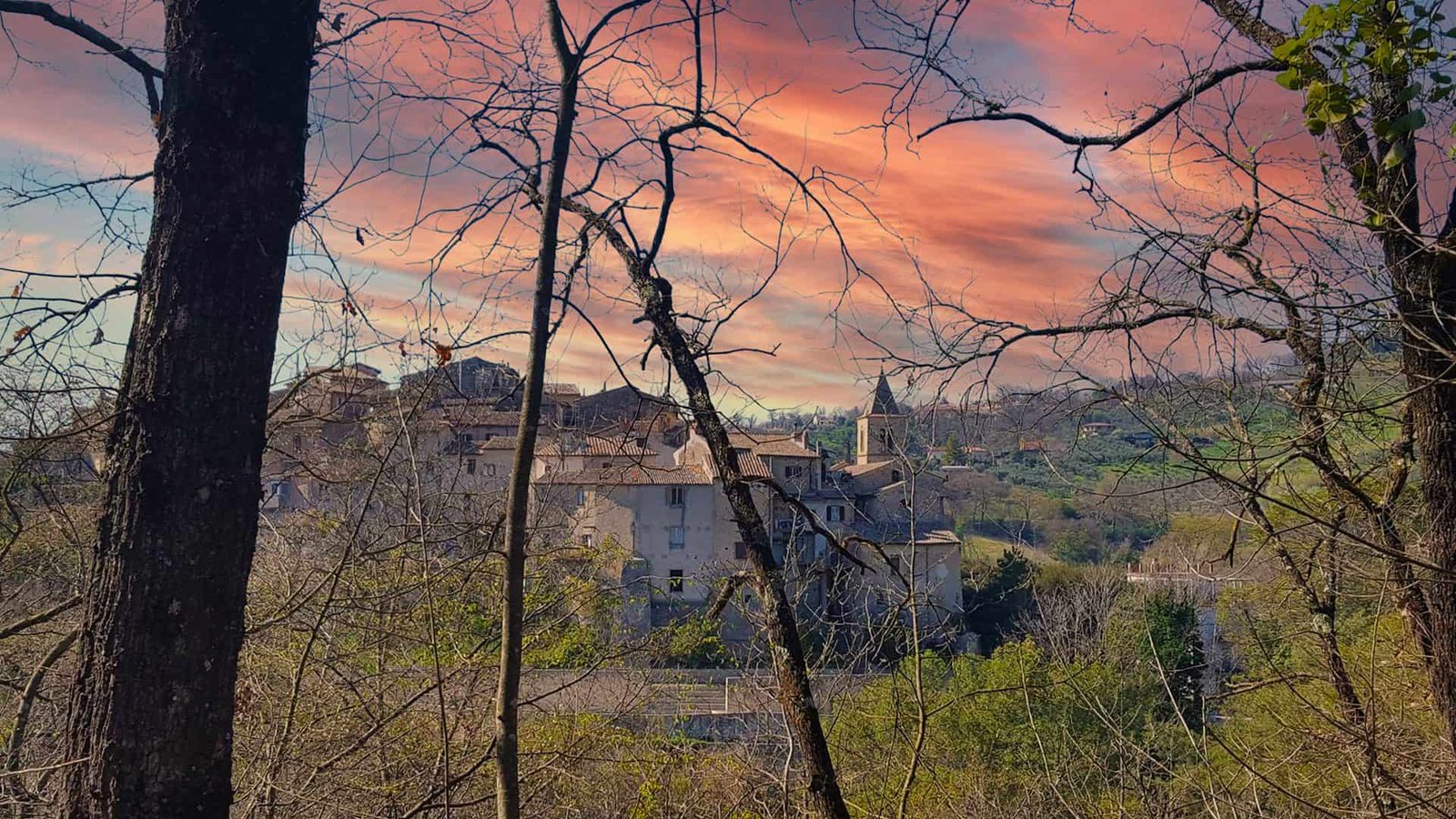
Quick Questions About Bocchignano (RI)
Where is Bocchignano?
In the province of Rieti, in Lazio, on the hills of Lower Sabina between the Tiber valley and the Farfa stream. It's a hamlet of the municipality of Montopoli di Sabina, four kilometers by road from the municipal seat and 8.5 from Poggio Mirteto.
How far is Bocchignano from Rome?
About 55-60 kilometers via the A1, between an hour and a quarter and two hours depending on traffic. From the highway toll gate to the village there are about 23 kilometers of state and provincial roads.
How much does it cost to visit Bocchignano?
Nothing. It's an inhabited village: you enter on foot through the gate, with no ticket and no hours. The churches open for services or on request.
How long does a visit to Bocchignano take?
Two hours for the village, the gate, the church and the panorama. Half a day to do it well. A full day if you combine it with the Abbey of Farfa and Fara in Sabina.
How do you get to Bocchignano without a car?
FL1 train from Roma Tiburtina, Ostiense or Trastevere to Poggio Mirteto (about 50 minutes), then a Cotral bus on the line to Rieti or the local urban line to the Bocchignano junction, about a hundred meters from the gate. Check the schedules first on the Cotral and municipality websites, because runs are few in the middle of the day and on holidays.
Where do you park in Bocchignano?
In the widenings outside the walls, along the access road and before the gate. You can't enter the village by car.
Is Bocchignano suitable for wheelchairs?
Only the gate area and the first stretch. The alleys are stepped and steep. The panorama can also be enjoyed from the outside road.
Is Bocchignano suitable for children?
Yes, if told as a castle: gate, walls, the siege of 1014, the growing stone, the six triple enclosures to find around the church. Stroller not recommended, baby carrier recommended.
Do you need to book to visit Bocchignano?
No for the village. Yes, in practice, for eating off-season: call the day before. For the inside of the church of San Giovanni Battista it's best to ask at the parish.
Who is the patron saint of Bocchignano and when is it celebrated?
Saint John the Baptist, on June 24, with the festival in the village.
When is the polenta festival held?
In winter, in the territory of Montopoli di Sabina, with polenta dressed with sausage sauce. The date and place change from year to year and must be checked on the channels of the municipality and the Pro Loco.
What is there to see in Bocchignano?
The late 16th-century gate with the inscription of Clement VIII, the circuit of walls, the alleys of the Burgu, the church of San Giovanni Battista with the bell tower with double-arched windows and the six carved triple enclosures, Palazzo Guadagni, the panorama over the Tiber valley. Outside the walls the growing stone, the Varro spring, the Farfa stream with the Roman bridge.
What are the triple enclosures of Bocchignano?
Six carvings of three concentric squares on the stones around the church: threshold, seats, arch. According to the most likely explanation they are boards for the game of nine men's morris. For others, a medieval protective symbol.
Since when has Bocchignano existed?
The hill has been inhabited since the 2nd century BC. The castle is documented from September 939, when a part of it was donated to the Abbey of Farfa.
Was Bocchignano ever a municipality?
Yes, from 1853 to 1880, when a Depretis decree merged it into Montopoli di Sabina.
What is the difference between Bocchignano and Montopoli di Sabina?
Montopoli is the municipal seat, with services, town hall, Torre Ugonesca and Porta Romana. Bocchignano is the castle, smaller and more compact, one kilometer as the crow flies and four by road. They are two distinct identities with the same administration.
What is the best time to photograph Bocchignano?
The first hour after dawn and the last before sunset. November for the fog on the valley floor and the olive mills. Winter for the raking light on the stones.
What do you eat in Bocchignano?
Sabina DOP oil raw, polenta with sausages in winter, pecorino cheeses, honey, handmade pasta, abbacchio and legume soups in the trattorias of the area.
Where do you buy oil near Bocchignano?
At the farm or in the shops of Poggio Mirteto and the nearby villages, asking for the vintage, the pressing date and the cultivar. Better in a tin or a dark bottle, to be consumed within the year.
Is Bocchignano worth it compared to Casperia?
They are different things. Casperia is the famous, well-kept pedestrian village. Bocchignano is the silent castle documented from 939. Whoever has one day should go to Casperia. Whoever has two days, or wants to understand Sabina, should see both.
Is there an information point in Bocchignano?
No. Information is asked for at the bar, from residents, at the Comune of Montopoli di Sabina and at the Pro Loco.
Does the phone get a signal in Bocchignano?
In the village yes, in the surrounding valleys in patches. Download offline maps before leaving.
Why I Go Back to Bocchignano
The question I'm asked most often about places like Bocchignano is: is it worth it? The honest answer is that it depends on what you're looking for, and it's an answer tourism marketing never gives because nobody wants to discourage a potential visitor. Whoever is looking for monuments to tick off, museums, starred restaurants, nightlife, impeccable services will find something else: there are a hundred places in Lazio better suited. Whoever wants to understand how the Italy of small towns is really made, whoever is interested in the way a community built, defended, abandoned and retaken its own space over a thousand years, from September 939 to the decree of 1880 to the 30 men saved by don Igino, whoever feels satisfaction before a panorama earned with a climb rather than with an elevator, should come: it's amply worth the trip, and they will probably come back.
Sabina, in this, is generous with those who take it seriously and indifferent to those who cross it distracted. Bocchignano is an excellent test bed: small, discreet, without spectacle, with everything that's needed legible to those who feel like reading. Take it as part of a broader day, put the abbey and Fara next to it, add a stop in Poggio Mirteto for coffee in the square, and you'll have spent one of the best-spent days you can spend an hour from Rome. In November the olive mills work and the fog fills the valley, and the stone seat in front of the church, with the carved nine men's morris board, is the right place to count the minutes of silence. I don't know a better place to do it.
Article written by the editorial team of TourLeaderPro, contact them for Private/Corporate/V.I.P. Tours and Experiences.
Planning a trip to Rome? The English-language guides for visiting the city are on ItalyPlanner.com.