Laura Pausini at Stadio Olimpico in Rome, Io Canto World Tour 2027
In short. On Saturday, July 3, 2027, with the start announced for 21:00, Laura Pausini sings at Stadio Olimpico in Rome, inside the Foro Italico complex, for the Rome stop of her Io canto World Tour.
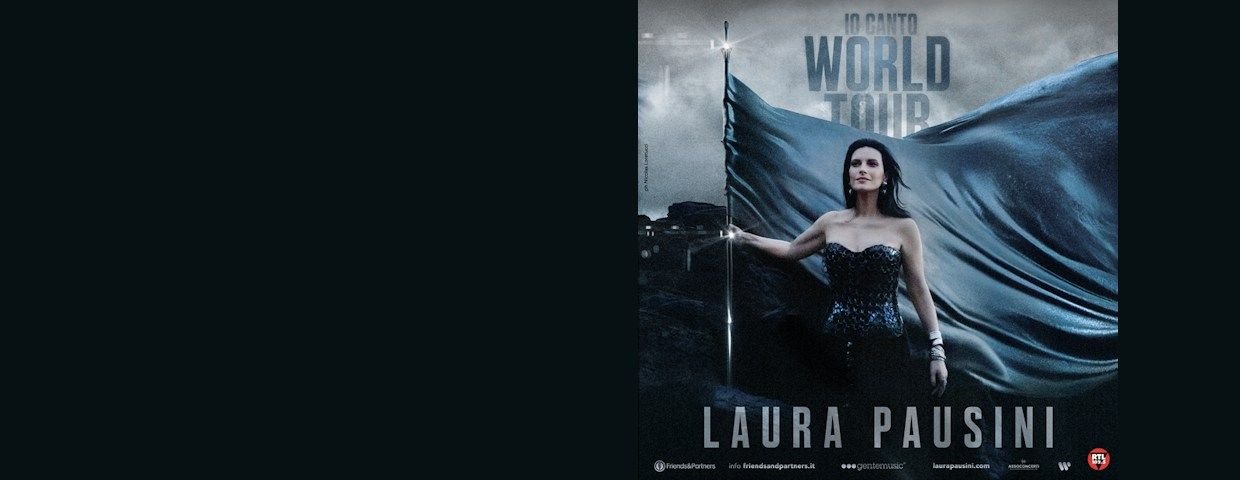
On Saturday, July 3, 2027, with the start announced for 21:00, Laura Pausini sings at Stadio Olimpico in Rome, inside the Foro Italico complex, for the Rome stop of her Io canto World Tour. It's the date that closes the Italian stadium leg of a tour that began in Pamplona in March 2026 and won't end until November 30, 2027 in Zagreb: 20 months of calendar, four separate legs, a run covering South America, North America and Europe. Rome comes toward the end of that journey, and it's a detail that matters more than it seems.
As I write these lines, the evening is almost 10 months away. That means everything about the show itself, the order of the songs, the shape of the stage, any guests on the Rome stage, the final section prices, doesn't yet exist in a public, verifiable form for that specific date, and anyone describing it in advance is imagining it. What already exists, and is worth knowing now, is everything else: who the artist taking that stage is and where a career of more than 30 years comes from, what Stadio Olimpico really is beyond league Sundays, how an evening with tens of thousands of people works in a part of the city that wasn't made to hold them, and what's around that complex in the hours before and after the concert.
Foro Italico is still one of the places people who come for the music walk through without looking at it. You enter from the nearest gate, stand in line, sing, leave, and nothing remains of a white marble complex designed to impress the world. And yet that complex is there, open, free, walkable in the hours before the gates open, and on an early July evening with the long light it's one of the most beautiful views in the city. The following pages are meant to get readers there prepared on three different levels: the musical one, the architectural and historical one, and the practical one.
What happens on July 3, 2027
The date falls on a Saturday, in the first full week of July, at a time of year when Rome has already completely changed pace. Schools have been closed since mid-June, the historic center has switched to late hours, outdoor seating areas stay open late and the city empties of Romans on weekends while it fills with visitors. The sun sets around 20:50 and real light lasts until almost 21:30: a concert starting at 21:00 on an evening like that has a feature you see only in this seasonal window, namely the first part of the show taking place with the sky still bright above the Teflon roof, and darkness arriving once the show is under way.

Why an early July Saturday changes things
A Saturday night concert works differently from a weekday one, and if you're planning the day you'd do well to keep it in mind. The advantage is obvious: there's no evening commute traffic, and if you're coming from outside Rome you have the whole day available without having to ask for time off. The disadvantage is just as concrete: Saturday is the day Rome reaches its peak tourist load, accommodation costs more, trains are fuller and booking anything in the center in the afternoon requires planning ahead.
The last of the Italian stadium dates
The Rome stop isn't just any date on the calendar. The third leg of the tour, the one dedicated to stadiums, begins on February 27, 2027 in São Paulo, Brazil, continues in Italy from June 2 in Lignano Sabbiadoro and then reaches Messina on June 12, Bari on the 19th and Pescara on the 26th, closing on July 3 right here in Rome. Five Italian stadiums in just over a month, with the capital as the final point.
This has two practical consequences. The first is that when the show reaches Olimpico the production has already set up and taken down the same structure four times in five weeks, and so it's well run in: anyone who has followed stadium tours knows that the difference between the first and last date of a series isn't the voice but the precision of the machine around it. The second is that the closing date of an Italian leg has historically carried a special emotional charge, because it's the last chance of the season and the people working backstage know it as well as the audience.
What's confirmed and what isn't
It's worth lining up honestly what's settled and what's still open. Confirmed are the venue, Stadio Olimpico in Rome inside the Foro Italico complex, the date, Saturday, July 3, 2027, the announced start time, 21:00, and the setting, a stadium stop of a world tour linked to an album of reinterpretations. Everything else belongs to the category of information the organizers publish when they have it, and should be looked for there: the section layout for that specific evening, the exact position of the stage, the gate opening time, if or not there's an opening act, entry conditions and the rules on permitted items.
A caution that applies to every stadium concert in Italy: the commercial capacity of a music evening almost never matches the capacity approved for sport, because part of the field is taken up by the stage and service structures, part of the stands ends up behind the stage and is excluded, and the rest of the field is opened to a standing audience on protective panels. The final number depends on that production's design, and 10 months ahead nobody can seriously predict it.
Who Laura Pausini is
To understand what a stadium date means for this artist you have to start far back, because hers is one of the longest and least interrupted Italian careers of the last 30 years, and because the repertoire the Rome audience will sing by heart that night was built up in successive layers starting in 1993.
Solarolo, piano bars, the first contests
She was born in Faenza on May 16, 1974 and grew up in Solarolo, in Romagna. She's the first daughter of Fabrizio Pausini, a piano bar singer who worked in a duo with Renzo Casadio, and of Gianna Ballardini, a kindergarten teacher. She has a younger sister, Silvia, born in January 1977. As a girl she began joining her father at his evening gigs along the Romagna coast, and between 1987 and 1992 she recorded three demos with him. It was a literal apprenticeship, made of other people's songs sung in front of tables full of people eating: training that comes back precisely in the two cover albums she released 20 years apart.
In 1991 she passed the auditions for the Castrocaro Festival but didn't make the final. The year after she won a TV contest that was supposed to open the doors of the 1992 Sanremo Festival, where however she wasn't called. The turning point came from there anyway: thanks to her first producers she got a contract and the chance to work on a record project.
Sanremo 1993 and the two years that changed everything
Success came in 1993 with her win at the Sanremo Festival in the Newcomers section with La solitudine: 7,464 votes against Gerardina Trovato's 7,209, a thin margin for an outcome that went on to define two decades of Italian music. On May 18, 1993 her first album came out, simply titled Laura Pausini, recorded in a hurry and largely at night so she could keep going to school and finish her high school diploma. In summer came her first tour, 28 Italian squares.
In 1994 she returned to the Festival, this time among the Champions, with Strani amori, and finished third despite being tipped as the favorite on the eve. On February 26 her second album, Laura, came out. It was at this moment that the thing happened that sets her career apart from almost all the other Italian pop careers of the same generation: instead of consolidating the home market she stepped away from Italy for about two years and set about building the foreign market. On November 22, 1994 she released her first Spanish-language record, an anthology of her first two Italian albums. In 1995 she also debuted in the English market, and from there she reached Spain and Latin America.
The 1990s albums and the first world tours
The third record, Le cose che vivi, came out on September 12, 1996 and was the first on which she also appears as a lyricist, often together with Cheope. It contains Il mondo che vorrei, written entirely by her for UNICEF, and the lead single Incancellabile, whose video was shot in Iceland. On March 1, 1997 her first world tour started from Switzerland, reaching Paris, Lisbon, Rotterdam, Madrid, Brussels, Monte Carlo and then Latin America.
The American attempt and the Grammy
In November 2002 she released From the Inside, the first record conceived for the North American market and sung in English. It didn't go as hoped, and a series of disagreements with the American record company was followed by the decision to stop the promotion and turn down the offer of a second record in English: it's one of the few moments where her career hit a wall, and it's worth remembering because the usual narrative tends to describe it as a smooth progression. The answer came from another direction. On October 22, 2004 she released Resta in ascolto, whose Spanish version is titled Escucha. Three songs on the record carry big names: Madonna gave her Like a Flower, originally written for one of her 1998 albums, Vasco Rossi and Gaetano Curreri co-wrote Benedetta passione, and Biagio Antonacci wrote Vivimi. On February 8, 2006, at the Staples Center in Los Angeles, with Escucha she became the first Italian woman to receive a Grammy Award, in the best Latin pop album category.
In between, on July 2, 2005, she was at the Circus Maximus in Rome for Live 8. It was the first of her big outdoor appearances in Rome, and it wouldn't be the last.
The first Io canto and the San Siro record
On November 10, 2006 she released Io canto, an album made up entirely of reinterpretations of Italian songs. It came out in 47 countries and in Italy it was the best-selling record of the year. It wasn't an easy option: these are songs linked to her piano bar apprenticeship or to specific moments in her life, and it includes, among others, the duets with Tiziano Ferro and with Juanes.
On June 2, 2007 she became the first female artist to perform at the Giuseppe Meazza stadium in Milan. Before her, concerts by Madonna in 1987 and by Céline Dion had been planned, but both were canceled. The evening sold out with 70,000 tickets sold, and was later released as a live record and DVD. It's the point at which she entered the small group of Italian artists able to fill a stadium, and the scale she has worked at since then hasn't changed.
The 2010s, motherhood, 20 years of career
On November 6, 2015 Simili came out, and in 2016 the related tour returned to Italian stadiums in June before moving to arenas in America and Europe. On March 16, 2018 she released Fatti sentire, and the tour that followed, 52 dates between July and November, started right in Rome with two nights at the Circus Maximus, on July 21 and 22, 2018. In 2019 came the stadium tour shared with Biagio Antonacci, 11 Italian venues between June and August, which overall topped 311,000 attendees.
The Golden Globe, the Oscar nomination, the documentary
On October 23, 2020 she released in five languages the EP Io sì (Seen), the soundtrack of the film The Life Ahead, with Sophia Loren, directed by Edoardo Ponti. In 2021 that song earned her a Satellite Award, a Nastro d'argento and a Golden Globe in the best original song category, plus an Oscar nomination and one for the David di Donatello. For those two occasions she performed on April 25 on the terrace of the Academy Museum of Motion Pictures in Los Angeles and on May 11 at Teatro dell'Opera di Roma.
30 years of career and Anime parallele
On October 27, 2023 she released Anime parallele, 16 tracks, and on November 14 she received from the Latin Recording Academy the Persona del Año award, given each year to an artist for achievements in the Latin music industry and for humanitarian commitment: she's the third woman to receive it, after Gloria Estefan and Shakira. The tour that followed, between June 2023 and December 2024, had 78 dates and began with three nights in Piazza San Marco in Venice and two in the Plaza de España in Seville. The takings from the Venice dates were donated to the people hit by the Emilia-Romagna flood of May 2023.
2026: the Winter Olympics, Sanremo, Io canto 2
The last two years are those in which her public presence reached its peak. On June 14, 2025 Desire came out, recorded with Robbie Williams, chosen as the official anthem of the Club World Cup and performed live at the opening ceremony and at the July 13 final at MetLife Stadium in New York. On September 7, 2025 she opened the Laura Pausini Museum in her childhood home in Solarolo, the first Italian museum dedicated to a female artist: stage costumes, awards, photographs, instruments, documents.
On February 6, 2026 she sang Il Canto degli Italiani at the opening ceremony of the Milan-Cortina Winter Olympics. The same day Io canto 2 came out, the second album of reinterpretations exactly 20 years after the first: 17 songs in the standard edition, 21 in the deluxe, 24 in the digital one, with duets with Annalisa, with Lucio Dalla in virtual form and with Achille Lauro. Between February 24 and 28, 2026 she hosted the Sanremo Festival together with Carlo Conti, returning as host to the stage where she had started 33 years earlier. On July 19, 2026 she was among the stars of the World Cup final, where she performed Desire with Robbie Williams and Nicole Scherzinger.
The Spanish-language version of the album, Yo canto 2, released on March 13, 2026, isn't a translation of the Italian one: it has its own selection, with songs from the Spanish and Latin American repertoire, from Europe to Mexico, from Cuba and Puerto Rico to Colombia, Venezuela, Peru, Chile and Argentina. It's a detail that seems to be for specialists but actually has direct consequences for the show, as I explain further on.
A curious fact about Laura Pausini at Stadio Olimpico in Rome, Io Canto World Tour 2027
The curious fact concerns the ground the audience will stand on that night, and not in a metaphorical sense. The area where the stadium stands was a wetland, prone to stagnant water coming down from the slopes of Monte Mario with no outlet toward the river. To build there, at the end of the 1920s, it was decided to raise the entire ground level by four meters, bringing in about 2 million cubic meters of excavated earth. 2 million cubic meters is the volume of a cube with 125-meter sides: a small artificial rise, built by hand, to reclaim a marsh from the water.
That earth didn't come from far away. It came from the excavations that in those same years were rewriting the center of Rome, from the demolitions that opened new streets through the city's medieval and Renaissance fabric. Put simply, under the field where tens of thousands of people will sing on July 3, 2027 there is, literally, a part of Rome that no longer exists.
It's one of those things that change the way you look at a place. Seeing the green hill behind the stadium, you might think of a natural hollow, a bowl dug into the ground. It isn't: Olimpico sits on a built-up rise, a few dozen meters from the Tiber, and its height relative to the river is the result of an engineering decision and not of geography.
A second curious fact, on the side
The stadium's name changed twice before becoming the current one, and neither of the previous two had anything to do with Olympic sport. The first was Stadio dei Cipressi, from the cypress trees that marked the area. The second, adopted with the postwar rebuild, was Stadio dei Centomila, from the 100,000 capacity it was meant to reach. The name it bears today came only after 1955, when the International Olympic Committee awarded Rome the 1960 Games. Three names in just over 30 years for the same piece of land, each the child of a different era and a different idea of what that place should represent.
Stadio Olimpico as a construction
What you see today is a venue almost entirely rebuilt between 1988 and 1990 for the soccer World Cup. The 1989 demolition left almost nothing standing of the 1953 structure: the only surviving portion is part of the outer facade of the Tribuna Tevere. The two curve were moved nine meters closer to the field, and the Tribuna Monte Mario was enlarged to take in the press center built for the 1987 World Athletics Championships.
The Teflon roof, which nobody looks at
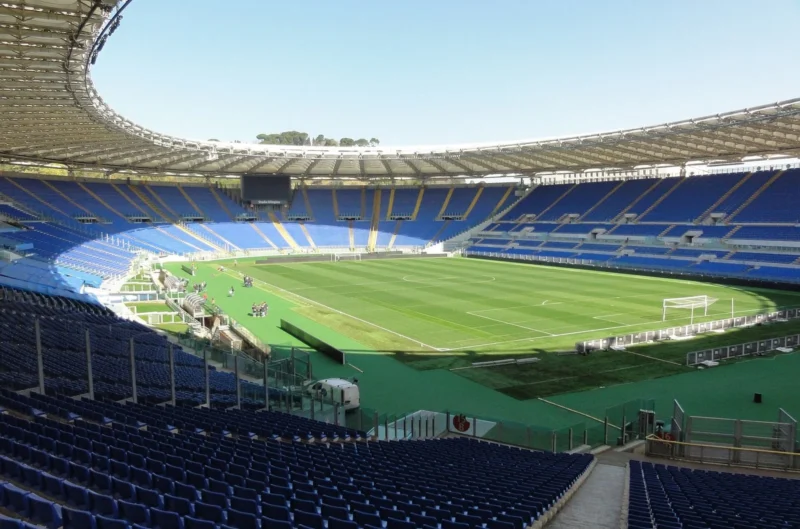
The most interesting part of the venue from a technical point of view is the roof, and it's worth looking up as soon as you're in, before the natural light fades. The support system consists of an outer ring, a triangular-section truss running along the whole upper perimeter 29 meters above street level, resting on 16 pylons: 12 in steel and four in reinforced concrete, the latter hollow inside because they contain the stairways. Further in runs a second ring, made of 12 steel cables 87 millimeters in diameter. Between the two rings stretches a radial structure of 78 pairs of cables, the upper ones load-bearing and the lower ones stabilizing, for a total overhang of 45 meters. From the cables hang the metal works that hold up the actual roof, made of Teflon and fiberglass.
The roof alone cost about 160 billion lire at the time. For concertgoers the practical result is twofold, and it's worth knowing before you choose your seat. On one hand that white membrane reflects the light from the rigs and gives the audience a diffuse brightness that no open stadium has: you can see it clearly in TV footage and in photos taken from inside. On the other it changes how the sound behaves, because the volume of air enclosed between the stands and the roof produces reverb. Technicians who regularly work at Olimpico know this, and it's why the acoustics in the upper and side sections differ noticeably from those on the field and in the front sections.
How the venue is divided
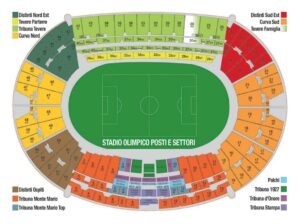
Inside, Olimpico has a single tier, without stacked rings, and is divided into three classes of sections. The Tribune are two, Tevere and Monte Mario, and correspond to the long sides. The Curve are the Nord and the Sud, and correspond to the short sides. The Distinti are four and occupy the corners between the curve and the tribune: Nord lato Tevere, Nord lato Monte Mario, Sud lato Tevere, Sud lato Monte Mario. It's a geography that Roman soccer fans know by heart and that people coming for a concert meet for the first time, often while looking for their entrance with ticket in hand and the line moving behind them.
There are 33 entrances to the stands in all, unevenly distributed: two for each Distinti section, four for each Curva, seven for the Tribuna Tevere and 10 for the Tribuna Monte Mario. The four hollow reinforced concrete pylons mentioned above give stair access to the highest level of the stands. The approved capacity after the 2008 work is 70,634 seats, second in Italy. The highest attendance ever certified for a match dates from the 1973-74 season, with 78,886 spectators: numbers from an era when safety criteria were completely different.
Foro Italico around the stadium
If you come for the concert and stay inside the barriers, you miss the most interesting part of the place, and you miss it for nothing, because almost everything worth seeing can be walked through freely. Foro Italico sports complex was designed in 1927 by Enrico Del Debbio and built from 1928, with completion continuing between 1956 and 1968. The original name was Foro Mussolini. In August 1943, right after the fall of the regime, CONI renamed the complex Foro Italico.
The mosaic avenue and the obelisk
The main entrance opens to the southeast, in line with Ponte Duca d'Aosta. From there starts a wide avenue covered entirely in black and white mosaic tiles, originally called Piazzale dell'Impero and today Viale del Foro Italico. Walking it takes 10 minutes and is worth every one of them: the mosaics tell, in an entirely explicit figurative language, the sporting and military vision the regime wanted to project onto the place. At the head of the avenue stands a Carrara marble obelisk 17.5 meters tall, base excluded, dedicated to Mussolini.
Stadio dei Marmi
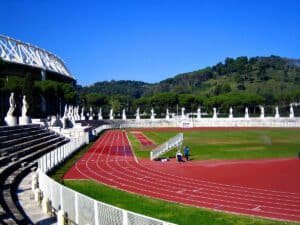
A few steps from Olimpico is Stadio dei Marmi, inaugurated in 1932 along with the first works of the complex. It's a ring of low tiers surrounded by marble statues of athletes, donated by individual Italian provinces and therefore made by different sculptors: the statue dedicated to javelin throwing came from the province of Perugia, the one dedicated to pallone col bracciale from the province of Forlì. You can walk through it in five minutes and, in the slanting light of a late July afternoon, it offers one of the most photogenic views in all of north Rome.
Something nobody tells you about Laura Pausini at Stadio Olimpico in Rome, Io Canto World Tour 2027
The first thing almost nobody mentions concerns the playing field and has very concrete consequences for how an evening like this is put together. Olimpico isn't a stadium designed for concerts: it's a multipurpose venue with an athletics track around the field, which has hosted the Golden Gala since 1980 and the big athletics events when they come to Rome. That track, and the field it encloses, are surfaces that need protection and that severely limit what can be done inside the ring.
Why the stage doesn't go where you'd like
The consequence is that the audience layout at an Olimpico concert isn't free. In the first years after the 1990 rebuild, when music shows started coming to the venue, the audience was admitted only in the Curva Sud, with the stage built in front of it: the rest of the stadium stayed empty. The setup with the field open to spectators, which today we take for granted, requires full protection of the turf and is granted under precise conditions.
There's one episode that explains the matter better than any technical description. On June 6, 1998 Claudio Baglioni played at Olimpico one of the two Rome stops of the Da me a te tour: for that evening 82,000 tickets were sold, plus about 8,000 complimentary entries, for a total of around 90,000 attendees, the highest attendance ever for a concert in Italy. The record was possible because the then CONI president, Mario Pescante, quite exceptionally authorized the installation inside the stadium of a huge star-shaped stage, 112 meters long and 72 wide. The reason for the exception wasn't artistic but agronomic: the field was going to be replaced that very summer, so damage to the turf no longer mattered. Without that coincidence that number would never have existed, and nobody has come close to it since.
The track, which nobody considers
A detail that almost always escapes ticket buyers: between the first row of the stands and the edge of the field runs the athletics track, nine lanes wide. Those are meters that simply don't exist in a soccer-only stadium. It means that anyone sitting in the first row of the stands at Olimpico is further from the stage than they would be in the same section of an English-style stadium. It isn't a flaw, it's a defining feature: the venue was born as an Olympic stadium, with the track at the center of the project, and that distance is part of the 1953 design even before the 1990 rebuild.
The second thing: the Italian show is a different show
Here comes the point that concerns this tour specifically and that never appears in generic presentations. The tour is divided into four legs, and the first, the Spanish one in 2026, is built around the Spanish-language version of the album. That version, unlike what happened with the first Io canto in 2006, doesn't translate the Italian songs: it offers a completely different selection, drawn from the Spanish and Latin American repertoire. The stated consequence is that the track list, sets, projections and costumes of the Spanish leg are different from those of the Italian-language show staged in 2026 and 2027.
In practice, two distinct shows coexist under the same title. If you've seen images or videos from the Spanish leg in spring 2026 and expect to find the same staging and the same journey at Olimpico, you'd do well to reconsider that expectation. And if you compare the Italian and Spanish record versions, you'll find they are, in fact, two different albums that share only the starting idea. It's a rare and expensive production choice, and it's worth knowing before you go in.
What it means for ticket buyers
Two practical consequences to keep in mind when choosing a section. The first: the number of seats actually put on sale for a concert at Olimpico is always lower than the sports capacity, because part of the stands ends up behind the stage and is excluded, and because the field holds structures that take up space. The second, more useful: the quality of what you see varies hugely from section to section, and not in proportion to the price. A seat in the Distinti on the right side relative to the stage can offer a full frontal view, while a seat in the tribuna near one of the ends can be at a sharp angle. Before choosing, look at the seating map published for that specific evening, not the soccer one, which circulates much more and is irrelevant.
My tip for Laura Pausini at Stadio Olimpico in Rome, Io Canto World Tour 2027
There's only one tip and it's worth more than all the others put together: get to Foro Italico at least two and a half hours before the start time, and use that time to be outside, not to stand in line. I'm not saying it out of organizational caution. I'm saying it because Foro Italico in early July, at 19:00, with the sun still high on the white marble and the green mass of Monte Mario behind, is one of the most beautiful and least visited places in Rome, and because otherwise those two and a half hours turn into a motionless wait on hot asphalt in front of a closed gate.
How to plan the afternoon
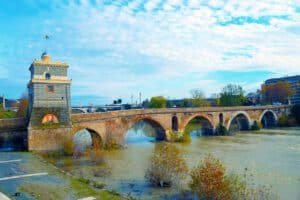
A route that always works starts from Milvian Bridge around 18:00. It's one of the oldest bridges in the city still in use, with a history that goes through the battle of 312, and in the late afternoon it's crossed by a flow of people who have nothing to do with the concert. From there you walk down along the Tiber on the right bank, skirt the sports complex, enter via the mosaic avenue, walk around Stadio dei Marmi, pass in front of Palazzo H and the pool complex, and find yourself at the gates of Olimpico having walked just over two kilometers and having seen something.
If you want a longer route, you can start even earlier from the other bank, in the Flaminio district, passing by MAXXI and Auditorium Parco della Musica, and then crossing Ponte della Musica, which links Flaminio directly to Foro Italico. It's a route that in a kilometer and a half lines up contemporary architecture and 1930s architecture, and that after the concert gives you the option of leaving on the opposite side from the main flow.
What to bring and what to leave at home
Rome in early July, at 21:00, is still around 28 degrees Celsius, and inside a full stadium the perceived temperature rises noticeably because of the density of people and the heat stored in the concrete during the day. The first rule is water: dehydration is the reason medical staff step in at summer concerts far more often than for any other cause, and in almost all cases it involves people who hadn't drunk enough before going in. At big venues bottles with caps don't get through the checks, while inside there are water points: the sensible thing is to arrive already hydrated and drink as soon as you're in, without waiting to feel thirsty.
Second rule: travel light. Every extra item means a longer check at the entrance, for you and for the people behind you in line. Large backpacks and bulky bags are usually not allowed, and storage near a stadium on concert nights is scarce and fills up immediately. Third rule: closed, comfortable shoes. If you buy a field ticket you'll spend several hours standing on a surface covered with protective panels, which isn't soft and doesn't forgive. If you stay in the stands you'll still climb plenty of flights of stairs, going and coming back, often in the middle of the crowd.
When to leave
At the end of a concert with tens of thousands of people, the outflow from Foro Italico takes a good hour, and the bottleneck is geographic before it's organizational: the complex is squeezed between the river and the hill, and there are few bridges available. If you have a train or a flight, factor in this time before buying your return ticket. If you have no constraints, though, you'd do well to do the opposite of what everyone else does: stay put for 20 minutes inside or just outside, let the crowd flow out, and walk calmly toward Ponte Milvio, where on summer evenings life goes on until late and you can find drinks and food even after midnight.
How to get to Foro Italico
The first thing to know is that the metro doesn't reach Stadio Olimpico. None of Rome's lines touch Foro Italico, and this determines all the rest of the logistics. The complex is on the right bank of the Tiber, at the foot of Monte Mario, in an area bordering the Della Vittoria and Tor di Quinto districts and facing, across the river, the Flaminio district just downstream of Ponte Milvio.
By public transportation
The pattern that works is always the same: take the metro to a line A station in the northwest part of the center, and from there continue above ground by bus or tram to one of the hubs near the complex. The arrival points to keep in mind are Piazzale Maresciallo Giardino, on the stadium side, and Piazza Mancini, on the other bank, reachable from the center by the tram that leaves from the Flaminio area. From Piazza Mancini you walk across Ponte Duca d'Aosta and find yourself right at the head of the mosaic avenue, which is also the most beautiful way to arrive.
By car, taxi or bike
Arriving by car is possible but rarely worth it. On event nights traffic around Foro Italico is rerouted, the right-bank Lungotevere roads are partly closed and available parking runs out well in advance. If you decide to drive anyway, you'd do well to aim for an area further away, toward Monte Mario or the Ponte Milvio area, and cover the last kilometer on foot. For taxis there's a rule of thumb that never fails: you won't find one at the exit, because demand is all concentrated in the same quarter hour and cars can't get close. Walking 20 minutes to a clear main road and calling one from there works better than waiting in front of the gates.
How a stadium concert works
People who have never seen a stadium concert often arrive with expectations built on arenas, and the two experiences have little in common. It's worth lining up the differences before buying a ticket, because some are structural and no production, however polished, can remove them.
The voice and the repertoire
A note about this artist in particular. A large part of her repertoire is built on melodic songs with an exposed voice, wide dynamics and passages where the volume drops a lot. In an arena those moments work because the environment is controlled. In a stadium with tens of thousands of people they depend on the audience being silent, and Italian audiences at summer concerts tend to sing over everything. It's a dynamic anyone who has been to an evening like this knows, and it's worth knowing so you can enjoy the quiet passages instead of complaining about them.
Another well-known fact, yet one that's rarely mentioned
The well-known fact is that Stadio Olimpico hosts concerts. What's rarely mentioned is when it started, and who played there first. The answer surprises almost everyone: the very first artists to perform in the venue, in a joint event in July 1991, were Miles Davis and Pat Metheny. Not a rock band, not an Italian singer-songwriter: two names from jazz, on a stage built in front of the Curva Sud, in front of about 20,000 people.
The first Italian to take that stage was Zucchero, in June 1993, in front of 10,000 spectators. It's worth pausing for a moment on that figure. In 1993, the same year La solitudine won at Sanremo, a concert at Olimpico could count 10,000 people in a venue that held 70,000. The idea that filling a stadium is the obligatory goal of every Italian pop career is much more recent than people think, and it grew alongside the generation of artists who debuted in those very years.
Why not before 1991
The reason is technical and lies entirely within the 1990 rebuild. Before that work the venue was almost entirely uncovered, except for the stand on the Monte Mario side, and its shape didn't make it suitable for large-scale music productions. It was the complete rebuild for the World Cup, with the Teflon roof, the new service structures and the new systems, that turned Olimpico into a place that could also be used for music. Put another way: the calendar of Rome concerts at this stadium starts with Italia 90, and not a day earlier.
Tickets and access
Almost 10 months ahead, any figure on prices would be invented, and any statement on remaining availability would be outdated within a few weeks. What can be said concerns the method, which doesn't change over the years.
Where to buy them
Tickets for a stadium concert in Italy are sold through the official channels listed by the organizers and at authorized physical outlets. Unauthorized resale channels are a concrete risk, not a theoretical one: you find out a ticket isn't valid at the turnstile, when there's nothing left to do and you're a thousand kilometers from home. In Italy the rules on named tickets for large-capacity events have changed the name-change procedures: if you buy a ticket today for a date far ahead, you'd do well to check right away the conditions for putting it in someone else's name, because doing it close to the date is generally more complicated and in some cases impossible.
Entry checks
Screening for an event with tens of thousands of people starts far from the turnstiles, with successive checkpoints. The first check usually verifies that you have a valid ticket, the last ones check the contents of bags and that the ticket matches your ID. The total time between the first checkpoint and your seat, on a full night, rarely drops below 40 minutes. If you arrive at 20:45 for a concert starting at 21:00 you'll get in after the show has begun: it's arithmetic, not pessimism, and the first song of an evening like this isn't the one you want to miss.
Accessibility
Stadio Olimpico has reserved spaces for spectators with disabilities and their companions, limited in number and located in specific sections. For music events the location and number of these spaces depend on the evening's setup, because the stage changes the geometry of the venue and blocks some sight lines. The correct procedure is always the same: contact the organizers well in advance, before general sales open when possible, because the dedicated places sell out quickly and aren't reopened.
A couple of practical notes about Foro Italico that never appear on official pages. The outdoor paths are largely flat and paved, but the mosaic avenue has a tiled surface that's uneven under a wheelchair, and the porphyry stretches in the service areas are uncomfortable. The distance between the points where a vehicle can stop on event nights and the stadium entrances is considerable, because roads are closed further up: if you have mobility difficulties, ask the organizers in advance which gate to use and what route is planned, instead of finding out on the spot in the heat.
For people with hearing-related needs, it's worth remembering that a stadium concert produces high and prolonged sound pressure levels. Filtered earplugs, the kind that lower the volume without distorting frequencies, are an accessory costing a few euros that radically changes the evening, and not only for those with problems: anyone bringing children to a stadium concert should use them, because exposing a child's ear to those levels for three hours isn't a matter of comfort but of health. Considering that this artist's audience regularly includes whole families, it's advice that counts double here.
The right photo to take at Laura Pausini at Stadio Olimpico in Rome, Io Canto World Tour 2027
The right photo isn't the one of the stage. Tens of thousands of people will take the photo of the stage, it'll be blurry, and in six months nobody will be able to tell theirs from anyone else's. The right photo is taken before you go in, and there are actually three, in three different spots, all reachable in the hour and a half before the gates open.
The first: the mosaic avenue with the obelisk
Stand at the far end of Viale del Foro Italico, on the Ponte Duca d'Aosta side, and frame the perspective with the obelisk centered and the black and white mosaic running into the distance. In early July, around 20:00, the light comes in low from the west and brings out the relief of the tiles, which at midday looks flat. Lowering the lens almost to ground level stretches the perspective and the marble of the obelisk takes on a warm color it doesn't have by day. It's the photograph that tells where you really are.
The second: Stadio dei Marmi against the light
The statues of Stadio dei Marmi, in the late afternoon, stand out against the sky and the green of Monte Mario. The shot that works isn't the frontal one of a single statue, which comes out like a caption, but the one taken from the bottom of the ring, with several figures lined up along the tiers and the sky behind. It's best to get there between 19:00 and 20:00, when the sun is low enough to create contrast but hasn't yet disappeared behind the hill.
The third: the roof seen from inside
Once you're in, before the natural light fades, it's worth pointing the lens upward and framing the underside of the Teflon roof with the pattern of radial cables converging toward the center. It's a structure that looks light from below and supports a 45-meter overhang. With the sky still bright in the central opening and the stadium lights already on, you get an image almost nobody ever thinks of taking and that is by far the most characteristic of Olimpico.
Some important events that happened here in history
Few arenas in the world have a density of events comparable to Olimpico's, and it's worth putting them in order, because the list alone explains why for an Italian artist playing here means something different from playing elsewhere.
The origins and the two rebuilds
Work on the complex began in 1928 under the direction of Enrico Del Debbio, commissioned by the Opera Nazionale Balilla. On October 28, 1932, for the regime's 10th anniversary, the venues completed included Stadio dei Cipressi, designed for 100,000 spectators and built with terracing on the Monte Mario side and earth fill on the other sides. The official inauguration took place on November 4 with a youth gymnastics display. From 1933 Luigi Moretti reworked its shape, adding masonry stands on the Tiber side too, and on May 9, 1937 the renovated venue was inaugurated with a capacity of 60,000 spectators.
The 1960 Olympics
On August 25, 1960 the stadium hosted the opening ceremony of the Games of the XVII Olympiad, and in the following days it was the stage for a series of records that remain among the most cited in athletics history. American Wilma Rudolph won three golds: the 100 meters in exactly 11 seconds, the 200 meters, after setting the Olympic record in the heats with 23.2 seconds, and the 4x100 relay with the world record of 44.4 seconds together with Martha Hudson, Lucinda Williams and Barbara Jones.
Soccer nights, athletics, rugby
Besides the Olympics, the venue hosted the European Athletics Championships in 1974 and 2024 and the World Championships in 1987. Since 1980 it has hosted the Golden Gala every year, today named after Pietro Mennea and since 2010 the Rome stop of the Diamond League. The first edition, on August 5, 1980, right after the Moscow Olympics, drew 74,000 spectators, of whom 54,000 paid: halfway through the evening it was decided to open the curva entrances and let in those asking to watch. Since 2012 the stadium has been the home ground of the Italian national rugby team in the Six Nations.
The dark pages
It would be dishonest to list only the victories. Olimpico is also the backdrop to two very serious episodes. In 1979 a flare fired from a homemade device killed a spectator, Vincenzo Paparelli, hit while he was in the stands. In 1994 a Mafia-linked subversive bomb attack, which failed for technical reasons, could have caused an unknown number of victims among civilians and police during a match. Two dates nobody in Rome has forgotten, and that are part of the place's biography as much as the finals and the records.
Who has passed through Laura Pausini at Stadio Olimpico in Rome, Io Canto World Tour 2027
Whoever takes the Olimpico stage on July 3, 2027 joins a list that starts in 1991 and has grown long since. It's worth knowing, because it helps you understand the scale of the thing.
The Italians
The artist who has performed here more times than anyone else is Vasco Rossi: 23 times between 1991 and June 2023. Behind him Ligabue, with 13 appearances between 1996 and 2023. The very first Italian was Zucchero in June 1993. The all-time attendance record belongs to Claudio Baglioni, with the June 6, 1998 concert and the roughly 90,000 attendees mentioned above: a number that, for the technical reasons already explained, is unlikely to be reached again.
The foreign artists
The very first, as mentioned, were Miles Davis and Pat Metheny in July 1991. Among international acts the most frequent are Depeche Mode, five times between 2006 and 2023. Right behind, with four, U2, between 2005 and the 2017 Joshua Tree Tour. In 1996 a festival brought David Bowie and Tina Turner here. In 2005 R.E.M. arrived with the Around the Sun Tour.
And the other 2027 dates
Rome's summer 2027 at Olimpico doesn't end with this date. Among the events announced at the same venue are Vasco Rossi, Olly, Achille Lauro and Pinguini Tattici Nucleari. If you follow her recent records, you'll notice there's already a studio precedent with Achille Lauro, the duet recorded for Io canto 2.
What's around
Foro Italico isn't in a tourist thoroughfare, and that's both a limit and an advantage: no lines, no historic center prices, but also very few services in one place. The nearest hub of activity is Milvian Bridge, just over a kilometer away: the square and surrounding streets are one of north Rome's evening meeting points, and they work well for before and even better for after.
Crossing Ponte Duca d'Aosta or Ponte della Musica you enter the Flaminio district, which offers MAXXI, Auditorium Parco della Musica and, going down Via Flaminia, the Villa Giulia Etruscan Museum and finally Piazza del Popolo. If you arrive in Rome in the afternoon and want to fill the hours before the concert, you'll find a complete route here without going more than three kilometers.
Quick questions
When is the concert?
Saturday, July 3, 2027, with the start announced for 21:00.
Where exactly?
At Stadio Olimpico in Rome, inside the Foro Italico complex, at the foot of Monte Mario on the right bank of the Tiber.
What's the set list?
There's no published set list for the Rome date, and almost 10 months ahead there can't be one. Anyone publishing it is guessing.
How much do tickets cost?
Prices vary by section and are set and published by the organizers: no indicative figure would be reliable this far ahead.
How many people fit in Stadio Olimpico?
The approved capacity for sport is 70,634 seats. For a concert the actual number is lower, because the stage and service structures take up part of the field and exclude some sections.
Who is Laura Pausini, in short?
A singer-songwriter from Romagna born in Faenza in 1974, active since her win at Sanremo in the Newcomers section in 1993, the first Italian woman to win a Grammy Award and winner of a Golden Globe for best original song in 2021.
Which tour is the date part of?
The world tour linked to the album of reinterpretations Io canto 2, which started in Pamplona in March 2026 and is set to close in Zagreb on November 30, 2027. The Rome date closes the Italian stadium leg.
How do I get there by public transportation?
There's no metro at Foro Italico. You take line A to the northwest part of the center and continue above ground to Piazzale Maresciallo Giardino or to Piazza Mancini, from where you walk across Ponte Duca d'Aosta.
What time should I arrive?
Two and a half hours early is a margin that lets you walk around the complex and go in without rushing. If you show up a quarter of an hour before the start, you'll get in after the show has begun.
Is it worth coming from outside Rome?
If you have a connection with that repertoire, yes: a stadium date isn't just any concert, and the first days of July in Rome offer very long days and warm evenings. As long as you treat the day as a whole day in Rome and not as a transfer to a gate.
On an evening like this the container matters as much as the content. A singer who started in the piano bars of the Romagna coast singing on a field built by draining a marsh, under a Teflon tensile structure designed for a soccer World Cup, in the middle of a white marble complex wanted by a regime that meant to impress the world, 200 meters from a bridge where a battle was fought in 312. None of these elements was put there to create atmosphere, and that's exactly why the atmosphere works. The only thing asked of those who come is the most obvious: check your section, the time and the entry conditions with the organizers in good time, arrive with enough margin to look around, drink water, and then sing.
Frequently asked questions about Laura Pausini at Stadio Olimpico in Rome, Io Canto World Tour 2027
When is the Laura Pausini concert at Stadio Olimpico?
The Laura Pausini concert at Stadio Olimpico in Rome is scheduled for Saturday, July 3, 2027, with the start announced for 21:00. The date falls in the first full week of July, when in Rome the sun sets around 20:50 and the light lasts until almost 21:30.
Where exactly is the Laura Pausini concert held?
The concert is held at Stadio Olimpico in Rome, inside the Foro Italico complex, at the foot of Monte Mario on the right bank of the Tiber, in an area bordering the Della Vittoria and Tor di Quinto districts.
How much do tickets for Laura Pausini at Stadio Olimpico cost?
Almost 10 months from the date, the ticket price for the Laura Pausini concert isn't set: tickets for stadium concerts in Italy are sold through the official channels listed by the organizers, where you should check the actual price as the date approaches.
Who is Laura Pausini, the artist in concert at Stadio Olimpico?
Laura Pausini was born in Faenza on May 16, 1974 and grew up in Solarolo, with a career that started in piano bars and early singing contests and that, from 1993 on, developed into one of the longest and least interrupted in Italian music.
How do I get to Foro Italico for the Laura Pausini concert?
The metro doesn't reach Stadio Olimpico: no Rome line touches Foro Italico, and this determines all the logistics of getting to the complex at the foot of Monte Mario, on the right bank of the Tiber.
What time should I arrive at the Laura Pausini concert at Stadio Olimpico?
The advice is to get to Foro Italico at least two and a half hours before the start time of the Laura Pausini concert, and to use that time to be outside rather than in line, because Foro Italico in early July, at 19:00 with the sun still high on the white marble, is one of the most striking places in the area.
Was Stadio Olimpico designed for concerts?
No, Olimpico isn't a stadium designed for concerts: it's a multipurpose venue with an athletics track around the field, which has hosted the Golden Gala since 1980 and the big athletics events when they come to Rome, and this layout always shapes the setup of a music evening like Laura Pausini's.
Are there spaces for people with disabilities at the Laura Pausini concert?
Yes, Stadio Olimpico has reserved spaces for spectators with disabilities and their companions, limited in number and located in specific sections that depend on the evening's setup. The correct procedure is to contact the organizers in advance.
Article written by the editorial team of TourLeaderPro, contact them for Private, Corporate and V.I.P. Tours and Experiences. If you'd like a guided walk through Foro Italico and the Flaminio district, between 1930s architecture and contemporary architecture, with a licensed guide, write from the TourLeaderPro contact page. For agencies and operators building evening and music programs in Rome, there's a consulting service in the area reserved for tour operators.
Planning a trip to Italy? The English-language guides are on ItalyPlanner.com. To plan your Rome days, the reference is the page on the best things to do in Rome, while if you have three full days you'll find a ready-made plan in the three-day Rome itinerary. If you'd like to extend the trip to Laura Pausini's Romagna, there's the page on Emilia-Romagna.
Contact Information
Nearby
 Stadio Olimpico200 m
- Foro Italico200 m
- Hotel Butterfly300 m
- Oasis in Rome 2027: the three dates at Stadio Olimpico600 m
- Ponte della Musica – Armando Trovajoli900 m
- Milvian Bridge1.0 km
Upcoming events nearby
- Vasco Rossi, Residency Show at Stadio Olimpico in Rome, June 2027100 m
- Olly at Stadio Olimpico in Rome, Tour Stadi 2027100 m
- Pinguini Tattici Nucleari at Stadio Olimpico in Rome, Tour Stadi 2027100 m
- Achille Lauro at Stadio Olimpico in Rome, Per Sempre Noi, Stadi 2027100 m


You might also like
- Talco Freek Tour 2027 at Hacienda Roma, April 2, 2027
- The Devon Allman Project at CrossRoads Live Club: March 26, 2027
- Voyage 35 (ex Porcupine Tree) at CrossRoads Live Club, March 10, 2027
- Spike and the Gimme Gimmes at Traffic Club, November 24, 2026
- The Molotovs at Hacienda Roma, November 11, 2026
- Angela Hewitt at Aula Magna della Sapienza, February 20, 2027