Achille Lauro at Stadio Olimpico in Rome, Per Sempre Noi, Stadi 2027
In short. Two nights in a row, Wednesday, June 30 and Thursday, July 1, 2027, at 21:00, Achille Lauro brings Per Sempre Noi to Stadio Olimpico in Rome, inside the Foro Italico complex.
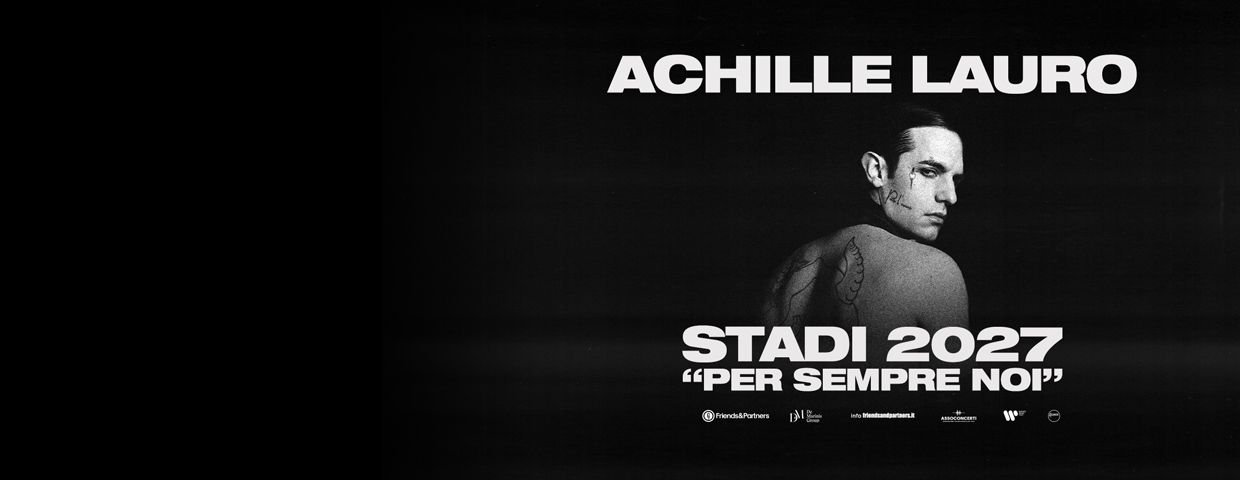
Two nights in a row, Wednesday, June 30 and Thursday, July 1, 2027, at 21:00, Achille Lauro brings Per Sempre Noi to Stadio Olimpico in Rome, inside the Foro Italico complex. The first of the two nights sold out more than a year in advance, and that early sellout is exactly what made the second necessary: for an artist who grew up between Serpentara and Vigne Nuove, singing at his own city's stadium on two consecutive nights is the kind of milestone you don't reach by chance.
I'm writing these lines about 10 months ahead of the first date, and it's worth being clear from the start about one thing: almost everything about the evening itself, the order of the songs, the shape of the stage, any guests, the exact division of sections, the final prices, simply doesn't exist yet in a public, verifiable form. Anyone describing it today is imagining it. What already exists, and is worth knowing now, concerns three different levels: who the artist taking that stage is and where his popularity comes from, what Stadio Olimpico really is beyond Sunday soccer, and how to get through an evening with tens of thousands of people gracefully in a corner of Rome that wasn't made to hold them.
Foro Italico is still one of the most misunderstood places in the city. People who come for sport walk through it without looking, people who come for a concert treat it as a parking lot with a stage inside. It's actually a complex that would deserve a visit of its own, with the right light on the mosaics, and on a concert night you can do almost all of that visit without paying anything and without missing a minute of music: you just need to arrive with enough margin. What follows is for that, to get readers there prepared on all three levels.
The two 2027 dates: June 30 and July 1
The two evenings fall across the end of June and the start of July, the window when Rome has already completely changed pace. Schools have been closed since mid-June, the city has switched to late hours, sunset comes around 20:45 and real light fades only after 21:30. A concert starting at 21:00 in that period has a feature you see in Rome only in this handful of weeks: the first part takes place with the sky still bright above the Teflon roof, and full darkness arrives when the show has long since started.
Why two nights and not one
The logic of double dates at stadiums is almost always the same, and there's nothing mysterious about it. A stadium concert involves huge setup costs: the stage, the sound towers, the video structures, vehicle logistics, staff. Setting all this up for a single night means spreading those costs over one evening. Setting it up for two consecutive nights, with the same setup already standing, radically changes the math. That's why, when the first date sells out early, the second comes almost automatically: it isn't a whim, it's the most rational way to use a structure that's already there.
There's also a less accounting-based reading, though, and it concerns Rome specifically. Lauro isn't an artist coming to the city on tour: he's an artist coming home. He was born in Verona in 1990, but it's in Rome that he grew up, and it's in the city's northern outskirts that everything that later became his raw material took shape. Two consecutive nights at Stadio Olimpico, for someone with that biography, mean something that goes beyond the number of tickets.
What's known and what's still open
It's worth lining up honestly what's confirmed and what isn't yet. Confirmed are the venue, Stadio Olimpico inside Foro Italico, the two dates, Wednesday, June 30 and Thursday, July 1, 2027, the announced start time, 21:00, the setting, a stadium tour titled Per Sempre Noi, and the fact that the first night was already sold out well in advance, so much so that a second had to be added.
Everything else belongs to the category of information the organizers make public when they have it, and should be looked for directly there: the section map for those specific evenings, the exact position of the stage, the gate opening time, if there's an opening act, entry conditions, the rules on what you can bring in. Anyone reading a set list published 10 months ahead is reading a hypothesis.
A caution that applies to any stadium concert in Italy: the commercial capacity of a music evening almost never matches the capacity approved for sport. The field is partly taken up by the stage and service structures, partly opened to a standing audience, and the stands behind the stage often aren't put on sale. The final number depends on that production's design and nobody can predict it months ahead.
Who Achille Lauro is
Lauro De Marinis was born in Verona on July 11, 1990, son of Nicola De Marinis, a magistrate and university professor from Gravina in Puglia, and of Cristina Zambon, from the Veneto. The family moved to Rome and he grew up between the Serpentara and Vigne Nuove neighborhoods, in the city's northern outskirts, far from both the tourist center and the most talked-about borgate. It's a detail that matters, because that part of Rome, made of 1970s and 1980s apartment blocks and badly stitched-together open spaces, shows through in all his work.
His brother, Quarto Blocco, the name
At 14 Lauro left his family, which had moved to another city, and went to live in a commune with his older brother Federico, known as Fet, already a producer for the Quarto Blocco crew. It was thanks to him that his passion for music was born, and thanks to him that the boy entered Rome's underground rap scene, the world of free downloadable mixtapes and home recordings.
His stage name came in that period, and the explanation he gave for it is disarming: many people associated his first name with the surname of the Neapolitan shipowner Achille Lauro, so he might as well accept it. In 2012 his first two mixtapes came out, Barabba and Harvard, made with producers affiliated with Quarto Blocco and distributed as free downloads. No label, no budget, no plan.
Roccia Music and the first albums
Lauro soon became the leading figure of his collective, to the point that established names of the Roman underground, including Noyz Narcos, helped him join Roccia Music, the label of Marracash and producer Shablo. From there came Achille Idol immortale and, on May 26, 2015, Dio c'è, preceded by the Young Crazy EP. Already in these works there was something that didn't fit traditional rap: at the end of each track of the first album there's a reading of a Gospel verse rewritten in a personal key, and religious references never left his writing.
On June 30, 2016 his departure from Roccia Music was announced. It wasn't a break: Lauro has always spoken well of that experience, comparing his case to that of other artists for whom the label worked as a launch pad toward independence. The reason was another, the same one that runs through his whole career: the will to do things himself. He founded the No Face Agency with producer DJ Pitch8, and in November 2016 released Ragazzi madre, his third studio album, which sealed his partnership with producer Edoardo Manozzi, known as Boss Doms.
The change in sound
2017 was the year Lauro started to move. He signed with Sony Music in October, took part in Pechino Express with Boss Doms finishing third, and above all began producing songs that had little to do with street rap. In that span of months the informal label of samba trap was born, a hybrid of Latin sounds, melody and trap structure that he himself claimed as his own.
The end point of this phase is Pour l'amour, released on June 22, 2018 in collaboration with Boss Doms. It's an openly experimental record, putting Neapolitan sounds, house, South American influences and trap in the same container. Lauro has said he conceived it by isolating himself in a villa with his collaborators, with the idea of also writing the next two albums in that session, as a trilogy. The same year he took part in the Concerto del Primo Maggio in Rome.
The four Sanremos
The general public met him in February 2019, at the Sanremo Festival, with Rolls Royce. The song, orchestrated and conducted by Enrico Melozzi, can be classified as rock and not rap, and lists in nursery-rhyme fashion a series of idols, from Jimi Hendrix to Amy Winehouse, from Elvis Presley to Axl Rose, with the Rolls-Royce as the symbol of the rock star life. It finished ninth out of 24 entries, low with the public opinion jury and high with the press jury: a split that sums up the character well.
He returned in February 2020 with Me ne frego, eighth in the final ranking, but that year people talked mostly about the outfits. Four appearances, four visual quotations built with the Gucci fashion house: a tight bodysuit recalling Giotto's Saint Francis, a semi-transparent dress with a feathered headdress inspired by the Marchesa Luisa Casati, a regal gown with a wig and pearls on his face referencing Elizabeth I of England, and for the duet with Annalisa a green outfit taken from Ziggy Stardust, David Bowie's alter ego. It's the moment Lauro stopped being a singer with a look and became a visual device in every sense.
In 2021 he didn't compete: he was a regular guest on all five nights, with five musical tableaux spanning glam rock, rock and roll, pop, punk and classical music. In 2022 he returned to the competition with Domenica, 14th. In February 2025 he took part for the fourth time with Incoscienti giovani, seventh place, and on the covers night he sang duets with Elodie on Riccardo Cocciante's A mano a mano and Loredana Bertè's Folle città.
The trilogy of the past and the Warner phase
In 2020 Lauro announced the launch of the MK3 agency and his move to Warner Music Italy, which named him Chief Creative Director of its subsidiary Elektra: he was the first Italian artist to receive a role of that kind. From there came, on July 24, 2020, the album 1990, and on September 25 1969 Achille Idol Rebirth, an expanded reissue of the Rolls Royce record.
On April 16, 2021 he released Lauro, an album with religious references in almost every track. On June 11 of the same year came Mille, sung with Fedez and Orietta Berti, which debuted at the top of the singles chart and became one of those songs you hear everywhere in Italy for three months straight.
San Marino, Eurovision, books, the rest
In February 2022 he won the first edition of Una voce per San Marino with the punk song Stripper, beating 18 entries, which secured him a place at the 2022 Eurovision Song Contest in Turin representing San Marino. He performed in the second semifinal and finished 14th out of 18 with 50 points, without qualifying for the final.
In parallel he pursued projects that make it hard to define him only as a musician: two books, Sono io Amleto in January 2019 and 16 marzo: L'ultima notte in May 2020, film productions, TV hosting, exhibitions, a role as a judge on X Factor in 2024. In March 2023 he gave a talk in the General Assembly Hall of the United Nations in New York, as part of the project that had led him to meet Italian high school students.
Comuni mortali and 2026
On April 18, 2025 Comuni mortali came out, an album with a more openly singer-songwriter approach, preceded by the Sanremo song and accompanied by the single Amor. The record reached the top of the albums chart.
2026 was a particularly packed year. On February 17 the launch of Fondazione Madre was announced, designed to offer care and listening programs to young people in fragile situations who are far from traditional support channels: a project that ties directly into the autobiographical material of his first records. The following week he closed the Milan Cortina Winter Olympics ceremony at the Arena di Verona, singing Incoscienti giovani. At the end of February he was one of the co-hosts of the second night of the 2026 Sanremo Festival, hosted by Carlo Conti, alongside Laura Pausini, Lillo and Pilar Fogliati.
On April 17, 2026 the reissue of the album came out under the title Comuni immortali. Since May 26, 2026 he has been creative director of the fashion company Dondup, and the first collection designed by him was presented on June 15, 2026 at his first stadium concert, at San Siro. That Milan date is the direct precedent to keep in mind: his first time with a stadium crowd came just a year before the Rome nights.
What he sings, and how
If you've never seen him live and expect a rap concert, you'll find something different. The repertoire spans at least four languages: the hip hop origins, the Latin and trap phase, the rock turn, and the more recent singer-songwriter writing. Live this translates into a show built in tableaux, with costume changes, set pieces and a theatrical component that isn't decoration but structure: the costume, in his language, works the way a key change works.
A curious fact about Achille Lauro at Stadio Olimpico in Rome, Per Sempre Noi, Stadi 2027
The most entertaining curious fact about these two nights concerns a coincidence of names that almost nobody notices. Lauro De Marinis chose his stage name because the public already associated his first name with the Neapolitan shipowner Achille Lauro, a huge figure in 20th-century Italian shipping and politics. Now: that shipowner was also the president of a soccer club and a man of stadiums, in an era when Italian stadiums were being designed and built at a fast pace. The boy who borrowed that name to get noticed in a circle of free mixtapes finds himself, 15 years later, filling Rome's biggest open-air venue twice in a row. It's not a historical link, just a rhyme: but it's the kind of rhyme the character, the way he has built himself, would probably have claimed.
Then there's a second layer, and it concerns Roman geography. Serpentara and Vigne Nuove, where Lauro grew up, are in the northeast quadrant of the city, in some stretches outside the Grande Raccordo Anulare ring road, and in any case very far from Foro Italico both in kilometers and in imagination. Foro Italico is white marble, monumental rhetoric, international tennis, CONI. Serpentara is 1970s public housing. Between the two points there are less than 15 kilometers and at least half a century of urban history that doesn't talk to itself. Two nights in a row on that stage mean, physically, that for once that dialogue happens.
A second curious fact, on the side
Stadio Olimpico has hosted live music only since 1991, and not by chance. Before the rebuild for the 1990 World Cup the venue was basically uncovered, and the shape of the stands wasn't suited to hosting a stage and the structures a concert requires. The first music event was, in July 1991, a joint evening by Miles Davis and Pat Metheny, with the stage built in front of the Curva Sud and about 20,000 spectators. Note the order of things: the first sound to come out of that stadium's speakers wasn't a pop song, it was a jazz trumpet. Achille Lauro, who built an entire album with a swing orchestra, would probably be the first to find that fitting.
Stadio Olimpico as a building
It's worth looking at it for what it is, because most people who go in never do. The stadium sits in the plain between the southern slopes of Monte Mario and the Tiber, and is part of the Foro Italico complex, built from 1928 to a design by Enrico Del Debbio.
From the Cipressi to the Centomila
The first version of the venue was inaugurated in 1932 under the name Stadio dei Cipressi. It was designed for 100,000 spectators and built with a simple, brutal method: terracing on the Monte Mario side and earth fill on the other sides. It had almost nothing of its current shape, and was designed more for rallies than for matches: the field covered about 20,000 square meters, roughly 200 meters by 100.
Between 1933 and 1937 the project was taken up and modified by Luigi Moretti, who added masonry stands on the Tiber side too. On May 9, 1937 the renovated venue was inaugurated, holding 60,000 spectators, with raised sections already planned that were supposed to bring it to 100,000. In the regime's intentions that stadium was to host the Olympic Games Rome hoped to win for 1940, Games that were never held.
The recovery took place between 1949 and 1953, in declared discontinuity with the original project. The work was entrusted to engineer Carlo Roccatelli and architect Cesare Valle, and after the former's death in 1951 it passed to Annibale Vitellozzi, who completed the structure in 1953 at a total cost of about 3.4 billion lire at the time. The name chosen was Stadio dei Centomila, after the planned maximum capacity. The current name came after 1955, when Rome was awarded the 1960 Olympic Games.
The Teflon roof
The shape everyone recognizes today isn't from the 1950s: it's from 1990. For that year's soccer World Cup the stadium was practically rebuilt, to a design CONI entrusted to Vitellozzi himself together with Clerici, Teresi and Michetti. The Tevere and Monte Mario stands were raised by six meters, the curve rebuilt, the old floodlight towers removed and the lighting built into the edge of the roof. The venue was approved for 85,000 seats and handed over to FIFA two weeks behind schedule, 10 days before the start of the World Cup.
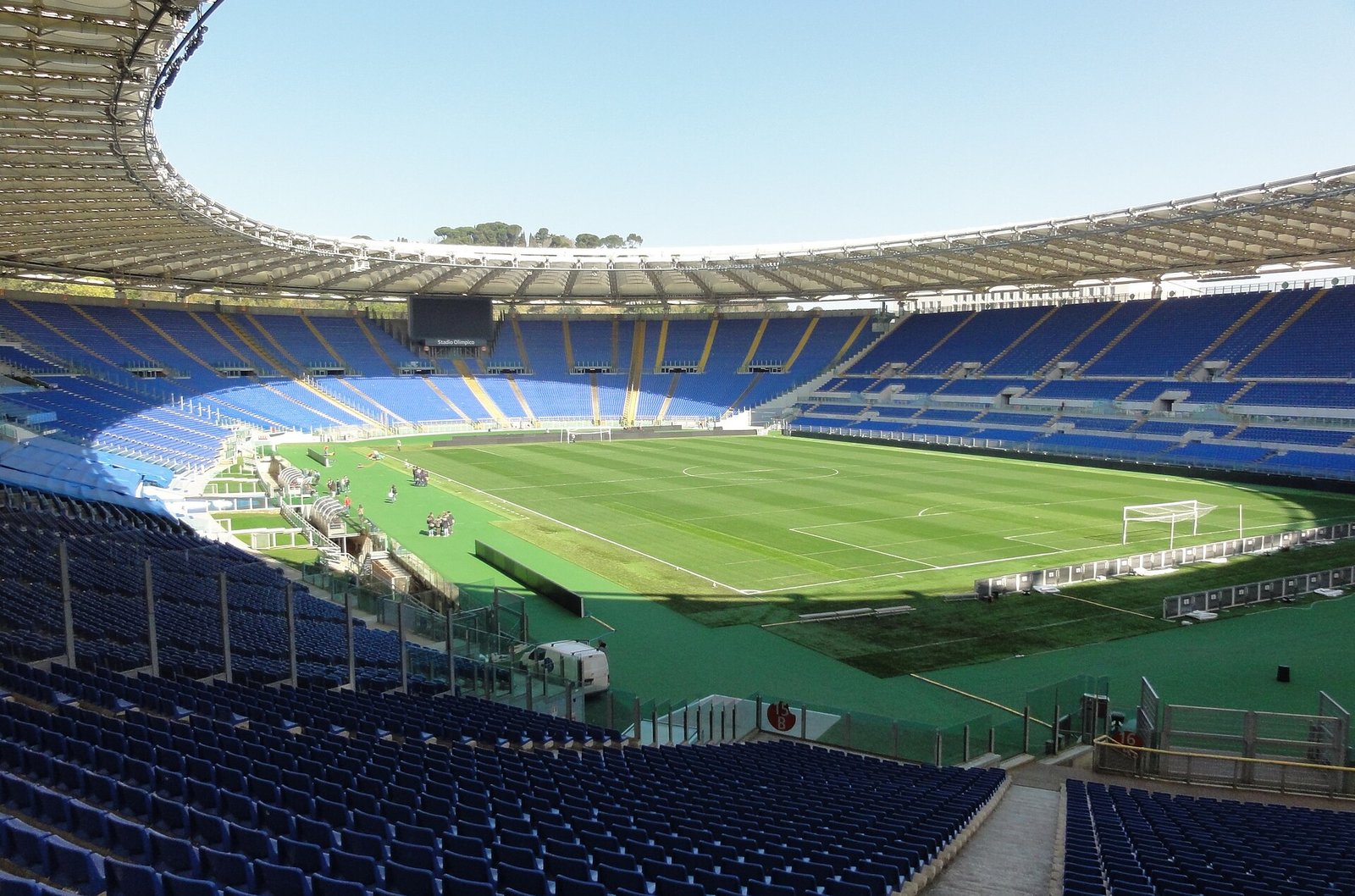
The Teflon roof is the element that overturned the original design and, for those listening to music, the element that matters most. It's a tensioned membrane covering the stands while leaving the field open, and it has two opposite effects worth knowing in advance. The first is positive: if you're in the stands you're sheltered from the low late-June sun and from a possible evening downpour. The second is less pleasant: a tensioned surface that size reflects sound, and in some side positions you notice a return that muddies the definition. It's not a flaw in the sound system, it's physics applied to a tensile structure.
How the stadium is divided
The section names are the sports ones, and on music nights they're almost always reused with the same names. The two long sides are the Tribuna Monte Mario, toward the hill, and the Tribuna Tevere, toward the river. The two ends are the Curva Nord and the Curva Sud. On a concert night the stage is set up in front of one of the two curve, the field becomes the standing area, and the curva behind the stage usually isn't sold.
Foro Italico around the stadium
Here comes the part most of the audience misses, and which to me is the real reason to arrive early.
The mosaic avenue and the obelisk
The main entrance to the complex is on the southeast side, in line with Ponte Duca d'Aosta. Arriving from that side, you walk along a wide avenue covered entirely in black and white mosaic tiles, originally called Piazzale dell'Impero and today Viale del Foro Italico. The mosaics depict, in a figurative language both archaizing and modern, sport, feats, geography and propaganda of the period in which they were made. Walking on them on a summer evening, with the low sun stretching shadows across the tiles, is a remarkable visual experience and completely free.
At the start of the avenue stands the Carrara marble obelisk, 17.5 meters tall not counting the base, dedicated to Mussolini. It's an object that keeps generating debate: in April 2015 a proposal to remove the inscriptions from the stele met objections from architectural experts and historians and went nowhere. The debate on recontextualizing the complex, that is, adding explanatory panels so that the original aesthetic doesn't remain the only voice in the public space, is still open among scholars. I mention it because walking in there without knowing it means missing half of what you're looking at.
The buildings of the complex
There are three buildings from the original project, and all three have had a second life. Palazzo H, by Del Debbio, built between 1928 and 1932, was the seat of the Fascist men's academy of physical education and since 1951 has been CONI headquarters. Palazzo delle Terme, by Costantino Costantini, built between 1930 and 1936, houses the indoor pools and contains two institutions that today belong to a completely different world: Auditorium Rai del Foro Italico, active since 1995 in the spaces that belonged to the music academy, and the physical education institute that in 2008 became the Università degli Studi di Roma Foro Italico. The third is Luigi Moretti's Fencing Academy, built between 1934 and 1936, a building architectural historians regularly cite among the most successful of Italian Rationalism.
Stadio dei Marmi
A few steps from Olimpico is perhaps the most photogenic object in the whole complex. Stadio dei Marmi was built between 1928 and 1932 to a design by Del Debbio, openly inspired by classical Greece, as an extension of the academy for the students' daily training. The white Carrara marble tiers around the perimeter were obtained by raising the ground by 5.5 meters, and on the tiers were placed 60 marble statues depicting different sports, plus four more bronze statues.
The statues were donated by Italy's provinces, one by one, and so they're by different sculptors: the sculpture dedicated to javelin throwing comes from the province of Perugia, the one dedicated to pallone col bracciale from the province of Forlì. The capacity is about 5,200 seats. Since September 12, 2013 the venue has been named after Pietro Mennea, the sprinter who held the 200-meter world record for 17 years. In 2024 it was renovated for the European Athletics Championships held in Rome.
Something nobody tells you about Achille Lauro at Stadio Olimpico in Rome, Per Sempre Noi, Stadi 2027
Here's the thing almost nobody puts in writing and that concretely changes the experience for anyone buying a field ticket: at Stadio Olimpico, between the standing audience and the stage, there's an athletics track.
The track, which nobody considers
Olimpico isn't an English-style stadium with the stands right up against the pitch. It's a multipurpose venue also built for athletics, and the track around the field takes up a strip several meters wide along the whole perimeter. This has two precise consequences. The first: anyone in the front rows of the lower stands is still further from the field than they would be in a soccer-only stadium. The second, more important for a music evening: the field area usable by the audience starts beyond the track, and the distance between the last row of the field and the stage can be considerable.
If you picture the concert seen from three meters from the microphone, scale back. The field of a stadium like this, on a night with tens of thousands of people, is a magnificent collective experience and a mediocre viewing position for anyone who doesn't arrive hours early and plant themselves at the front barriers.
Why the stage doesn't go where you'd like
A second thing rarely mentioned concerns the constraints. A stadium stage isn't placed where it looks best: it's placed where access routes for heavy vehicles allow, where emergency exits stay clear, and where the load on the structures is sustainable. At Foro Italico these constraints are tighter than elsewhere, because the area around the stadium is packed with protected buildings and sports facilities in use, and maneuvering space is limited. The result is that over the years the stage has almost always been placed in the same spot, in front of one of the two curve, and that service areas take up a substantial portion of the field.
The difference between the first and second night
A third thing you almost never read, and that applies specifically to double dates. The first and second night of a double date aren't identical, even when the production is the same. The first usually has the energy of the opening event, the audience of hardcore fans who bought first, and the technical tension of a setup going on stage for the first time in that place. The second comes with the system already run in, often with sound more dialed in and the artist more relaxed.
There's no answer that's right for everyone on which to choose. If you want the thrill of the first time and the warmest crowd, go for the first. If you value technical quality and organization that's already been tested, inside and outside the stadium, you'll probably be better off on the second night. I'll add one detail about the city: by the second night the transportation and security machine has also had a dress rehearsal, and it usually shows.
My tip for Achille Lauro at Stadio Olimpico in Rome, Per Sempre Noi, Stadi 2027
There's only one tip and I'll say it plainly: don't treat that evening as a transfer to a gate. Treat it as a day in Rome that ends with a concert. If you arrive at 20:45 by car on the Lungotevere, you'll have an evening of lines, checks and stress. If you arrive at 18:00, you'll have a completely different evening, for the same ticket price.
How to plan the afternoon
The recommended plan is simple. Arrive in the area in the late afternoon, leave everything unnecessary where you're staying, and walk your way in. If you arrive from the left bank of the Tiber, crossing Ponte Duca d'Aosta puts the obelisk and the mosaic avenue exactly in line in front of you, and it's the sequence of images that complex was designed for. From there, 20 minutes is enough to walk the avenue, take a look at Stadio dei Marmi and its statues, and reach your entrance without rushing.
Alternatively, at the end of June it's worth taking an extra hour and going up toward Monte Mario, which is behind the stadium: the view over Rome from above, in the 19:30 light of late June, is one of the best the city offers, and very few of those heading down to the stadium go there. If you'd rather stay low, you can head toward Milvian Bridge, a quarter of an hour's walk away, where evening life starts long before the concert.
What to bring and what to leave at home
Water, first of all, as far as the evening's rules allow it: Foro Italico at the end of June, at 21:00, holds the heat stored all day by the concrete and marble, and dehydration is the most common reason someone feels sick in the stands. Closed, comfortable shoes, because between getting there, waiting, the concert and the outflow you walk a lot and stand for several hours.
How to get to Foro Italico
I'll say it right away because it's what causes the most mistakes: the metro doesn't reach Stadio Olimpico. There's no stop under the stadium, there's no direct line from the center, and anyone planning the evening assuming otherwise will find themselves walking much more than they thought.
By public transportation
The most reliable method is a combination. From the center you reach the area on the surface lines running up the right-bank Lungotevere roads, or you take metro line A to the Flaminio area and from there continue above ground or on foot along the river: it's a 30 or 40-minute walk, pleasant in the late June light, less pleasant on the way back at midnight.
On big event nights extra services and dedicated runs are usually added, with routes and terminals that change from the usual ones. That information is published by the transit company and the City in the days just before, and it's worth looking for it 48 hours ahead and not 10 months ahead. Another option, often overlooked, is Ponte della Musica, the pedestrian and bike bridge linking Foro Italico bank with the Flaminio district: crossing it on foot lets you go from one bank to the other while avoiding the most congested junctions.
By car and taxi
The short answer is: preferably not. On busy nights the area around Foro Italico is closed to private traffic with arrangements that change each time, available parking is far from enough for the numbers, and the right-bank Lungotevere roads become a funnel. If you really have to drive, you'd do well to leave the car far away, in an area served by public transportation, and cover the last stretch another way.
A taxi works on the way there, with reasonable advance planning, and works much less on the way back: at the end of the concert, simultaneous demand from tens of thousands of people in an area with few exits makes waiting times unpredictable. If you really need a private ride home, agree on a meeting point far from the stadium, across the bridge, and walk there.
How a stadium concert works
If you've never been to one, it's worth knowing in advance what to expect, because a stadium concert isn't a big concert: it's a different genre.
Distance and screens
In a venue for tens of thousands of people, the human figure on stage is small for the vast majority of the audience. The show comes across through the screens, the set design, the lights and the sound, and the video direction becomes an integral part of the dramaturgy. An artist with a repertoire built on visual tableaux, as in Lauro's case, has an advantage: the language of the stadium rewards strong images and sharp transitions, and penalizes nuance.
The field
A spot on the field is the right choice for a specific slice of the audience: those who are young, used to it, willing to arrive early and stand for many hours. It's the position where you experience the concert as a collective phenomenon, with the chorus around you and the bass vibrating in your chest. It's also the most tiring position, the hottest, the one with the least access to facilities, and the one where it's hardest to move once the crowd gets dense.
Another well-known fact, yet one that's rarely mentioned
The fact is this: Stadio Olimpico is, by capacity, the second-largest venue in Italy, but it's first in symbolic weight, and this double status isn't a rhetorical detail. It has concrete consequences for those who play there and how they talk about it.
Why music arrives only after 1990
It's well known that Olimpico hosts concerts. Much less known is that this role is recent and derivative: it was the renovation for the 1990 World Cup, with the roof and the rebuilt curve, that made the venue suitable. Before then, for almost 40 years of its life, that stadium had never hosted a concert. It means that the whole musical tradition of the place, which seems old to us, is just over 30 years old: it's younger than the careers of many of the artists who take the stage there.
The corollary mentioned even less concerns the field. A pitch where two Serie A teams and the national rugby team play is a delicate and expensive agronomic system, and every concert puts it under stress: the stage, the platforms, the weight of the vehicles, thousands of people standing for hours. That's why the stadium's concert calendar is concentrated in the window between the end of the league season and the start of preseason training, roughly between June and early July. It isn't a matter of summer taste: it's the period when the field can be sacrificed and relaid.
A historical anecdote makes it clear. The concert with the highest attendance ever recorded in Italy was held right here, on June 6, 1998, with Claudio Baglioni on the Da me a te tour: 82,000 tickets sold plus about 8,000 complimentary spectators, for a total of around 90,000 attendees. It was possible because the then CONI president exceptionally authorized the installation of a huge star-shaped stage 112 meters long and 72 wide, and he authorized it for a very concrete reason: the field was going to be replaced that very summer, so it didn't matter.
Tickets and access
I'm writing 10 months ahead, so I'll stick to principles, which are the things that don't change.
Where to buy
Tickets should be bought through the official channels listed by the tour organizers. For these two dates the recommendation is stronger than usual, precisely because the first night has been sold out for a while: when a date sells out well in advance, unofficial resale proliferates, and with it the risk of buying invalid tickets. A ticket rejected at the gate can't be recovered, and neither can the trip.
Entry checks
The gates open several hours before the start and the flow isn't even: there's a first wave of people who want the front of the field, and then a very dense concentration in the last hour. Showing up in the last half hour almost certainly means missing the start.
Accessibility
Stadio Olimpico has spaces for spectators with mobility disabilities and their companions. They're limited in number, located in dedicated sections, and their position depends on the music evening's setup, which isn't the same as the sports one. The request should be made to the organizers well in advance, following the procedure given when tickets go on sale, and it isn't a formality: the places run out.
The right photo to take at Achille Lauro at Stadio Olimpico in Rome, Per Sempre Noi, Stadi 2027
Inside the stadium, with the stage 200 meters away and the light changing every two seconds, photos come out badly for almost everyone. The photos worth taking on this evening are taken before you go in. I'll suggest three.
The first: the mosaic avenue with the obelisk centered
Arrive from Ponte Duca d'Aosta and stop at the start of the avenue, standing in the center. The white marble obelisk stands out against the green of Monte Mario, and the black and white mosaic converges toward it, creating a perspective that is exactly what the complex was designed for. The right time, at the end of June, is between 19:30 and 20:15: the sun is low, the marble takes on a warm tone and the mosaic tiles gain relief thanks to the raking shadows. At midday the same shot is flat and washed out.
The second: Stadio dei Marmi against the light
The 60 statues on the tiers, shot from below with the sky behind, give an image that seems to come from another century, and in a sense it does. The trick is not to try to photograph them all: a single statue, isolated against the sky, with a sharp backlit outline, says more than a panorama. If you can catch the moment the sky turns orange, the contrast between white marble and warm background is remarkable.
The third: the roof seen from inside before the lights go down
Once you're in and seated, before dark falls, it's worth turning the lens upward instead of toward the stage. The Teflon membrane, seen from below with the twilight coming through it, has a texture and geometry no photo of the stage can capture, and in shots that also include the heads of the audience and the line of the stands, it conveys the scale of the event much better than a blurry zoom on a distant figure.
One last recommendation, not a technical one: 10 minutes of photos at the start and then the phone in your pocket. A stadium concert watched through a screen is the worst version of itself, and nobody will rewatch the video shot from that distance.
Some important events that happened here in history
The history of this piece of the city is almost embarrassingly dense, and it's worth having at least its coordinates while you walk over it.
The origins and the rebuild
The complex was born in 1928 on the initiative of Renato Ricci, then undersecretary of National Education and founder of the Opera Nazionale Balilla, to a design by Enrico Del Debbio. Stadio dei Cipressi, inaugurated in 1932 for the regime's 10th anniversary, was a venue made with terracing and earth fill, designed more for rallies than for sport. Luigi Moretti's changes between 1933 and 1937 turned it into a stage backdrop, with the renovated version inaugurated on May 9, 1937.
The postwar rebuild, entrusted to Roccatelli, Valle and then Vitellozzi, produced a venue in declared discontinuity with the previous project. The inauguration took place on May 17, 1953, in the presence of the President of the Republic Luigi Einaudi, with a double program: the return match of the International Cup between Italy and Hungary, won 3-0 by the visitors with a goal by Nándor Hidegkuti, the first official scorer in the new venue, and two by Ferenc Puskás, and right after that the finish of the Naples-Rome stage of the Giro d'Italia, won in a sprint by Giuseppe Minardi. The following week the first club match was played, and the Sunday after that it was the other city team's turn.
The 1960 Olympics
In 1955 the International Olympic Committee awarded Rome the Games of the XVII Olympiad. For the stadium the work was fairly limited: an expanded press box, a lighting system for night events mounted on four towers at the corners of the field, and two electronic scoreboards on top of the curve, inaugurated in October 1959.
On August 25, 1960 the stadium hosted the opening ceremony, and in the following days the track was the stage for a series of records that went down in athletics history. American Wilma Rudolph won three gold medals, in the 100 meters, the 200 meters and the 4x100 relay, where the time of 44.4 seconds set the world record with her teammates. Livio Berruti won the 200 meters in 20.5 seconds, equaling the world record in both the semifinal and the final, and bringing Italy its first gold medal in sprinting. At the same Games American Otis Davis set the 400-meter world record and Australian Herb Elliott the 1,500-meter one.
Soccer nights
On the soccer side the list is long. In June 1968 the stadium hosted the European Championship final between Italy and Yugoslavia, which ended 1-1 after extra time and was replayed two days later, when Italy won 2-0 with goals by Gigi Riva and Pietro Anastasi. In 1973 it hosted the single-match Intercontinental Cup. In May 1977 it hosted the European Cup final between Liverpool and Borussia Mönchengladbach. In June 1980 the European Championship final between West Germany and Belgium, won 2-1 by the Germans.
On May 30, 1984 the European Cup final between Liverpool and Roma was played here, the first in the competition's history decided on penalties, in front of more than 69,000 spectators. On July 8, 1990 came the World Cup final between West Germany and Argentina, decided by a penalty in the 85th minute in front of over 73,000 people. In 1991 the stadium hosted the second leg of the UEFA Cup final, in 1996 the Champions League final between Juventus and Ajax, also decided on penalties, and in 2021 a European Championship quarterfinal played with reduced capacity.
Athletics and rugby
Besides the 1960 Games, the track has hosted the European Athletics Championships in 1974 and 2024, the World Championships in 1987 and the 1975 Universiade. Since 1980 an international athletics meeting has been held there every year, set up on the initiative of the then federation president, and today named after Pietro Mennea.
Since 2012 the stadium has been home to the Italian national rugby team for Six Nations matches, and rugby at Olimpico has an atmosphere unlike any other: mixed stands, no separation, a relationship with the crowd you don't usually see in that stadium. Already in April 1954, a year after the inauguration, the European Rugby Cup final between Italy and France was played here in front of 25,000 spectators.
The dark pages
It would be dishonest to tell the story of this place only through records. On October 28, 1979, about an hour before the start of the derby, Vincenzo Paparelli, a 33-year-old mechanic sitting in the central section of the Curva Nord, was hit in the face by a homemade flare fired from the opposite curva and died before reaching the hospital. The trial ended in May 1987 with the ruling of the Court of Cassation. That death started, both legislatively and culturally, Italy's long discussion on safety at sports venues and on the organized violence of extreme fan groups.
On January 23, 1994 the stadium was the target of a bomb attack placed within the bombing strategy of those years: a car loaded with explosives parked along the side avenue was supposed to explode near the vehicles of the Carabinieri on public order duty during a match. The device didn't go off, and the story came out only years later thanks to statements by some state witnesses. It's a page few people know and that's worth remembering while you walk calmly along that same avenue with a ticket in hand.
Who has passed through Achille Lauro at Stadio Olimpico in Rome, Per Sempre Noi, Stadi 2027
The list of artists who have played this stage is shorter than you'd imagine, for the reason explained above, but it's dense.
The first ones
The very first music event dates from July 1991: a joint evening by Miles Davis and Pat Metheny, with the stage set up in front of the Curva Sud and about 20,000 spectators. The first Italian artist to perform was Zucchero in June 1993, during his L'Urlo tour, in front of 10,000 people: numbers that would make people smile today, but that should be read in the context of a venue that didn't yet have a musical tradition.
The Italians
The all-time attendance record belongs to Claudio Baglioni, on June 6, 1998, with the Da me a te tour: about 90,000 attendees in total, the highest figure ever recorded for a concert in Italy, made possible by the star-shaped stage exceptionally authorized. Among Italians the most frequent visitor is Luciano Ligabue, who between 1996 and 2023 took that stage 13 times: a number unmatched, which tells of an almost domestic relationship with the venue.
The foreign artists
Among international artists the most frequent are Depeche Mode, five times between 2006 and 2023, followed by U2 with four appearances between 2005 and 2017. In 1996, at a rock festival, David Bowie and Tina Turner performed here. In 2005 R.E.M. came through. It's a list that, read in sequence, shows well the selective nature of this stage: you don't get to Stadio Olimpico by chance and you don't get there at the start of a career.
The other 2027 dates
Summer 2027 at Stadio Olimpico looks set to be especially busy, and Achille Lauro's two dates fit into a season that sees several leading names of Italian music pass through: Olly, Laura Pausini, Pinguini Tattici Nucleari and the residency of Vasco Rossi. If you're coming to Rome from out of town and have some flexibility on dates, it's worth looking at the calendar as a whole before booking your trip.
What's around
Foro Italico isn't an island, and it's surrounded by a part of Rome few tourists see and that becomes very useful to know in the hours before and after a concert.
Ponte Milvio and around
A quarter of an hour's walk to the north is Milvian Bridge, one of the oldest bridges in Rome and, historically, the site of the battle of 312 between Constantine and Maxentius. Today the area around the bridge is one of the hubs of Roman nightlife, with a concentration of bars and restaurants that fill up early on summer evenings. It's the natural place to spend the hours before the concert or to go and unwind after, and it's fairly well served by public transportation.
The opposite bank: Flaminio
Crossing the river you enter the Flaminio district, which in the last 20 years has become Rome's contemporary quarter. Here you'll find MAXXI, the national museum of 21st-century arts designed by Zaha Hadid, and Renzo Piano's Auditorium Parco della Musica, which in summer hosts a program of concerts in the open-air cavea. If you're coming to Rome for a stadium night and want to build a sensible day, an afternoon at MAXXI and an evening at Olimpico are a combination that works: you stay in the same area and cross a century of Italian architecture in a few kilometers.
Quick questions
When are the concerts?
Wednesday, June 30 and Thursday, July 1, 2027, with the start announced for 21:00 on both nights.
How much do tickets cost?
Final prices by section and any changes are up to the organizers and the official sales channels, and should be checked there. The first night has been sold out for a while.
Who is Achille Lauro, in short?
Lauro De Marinis, born in Verona in 1990 and raised in Rome between Serpentara and Vigne Nuove. Starting out in Rome's underground rap scene in the early 2010s, he has become one of the most recognizable figures in Italian pop, with four competition entries at the Sanremo Festival, a role as a regular guest in 2021, a Eurovision entry for San Marino in 2022 and work ranging across music, books, fashion, television and visual arts.
How do I get there by public transportation?
There's no metro stop at the stadium. You combine the metro to the Flaminio area with a stretch above ground or on foot along the river, or you use the surface lines running up the Lungotevere roads. On event nights dedicated services are added, announced in the days just before.
What's the best section?
It depends on the evening's setup, which will be published by the organizers. In general the central sections facing the stage offer the best visual and acoustic experience, while very side positions suffer from the distance and the reflections off the roof.
Is a field ticket a good idea?
If you're young, used to it and willing to arrive many hours early, yes. If you're bringing children, have trouble standing for a long time or want to see the whole stage, a numbered seat facing the stage is a more sensible choice.
What time does it end?
A summer stadium concert usually actually ends after 23:30, and to be really out of the area and on the move you need another hour.
Is it worth coming from outside Rome?
If you have a connection with that repertoire, yes. A stadium date isn't just any concert, late June in Rome offers the longest days of the year, and with two consecutive dates there's also extra flexibility in planning the trip. As long as you treat it as a whole day in Rome and not as a trip to a turnstile.
On an evening like this the container matters as much as the content. An artist who grew up in Rome's northern outskirts, who started with mixtapes given away online, singing on a field surrounded by an athletics track where Wilma Rudolph won three golds, under a Teflon membrane designed for a soccer World Cup, in the middle of a white marble complex wanted by a regime to impress the world, 200 meters from a bridge where in 312 the history of the empire was decided. None of these elements was put there to create atmosphere, and that's exactly why the atmosphere works. What you need if you come is the most obvious thing in the world: check your section, the time and the entry conditions with the organizers in good time, arrive with enough margin to look around, drink water and then sing.
Frequently asked questions about Achille Lauro at Stadio Olimpico in Rome, Per Sempre Noi, Stadi 2027
When are the Achille Lauro concerts at Stadio Olimpico?
The Achille Lauro concerts at Stadio Olimpico in Rome take place on Wednesday, June 30 and Thursday, July 1, 2027, with the start announced for 21:00 on both nights. The two dates fall in the period when Rome already has its long summer hours and sunset comes around 20:45, so the show starts with some light still in the sky.
Where is the concert held?
The concert is held at Stadio Olimpico in Rome, inside the Foro Italico complex, between the southern slopes of Monte Mario and the Tiber. The stadium was inaugurated in 1932 as Stadio dei Cipressi, to a design by Enrico Del Debbio, and today it's the second-largest venue in Italy by capacity but the first in symbolic weight.
How much does a ticket cost?
Final prices by section for Achille Lauro's two nights at Stadio Olimpico are up to the organizers and the official sales channels, and should be checked there: no precise figures are given. What's certain is that the first night, June 30, has been sold out for a while.
Who is Achille Lauro?
Achille Lauro, legal name Lauro De Marinis, is a singer born in Verona on July 11, 1990 and raised in Rome, between the Serpentara and Vigne Nuove neighborhoods. He chose his stage name because the public already associated his first name with the Neapolitan shipowner Achille Lauro, a huge figure in 20th-century Italian shipping and politics.
How do I get to Stadio Olimpico, given there's no metro?
The metro doesn't reach Stadio Olimpico in Rome: there's no stop under the stadium and no direct line from the center. If you plan the evening assuming otherwise, you'll end up walking much more than expected. The most reliable method is a combination of public transportation to the Foro Italico area.
Is it true the first night is already sold out?
Yes, for the Achille Lauro concert at Stadio Olimpico the night of Wednesday, June 30, 2027 has been sold out for a while. When a date sells out well in advance, be wary of resale outside the official channels and check for any new availability only through the channels listed by the tour organizers.
Is Stadio Olimpico accessible for people with mobility disabilities?
Yes, Stadio Olimpico has spaces for spectators with mobility disabilities and their companions. They're limited in number, located in dedicated sections, and their position depends on the music evening's setup, which differs from the sports one: the request should be made to the organizers well in advance.
Article written by the editorial team of TourLeaderPro, contact them for Private, Corporate and V.I.P. Tours and Experiences. If you'd like a guided walk through Foro Italico and the Flaminio district, between 1930s and contemporary architecture, with a licensed guide, write from the TourLeaderPro contact page. For agencies and operators building evening and music programs in Rome, there's a consulting service in the area reserved for tour operators.
Planning a trip to Italy? The English-language guides are on ItalyPlanner.com. To plan your Rome days, the reference is the page on the best things to do in Rome, while if you have three full days you'll find a ready-made plan in the three-day Rome itinerary.