Las Grietas by Fabiola Ferrero at the Museo di Roma in Trastevere, from October 1 to November 22, 2026
In short. Las Grietas. Sulle tracce di una fantasia, the solo exhibition by the Venezuelan photographer and journalist Fabiola Ferrero, winner of the 16th IILA Photography Prize, is open at the Museo di Roma in Trastevere, Piazza di Sant'Egidio…
Las Grietas. Sulle tracce di una fantasia, the solo exhibition by the Venezuelan photographer and journalist Fabiola Ferrero, winner of the 16th IILA Photography Prize, is open at the Museo di Roma in Trastevere, Piazza di Sant'Egidio 1/b, from October 1 to November 22, 2026. The opening is Wednesday, September 30 at 18:00. The museum is open Tuesday to Sunday from 10:00 to 20:00, with last entry at 19:00, and closes on Monday. You get there by tram 8 along Viale di Trastevere, getting off in Piazza Sonnino area and continuing on foot toward Piazza di Santa Maria in Trastevere, from which Piazza di Sant'Egidio is a few steps away. Admission is free with the MIC card. Other rates are published on the museum's official website, on the tickets page, and tickets are bought at the museum's ticket office or on the presale circuit indicated by the Musei in Comune website. Information at 060608, active every day from 9:00 to 19:00.
Las Grietas at the Museo di Roma in Trastevere: Dates, Hours and Tickets
Las Grietas is a seven-week photography exhibition in one of the civic museums most loved by Romans, small enough to be visited at an easy pace in an hour and a half. The practical information is what the museum has published.
The dates
The exhibition stays open from October 1 to November 22, 2026. The opening, open to the public and the press according to the museum's presentation, is Wednesday, September 30 at 18:00.
The hours
The Museo di Roma in Trastevere is open Tuesday to Sunday from 10:00 to 20:00, with last entry at 19:00. Monday is the closing day. The museum invites you to always check the notices page on its website before planning the visit, because special openings and closures are communicated there.
Tickets and the MIC card
For MIC card holders, the card of the Musei in Comune of Roma Capitale, admission is free. The regular and reduced rates are published on the tickets page of the museum's official website.
Who organizes it
The exhibition is promoted by Roma Capitale, Assessorato alla Cultura, Sovrintendenza Capitolina ai Beni Culturali, and organized by IILA, the Italo-Latin American International Organization. The museum services are by Zètema Progetto Cultura.
Las Grietas: What You See in the Exhibition
Las Grietas brings together some of Fabiola Ferrero's most significant works, Whispering Walls, I can't hear the birds and Reinas, together with Antimonumento, the project developed during her time in Italy for the IILA Photography Prize and presented to the public for the first time. Grietas, in Spanish, are cracks: and it is through the image of cracks that the exhibition moves through collective memory, social fragility, urban transformations and historical tensions.
Whispering Walls
The first core carries a title that sounds like a statement of poetics: walls that whisper. It is consistent with what Ferrero herself writes about her work, which investigates the cultural legacies of Venezuela's 20th-century modernization, fueled by oil. Walls, buildings, urban spaces become archives of a recent history that the country struggles to tell.
I can't hear the birds
I can't hear the birds is the project with which Fabiola Ferrero won the World Press Photo in 2023 in the Long Term Projects category for South America, also earning an honorable mention at the Picture of the Year International. It is a long-term work on Venezuela, built over time, and it is probably the reason why many visitors will already know her name.
Reinas
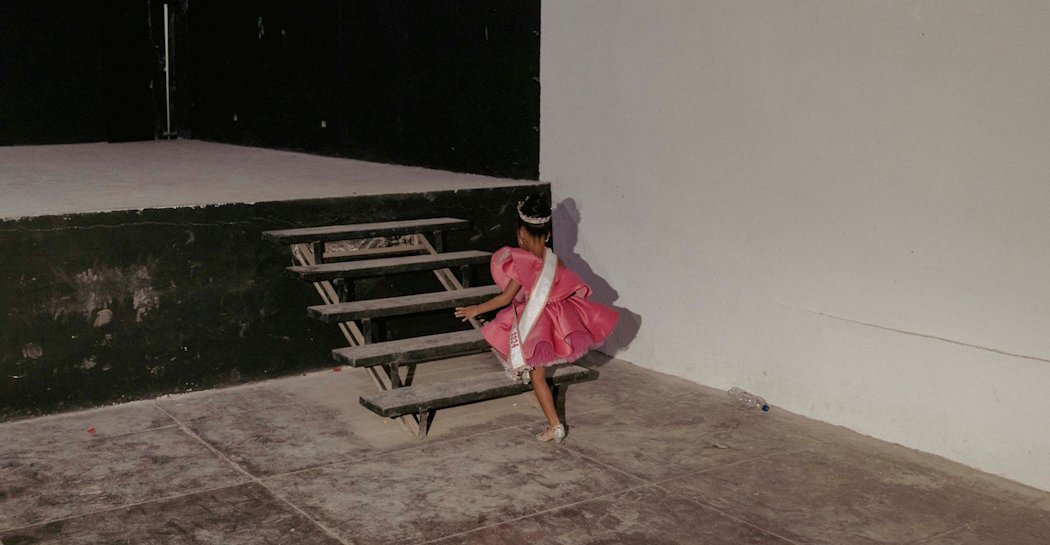
Reinas, queens, is the project with which Ferrero won the Deloitte Photo Grant in 2024. The photographer's website places her research in the way oil has shaped the imaginaries of progress, beauty, religion and national identity: the theme of beauty, in a country that has made contests an institution, is the ground of this work. One of the images in the exhibition, published by the museum, shows a young contest participant rehearsing the runway before going up on stage.
Antimonumento, the novelty
The new work of the exhibition is Antimonumento, developed in Italy as part of the IILA prize. The museum presents it as the gaze that goes from Venezuela all the way to Rome, relating the fractures of history to the more intimate ones of memory and the body. It's the part that on its own justifies the visit for those who already know the earlier works.
A thread that holds it together
The cracks of the title are both real and metaphorical: those of walls and those of a society, those of history and personal ones. The choice of a single visual motif to tie together different projects is the most successful thing in the presentation, and it gives the exhibition a coherence that photojournalism solo shows often lack.
Fabiola Ferrero: Her Biography
Fabiola Ferrero was born in Caracas in 1991 and is a documentary photographer with training in writing and investigative journalism. Her official website describes a body of work that investigates the cultural legacies of Venezuela's 20th-century oil modernization, with the themes of politics, history and collective memory.
From journalism to photography
Ferrero's training is in journalism, and it shows: her projects are long-term investigations, built over time, closer to investigative reportage than to gallery art photography. She speaks Spanish, English, Italian and French, as she herself states, and her work has circulated in international outlets.
Semillero Migrante
In 2021 she founded Semillero Migrante, a free mentoring program for emerging photographers from Latin America, created to make photography training more accessible. In the same year the initiative received a Getty Images Grant for Programs. It's a detail that says a lot: a still-young photographer using her own success to open the way for others.
The awards
The list of recognitions published on her website is long. In 2021 Ferrero won the Carmignac Photojournalism Award, the 6Mois Photojournalism Award and the Inge Morath Award of Magnum Photos and Magnum Foundation, and was a finalist at the Eugene Smith Memorial Fund. In 2023 the World Press Photo for long-term projects in the South America region. In 2024 the Deloitte Photo Grant for Reinas and the nomination at the Premios Gabo in the photography category. In 2025 the IILA prize, and in 2026 a grant as a National Geographic Explorer of the National Geographic Society.
Magnum, World Press Photo, Columbia
In 2018 she was a Magnum Foundation Fellow for the Photography and Social Justice program and took part in the World Press Photo 6x6 program for South America. In 2019 she attended the Joop Swart Masterclass. She was a World Press Photo juror for the South American region and a fellow of the Institute for Ideas and Imagination at Columbia University in Paris for the 2023 to 2024 period. She is part of Ruda Colectiva and Women Photograph.
The IILA Photography Prize and the IILA
The IILA Photography Prize is promoted by IILA, the Italo-Latin American International Organization, and Las Grietas is the exhibition of the winner of the 16th edition. The prize includes a period of work in Italy, from which Antimonumento was born.
A bridge between Rome and Latin America
IILA is the international organization that links Italy to the Latin American countries. The photography prize brings to Rome every year the gaze of an author from the region, and the Museo di Roma in Trastevere, with its vocation for photography and for dialogue between cultures, is the natural venue for the exhibition.
Why it matters
For a Latin American photographer, a residency period and an exhibition in a Roman civic museum are an important step. For the Roman public it's a chance to see photography that rarely reaches our rooms, and to see it in its most complete form.
A Curiosity about Las Grietas by Fabiola Ferrero at the Museo di Roma in Trastevere, from October 1 to November 22, 2026
An exhibition about cracks, about the wounds of history and social fragility arrives in a building that has really tended wounds. The complex that houses the Museo di Roma in Trastevere was the monastery of the Discalced Carmelites. After the Unification, expropriated by the State, it changed function several times. It was a barracks for the municipal guards, then a Pretura, then a quarantine house. It became a lazaretto for the refugees of the Marsica earthquake and a shelter for sick and infected soldiers of the Great War. In 1921 it was named after Ettore Marchiafava, a doctor and senator expert in malaria, and housed a children's antimalarial sanatorium: the plaque at the museum's entrance still recalls it.
The curiosity, then, is this: those who come in to see Fabiola Ferrero's photographs on the fractures of a country in crisis walk in a place that for decades took in refugees, the sick and children. There's no need to load the comparison with rhetoric. It's enough to raise your eyes to the plaque before going in, and then look at Ferrero's images knowing that these walls too, to use the title of one of her projects, would have a lot to whisper. It's a coincidence that no curator built, and for exactly this reason it works.
The Museo di Roma in Trastevere, Home of the Exhibition
The Museo di Roma in Trastevere is at Piazza di Sant'Egidio 1/b, in a part of the complex that was the monastery of the Discalced Carmelites, a few steps from Piazza di Santa Maria in Trastevere. It is one of the Musei in Comune of Roma Capitale.
The Carmelite monastery
The first core of the monastery was born in the first decades of the 17th century near the church of San Lorenzo in Ianiculo, later restored and dedicated to Sant'Egidio. The Carmelites spread in the rione after the canonization of Saint Teresa of Avila, in 1622, and over time acquired a large space near Piazza di Santa Maria in Trastevere, joining the buildings into a single cloistered monastery.
The 1723 architecture
In 1723 the nuns entrusted works to the architect Francesco De Sanctis. In the 1960s the Comune, which had acquired the wings facing the cloister, started a recovery signed by Attilio Spaccarelli with Fabrizio Bruno, which brought back to light precisely the 18th-century architecture.
From folklore to photography
The museum was born in 1976 to tell the popular traditions of the Rome of the 1700s and 1800s. In 2000 the administration changed its name and mission, and today the Museo di Roma in Trastevere stands out above all for its large photography exhibitions, with rooms for meetings, video and music and a cloister used as a multipurpose space.
The permanent collection
Alongside the exhibitions, the museum keeps the 119 watercolors of the Roma pittoresca series of Ettore Roesler Franz, 76 small oils by Diego Angeli, three early paintings by Gino Severini, photographs by Mario Carbone, Emilio Gentilini and Gianni Turillazzi, a nativity scene, six reconstructed settings called Scene romane and a room with objects that belonged to Trilussa. The page on the Museo di Roma in Trastevere tells the museum in detail.
Something Nobody Tells You about Las Grietas by Fabiola Ferrero at the Museo di Roma in Trastevere, from October 1 to November 22, 2026
Almost nobody says it, but a visit to a temporary exhibition at the Museo di Roma in Trastevere should always be extended by half an hour for the permanent collection. Roesler Franz's watercolors are the Rome that was disappearing at the end of the 19th century, with the alleys, the banks of the Tiber before the embankment walls, the osterie: a city that modernization was erasing. Looking at them right after Fabiola Ferrero's photographs, which tell how oil modernization marked Venezuela, is an exercise worth more than any wall text.
The second thing concerns time. The photography exhibitions of this museum attract a loyal audience, and the weekends of October and November in Trastevere are crowded: on Saturday afternoon the rione fills up and the rooms get tight. The best visit is on a weekday at 10:00, at opening, or in the late afternoon, between 17:30 and 19:00, when the light in the cloister changes and the museum empties.
Third point: the captions. Long-term photojournalism lives on context, and Ferrero's images should be read with the texts that accompany them. Those in a hurry risk seeing beautiful photographs and missing the story. Better to dedicate time to fewer rooms than to skim everything.
My Advice for Visiting Las Grietas by Fabiola Ferrero at the Museo di Roma in Trastevere, from October 1 to November 22, 2026
My advice is to go to the opening on Wednesday, September 30 at 18:00, if you can, or on a weekday in October, and to build a morning in Trastevere around the exhibition. You go in at 10:00, look at Las Grietas without hurry, pass through the permanent collection, and come out on Piazza di Sant'Egidio when the rione starts to wake up. From there, in two minutes, you're in front of the basilica of Santa Maria in Trastevere, and in a quarter of an hour's climb you reach the Gianicolo.
Before the visit, if you don't know Ferrero's work, read something about contemporary Venezuela. It doesn't take much: it's enough to know that the country has lived through a long economic and political crisis and a great emigration. The photographs speak for themselves, but those who arrive with a minimum of context see them differently.
And if you have the MIC card, use it: admission is free, and the Musei in Comune card lets you return to the civic museums as many times as you like for a year. For those who live in Rome it's the smartest choice, and an exhibition like this one, which asks for time, deserves a second visit too.
How to Get to the Museo di Roma in Trastevere
The Museo di Roma in Trastevere is at Piazza di Sant'Egidio 1/b, in the rione Trastevere, a few steps from Piazza di Santa Maria in Trastevere. The most convenient way is tram 8, which runs along Viale di Trastevere.
By tram
Tram 8 links Piazza Venezia and Largo Argentina with Trastevere and Monteverde along Viale di Trastevere. You get off in Piazza Sonnino area and continue on foot toward Piazza di Santa Maria in Trastevere and Piazza di Sant'Egidio, in a few minutes.
By bus
Viale di Trastevere and the lungotevere are served by several surface lines that link the rione with Termini station, Piazza Venezia and the Vatican. Lines and schedules should be checked on the Roman public transport information service before leaving.
By train
Roma Trastevere station, served by regional trains, is linked to the rione by tram 8, which stops on the station forecourt and then runs along Viale di Trastevere to the river. For those arriving from Fiumicino or from the coastal towns by regional train it's the simplest solution.
By car
Trastevere is largely a limited traffic zone and parking is very scarce. Those arriving by car must leave it outside the rione and continue by public transport or on foot. A taxi to Piazza Sonnino or Piazza di Santa Maria is the most practical alternative.
On foot
From the historic center you arrive by crossing Ponte Sisto from Campo de' Fiori or from the Ghetto, and then walking through the alleys of the rione. It's the most beautiful way to arrive, and the route takes about a quarter of an hour.
Another Well-Known Fact, Yet Rarely Mentioned
Everyone knows that Trastevere is the rione of Trilussa, the Roman dialect poet to whom the square at the start of Ponte Sisto is dedicated. Less often remembered is that the Museo di Roma in Trastevere itself keeps a room with art and craft objects that belonged to the poet. It is one of the most visited rooms of the collection, and with the Scene romane it tells the popular Rome that the museum was born to document when, in 1976, it opened as a museum of popular traditions.
There is a link with Las Grietas worth noting. Trilussa told his city in verse, its inhabitants, the hypocrisies of power. He did it with irony, but the gaze was that of a chronicler. Fabiola Ferrero, with different tools and on another continent, does something similar: she tells her own country, its fractures and its illusions, with the gaze of a journalist. Two ways of keeping the memory of a community, a century apart, under the same roof. The museum, which in 2000 chose to open to dialogue between cultures, holds the two together without forcing: on the exhibition floor international photography, in the permanent rooms the Rome of Trilussa and Roesler Franz. Those who pass from one to the other realize that the question, at bottom, is the same: how do you tell a city, or a country, while it changes.
The Right Photo to Take at Las Grietas by Fabiola Ferrero at the Museo di Roma in Trastevere, from October 1 to November 22, 2026
The right photo, at a photography exhibition, is not the one of the photographs on show. Reproducing an author's work with your phone does not do it justice, and the rules on shooting should be checked at the entrance anyway. The photo worth taking is the one of the museum's cloister, the open space around which the old monastery is organized, with the late afternoon light falling on the arches. It's the image that tells the place, and that no guide puts on its cover.
The second photo is taken outside, in Piazza di Sant'Egidio, framing the museum entrance with the plaque dedicated to Ettore Marchiafava. It's a detail almost everyone ignores and that condenses the history of the building: the monastery, the sanatorium, the museum.
The third, a few steps away, is the facade of Santa Maria in Trastevere with the mosaics lit at sunset, seen from the side of the fountain. It's a photo many have taken, but after an exhibition on the cracks of a country it takes on another meaning: the continuity of a community that has lived for centuries around the same square. A technical tip: with your phone, lower the exposure so you don't burn out the gold of the mosaics.
Accessibility and Visiting with Kids
The Museo di Roma in Trastevere is a civic museum housed in a historic building. Up-to-date information on accessibility, elevators and services can be asked for at 060608, active every day from 9:00 to 19:00.
With kids
Las Grietas is a photojournalism exhibition on adult themes: crisis, emigration, social fragility. For a high schooler it can be an excellent chance for discussion. For small children the Scene romane and the nativity scene in the permanent collection are more suitable, and the cloister is a space where you can breathe.
Length of the visit
For the exhibition and a tour of the permanent collection, plan an hour and a half. The museum is compact, and it doesn't tire you.
Around the Museo di Roma in Trastevere
The Museo di Roma in Trastevere is in the middle of the rione, and a visit to the exhibition pairs easily with a walk among churches, villas and viewpoints. The page on what to see in Trastevere collects the main stops.
Santa Maria in Trastevere
Two minutes on foot away is the basilica of Santa Maria in Trastevere, with the mosaics of the facade and the apse and the fountain in the middle of the square.
Villa Farnesina and the Lungara
Heading north you reach Via della Lungara and the Villa Farnesina, with the frescoes of Raphael and his workshop.
The Gianicolo and the Orto Botanico
Climbing from Via Garibaldi you reach the Janiculum Hill, with the viewpoint over the whole city. At the foot of the hill is the Rome Botanical Garden, an excellent complement for an October morning.
Santa Cecilia and Villa Sciarra
On the other side of Viale di Trastevere, in the quietest part of the rione, is the basilica of Santa Cecilia in Trastevere. Higher up, toward Monteverde, the garden of Villa Sciarra.
Some Important Events That Happened Here in History
The history of the building that houses Las Grietas begins in the 17th century. In the first decades of the century the Discalced Carmelites founded the first core of the monastery near the church of San Lorenzo in Ianiculo, later dedicated to Sant'Egidio. The canonization of Saint Teresa of Avila, in 1622, gave impetus to the order's expansion in the rione, with Santa Maria della Scala, the Regina Coeli and Santa Maria dei Sette Dolori. In 1723 the nuns entrusted the works to the architect Francesco De Sanctis.
After the Unification of Italy and the liquidation of church property, the monastery was expropriated and from 1875 divided among different uses. One part passed to the Comune, which made it the barracks of the municipal guards and then the Pretura of the 5th Mandamento with the magistrate's residence. In the early 1900s it became a quarantine house, then a lazaretto for the refugees of the Marsica earthquake, then a shelter for the sick soldiers of the Great War.
In 1921, under the Governatorato, the complex became a children's antimalarial sanatorium, named after Ettore Marchiafava. In the 1960s the restoration by Attilio Spaccarelli and Fabrizio Bruno brought back to light the 18th-century architecture. In the spring of 1976 the new museum of Roman popular traditions opened. In 2000 the Comune changed its name and mission, and since then the Museo di Roma in Trastevere has become one of the reference venues for photography in Rome. Las Grietas is the latest chapter of this story.
Who Has Passed Through Las Grietas by Fabiola Ferrero at the Museo di Roma in Trastevere, from October 1 to November 22, 2026
Through the rooms of the Museo di Roma in Trastevere have passed, in the form of works, some of the great storytellers of Rome. Ettore Roesler Franz, with the 119 watercolors of the Roma pittoresca series. Diego Angeli, an intellectual tied to the capital and known for the Cronache del Caffè Greco, with 76 small oil paintings. Gino Severini, with three early paintings. Trilussa, with the objects of the room dedicated to him. And the photographers who told the Trastevere of the 20th century and its inhabitants: Mario Carbone, Emilio Gentilini, Gianni Turillazzi.
Through the building have also passed the architect Francesco De Sanctis, who worked there in 1723, and the doctor Ettore Marchiafava, after whom the sanatorium was named in 1921: the plaque still recalls him at the entrance.
Then there are the photographers of the temporary exhibitions, who have made this museum one of the reference venues for photography in Rome. In recent years there have passed through, among others, Hervé Gloaguen with À Rome la nuit and Matilde Damele with her photographs of New York, and the exhibition Lungo le Strade Blu. Fabiola Ferrero joins this list, bringing for the first time to these rooms a project born in Italy, Antimonumento, and the Venezuela she has been telling for more than 10 years.
How to Plan the Visit to Las Grietas
A visit to Las Grietas fits in half a day: the exhibition, the permanent collection, a walk in Trastevere and a lunch or dinner in the rione.
Where to eat
Trastevere has every kind of place: Roman trattorias in the alleys around Piazza di Santa Maria, pizzerias, bakeries with pizza by the slice, wine bars, gelaterias. The quietest area is the one beyond Viale di Trastevere, toward Santa Cecilia. The most touristy is around Piazza di Santa Maria. In the evening, on weekends, it's best to book.
October and November in Rome
The exhibition covers the two most beautiful months for visiting Rome: mild temperatures, low warm light, fewer tourists than in summer. In November the days get shorter and rain is more frequent: an umbrella in your bag is always a good idea.
Morning or afternoon
In the morning, at opening, the museum is almost empty and the rione still quiet: it's the best moment for those who want to look at the photographs without distractions. Late afternoon, on the other hand, lets you leave the museum around 19:00 and stop in Trastevere for aperitivo and dinner, when the squares come alive. Better the morning for the exhibition, leaving the rione to the evening of another day: Trastevere in the evening and Trastevere in the morning are two different places, and both deserve a dedicated visit.
A photography route
Those passionate about photography can build a dedicated day: Las Grietas in the morning, then the other photography exhibitions open in the city in the fall, checking the Musei in Comune calendar.
Frequently Asked Questions about Las Grietas by Fabiola Ferrero
When is the Las Grietas exhibition open in Rome?
Las Grietas. Sulle tracce di una fantasia is open at the Museo di Roma in Trastevere from October 1 to November 22, 2026, Tuesday to Sunday from 10:00 to 20:00, with last entry at 19:00. On Monday the museum is closed.
How much does a ticket to Las Grietas cost?
Admission to Las Grietas at the Museo di Roma in Trastevere is free with the MIC card. The regular and reduced rates are published on the tickets page of the museum's official website. For information, call 060608, every day from 9:00 to 19:00.
Who is Fabiola Ferrero?
Fabiola Ferrero is a documentary photographer born in Caracas in 1991, winner of the 2023 World Press Photo for long-term projects in South America, the 2021 Carmignac Photojournalism Award and the 16th IILA Photography Prize. She tells the story of Venezuela and the legacy of oil modernization.
Which projects are on show in Las Grietas?
Las Grietas brings together Whispering Walls, I can't hear the birds and Reinas by Fabiola Ferrero, together with Antimonumento, the work born during her time in Italy for the IILA Photography Prize and presented to the public for the first time in this exhibition.
When is the opening of Las Grietas?
The opening of Las Grietas at the Museo di Roma in Trastevere is Wednesday, September 30, 2026 at 18:00. The museum presents it as a chance for the public and the press to discover the exhibition's route.
How do I get to the Museo di Roma in Trastevere?
The Museo di Roma in Trastevere is at Piazza di Sant'Egidio 1/b. Tram 8 runs along Viale di Trastevere: get off in Piazza Sonnino area and continue on foot. From the historic center you arrive on foot by crossing Ponte Sisto.
How much time does it take to visit the exhibition?
For Las Grietas and a tour of the permanent collection of the Museo di Roma in Trastevere, plan about an hour and a half. Ferrero's photographs should be read with the captions, and haste doesn't help.
The Final Advice
Trastevere is usually visited for its alleys and churches, and almost never for the museum. It's a mistake. Las Grietas is the right chance to correct it: a photographer telling the cracks of her own country in a building that has known refugees, the sick and children. Go on a weekday, in the morning, and then stop in front of Roesler Franz's watercolors. You'll leave with two ideas of a city, and with the wish to come back.
Article written by the editorial team of Tour Leader Pro, contact them for Private/Corporate/V.I.P. Tours and Experiences.
Planning a trip to Rome? The English guides to visiting the city are on ItalyPlanner.com.