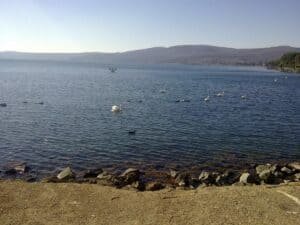
Laghetti della Mercareccia (RM)
In short. The Laghetti della Mercareccia are two bodies of water in the territory of Canale Monterano, in the province of Rome, inside the Monterano Regional Nature Reserve, about 50 kilometers north of the capital, between the Tolfa Mountains and the Sabatini Mountains.
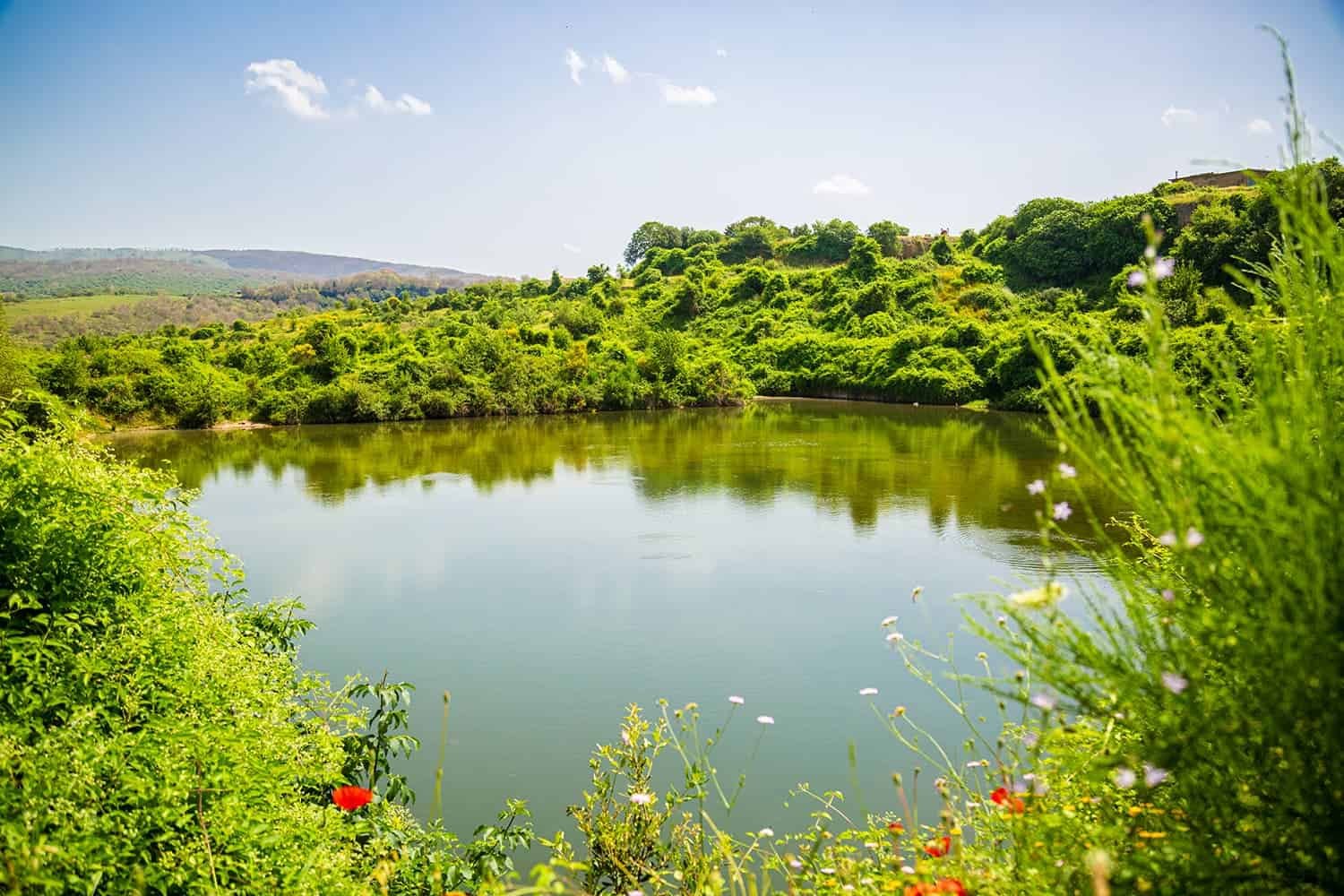
The Laghetti della Mercareccia are two bodies of water in the territory of Canale Monterano, in the province of Rome, inside the Monterano Regional Nature Reserve, about 50 kilometers north of the capital, between the Tolfa Mountains and the Sabatini Mountains. The Reserve's office is at Piazza Tubingen 1, in Canale Monterano, and the phone number given by the managing body is 06 9962724. The official website of the protected area is monteranoriserva.it. There is no ticket office: you walk on the marked trails starting from the Reserve's parking lots, the one at Comunaletto and the one at Casale de' Persi along Strada Antica Monterano, the one at the Diosilla Waterfalls on Via della Madonnella and the one at Poggio Lupino on Via dei Grottini. Office hours, the calendar of guided visits and the cost of educational activities need to be checked on the Reserve's official website or by phone before you leave, because they change with the seasons. By car you get here from Rome via Via Braccianese and then Canale Monterano. By public transportation you take the regional buses to the town, and from the town center to the trails there are still a few kilometers, so your own vehicle remains the most convenient solution. Good hiking shoes, water, binoculars: nothing more is needed for a day here. A visit to the Laghetti della Mercareccia is almost always combined with one to ancient Monterano, the abandoned village that occupies the tuff spur not far away.
The rest of the natural and archaeological destinations in Lazio that we cover is collected on the page of tourist attractions.
What the Laghetti della Mercareccia really are
Anyone who arrives expecting a real lake is left disoriented. The Laghetti della Mercareccia are two modest basins, the kind that shrink in summer and leave a band of cracked mud along the shore. Their importance has nothing to do with size: it has to do with the fact that in the middle of the Tuscia Romana, where watercourses carve narrow gorges and still water is a rare commodity, two permanent pools are worth as much as an oasis in the desert to everything that needs to lay eggs in water.
A tuff quarry that became a pond
The origin of the Laghetti della Mercareccia is industrial, not natural. The bottom of the two basins, in particular one of them, occupies the floor of an old disused tuff quarry. When the excavators left, the water table did its work: the impermeable bottom held the rainwater and the water that rises from below, reed beds colonized the banks, willows took the shores, and within a few decades a construction pit became the most precious aquatic habitat of the whole protected area. It's a textbook case of spontaneous renaturalization, and it's worth keeping in mind the next time someone says that the wounds of a landscape never heal. They do, sometimes, when the disturbance stops and nobody builds a warehouse on top.
The red tuff with black scoriae under the Laghetti della Mercareccia
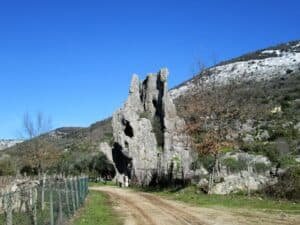
The rock the quarrymen came here to take is the red tuff with black scoriae, one of the materials that built half of Tuscia. Its age falls between 490,000 and 430,000 years ago: it is the product of Sabatini volcanic activity, a compact, workable ignimbrite, easy to cut into blocks with a hand saw and strong enough to hold up a wall. In the area the tuff banks alternate with calcareous-marly sediments, clays and sands of marine origin: a geological sandwich that explains both the shape of the gorges and the presence of springs where the water meets the impermeable layer. Our opinion: the Laghetti della Mercareccia are the best place in Lazio to make a layperson understand what a quarry is and why the urban landscape of Rome depends on the volcanic hills that surround it.

The bird-watching hide at the Laghetti della Mercareccia
Observation of the aquatic fauna takes place from a bird-watching hide overlooking the water. It's not a panoramic viewpoint: it's a wooden structure with horizontal slits, designed to hide the human shape and let the birds keep behaving as if nobody were there. The hide works if you use it the way it should be used, which means in silence, without leaning out of the openings, without phones with the ringer on, staying still for at least 20 minutes before expecting anything. The little grebe, which is the easiest bird to watch here, dives and resurfaces 30 meters away if the hide stays quiet, while it disappears into the reeds at the first sound of footsteps on the gravel.
The professional's advice is to go with 8x42 binoculars and not with your phone's zoom, and to plan for an hour and a half of waiting. People who go with the idea of taking three photos and leaving see nothing and then say there's nothing at the Laghetti della Mercareccia. There's a great deal: you just have to accept working at the animals' pace and not your own. The right hours are the first light of morning and the two hours before sunset. Midday in July, with the glare on the water and the birds in shelter, is the worst moment of all.
The amphibians and reptiles that live in the ponds
If there is a scientific reason why these two ponds end up on European lists, it's the animals that use them to reproduce. The populations present here are abundant precisely because still water is rare in the area: amphibians can't choose, and they concentrate where they can.
The Italian crested newt
The Italian crested newt, Triturus carnifex, is the largest newt species in Italy: males measure 10 to 15 centimeters, females reach 18. It has two different liveries depending on the season, brownish gray with dark spots in the land phase, much brighter in the aquatic phase. In the breeding period the male develops a serrated dorsal crest and a white stripe along the tail, and waves it in front of the female in an elaborate courtship that serves to spread pheromones. Fertilization is internal and happens through spermatophores deposited on the bottom. Breeding takes place, depending on humidity, rain and temperature, in a wide window running from December to June. In summer the animal leaves the water and lives in damp woods. The Red List classifies it as vulnerable, and it is one of the species for which the European Union asks member states for habitat protection measures. Watching a crested newt in its breeding season in a pool in a former quarry is, for anyone who knows how hard this species struggles to find clean water, one of the small luxuries of Tuscia.
The European pond turtle
The other presence that gives value to the Laghetti della Mercareccia is the European pond turtle, Italy's native freshwater turtle, not to be confused with the American red-eared turtles abandoned in the ponds of city parks. It has a dark carapace with yellow speckles, shy habits and a surprising ability to vanish underwater at the first movement on the bank. You almost always see it in the sun, on a half-submerged log or a tongue of mud, on mild spring days. It is a species in sharp decline throughout Italy because of the destruction of wetlands and competition with non-native species: its stable presence here is the best thermometer of the quality of these two ponds.
Frogs, toads and the spectacled salamander
Around the Laghetti della Mercareccia the spring evening chorus is the classic one of the wetlands of Lazio. In the Reserve as a whole, 142 species of vertebrates have been recorded, 24 of them on the Red Lists. Among the amphibians the spectacled salamander deserves a mention, an Italian endemic tied to damp gorges and rivulets of clear water that run down toward the Mignone. It is not an animal of open ponds and you will hardly meet it on the shore of the lakes, but the fact that it lives a few hundred meters away says how rich in microenvironments this strip of Tuscia Romana is.

The waterbirds that nest in the reed beds
The renaturalized zones of the Mercareccia, recolonized over recent decades, are today regular nesting sites for a small but reliable group of aquatic species. Anyone who reaches the hide in spring with a bit of patience finds almost all of them.
The little grebe
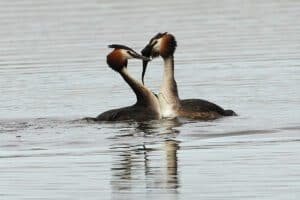
The little grebe, Tachybaptus ruficollis, is the smallest European grebe and the master of the house in these ponds. It nests on floating platforms of vegetation anchored to the rushes, incubates under a layer of wet plant material and, when it leaves the nest, covers the eggs with plants to hide them. It has a shrill, vibrating trill that in April can be heard dozens of meters away and that is the simplest way to notice its presence before even seeing it. Adults carry the chicks on their backs in the first weeks: whoever manages to photograph that scene at the Laghetti della Mercareccia takes home the best image of the whole day.
The common moorhen
The common moorhen, Gallinula chloropus, also nests among the reed beds. It has a red bill with a yellow tip, a bright frontal shield and that jerky way of walking on floating vegetation with very long toes that makes it look, from a distance, like an animal on skates. It is less shy than the little grebe and can be watched well even from outside the hide, along the banks, as long as you move slowly.
The wintering coots
In winter the makeup changes. In the cold months at the Laghetti della Mercareccia you meet pairs of coots, Fulica atra, wintering here: black, with the white frontal shield that makes them recognizable at a glance, more gregarious and noisier than the other species. Anyone who wants to see the pond in its most crowded version has to come in January, not in August. It's one of those seasonal reversals that surprise people who imagine nature as all concentrated in spring.
The raptors that hunt above the Laghetti della Mercareccia
The chapter that makes this area famous among the ornithologists of Lazio is about raptors. The clearings, the meadow pastures and the open banks of the ponds work as hunting ground for a list of species that in few places in Lazio gather like this.
The red kite
The red kite, Milvus milvus, is the name that carries the most weight. The Italian nesting population is estimated at an order of magnitude of a few hundred pairs, and in Lazio the known pairs are very few, all located in the Tolfa Mountains. One of them uses the Reserve's territory as a hunting area, looking for small animals and carcasses. It is recognized by its deeply forked tail and by the reddish contrast of the plumage against the white of the wing patches. In winter sightings increase because wintering individuals arrive from central Europe. Seeing one is not guaranteed, but the sky above the Laghetti della Mercareccia on windy days after a cold front is one of the best observatories in northern Lazio.
The short-toed snake eagle
The second raptor of great interest is the short-toed snake eagle, Circaetus gallicus, the snake eagle. It frequents the environments of Ranco della Bandita, Poggio Martino and the Laghetti della Mercareccia, where hunting reptiles is easier: snakes are almost the exclusive basis of its diet. It has a very pale, almost white belly and an unmistakable hunting technique, the "holy spirit," that is, hovering in place with its head pointed down and its wings beating slowly. It is a trans-Saharan migrant: you see it from March to September, then it disappears.
Kestrel, buzzard, hobby and black kite
Among the other raptors reported in the clearings as hunting grounds are the kestrel, Falco tinnunculus, also able to stay suspended in midair above a meadow. The buzzard, Buteo buteo, the most common and the one most often mistaken for an eagle by people without binoculars. The hobby, Falco subbuteo, a very fast hunter of dragonflies and swallows on summer evenings, and it is precisely the ponds' wealth of odonates that attracts it here. And the black kite, Milvus migrans, darker and with a less notched tail than its royal cousin. An hour at sunset at the edge of the clearing in June, with the hobby intercepting dragonflies above the water, is worth the whole trip.
The bee-eaters of the Laghetti della Mercareccia
Colorful colonies of bee-eaters, Merops apiaster, live in the area of the Laghetti della Mercareccia. They are the showiest birds you can meet in this landscape: chestnut and gold back, yellow throat, blue belly, long curved bill. They nest by digging deep tunnels in walls of earth and sand, and the old quarry slopes offer exactly the substrate they look for. You recognize them with the ear before the eye, by a bubbling, rolling call that accompanies the flock in flight, typical of the migration period. They hunt hymenopterans in flight and beat them against a branch to empty the stinger before swallowing them: a behavior you can watch very well from the hide with good binoculars. They are migrants: they arrive in April and leave for Africa between the end of August and September.

Dragonflies and the value of temporary ponds
There is a category of animals for which this place matters more than for the birds, and almost nobody talks about it: insects tied to water. The Laghetti della Mercareccia are a strategic area for the reproduction of many species, above all dragonflies, and in particular those tied to temporary ponds, habitats that are increasingly rare in Europe. A temporary pond is the pool that fills with the autumn rains and dries up in summer: an extreme environment, without fish precisely because the water disappears, and therefore a refuge for a procession of species that elsewhere would be eaten. Its rarity depends on the fact that it is the first to be reclaimed, leveled or turned into an irrigation tank, because to an untrained eye it looks like a useless puddle.
Dragonflies are easy to watch from May to September along the banks, and they are the ideal fauna for people who bring children: big, colorful, slow when they land, indifferent to human presence if you don't make sudden gestures. In the Reserve, odonate sampling has been carried out precisely in the Mercareccia locality, which says that the two ponds are not just a hiking destination but a research site. It's worth devoting at least half an hour to the strip of reeds on the sunny side: that's where emergences happen and where you find the exuviae, the empty shells of nymphs attached to the stems, excellent to show kids to explain metamorphosis without needing a book.
Why the Laghetti della Mercareccia are an area recognized at the European level
The area of the Laghetti della Mercareccia is included in the lists of important wetland areas of the Mediterranean basin and the Alpine Arc as far as the presence of ponds is concerned. There are three recognitions.
Special Protection Area and Site of Community Importance
The area is classified as a Special Protection Area (SPA) and as a Site of Community Importance (SCI), the two Natura 2000 Network categories that came respectively from the Birds Directive and the Habitats Directive. The first protects sites important for birdlife, the second the habitats and species listed in the European annexes: the crested newt and the European pond turtle are among them. The Mignone River, which crosses the Reserve, is in turn the subject of a Natura 2000 site dedicated to its middle course, with conservation measures approved by the Lazio Region.
Important Areas for Ponds and the European Pond Conservation Network
The third recognition is less well known and needs explaining, because its English name says little to someone reading it for the first time. The Mercareccia ponds appear among the Important Areas for Ponds (IAPs) in the Mediterranean Basin and Alpine Arc, a census promoted by the EPCN, European Pond Conservation Network, the international association based in Switzerland whose aim is the cataloging and conservation of minor wetlands of particular natural significance in a European landscape that is changing fast. In practice: a network of scholars decided that small ponds deserve a list of their own, because conservation reasoned only around large wetlands left out the most fragile and richest part of the system. Two pools in an abandoned quarry at the gates of Rome end up on that list. It's the most interesting fact, because it overturns the idea that natural value coincides with spectacle.
The Monterano Nature Reserve around the Laghetti della Mercareccia
The two ponds can't be understood without the protected area that contains them. The Monterano Regional Nature Reserve includes the area of the Laghetti della Mercareccia and is managed by the Municipality of Canale Monterano.
Establishment and expansion
The Reserve was established by Regional Law No. 79 of December 2, 1988 to protect about 900 hectares among the most representative and intact of the Tuscia Romana. With Regional Law No. 62 of 1993 the boundaries were expanded, precisely to include the wetlands, and the total area reached a little over 1,000 hectares, 1,082 according to the current figure. It's a detail worth underlining: the 1993 enlargement came from the awareness that the ponds were worth it, that is, that a renaturalized disused quarry deserved the same protection as an ancient forest. In 1988 that was not obvious.
Woods, gorges and meadow pastures
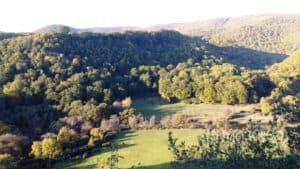
A thousand hectares hold a remarkable variety of environments: hill woods, volcanic gorges with microthermal vegetation and very rare ferns, meadow pastures with their own flora and fauna. The riparian vegetation along the watercourses is dominated by alders and willows. In the cold, damp gorges you find hornbeam and beech at very low elevations, a thermal inversion phenomenon that is worth a botany lesson by itself. On the exposed slopes holm oak and heather appear, that is, the Mediterranean scrub. And in between, mesophilic oak woods thrive. Wild orchids are the Reserve's other wealth, with blooms concentrated between April and May.
The Mignone River
All of this is crossed by a watercourse, the Mignone River, included among the sites that make up European Union heritage under the Natura 2000 Network. The Mignone rises in the Sabatini Mountains and flows into the Tyrrhenian Sea a little north of Civitavecchia. It is one of the few rivers in Lazio that keeps long stretches of natural flow, with otter historically reported in its basin and a fish fauna of community interest.
Ancient Monterano and the lion fountain
Of great historical and archaeological interest, and at the same time a continuous source of views, is the dead city of Monterano, with its ducal palace, the aqueduct on daring arches, the lion fountain attributed to Bernini's circle, the Convent of San Bonaventura and a fabric of minor buildings that often have roots in Etruscan remains. Thanks to the presence of the protected area, this heritage is the subject of conservation restorations that counter the demolishing work of time. The village was abandoned at the end of the 1700s and since then vegetation has done the rest: anyone who comes from the ponds and emerges in front of the aqueduct arches understands in two seconds why Italian cinema used this place for decades.
The Caldara di Monterano and the sulfurous waters
Along the trail that leads to the Diosilla waterfall you come across an area of solfataric activity, with sulfurous springs, vapors and mists that in the early light of morning turn the valley floor into something that recalls Iceland more than Lazio. Here clarity is needed. Those waters are not a spa facility, they have no operator, they have no health controls and they are not to be used for bathing: in the hollows where the gases stagnate the air can be unbreathable at ground level, the bottom is unstable and the water temperature varies from point to point. I attribute no healing property to these springs, because there is no documentation that supports one. You look at them, you photograph them, you stay on the marked trails and you don't bring dogs to drink. Whoever wants a hot tub should go where the service exists. Whoever wants a rare geological phenomenon at the gates of Rome has come to the right place. The Caldara di Manziana, not far away, also presents similar phenomena and should be treated with the same respect.
The Diosilla waterfall
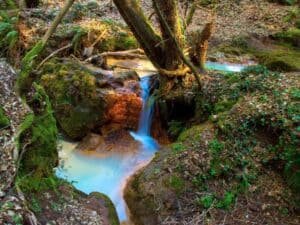
The Diosilla waterfall generally closes the classic loop. Its waters are rich in iron oxides, which stain the rock red and orange: a contrast that, with the surrounding vegetation, gives the most recognizable image of the Reserve after the Monterano aqueduct. You reach it from the Caldara area and then head back toward the starting point.
How to get to the Laghetti della Mercareccia and which trails to take
The logistics here are simple but need preparing, because there is no road sign saying Laghetti della Mercareccia along the provincial road: you reach Canale Monterano, park at one of the Reserve's four equipped spots and walk.
By car and where to park
From Rome you head out north and aim for Bracciano and Canale Monterano. There are four Reserve parking lots: Comunaletto and Casale de' Persi along Strada Antica Monterano, the one at the Diosilla Waterfalls on Via della Madonnella and the one at Poggio Lupino on Via dei Grottini. Casale de' Persi is the most used as a trailhead because the main loop starts from there. The access roads are narrow and partly unpaved: in winter, after days of rain, a low car suffers. Arrive early, because on spring Sundays the spots are gone by 10.
By public transportation
Canale Monterano is served by the regional buses that connect Rome with the Bracciano area and with Tolfa. From the town center to the Reserve's trails there are still a few kilometers of road, which can be walked by anyone with legs and time but are awkward with children or with photographic equipment. If you come by train you can get off at Bracciano and continue by road, but connections are sparse: check the schedules the day before on the carriers' official channels.
The Reserve's main loop
The most-trodden route starts from the Casale de' Persi parking lot and follows an almost flat track through woods of oaks and downy oaks: about 4 kilometers, two and a half hours with stops. After about 20 minutes you meet the abandoned city, with its walls, the church and convent of San Bonaventura, the lion fountain and the ducal palace. You continue toward the Caldara area, where the sulfurous vapors rise from the central zone, and you finish by passing the Diosilla waterfalls. The Laghetti della Mercareccia fit into this scheme as a detour or as the goal of a second outing: many hikers combine them with ancient Monterano and the Grottini necropolis in a longer loop, a full half day.
The rules to follow at the Laghetti della Mercareccia
We are inside a regional protected area that also includes farmland and private pastures. This means three very concrete things. First: you walk on the marked trails and don't cut across the meadows, both to avoid trampling the orchids and to avoid ending up on someone else's property. Second: the pasture gates are closed again exactly as you found them, because inside there are animals grazing free-range and Maremma cattle don't like surprises. Third: in the wetland you don't enter the water, you don't collect amphibians, you don't fish, you don't light fires and dogs must be kept on a leash, because a loose dog on the shore empties the pond of birds for the rest of the day. Where the Reserve signals bans or temporary closures for reasons of protection or safety, those indications count for more than any track downloaded from an app.
A curiosity about Laghetti della Mercareccia (RM)
The curiosity almost no visitor knows concerns the complete reversal of meaning this place has lived through. The Laghetti della Mercareccia are children of a wound: the bottom of the basins occupies the floor of a disused tuff quarry, that is, of an extraction site that for years took rock from the hill. In any environmental impact manual a quarry appears in the chapter on damage. Here the damage has turned into the element of greatest natural value in the whole protected area, so much so that the expansion of the Reserve's boundaries in 1993 served, among other things, precisely to take in the wetlands.
The mechanism deserves to be told in full, because it's counterintuitive. By digging, the quarrymen removed the permeable banks and exposed impermeable clay layers. The water table and the rain found a basin that doesn't drain, and the water stayed. Within a few years the first helophytes arrived, the marsh plants with submerged roots and stems out of the water, then the aquatic insects, then the amphibians, and finally the birds that feed on the amphibians and insects. Ecological succession did everything on its own, without a project, without funding and without an engineer. The result is that today the place is included in the European lists of significant minor wetlands, while a few hundred meters away stand ancient woods that are not part of that list.
Our firm opinion: the Laghetti della Mercareccia are the right place for anyone convinced that conservation consists only of not touching anything. Here the opposite happened. A place heavily transformed by humans, and then left in peace, produced in 30 years a biodiversity that a mature forest doesn't offer. The lesson is not that digging quarries is good for you: it's that giving space back to water works much faster than people believe.
Something nobody tells you about Laghetti della Mercareccia (RM)
No general-purpose guide makes it clear, and the result is a lot of disappointed visitors: the best time for the Laghetti della Mercareccia is not summer. These basins are largely fed by rain and by the shallow water table, and in the hot months the level drops quite a lot. Between July and September, after a dry season, anyone who reaches the hide risks finding a reduced surface, muddy banks and most of the waterbirds elsewhere. It's not a failure of the Reserve: it's the physiology of a Mediterranean pond, and it's exactly the reason why these environments are called temporary ponds and are considered rare and precious.
The second little-known piece of information concerns the fauna. The two species that give this place its European value, the Italian crested newt and the European pond turtle, are almost never seen from the bird-watching hide, which is calibrated for birds. The newt breeds in water in a window running roughly from December to June depending on rain and temperature, and to see it you have to approach the shallow, clear waters calmly on mild late-winter days, without entering the water and without stirring up the bottom. The turtle, instead, is caught by surprise while sunning itself on a log or a tongue of mud, and it disappears at the first sudden movement on the bank.
The third thing nobody says: noise matters more than distance. In a wetland of this size a voice at normal volume carries across the whole water surface. Groups that arrive chatting empty the scene before they even sit down. If you want to see something, the last 200 meters are done in silence. It's the most important recommendation and, when it's ignored, it regularly produces the claim that the Laghetti della Mercareccia are a place where there's nothing.
The advice I give you for visiting Laghetti della Mercareccia (RM)
The most useful advice is to reverse the order in which people organize the day. Almost everyone arrives mid-morning, does the loop of ancient Monterano, eats a packed lunch among the ruins and, around 3 in the afternoon, when they're already tired, wonders whether it's worth stretching on to the ponds. At that hour the light is flat, the heat is at its peak and the animals are in shelter: the detour disappoints and the visitor's mental file records a mediocre place. Do the opposite. Leave early, reach the bird-watching hide within the first hour of light, stay there as long as you need, and only afterward go walk among the walls, the aqueduct and the lion fountain, which hold up very well at midday.
Second piece of advice, a practical one: minimal but right equipment. Binoculars with magnification of 8 and a 40 millimeter objective, shoes with a lugged sole because the banks are muddy even when the trail is dry, long pants for the grasses and brambles, mosquito repellent from May to September, two liters of water per person in summer because there are no reliable drinking fountains along the route. A tripod is only for those doing serious photography: otherwise it's dead weight. Leave the drone at home, which in a protected area with nesting raptors is the most wrong thing you can bring.
Third piece of advice, about method. Take the time due, calmly, lingering not only on the views but on the smallest details: the flight of a dragonfly over the water, the bubbling of a sulfurous spring hidden in the vegetation, the furtive passing of a woodpecker, the search for the big raptors in the sky after the wind has picked up. And, if you get the chance, exchange a few words with one of the elders of Canale Monterano: many of them gladly recall events that took place in this territory, to which they feel a strong sense of belonging. You learn more about the quarry, the pastures and the old tuff trades in a conversation at the village bar than in three technical reports.
Another well-known fact, yet rarely cited
That the Monterano Reserve was a film set is known by everyone in the area, and it's repeated in every article. What almost nobody connects is the reason why directors came here and the way this vocation protected the place. Since the 1950s the Monterano landscape has served as natural scenery: among the productions shot here are Mario Monicelli's Brancaleone at the Crusades, from 1970, and Il marchese del Grillo, by the same director, from 1981. The ruins of the ancient city, the aqueduct on arches and the gorges offered what studios couldn't build: real ruins, invasive vegetation, no power lines in the frame.
The little-cited link is this: film fame gave the site a recognizable value long before the regional law of 1988 arrived. A ruin that appears in a Monicelli film becomes an asset the town is proud of, and an asset a town is proud of is harder to demolish, to fence off or to turn into a quarry. It's not an isolated case: it happens in half of Italy, but rarely with such a clean overlap between set, abandoned village and protected area.
The second known and little-explored fact concerns the numbers of the fauna. People repeat that the Reserve is rich, but rarely say how rich: 142 vertebrate species recorded, 24 of them on the Red Lists, on a little over 1,000 hectares. It's a density that puts this strip of Tuscia Romana in a prominent position in the Lazio landscape, and the aquatic part of that count depends decisively on the Laghetti della Mercareccia. Take away the two ponds and a substantial slice of those species would have nowhere to breed.
The right photo to take at Laghetti della Mercareccia (RM)
The photograph that is worth the trip to the Laghetti della Mercareccia is not the panorama of the water. The panorama, honestly, is modest: two basins of modest size, reed beds, a few willows. The right photo is the one taken from the slit of the bird-watching hide, with the telephoto lens resting on the wood and the little grebe in the center of the frame, better still with chicks on its back. Side light of early morning, water still motionless, the reflection of the reed bed as a background: the result has a quality that no wide shot can give.
The second shot to plan is the insect. A dragonfly just emerged on a stem, with its wings still opaque, or the empty exuvia clinging to the rush: a modest macro lens or even a recent phone with close-up mode is enough, because in those minutes the animal doesn't move. It's the photograph kids can take by themselves, and it pays them back for the walk.
The third, for anyone who wants a recognizable image of the place, is the backlight on the cracked mud of late summer, with the footprints of herons and moorhens stamped on the shore: it says more about the temporary pond than any caption. Two non-negotiable rules: no flash toward the animals and no approaching the nests, because a disturbed reed bed in April is an abandoned nest in April. And no drone, which here is both useless and harmful.
Some important events that took place here in history
The history of this corner of Tuscia Romana is read in phases, and each one has left a mark recognizable to anyone walking between the ponds and the ruins.
The oldest phase is the Etruscan one. The plateau and the gorges around Monterano preserve burials and caves dug in the tuff, and many buildings of the medieval village have their foundations on Etruscan remains: the Grottini necropolis, which many hikers include in the same loop as the ponds, belongs to this deep layer of the landscape. Here tuff is not just geology: it's the material in which a civilization dug its own tombs before the Romans even arrived.
The modern phase coincides with the ducal season of the village, when Monterano had a palace, an aqueduct, a church and the convent of San Bonaventura, and with the building site that brought the language of Roman Baroque architecture here, the lion fountain included. The abandonment came at the end of the 1700s and has two causes that local tradition intertwines: the passage of French troops, with the sacking and burning of the settlement, and the malaria that made the valley floor uninhabitable. Since then nobody has gone back to live there, and an entire city has handed itself over to vegetation.
The industrial phase is the one that concerns us most closely: the opening and then the closing of the tuff quarry that generated the Laghetti della Mercareccia. We don't know the exact dates of that site, but its outcome is plain for everyone to see, and it is probably the only case in Lazio where an excavation produced, by roundabout ways, a site of European interest.
The contemporary phase has two precise dates. On December 2, 1988, with Regional Law No. 79, the Monterano Regional Nature Reserve was born on about 900 hectares. In 1993, with Regional Law No. 62, the boundaries were expanded to a little over 1,000 hectares precisely to include the wetlands, and therefore the ponds too. In between, from the 1950s onward, the long season of film sets. If I had to name the most important event that happened here in the last 50 years, I wouldn't hesitate: it's that 1993 expansion, which recognized in a pool of water in an abandoned quarry the dignity of a public good to be protected.
Who has passed through Laghetti della Mercareccia (RM)
The name that carries the most weight is Mario Monicelli, who shot at least two films at Monterano that entered Italian collective memory: Brancaleone at the Crusades in 1970 and Il marchese del Grillo in 1981. The crews worked for weeks among the ruins and gorges of the future Reserve, and with them came the actors of those productions, the technicians, the extras recruited in nearby towns. From the 1950s onward this landscape was used repeatedly as natural scenery: it's the reason why so many visitors, arriving for the first time, have the feeling of having already seen the aqueduct and the convent.
Before cinema, the protagonists of the village's history passed through: the lords who wanted the ducal palace and the aqueduct, the architects and stonecutters who brought the language of Roman Baroque to inland Lazio, the friars who lived in the convent of San Bonaventura, and then, at the end of the 1700s, the French troops whose passage local tradition points to among the causes of the abandonment. Before that, the Etruscans who dug the Grottini tombs into the tuff.
Those who pass through the Laghetti della Mercareccia today belong to a different and quieter category: researchers and naturalists. In the Reserve, odonate sampling has been carried out precisely in the Mercareccia locality, and the amphibian and bird censuses are the ones that produced the figures cited in official reports, starting from the 142 vertebrate species. To them are added the Lazio birdwatchers, who come here for the red kite with a constancy that Sunday visitors don't imagine, and the inhabitants of Canale Monterano, who keep the oral memory of this territory and are almost always willing to tell it. If mass tourism has never reached the two ponds, that's a good thing: they are places that can hold only a few people at a time.

When to go to the Laghetti della Mercareccia
The calendar of this place is clear-cut and it pays to respect it. From late February to April you get the peak of amphibian activity and the first orchid blooms: it's the season I recommend to anyone coming only once. From May to June the dragonflies arrive, the bee-eaters are back, the short-toed snake eagle hunts over the meadow pastures and the days are long. July and August are the worst months: low water level, heat, little activity, mosquitoes. September and October offer the autumn migration and the colors of the woods. December and January bring the wintering coots and the most frequent sightings of red kite, with the advantage of total silence and the disadvantage of muddy trails.
On weather, one rule that never fails: the best days for raptors at the Laghetti della Mercareccia are the windy ones right after a front passes, when the air is clear and the thermals work. Days of summer haze are to be avoided.
The Laghetti della Mercareccia with children
It works, as long as you don't treat the walk as a goal. The stretch from the parking lot to the ponds is short and without technical difficulties, and a child from six years up covers it with no problem. With the smallest ones a baby carrier is better, because a stroller on unpaved, muddy ground is unmanageable. The material that really works with kids here is the insects: the dragonfly exuviae attached to the rushes can be picked up by hand, they're empty and harmless, and they let you explain metamorphosis by looking at the object instead of a drawing in a book. Then the hide, explained as a game: whoever manages to stay quiet longest sees the most animals. It works much better than a threat.
Two cautions. The bank is muddy and slippery, so children stay on the trail and don't go near the water's edge. And if you combine the day with the Caldara area, keep in mind that the sulfurous vapors and the hot pools are not an attraction to bring little ones close to: they are watched from a distance, from the trail.
Accessibility, services and what to expect on site
The Reserve's routes are natural trails on packed earth, with roots, stones and muddy stretches after rain. They are not equipped for wheelchairs and not for people who walk with difficulty either, and it would be wrong to describe it any other way. Anyone with specific accessibility needs would do well to contact the Reserve's office in Canale Monterano before planning the outing, to find out which stretch is passable in the chosen period and whether adapted activities are on the calendar. There are no restrooms along the trails, nor refreshment points: bars and grocery stores are in town.
What to see around the Laghetti della Mercareccia
Within half an hour by car the choice is wide and coherent. Ancient Monterano is the natural pairing, a few minutes on foot. The Macchia Grande di Manziana woods, a monumental Turkey oak forest, and the Caldara di Manziana, with its sulfurous phenomena, complete the natural picture. To the west you climb to the village of Tolfa and to the Allumiere beech grove, with its beech forest at an unusually low elevation. To the east you descend to Lake Bracciano, with the Odescalchi castle and the shores of the Bracciano and Martignano park. Anyone who wants to stay on the theme of wetlands and birds will find, not far away, the Trevignano marshes and, on the coast, the Macchiatonda Nature Reserve, which is the other great bird-watching observatory of the northern coast. Among the villages, Oriolo Romano with its beech forest and the Mola di Oriolo are worth an afternoon.
Quick questions about Laghetti della Mercareccia (RM)
Where exactly are the Laghetti della Mercareccia?
In the municipal territory of Canale Monterano, in the province of Rome, inside the Monterano Regional Nature Reserve, between the Tolfa Mountains and the Sabatini Mountains, about 50 kilometers north of Rome.
Do you pay a ticket to enter the Laghetti della Mercareccia?
There is no ticket office at the trail access: you park in one of the Reserve's areas and walk. Costs and terms of guided visits and educational activities must be asked at the Reserve's office or checked on the managing body's official website.
How long does a visit to the Laghetti della Mercareccia take?
For the ponds and the hide alone you need at least two hours, if you want to observe anything. Adding the classic loop of ancient Monterano, which from Casale de' Persi measures about 4 kilometers for two and a half hours, you comfortably reach a full half day.
Is there a bird-watching hide at the Laghetti della Mercareccia?
Yes, observation of the aquatic fauna takes place from a bird-watching hide overlooking the water. It must be used in silence and without leaning out of the slits, otherwise it's useless.
What animals can you see at the Laghetti della Mercareccia?
Nesting little grebe and common moorhen, wintering coots, Italian crested newt and European pond turtle, many species of dragonflies, colonies of bee-eaters, and in the sky red kite, short-toed snake eagle, kestrel, buzzard, hobby and black kite.
What is the best time to visit the Laghetti della Mercareccia?
From late February to June for amphibians, orchids, dragonflies and bee-eaters. December and January for the wintering coots and for the red kite. July and August are the least interesting months, with the water level at its minimum.
How were the Laghetti della Mercareccia formed?
They occupy the floor of a disused former tuff quarry and renaturalized spontaneously, without a restoration project: the water stayed in the excavated basin and the marsh vegetation did the rest.
Are the Laghetti della Mercareccia a protected area?
Yes. They fall within the Monterano Regional Nature Reserve and are classified as a Special Protection Area and a Site of Community Importance, as well as appearing among the Important Areas for Ponds of the Mediterranean basin and the Alpine Arc recorded by the European Pond Conservation Network.
Can you swim in the Laghetti della Mercareccia?
No. They are protected wetlands and breeding habitat of protected species: you don't enter the water, you don't fish and you don't collect amphibians or reptiles.
Can you bring dogs to the Laghetti della Mercareccia?
The dog must be kept on a leash along all routes and must not be allowed near the banks: a loose dog in a wetland drives waterbirds away for the entire day. Any seasonal restrictions must be checked with the Reserve.
Are the Laghetti della Mercareccia wheelchair accessible?
No, the trails are on natural ground with roots, stones and muddy stretches. Anyone with accessibility needs should contact the Reserve's office in Canale Monterano to find out what is practicable.
Do you need to book to visit the Laghetti della Mercareccia?
Not for the free walk. Guided visits, educational activities and nature outings organized by the Reserve are booked with the managing body.
How do you get to the Laghetti della Mercareccia without a car?
You reach Canale Monterano by regional bus and continue on foot for a few kilometers to the Reserve's entrances. It's doable but awkward: check the carriers' schedules in advance on their official channels.
Where do you park for the Laghetti della Mercareccia?
In the Reserve's parking areas: Comunaletto and Casale de' Persi along Strada Antica Monterano, Diosilla Waterfalls on Via della Madonnella, Poggio Lupino on Via dei Grottini.
Are the Laghetti della Mercareccia suitable for children?
Yes, the approach stretch is short and easy. Dragonflies, exuviae and the silence game at the hide work very well with the little ones. The stroller, though, can't be used on unpaved ground.
What is the difference between the Laghetti della Mercareccia and the Caldara di Monterano?
The ponds are freshwater wetlands born from a disused quarry. The Caldara is an area of solfataric activity with sulfurous springs and vapors, along the trail to the Diosilla waterfall. They are two opposite environments, a short distance from each other.
Do the sulfurous waters of the Reserve have healing properties?
There is no documentation that attests to it and none is attributed here. They are not managed thermal waters, they are not controlled for health purposes and they are not to be used for bathing: in the hollows the gases can stagnate and the bottom is unstable.
Can you bivouac or light a fire at the Laghetti della Mercareccia?
No. We are in a protected area: fires and free camping are not allowed, and trash is carried back down.
Can you use drones at the Laghetti della Mercareccia?
It's a terrible idea in an area with nesting raptors and waterbirds, besides being subject to the protected area's rules and to aviation regulations. Anyone intending to fly for professional reasons should contact the managing body beforehand.
How big are the Laghetti della Mercareccia?
They are two small basins, with a level that varies by season: in the hot months the surface shrinks noticeably. Their value doesn't depend on size but on the rarity of still water in this area.
What is there to see near the Laghetti della Mercareccia?
Ancient Monterano with the aqueduct and the lion fountain, the Caldara and the Diosilla waterfall, the Grottini necropolis, the Macchia Grande woods and the Caldara di Manziana, the village of Tolfa, Lake Bracciano with the Odescalchi castle.
Are the Laghetti della Mercareccia on private land?
The protected area also includes farmland and pastures in private ownership. For this reason you walk only on the marked trails, you close the pasture gates again and you respect the fences and the posted bans: no view is worth entering someone else's land.
The Laghetti della Mercareccia are not a spectacular place and never will be: anyone looking for the postcard should stay among the arches of the Monterano aqueduct, which delivers that. These two ponds are a place to understand, and to understand it you have to sit in a wooden hide at 7 in the morning in March and wait. Whoever does so leaves with the feeling of having seen something almost no visitor to Rome will ever see: an industrial wound that time has turned into the most precious environment of an entire protected area. It's worth the trip, as long as you go at the right pace and with your mouth shut.
Frequently asked questions about Laghetti della Mercareccia (RM)
Where exactly are the Laghetti della Mercareccia?
The Laghetti della Mercareccia are in the municipal territory of Canale Monterano, in the province of Rome, inside the Monterano Regional Nature Reserve, between the Tolfa Mountains and the Sabatini Mountains, about 50 kilometers north of Rome. They are two modest basins born from the floor of an old tuff quarry.
Do you pay a ticket to enter the Laghetti della Mercareccia?
There is no ticket office at the access to the trails of the Laghetti della Mercareccia: you park in one of the equipped areas of the Monterano Regional Nature Reserve and walk freely. Access to the protected area is therefore free, even though parking is limited to four spots.
What is the best time to see birds at the Laghetti della Mercareccia?
The best time for bird observation at the Laghetti della Mercareccia runs from late February to April, when amphibian activity is at its peak along with the first orchid blooms. From May to June, instead, the dragonflies arrive and the bee-eaters return, while July and August are the worst months because of the low water level and the heat.
How do you get to the Laghetti della Mercareccia?
You get to the Laghetti della Mercareccia by reaching Canale Monterano from Rome in the direction of Bracciano, then parking at one of the four equipped spots of the Monterano Regional Nature Reserve and continuing on foot. There is no road sign pointing directly to the ponds along the provincial road.
Are the Laghetti della Mercareccia suitable for children?
The Laghetti della Mercareccia work well with children, as long as you don't treat the walk as a goal in itself. The stretch from the parking lot to the ponds is short and without technical difficulties, doable for a child from six years up, while with the smallest ones a baby carrier is better because a stroller on unpaved, muddy ground is unmanageable.
Are the trails of the Laghetti della Mercareccia wheelchair accessible?
The Reserve's routes that lead to the Laghetti della Mercareccia are natural trails on packed earth, with roots, stones and muddy stretches after rain, and they are not equipped for wheelchairs nor for people who walk with difficulty. Anyone with specific needs can contact the Reserve's office in Canale Monterano in advance.
What can you observe from the bird-watching hide?
From the bird-watching hide at the Laghetti della Mercareccia you can observe waterbirds such as the little grebe, which nests on floating platforms of vegetation, as well as raptors such as the red kite, which hunts over the clearings and the surrounding meadow pastures. The wooden structure with horizontal slits hides the human shape and works only if used in silence.
What can you see near the Laghetti della Mercareccia?
Near the Laghetti della Mercareccia is ancient Monterano, an abandoned village and the set of films such as Brancaleone at the Crusades and Il marchese del Grillo by Mario Monicelli, a few minutes on foot away. Within half an hour by car you can add the Macchia Grande di Manziana woods and the Caldara di Manziana with its sulfurous phenomena.
To organize the outing with a professional, information on accompaniment services is at TourLeaderPro, while the network's pages dedicated to Rome and its surroundings are in the Rome section of TourLeaderPro. If you travel in English, you'll find the practical guide to safety in the city at ItalyPlanner and the program of Roman evenings at Rome at Night.
Article written by the editorial team of TourLeaderPro, contact them for Private/Corporate/V.I.P. Tours and Experiences.
Planning a trip to Rome? The English guides to visiting the city are at ItalyPlanner.com.