Published on
Some links on this page are affiliate links: if you buy through them, Estate Romana receives a small commission at no extra cost to you. As an Amazon Associate, Estate Romana earns from qualifying purchases.
For a day in Rome you need a power bank of about 10,000 mAh, a USB-C cable long enough and, if you’re sleeping in a hotel, a compact charger to recharge everything overnight. The ideal Rome power bank is not the biggest one in the store: it’s the one that weighs little, fits in a backpack allowed in museums and passes airport checks without problems. In the city the phone is your map, ticket, camera and wallet, and it usually gives up around mid-afternoon.
The questions we get most often are always the same: how many mAh to buy, if you can bring a power bank on a plane, if your backpack gets into the Colosseum or the Vatican Museums. Here you’ll find the answers, a typical day with the phone on from morning to night and a collection of accessories divided by group, with several alternatives for each because models come and go.

Data checked on October 3, 2026 on the official ITA Airways pages on electronic devices and batteries, on the visitor regulations of the Colosseum Archaeological Park and on the cloakroom regulations of the Vatican Museums. The rules on batteries in flight have changed several times in the last two years: before leaving it’s always worth rereading your airline’s page.

Power banks for Rome at a glance
- What: for a full day in Rome a 10,000 mAh power bank, equal to about 37 Wh, is generally enough, charging a smartphone from one and a half to two times.
- When you need it: the phone drains mostly between 15:00 and 18:00, after a morning of maps, photos and digital tickets with the screen in the sun.
- On a plane: the power bank travels only in carry-on, never in checked baggage. Up to 100 Wh no authorization is needed, between 100 and 160 Wh the airline’s approval is needed.
- On board ITA Airways: since January 15, 2026 on Lufthansa Group flights, ITA included, using or recharging power banks is forbidden, at most two can be carried and they must not go in the overhead bins.
- In museums: at the Colosseum Archaeological Park carry-on baggage must not exceed 30x40x15 cm and there is no storage. At the Vatican Museums items over 40x35x15 cm go to the cloakroom.
- Good to know: at the Colosseum glass bottles are not allowed, so a metal bottle is the right choice together with the power bank.
How much battery do you really need for a day in Rome?
A day in Rome drains the battery more than a day at the office, even if you use the phone the same number of hours. The reason is simple: screen at maximum brightness in the sun, GPS on for hours, a mobile network searching for signal in narrow alleys and inside churches with thick walls. Add the photos, the short videos to send home and the tickets with QR codes to show at the entrance, and it adds up.
A recent phone starts the morning at 100 percent and, with this use, reaches 30 percent around three in the afternoon. The critical moment is almost always the same: you’re in Trastevere or on the Aventine, you want to find the restaurant for the evening, check the last bus or show a museum ticket, and the phone asks you to turn on power saving. With a power bank in your backpack the problem disappears, because 20 minutes of charging during a coffee is enough to get to the evening.
Think about payments too. In Rome you increasingly pay with your phone, and the public transport system accepts contactless payment at the metro turnstiles: if your phone is also your card, running out of battery means running out of ticket. My advice is to always keep a physical card in your wallet, but the power bank remains the most convenient way not to depend on anyone.
Anyone traveling as a couple or a family has another problem: the phones are two, three, four, and maybe there’s also a tablet for the kids at the restaurant. In this case a single 10,000 mAh power bank is no longer enough, and it’s best to move up to a 20,000 mAh model with two outputs, or split the load across two smaller power banks, one per backpack. The second route, in our view, is the most practical: if you separate for an hour, everyone has their own reserve.
10,000 or 20,000 mAh power bank: which to choose for Rome?
The number in mAh tells you how much energy the battery holds, but to know what you can bring on a plane you need the value in watt-hours. The approximate conversion is this: multiply the mAh by 3.7 and divide by a thousand. A 10,000 mAh power bank is therefore worth about 37 Wh, a 20,000 mAh one about 74 Wh, a 27,000 mAh one comes close to 100 Wh. Many manufacturers print the Wh directly on the casing: that’s the figure to check before leaving.
Now the contrary view, because people often get this wrong here: the 20,000 mAh power bank, for a single tourist in Rome, is overrated. It weighs twice as much as a 10,000 model, takes up space in a backpack that has to stay small to get into museums and, at the end of the day, goes back to the hotel half charged. After six hours on foot on the sampietrini, you feel every ounce. The big model makes sense for those traveling as two with a single backpack, for those who shoot video or for those who do full-day trips outside the city.
The other common mistake is looking only at capacity and forgetting output power. A slow power bank charges the phone in two hours. One with fast USB-C Power Delivery charging of at least 20 W takes it to half in half an hour, that is, the time of a quick lunch. If you have a recent iPhone, the MagSafe power bank is handy because it attaches to the back and needs no cables, but it charges more slowly and heats up more: fine as a light reserve, less so as the only source.
Finally, the cable. It seems like a detail, but a short cable forces you to hold power bank and phone in the same hand while walking. A one-meter USB-C cable, or even a two-meter one for the hotel nightstand, lets you leave the power bank in your backpack and use the phone normally. Many hotels in the historic center have few outlets, often far from the bed: a multi-port GaN charger solves the problem with a single footprint.
What do the rules say on power banks on planes and in museums?
The rules on lithium batteries in flight follow international guidance adopted in Italy by ENAC and taken up by the airlines. The power bank is considered a spare battery: it travels only in carry-on, never in checked baggage. Up to 100 Wh no authorization is needed. Between 100 and 160 Wh the airline’s approval is needed. Above 160 Wh carriage is forbidden. Terminals must be protected against short circuits, and a damaged or swollen power bank must not board.
Those arriving in Rome with ITA Airways need to know one more thing. According to the airline’s official page on electronic devices and batteries, you can carry at most two power banks per person, using or recharging them on board is forbidden, except for those for approved medical devices, and they must not be stored in the overhead bins: they go under the seat in front, in the seat pocket or on your person. The rule has applied since January 15, 2026 to the whole Lufthansa Group. Other airlines have introduced similar limits too: the page of the carrier you fly with is what counts.
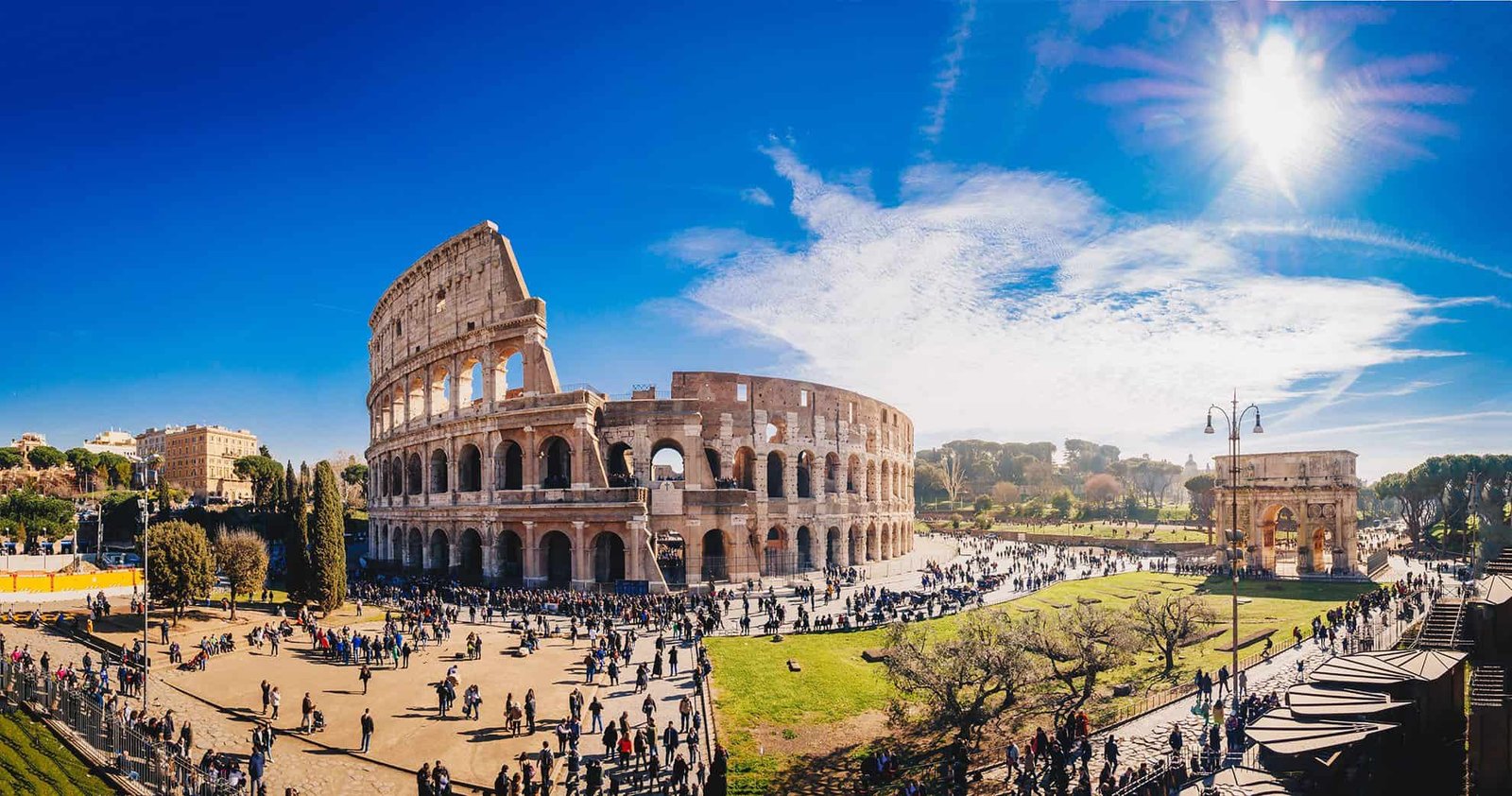
Once on the ground, the problem becomes the backpack. The visitor regulations of the Colosseum Archaeological Park
set carry-on baggage within 30x40x15 cm, forbid glass bottles and specify that the Park has no cloakroom or luggage storage. At the entrance there is a metal detector: keeping the power bank and cables in an outside pocket speeds up the check.
At the Vatican Museums the cloakroom regulations ask you to leave bags and containers over 40x35x15 cm. Small backpacks are allowed if, worn on the shoulder, they don’t stick out from the body by more than 15 centimeters. The practical consequence is clear: for a day of museums you need a slim city backpack and a flat power bank, not a trekking backpack with a kilogram battery inside.
A day in Rome with a charged phone: where to go
A typical day, designed to test the battery, starts early from the central archaeological area: the Colosseum, Roman Forum and Palatine are visited with a timed ticket, and the digital ticket must be shown at the entrance. Here the power bank stays in the backpack: the phone is charged and you only need the photos. The pages of all the main tourist attractions of Rome collected by Estate Romana help you choose what to put in the program and in what order.
In the middle of the day, after three or four hours of photos and maps, the battery drops below half. It’s time to plug in the power bank during lunch, maybe toward the Circus Maximus, and to climb the Aventine. The Orange Garden is one of the most photographed stops in the city, and the nearby Piazza dei Cavalieri di Malta draws a line for the famous keyhole. The afternoon can continue going down toward Trastevere, where in the evening the phone is for finding a table and the bus back.
If you want to book entrances and activities in advance, the tickets for Rome attractions on Tiqets arrive directly on your phone, as do the experiences in Rome on GetYourGuide. That’s exactly why the power bank is not optional: without the phone you don’t have the ticket. My advice is to save a copy of the tickets offline or as a PDF, and to take a screenshot of the QR codes before leaving the hotel.
If it rains, the day moves indoors, among museums, churches and galleries. Battery use changes little, because inside museums the signal is weak and the phone works harder to stay connected. It’s worth turning on airplane mode during the longest visits, if you don’t need audio guides on the phone, and turning the network back on only at the exit. A waterproof phone case and a compact umbrella, within the meter allowed at the Colosseum, complete the backpack.
With kids, the rule is to halve the stops and double the breaks. The power bank is also for the tablet or the little ones’ headphones during waits, and a Bluetooth tracker attached to the older kids’ backpack gives extra peace of mind in crowded places. As a couple, on the other hand, it’s best to split the tasks: one phone for photos, the other for maps and tickets, with a power bank each.
For meals, instead of relying on the first place on the main square, you can consult the Estate Romana restaurant map, also useful for choosing where to stop and recharge. Many bars and trattorias have no outlets available to those who sit down, and asking to plug in the phone isn’t always met with a smile: another reason the power bank beats the hunt for an outlet.
When to order and how to get organized before leaving?
If you’re leaving in a few days, order now: the estimated delivery date at the time of the order is what counts, and it’s best to have the package delivered to your home before departure, not to the hotel. Many properties accept packages for guests, but not all, and finding out at the front desk is not the best way to start a vacation. If you are already in Rome, you can ask the property if it picks up deliveries in your name.
As soon as it arrives, the power bank should be fully charged and tried with your phone and your cable. Check that the casing shows the Wh or at least the mAh and the voltage: at airport security checks a power bank without legible markings can be held. The same goes for chargers: a GaN travel charger with an adapter for Italian outlets saves you from looking for an adapter on the first evening.
The evening before each day of sightseeing, the routine is simple: phone, power bank, headphones and watch all charging together on the multi charger. In the morning the power bank goes in the outside pocket of the backpack, the cable already connected, the bottle full. Rome’s public fountains, the nasoni, let you refill it during the day. For those coming from abroad, a Europe data eSIM activated before departure saves you from looking for a phone shop right after landing.
The collection: power banks and travel accessories for Rome
For each group you’ll find several searches, so if a model is sold out you have an alternative right away. Prices change every day and we don’t give them: compare capacity, weight, output power and recent reviews.
Power banks
- 10,000 mAh power bank (alternative · more): the right choice for one person and a full day in the city, light and thin.
- 20,000 mAh power bank (alternative · more): for those traveling as two with a single backpack or doing day trips outside Rome.
- MagSafe power bank (alternative · more): it attaches to the back of the iPhone and leaves your hands free while you walk.
- Power bank with built-in cable (alternative · more): one less thing to forget at the hotel.
- USB-C Power Delivery power bank (alternative · more): fast charging during a lunch break.
- Slim, light power bank (alternative · more): fits in a pocket or a waist pack, useful in museums with limited backpacks.
Chargers, cables and outlets
- GaN charger (alternative · more): compact and with multiple ports, it charges your phone and power bank together from the same outlet.
- Long USB-C cable: it reaches from the far-off outlet to the hotel nightstand.
- USB-C to Lightning cable: for anyone who still has an iPhone with the old port.
- Universal adapter (alternative · more): a must if you’re coming from countries with outlets different from the Italian ones.
- Travel power strip with USB: turns the room’s single outlet into four.
- 3-in-1 charging station: phone, watch and earbuds charging overnight on a single stand.
Connectivity and security
- Europe eSIM: data on as soon as you land, especially useful if you’re coming from outside the European Union.
- AirTag (alternative · more): in your backpack or suitcase, so you always know where they are.
- Bluetooth tracker for Android: the alternative if you don’t use an iPhone.
- Anti-theft city backpack (alternative · more): hidden zippers and a size that works with the museums.
- Anti-theft fanny pack: for your power bank, phone and documents on crowded public transport.
- RFID wallet: protects the contactless cards in your pocket.
Comfort during the day
- Noise-cancelling headphones: on the plane and the train they make a difference, and they charge from the power bank.
- Bluetooth earbuds: for audioguides on your phone without bothering anyone.
- Insulated water bottle (alternative · more): it’s metal, so it’s allowed where glass is banned, and you can fill it at the nasoni.
- Waterproof phone case: for rainy days and for the fountains.
- Compact windproof umbrella: small enough to stay in your backpack.
To read and to book
- Rome guidebooks: paper never runs out of battery, and it’s the best plan B.
- Map of Rome: foldable, to find your way around even with your phone off.
- Rome on foot, itineraries: routes to follow at an easy pace, neighborhood by neighborhood.
- Colosseum tickets on Tiqets: timed entry, with the ticket right on your phone.
- Vatican Museums entry on GetYourGuide: book ahead in peak periods.
Frequently asked questions
How many mAh should a power bank have for a day in Rome?
For one person, 10,000 mAh is enough, about 37 Wh. That’s the capacity that charges a recent smartphone from one and a half to two times, it’s light, and it fits in a backpack allowed in the museums. If two of you are traveling with a single power bank, or you’re taking day trips outside the city, it’s worth going up to 20,000 mAh.
Can you take a power bank on a plane to Rome?
Yes, but only in your carry-on, never in checked luggage. Up to 100 Wh you don’t need authorization, between 100 and 160 Wh you need the airline’s approval, and above that it’s banned. On ITA Airways and the other airlines of the Lufthansa group, since January 15, 2026, you can bring at most two, and you can’t use them on board.
Can you bring a power bank into the Colosseum and the Vatican Museums?
Yes, the power bank isn’t among the banned items, but the backpack matters. At the Colosseum Archaeological Park, carry-on bags must not exceed 30x40x15 cm and there’s no storage. At the Vatican Museums, items over 40x35x15 cm go to the cloakroom. At the entrance there’s a metal detector check.
Is a MagSafe power bank better, or one with a cable?
For a whole day, a power bank with a USB-C cable and fast charging is better. MagSafe is handy because it snaps onto the back of the iPhone and leaves your hands free, but it charges more slowly and heats up more in the sun. It makes sense as a light second reserve, not as your only source of power.
Are there places in Rome to charge your phone?
There are, but don’t count on it. Some venues and stations have outlets or charging points, but they’re not always free or working, and many bars don’t make outlets available. A power bank in your backpack saves you the outlet hunt and leaves you free to decide where to stop.
What’s worth buying besides the power bank?
A long USB-C cable, a GaN charger with multiple ports for the evening at the hotel and, if you’re coming from abroad, a universal adapter. For the day you also need a metal water bottle, because glass isn’t allowed at the Colosseum, and a compact city backpack. A paper map is still the most reliable plan B.
When should you order the power bank before the trip?
As soon as possible, and with home delivery. What counts is the estimated delivery date at the time of the order. As soon as it arrives, charge it fully and try it with your phone and your cable, checking that the Wh or mAh are legible on the casing, because they can be asked for at airport checks.
Who wrote this and from what sources
The text comes from the editorial team of Tour Leader Pro, the Rome-based company that designs itineraries, visits and cultural events in Rome and Lazio. The rules on batteries and luggage were checked against the official pages of ITA Airways, the visitor rules of the Colosseum Archaeological Park and the rules for the Vatican Museums cloakroom, as of the date shown at the top. Let us know if you find anything changed.
Organizing a day in Rome, on your own or with a group of friends, means lining up timed tickets, transfers and breaks, and making everyone’s battery last until evening: a useful resource for anyone organizing group trips is Tour Leader Pro. If after Rome you want to widen the trip to the Castelli Romani, Tuscia or the coast, a useful resource for putting together a multi-day itinerary is Italy Planner.