River Bar
In short. River Bar is the summer version of the TAG, the space that faces the right bank of the Tiber at Via di Santa Passera, between Portuense and Magliana.
Via di Santa Passera, 25
Rome
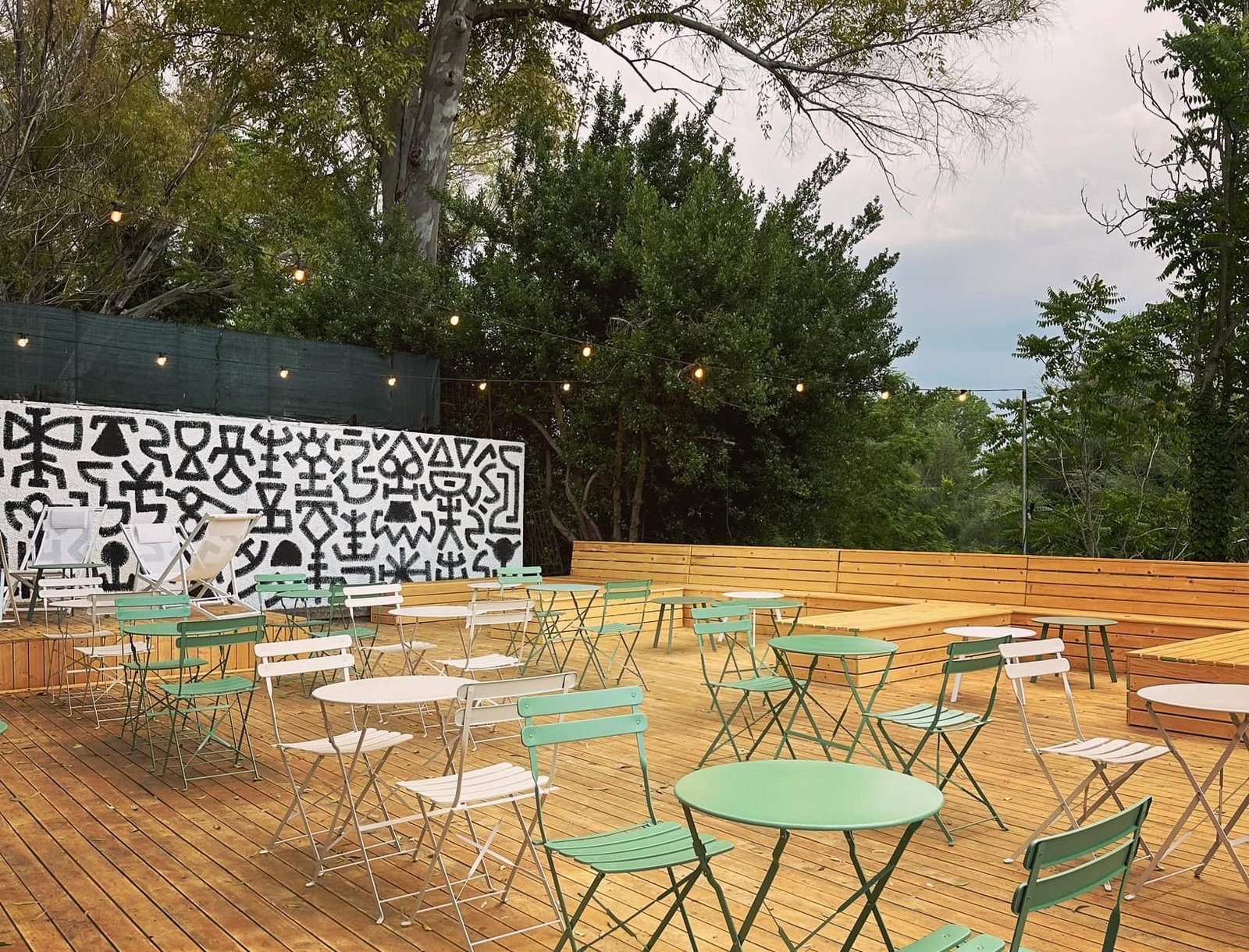
River Bar is the summer version of the TAG, the space that faces the right bank of the Tiber at Via di Santa Passera, between Portuense and Magliana. In summer it changes skin: the river view stays the same, enviable and fairly rare in this city, but the place gets a makeover and above all turns up the volume of the music. It's one of those seasonal transformations that happen in Rome more often than people think, and that almost nobody tells properly, because the place isn't in the center, doesn't have a storefront on a famous square and doesn't end up in the guides that tourists carry around.
Let me tell you one thing right away, so we agree on the tone of what follows. Rome has a strange relationship with its own river. It has it running right through the middle, used it for 2,700 years as a water road, built the most beautiful bridges anyone can remember over it, and then, after the floods of the 1800s, shut it inside the high embankment walls and stopped looking at it. The result is that in a city with a river that cuts it in two, the places from which you can really see the water while you have a drink can be counted on the fingers of two hands, and several of them are seasonal, temporary, always a bit in limbo between one concession and the next. River Bar belongs to this family, and that, before any talk of cocktails and DJ sets, is the reason it's worth writing about.
The location is the interesting part. Via di Santa Passera is a short street that goes down toward the river on the right side, the one facing San Paolo. It takes its name from the church of Santa Passera, which is a few steps farther on and is, without exaggeration, one of the most curious and least visited places in all of Rome: a church dedicated to a saint who never existed, built on top of a Roman mausoleum of the second century, with a medieval oratory on the middle floor and an underground crypt below that. If you've never seen it, the evening you stop by River Bar gives you a perfect excuse to arrive an hour early and take a short walk. I'll come back to it shortly at length, because the story deserves it.
The river front here is that of the right floodplain. On the opposite bank, almost across from it, are the Basilica of St. Paul Outside the Walls and the Ostiense neighborhood. It's a stretch of the Tiber that Romans cross every day by car on the Magliana or on the Circonvallazione Ostiense without ever looking at it, and which from water level has a completely different look: wide, slow, with riverside vegetation that covers the banks in summer and herons that, if you're patient and keep quiet, really do show up. It's not the postcard Tiber of Ponte Sant'Angelo. It's the working Tiber, the one that ran down toward the port, and it has a charm all its own that you only appreciate by standing still and watching it for 20 minutes.
What this place is, explained properly
Let's line up the facts that can be stated without making anything up. The address is Via di Santa Passera 25, Portuense neighborhood, Municipio XI. The source classifies it at once as a bar, a cocktail bar and a venue with evening music programming, indicates opening every day of the week from 19:00 to 02:00 and flags two things that matter quite a lot in this context: that it's open on Sundays too and that it has outdoor tables. On paper they look like trivial details. In practice, for a place that lives off its view of the river, the outdoor table is the whole venue, and Sunday opening in an area where a kind of curtain falls on Sunday evenings is a deliberate choice.
The line the source uses to describe it is blunt and says the essentials: the TAG dresses up for the summer season and keeps its enviable river view with a new look and a lot more music. Three pieces of information in 22 words. First: there is a winter identity, the TAG, and a summer one, River Bar, in the same physical space. Second: the element that never changes, the one the place is built on, is the view of the water. Third: the difference between the two seasons isn't just aesthetic but one of programming, because in summer the music becomes the centerpiece instead of the background.
As to what exactly the TAG is in its winter format, and for how many years it has existed in this form, there are no documented facts. I'm telling you openly because I prefer a stated gap to an invented filler. What can be observed is the mechanism, and it's a classic mechanism of river Rome: a space that works as an indoor venue in winter and turns outward in summer, toward the terrace, toward the water, changing its name to signal to the public that it's a different experience. It isn't clever marketing. It's the way this city has always handled its climate, which keeps you inside for eight months of the year and throws you out for four.
On the current season, a calendar note is in order. It's mid-September 2026, and for a summer place this means either the very last weekends or a closure that has already happened, with the switch to indoor programming. I don't know this year's exact opening and closing dates and I won't invent them: if the place interests you for a Friday in late September, the sensible thing is to check their channels before leaving the house, because in this part of the season the programs change from week to week and depend on the weather more than on the intentions of whoever runs the place.
The church that gives the street its name
Now the most interesting part, which is also the reason this address is worth much more than it seems. Santa Passera is a saint who never existed. It's not a joke, it's a historical observation: there is no saint with that name in the Christian martyrology, and yet in Rome there has been for centuries a church called that, a street that takes its name from the church, a little hamlet that took its name from the street, and a venue that today bears that street number.
The most accepted explanation is a chain of popular mangling, and I find it one of the best stories Rome can tell about its way of chewing words. The church, at the beginning, was dedicated to two Alexandrian saints, Cyrus and John, physicians and martyrs, whose remains according to tradition were landed right here, on the bank of the Tiber, at the beginning of the fifth century, arriving from Egypt to be taken into Rome. In documents from the 11th to the 13th century the place appears as Sancti Abbacyri, or Sancti Cyri et Iohannis. Abbacyri comes from Abbàs Cyrus, Father Cyrus. From there the Roman dialect does its job: Appaciro, Appàcero, Pàcero, Pàcera, and finally Passera. In a document of 1317 a plot of land is already described as located outside Porta Portuense, in loco qui dicitur Sancta Pacera. From the 1300s on that name becomes the official one, and a nonexistent saint enters the toponymy of Rome for good.
It doesn't end there, because at some point popular confusion adds its own touch and tries to assimilate this invented Passera to Saint Praxedes, who did exist, and celebrating her feast day on July 21. The result is that for centuries, in this corner of the right bank, people celebrated a saint who was the phonetic deformation of an Egyptian father of the church, mistakenly overlaid on a Roman martyr with whom he had absolutely nothing to do. If you're looking for an example of how popular religiosity really works, you'll hardly find a clearer one.
Then there's the other aspect, the one nobody in Rome can ignore and which has indeed produced centuries of jokes: the name coincides with a word in Roman dialect for the female sex organ, and Giuseppe Gioachino Belli certainly didn't need to be asked twice. The double meaning has accompanied the place for generations, and it's probably one of the reasons the place name has survived so tenaciously: names that make people laugh are not forgotten. It's worth pointing out because it's part of the history of the place, not to make a joke.
The crypt, the oratory, the three stacked levels
From an archaeological point of view the Santa Passera complex is a serious matter, and it's worth understanding its structure before going, because at first glance it looks like just a little country church that ended up by mistake among the apartment buildings.
There are three stacked levels. At the top, the 14th-century church: rectangular plan, single nave, apse, wooden ceiling, raised facade preceded by a terrace reached by a double flight of stairs. Inside, in the semicircular presbytery, there is a Christ surrounded by saints and a second painting with Christ together with Cyrus and John. But the 14th-century church was built on top of something much older, and you can see it even from outside: on the left side the characteristic architectural features of a Roman mausoleum from the second half of the second century AD still emerge, with traits that scholars have compared to the cenotaph of Annia Regilla on the Appia Antica. You look at a medieval church and in reality you're looking at a reused imperial tomb.
On the middle level is the medieval oratory, which dates to the fifth century and is entered through an outside door raised above ground level. It has four interconnecting brick rooms. Over the door runs the inscription that explains what the place was for, and the translation is the kind that gives you goosebumps: here shine the holy bodies of Cyrus and John, whom one day great Alexandria gave to Rome. A single line, and you find yourself with late antique Egypt, the Mediterranean of ships that sailed up the Tiber and early Christian Rome all at the same point on the bank.
Lower still, down a small staircase, is the underground crypt: a narrow, rectangular space, datable between the end of the second and the beginning of the third century, which originally held the remains of the two martyrs. It was buried after 1706 and rediscovered only in 1904. The light comes from an opening in the vault and from the stairs, and it barely suffices. On the walls there remain traces of painted decoration, partly ruined by the countless floods of the Tiber that over the centuries have flooded everything, partly vandalized. You can make out glyphs and stars on the vault, on the north wall a female figure holding scales identified as the goddess Dike, a bird and a boxer, on the south wall a sheep and traces in red pigment. Toward the end of the 1200s a Madonna and Child was painted there, which was removed and stolen in 1968 and never came back.
Put this information together and you understand what you have under your feet when you sit at a table on the river on Via di Santa Passera: a pagan mausoleum turned Christian tomb, turned oratory, turned church, flooded dozens of times by the river, buried, forgotten for two centuries, rediscovered, robbed, and still there. It's the kind of layering people cross half the world for, and here it sits 200 meters from a bar where most of the people present have not the slightest idea of it.
A curiosity about River Bar
The curiosity I like best concerns the name and the fact that it's one of the few Roman signs where the English word is more literal than the Italian equivalent. River Bar means exactly what it says: the bar of the river. It's not an exotic affectation, it's a land-registry description. And in a city where venues are named after minor goddesses, neighborhoods, songs or randomly chosen Latin words, a name that tells the truth and nothing more is almost an act of modesty.
But the real curiosity is another one: this stretch of right bank, where today you have a drink looking at the water, was for centuries one of the landing points on the Tiber. Not a monumental port like Ripa Grande or like Trajan's port at the mouth, but a service landing along the road that went down from the city toward the sea. The tradition of the landing of the relics of Cyrus and John right here, at the beginning of the fifth century, is not a baseless devotional detail: it reflects the fact that that bank was a place where boats really did stop. Whoever came from the Mediterranean went up the river from Porto, and before entering the city touched land at points like this one.
Which means that the act of arriving at Via di Santa Passera, stopping on the bank and looking at the water is not an invention of contemporary nightlife. It is literally the original function of this piece of shore, rediscovered 1,700 years later for different purposes. These undeclared continuities amuse me more than official reconstructions, because nobody designed them: they simply showed up again, because geography is stubborn and the places where it makes sense to stop on the river are always the same.
I'll add a second, lighter curiosity. We're on the right bank, so technically on the opposite side from the historic center, and this means the view you get from here has its back to monumental Rome and looks toward Ostiense, San Paolo, the Gazometro. It's the panorama of industrial 20th-century Rome, not of the popes. And it's one of the reasons the evening works here: you're not inside a postcard, so you don't feel obliged to photograph anything. You're in a normal place that looks onto a river, and that is a rarer luxury than a view of the Colosseum.
Something nobody tells you about River Bar
What nobody tells you is that the Tiber, here, didn't always run where it runs now. And this is no trivial curiosity, it's the key to understanding the whole landscape in front of you.
The river, in the stretch from the city toward the mouth, changed its course several times over the centuries, drawing very wide bends that it then abandoned, leaving low, marshy ground, farmable but at risk. The plain between Portuense and Magliana is made like that: a succession of alluvial deposits on which for centuries it made no sense to build anything stable, because sooner or later the water came back to take what was its own. That is why, until well into the 1800s, in an area 4 kilometers from the center of Rome, there were fields, reed beds, a few farmhouses, a little church raised on a mausoleum and almost nothing else. It wasn't the outskirts. It was floodplain.
The floods, in this story, are the main voice. The Tiber flooded Rome dozens of times in documented fashion, and the last catastrophic one was in December 1870, a few months after the breach of Porta Pia, which convinced the new Italian state to make the radical choice of the embankment walls. From that moment the river was channeled between travertine walls about 10 meters high, the historic river ports were wiped out, commercial navigation died, and Rome physically stopped being able to touch its own water. It was a decision that saved the city from floods and took its river away from it, all at once. Here outside the walls, where the embankment walls don't reach in the same form, the relationship has remained more direct, and in fact you can still find traces of the floods in the crypt of Santa Passera, with paintings washed out by the water that over the years rose all the way in there.
The second thing nobody tells you concerns the Magliana, which gives its name to the area and to the road that passes above here. The Magliana didn't start out as a neighborhood: it is a watercourse, a tributary, and the area took its name from it. Before becoming what it is today, this was a papal hunting area. In 1480 Cardinal Raffaele Riario had a building constructed there, and shortly after, Innocent VIII, finding the place pleasant and the landscape beautiful, renovated and enlarged it until it became a real villa, the one known as the Castello della Magliana. Later popes kept enlarging it, adding a garden and a chapel frescoed by the school of Raphael and dedicated to Saint John the Baptist. Around the middle of the 1700s the papal villa, by then in ruins, was abandoned. Since 1957 it has belonged to the Sovereign Military Order of Malta, which has restored it.
So: within a space of 2 kilometers you have a Roman mausoleum reused as a church, a hunting villa of the Renaissance popes with Raphaelesque frescoes, a floodplain cyclically flooded for 2,000 years and, on top of all this, a neighborhood built in the 1960s and 1970s with a speed and casualness that are still visible. If it seems to you that the area has no history, it's only because nobody ever lined it up for you.
Third thing, and I say it quietly because it's the one that weighs. The Magliana, in the national imagination, is above all the name of a criminal gang of the 1970s and 1980s, and a whole strand of films, series and novels has been built on it. It's worth knowing that most of the members of that group actually lived in the new buildings of Pian due Torri, the area that the real estate business of the 1970s rebranded Nuova Magliana, and that the identification between a place name and a crime story has ended up crushing for decades the perception of a piece of the city that has much more to say. People who live there know it and find it tiresome. If you come here for an evening on the river, keep in mind that the neighborhood you're passing through has a much longer and much less spectacular history than the one they told you about at the movies.
The advice I give you for visiting River Bar
There is only one piece of advice and I put it above everything: don't arrive in the dark. Arrive with at least an hour of light ahead of you, better still an hour and a half, and use that time to walk.
Let me explain why. A place on the river is worth it for the river, and after sunset the river becomes a presence of sound and a dark patch: you hear it, you don't see it. If you arrive at 23:00, what you find is a venue with some music and some lights, and it could be anywhere. If you arrive at 19:30 on a late summer day, instead, you get the half hour in which the light comes down at a slant onto the water from the west, the color goes from yellow to orange to purple in 20 minutes, the opposite bank lights up and the dome of San Paolo stands out against the sky. That half hour is the reason this address exists. Throwing it away is a shame.
The second part of the advice is the walk. From Via di Santa Passera to the church it takes a few minutes on foot. Go there first, walk around the building, look at the left side where the Roman mausoleum emerges, climb the double flight of stairs and look out from the terrace. If you find it open, go in. If you find it closed, and it often happens, no matter: the outside alone already tells three quarters of the story, and the feeling of having in front of you a second-century structure absorbed into a 14th-century church comes across very well even from the gate. I don't know the church's opening hours for certain and I won't invent any for you: if you care about seeing the crypt, ask beforehand, because the visit to the underground rooms is not always available and generally depends on someone being there to open it.
Third: the table. If the place is full and they offer you a table far from the water, and you came for the water, wait. Better 20 minutes standing with the right view than a table right away facing the parking lot. This applies to any venue built on a view, but on the river it applies double, because the difference between the first and second row isn't a few meters, it's a completely different experience.
Fourth: dress with the humidity in mind. On the Tiber, even in July, after midnight the perceived temperature drops noticeably, and in September the difference between 21:00 and 01:00 becomes significant. One extra light shirt changes the evening. I'm writing it because it's the kind of detail nobody puts in venue descriptions and that then decides whether you stay until the end or leave at 23:00.
Fifth, and it concerns the way back: organize it before leaving the house. This is not an area with convenient night transport, and getting back toward the center or toward the north late at night, without a car, requires a minimum of planning. I'll come back to it in the next block, because it deserves to be said properly.
How to get there, honestly
Let's talk logistics without beating around the bush, because it's the point where most Roman evenings get ruined.
The area is served by Metro Line B on the opposite side of the river, with the Marconi and Basilica San Paolo stops leaving you within walking distance of the left bank, and by the Villa Bonelli railway station on the line to Fiumicino, which is on the right side instead. None of these brings you to the door: from all of them there's walking to do, and in some cases a river to cross. If you're coming by public transport, check the exact route beforehand, because the difference between the best connection and the worst here is 20 minutes of walking along streets that in the evening are not particularly cheerful.
By car it's easy to reach: Via della Magliana and the Circonvallazione Ostiense pass nearby, parking in the area exists to a decidedly greater extent than in the center, and this is one of the reasons the venues on the river on this side have always had an audience arriving on four wheels. Which raises the classic problem of an evening at a cocktail bar: if you're driving, the reasonable choice is to drink something non-alcoholic, and by now any serious place has some on the menu. It's not a matter of moralizing, it's that getting home from the right bank late at night on fast roads is exactly the context in which you don't want to take risks.
By bike is perhaps the best option, and I mean it. Along the Tiber runs a bike path that goes up from the mouth toward the center, and this stretch of right bank is one of the most pleasant to ride at sunset: water on one side, riverside vegetation on the other, traffic staying above and far away. Arriving by bike from Marconi or from Trastevere along the embankment turns the trip into half of the evening. On the way back, in the dark, you need a serious light and a bit of attention, because the surface in some places is uneven and the lighting is not continuous.
One last practical note. On the weekends of high season, the few Roman places with a direct view of the water fill up, and this applies outside the center too. If you have a large group or care about a specific table, contacting them in advance avoids the line. The source lists an active phone number for the venue, and it's the most direct route.
Another well-known fact, yet rarely cited
The well-known fact is that Via Portuense is a real Roman road, built in the first century AD to connect the Urbe with the imperial port at the mouth of the Tiber. Many people know this. What is cited much less is what it means, concretely, for the territory you're in when you're on Via di Santa Passera.
It means that this strip of right bank was for centuries a logistics corridor, not a residential periphery. The Portuense was born to serve the port of Claudius and then that of Trajan, that is the system that supplied Rome with grain, oil, marble, animals and people from all over the Mediterranean. In the ancient city the road left the Aurelian Walls at Porta Portuensis, the ancestor of today's Porta Portese, and from there followed the right embankment of the river to the port. The route ran parallel to the water because the water was the real transport system: heavy goods went up the Tiber on towed barges, and the road served for everything else.
With the building of the Portuense, an even older road, Via Campana, progressively lost importance. It already existed before the founding of Rome and served to carry salt from the salt pans of the Tyrrhenian toward the interior, in a unified system with Via Salaria that crossed the whole peninsula. Via Campana, today, is Via della Magliana. When you drive along it to get here, you're driving over the route of a salt road older than Rome itself. This is the kind of information that changes the perception of a place: it doesn't make you see anything different, but it makes you understand why everything is laid out as it is.
There is another rarely cited element, which is that along this axis important funerary remains are preserved. The necropolis of Via Portuense documents the use of the road as a burial corridor, following the Roman rule by which the dead were buried outside the walls along the consular roads. The mausoleum on which Santa Passera is built belongs to the same logic: a monumental family tomb, facing the road and the river, in a position that guaranteed visibility to those passing by. Roman tombs were made to be seen by travelers, not to hide.
And so here is the complete picture: you're sitting on a bank that has been, in this order, a river landing, a monumental burial strip, flood-prone floodplain countryside, a papal hunting estate, an industrial area and finally a working-class neighborhood. Each layer left something and none completely erased the one before. It's how Rome works everywhere, but here, without the noise of the famous monuments, you read it with unusual clarity.
The river as seen from here: what you're really looking at
It's worth devoting a block to what's in front of you, because the river view is the one thing this place cannot lose and it pays to know how to read it.
The Tiber in this stretch is wide, with a slow current and a color that changes a great deal with the season: greenish and almost still in late summer, muddy and brown after the rains, with branches and debris coming down when it has rained upstream. In August and September, with low flow, you see the shallows and sandbars along the banks, and the riverside vegetation reaches down to the water: reeds, poplars, willows, and an amount of green that surprises anyone who has in mind the Tiber boxed in between the embankment walls of the center.
The wildlife is the real surprise. On this stretch you regularly see gray herons, little egrets, cormorants, gulls that have come up from the sea, moorhens among the reeds, and with a bit of luck a kingfisher, which is a blue arrow and you see it for a second and a half. Nutria are there and there are a lot of them, and I leave you free to consider them wildlife or a problem, because they are a non-native species and the issue is debated. At sunset the gulls pass in formation downstream, and the noise they make on the still water is one of the most recognizable things about a Roman evening on the river.
On the other bank, the main view is toward the Ostiense neighborhood and the Basilica of St. Paul. Farther upstream, toward the center, you can make out the industrial silhouettes of the Gazometro area and the Marconi front. It's not a classically beautiful panorama. It's an industrial and river panorama, with colors that at sunset improve it considerably, and it has the enormous advantage of being real: nobody staged it for you.
A word on noise. The river, in the evening, is much quieter than you'd expect, because the water absorbs and the bank is low, but the traffic of the big arteries still arrives as a continuous background hum. If you're looking for absolute silence, this is not the place. If you're looking for a distant urban backdrop with water in front of you, then we're there.
The right photo to take at River Bar
The right photo is just one and it's not the one of the glass.
You stand at the edge of the lookout, as close to the water as possible, and wait for the 25 minutes before and after sunset. Then you turn the frame upstream, that is toward the center, so that the river enters the photo from below and runs off toward the back, the opposite bank as a horizontal line and the sky taking up the upper two thirds. That's the photo. The river fleeing, the bank as a measure, the sky doing the heavy lifting. Elementary composition, and it works every time because the geometry of the place is already set up.
The best technical moment, if you want to be precise, is what photographers call the blue hour, that is the 20 minutes after the sun has gone below the horizon, when the sky turns a deep blue and the artificial lights on the opposite bank come on and still have the same intensity as the natural light. In that quarter of an hour the two lights balance each other and the water reflects both. A quarter of an hour later the sky is black, the reflections are only of the lights, and the photo becomes banal.
A technical tip, for those shooting with a phone. The problem with these shots is not the light, it's the shake: in low light the phone lengthens the exposure time and the blur eats everything. Rest the phone somewhere, a railing, a small table, your bag, and use the timer or the headphone volume button so you don't touch it at the moment of the shot. Two seconds of stability completely change the result. If you have night mode, let it do its thing, but hold your hand still.
The second photo worth taking, and which almost nobody takes, is at Santa Passera. Not the interior, which is difficult and often not accessible: the exterior of the left side, where the Roman wall of the mausoleum emerges from the medieval masonry. Frame it so that the junction between the two is visible, the ancient brick and the later one, and you have in a single image 1,200 years of building history. It's a photo the algorithms don't like and that people who understand what they're looking at like very much. The other good frame is from below toward the terrace with the double flight of stairs, late afternoon, with the raking light that makes the bricks stand out.
The third, if you feel like doing the least obvious thing: the bank in the foreground, with the reeds and riverside vegetation acting as a dark frame at the bottom, and the river opening up beyond. It's the only photo that conveys the fact that you're in a river environment and not on a panoramic terrace, and it's the one that in 10 years will make you remember the smell that was there.
A general rule of common sense, which applies here as everywhere: if you're framing other people sitting at the tables, ask. A venue on the river in the evening is full of people who have no wish to end up in strangers' photographs, and respecting this elementary thing makes the evening better for everyone.
Some important events that took place here in history
Here is what is known, in chronological order, because this piece of shore has a surprisingly dense chronology.
Before the founding of Rome Via Campana already passed through here, or rather a little farther on: the salt road, which connected the salt pans at the mouth of the Tiber with the interior of the peninsula in a unified system with Via Salaria. It is the oldest document of the fact that this corridor has always been a passage.
In the first century AD Via Portuense is built, to connect Rome to the imperial port of Claudius at the mouth, and from that moment this bank becomes the main logistics axis toward the sea. The road leaves the Aurelian Walls at Porta Portuensis and follows the right embankment.
In the second half of the second century AD the Roman mausoleum is built, on whose structures the church of Santa Passera will rise, much later. Between the end of the second and the beginning of the third century the underground crypt can be dated, with the funerary painted decorations of which traces remain today: the glyphs, the stars, the goddess Dike with the scales, the bird, the boxer, the sheep.
At the beginning of the fifth century, according to tradition, the remains of Saints Cyrus and John land on this bank, brought from Egypt and bound for Rome. It is the founding event of the whole complex: the fifth-century oratory, with its four brick rooms and the inscription on the door, was created precisely to house them.
From the 11th century on the place belongs to the monastery of Santa Maria in Via Lata and appears in documents as Sancti Abbacyri or Sancti Cyri et Iohannis. In 1317 a document already speaks of a plot of land in loco qui dicitur Sancta Pacera: the name has been deformed and the nonexistent saint is born.
In the 14th century the ancient church is completely renovated and raised, taking the form it still has today: single nave, apse, wooden ceiling, raised facade with double flight of stairs. Toward the end of the 1200s, in the crypt, a Madonna and Child had been painted.
In 1480 Cardinal Raffaele Riario has a building constructed a short distance away, in the Magliana area, intended for rest after the hunt. Innocent VIII turns it into a villa, and later popes enlarge it with a garden and a chapel frescoed by the school of Raphael. The Castello della Magliana becomes for decades a place of the papal court. Around the middle of the 1700s it is abandoned in ruins. Since 1957 it has belonged to the Sovereign Military Order of Malta, which has restored it.
After 1706 the crypt of Santa Passera is buried and disappears from view. It will remain buried for almost two centuries.
In December 1870, a few months after Italy's entry into Rome, the Tiber produces the city's last great flood. The consequence is the decision to build the embankment walls, which between the end of the 1800s and the early 1900s change forever the relationship between Rome and its river: no more river ports, no more commercial navigation, no more direct contact with the water in the urban stretch.
On April 23, 1891 the Monteverde powder magazine explodes, in the area of today's Piazza Piero Puricelli. The seismograph of the Central Office of Meteorology at the Collegio Romano records the blast as an earthquake. The confirmed dead are four, the injured more than 200. Within a radius of 600 meters the farmhouses are destroyed or damaged. The Trastevere station and the Slaughterhouse suffer damage, the windows of the Basilica of St. Paul Outside the Walls shatter from the shock wave, and the right wall of the church of Santa Passera collapses. The commission of inquiry finds that the depot contained 285,000 kilograms of powder against the 233,000 permitted, and that the most likely trigger was a signal rocket that ignited by itself from the vibrations of a passing train. It is the most dramatic event in the modern history of this piece of the neighborhood, and it is almost entirely forgotten.
In 1904 the underground crypt of Santa Passera is rediscovered after almost two centuries of oblivion, and becomes accessible again. The paintings turn out to be already damaged by the river's repeated floods.
In 1911 the Portuense neighborhood is born, one of the first 15 neighborhoods of Rome, officially established in 1921 and named after the Roman road.
In 1966 Pier Paolo Pasolini shoots some scenes of Uccellacci e uccellini using the church of Santa Passera as a backdrop. It is probably the moment when this place enters, for an instant, Italian culture with a capital C.
In 1968 the Madonna and Child painted in the crypt at the end of the 1200s is removed and stolen. It has never come back.
In the 1960s and 1970s the area urbanizes rapidly. In 1977 the neighborhood committee publishes with Feltrinelli a volume titled La Magliana, vita e lotte di un quartiere proletario: it is the sign of a season in which this part of the city tells its own story, in its own words, and not through the crime reporting that would come later.
On River Bar as such, that is on when this specific venue opened and how many seasons it has behind it, there are no sources that allow a date to be given. I prefer to leave the space empty rather than fill it at random: everything else in this chronology is documented, and there's no point soiling it with a guess.
Who has been through River Bar
Here I have to be clear, because it's the point where people usually start making things up. Names of famous people verifiably linked to this venue do not appear. A list of celebrities concocted at a desk would be the easiest thing in the world to write and the most useless to read. So I take the question seriously and turn it to where it makes sense to turn it: who passes through this piece of the bank, and who has passed through over time.
Those who pass through every evening, to begin with, are the neighborhood. The audience of the venues on the river on this side is largely people who live between Portuense, Magliana, Marconi and Montagnola, plus a sizable slice of students from the university whose main campus is a few metro stops away. It's an audience that doesn't come here to be seen: it comes because it's close, because there's air and because in summer staying inside in Rome is unbearable. This completely changes the atmosphere compared with the venues in the center, where half the people are passing through and the other half are there for the photograph.
Then come the river people in the strict sense. The rowers, who really do train on this stretch of the Tiber: the historic Roman clubs have their headquarters along the embankment and you see the boats go down early in the morning and come back up in the late afternoon, with the rhythm of the oars perhaps the only ancient sound left on this river. The cyclists of the bike path, who in summer at sunset become a continuous flow. The fishermen, who are there and are tenacious, generally silent and in improbable positions. And the dogs, many, because the bank is one of the few places in the area where you can take them to run without dying of traffic.
On the historical level, instead, the list of those who have passed through this point of the bank is far more illustrious than contemporary geography lets you imagine. To begin with, Saints Cyrus and John passed through, or rather what was left of them: two Alexandrian physicians martyred in Egypt, whose bodies tradition has landing exactly here at the beginning of the fifth century. The inscription on the door of the crypt says it with a solemnity that cannot be improved: here shine the holy bodies of Cyrus and John, whom one day great Alexandria gave to Rome.
Passing through, anonymously, were all those who for four centuries went up the Tiber from Porto toward the city: sailors, merchants, grain-supply officials, slaves, animals destined for the shows, blocks of Numidian marble and cargoes of Egyptian grain. The Portuense and the river were Rome's service entrance, and anyone arriving from the Mediterranean came in from here.
The popes passed through. The Castello della Magliana, not far away, was for decades between the 1400s and the 1500s a hunting residence of the papal court: Innocent VIII chose it because he liked the landscape, and his successors worked on it until they made it a villa with a garden and a chapel frescoed by the school of Raphael. For a long period, this countryside outside the gate saw the most powerful part of Europe go by in hunting dress.
Giuseppe Gioachino Belli passed through, not necessarily in person but certainly with his tongue: the double meaning on the name of the church entered the Roman dialect repertoire forever, and the poet who recorded the speech of this city better than anyone did not let it slip away.
Pier Paolo Pasolini passed through, and this in documented fashion: the church of Santa Passera appears as a backdrop in some scenes of Uccellacci e uccellini, the 1966 film with Totò and Ninetto Davoli. It's perfectly consistent with the way Pasolini looked at Rome: not the monuments, but the edges, the borgate, the churches forgotten in the middle of the countryside that was becoming suburb. Knowing that this wall ended up in that film changes the way you look at it.
And every summer a lot of musicians and DJs pass through, and nobody keeps a record of them. It's the most fragile and most alive part of Rome's nightlife: the lineups of the summer venues change every week, they never end up in any archive, and what remains is the memory of the people who were there. The lists of this venue's past programming don't appear to have been published. But if you were here on a night when someone played who later became somebody, that is exactly the story worth telling, and you won't find it written down anywhere.
What's around it, if you want to make a day of it
An evening venue works perfectly well on its own, but this area is at its best if you arrive with something behind you. I'm suggesting three different days, all doable.
The first is the river day. Take your bike and ride down the Tiber starting from Ponte Marconi or, if you want to go longer, from farther upstream. The bike path follows the embankment, crosses surprisingly green stretches and makes you understand in an hour what a thousand descriptions can't explain, which is that Rome has a real river and doesn't use it. You get to the area in the late afternoon, leave the bike, and catch the sunset from the lookout. If you like this way of looking at the Tiber, in the center the summer has offered for years the route of Lungo il Tevere Roma, which takes over the embankments between Ponte Sublicio and Ponte Sisto and is the urban, monumental counterpart of what you get here in a peripheral version without the scenery.
The second is the archaeological and devotional day, maybe the best one. You start at Santa Passera, slowly, walking around it and trying to read its three levels. Then you cross the river and go to the Basilica of St. Paul Outside the Walls, which is almost exactly across from it and which forms an extraordinary pair with Santa Passera: the enormous papal basilica, rebuilt after the fire of 1823, with the Cosmatesque cloister that is one of the most beautiful things in Rome, and the tiny little church on the other side of the water, dedicated to a saint who doesn't exist. Roman Christianity in its two faces, 700 meters apart as the crow flies. If you still have time and energy, the Via Ostiense Museum, inside Porta San Paolo, explains how the road and port system toward the sea worked, which is exactly the context in which everything we've talked about sits.
The third is the city and working-class day. Start from Porta Portese on a Sunday morning, which is the most famous market in Rome and also the exact point where Via Portuense left the walls. Then go south along the road, or along the river, and watch the urban fabric change: Trastevere, then historic Portuense, then the big apartment blocks of the 1960s, then the floodplain. It's a 4-kilometer route in which you see 2,000 years of urban history go by in reverse chronological order, and ending it with a chair and a view of the water is the natural conclusion. If you're looking instead for the neighborhood variant on the other bank, the Museo diffuso del rione Testaccio tells the story of the working-class Rome of the river from the opposite side, and the two stories complete each other.
I'll add, for anyone who wants to stay in the area in the evening, that the right bank between Marconi and Magliana has a life of its own made of neighborhood spots, pizza by the slice, beer halls and venues on the riverside road that open in summer. It doesn't have the density of the center, but it has the advantage of not being built for tourists, and so of having prices and atmospheres that look like those of a normal city.
2026 season, where we stand
It's mid-September, and for a Roman summer venue this is the most ambiguous moment of the year. In theory summer is over. In practice, in Rome, September evenings are often the best of the season: the light goes down earlier and has a warmer color, the temperature stays around 26 or 27 degrees until late, and the humidity on the river is more bearable than in August. Many summer venues make use of this tail end and keep going until the first half of October. Others close right after Ferragosto and don't reopen.
Which of the two River Bar is doing this year I don't know for certain, and I don't want to write it at random. The honest thing to tell you is this: if the place interests you now, check the venue's channels before you set out, because at this point in the season information goes stale within a few days. The source lists an active social profile and a phone number, and both are more reliable routes than anything that can be written in a text that stays still while the season moves.
What can be said with confidence, though, concerns the mechanism: since it's the summer version of a space that also has a winter identity, River Bar closing doesn't mean the place closing. It means a change of skin. The terrace empties, the programming moves indoors, the music goes back to being something different. People who loved the river version tend to find the other one less interesting, and that's normal: you only get the river when it's warm enough to be outside.
A note for next year, since there's still time to jot it down. The best moment for a place like this is not July, when the city is empty, the heat is fierce and the people who stay are worn out. It's the second half of June, when the season has just started, the light lasts past 21:00, the Romans haven't left yet and the evening air is still cool. If you have the chance to choose, aim for that.
Who it suits and who it doesn't
I'll try to be useful rather than enthusiastic, because not every place is right for everyone.
It would suit people who want the river and not the crowd, people who live on this side of the city and are tired of crossing half of Rome to get a drink, people who have a bike and want to make the ride half of the experience, people who love music as the central element of an evening and not as background, and people who have even a slight interest in historical layering and like the idea of having a drink 200 meters from a Roman mausoleum of the second century.
It would suit less people who want a postcard monumental view: from here you see Ostiense, not the Cupolone. People who need a convenient late-night public transport connection and have no alternatives. People who want absolute silence, because the hum of the big arteries reaches this far. And people who expect the service and timing of a textbook cocktail bar on the busiest nights, because a crowded summer venue on the river works at its own pace.
One last consideration about families: outdoor tables and opening every day make the early evening, say between 19:00 and 21:00, the best time if you have children, while later the music programming takes over and the setting becomes something else. It's how any space that changes function over the course of an evening normally works, but it's better to know it beforehand than to find it out afterward.
In two lines, for those in a hurry
River Bar is the summer face of the TAG, at Via di Santa Passera 25, on the right bank of the Tiber between Portuense and Magliana. It lives off its view of the river, has outdoor tables, opens every day from 19:00 to 02:00 and in summer relies heavily on music. It's mid-September 2026, so the season is winding down or already closed: before leaving the house, checking the venue's channels is a must.
The reason this address deserves more attention than an ordinary bar is all around it: the church of Santa Passera with its Roman mausoleum, its fifth-century oratory and its underground crypt, dedicated to a saint who never existed and born from the Roman-dialect mangling of Abbàs Cyrus. Via Portuense, which is a real imperial road. Via della Magliana, which follows Via Campana salt route, older than Rome. And a river that here, outside the high embankment walls, you can still look at up close.
The advice, repeated because it's the one that matters: arrive with the light, walk to the church, come back for the sunset, sit as close to the water as possible and let the river do its job. If the music is good, all the better. But the reason to be here is the water.
Frequently asked questions about River Bar
Where is River Bar?
River Bar is at Via di Santa Passera 25, in the Portuense neighborhood, Municipio XI, on the right bank of the Tiber between Portuense and Magliana, next to the church and archaeological area of Santa Passera.
Is River Bar open on Sundays?
Yes, River Bar is open on Sundays too. The source classifies it as a bar, cocktail bar and venue with evening music programming, open every day of the week from 19:00 to 02:00, with outdoor tables on the river.
How do you get to River Bar by public transport?
You get to River Bar with Metro Line B, with the Marconi and Basilica San Paolo stops on the opposite side of the river from the venue, or with the Villa Bonelli railway station on the line to Fiumicino, which is on the right side of the Tiber instead.
What is River Bar's opening season in 2026?
In mid-September 2026, when the source describes the venue, River Bar's season appears to be winding down or already closed, as with many Roman summer venues at this time of year. Before leaving the house, checking the venue's direct channels is recommended to find out whether it's still open.
What is the best time to go to River Bar?
The best time to go to River Bar is to arrive with at least an hour of light ahead of you, better an hour and a half, because the place is worth it above all for the view of the river, which after sunset becomes only a presence of sound and a dark patch. By arriving earlier you can also walk along the bank before sitting down.
What exactly is River Bar?
River Bar is the summer face of the TAG, a venue overlooking the Tiber at Via di Santa Passera 25, with outdoor tables and music programming that in summer plays a central role in the evenings. The name literally describes its position: it is, quite simply, the bar of the river.
If this itinerary is really useful to you
Two useful addresses, for those who want to go from reading to organizing. If you lead groups, build itineraries for others or work in hospitality and tour guiding, the tools and materials of TourLeaderPro are designed exactly for people who have to put together routes that hold up in the field, including ones that are hard to sell, like an evening on the right bank of the Tiber that starts at a church dedicated to a nonexistent saint and ends with a sunset in front of St. Paul's. If instead you're organizing your own trip to Italy and want to work out how to fit together Rome, the river, the neighborhoods outside the center and the rest without burning days on transfers, ItalyPlanner is the right place to line up stops, timing and priorities. Two different needs, same underlying logic: first you understand what a place is, then you decide what to do with it.
Contact Information
Via di Santa Passera, 25
Roma Roma Città, Roma Città