Marcinelle at Teatro Nino Manfredi: Storia di minatori, April 15 to 25, 2027
In short. Marcinelle at Teatro Nino Manfredi: Marcinelle. Storia di minatori (A Story of Miners), written and directed by Ariele Vincenti, is on at Teatro Nino Manfredi in Ostia from April 15 to 25, 2027, at Via dei Pallottini 10, Ostia Lido.
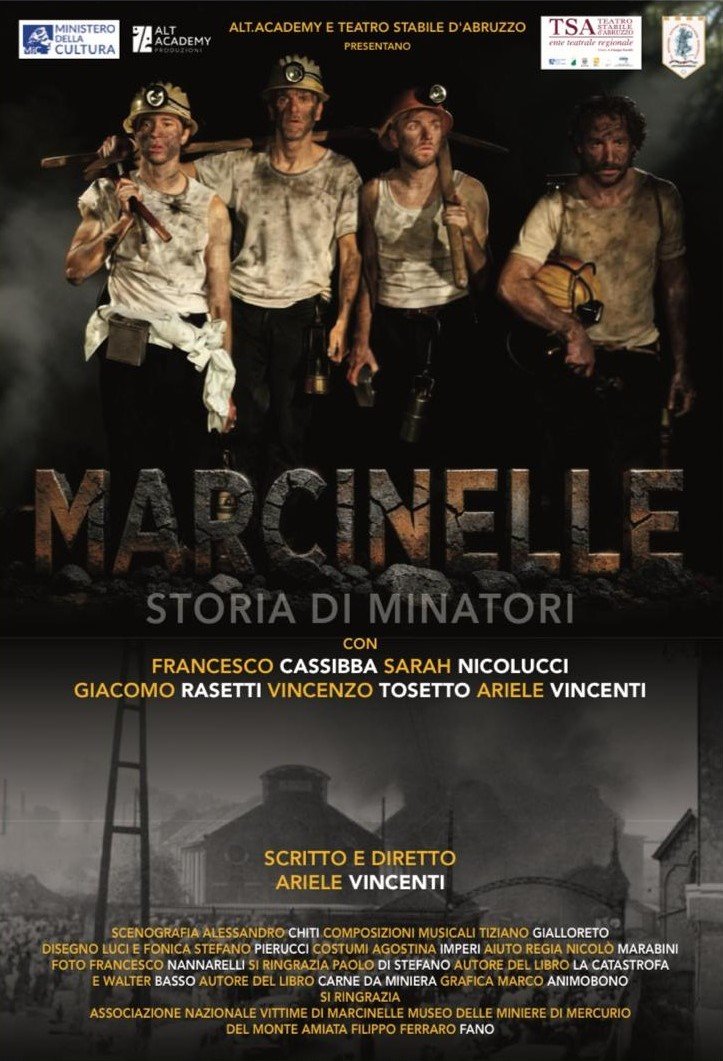
Marcinelle at Teatro Nino Manfredi: Marcinelle. Storia di minatori (A Story of Miners), written and directed by Ariele Vincenti, is on at Teatro Nino Manfredi in Ostia from April 15 to 25, 2027, at Via dei Pallottini 10, Ostia Lido. The theater's calendar lists eight dates: Thursday the 15th, Friday the 16th and Saturday the 17th at 21:00, Sunday the 18th at 17:30, Thursday the 22nd at 17:30, Friday the 23rd at 21:00, Saturday the 24th at 17:30 and Sunday the 25th at 17:30. The cast is Ariele Vincenti, Vincenzo Tosetto, Giacomo Rasetti, Francesco Cassibba and Sarah Nicolucci, and the show is produced by Teatro Stabile d'Abruzzo with Alt Academy Produzioni and included in the 2026/2027 season subscription. Prices listed by the theater are €25 full price, €23 reduced, €12 for under-25s and €17 per person for groups of at least 15. The Manfredi is reached by the Roma-Lido railway, which leaves from Porta San Paolo station next to the Piramide stop on Metro B, getting off at Lido Centro, a short distance from the theater. Tickets are sold on the official Teatro Nino Manfredi website, which links to the authorized presale network, or at the box office, by phone at 06 56324849.
Language: performed in Italian. No English version or English surtitles are announced.
The show follows four Italian miners from leaving their villages to their deaths in the Bois du Cazier mine at Marcinelle, Belgium, where on August 8, 1956 a fire killed 262 people, 136 of them Italian. Below you'll find the dates, the story scene by scene, the true history of the disaster, profiles of Ariele Vincenti and the production, the Ostia theater, how to get there and how to plan a spring day on the coast. The play is in Italian.
Marcinelle at Teatro Nino Manfredi: dates, times and prices
Marcinelle. Storia di minatori is on at Teatro Nino Manfredi from April 15 to 25, 2027, over two long weekends, and is one of the subscription titles of the Ostia theater's 2026/2027 season.
The schedule
First week: Thursday, April 15 at 21:00, Friday the 16th at 21:00, Saturday the 17th at 21:00, Sunday the 18th at 17:30. Second week: Thursday the 22nd at 17:30, Friday the 23rd at 21:00, Saturday the 24th at 17:30, Sunday the 25th at 17:30, the last performance. For Saturday the 24th the theater's calendar repeats the same 17:30 time twice: if you're interested in an evening show on that date, ask the box office to confirm before buying.
Prices
Teatro Nino Manfredi lists for Marcinelle a full price of €25, a reduced price of €23, an under-25 ticket at €12 and a rate of €17 per person for groups of at least 15.
The matinees
There are four 17:30 performances: Sunday the 18th, Thursday the 22nd, Saturday the 24th and Sunday the 25th. If you're coming from Rome by train they're the most convenient, since they let you get back to the city without a late night and spend the morning on the coast.
What Marcinelle tells: four lives from village to mine
Marcinelle. Storia di minatori precisely retraces the timeline of four Italian miners, from leaving their hometowns to their deaths in the Marcinelle mine. The official presentation describes a story that follows the characters step by step, without jumps, like a travel diary that suddenly breaks off.
Departure from village stations
It all begins on the platforms. When the miners left, the small stations of their villages filled with mothers, girlfriends, friends and relatives come to say goodbye. Some were happy for them, like friends and acquaintances, and some were in despair, like the mothers and girlfriends. The show starts from this double emotion, the hope of a job and the fear of never seeing each other again.
Five days instead of 28 hours
With cardboard suitcases the miners traveled by train to Belgium. They had been promised a 28-hour journey, and according to the production's account it took five days, in inhuman conditions in terms of logistics and hygiene. It's the first gap between what was announced and what awaited the emigrants.
Lodging in the barracks
The arrival in Marcinelle was not a good one. The lodgings, described as warm and comfortable, turned out to be uncomfortable and cold: the rooms were inside former concentration camps used by the Germans during World War II. The show conveys this collision with the emigrants' daily life.
Working 1,000 meters down
Working conditions were brutal: long, exhausting shifts, piecework pay, so that the more coal you dug the more you earned, and meager meals. Anyone who asked a superior for explanations was harshly reprimanded and threatened. In the mine, 1,000 meters down, the miners spent hours lying in small tunnels half a meter high, digging with a chisel struck by an iron hammer or with the Motor Pique, the small pneumatic hammer issued at the time.
Free time and Coppi in Liège
The show also tells of the hours outside the mine. One day the four go to Liège to see Fausto Coppi's victorious finish and discover that Italians are barred from the bars. Then the card games, the phone calls home, the small rituals of a community far from home.
The final silence
Until the moment of the disaster, when all the miners stop talking. What remains in the background is what the men called the music of the mine. It's an essential directing choice: the catastrophe isn't shown, it's heard.
The staging: sounds, noises and sets
In Marcinelle. Storia di minatori the noises of the mine become the soundtrack of the stage action: music and sound are by Tiziano Gialloreto, sets by Alex Chiti.
The music of the mine
The lack of air, the dust, the deafening noise, the carts loaded with coal, the neighing of horses, the elevators: according to the production's presentation, these sounds build the score the actors move on. Gialloreto's work is therefore part of the dramaturgy, not mere commentary.
A workspace
Alex Chiti's sets have to render two worlds: the stations and barracks above ground, the low tunnels below. The text dwells on the miners' bodies, lying for hours in passages half a meter high: it's a physical theater, where you see the strain.
Five performers
There are five actors on stage: Ariele Vincenti himself, Vincenzo Tosetto, Giacomo Rasetti, Francesco Cassibba and Sarah Nicolucci. Four are the miners at the heart of the story, and the female presence brings back on stage the world of those who stayed home, the mothers and girlfriends at the departure stations.
Study of the sources
The production presents the show as the fruit of careful study of the facts and the social context of the time, carried out by the author on written, filmed and oral sources. It's the method of narrative theater: starting from documents and testimony to build believable characters.
The true story: the Marcinelle disaster of August 8, 1956
The Marcinelle disaster happened on the morning of August 8, 1956 in the Bois du Cazier coal mine in Belgium: a fire filled the underground works with smoke and killed 262 of the 275 people present, including 136 Italian immigrants.
Men in exchange for coal
On June 23, 1946 Italy and Belgium signed a protocol providing for 50,000 Italian workers to be sent in exchange for coal. Belgium had little labor available for its Walloon mines, and Belgians were no longer willing to do such grueling, dangerous work. In 1956, out of 142,000 miners employed in the country, 63,000 were foreigners, and 44,000 of these were Italian.
The morning of the accident
According to the reconstruction in the inquiry report, around 8:10 an elevator started while, at the 975-meter level, two small carts were still sticking out of the cage. On the way up it struck a beam that severed a pressurized oil pipe, the telephone wires and two electric cables: a fire broke out in the air intake shaft, and smoke soon reached every tunnel.
Two weeks of rescue efforts
The Red Cross, firefighters, the army and ordinary citizens joined the rescue, and teams arrived from other Belgian mines, from France and from Germany. Nearby schools became canteens and dormitories, churches became chapels of rest. On August 22, after two weeks of attempts, one of the rescuers coming back up said in Italian "tutti cadaveri", all dead. 13 survived.
The trials
The first trial was held in Charleroi from May to October 1959 and ended with the acquittal of the five defendants. On appeal only the mine's engineer was convicted, to six months, suspended. The legal case ended on April 27, 1964 with a settlement between the parties.
Who Ariele Vincenti is: writer, director and performer
Ariele Vincenti was born in Rome in 1977 and is an actor, writer and stage director: since 2016 he has built a repertoire of narrative shows devoted to forgotten pages of Italian history, of which Marcinelle is the latest chapter.
Training
A DAMS graduate, he trained at the Teatro Azione acting school and then attended workshops in commedia dell'arte, biomechanics, musical theater and narrative theater. Since 2002 he has acted in films and TV dramas, but his stated passion remains the theater.
His acting career
He has acted in about 70 shows, many with national tours, and was assistant director and actor coach on the musicals Faust and Evita. He has worked with Simone Cristicchi, Paolo Sorrentino, Flavio Insinna, Enzo Iacchetti, Vittorio Matteucci, Ugo Pagliai, Nicola Pistoia and Paolo Triestino, among others.
Marocchinate
In 2016 he debuted with his first monologue, Marocchinate, written with Simone Cristicchi, which became a book of the same name published by La Nave di Teseo. The show tells of the violence suffered by thousands of women in the Ciociaria area during the war: a repressed memory Vincenti brings back to the stage with the tools of storytelling.
From the outskirts to prison
In 2017, as director and co-writer, he staged a show about life on the city outskirts in the 1980s. In 2018 he led a workshop in Pescara prison and, as actor and director, made a musical show with 12 inmates, produced by Teatro Stabile d'Abruzzo with music by Emilio Stella.
Di Bartolomei, Trilussa and the Messiah of Abruzzo
In 2019 he wrote, directed and starred in a show devoted to Agostino Di Bartolomei, the historic AS Roma captain. In 2020 he directed a show set in a slot-machine hall about gambling addiction and debuted a monologue on the Roman poet Trilussa. In 2021 he wrote and directed a musical show on the life of Oreste De Amicis, who in the mid-19th century proclaimed himself the Messiah of Abruzzo.
Teatro Stabile d'Abruzzo and Alt Academy: the production
Marcinelle. Storia di minatori is produced by Teatro Stabile d'Abruzzo in co-production with Alt Academy Produzioni, and it was created for the 70th anniversary of the disaster, marked in 2026.
The bond with Abruzzo
The partnership between Vincenti and the Abruzzo company goes back a long way: his prison musical show was already a Teatro Stabile d'Abruzzo production.
A curious fact about Marcinelle at Teatro Nino Manfredi, April 15 to 25, 2027
The most surprising curious fact comes from the Liège scene. In the show the four miners go to see Fausto Coppi's victorious finish and discover that Italians are barred from the bars: the country's most beloved champion races and wins, and his fellow countrymen can't even have a coffee to celebrate. Cycling, in fact, stayed tied to Marcinelle afterward too: in 2006 the Giro d'Italia, in its 89th edition, started from Belgium precisely as a tribute to the thousands of Italian emigrants in those regions. A second curious fact concerns the show's sound language. What the audience hears as stage music is actually a landscape of noises: carts, elevators, horses neighing. The horses are part of the true story too: the inquiry report records that the horses at the 1,035-meter level managed to break the ropes they were tied with and took refuge in a dead end, and that the first body the rescuers found was a horse's. A third curious fact concerns the names. The list of victims published by the Belgian daily Le Soir on August 10, 1956 counts 11 nationalities: Italians, Belgians, Poles, Greeks, Germans, Hungarians, Algerians, French, Soviets, a Briton and a Dutchman. A fourth concerns dates: in 2024 and 2025 some victims who had remained nameless were identified through DNA, almost 70 years later.
Teatro Nino Manfredi in Ostia
Teatro Nino Manfredi is a 288-seat drama theater at Via dei Pallottini 10, Ostia Lido, born from a former cinema-theater taken over in December 2004 by Felice Della Corte and four partners and opened on September 30, 2005.
The name
The hall is named after Nino Manfredi, who died in June 2004, a few months before the project began. Erminia Ferrari, the actor's widow, attended the opening night, and the program takes its cue from his lesson: that of a dramatic actor who performed with irony.
Artistic direction
The theater is run by Felice Della Corte, a Neapolitan trained in Eduardo's theater, who in 2015 also opened Teatro Marconi and in 2019 became president of the Unione dei Teatri di Roma, which he co-founded.
The program
The Manfredi offers a subscription drama season, shows for children and teens, school matinees and a drama school, and has its own app for Android and iOS.
An intimate hall
With 288 seats it's a mid-sized theater, well suited to narrative theater like Marcinelle, where voices, silences and noises matter: even from the back rows you catch the details of the sound.
Something nobody tells you about Marcinelle at Teatro Nino Manfredi, April 15 to 25, 2027
What's rarely said about Marcinelle is that the disaster didn't come out of the blue. Belgian mines were outdated and worn machinery was a known problem: between 1947 and 1956 they had already caused the deaths of 1,164 miners, 435 of them Italian, and in the first seven months of 1956 alone, 21 Italians had died on the job. The shaft where the disaster struck had been in use since 1830. By showing the shifts, the piecework pay and the threats to those who protested, the show reveals exactly this ground: the catastrophe arrives at the end of a long chain of conditions accepted out of necessity. A second thing concerns the legends that arose afterward. It was said the accident was caused by a firedamp explosion or by a language misunderstanding between an Italian miner and a Belgian worker, but the official reconstruction refutes both versions, because there was no firedamp in the air intake shaft and communications between the two were bell signals according to a set code. If you go to the theater with these stories in mind, you'll find a simpler and harsher truth. The third thing is practical: the second week of performances ends on Sunday, April 25 with the 17:30 matinee, and on holidays check the Roma-Lido railway schedule, which may differ from weekdays.
Tickets for Marcinelle. Storia di minatori
Tickets for Marcinelle. Storia di minatori are sold on the official Teatro Nino Manfredi website, which links to the authorized presale network, or at the box office.
Contacts
The box office answers at 06 56324849 and info@teatroninomanfredi.it, and the theater also lists 388 0736402 for information.
Rates
Full price €25, reduced €23, under-25s €12, groups of at least 15 people €17 each. The under-25 rate makes the show affordable for university and high school students, for whom the history of Italian emigration is often a subject of study.
Subscription
The theater lists Marcinelle as a subscription show: those who follow the Manfredi season already have their seats, and on the most popular nights single tickets may sell out sooner.
My tip for Marcinelle at Teatro Nino Manfredi, April 15 to 25, 2027
My tip is to arrive at the theater knowing little about the plot and something about the history. The show has no plot twists: everyone knows the ending, and that's exactly what gives weight to every earlier scene. So read up on two or three essential facts beforehand, the 1946 protocol, the date of August 8, 1956, the number of victims, and let the story of the four miners do the rest. As for which performance, in our opinion the Thursday, April 22 matinee at 17:30 is the most interesting: a weekday afternoon, an audience of subscribers and enthusiasts, an intimate hall, and back in Rome before dinner. If you prefer the evening, choose one of the four 21:00 performances, April 15 to 17 or Friday the 23rd, making sure to check the time of the last train. If you have teenagers, or teach, the show is a lived history lesson: the production has already presented it to students on the regional circuit. As for seats, in a 288-seat hall the view is good almost everywhere, and for a show built on sound the center rows give the best listening. Finally, if you're under 25 you pay €12: one of the best-value tickets of the Roman theater season.
How to get to Teatro Nino Manfredi
Teatro Nino Manfredi, at Via dei Pallottini 10 in Ostia Lido, is reached by the Roma-Lido railway to Lido Centro station, a short distance from the theater.
By the Roma-Lido railway
The railway leaves from Porta San Paolo station, next to the Piramide stop on Metro B, in the shadow of the Pyramid of Cestius and Porta San Paolo. From Termini take Metro B to Piramide, change and get off at Lido Centro. For the 21:00 performances, check the time of the last train back in advance.
By car
From Rome you arrive via Via del Mare or Via Cristoforo Colombo. In April, before beach season, parking on the streets of Ostia Lido is generally easier than in the summer months.
By bus
Ostia is served by city lines linking the Roma-Lido stations with the coastal neighborhoods. Up-to-date routes and times are on the ATAC journey planner.
Another well-known fact, yet one rarely mentioned
Many people know that many Italians died at Marcinelle. Less often mentioned is that Italy devotes an official observance to that date: August 8 is the National Day of the Sacrifice of Italian Labor in the World, dedicated to the memory of the Bois du Cazier victims and, through them, of all Italian workers who died abroad. A second fact, known to historians and little remembered by the public, concerns Marcinelle's place in the history of emigration: it's the third-worst disaster by number of Italian victims abroad, after Monongah and Dawson. The Bois du Cazier site, now closed, is a UNESCO World Heritage Site together with the main mining sites of Wallonia. A third fact concerns cultural memory. The disaster entered dialect poetry, with Sicilian Ignazio Buttitta's Lu trenu di lu suli in 1963 and Giuseppe Tontodonati's Abruzzese sonnets, music, with the New Trolls' Una miniera in 1969, and television, with the 2003 Rai miniseries Marcinelle, directed by Antonio and Andrea Frazzi. Vincenti's show joins this line with the tools of narrative theater. A fourth fact concerns Nino Manfredi, after whom the Ostia hall is named: before film, he graduated from the Accademia d'arte drammatica in 1947 and worked with Eduardo at the Eliseo in the 1952 and 1953 season.
Ostia Lido around the theater
Teatro Nino Manfredi is in Ostia Lido, in Municipio X, Rome's seaside district. In April the coast wakes up: the days get longer and the seafront becomes the locals' promenade again.
Ostia Antica
One train stop away are the excavations of Ostia Antica, ancient Rome's port city, and the village of Ostia Antica with the castle of Julius II.
The pine forest and the coast
To the south opens the Castel Fusano pine forest, one of Rome's great green spaces, and then the beaches of the Roman coast.
The seafront in spring
In April the beach clubs get ready for the season and the seaside promenade is pleasant on sunny days: before a 17:30 matinee it's the easiest way to reach the theater without rushing.
How to plan a day in Ostia with Marcinelle
With the 17:30 matinees, Marcinelle. Storia di minatori lends itself to closing a day on the coast organized entirely around the Roma-Lido railway, no car needed.
Morning at the excavations
From Porta San Paolo get off at Ostia Antica station for the excavations: ancient Rome's port city, with its theater, shops and warehouses, easily fills a whole morning.
Afternoon at the Lido
On the same line continue to Lido Centro for lunch and a walk on the seafront. At 17:30 you go into the Manfredi, and on the way out the train takes you back to Piramide in time for dinner.
If you choose the evening
For the 21:00 performances the order flips: the sea in the afternoon, an early dinner in Ostia, curtain, and the trip home after checking the time of the last train.
The right photo to take at Marcinelle at Teatro Nino Manfredi, April 15 to 25, 2027
No photos during the show: in a story built on sound and on the final silence, a lit phone breaks the tension for the whole hall and disturbs the actors. The first right photo is taken at the theater entrance on Via dei Pallottini, with the Marcinelle poster and Nino Manfredi's name on the facade. The second is taken on the Ostia seafront before a matinee, in the April light: an open horizon, the opposite of the half-meter-high tunnels where the Bois du Cazier miners worked. The contrast says a lot about what the show tells. The third is for those arriving by train: a photo at Porta San Paolo station, with the Pyramid of Cestius in the background, at the start of the train trip to the sea. Thinking that the show's characters traveled five days with cardboard suitcases gives that trip another measure. If you like details, photograph the official poster displayed in the lobby. No flash and no video during the applause, unless the theater says otherwise.
Where to eat in Ostia before or after Marcinelle
Around Teatro Nino Manfredi and toward the seafront there are seafood restaurants, pizzerias and bars, open outside the summer season too.
Before the matinee
A seafood lunch near the sea and then the theater at 17:30: the most typical combination on the coast.
After the evening performance
After the 21:00 performances, head for pizzerias and spots in central Ostia, keeping an eye on the train schedule if you're going back to Rome.
Some important events that happened here in history
The history of Teatro Nino Manfredi begins in December 2004, when Felice Della Corte and four partners, Luciano, Enzo, Paolo and Salvatore, took over a run-down former cinema-theater in Ostia Lido and decided to turn it into a 288-seat drama theater. On June 4 of that year Nino Manfredi had died, born in Castro dei Volsci in 1921 and raised in Rome's San Giovanni district: the new theater took his name. On September 30, 2005 the hall opened with Josiane Balasko's Un grande grido d'amore, performed by Pamela Villoresi and Pietro Longhi, under the moved gaze of Erminia Ferrari, the actor's widow. In the years that followed the theater became a fixture on the coast, with subscription seasons, shows for young people, school matinees and a drama school. In October 2015 the same venture gave birth to Teatro Marconi, in Rome, and in 2019 Della Corte was elected president of the Unione dei Teatri di Roma, the association of private theaters he helped found. The 2024 and 2025 season opened with Pirandello's Six Characters in Search of an Author, directed by Claudio Boccaccini. In the 2026/2027 season, the one just after the disaster's 70th anniversary, the Manfredi hosts Marcinelle. Storia di minatori: the Ostia theater, born to keep the name of a great Italian actor alive, welcomes the memory of 136 Italian workers who died 1,000 meters underground.
Accessibility, young people and practical information
For access for people with disabilities, contact the Teatro Nino Manfredi box office before buying, at 06 56324849 or 388 0736402.
With young people
Marcinelle suits adults and high school students, also thanks to the under-25 ticket. The theme is death at work and the ending is dramatic: it isn't meant for small children. The Manfredi has dedicated school contacts, listed on the theater's website.
Arriving on time
Ostia Lido is flat and the walk from Lido Centro station to the theater is short. If you're coming by car you can be dropped off at the entrance at Via dei Pallottini 10.
Who has passed through Marcinelle at Teatro Nino Manfredi, April 15 to 25, 2027
From the very first night, Teatro Nino Manfredi's stage has hosted performers such as Pamela Villoresi and Pietro Longhi, the stars of the September 30, 2005 opening, and since then the hall has welcomed a long line of actors, directors and companies. Among recent guests the local press has noted Nathalie Caldonazzo, starring with Felice Della Corte in a comedy directed by Claudio Boccaccini, and productions by Della Corte himself such as La cena di Vermeer. In October 2026 the Compagnia Mauri Sturno came to the Manfredi with Amore non eri prevista. And there's someone who passed through without ever setting foot on that stage: Nino Manfredi, star of Garinei and Giovannini's Rugantino in 1962 alongside Aldo Fabrizi and Bice Valori, present in Ostia in name and in the spirit of the program. With Marcinelle now come Ariele Vincenti, a Roman actor who has worked with Simone Cristicchi, Paolo Sorrentino and Ugo Pagliai, and with him Vincenzo Tosetto, Giacomo Rasetti, Francesco Cassibba and Sarah Nicolucci, along with Tiziano Gialloreto's sound work and Alex Chiti's sets. In spirit, the names of the Bois du Cazier pass through too: Antonio Iannetta, the miner who came up first and raised the alarm, Angelo Galvan, the rescuer his companions called the fox of the Cazier, and the 136 Italians who never came back.
Frequently asked questions about Marcinelle at Teatro Nino Manfredi
When is Marcinelle on at Teatro Nino Manfredi?
Marcinelle. Storia di minatori is on at Teatro Nino Manfredi in Ostia from April 15 to 25, 2027: Thursday the 15th, Friday the 16th and Saturday the 17th at 21:00, Sunday the 18th at 17:30, Thursday the 22nd at 17:30, Friday the 23rd at 21:00, Saturday the 24th and Sunday the 25th at 17:30.
How much are tickets for Marcinelle in Ostia?
For Marcinelle. Storia di minatori, Teatro Nino Manfredi lists a full price of €25, a reduced price of €23, an under-25 ticket at €12 and €17 per person for groups of at least 15.
Who is in Marcinelle. Storia di minatori?
The cast of Marcinelle. Storia di minatori is Ariele Vincenti, the show's writer and director, Vincenzo Tosetto, Giacomo Rasetti, Francesco Cassibba and Sarah Nicolucci. Music and sound are by Tiziano Gialloreto, sets by Alex Chiti, and it's produced by Teatro Stabile d'Abruzzo with Alt Academy Produzioni.
What is the show about Marcinelle about?
Marcinelle. Storia di minatori follows four Italian miners from leaving their villages to the train journey, from the barracks to work 1,000 meters underground, up to their deaths in the Bois du Cazier fire of August 8, 1956.
What happened at Marcinelle in 1956?
At Marcinelle, Belgium, on August 8, 1956 a fire in the Bois du Cazier coal mine filled the tunnels with smoke and killed 262 of the 275 people present. Among the victims were 136 Italians, who had emigrated under the 1946 protocol between Italy and Belgium.
How do you get to Teatro Nino Manfredi?
Teatro Nino Manfredi, at Via dei Pallottini 10 in Ostia Lido, is reached by the Roma-Lido railway from Porta San Paolo, next to the Piramide stop on Metro B, to Lido Centro station. By car you arrive via Via del Mare or Via Cristoforo Colombo.
Is the Marcinelle show suitable for young people?
Marcinelle. Storia di minatori suits high school students and adults: it tells a chapter of the history of Italian emigration with a dramatic ending. The under-25 ticket costs €12 at Teatro Nino Manfredi.
Final tip on Marcinelle at Teatro Nino Manfredi
Marcinelle. Storia di minatori is civic theater in the most concrete sense: it tells about people, not numbers, and does so with the sounds of work rather than the words of rhetoric. In our opinion it's one of the most worthwhile shows of the Manfredi season, especially if your family has its own story of emigration. The practical tip is to choose a matinee, pair the show with a morning at Ostia Antica and lunch by the sea, and take advantage of the €12 ticket if you're under 25.
Article written by the editorial team of Tour Leader Pro, contact them for Private/Corporate/V.I.P. Tours and Experiences.
Planning a trip to Rome? The English-language guides for visiting the city are on ItalyPlanner.com.
Contact Information
Nearby
Upcoming events nearby
 Uno scherzo del genere with Emanuela Grimalda and Gianluca Ramazzotti at Teatro Nino Manfredi, March 11 to 21, 2027100 m
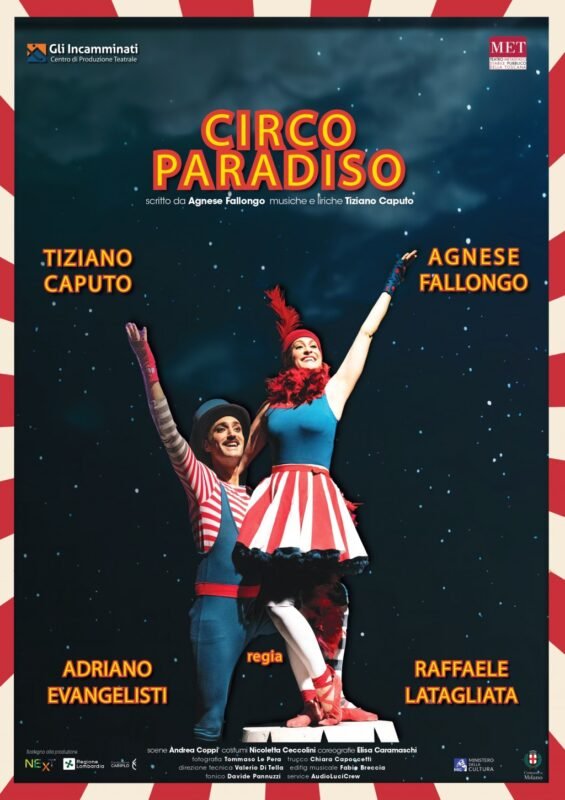
- Circo Paradiso by Agnese Fallongo at Teatro Nino Manfredi, April 1 to 11, 2027100 m
- Ferdinando by Annibale Ruccello at Teatro Nino Manfredi, January 14-24, 2027100 m
- Scappati di casa, il ritorno dei casalinghi disperati at Teatro Nino Manfredi, from February 25 to March 7, 2027100 m



You might also like
- Martina Catuzzi, UOMA at Hacienda Roma, April 19, 2027
- Teatro Marconi 2026-2027 Season, September 28 to December 31, 2026
- I cattivi pensieri at Teatro Elsa Morante, performances from October 24 to November 6, 2026
- Conigli by Salvo Di Paola at Hacienda Roma, November 30, 2026
- Re Lear e il suo buffone, a tragicomic score for two artists
- Il medico dei pazzi by Eduardo Scarpetta with Gianfelice Imparato at Teatro Tor Bella Monaca