I Convitati 2026: Arte per i Diritti Umani at the Waldensian Temple in Piazza Cavour, October 19 to 24, 2026
In short. I Convitati 2026, Arte per i Diritti Umani, is open from Monday, October 19 to Saturday, October 24, 2026 in the Conference Hall of the Waldensian Evangelical Church at Piazza Cavour 32, in the Prati district, from 10:30 to 12:30 and from 16:30 to 19:00.
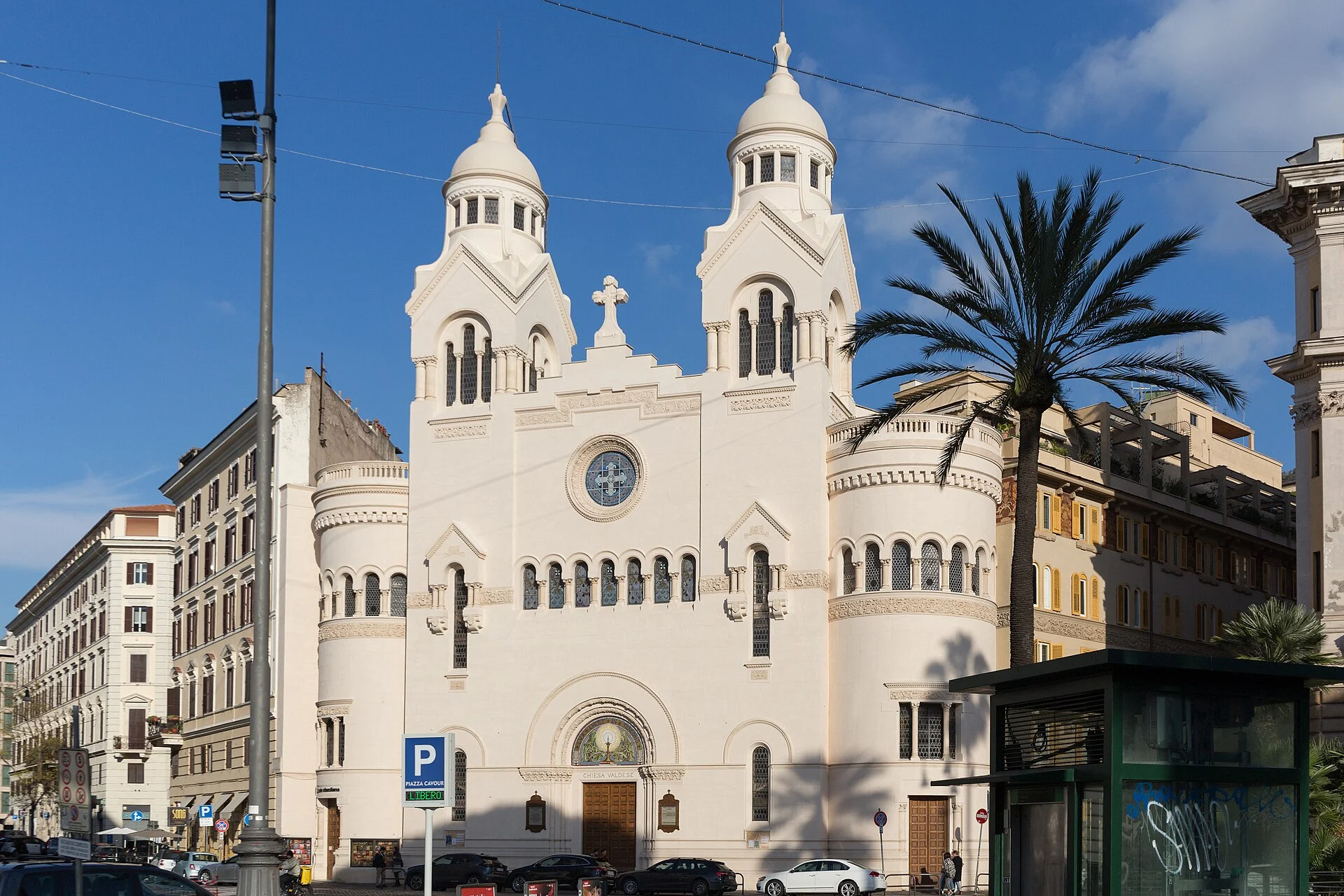
I Convitati 2026, Arte per i Diritti Umani, is open from Monday, October 19 to Saturday, October 24, 2026 in the Conference Hall of the Waldensian Evangelical Church at Piazza Cavour 32, in the Prati district, from 10:30 to 12:30 and from 16:30 to 19:00. On Friday, October 23 at 17:00 the conference Quali Diritti Umani nel 2026? is scheduled. The temple is reached by Metro Line A, Lepanto stop, crossing Prati on foot in about 10 minutes, or by the bus lines that stop in Piazza Cavour and on Via Crescenzio. The terms of entry are not listed as a paid ticket. For information the Associazione I Convitati answers at iconvitati@gmail.com and at 351 6817824, published on the official website artedirittiumani.com.
A graphic arts exhibition inside an early 20th-century Protestant church, devoted to men and women locked up in prison for their ideas. The I Convitati project has reached its third edition and returns to the place where it was born, the Conference Hall of the Waldensian temple in Piazza Cavour, after a year spent between university residences and the artists' church of Piazza del Popolo. It is a small, civic exhibition, with no pretense of spectacle, and precisely for that reason it deserves an hour of your time.
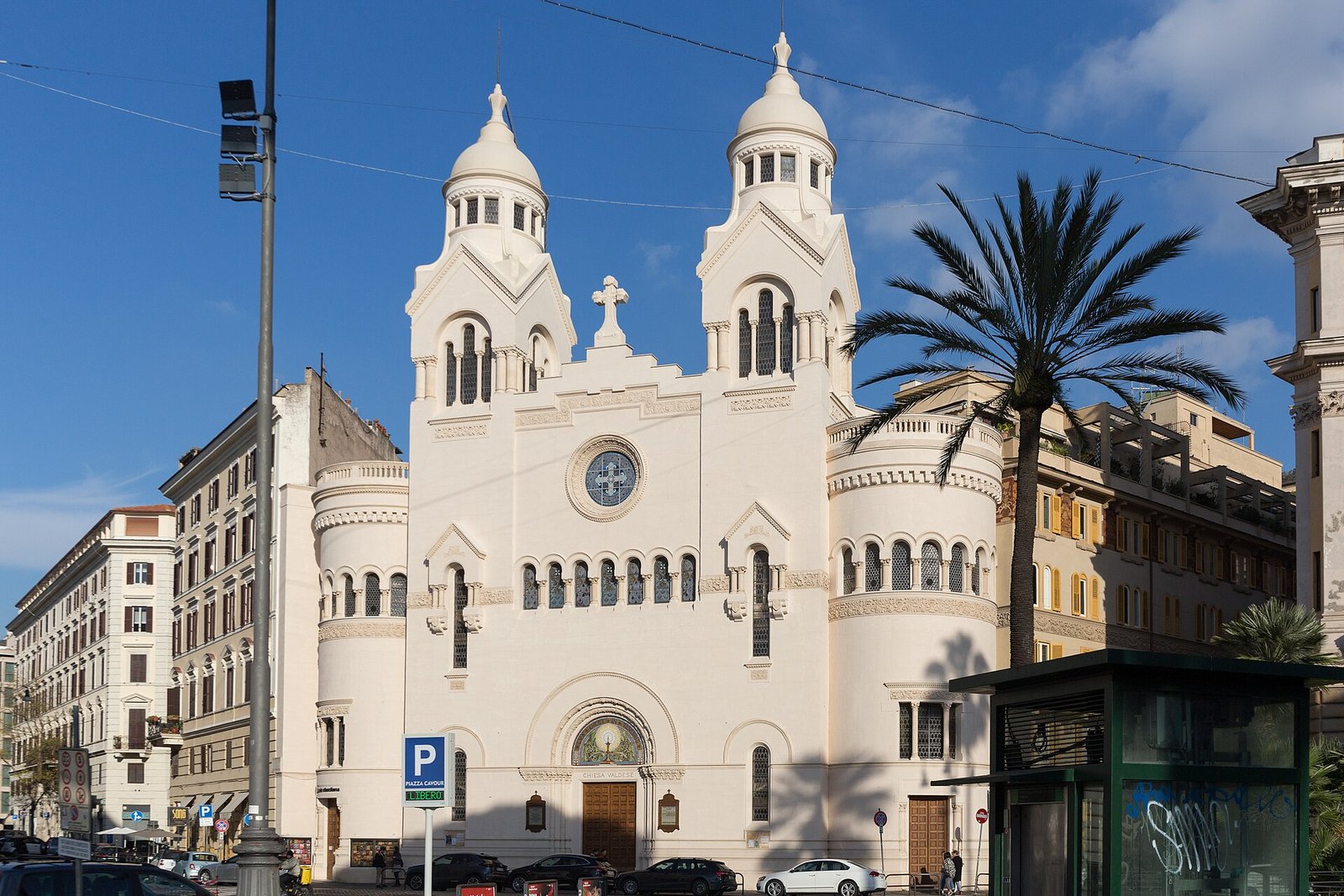
I Convitati 2026 at the Waldensian Temple: the exhibition in brief
I Convitati 2026, Arte per i Diritti Umani, is the third edition of a graphic arts exhibition that, according to the presentation published on the tourism portal of Roma Capitale, turns art into a gesture of memory and civic responsibility. It is promoted by the Associazione I Convitati, a social promotion association that describes itself as the founding group of a project open to other artists and other cultural organizations.
What you see
The 2026 edition's rules, published by the association, set two themes. The first is portraits: people whose human rights have been violated, prisoners of conscience and of opinion, journalists, activists. The second is populations: persecution, exploitation, wars, migrations. The works are drawings, engravings, paintings and graphic works made by artists who responded to the call, and which in the Conference Hall are accompanied by biographical sheets and documentary materials.
The Quaderno Reportage
The heart of the project is the Quaderno Reportage, which the association defines as a documented collection of portraits and biographical notes of political prisoners and prisoners of conscience, ordered by country. For 2026 the organizers announce the complete display of the exhibition with an immersive route and the materials of the Quaderno della Memoria. Each sheet, they explain, goes into the geopolitical context, the trial history and the human impact of detention. It is an archive updated year after year, and it can also be consulted on the website.
The October 23 conference
On Friday, October 23 at 17:00 the exhibition hosts the conference Quali Diritti Umani nel 2026?. The speakers are not named in the public pages available. It's best to ask the association for the program. For anyone who wants to visit the exhibition and hear the conference on the same day, Friday afternoon is the natural choice: the hall opens at 16:30.
Hours and admission to I Convitati 2026
I Convitati 2026 can be visited from Monday, October 19 to Saturday, October 24, in two slots: the morning from 10:30 to 12:30 and the afternoon from 16:30 to 19:00. That is six days in all, Sunday excluded: on Sunday morning the temple hosts the 11:00 service, and the Waldensian community lives its week there.
How much it costs
No price is published on the tourism portal or on the association's website, which presents the project as a cultural awareness initiative. Anyone who wants confirmation can write to the association or phone the number given. There is no presale circuit: you enter the hall during opening hours.
How much time you need
A conference hall is not a museum: to look at the works and read the sheets you need between 40 minutes and an hour. Anyone who really wants to read the stories of the Quaderno, and they are stories that ask for attention, can count on something more. Then there is the temple, which is worth the visit on its own, if the community keeps it open.
Who I Convitati are: the project and the editions
I Convitati, Arte per i Diritti Umani, presents itself as an artistic and social project born to give voice and face to those who have been deprived of freedom for crimes of opinion. The association uses visual language and reportage to bring the public's attention to freedom of expression, and offers its experience free of charge to anyone, in Italy and abroad, who wants to start independent initiatives inspired by the same principles.
December 2024, the first exhibition
The first exhibition of the cycle was held from December 8 to 12, 2024, in the same Conference Hall of the Waldensian Church in Piazza Cavour. On that occasion the Quaderno was presented, conceived from the start as a catalog to be updated every year.
2025, a year around Rome
In 2025 the project left its home venue several times. On February 16 part of the exhibition was shown in the church in Piazza Cavour for the commemoration of February 17, 1848, the date civil and political rights were granted to the Waldensians. On March 28 and May 28 other partial displays were held at the Residenza Universitaria Celimontano, in conferences promoted by Aster Cultura and the Associazione Pedagogica Italiana. From November 6 to 16 the exhibition was set up in the Basilica di Santa Maria in Montesanto, the artists' church of Piazza del Popolo, with photographic and graphic works and civic narrative.
The preview and the return
On December 5 and 6, 2025 the association previewed the contents of the new edition, again in the church in Piazza Cavour. The 2026 return closes the circle: the complete exhibition comes back to the hall that saw it born. It is a habit that says a lot about the relationship between the project and the Roman Waldensian community, which in its public statements calls on churches to watch over the defense of human rights.
An open project
The 2026 rules are published on the website, in Italian and English, and anyone can read them. The idea is that the exhibition grows with the artists who join, and that the Quaderno is enriched by the reports that come in. It is a different model from that of the big curated exhibitions: here the visitor sees a collective work in progress, with its unevenness and its urgency.
Why see I Convitati
The I Convitati exhibition asks the visitor for something simple and uncomfortable: to look in the face people they don't know and read why they are in prison. The portrait is the oldest form of civic painting, and here it returns to its primary use, giving a face to those who have no public one. It is recommended for anyone bringing high schoolers: an hour here is worth a civics lesson.
Art as testimony
The organizers write that art becomes a tool of active testimony, denunciation and civic reflection. Not all the works will be at the same level, and that is normal in an open group show. The value lies elsewhere: in the choice to display, beside every image, a true story, and to ask the viewer to remember a name.
An exhibition outside the circuits
In Rome in October dozens of exhibitions open in the big museums, with tickets, audio guides and lines. I Convitati is at the opposite end: a room in a neighborhood church, parish hours, no presale. Anyone looking for the real city, that of associations and communities, finds it here.
The Waldensian Temple in Piazza Cavour
The Waldensian Temple in Piazza Cavour was inaugurated with a solemn ceremony on February 8, 1914. The tourism portal of Roma Capitale describes it as built in national-Protestant style, so that it would be recognized at once as a church, but not a Catholic one. It is the second Waldensian church in Rome after the one on Via Quattro Novembre, completed in 1884.
The architects and the reinforced concrete
The design was by the architects Rutelli, Pazzi and Bonci. The technical detail few people know is that the temple was the first place of worship in Rome built with load-bearing structures in reinforced concrete, a technology then at the cutting edge. In a city where churches are measured in centuries and travertine, a 1914 church in reinforced concrete is already a declaration of modernity.
The facade
The facade has two cylindrical side bodies that enclose the front elevation and two bell towers that have no bells. At the center, the mosaic of the entrance lunette and the roundel on the facade were designed by Paolo Antonio Paschetto. Anyone arriving from Via Crescenzio sees the temple at an angle, and the silhouette with the two towers distinguishes it from all the Umbertine buildings of the square.
Paschetto's Liberty interior
The interior decoration is by Paolo Antonio Paschetto, a painter and decorator born in Torre Pellice in 1885 and the son of a Waldensian pastor. Paschetto began the work in 1912 and devoted more than two years to it, asking, according to his biography, only for reimbursement of out-of-pocket expenses, about 20,000 lire. He designed the wall decoration, inspired by Romanesque art, the furnishings and the cartoons for the stained glass.
Picchiarini's stained glass
The stained glass was made by the master glassmaker Cesare Picchiarini with the lead-came technique. Along the side aisles run eight two-light windows with pairs of biblical symbols: the peacock and the eagle, the candlestick and the vine, the lighthouse and the Good Shepherd, the anchor and the lamb, the palm and the lamp, the lily and the dove, the monogram of Christ and the burning bush, the Eucharistic table and the ark. In the women's gallery 10 three-light windows have floral motifs. On the facade seven single-light windows and in the central nave 12 three-light windows have geometric motifs.
How to get to the Waldensian Temple in Piazza Cavour
The Waldensian Temple is at Piazza Cavour 32, in the Prati district, on the side of the square opposite the Palazzo di Giustizia. It is one of the best-connected areas of the right bank of the Tiber, a few minutes from Castel Sant'Angelo.
By metro
The most convenient stop is Lepanto, on Line A. From there you head down toward the river crossing Prati, between Via Cola di Rienzo and Via Crescenzio, and in about 10 minutes you reach Piazza Cavour. Anyone coming from Termini has a direct ride, with no changes.
By bus
Piazza Cavour and Via Crescenzio have stops served by several lines connecting Prati with the historic center, the Vatican and Piazza del Popolo. Detours are frequent: it's best to check route and schedule on the transport company's app before leaving.
By car
Under Piazza Cavour there is a paid public parking garage, the closest possible to the temple. Prati is busy during the day, and street parking on weekdays is difficult because of the offices and the courthouse. In the morning, between 10:30 and 12:30, the advice is to leave the car at home.
On foot from the center
From Piazza Navona or the Pantheon you arrive by crossing Ponte Umberto I or Ponte Cavour: a 20-minute walk, with the Palazzo di Giustizia ahead of you. It is the most beautiful way to arrive, and it combines the exhibition with a visit to the right bank.
How to organize the visit to I Convitati
The visit to I Convitati is well organized in half a day, if you combine it with Prati and Castel Sant'Angelo. The split hours, morning and afternoon, force you to choose one of the two slots.
The morning
Arrive at 10:30, at opening, when the hall is quiet. After the exhibition you can go down to the Lungotevere and reach Castel Sant'Angelo in 10 minutes, or walk toward Via Cola di Rienzo for lunch in the area.
The afternoon
The slot from 16:30 to 19:00 coincides with the best October light on Piazza Cavour. After closing the neighborhood offers many possibilities for an aperitivo or dinner. Friday is the day of the conference, and will be the busiest.
With a school or a group
Anyone bringing a class or an organized group does well to notify the association in advance, through the published contacts, to avoid crowding a hall that isn't large. It is also a chance to ask if someone from the association can accompany the group among the works.
Accessibility and children
The Conference Hall is part of the Waldensian church complex. For information on steps, elevators and accesses it's best to contact the association or the church before the visit. The church publishes a phone number and an email address on the tourism portal of Roma Capitale.
With children
The exhibition's themes are hard: prison, persecution, wars, migrations. For small children it is a poorly suited visit, while for a middle or high school student it can be the starting point for an important conversation. The advice is to choose beforehand, together, two or three stories to read calmly.
Respect for the place
The exhibition is in the spaces of a living religious community, which holds services on Sunday and during the week hosts meetings, choir rehearsals and activities. Low voice, silent phone, attention to the temple's spaces: these are rules of common sense that apply everywhere, and here a little more.
Where to eat near Piazza Cavour
Around Piazza Cavour, Via Cola di Rienzo and Via Crescenzio, Prati offers pizza-by-the-slice places for a quick lunch, neighborhood trattorias, wine bars with kitchens and bars for an aperitivo. It is a neighborhood of offices and residents, and the offering is designed for those who live and work there, with more reasonable prices than in Borgo.
Lunch after the morning
Anyone leaving at 12:30 finds the Prati places full of courthouse and office workers: it's best to move a few streets toward Via Cola di Rienzo or to book. A bakery or a pizza-by-the-slice place is the quickest solution.
Aperitivo and dinner
After 19:00 the neighborhood changes: the wine bars and bars of the Lungotevere and the side streets fill up. For a more traditional Roman dinner you can venture toward Borgo, 10 minutes on foot, knowing that the offering there is more touristy.
What to see around the Waldensian Temple
Piazza Cavour is at the center of Prati, the neighborhood born after 1870 between the Vatican and the Tiber, and a stone's throw from the Palace of Justice, the Palazzaccio as Romans call it. A guide for getting oriented in the neighborhood is Prati and Borgo, what to see.
Castel Sant'Angelo and the Tiber
Castel Sant'Angelo is a 10-minute walk away. Across the river, crossing Ponte Cavour, you reach in a few minutes the Ara Pacis and the Mausoleum of Augustus, two stops that speak of imperial Rome and its public memory.
Toward the Vatican
Anyone with half a free day can continue toward the St. Peter’s Basilica. The contrast is instructive: in a few minutes you pass from the temple of a Protestant minority, which in Rome was able to build its churches only after 1870, to the center of the Catholic world.
A curiosity about I Convitati 2026: Arte per i Diritti Umani at the Waldensian Temple in Piazza Cavour, October 19 to 24, 2026
The man who decorated the interior of the temple hosting I Convitati is the same one who designed the emblem of the Italian Republic. Paolo Antonio Paschetto won the competition for the emblem, approved by the Constituent Assembly with the vote of January 31, 1948. The design was later modified for non-artistic reasons, and the sketches are kept at the Archivio Centrale dello Stato, in Rome.
Paschetto was a versatile artist. In 1907, with Umberto Vico, he won the competition for the 5-lire banknote. In 1924 he designed the friezes of the Salone degli Stemmi and the hall of the Garibaldian relics on the Campidoglio. In philately he designed stamps issued in 1929 and the Libertà e rinascita series. From 1914 to 1949 he held the chair of Ornato at the Istituto di Belle Arti in Rome, and some of his stained glass is at the Casina delle Civette in Villa Torlonia.
For an exhibition on human rights it is a coincidence that makes you think: the walls that welcome the portraits of prisoners of conscience were designed by the artist who gave the symbol to the Republic born of the Constitution. Before leaving, look for the biblical symbols in the stained glass: it is the same graphic language, clean and without rhetoric, that you find in the star and the cogwheel of the emblem.
Something nobody tells you about I Convitati 2026: Arte per i Diritti Umani at the Waldensian Temple in Piazza Cavour, October 19 to 24, 2026
The two bell towers of the temple in Piazza Cavour have no bells. It is an architectural detail, but it tells the story of a community that in 1914 wanted to be recognizable as a church without imitating the Catholic churches that surrounded it. The national-Protestant style is born precisely from this need: to be seen, and to be seen as different.
The second thing concerns the building site. Paschetto asked for the decoration only his out-of-pocket expenses, about 20,000 lire, and worked on it for more than two years. The temple in Piazza Cavour is therefore also the fruit of donated work, and the I Convitati exhibition, built by artists who respond to a call and by an association that offers its experience free of charge, fits into that same logic.
The third is practical. The exhibition is not in the temple's main hall but in the Conference Hall: if you find the church closed, don't think you have the wrong day. Look for the hall's entrance, and if in doubt, ask. The community is used to welcoming people, and says so openly on its website.
My advice for visiting I Convitati 2026: Arte per i Diritti Umani at the Waldensian Temple in Piazza Cavour, October 19 to 24, 2026
Before going, open the association's website and read two or three stories from the Quaderno Reportage. You will arrive in the hall already knowing a few names, and you will recognize the faces with a different emotion. It is the same method that works in front of monuments: the visit works if you arrive with a question.
In the hall, don't try to see everything. Choose three portraits, the ones that strike you most, and read their sheets in full: the country, the charge, the sentence, the current situation. Then look at the work again, and you'll notice details that had escaped you before.
If you can, come on Friday, October 23: visit the exhibition at 16:30 and stay for the 17:00 conference, Quali Diritti Umani nel 2026?. On the way out, if the community keeps the temple open, go in for a few minutes. Paschetto's stained glass, in the light of late afternoon, is the best way to close a visit that asks for attention and leaves you with thoughts.
Another well-known fact, yet rarely mentioned
It is well known that the Waldensians are the oldest Italian Protestant church. Less often cited is that February 17, 1848 is the date on which the Waldensians were granted civil and political rights, and that this anniversary is commemorated every year. The I Convitati project chose precisely this anniversary, February 16, 2025, to show part of the exhibition in the church in Piazza Cavour.
The link is not decorative. A minority that obtained civil rights only in the mid-19th century, and that in Rome could build its churches only after 1870, knows from experience the value of freedom of conscience. Hosting an exhibition on prisoners of opinion is for that community a form of active memory.
There is a second fact few remember. In 2018 the Conference of the III District of the Methodist and Waldensian churches approved an act, published on the website of the church in Piazza Cavour, that calls on communities to open their spaces and to watch over the defense of human rights, in particular of the most fragile groups. The October exhibition is one of the concrete forms of that commitment.
The right photo to take at I Convitati 2026: Arte per i Diritti Umani at the Waldensian Temple in Piazza Cavour, October 19 to 24, 2026
The right photo is taken outside, from the center of Piazza Cavour, with the temple framed between the two cylindrical bodies and the bell towers without bells. The mosaic of the lunette and the roundel on the facade, designed by Paschetto, catch the light in the afternoon: the opening slot from 16:30 to 19:00 is also the best for photography.
A second, wider framing puts together the temple and the Palazzo di Giustizia on the opposite side of the square: two almost contemporary buildings, one monumental and one intimate, that tell two very different ideas of Rome as capital. Shoot from the side of the gardens, where the square opens up.
Inside the exhibition, ask before photographing the works: they are works by artists who hold rights to their images, and some sheets tell the stories of real people. If you want to remember a portrait, photograph the name on the sheet: you'll need it to look up the story at home.
Some important events that happened here in history
In 1912 Paolo Antonio Paschetto began the decoration of the Waldensian temple in Piazza Cavour, his most important commission, which lasted over two years. On February 8, 1914 the temple was inaugurated with a solemn ceremony: it was the first place of worship in Rome built with load-bearing structures in reinforced concrete.
In the same year, 1914, Paschetto obtained the chair of Ornato at the Istituto di Belle Arti in Rome, which he held until 1949. In January 1948 the Constituent Assembly approved his design for the emblem of the Republic. The temple he had decorated 30 years earlier was already a landmark for the Roman Protestant community.
The recent history of the temple also runs through the I Convitati project: the first exhibition from December 8 to 12, 2024, the display for the February 17 commemoration in 2025, the preview of the new edition on December 5 and 6, 2025, and finally the complete third edition from October 19 to 24, 2026. The story of the church and its community is told in the book by Laura Ronchi De Michelis, Il tempio Valdese di Piazza Cavour, on sale at the Libreria Claudiana in the same square.
Who has passed through I Convitati 2026: Arte per i Diritti Umani at the Waldensian Temple in Piazza Cavour, October 19 to 24, 2026
Through the temple's building site passed the architects Rutelli, Pazzi and Bonci, who designed it, and above all Paolo Antonio Paschetto, who for over two years designed its walls, furnishings, mosaics and stained glass. With him worked Cesare Picchiarini, the Roman master glassmaker who also collaborated with Duilio Cambellotti and Umberto Bottazzi and who made the temple's lead-came stained glass.
Through the hall have passed, in the previous editions, the artists who joined the I Convitati project and the visitors to the first exhibition of December 2024. And, in a different sense, have passed the faces of the prisoners of conscience portrayed in the works: journalists, activists, opponents, people who have never seen Rome and who are remembered here by name.
Every Sunday, at 11:00, the Waldensian community of Piazza Cavour gathers for worship. During the week the temple welcomes the choir, courses and meetings, and in autumn the celebrations of the Waldensian Faculty of Theology. It is a living church, and the October exhibition is part of it as one of the many appointments on its calendar.
Rome in late October: the exhibition season
The third week of October in Rome generally has mild temperatures and shortening days: the exhibition's afternoon closing, at 19:00, now falls in the dark. It is a period rich in openings and cultural events, and Prati, with its cinemas and bookshops, is directly involved.
What to bring
A light jacket for the evening, comfortable shoes if you want to arrive on foot from the center, and a notebook if you want to jot down the names of the portraits. Rainy days in October are possible: the hall is indoors, and the visit isn't affected.
Frequently asked questions about I Convitati 2026
When is the I Convitati 2026 exhibition open in Rome?
The I Convitati 2026 exhibition, Arte per i Diritti Umani, is open from Monday, October 19 to Saturday, October 24, 2026, from 10:30 to 12:30 and from 16:30 to 19:00. On Friday, October 23 at 17:00 the conference Quali Diritti Umani nel 2026? is scheduled. Sunday is not listed among the opening days.
Where is the I Convitati exhibition?
I Convitati 2026 is set up in the Conference Hall of the Waldensian Evangelical Church at Piazza Cavour 32, in the Prati district. The temple is recognized by the two bell towers without bells and the mosaic on the facade. You get there by Metro A to Lepanto and then on foot, or by the buses of Piazza Cavour.
How much does it cost to enter I Convitati 2026?
For I Convitati 2026 no admission price is published by the organizing association or by the tourism portal of Roma Capitale. For confirmation you can write to iconvitati@gmail.com or call 351 6817824, contacts given on the official website artedirittiumani.com. There is no presale.
What do you see at the I Convitati exhibition?
The I Convitati exhibition displays graphic arts works devoted to two themes: portraits of people whose human rights have been violated, above all prisoners of conscience and of opinion, and works about populations hit by persecution, exploitation, wars and migrations. Alongside the works are the sheets of the Quaderno Reportage.
Who organizes I Convitati Arte per i Diritti Umani?
I Convitati is promoted by the Associazione I Convitati, a social promotion association that founded the project and maintains its rules, published every year on the website. The first exhibition was held in December 2024 in the same hall. In 2025 the project was also shown at Santa Maria in Montesanto.
Is the I Convitati exhibition suitable for kids?
I Convitati addresses serious themes such as prison for crimes of opinion, wars and migrations, and for this reason it is more suitable for middle and high school students than for small children. Groups and classes do well to notify the association in advance, because the Conference Hall is not large.
Can you also visit the Waldensian Temple in Piazza Cavour?
The Waldensian Temple in Piazza Cavour has hours tied to the life of the community: the Sunday service is at 11:00 and during the week activities and moments of welcome take place. To visit the hall with Paschetto's stained glass it's best to ask the church, which publishes phone and email on the tourism portal of Roma Capitale.
Final advice
In Prati people almost always talk about the Palazzaccio, and too often the Waldensian temple stays in the background of the square. I Convitati is the chance to go in, and to do it with a precise reason. Give the exhibition an hour, read at least three stories in full, and leave looking at Paschetto's facade. Few places in Rome hold together, in the same courtyard, the history of religious freedom and the relevance of freedom of speech.
Article written by the editorial team of Tour Leader Pro, contact them for Private/Corporate/V.I.P. Tours and Experiences.
Planning a trip to Rome? The English-language guides for visiting the city are on ItalyPlanner.com.