Giorgio Griffa / Kamrooz Aram: Paintings at the American Academy in Rome, from October 20 to November 28, 2026
In short. The show Giorgio Griffa / Kamrooz Aram: Paintings is open at the American Academy in Rome from October 20 to November 28, 2026, in the AAR Gallery of the McKim, Mead & White building, at Via Angelo Masina 5, on the Janiculum Hill.
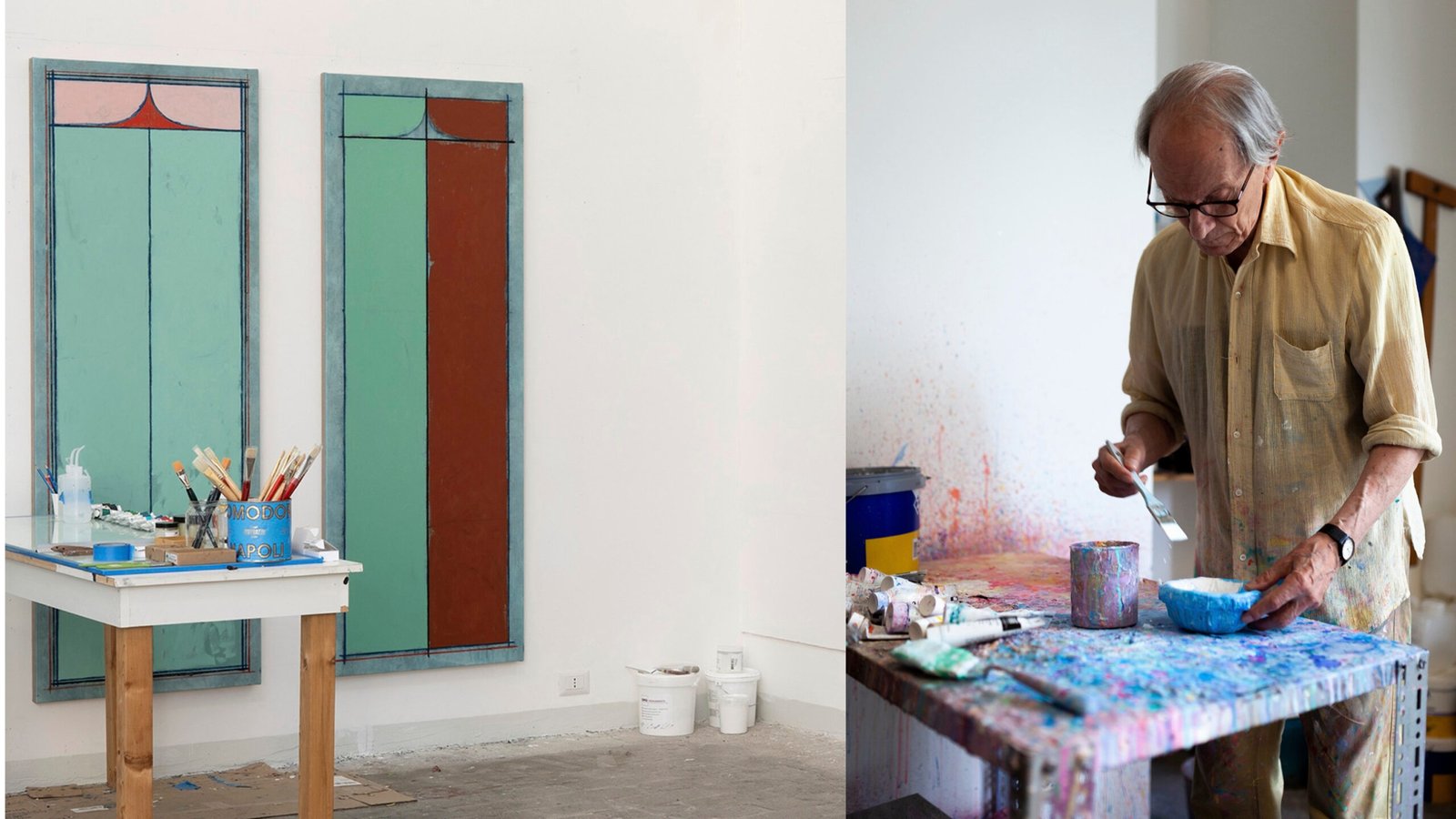
The show Giorgio Griffa / Kamrooz Aram: Paintings is open at the American Academy in Rome from October 20 to November 28, 2026, in the AAR Gallery of the McKim, Mead & White building, at Via Angelo Masina 5, on the Janiculum Hill. The opening is Tuesday, October 20 from 18:00 to 21:00, with a poetry reading by Silvia Bre and Carmen Gallo. The Academy is a short walk from Porta San Pancrazio: it is served by the bus lines of Monteverde Vecchio and Via Carini, and from Trastevere you can walk up in about 20 minutes. Opening hours and access conditions are published on the official website of the American Academy in Rome. At the entrance you show a photo ID.
It is the autumn show of the American Academy, and it puts in dialogue two painters far apart in age and origin: the Turin painter Giorgio Griffa, born in 1936, one of the protagonists of Italian painting since the 1960s, and Kamrooz Aram, born in Shiraz, Iran, and active in Brooklyn, a Rome Prize fellow in 2024. The theme is abstraction and the way it travels through time and space. One of those small, precise shows that are worth the climb up the Janiculum Hill.
Giorgio Griffa / Kamrooz Aram: Paintings at a glance
Giorgio Griffa / Kamrooz Aram: Paintings is on view from October 20 to November 28, 2026 in the AAR Gallery of the American Academy in Rome, Via Angelo Masina 5. The opening with a poetry reading is Tuesday, October 20 from 18:00 to 21:00.
The dates
The show opens Tuesday, October 20, 2026 and closes Saturday, November 28, 2026. The opening night, from 18:00 to 21:00, is the most visible public occasion. For the opening days and hours in the following weeks, the reference is the calendar published by the Academy on its website.
The collaborations
The show is produced in collaboration with the Giorgio Griffa Foundation, the Clark Art Institute, the Lorcan O'Neill Gallery and Alexander Gray Associates. The project is supported by the General Directorate for Contemporary Creativity of the Ministry of Culture under the Italian Council program (2025).
The title
In the Academy's materials the show also appears under a longer working title, Chance Encounters: Kamrooz Aram and Giorgio Griffa. Chance encounters: it's the best summary of how the project came about.
What you see in Giorgio Griffa / Kamrooz Aram: Paintings
Giorgio Griffa / Kamrooz Aram: Paintings creates a dialogue between two painters whose work shows how abstract painting propagates through time and space: cultural tradition, painting as a measure of time and rhythm, the gesture and its trace.
A meeting in Turin
Griffa and Aram met in 2024 in Turin, the city where Griffa has always lived and painted. The show, the Academy explains, extends a conversation that began then: about the place and purpose of cultural tradition, about painting as a measure of time and rhythm, about how the gesture is traced and captured.
Ornament and decoration
The second thread is that of ornament. The presentation speaks of different approaches to ornament and decoration, of presence and loss, of margins and intimacy. For Aram, ornament is the center of the research. For Griffa, decoration enters the work through the arabesque, one of the recurring signs of his cycles. Seeing them side by side means discovering that two painters who set out from opposite points arrive at similar questions.
Free canvases and installation
Those who know Griffa know that his canvases are not mounted on stretchers: they are raw cloths, fixed to the wall with small nails along the top edge, which keep the folds of storage. Aram, for his part, works precisely on installation and on the relationship between the work and the way it is shown. In a room like the AAR Gallery the meeting of these two ideas of display is part of the show.
The verdict
A two-voice show works when the voices don't resemble each other too much. Here the distance is there: a 90-year-old Italian who grew up next to Arte povera and an artist of Iranian origin who questions Western modernism. It's the kind of pairing that is rarely seen in Rome, and that the American Academy, with its nature as a place of passage, knows how to do well.
Giorgio Griffa, the painter of primary signs
Giorgio Griffa, born in Turin on March 29, 1936, is one of the international protagonists of painterly research since the 1960s: from 1967-1968, with the Segni primari, he has painted on raw, unprepared canvas without a stretcher.
The lawyer who painted
Griffa begins to paint as a child, with the traditional painters of the Circolo degli Artisti of Turin. In 1958 he graduates in law and practices as a lawyer for years. From 1960 to 1963 he is a pupil of Filippo Scroppo, an abstract painter and teacher at the Accademia Albertina. In the mid-1960s the first abstract elements appear in his figurative paintings.
The Segni primari
In 1967-1968 the cycle of the Segni primari is born: on canvas or paper laid on the floor, a repeated sign, always the same and always different because of the imperfections of the hand. They are signs that, as the Academy recalls quoting the artist, could belong to anyone's hand. From here come the constants of all the later work: the unfinished and the anonymity of the sign.
Next to Arte povera
His arrival at Galleria Sperone at the end of the 1960s puts him in relation with the artists of Arte povera: Giovanni Anselmo, Gilberto Zorio, Giuseppe Penone. In 1970 he shows with Ileana Sonnabend in New York and Paris. His path remains solitary, however, not reducible to a movement: the American Academy speaks of 50 years of practice and 13 painting cycles.
The cycles
After the Segni primari come the Connessioni, the Frammenti di tela ritagliata, Segno e campo in the 1980s, the Tre linee con arabesco in the 1990s, the Numerazioni, the Alter ego dedicated to other artists, from Matisse to Paolo Uccello, and the cycle of the Sezione aurea in the early 2000s. Each cycle has a start date but no end date: they live side by side.
Shows and museums
Griffa has exhibited at the Venice Biennale in 1978, 1980 and 2017, at the São Paulo Biennial in 1977, and at the Rome Quadriennials of 1986 and 1999. In Rome he held a solo show at MACRO in 2010, Canone aureo, and has exhibited at Galleria Lorcan O'Neill and at the Fondazione Giuliani. The New York show of 2012-2013 at Casey Kaplan Gallery led American critics to rediscover him. His works are at the Tate Modern, the Centre Pompidou, the Castello di Rivoli, the GAM in Turin and the Galleria d'Arte Moderna in Rome. Since 2007 he has been a member of the Accademia di San Luca.
Kamrooz Aram, Rome Prize fellow
Kamrooz Aram, born in Shiraz, Iran, and active in Brooklyn, was a Carla Fendi Foundation Rome Prize Fellow at the American Academy in Rome in 2024. His work challenges the false opposition between ornament and abstraction.
Ornament against modernism
The Academy describes his research as a challenge to the relegation of ornament to discourses of criminality and excess, an evident echo of the modernist polemic against decoration. In his shows Aram stages a meeting between the Euro-American avant-garde and non-Western forms of abstraction, questioning the boundaries between art, artifact and modes of display.
Painting, sculpture, installation
His work combines painting, sculpture, collage and exhibition design, creating an interdependence between the object and its installation. It is a way of recalling how much design and architecture influence the interpretation of art: a theme that, in a building designed by McKim, Mead & White, finds a natural context.
Recent shows
Among the recent exhibitions: the Whitney Biennial 2026 at the Whitney Museum of American Art in New York. Kamrooz Aram: Privacy, An Exhibition at the Arts Club of Chicago (2022). Lives of Forms with Iman Issa at Z33 in Hasselt, Belgium (2021). Paraventi, at Fondazione Prada in Milan (2023-2024). Desorientalismos at the Centro Andaluz de Arte Contemporáneo in Seville (2020).
Collections and awards
His works are in the collections of the Metropolitan Museum of Art in New York, M+ in Hong Kong, the Art Gallery of New South Wales in Sydney, the Modern Art Museum of Fort Worth and the Sharjah Art Foundation, among others. He received a Guggenheim Fellowship in 2025, the Trellis Art Fund Stepping Stone Grant in 2025, the Rome Prize in 2024 and the Abraaj Group Art Prize in 2014.
The opening of Giorgio Griffa / Kamrooz Aram: Paintings with the poets
At the opening on Tuesday, October 20, from 18:00 to 21:00, the poets Silvia Bre and Carmen Gallo read a selection of texts chosen to reflect the themes of the show.
Silvia Bre
Silvia Bre is a poet and translator. She has published I riposi and Sempre perdendosi and, with Einaudi, the collections Le barricate misteriose, Marmo, La fine di quest'arte and Le campane. In 2022 came the essay Mistero with Vallecchi. She has translated Louise Labé, Claudia Rankine, Vita Sackville-West, Margaret Atwood, a lot of Emily Dickinson for Einaudi and Fire and Ice by Robert Frost for Adelphi.
Carmen Gallo
Carmen Gallo is a poet and translator and teaches English literature at Sapienza. Among her books are Le fuggitive (Aragno, 2020), Premio Napoli, Tecniche di nascondimento per adulti (2024), Stanze per una fuga (2025) and Procne Machine (Einaudi, 2026), a finalist for the Premio Strega 2026. She has written on the metaphysical poetry of John Donne and translated Shakespeare, T.S. Eliot and Caryl Churchill.
Why poetry
The Academy explains the choice: both work on language in an organic way, building vivid images and atmospheres, with a deep commitment to the truth-telling power of language. For a show on the sign and on rhythm it's a coherent pairing, and for those who love contemporary poetry one more reason to be there on the first evening.
The American Academy in Rome, the show's venue
The American Academy in Rome is a U.S. cultural institution founded in 1894, based on the Janiculum Hill at Via Angelo Masina 5, in a building opened in 1914 designed by the firm McKim, Mead & White.
The origins
The current setup dates to 1913, when the American School of Architecture, founded in 1894, and the American School of Classical Studies in Rome, established in 1895 by the Archaeological Institute of America, merged. Among the founders are the architect Charles Follen McKim, William Kissam Vanderbilt, Henry Clay Frick, John D. Rockefeller Jr., Andrew Carnegie, Richard Morris Hunt and Daniel Burnham: the who's who of late 19th-century America.
The building
The main building was designed by Charles Follen McKim, William Rutherford Mead and Stanford White, the firm that in the United States signed some of the most famous Beaux-Arts architecture. The courtyard has a fountain designed by the sculptor Paul Manship. The rare book library is the work of the architect Michael Graves, in 1996. The AAR Gallery, where the show is installed, is in this building.
Villa Aurelia
The Academy also owns Villa Aurelia, built in 1650 for Cardinal Girolamo Farnese. In 1849 it was the headquarters of Giuseppe Garibaldi during the French siege of the Roman Republic, and it was heavily damaged. Restored, it was bought by the Philadelphia heiress Clara Jessup Heyland, who on her death, in 1909, left it to the Academy.
The Rome Prize
Every year the Academy awards the Rome Prize to about 30 American artists and scholars, who live and work at the site for a period: architecture, design, conservation, landscape, musical composition, visual arts, literature and humanistic studies from antiquity to the modern age. Kamrooz Aram was one of them in 2024: the show grows out of that residency.
The Janiculum Hill around the American Academy
The American Academy in Rome stands at the top of the Janiculum Hill, a short walk from Porta San Pancrazio, in an area marked by the defense of the Roman Republic in 1849.
Porta San Pancrazio and the Museo della Repubblica Romana
About 100 meters from the entrance is Porta San Pancrazio, rebuilt by Virginio Vespignani between 1854 and 1857 after the French bombardments of 1849. Inside the gate is the Museum of the Roman Republic and Garibaldian Memory, which tells precisely the story of the siege in which Villa Aurelia was Garibaldi's headquarters.
Acqua Paola and San Pietro in Montorio
Going down toward Trastevere you meet the Acqua Paola Fountain, the Fontanone, with its terrace over the whole city. A little lower down are San Pietro in Montorio and, in its cloister, Bramante's Tempietto, the model of the Roman Renaissance.
Villa Pamphilj and Villa Sciarra
Beyond the gate opens Villa Doria Pamphilj, the largest historic park in Rome. On the other side, toward Monteverde Vecchio, is Villa Sciarra, more intimate, with its fountains and avenues. Both are excellent for a walk before going into the gallery.
Trastevere
At the foot of the hill is Trastevere. Those who walk up from the rione pass in front of all the places mentioned: it's the best way to arrive at the Academy, and to understand why the Americans chose precisely this spot in the city.
How to get to the American Academy in Rome
The American Academy in Rome, at Via Angelo Masina 5, is reached by bus with the lines serving Monteverde Vecchio and Via Carini, or on foot from Trastevere, climbing Via Garibaldi to Porta San Pancrazio.
By bus
Lines 75, 44, 710, 870 and 871 serve the area of Monteverde Vecchio and Via Carini, a short distance from Porta San Pancrazio. For the stop nearest your starting point, it's best to use the route planner of the transport company.
On foot from Trastevere
From Piazza di Santa Maria in Trastevere you climb Via Garibaldi, pass San Pietro in Montorio and the Fontanone and arrive at Porta San Pancrazio: about 20 minutes of steady climb. With the right shoes it's one of the most beautiful walks in Rome, and at sunset the view from the Fontanone repays the effort.
By car and taxi
The Janiculum Hill can be reached by car, but on opening night the area will be busy and spaces limited. A taxi is the most comfortable solution for the return, especially after 21:00.
Access rules
To enter the Academy you show a valid photo ID. Backpacks and bags larger than 40 by 35 by 15 centimeters are not allowed, and there is no storage. Animals are not allowed, except guide dogs. Travel light.
How to organize the visit to the show
Giorgio Griffa / Kamrooz Aram: Paintings is a show to visit calmly in an hour, to combine with a walk on the Janiculum Hill. The opening hours of the AAR Gallery are published on the Academy's website.
Opening night
The evening of October 20, from 18:00 to 21:00, is the liveliest: there are the readings by Silvia Bre and Carmen Gallo and, predictably, the artists. If you want to look at the paintings in silence, come back another day. If you want to breathe the air of the Academy, come that evening, arriving early.
A morning on the Janiculum Hill
For those with half a day: climb from Trastevere, Tempietto del Bramante, Fontanone, show, then a walk at Villa Pamphilj or a descent along the Janiculum promenade toward Sant'Onofrio. All on foot.
Where to eat
On the Janiculum Hill the places are few. The offer is concentrated in Monteverde Vecchio, along the streets around Via Carini, and above all in Trastevere, with trattorias, pizzerias and bars on every corner. My advice is to have lunch or dinner in Trastevere, before climbing up or after coming down.
Accessibility and visiting with children
The American Academy in Rome is accessible to wheelchair users and to those who need to avoid stairs. The Academy asks you to write to events@aarome.org to organize the visit as well as possible.
Reduced mobility
Wheelchair users or those using other aids are invited to report it in advance, as are people with a disability or a condition that requires particular arrangements. It's a common-sense rule in a historic building with multiple entrances and levels.
With children
A show of abstract painting can work with children if you present it as a game: counting the signs on a Griffa canvas, looking for the three lines and the arabesque, comparing the colors of the two painters. Half an hour in the gallery, then Villa Pamphilj to run around. With the youngest, remember the rule on backpacks.
A curiosity about Giorgio Griffa / Kamrooz Aram: Paintings at the American Academy in Rome, from October 20 to November 28, 2026
The nicest curiosity concerns the way Giorgio Griffa stores his canvases. Since he doesn't mount them on stretchers, when they are not on display they are folded and stacked, and the folds form a grid that remains visible under the paint when the canvas returns to the wall. The time spent in storage becomes part of the work. In a show that the Academy presents as a reflection on painting as a measure of time, it's a detail to look for with your eyes: look at Griffa's canvases at an angle and you'll see the lines of the folds.
The second curiosity is about birth dates. Griffa graduated in law in 1958 and practiced as a lawyer while building a career as a painter that would take him to the Venice Biennale and the Tate Modern. Kamrooz Aram, born in Shiraz, won the Rome Prize almost 90 years after his colleague's birth. Their meeting, in 2024 in Turin, is truly a chance encounter, as the working title of the project says: two generations, two continents, one same question about what a painted sign is.
Something nobody tells you about Giorgio Griffa / Kamrooz Aram: Paintings at the American Academy in Rome, from October 20 to November 28, 2026
Nobody writes it in the press releases, but the American Academy in Rome is a place many Romans have never entered. It is a residence for artists and scholars, with precise access rules: photo ID at the entrance, no backpacks beyond a certain size, no baggage storage. Anyone arriving with a tourist daypack risks having to leave it outside, and outside there's nowhere to leave it. The practical advice is to come with a small bag and your ID in your pocket.
The second thing that is little said: a show like this is also a chance to see from the inside one of the most interesting buildings on the Janiculum Hill, designed by the firm McKim, Mead & White, the same architects of some of the great American public buildings of the early 20th century. The courtyard with Paul Manship's fountain is one of the quietest places in the city. Look at it carefully as you head toward the gallery.
The third: Griffa has a long Roman history, from the Marlborough gallery in the 1970s to the solo show at MACRO in 2010, to Galleria Lorcan O'Neill, which collaborates on this show. Whoever discovers him here can find him again at the Galleria d'Arte Moderna in Rome, which holds his works.
My advice for visiting Giorgio Griffa / Kamrooz Aram: Paintings at the American Academy in Rome, from October 20 to November 28, 2026
It's worth making two visits, if you can. The first on opening night, October 20 between 18:00 and 21:00, to listen to Silvia Bre and Carmen Gallo and to see the Academy at its most open. The second on a weekday in November, with the gallery quiet, to stand in front of the paintings for as long as it takes. Griffa's painting asks for slowness: his signs have to be followed one by one, and the rhythm is understood only after a few minutes.
If you make only one visit, arrive on foot from Trastevere. The climb along Via Garibaldi, with Bramante's Tempietto and the Fontanone, prepares your gaze: you go from the most measured Renaissance to the view over all of Rome, and you enter the gallery with a clear head.
In the room, look first at one painter and then the other, and only afterward at the points where the works speak to each other. Look for the arabesque in Griffa's canvases and the decoration in Aram's works: that is where the show makes its argument. And before leaving, stop in the courtyard. Bring an ID and no backpack.
Another well-known fact, yet rarely mentioned
It is well known that the Janiculum Hill is Garibaldi's hill, with the equestrian monument, the bust of Anita and the lighthouse. It is less often mentioned that one of the key places of the defense of 1849 today belongs to an American institution. Villa Aurelia, built in 1650 for Cardinal Girolamo Farnese, was Garibaldi's headquarters during the French siege of the Roman Republic and came out of it heavily damaged. Restored, it was purchased by a Philadelphia heiress, Clara Jessup Heyland, who on dying in 1909 left it by will to the American Academy.
The second fact rarely cited concerns the founders. Among the names who in 1894-1913 gave life to the Academy are Andrew Carnegie, John D. Rockefeller Jr., Henry Clay Frick and William Kissam Vanderbilt, that is, some of the biggest industrial fortunes in American history, alongside architects like McKim and Daniel Burnham. The idea was clear: to train American artists and architects on the Roman model, as the French had done for centuries at Villa Medici. Today the Academy hosts artists like Kamrooz Aram, born in Iran and living in Brooklyn: the mission has remained, the world that inhabits it has changed. In 1939 King Victor Emmanuel III also paid a visit.
The right photo to take at Giorgio Griffa / Kamrooz Aram: Paintings at the American Academy in Rome, from October 20 to November 28, 2026
The right photo of the visit is taken before going in, and not at the Academy: from the terrace of the Fontana dell'Acqua Paola, five minutes lower down. From there Rome spreads out whole, with the domes in a row, and in the light of late October, around 17:00, the outlines are sharp and warm. It's the shot every Janiculum traveler takes home, and it makes sense to take it right before a show on painting as a measure of space.
The second photo is in front of the Academy's entrance on Via Angelo Masina, with the facade of the McKim, Mead & White building: an American palace built on the Roman model, a short walk from the 17th-century walls. For photographs inside the gallery, ask the staff if they are allowed, and in any case no flash.
If photos in the room are allowed, choose a detail instead of the whole wall: a Griffa sign up close, with the weave of the raw canvas visible, or a corner where an Aram work talks to the space around it. The official images of the show, with portraits of the artists by Emily B. Frank and Giulio Caresio, are published by the Academy.
Some important events that happened here in history
The stretch of the Janiculum Hill on which the American Academy in Rome stands is one of the places most marked by the Risorgimento history of Rome. In 1849, during the French siege of the Roman Republic, the defense led by Garibaldi concentrated right around Porta San Pancrazio. The gate was destroyed by the bombardments and then rebuilt by Virginio Vespignani between 1854 and 1857 for Pius IX. Villa Aurelia, today the Academy's, was Garibaldi's headquarters. Here fell, in the defense of the Republic, Goffredo Mameli, Luciano Manara and Emilio Dandolo.
The second chapter is American. In 1894 the American School of Architecture was born, in 1895 the American School of Classical Studies, and in 1913 the two schools merged into the American Academy in Rome. In 1914 Via Angelo Masina building, designed by McKim, Mead & White, opened. 1909 had brought the bequest of Villa Aurelia.
The third chapter is that of the 20th century: the visit of Victor Emmanuel III in 1939, the birth of the Fototeca Unione founded by Ernest Nash, Michael Graves's rare book library in 1996. And, year after year, the passage of the Rome Prize fellows, of whom this show is the latest fruit.
Who has passed through Giorgio Griffa / Kamrooz Aram: Paintings at the American Academy in Rome, from October 20 to November 28, 2026
Through the American Academy in Rome have passed, first of all, its founders and its architects: Charles Follen McKim, who with William Rutherford Mead and Stanford White designed the building, and figures like Daniel Burnham and Richard Morris Hunt, who wanted an American school in Rome. In the courtyard worked the sculptor Paul Manship, author of the fountain. In 1996 Michael Graves signed the rare book library. Ernest Nash founded the Fototeca Unione there, one of the most important photographic archives for the archaeology of Rome. In 1939 the Academy received the visit of King Victor Emmanuel III.
Then there are the fellows: every year about 30 American artists, architects, composers, writers and scholars win the Rome Prize and live here for months. Kamrooz Aram was one of them in 2024, with the Carla Fendi Foundation fellowship, and the show grows out of that Roman season.
Even before the Academy, Giuseppe Garibaldi passed over the grounds of Villa Aurelia, which in 1849 he made his headquarters. And in these weeks pass Giorgio Griffa, one of the masters of Italian painting of the second half of the 20th century, and the poets Silvia Bre and Carmen Gallo, expected at the evening of October 20.
Frequently asked questions about Giorgio Griffa / Kamrooz Aram: Paintings
When can you see the Griffa and Aram show in Rome?
The show Giorgio Griffa / Kamrooz Aram: Paintings is on view at the American Academy in Rome from October 20 to November 28, 2026. The opening is Tuesday, October 20 from 18:00 to 21:00. Days and hours of opening of the AAR Gallery are published on the Academy's official website.
Where is the American Academy in Rome?
The American Academy in Rome is on the Janiculum Hill, at Via Angelo Masina 5, a short walk from Porta San Pancrazio. The show is in the AAR Gallery, inside the building designed by McKim, Mead & White. From Trastevere you walk up in about 20 minutes.
What do you need to enter the American Academy?
To enter the American Academy in Rome you need a valid photo ID. Backpacks and bags over 40 by 35 by 15 centimeters are not allowed, there is no storage, and animals are not allowed, except guide dogs.
Who are Giorgio Griffa and Kamrooz Aram?
Giorgio Griffa, born in Turin in 1936, is one of the protagonists of Italian painting since the 1960s, known for signs painted on raw canvas without a stretcher. Kamrooz Aram, born in Shiraz and active in Brooklyn, works on the relationship between ornament and abstraction and was a Rome Prize fellow in 2024.
Who reads at the opening of the show?
At the opening of Giorgio Griffa / Kamrooz Aram: Paintings, on October 20, the poets Silvia Bre and Carmen Gallo read, with a selection of texts chosen to reflect the themes of the show. Carmen Gallo was a finalist for the Premio Strega 2026 with Procne Machine.
Is the American Academy in Rome wheelchair accessible?
The American Academy in Rome is accessible to wheelchair users and to those who need to avoid stairs. The Academy asks you to write in advance to events@aarome.org to organize the visit as well as possible, also in case of other particular needs.
How do you get to the American Academy by public transport?
You get to the American Academy in Rome by the bus lines serving Monteverde Vecchio and Via Carini, such as the 75 and the 44, or on foot from Trastevere, climbing Via Garibaldi to Porta San Pancrazio. For the most convenient stop, it's best to use the transport company's route planner.
To close, one piece of advice: a show at the American Academy is the best excuse to go up the Janiculum Hill with a purpose. Walk up from Trastevere, look at Griffa up close and at Aram with attention to the installation, then come down at sunset from the Fontanone. It's a complete Roman afternoon.
Article written by the editorial team of Tour Leader Pro, contact them for Private/Corporate/V.I.P. Tours and Experiences.
Planning a trip to Rome? The English-language guides to visiting the city are on ItalyPlanner.com.