Free Visits to the Pyramid of Cestius After the PNRR Works, October 3 to 31, 2026
In short. The Pyramid of Cestius is open with free visits, reservation required, on Saturday, October 3, 10, 17, 24 and 31, 2026, with sessions at 16:30, 17:30 and 18:30.
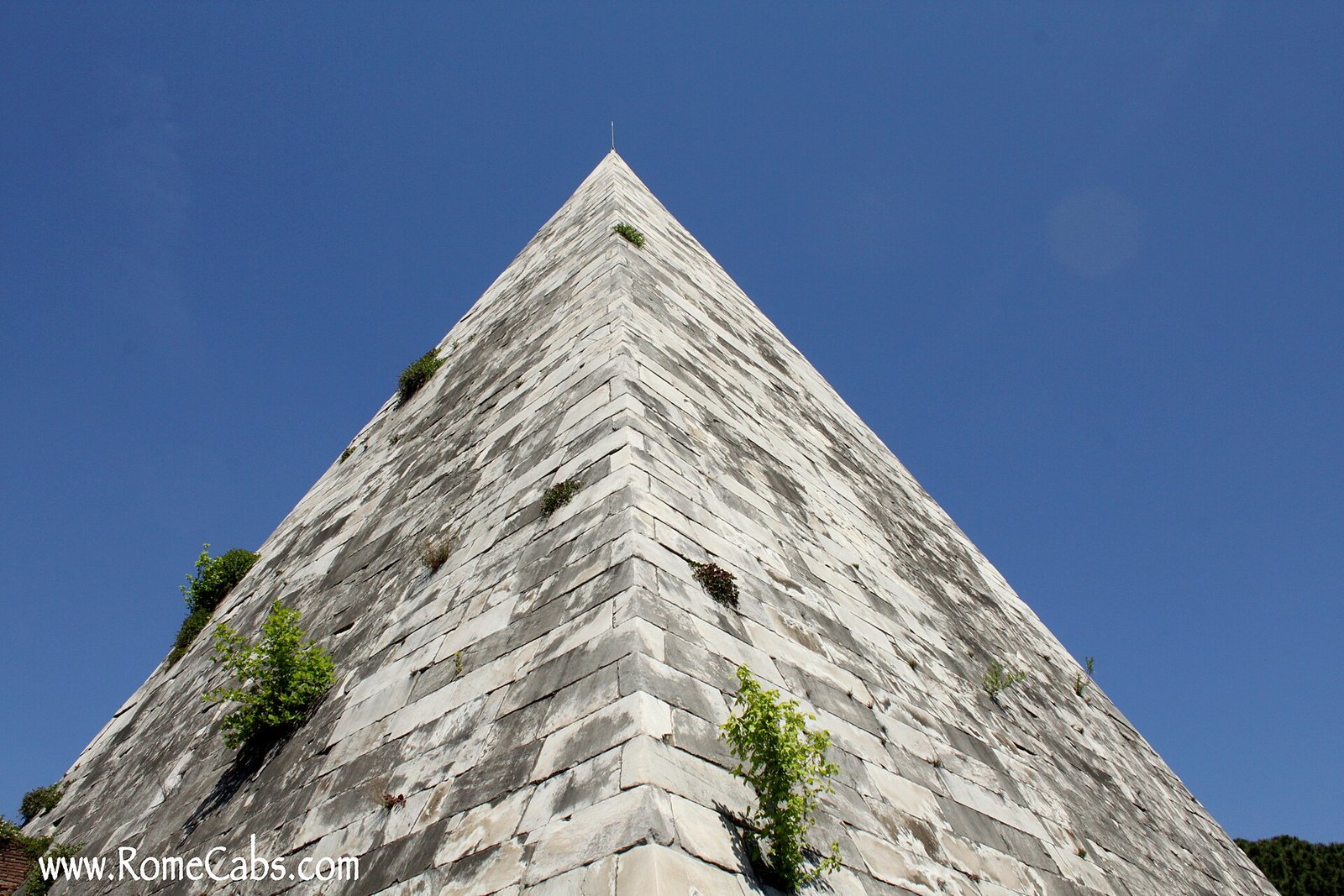
The Pyramid of Cestius is open with free visits, reservation required, on Saturday, October 3, 10, 17, 24 and 31, 2026, with sessions at 16:30, 17:30 and 18:30. These are the last dates of the cycle of special openings sponsored by the Special Superintendency of Rome after the works funded by the PNRR. Each session admits a maximum of 50 people, the visit is self-guided, without a guide, and lasts 45 minutes. The entrance is on via Raffaele Persichetti, next to Porta San Paolo. The Piramide station on metro line B takes its name from the monument itself. Reservations are made on the platform indicated by the Superintendency on its website, until places run out. The Superintendency asks you to arrive at the entrance at least 10 minutes before the reserved time.
After about three years of closure, the Pyramid reopened on September 4, 2026 with new lighting, an accessible route, a tidied garden and new signage. It's one of those monuments that all Romans see every day from the tram or the car and that almost no one has visited inside. October is the right chance to fix that: five Saturdays, then the cycle closes.
The special openings of the Pyramid of Cestius: dates, sessions and rules
From September 4 to October 31, 2026 the Special Superintendency of Rome has scheduled eight daytime openings with free self-guided visits, five evening openings with a free guided visit and two special days for the European Heritage Days, all with reservation required.
The dates that remain
The evening openings with guided visit were held on September 4, 11, 18 and 25. The special days on September 26 and 27. Of the daytime openings, those of October remain: Saturday 3, 10, 17, 24 and 31. On each the visit sessions are at 16:30, 17:30 and 18:30.
How the visit works
The October visits are free and unguided, for a maximum of 50 people per session. The duration is 45 minutes. You enter from via Raffaele Persichetti.
The rules of conduct
The Superintendency recommends comfortable shoes and asks you to follow the staff's instructions. In the passage leading to the burial chamber you go one at a time, head lowered, without running and without passing. Climbing on low walls and archaeological structures is forbidden. They are simple rules, but they say a lot about the space: the passage is narrow and low.
What changed with the PNRR works
The restoration and enhancement project, funded with PNRR funds under the Caput Mundi program, secured the access stairway, tidied the garden, renewed the lighting system and created educational and welcome signage to improve accessibility.
The stairway, the gate, the route
The works included installing a handrail on the access stairway, replacing the gate on piazzale Ostiense, an accessibility route with new paving and the upgrading of the fencing. They also covered the irrigation system and the organization of the spaces intended for the cat colony.
The garden
The botanical tidying of the garden started from a survey of the existing plant species and monitoring of their condition. The greenery around the Pyramid is not a detail: for centuries spontaneous vegetation damaged the monument, settling into the cracks and damaging the conglomerate with its roots.
The new lighting
The new lighting system covers both the exterior and the funerary chamber. The head of the Pyramid, Barbara Rossi, explains that it was designed to guide the eye, highlighting the volumes and the frescoes without altering how they are perceived. The Minister of Culture Alessandro Giuli and the Superintendent Daniela Porro, in the presentation, insisted on the same point: protection and accessibility together.
The Pyramid of Gaius Cestius: what it is
The Pyramid of Cestius is the tomb of Gaius Cestius Epulo, erected between 18 and 12 BC along via Ostiense, outside the urban perimeter of the time. It is the only survivor of the pyramid-shaped monuments built in Rome in the 1st century BC. The page for the site is at Pyramid of Cestius.
The patron
Of Gaius Cestius almost only what the monument's inscriptions say is known: the name, the tribe and the offices, among them membership in the college of the septemviri epulones, the priests in charge of sacred banquets. He is a minor figure of Augustan Rome who became immortal thanks to his tomb.
The Egyptian fashion
The pyramid shape comes from the Egyptianizing taste that spread in Rome after the conquest of Egypt and the Battle of Actium in 31 BC, which affected above all the funerary architecture of the ruling class. The Pyramid of Cestius is the only funerary monument of this type to have come down to us.
The measurements
It is 36.40 meters high, with a square base 29.50 meters per side. The core is concrete conglomerate with a brick facing, the cladding in slabs of Luna marble. The profile is much sharper than that of the Giza pyramids: the faces slope at about 68 degrees, against about 52 for the pyramid of Cheops. Hence the hypothesis, undocumented, of a Nubian model, the pyramids of the kingdom of Meroe.
Built in 330 days: the inscription and the will
Cestius stipulated in his will that the tomb be completed within 330 days, on pain of losing the inheritance. The inscription on the eastern side of the monument records that the work was finished within that term.
What the inscription says
The inscription, cataloged as CIL VI 1374, attests that the work was completed by testamentary provision in 330 days under the responsibility of the heir Lucius Pontius Mela and the freedman Potho. On the eastern and western sides, higher up, another inscription gives the name and titles of Cestius.
The hangings that never went in
An inscription on one of the statue pedestals recalls the sale of the attalica, the gold-woven fabrics that Cestius wanted hung in the chamber and that a sumptuary edict, issued shortly after his death, instead obliged to be sold. The date of construction is drawn from precisely this: after the sumptuary law of 18 BC and before the death of Agrippa in 12, named among the beneficiaries of the will.
The burial chamber and its frescoes
Inside the Pyramid opens a single funerary room of about 23 square meters, covered by a barrel vault and decorated in fresco according to the Third Pompeian Style. Its volume corresponds to just over 1 percent of the total volume of the monument.
The winged Victories
The walls are divided into panels with female figures alternating with lustral vases on a light ground. At the corners of the vault four winged Victories carry a crown and a ribbon. At the center a large gap occupies the place of what must have been a scene of the deceased's apotheosis. The restoration established that the four Victories were painted from a single cartoon: three can be superimposed, the fourth has its face flipped.
The colors
The painting, done in fresco, has the glossy, almost marble-like look obtained through the polishing that Vitruvius calls expolitio. The palette includes Egyptian blue, green frit, lampblack, yellow ocher, red ocher and cinnabar red. With the new lighting, these colors are the real reason to go in.
Vasari's graffito
On the walls there are graffiti from different eras left by visitors after the opening of the passage. One, a red chalk drawing with two human figures, bears the signature Giorgio basari Haretino. The reading has suggested a possible attribution to Giorgio Vasari, in the sixteenth century.
From the excavations of Alexander VII to the recent restorations
Between 1660 and 1663 Pope Alexander VII had excavations made around the Pyramid and an access opened that made the burial chamber reachable again, found empty. The works are recalled by an inscription on the facade.
The columns and the statues
The tomb was enclosed by a precinct of tuff blocks with four columns at the corners. The seventeenth-century excavations raised again the two columns on the side opposite the Ostiense. On either side of the entrance there were two bronze statues of Cestius: only an arm and a foot have been recovered, while the two inscribed pedestals were found around 1662.
Borromini's project
Tied to the same period is a project by Francesco Borromini to turn the funerary chamber into a church. Nothing came of it, and the Pyramid remained a tomb. Judging by how things went, it was a stroke of luck.
Lightning, water and roots
Over the centuries the monument has been struck several times by lightning, which brought down parts of the cladding, and by flooding due to its low elevation relative to the city, with a water table that runs right under the chamber floor. Spontaneous vegetation deformed the surfaces and damaged the conglomerate. According to those in charge of the late twentieth-century work site, the restorations of the 1960s had used strongly acidic materials to clean the marbles, and the decision not to fill the joints between the blocks had let water in.
The work site from 1997
The conservation project was set up in 1997, under the superintendent Adriano La Regina, directed by Maria Grazia Filetici and Rita Paris. The gaps due to natural decay were filled, while it was decided to leave visible those produced by intrusions and excavations. Since 2001 a maintenance program with microclimate monitoring has been active, which makes it possible to keep the chamber open to the public while limiting the effects of the carbon dioxide produced by visitors. That is also why groups are small and visits short.
The Japanese patron and the road to the port
The restoration of the Pyramid's exterior surfaces was paid for by a private individual: the Japanese entrepreneur Yuzo Yagi, owner of Yagi Tsusho Ltd, who in December 2010 announced to the Ministry an initial allocation of a million euros, doubled in December 2013.
The 2012 and 2014 work site
With those funds the Pyramid and the two columns were restored. The specialist works took place between 2012 and 2014 and ended on December 19, 2014. In 2015 Yagi was named Grand Officer of the Order of Merit of the Italian Republic. The white marble you see today, compact and luminous, is largely the result of that work site.
The postern and the paving
When the Pyramid was incorporated into the walls, next to the monument there opened a small secondary gate, a posterula, from which a road led directly to the emporium on the Tiber. The paving of that road is still visible. During the visit it's worth looking for it: it is the trace of the link between the tomb, via Ostiense and the river port.
The Pyramid of Piranesi and of travelers
The unusual shape and the legend of the tomb of Remus made the Pyramid a customary stop for travelers headed to Rome, already noted in seventeenth-century guides.
Vasi and Piranesi
The monument recurs often in prints of antiquities and Roman views between the seventeenth and eighteenth centuries. Giuseppe Vasi and above all Giovanni Battista Piranesi devoted plates to it, and Piranesi published a series of engravings of it in the Antichità romane.
The engravings as documents
Piranesi's plates have become a firsthand document for restorers: the comparison made during the restoration of 1999 and 2000 showed that the gaps in the frescoes were already reproduced exactly and coincided with those recorded two centuries later, apart from slight enlargements. Piranesi, in short, drew like an archaeologist. Whoever enters the chamber in October sees, in broad terms, what he saw.
A name for a neighborhood
From the monument take their name the square in front of it, the Piramide station of metro line B and, by extension, the whole area around it. Few ancient monuments in Rome have become an everyday place name in this way.
A curiosity about the Free Visits to the Pyramid of Cestius After the PNRR Works, October 3 to 31, 2026
Throughout the Middle Ages the Pyramid of Cestius was not the tomb of Cestius: it was the tomb of Remus. Popular belief called it the meta Remi and paired it with another pyramid, the meta Romuli, which stood in the Borgo district, near the Vatican. The latter, documented in Alessandro Strozzi's 1474 map of Rome, was demolished between the end of the fifteenth century and the sixteenth to open Borgo Nuovo.
The identification also found favor among the learned. Francesco Petrarca, in one of his epistles, names the pyramid as the tomb of Remus. Poggio Bracciolini, a few decades later, explained the error: the inscription with the name of Cestius was hidden by vegetation. All it took was removing the ivy to read the truth.
The story is instructive for those who visit the monuments of Rome. For centuries people looked at the Pyramid without reading it, building around it a legend more fascinating than reality. Today the garden has been tidied, the inscriptions read clearly and the new signage explains everything. Whoever goes in October knows who Cestius was. But remembering Remus helps to understand how much the city has always wanted to turn its stones into myths.
One thing nobody tells you about the Free Visits to the Pyramid of Cestius After the PNRR Works, October 3 to 31, 2026
What nobody says is that the visit to the burial chamber isn't for everyone. To get there you go through a passage, opened in the medieval period on the north side to break into the tomb. The Superintendency says so explicitly in its rules: one at a time, head lowered, don't run, don't pass. Whoever suffers from claustrophobia or has trouble bending needs to know before booking.
The second thing rarely said concerns the places. 50 people per session, three sessions a day, one day a week: that's very few. The October dates are five Saturdays, and whoever plans to book at the last moment risks finding no place. Reservation is required and until places run out. Without a reservation you don't get in.
The third concerns the when. The 18:30 session is the latest: with the days getting shorter, it's the one in which the new exterior lighting makes the most sense. Whoever wants to photograph the lit-up Pyramid should choose the last session of one of the last Saturdays.
The advice I give you for visiting the Free Visits to the Pyramid of Cestius After the PNRR Works, October 3 to 31, 2026
The advice is to book right away and to build a whole afternoon in the area around the visit. The Pyramid takes 45 minutes. The neighborhood around it deserves at least three hours. Book the 16:30 session, arrive 10 minutes early as the Superintendency asks, and after the visit move a few steps to the Non-Catholic Cemetery, which borders the Pyramid.
During the visit, give your time to the burial chamber: look at the Victories at the corners of the vault and look for the one with the flipped face. Then look for the graffiti, and among them the red chalk drawing signed Giorgio basari Haretino. It's a small game that turns the visit into an investigation, and it works with kids too.
Outside, walk around the monument and read the 330-day inscription on the eastern side. Then look up toward Porta San Paolo: the Pyramid was incorporated into the Aurelian Walls, of which it became a bastion, and the link between the two structures is understood only by standing there. Comfortable shoes, no bulky backpacks for the passage, and a charged phone for photos of the chamber.
Another well-known fact, yet rarely cited
Everyone knows the Pyramid is next to the Non-Catholic Cemetery, where John Keats and Percy Bysshe Shelley, among others, are buried. It's less often recalled why the cemetery is right there: from the eighteenth century non-Catholic foreigners who died in Rome began to be buried at the foot of the Pyramid, inside the city wall but hard against it. The area was formalized as a cemetery in 1821. The adjacency has forever tied the image of the Pyramid to the literature of English Romanticism.
A second little-cited fact: the Pyramid survived precisely because it was incorporated into the Aurelian Walls, built, according to the Superintendency's dating, between 272 and 279. Having become a bastion, it escaped the plundering that over the centuries struck the other ancient monuments of Rome.
The third: the restoration of the exterior surfaces, completed on December 19, 2014, was financed by the Japanese entrepreneur Yuzo Yagi, with 2 million euros in total. In 2017 the restoration received the Europa Nostra award for conservation. The PNRR works of 2025 and 2026 add to that season.
The right photo to take at the Free Visits to the Pyramid of Cestius After the PNRR Works, October 3 to 31, 2026
The right photo of the Pyramid of Cestius is the one that relates it to the Aurelian Walls and to Porta San Paolo. From piazzale Ostiense the view is frontal but flat. Better to look, from inside the enclosure during the visit, for an angle that frames the corner of the monument with the stretch of wall beside it. It's the image that tells its story as a tomb turned bastion.
Inside the burial chamber the most beautiful photo is one of the winged Victories at the corners of the vault, lit by the new system. Follow the staff's instructions: the space is small, sessions are short and the other visitors are waiting.
The third photo is from the Non-Catholic Cemetery: the Pyramid seen beyond the tombs. It's the image drawn by Giuseppe Vasi and Giovanni Battista Piranesi and that for two centuries was the romantic postcard of Rome. In the late afternoon of October the raking light on the marble is the right one.
Some important events that happened here in history
18 and 12 BC: the tomb of Gaius Cestius Epulo is built along via Ostiense, in 330 days as prescribed by the will.
272 and 279 AD: the Pyramid is incorporated into the Aurelian Walls and becomes a bastion. Beside it opens a posterula toward the emporium on the Tiber, of which the paving remains.
Middle Ages: a passage dug on the north side breaks into the tomb. The central scene of the vault and the urn are lost. The Pyramid becomes the meta Remi, the tomb of Remus.
1660 and 1663: Pope Alexander VII promotes excavations around the monument and makes the burial chamber accessible again, found empty. Around 1662 the pedestals of the statues of Cestius are found. Borromini plans to turn the chamber into a church, without follow-up.
1821: the area at the foot of the Pyramid formally becomes the Non-Catholic Cemetery.
1864: a ministerial report states that lightning has knocked down the apex and part of the cladding. A lightning rod is installed.
1999 and 2001: restoration of the frescoes, funded by the employees of ATAC and Cotral. From 2012 to 2014 the restoration of the exterior surfaces. In 2017 the Europa Nostra award.
September 4, 2026: after about three years of closure and the PNRR works, the Pyramid reopens to the public.
Who has passed through the Free Visits to the Pyramid of Cestius After the PNRR Works, October 3 to 31, 2026
The first name is that of Gaius Cestius Epulo, priest of the sacred banquets, with his heir Lucius Pontius Mela and the freedman Potho, who had the tomb built in 330 days. Among the beneficiaries of the will was Agrippa, Augustus's son-in-law. Two and a half centuries later the builders of Aurelian's walls passed through here, turning the tomb into a bastion.
In the Middle Ages came Francesco Petrarca, who thought he saw the tomb of Remus, and in the fifteenth century Poggio Bracciolini, who corrected the error. In the sixteenth century someone who signed himself Giorgio basari Haretino left a drawing on the chamber walls. Perhaps it was Giorgio Vasari. In the seventeenth century came the excavators of Alexander VII and Francesco Borromini, with his church project that was never carried out.
In the eighteenth century the Pyramid became a stop for travelers and a subject for Giuseppe Vasi and Giovanni Battista Piranesi, whose engravings were used by restorers to compare the gaps in the frescoes. Beside it rest John Keats and Percy Bysshe Shelley. In recent times Yuzo Yagi, who financed the exterior restoration, and the employees of ATAC and Cotral, who paid for that of the frescoes, have passed through here.
How to book the visit to the Pyramid of Cestius
Where to book
Reservation is required and is made on the booking platform indicated on the official page of the Special Superintendency of Rome devoted to the cycle of openings, until places run out. The correct link for the September and October visits is published on that page.
How much it costs
The visits are free. There is no ticket to pay for, but without a reservation you don't get in, and the reserved place must be honored: whoever can no longer go would do well to cancel, to leave it to someone else.
When to arrive
The Superintendency recommends arriving at the via Raffaele Persichetti entrance at least 10 minutes before the start of the reserved session. With 45-minute sessions and groups of 50 people, whoever arrives late risks missing the visit.
How to get to the Pyramid of Cestius
By metro
The Piramide station on metro line B takes its name from the monument: it's the stop to use. From there the entrance on via Raffaele Persichetti is a few steps away, in the area of Porta San Paolo and piazzale Ostiense.
By bus and tram
To choose the most convenient line from your starting point it's best to use the ATAC route calculator, with destination via Raffaele Persichetti.
By car
The piazzale Ostiense area is a traffic hub and parking is hard. With the metro a few steps away, the car is the least sensible choice.
Around the Pyramid: Testaccio, Ostiense and Aventino
Porta San Paolo and the Non-Catholic Cemetery
The Pyramid stands between Porta San Paolo and the Non-Catholic Cemetery. Whoever has time can add the Via Ostiense Museum: these are visits you can do on foot in a single afternoon.
Testaccio
On the other side of the Pyramid opens Testaccio, with the Monte dei Cocci and the Ex Mattatoio. A guide to the neighborhood is at Testaccio: what to see.
Ostiense
Along via Ostiense, heading south, you reach the Centrale Montemartini, one of the most original archaeological museums in the city.
Accessibility and visiting with children
Accessibility
The PNRR works created an accessibility route with new paving and signage designed to improve accessibility. The burial chamber, however, is reached through a narrow, low passage. Whoever has specific needs should contact the Superintendency before booking.
With children
A pyramid in Rome intrigues any child. The story of the tomb built in 330 days so as not to lose the inheritance and that of the tomb of Remus are perfect for kids. The passage should be approached calmly, holding them by the hand.
Where to eat after the visit
Testaccio, a couple of steps from the Pyramid, is the neighborhood of traditional Roman cooking, with trattorias, pizzerias and the covered market. Whoever takes the first session at 16:30 can instead stop for a snack at the market or in a neighborhood bar before continuing to the Non-Catholic Cemetery or the Monte dei Cocci. On Saturday afternoon Testaccio is lively but not touristy: it's one of the best places to see how Romans really eat. After the 18:30 session it's the natural direction for dinner. Toward Ostiense the offering is younger and more evening-oriented.
Frequently asked questions about the Pyramid of Cestius
When can you visit the Pyramid of Cestius in October 2026?
The Pyramid of Cestius can be visited on Saturday, October 3, 10, 17, 24 and 31, 2026, with sessions at 16:30, 17:30 and 18:30. The visits are free, unguided, for a maximum of 50 people per session, and last 45 minutes.
Do you need to book the visit to the Pyramid of Cestius?
The visit to the Pyramid of Cestius requires a reservation, on the platform indicated by the Special Superintendency of Rome on its website, until places run out. Without a reservation you don't get in.
How much does it cost to enter the Pyramid of Cestius?
The special openings of the Pyramid of Cestius in September and October 2026 are free. Only the required reservation is needed. The cycle of openings is sponsored by the Special Superintendency of Rome after the PNRR works.
Where is the entrance to the Pyramid of Cestius?
The entrance to the Pyramid of Cestius is on via Raffaele Persichetti, in the area of Porta San Paolo. The closest station is Piramide, on metro line B. The Superintendency asks you to arrive at least 10 minutes before the session.
What do you see inside the Pyramid of Cestius?
Inside the Pyramid of Cestius you visit the burial chamber of about 23 square meters, with frescoes in the Third Pompeian Style: female figures, lustral vases and four winged Victories at the corners of the vault, lit by the new system.
Who was Gaius Cestius?
Gaius Cestius Epulo was a member of the priestly college of the septemviri epulones, in charge of sacred banquets, in the Rome of Augustus. In his will he stipulated that his tomb, the Pyramid of Cestius, be built within 330 days.
Is the visit to the Pyramid suitable for people with claustrophobia?
The visit to the Pyramid of Cestius includes passing through a narrow, low passage, to be walked one at a time with head lowered. Whoever suffers from claustrophobia or has mobility difficulties must weigh this before booking.
The final advice on the Pyramid of Cestius
It's best to book right away, not the following week: places are few and there are five Saturdays. The first session is the right choice to have the whole afternoon for Testaccio and the Non-Catholic Cemetery, the last to see the Pyramid lit up. And inside the chamber, in our judgment, the detail to look for is the Victory with the flipped face: it stays in the mind more than all the measurements.
Article written by the editorial team of Tour Leader Pro, contact them for Private/Corporate/V.I.P. Tours and Experiences.
Planning a trip to Rome? The English-language guides for visiting the city are on ItalyPlanner.com.