Church of Santi Angeli Custodi
In short. The Church of Santi Angeli Custodi is in Montesacro, on the upper side of Piazza Sempione, and the address given by the Rome city tourism portal and the city listings is Via delle Alpi Apuane 1, 00141 Roma.
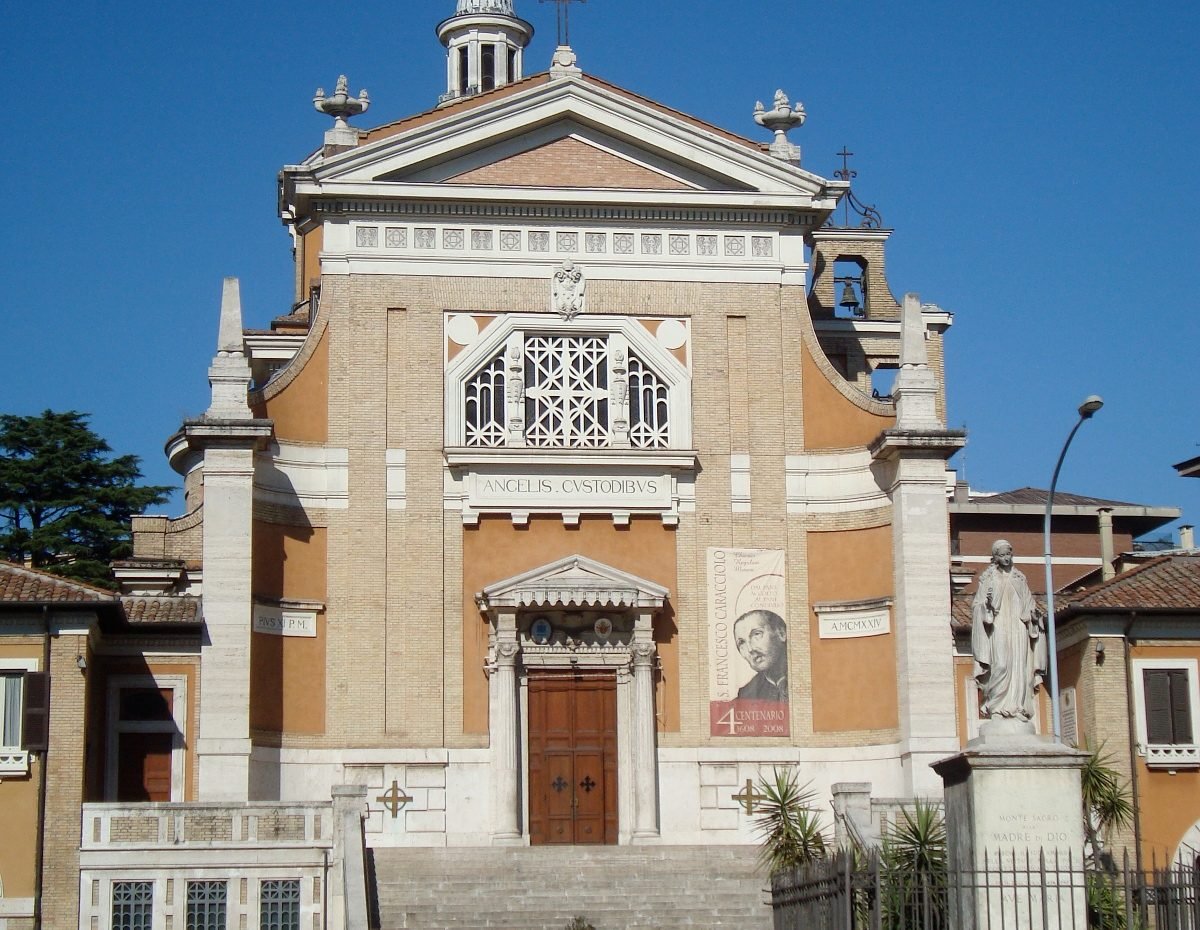
The Church of Santi Angeli Custodi is in Montesacro, on the upper side of Piazza Sempione, and the address given by the Rome city tourism portal and the city listings is Via delle Alpi Apuane 1, 00141 Roma. Something that confuses many people: you see the church from Piazza Sempione, the staircase comes down to the square, but the official street number is on Via delle Alpi Apuane, which is the street running alongside it. If you search for "Piazza Sempione" on your GPS you get there all the same, but then don't be surprised if the rectory's doorbell is around the corner. The contacts published on the listing of the Turismo Roma portal are 06 86899433 and 06 86899480, with the email santiangelicustodi@yahoo.com and the parish website santiangelicustodi.org. The number 06 86899480 also appears on the home page of the parish website.
The Church of Santi Angeli Custodi doesn't appear in any of the guidebooks you buy at the airport. It is not an ancient church. It has no Caravaggio. It doesn't even have a Cosmatesque floor. It has something that almost no church in the center has anymore: a real neighborhood around it, which uses it every day, and a 20th-century history you can touch, including two plaques that tell serious things. If you are doing the tour of the seven basilicas, this one is no use to you. If instead you want to understand how Rome expanded in the 1920s and what that Rome looked like, then go up to Piazza Sempione.
Where exactly the Church of Santi Angeli Custodi is and how you get there
The church closes off the north side of Piazza Sempione in scenic fashion, in the Monte Sacro neighborhood, Municipio III, above the bend of the Aniene. Whoever arrives from Rome along Corso Sempione finds it exactly on axis, at the end of the perspective, above a staircase. It is no accident: the Comitato Salviamo piazza Sempione, which published in November 2022 a very detailed listing on the church, explains that Gustavo Giovannoni designed the building following a principle of Leon Battista Alberti, that is, that the church should stand in an elevated place, isolated in a noble square, and detach from the ground by means of an underlying structure. Translated: the staircase is not decoration, it is the design.

Where is the church of Santi Angeli Custodi in Rome
It is in Montesacro, in the Monte Sacro neighborhood, facing Piazza Sempione, with the address Via delle Alpi Apuane 1. It is northeast of the center, beyond the Aniene, on the axis of Via Nomentana. From the Colosseum it is about six kilometers as the crow flies, but the feeling is of another city: here there are no tour groups, no selfie-stick sellers, and at eight in the evening the square is full of neighborhood kids. The Church of Santi Angeli Custodi is the backdrop to all of this. If you expect the historic center, you have the wrong expectation and end up disappointed. If you expect lived-in Rome, that is exactly what you find.
How to get to Piazza Sempione by public transport
By bus, and it is the most direct way. An official notice from Roma Servizi per la Mobilità, published for the religious festival of Piazza Sempione with a partial closure of the square until May 24, 2026, lists in black and white the lines that normally stop at Piazza Sempione: 66, 82, 211, 211F and 351. The same notice cites, for the area immediately around, also lines 311 and 338 on Viale Tirreno and the night line n92, whose terminus in those days was moved to Via Cimone. It is the most reliable list, because it comes from the city's mobility agency and not from an aggregator. On Corso Sempione, a little lower down, the 60 and the 90 also pass: RomaToday devoted an article precisely to the unified stop on Corso Sempione for these two lines.
What is the nearest metro stop to the Church of Santi Angeli Custodi
The most convenient is Conca d'Oro, on the B1 branch of line B, opened to service on June 13, 2012. From there to Piazza Sempione you get there on foot or by bus, but the walking part is not trivial: the station has its platforms 20 meters below street level, so between escalators and the climb up it takes you longer than you think. If you have suitcases or a stroller, better to take the bus at street level. Conca d'Oro has an ATAC stop at street level and a taxi stand, and since March 2024 also an underground car park with 200 spaces: that, if you arrive by car from outside Rome, is the most sensible solution. You leave the car there and do the last stretch by public transport.
Can you arrive by car and park near the church
You can get there by car, but parking is the sore point and for some years now it has been even more so. Piazza Sempione was pedestrianized with a redevelopment project whose works, according to Il Messaggero, started in June 2021, and the removal of parking spaces was one of the main criticisms from shopkeepers reported by that newspaper. So: in front of the Church of Santi Angeli Custodi today you don't park. You have to circle the streets of the ring, Viale Adriatico, Viale Carnaro, Viale Gottardo, Via Cimone, and hope. The blunt advice is not even to try on Sunday morning, when there are several Masses in a row and the whole neighborhood is there.
How long it takes to visit the Church of Santi Angeli Custodi
20 minutes is enough for the interior, 40 if you stop to look properly at the dome and the two side chapels. But it is a visit that makes sense only inside a wider outing: the church alone doesn't justify the trip from Trastevere. If you go, put it in an afternoon that includes the square, Ponte Nomentano and a walk along the Aniene. With that cut the afternoon fills up well and you go home with something none of the other tourists have seen. By itself, the monument is a little under half an hour. With the neighborhood around it, it is a full three hours.
A curiosity about the Church of Santi Angeli Custodi
The altarpiece you see behind the main altar is not an original, and it is a declared copy. Father Michele De Angelis, of the Clerics Regular Minor, painted it in 1925 tracing Guercino's Guardian Angel, the famous picture kept in Fano. So far, nothing odd: devotional copies were common practice. The real curiosity is another: in his version, De Angelis changed the background and put Ponte Nomentano in it. That is, he took a 17th-century masterpiece from the Marche and transplanted it into the landscape of the neighborhood that was being born right below, 500 meters from the church. It is a gesture that today we would call localization, made in 1925 by a friar painter.
You find this told in the listing of the Comitato Salviamo piazza Sempione, and it is worth stopping to look at it in person, because in photos the background gets lost. You stand at the back of the nave, look toward the apse, and look for the bridge with the towers behind the angel. When you recognize it, the church stops being just any 20th-century church and becomes the portrait of a piece of Rome.
Who Guercino was and why the Guardian Angel is famous
Giovan Francesco Barbieri, known as Guercino, is one of the greats of the Italian 1600s, and his Guardian Angel is today in the Museo Civico of Fano. The museum's audio guide listing says that the patron was Vincenzo Nolfi, a literate and devout nobleman, and that the painting originally stood on an altar of the church of Sant'Agostino in Fano. The scene shows an angel of imposing physique embracing a naked child kneeling in prayer, with the divine light piercing the clouds. The museum also notes a curious aftermath: that picture inspired a poem by Robert Browning in 1848, and from that poem the Fano Club was born in the United States in 1912. A picture from the Marche, an English poet, an American club, and a Roman copy in Montesacro with Ponte Nomentano in the background.
Why a Roman church copies a picture from Fano
Because the subject was exactly what was needed. The church is dedicated to the Guardian Angels, and Guercino's Guardian Angel was, and is, the most recognizable image of that theme in Italian painting. A parish priest in 1925 who has to fill an apse and doesn't have the money for a top-level commission chooses the strongest iconography available and has it replicated in house, by a confrere who knows how to paint. It is a practical choice, not a trick. And the fact that De Angelis slipped Ponte Nomentano into it shows he wasn't just photocopying: he was adapting.
What you really see when you enter the Church of Santi Angeli Custodi
You enter and the first impression is of spaciousness, not richness. The nave is single, and the measurements given by the listing of the Comitato Salviamo piazza Sempione are 39 meters by 20, with a trilobate plan: the central apse is flanked by two side apses that act as a transept, and near the entrance there are two chapels. Above, the dome: 12 meters in diameter, 37 meters high. Giovannoni applied to it his studies on the double dome, the technique of Bramante and Michelangelo. It is not a textbook detail: it is the reason why, from inside, the volume seems taller than you would expect from outside.
The second impression is that the interior is much more painted than Giovannoni had planned. And it's true. The architect had imagined an austere space, decorated in stucco but not frescoed. The frescoes came later, in two waves, and completely changed the character of the place. Some consider it a betrayal of the design and some consider it the natural settling of a neighborhood church. The second view is the more convincing, but the first is perfectly understandable: the Church of Santi Angeli Custodi in white and stucco would have been something else, more severe and perhaps more modern.
Who frescoed the dome of the Church of Santi Angeli Custodi
Aronne Del Vecchio, a painter who lived between 1910 and 1998. On the dating the sources don't agree: the Comitato Salviamo piazza Sempione speaks of a decorative campaign between 1958 and 1963, Italian Wikipedia and the Turismo Roma portal date the frescoes of the dome to 1962, the English Wikipedia entry dates them to 1961. What all the sources say in agreement is the subject: adoring angels, the archangels Michael and Raphael, the Holy Trinity and the Paradise of the angels, with the Virgin Mary. In the pendentives at the base of the dome are the four Evangelists.
What else Aronne Del Vecchio painted inside the church
Not just the dome. Again according to the Comitato's listing, in the side apses there is the Sacred Heart of Jesus, and at the sides of the church the Nativity and the Deposition of Christ. They are works that are best seen in afternoon light, when the sun comes in from the high windows. A technical detail that almost nobody tells: on the outside the dome had small aedicules with windows, and those windows were later walled up precisely in order to make the interior frescoes. That is, it was decided to sacrifice natural light in order to have painted surface. It's a decision you can see: the dome today is darker and more theatrical than Giovannoni had conceived it.
What is in the two side chapels
The right chapel is dedicated to the Most Holy Crucifix and contains a plaster reproduction of the wooden Crucifix of the Church of the Gesù, the Jesuit church in the center. It was restored in the 1980s and today looks rather bare. The left chapel is dedicated to the Madonna della Misericordia, who is the neighborhood's patron, and houses a polychrome wooden statue of the Virgin with Child donated in 1925 by Cardinal Pompilj. The two chapels were designed by Father Michele De Angelis, the same as the apse. If you have little time, look at the left one: the neighborhood's devotion passes through there, and on feast days you can tell at a glance from the flowers.
Is there an organ in the Church of Santi Angeli Custodi
Yes, and it is a Tamburini, opus 151, eight stops on two manuals and pedalboard, placed on the inner wall of the facade above the entrance portal. Here too the sources differ on the year: Italian Wikipedia dates it 1931, the Comitato Salviamo piazza Sempione dates it 1933. Eight stops are few, it is a parish instrument and not a concert one, so don't expect the sound machine of a basilica. But it is a period Tamburini in a declared good state of preservation, and for those interested in Italian organs of the early 1900s it is a piece worth a photograph from below.
What the facade is like and what is written on it
The facade is in brick and travertine, and the whole play lies in the contrast between the brick and the light stone. It has two orders, a classical tympanum, a pediment with a stucco frieze and a small-temple portal in travertine with Ionic columns. Along the cornice runs the inscription ANGELIS CVSTODIBVS. There is one element that scholars call Baroque: the slightly concave line at the sides, which converges toward the square and embraces it. On the large window above the portal the sources don't say the same thing: the listing of the Comitato Salviamo piazza Sempione explains that in place of the traditional rose window Giovannoni put a large latticed window woven like lace, while the Roma.com portal speaks precisely of a rose window under the tympanum. Look at it yourself and judge: from the bottom of the staircase you see it perfectly.
Why the bell tower is so small
Because the big one was never built. The initial project foresaw an important bell tower, later replaced by a bell-gable structure on the right. There are three bells, of the flying-clapper type, made by the Pasqualini foundry of Fermo and installed in 1931. This is one of those things that explain more than a thousand words how neighborhood churches were built in those years: you started with ambition and ended with what was in the till. The result, however, works: a tall bell tower would have competed with the dome, and the dome is the true sign of the Church of Santi Angeli Custodi on the Montesacro skyline.
Something nobody tells you about the Church of Santi Angeli Custodi
Inside that dome, in February 1944, some boys hid. It is not a neighborhood legend: it is a documented fact and is today remembered by a plaque on the facade. During the Nazi roundup of February 3, 1944, when the Fascists blocked the access roads to the neighborhood, the parish priest Father Fiorello Piersanti hid some young anti-Fascists in the dome of the church. The names that circulate in the most detailed reconstruction, the one published by Andrea Gaddini on his page about the Resistance in Montesacro, are Nicola Rainelli, Luciano Celli, Franco Caccamo, Aldo and Mario Gaudiano.
On March 17, 2022 Father Piersanti was remembered with a Civico Giusto, the plaque with the carob tree symbol that in Rome is affixed to the houses of those who protected the lives of the persecuted. The plaque is on the facade of the church. Here is the thing: most of the people who climb that staircase on Sunday don't raise their eyes and don't see it. You raise yours. The Church of Santi Angeli Custodi has a dome frescoed with the angels of Paradise and, under those angels, a real hiding place used by real people who were risking their skin. The two things are in the same building, a few meters from each other.
Can you go up into the dome of the Church of Santi Angeli Custodi
No organized visit to the dome appears, and no source publishes hours, prices or ways of access to the inner walkway. So the honest answer is: n/a. It is not like the dome of Saint Peter's, there is no ticket office and no equipped route. If you are interested, the only way is to ask at the parish at the published numbers, knowing that the most likely answer is no.
Where exactly the Civico Giusto plaque is
On the facade of the church, according to Andrea Gaddini's reconstruction. It is a small plaque, with the carob tree, and it is the kind of object you notice only if you know it's there. The Civico Giusto project affixes these plaques on Roman buildings where someone hid Jewish families and persecuted people during the Nazi-Fascist occupation. Take 30 seconds to look for it before going in: it changes the way you then look at the interior.
The neighborhood around it: Città Giardino Aniene
To understand the Church of Santi Angeli Custodi you have to understand why the neighborhood exists. Città Giardino Aniene was born in the early 1920s applying to Rome the principles of Ebenezer Howard's garden cities, and the urban plan is by Gustavo Giovannoni, the same man who then kept the design of the church for himself. The listing of ArchiDiAP, the digital architecture archive of the Department of Architecture of Sapienza, places the cooperative in 1919 and the passage of management to the Istituto Case Popolari in 1923. The Comitato Salviamo piazza Sempione dates the start of works to the end of 1920 and completion within a decade. The portal of Via di Francesco walking route in Lazio speaks of a Giovannoni project from 1919, of plots of about 1,000 square meters and of 700 villas already built by 1924.
The layout is of two road rings forming a kind of figure eight: the north ring on Viale Adriatico and Viale Carnaro, the south ring on Viale Gottardo and Via Cimone. The streets bear names of mountains and geographic places, and that is why you find yourself on Via delle Alpi Apuane in front of a church. Piazza Sempione is the civic heart: church, civic building with clock tower, cinema theater. ArchiDiAP attributes to Innocenzo Sabbatini the buildings of Piazza Sempione and to Alfredo Energici other structures, while to Giovannoni remain the general plan and the church. By a resolution of July 16, 1924 the area became the XVI Quartiere of Rome with the name Monte Sacro, and in 1927 10,000 people lived there.
Why it is called Monte Sacro
From the hill on which, according to tradition, the first secession of the Roman plebs took place. And here there is a discrepancy: the Comitato Salviamo piazza Sempione gives 495 BC, while the Wikipedia entry on the secessions of the plebs, which follows Livy, gives 494 BC. Both dates circulate. What is shared is the story: the plebeian soldiers withdrew to the Monte Sacro, three miles from Rome, and the Senate sent Menenius Agrippa to persuade them to return, which according to Livy he managed to do by telling the fable of the limbs and the stomach. The same entry warns that on the exact number of secessions there is no unanimous agreement among historians and that the destruction of Rome's archive in 390 BC made it difficult to distinguish historical fact from oral tradition.
What has happened in Piazza Sempione in recent years
It has been pedestrianized, and it has split the neighborhood into two camps of fans. The redevelopment project bears the signature of Studio Bradaschia and of Maurizio Bradaschia, with the City of Rome as client, with completion year given as 2022 in the listing of the BIG SEE prize, where the project appears as winner of the BIG SEE Architecture Award 2023. The works, according to Il Messaggero, had started in June 2021. The criticisms collected by that newspaper are precise: little greenery and no trees, hence no shade, backless benches described as boulders, absence of trash bins, damage to shopkeepers because of the removed parking, fear of a nighttime movida scene. The article describes it as an orderly but empty expanse of concrete.
What the statue of the Madonna in the middle of the square is
It's the Marian monument that the Romans of Montesacro consider a piece of the neighborhood's identity, and it stands on the traffic island of the square. On the date, sources diverge: RomaToday and the portal for Via di Francesco in Lazio give 1948, while the English Wikipedia entry on the church speaks of a statue of the Immaculate Conception from 1949, attributed to Gino Giammei, placed in piazza Sempione. In 2021, as part of the pedestrianization project, it had been proposed to move it in front of the staircase of the Chiesa dei Santi Angeli Custodi, in line with the facade. The faithful objected and the statue stayed where it was. It's one of those neighborhood battles that look small from the outside and are worth a decade of meetings from the inside.
Has the statue been restored recently
Yes, by the Sovrintendenza Capitolina, with a conservation restoration that began on May 14 and ended on May 17. The exact year is not given in the RomaToday article. What the article does say is that the previous restoration dated to 1986, on the occasion of Pope John Paul II's visit to the parish, and that after the work the restoration of the fence, better lighting and the return of the parish festival at the end of May were planned.
My advice for visiting the Chiesa dei Santi Angeli Custodi
Go on a Sunday morning, early, at nine, and then stay. The reasoning is simple. The Chiesa dei Santi Angeli Custodi is not a museum, it has no guards, it has no visitor route: it's open when there's a service and in the hours around it. If you get there at three on an August Tuesday afternoon, you risk a closed door and a wasted trip. At nine on Sunday there's Mass, the church is surely open, and above all it's full of the people it was built for. You go in at the back, stay standing, look at the dome while the neighborhood prays. Then you go out, stop on the staircase, and at 10 the square fills with families. That is the Chiesa dei Santi Angeli Custodi worth the trip.
Second tip, and this is the part almost nobody does: after the church, walk down toward the Aniene. From piazza Sempione, following the slope down to the river, you reach ponte Nomentano, the same one that Father De Angelis painted behind the angel in the apse. Seeing the painting first and then the real bridge, 10 minutes away on foot, is the kind of short circuit that stays with you. And since you're already there, it's the natural gateway to the Parco delle Valli and the Riserva naturale Valle dell'Aniene, the green belt that Montesacro looks out on.
Third tip, a contrarian one: don't go in August at noon. Not for the heat, which is everywhere, but because piazza Sempione after the restyling has no trees and no shade, and it's the main criticism Il Messaggero collected from residents. A square without shade in Rome in August at 13:00 is unlivable. Go early in the morning or after 18:00, when the light drops and the travertine of the facade takes on color.
What is the best time of year to go
Late May, if you want to see the neighborhood in festival mode. There's a religious festival in piazza Sempione that brings a partial closure of the square and the rerouting of buses: the notice from Roma Servizi per la Mobilità refers to the partial closure until May 24, 2026 and to the rerouting of lines 66, 82, 211, 211F and 351. RomaToday links the return of the parish festival at the end of May to the work on the statue of the Madonna. If instead you want the church quiet and the good light, October and early November are the right months: low sun, clean air, a neighborhood going about its ordinary business.
Do you need to book to enter the Chiesa dei Santi Angeli Custodi
No, no need to book and there's no ticket: it's a parish church, you just walk in during the hours when it's open. No source mentions a ticket office, a ticket or a booking system, and there's no reason for one. The only caution is respect for the service: if there's Mass, you go in quietly and you don't walk around with a camera in front of the altar. It sounds trivial to say, but in Rome you see worse every day.
Another well-known fact, yet rarely cited
The name of this church is a compensation. The dedication to the Guardian Angels doesn't come from a local devotion in Montesacro: it was wanted by Pope Pius XI to make up for the loss of a building of the same name in central Rome, near the Tritone, which was demolished in those years. The Comitato Salviamo piazza Sempione speaks of a shrine of the same name demolished in Rome. The Roma.com portal writes that the name commemorates the earlier Chiesa dei Santi Angeli Custodi at the Tritone, which was demolished at the end of the 1920s. The two sources don't say the same thing about the nature of the lost building, shrine or church, and no third source that settles the question turns up: it stays open.
The meaning is clear, though, and worth keeping in mind as you climb the staircase: in the 1920s Rome was gutting its center and expanding its outskirts, and the titles of churches demolished inside the walls were transferred outside, to the new neighborhoods. The Chiesa dei Santi Angeli Custodi is one of these transfers. The name traveled from the Tritone to Montesacro inside a crate, as is done with relics. If you think about it, it's the same operation the popes of the 1500s used to move obelisks: take a sign from one place and plant it in another to give it meaning.
The financial contribution goes in the same direction. Pius XI put in a million lire out of his own pocket, or rather the Holy See's, for the construction: Italian Wikipedia, the Turismo Roma portal and Roma.com all agree on this. A million lire in 1924 was not a symbolic sum. It was a political investment, at a time when the Church wanted to hold the new neighborhoods before someone else did.
What does it mean that the church is a cardinal's title
It means that since 1965 the Chiesa dei Santi Angeli Custodi a Città Giardino has been assigned as a title to a cardinal, who formally becomes its titleholder without administering it. It's the system by which cardinals from all over the world remain technically part of the clergy of Rome. The English Wikipedia entry lists among the titleholders Alfredo Pacini from 1967, Sebastiano Baggio from 1969 to 1973, Agostino Cacciavillan from 2001 to 2011 and Angelo Acerbi from 2024. For the parish this means little in daily life and a lot on the occasion: when the titular cardinal takes possession, the church fills up and the neighborhood tidies itself up.
Who runs the Chiesa dei Santi Angeli Custodi
The Clerics Regular Minor, whom everyone in Rome calls Caracciolini after the name of the founder, Saint Francis Caracciolo. The order was born in Naples in 1588 on the initiative of three people: Giovanni Agostino Adorno, from Genoa, who lived from 1551 to 1591, Fabrizio Caracciolo, 1555-1615, and Francesco Caracciolo, 1563-1608. Approval came from Pope Sixtus V with the bull Sacrae religionis of July 1, 1588, and Pope Gregory XIV confirmed the order in 1591. Treccani sums up the order's mission in three items: preaching, education, assistance to the sick and to prisoners.
What is the fourth vow of the Caracciolini
Besides the three classic vows of poverty, chastity and obedience, the Clerics Regular Minor take a fourth vow: not to aspire to ecclesiastical dignities. Pope Clement VIII granted it to them in 1592. In Roman terms: they promise not to make a career. It's perhaps the most interesting detail in the whole history of the order, and it explains why these friars are rarely talked about: they swore not to get noticed. An order with a vow like that running a suburban parish since 1926 is consistent all the way.
Where is the general headquarters of the Clerics Regular Minor today
Here there's a clear contradiction between sources. The Italian Wikipedia entry on the Chierici regolari minori states that the general curia is in Rome at the church of the Santi Angeli Custodi. The order's official website, crmfathers.org, instead publishes as the address of the Curia Generalizia CRM Via Tribuna Campitelli 6A, 00186 Roma, with telephone +39 06 68801819 and hours from Monday to Friday from 8 to 18. That is, the center, near Santa Maria in Campitelli, not Montesacro. Between the two, in our judgment the order's website is more reliable, but it remains a discrepancy between sources. Again according to the order's website, as of December 31, 2005 the Clerics Regular Minor had 15 houses and 86 religious, of whom 44 were priests, with a presence in Congo, Kenya, the Philippines, Germany, India, Italy and the United States.
Hours, Masses and when the Chiesa dei Santi Angeli Custodi is really open
A premise that holds for all Roman parishes: hours change often, especially between summer and winter and in the weeks around Ferragosto, so check before you leave. That said, here is what appears published as of August 2026. The listing on the Turismo Roma portal distinguishes winter hours and summer hours, and itself specifies that hours may vary and that it's best to contact the church.
| Period | Days | Mass times |
|---|---|---|
| Winter | Monday to Friday | 7.00, 9.00, 10.00, 19.00 |
| Winter | Saturday and eves of holidays | 7.00, 9.00, 10.00, 19.00 |
| Winter | Sunday and holidays | 7.00, 9.00, 10.00, 11.00, 12.00, 18.00, 19.30 |
| Summer | Monday to Friday | 7.00, 9.00, 19.00 |
| Summer | Saturday and eves of holidays | 7.00, 9.00, 19.00 |
| Summer | Sunday and holidays | 7.00, 9.00, 11.00, 19.30 |
The home page of the parish website shows a schedule consistent with the winter hours: weekdays 7.00, 9.00, 10.00, 19.00, holidays 7.00, 9.00, 10.00, 11.00, 12.00, 18.00, 19.30, eve of a holiday at 19.00. Be careful, though: the parish page contains material dated 2018, so it shouldn't be considered a source updated to 2026. To be sure, call 06 86899433 or 06 86899480.
What time does the Chiesa dei Santi Angeli Custodi open and close
The opening time of the door, as distinct from the Mass times, does not appear to be published by reliable sources: n/a. The practical rule for Roman parishes is this: open around the first morning Mass, often closed in the middle of the day, reopened an hour before the evening Mass. For this church, with that schedule of services, the safest window remains the morning between 7:00 and 11:00 and the late afternoon after 18:00. But it's a rule of thumb, not an official schedule.
Can you visit the Chiesa dei Santi Angeli Custodi during Mass
You can go in, you can stay at the back, you can't walk around the nave taking pictures. It's a living church, with a community that uses it, and on Sunday there are families, children, catechism. The right way is to go in, sit or stand by the inside of the facade, look at the dome and the apse from there, and put off the full tour until the service is over. Besides, it's also in your interest: after Mass the church empties in five minutes and you find yourself alone under 37 meters of dome.
The right photo to take at the Chiesa dei Santi Angeli Custodi
The right photo is taken from corso Sempione, walking toward the square, with the church at the end and in line. Not from below the staircase, not at three quarters, not with the wide angle stuck to the portal. From corso Sempione, because it's exactly the point of view for which the building was designed: the Comitato Salviamo piazza Sempione explains that the Chiesa dei Santi Angeli Custodi is the only building facing the main access of the square and forms the scenic backdrop for those arriving from Rome. Giovannoni worked for that framing. You stand where he wanted you to, and forget about creativity.
On timing: late afternoon. The travertine of the portal and the frames, against the brick, takes a warm light that at noon goes completely flat. In summer we're talking after 19:00, in winter after 16:00. And since the facade faces south, early in the morning you get it in flat backlight, which is the worst possible combination. If you have only one try, make it in the evening.
What is the best spot to photograph the dome
From far away, not from close. The dome has a diameter of 12 meters and a height of 37 meters, so from below the staircase it disappears behind the pediment and you can't see it. You have to move away: from the end of corso Sempione, or from the streets of the south ring, viale Gottardo and via Cimone, where the fabric is low and the villini with gardens leave you a clear view. From there the dome emerges above the roofs and you understand why it's the sign of Montesacro in the profile of the neighborhood. A practical warning: the trees in the private gardens have grown a lot in a hundred years, so the good spot changes from season to season. In winter, with bare branches, you see better.
Can you take photos inside the Chiesa dei Santi Angeli Custodi
There is no published rule that explicitly forbids or authorizes photographs inside: on the written rule, n/a. The practice of Roman parishes, and common sense, say: no flash, no tripod, no photos during services, and if someone is praying you wait. For the dome you need a steady hand and high sensitivity anyway, because natural light is scarce: remember that the windows of the external aedicules were walled up precisely to make room for the frescoes. That choice made the dome more painted and darker.
What photo do you take of the statue of the Madonna in piazza Sempione
The statue stands on the traffic island in the center of the square, since 1948 according to RomaToday and the portal for Via di Francesco in Lazio, while the English Wikipedia entry speaks instead of a statue of the Immaculate Conception from 1949 by Gino Giammei. Either way, the sensible photo is the one that puts it in the foreground with the church behind: it's the framing that tells the relationship between the two things, and it's also the reason why in 2021 someone proposed moving it in line with the facade. Proposal rejected by the faithful, statue left in its place. Which, from the photographic point of view, is a pity and from the neighborhood's point of view is a victory. The neighborhood has its reasons, but the photo comes out better from the other side.
Do photos come out better now that the square is pedestrian
Yes, and this is one of the few things on which the restyling has objectively improved the situation. Without cars parked in front of the staircase the frontal framing is clean, which 10 years ago was impossible. That said, the same pedestrianization produced what Il Messaggero describes as an esplanade of concrete with no greenery: so you gain in cleanliness of the framing and lose in substance. If you like photographing people, though, the change works in your favor: the pedestrian square in the evening is full of people and the staircase has become a set of bleachers where the kids sit.
What kind of architecture it is, in simple words
Here there's a small mess of labels. Sources classify it in different ways and all are partly true. Italian Wikipedia speaks of monumental classicizing forms with a dome. The Rerum Romanarum site speaks of a building that combines Renaissance and Baroque forms, with a brick facade and travertine elements and a Latin cross plan with circular transepts. English Wikipedia defines it as neoclassical inspired by the Italian Renaissance. The portal for Via di Francesco in Lazio says 16th-century style. The Comitato Salviamo piazza Sempione speaks of a classicizing building with a single nave and a trilobate plan.
Looking at the building, the simplest reading is this: it's a 20th-century church that speaks the language of the Roman 1500s, with some Baroque inflection in the concave sides of the facade, built with the materials and means of the 1920s. The neighborhood around it, according to the ArchiDiAP entry, is held together by the style that in Rome is called barocchetto, that is, that domestic and slightly playful reinterpretation of Roman architecture that you see in villini with little roofs, loggias and small bricks. The church stands a step above: more severe, more monumental, because it had to serve as a backdrop.
What does double dome mean and why does it matter
It means the dome is made of two shells, one inner and one outer, instead of a single one. It's the solution with which Bramante and Michelangelo solved the problem of having a dome that is tall and slender from outside and a vault that is proportioned from inside. Giovannoni, who besides being a designer was a scholar, had worked on that technique and applied it here: the entry from the Comitato Salviamo piazza Sempione says so explicitly. Why should you care? Because it's the reason why this church, which from outside looks medium-sized, surprises you inside. 37 meters of height under the lantern, in a neighborhood parish, is not to be taken for granted.
Who was Gustavo Giovannoni
One of the greatest Italian designers of the 20th century, according to the definition given by the Comitato Salviamo piazza Sempione, and he is the person who designed both the urban plan of Città Giardino Aniene and the church that is its center. ArchiDiAP attributes to him the urban plan of the neighborhood. The portal for Via di Francesco in Lazio indicates him as the designer of 1919 who followed the principles of the English garden cities. There is a vast literature on Giovannoni. What can be said without risk is that in Montesacro Giovannoni did two jobs at the same time, urban planner and architect, and that the coherence between the neighborhood and its church comes from there.
What does ponte Tazio have to do with the neighborhood
It matters because it was the entrance gate. The Comitato Salviamo piazza Sempione writes that ponte Tazio was designed directly by Giovannoni as the main access to the neighborhood, with tram service. The portal for Via di Francesco in Lazio describes it as the overpass of via Nomentana over the Aniene, which provided the connection with Rome and with piazza Sempione, and explains its name: Titus Tatius, the Sabine king. So the overall design was: you arrive from Rome along the Nomentana, you cross the Aniene on ponte Tazio, you go up corso Sempione, and at the end of the perspective there's the Chiesa dei Santi Angeli Custodi. A planned sequence, not a casual one.
Some important events that took place here in history
A premise: on this church the dates wobble quite a lot. The available reconstructions are different: Italian Wikipedia, English Wikipedia, the Turismo Roma portal of the city, the Roma.com site, the Rerum Romanarum site and the entry from the Comitato Salviamo piazza Sempione. On some points they agree, on others they don't, and where they don't agree you find all the versions.
When was the Chiesa dei Santi Angeli Custodi built
The first stone was laid on November 22, 1922, and the Comitato Salviamo piazza Sempione and Rerum Romanarum agree on this. On the duration of the construction site they don't: Italian Wikipedia and Roma.com write that the church was built between 1924 and 1925, while Rerum Romanarum gives the period 1922-1924, by the Consorzio Città Giardino Aniene. The Comitato adds a detail that helps put the pieces together: in April 1924 the exterior structure was almost completed, and at that point the contract was signed between the Unione Edilizia Romana and the Vicariato di Roma. So the most coherent reading, which is an interpretation and not a source, is that the rough structure dates to 1922-1924 and the finishing to 1924-1925.
When was it opened for worship
December 8, 1925, according to the Comitato Salviamo piazza Sempione. Even earlier, on September 13, 1924, the crypt was blessed, today a small theater hall, named Sala Pio XI. Here too, though, there's a discordant and sizable version: the English Wikipedia entry claims that the church was built in 1922 at the wish of Pope Benedict XV, that the Clerics Regular Minor began their activity there on April 7, 1922 and that it was consecrated on December 8, 1922 by Pope Pius XI. The Italian sources confirm none of these three dates. The sources don't agree: the Italian reconstruction leads to 1925, the English one to 1922.
When did it become a parish
Again two versions, and the difference is exactly one year. Italian Wikipedia writes that it became a parish seat on October 2, 1925 with the apostolic constitution Ad culmen apostolicae of Pius XI, entrusted to the Clerics Regular Minor. The Comitato Salviamo piazza Sempione writes that it became a parish on October 2, 1926, again by apostolic constitution and again entrusted to the Clerics Regular Minor. English Wikipedia says generically 1926. The day and month coincide, October 2, which in the liturgical calendar is precisely the memorial of the Holy Guardian Angels: that date is no accident. On the year, the sources don't agree.
What happened here during the war
The best documented fact is that of February 3, 1944. According to Andrea Gaddini's reconstruction of the Resistance in Montesacro, during the Nazi roundup of that day the Fascists blocked the accesses to the neighborhood and the parish priest Father Fiorello Piersanti hid some young anti-Fascists in the dome of the church: Nicola Rainelli, Luciano Celli, Franco Caccamo, Aldo and Mario Gaudiano. On March 17, 2022 he was dedicated a Civico Giusto, the plaque with the carob tree, placed on the facade of the church.
The same source places the neighborhood within a broader history of clandestine struggle: in via Maiella at the corner with corso Sempione there's a plaque from 1945 commemorating the 14 martyrs of Montesacro and Val Melaina, a plaque that between October 21 and 22, 2004 was seriously damaged and set on fire. Also in via Maiella, on December 14, 1943, the consul of the Fascist militia Nussu was hit by six bullets in a partisan attack. The portal for Via di Francesco in Lazio confirms the general picture: sabotage actions against the Germans and young anti-Fascists of the neighborhood killed at the Fosse Ardeatine.
When was the interior decorated
In two phases. In 1925 Father Michele De Angelis, who lived from 1885 to 1982, painted the Guardian Angel in the apse behind the high altar, copying the Guercino of Fano and putting the Ponte Nomentano in the background, plus the side medallions with the Guardian Angel at the beginning and at the end of life and the Risen Christ in the infill of the oval large window. Then, much later and thanks to the donation of a benefactress, came Aronne Del Vecchio, 1910-1998, with the great campaign of frescoes. On the dating of this second campaign, as said, the sources diverge: 1958-1963 for the Comitato, 1962 for Italian Wikipedia and for Turismo Roma, 1961 for English Wikipedia.
Have there been recent restorations
On the building, the documented works date to the 1980s: the chapel of the Santissimo Crocifisso was restored in that decade, taking on a more austere look, and the presbytery was reorganized to comply with the liturgical directions of the Second Vatican Council, with a new altar, wooden choir and marble flooring. More recent restorations of the church don't appear to be published by reliable sources. What is documented instead is the conservation restoration of the statue of the Madonna in the square, carried out by the Sovrintendenza Capitolina from May 14 to 17, with the year not specified in the RomaToday article, and the earlier restoration of the same statue in 1986 on the occasion of John Paul II's visit.
What has changed in the square in the last five years
Everything, as far as the ground is concerned. Works started in June 2021 according to Il Messaggero, a project by Studio Bradaschia with Maurizio Bradaschia for the Comune di Roma, with the year of completion given as 2022 in the BIG SEE entry that awarded the project the BIG SEE Architecture Award 2023. Pedestrian square, parking removed, seating in the form of boulders without backs, bollards. The signatures collected against the project were in the thousands, and the question of moving the statue of the Madonna was one of the bitterest points of conflict. Today, if you arrive at piazza Sempione, you walk on a pedestrian square with the Chiesa dei Santi Angeli Custodi at the end and no cars in front. For some it's an improvement, for many residents it's not.
Who has passed through the Chiesa dei Santi Angeli Custodi
The biggest name is John Paul II, who made a pastoral visit to the parish on April 6, 1986. Italian Wikipedia, the Turismo Roma portal, Roma.com and the Comitato Salviamo piazza Sempione agree on this date, and Rerum Romanarum adds that the visit is remembered by a plaque next to the church. It's not a small detail for a neighborhood: that visit is still today the time reference by which things are dated in Montesacro, so much so that the restoration of the statue of the Madonna in the square was done precisely on that occasion.
Then there are the popes who were never there but counted all the same. Pius XI, who put in the 1 million lire and wanted the dedication to the Guardian Angels. And Cardinal Pompilj, who in 1925 donated the polychrome wooden statue of the Madonna and Child now in the left chapel.
Who have been the parish priests of the Chiesa dei Santi Angeli Custodi
The succession published by the Comitato Salviamo piazza Sempione is this, and it has the merit of being a continuous list of almost a hundred years.
- Father Guglielmo Marinelli, from 1927 to 1968. 41 years: the parish priest who built the community and who was there during the war and the reconstruction.
- Father Luigi Affoni, from 1969 to 1976.
- Father Nello Morrea, from 1976 to 1994.
- Father Mario Aceto, from 1994 to 2024. A round 30 years.
- Father Joby Emmanuel, from 2024.
Five parish priests in a century. It's a parish with a continuity that almost no church in the historic center can claim, because in the center churches are often rectories or titles without a resident population. Here instead there's a community that has passed the baton for generations, with two very long terms, Marinelli and Aceto, which alone cover 71 years out of a hundred.
Which cardinals have held the title of this church
The cardinal title of the Santi Angeli Custodi a Città Giardino has existed since 1965. Among the titleholders, according to the English Wikipedia entry, have been Alfredo Pacini from 1967, Sebastiano Baggio from 1969 to 1973, Agostino Cacciavillan from 2001 to 2011 and Angelo Acerbi from 2024. The list is not complete. If you're interested in the full succession, the source to look for is the Annuario Pontificio.
Ponte Nomentano, the piece that gives the visit its sense
If you make only one detour after the church, make it toward ponte Nomentano. It's a short way off, down below, where via Nomentana crosses the Aniene between the urban zones of Monte Sacro and Sacco Pastore in Municipio III. And above all it's the backdrop that Father Michele De Angelis painted behind the Guardian Angel in the apse of the Chiesa dei Santi Angeli Custodi in 1925. Seeing one and then the other in the same hour is the reason why this outing makes sense beyond the single church.
Its history is truly long. The first construction dates to the Republican age, and the bridge was rebuilt after Totila's invasion in the 6th century. In the 8th century it was fortified with two towers under Pope Hadrian I. In 1433 it was occupied by condottieri, in 1485 by Paolo Orsini, and at the time of the Pazzi conspiracy it was a possession of that family. In 1532 it became the city customs house. The two towers have Ghibelline crenellation, were reinforced with walls between the 12th and 13th centuries and later raised under Nicholas V. It suffered destruction during the French invasion of 1849, repaired seven years later. In 1997 it was closed to car traffic and in 2002 restored. Today it's an exclusively pedestrian route, occasionally open to the public, from which the internal structures can be visited.
Can you walk across ponte Nomentano
Yes, it's been pedestrian since it was closed to traffic in 1997 and restored in 2002. On the extraordinary openings that allow you to visit the internal structures of the towers, the sources say they happen occasionally but don't publish a calendar: on dates and hours, n/a. The advice: consider the bridge something to see from outside and to walk across, and the tower visits an unpredictable bonus. If you happen to be there on the right day, all the better.
How long does it take on foot from the church to ponte Nomentano
It's a short descent, the kind that in Rome takes a little under a quarter of an hour including stops. The exact minutes depend on the route you choose and on the traffic at the crossings of the Nomentana, which at that point is a serious road and not an alley. What's certain is that it's all downhill on the way there and all uphill on the way back: if you have knee problems or you're with someone who walks poorly, take it into account and consider going back by bus instead of on foot.
What to see around the Chiesa dei Santi Angeli Custodi
This is the part where the outing turns into a day. Montesacro has no postcard monuments, but it has the river, it has greenery and it has two or three serious things a short distance away on the Nomentana and Salaria axis. Here are the stops, in order of convenience.
- The Parco delle Valli, the large green area next to the neighborhood and to Conca d'Oro station. It's the natural place to let the children breathe after the church.
- The Riserva naturale Valle dell'Aniene, the protected belt along the river, with paths that start right from the Montesacro area and go very far.
- The Parco di Aguzzano, a little further east, for those who want to extend the walk inside the green of the Municipio.
- The Priscilla Catacombs on the Salaria, the serious archaeological monument closest to this area, which builds a strong contrast with the church of Montesacro: underground chambers of the 3rd century and a church of the 1920s in the same afternoon.
- Villa Torlonia, also on the Nomentana but closer to the center, with its Casino Nobile, if you want to end the day inside a house museum.
- Villa Ada, on the other side of the Salaria, for those who prefer big green space to a museum.
- The basilica of San Lorenzo fuori le Mura and the Verano Cemetery, if you want to understand how Rome treated its outskirts before Città Giardino was born.
A note on how to fit them together. Don't try to do Catacombe di Priscilla and Villa Torlonia on the same day as the church if you're moving only by public transport: that's three transfers and you eat up the afternoon on buses. Choose: either the green package, church plus river plus parks, or the Nomentana package, church plus one of the two historic stops. Doing everything is the recipe for seeing nothing.
Are there other interesting churches in the Montesacro area
Within Montesacro there are several 20th-century parishes, but none with the architectural history of the Chiesa dei Santi Angeli Custodi. If you're interested in the strand of Roman churches with important works of art, it's worth heading toward the center: the Chiesa di Sant'Ignazio di Loyola with Pozzo's vault is the most useful yardstick for understanding what a painted ceiling can do when there is money and there are masters, and the comparison with Del Vecchio's dome is instructive precisely because it's merciless.
Is there anything to do in the evening in piazza Sempione
Yes, and this is one of the reasons why pedestrianization has divided the neighborhood. The pedestrian square fills up in the evening, and the fear of the so-called nightlife is one of the criticisms Il Messaggero collected from residents. From the point of view of the visitor, this means that in the evening piazza Sempione is alive, with venues and people sitting on the steps, and that the illuminated Chiesa dei Santi Angeli Custodi serves as a backdrop. From the point of view of those who live there, it means noise under the windows. Both are true and they don't cancel each other out.
Are there any events in Montesacro in summer
On the bank of the Aniene, yes. There's a summer program tied to Parco Nomentano that brings together music, theater and culture, and you find it in the listing for the Aniene Festival 2026. It's the kind of event that makes an evening around here make sense even for those who don't live in the area: you visit the church in the late afternoon, walk down toward the river, and stay there in the evening. For the precise calendar, the dates and any program changes, look directly at the event listing, because those things change week by week.
The church as a stage on a walking route
There's a detail almost nobody knows and that for some visitors changes everything: according to the Comitato Salviamo piazza Sempione, the Chiesa dei Santi Angeli Custodi is the arrival point of the first stage of Via del Sud from Rome to Assisi, one of the routes of Via di Francesco. That is, whoever leaves the center of Rome on foot to go to Assisi arrives here on the first day. This explains why in the neighborhood every now and then you see people with big backpacks and walking poles, and it also explains why the official portal for Via di Francesco in Lazio devotes an entry to Città Giardino.
If you're interested in that world, the thing to understand is that a walking stage is not an outing: the first stage from Rome serves to get out of the city, and for those walking, the church of Montesacro is the signal that the traffic is over and that the Aniene countryside begins. Seen from there, Giovannoni's staircase has a completely different meaning: it's not a scenic backdrop, it's a finish line at the end of the day.
Where does the first stage of Via del Sud toward Assisi start
From Rome, and it arrives here according to the entry from the Comitato Salviamo piazza Sempione. The exact starting point in the center, the mileage and the elevation gain don't appear to be published by a verifiable source: n/a. The institutional portal of reference for the Lazio stretch of the route is the one for Via di Francesco in Lazio, and there you find the entry on Città Giardino. For the complete route and the technical data of the stage, that's the way to go.
The practical things people always ask
This is the boring and useful section. Where a piece of data isn't published, you'll find it written: better one more phone call than a lost afternoon.
How much does it cost to enter the Chiesa dei Santi Angeli Custodi
Nothing. It's a parish church of the Vicariato di Roma entrusted to the Clerics Regular Minor, not a museum, and there's no ticket. No source mentions a ticket, a mandatory contribution or a paid reservation, and the opposite would be strange. The only thing you'll find is the offering box, which is a different matter and not an entrance fee. If someone offers you a paid tour that includes entry to this church, know that you're paying for the guide, not for the door.
Is the church accessible to people with mobility difficulties
Here honesty is needed: the staircase is the problem, and it's the problem by design. The building is raised above the square precisely because Giovannoni wanted to detach it from the ground with a structure underneath, so the steps are not an accessory, they are the layout. An alternative level entrance on the via delle Alpi Apuane side is not documented by any published source, so on accessibility the data is n/a: better to phone the parish at 06 86899433 or 06 86899480 before setting out with a wheelchair.
Can you get married in the Chiesa dei Santi Angeli Custodi
It's a fully active parish, so weddings are celebrated, like baptisms and funerals. The conditions, the required documents, the booking times and any offerings don't appear to be published. The procedure is always the same all over Rome: you talk to the parish priest, you go through the couple's home parish, you do the courses. The parish priest in office since 2024, according to the list published by the Comitato Salviamo piazza Sempione, is Father Joby Emmanuel.
Is it suitable for children
The church itself is short and young children find it zero interesting, like all churches. What works with children is the surroundings: the pedestrian square, where they can run without cars, and the green a few hundred meters away between Parco delle Valli and the reserve along the Aniene. If you have children, flip the order of the day: first the park, then the church at the end of the afternoon when they're tired and sit down. The dome with the angels, if you tell it to them as a story instead of as art history, does have an effect: it's 37 meters over their heads and they notice it.
How do you dress to enter
As in any Catholic church: shoulders and knees covered. There's no check at the entrance like at St. Peter's, because there's no check at the entrance at all, but this is a neighborhood parish and on Sunday you find elderly ladies who have been going to Mass for 70 years. Respect here isn't a rule written on a sign, it's a matter of good manners, and it shows much more than in a basilica full of tourists.
Where to eat in Montesacro near the church
No names here. Not because there aren't any, but because restaurant tips copied from reviews are exactly the kind of content that lands you in a place that's been closed for two years. One criterion holds: piazza Sempione and the streets of the rings, viale Adriatico and viale Gottardo in particular, are a residential neighborhood area with a local clientele, so value for money is normally better than in the center and tourist menus don't exist. Look around, go in where there are local people, and don't worry.
Are there public restrooms in the area
No source documents public restrooms in piazza Sempione: n/a. The standard Roman solution is the bar: have a coffee and ask. With the square pedestrianized, the venues around it are the most obvious resource. Among the criticisms of the restyling collected by Il Messaggero there is also one detail: in the renovated square people even complained about the absence of trash bins: if you expect the kind of facilities of a monumental square, lower your expectations.
What is overrated and what is really worth it
Here are our tips, which are not sources but practical indications.
Overrated is the frescoed dome. Yet it's the first thing everyone photographs and the only one that ends up in the listings. Aronne Del Vecchio's frescoes are decent mid-20th-century work, but if you have Sant'Ignazio or the Gesù in your head, here you're left with your mouth shut and not open. The value of that dome is not pictorial: it's structural and historical. 12 meters in diameter, 37 in height, double shell according to the technique of Bramante and Michelangelo, in a suburban parish of the 1920s. That is truly remarkable. The painting on top is the blanket they put on it 30 years later.
Underrated, and by quite a lot, is the facade seen from afar. The sequence of corso Sempione, staircase, temple-like portal, pediment, dome behind, is one of the few 20th-century urban perspectives in Rome that really work the way the Baroque ones did. There's no sign that says so, no guide that tells it, and people walk right through it looking at their phones. Stop at the end of the avenue and look for 30 seconds. It's free and it's the best thing about the place.
The trap, instead, is arriving here thinking you'll find a historic Roman church and being disappointed because there's no ancient marble. It's not a commercial trap, it's a trap of expectation, and if you bring it with you, you ruin the visit. The Chiesa dei Santi Angeli Custodi is a building of 1922-1925: if you judge it by the standard of Santa Sabina, it loses. If you judge it for what it is, that is, the civic and religious center of a Roman garden city designed by an urban planner who kept the church for himself, it wins easily.
Is it worth coming all the way here just for the church
No, and it has to be said clearly. If you have three days in Rome and have never been, don't take the bus to Montesacro: you have 50 other things first. The Chiesa dei Santi Angeli Custodi is worth the trip if you fall into at least one of these categories: you're interested in 20th-century Italian architecture, you're interested in the urban planning of garden cities, you're walking Via di Francesco, you've already seen Rome three times and want to see the real one, or you live nearby. Outside these cases, put it on the list for next time.
Is it better than a church in the center
It depends on what you're looking for, and the difference is not one of quality but of nature. A church in the center is a container of art in a neighborhood emptied of residents. This is a church of modest art in a neighborhood full of people. If you want masterpieces, go to the center, no contest. If you want to understand how a real Roman parish works, with the oratory, the catechism, the scouts, the end-of-May festival and the parish priest everyone knows, then this gives you something the center no longer has. Roma.com points out that the parish complex hosts an oratory and scout groups.
How to read Città Giardino on foot
Here is a key to reading, so that the half-hour walk around the Chiesa dei Santi Angeli Custodi becomes understandable instead of generic. The neighborhood is not a grid. The streets are curved and irregular because they follow the topography of the hill instead of imposing a grid on it: it's one of the principles of Ebenezer Howard's garden cities, and it's the reason why you get lost even with the phone in your hand. The load-bearing structure is two rings forming a kind of figure eight, the north ring on viale Adriatico and viale Carnaro and the south ring on viale Gottardo and via Cimone. Piazza Sempione sits at the pinch point of the eight. From there you see everything and everything converges there.
Density is low by design: family-sized villini with a kitchen garden, on lots of about 1,000 square meters according to the portal for Via di Francesco in Lazio, which speaks of 700 villini built by 1924. Alongside the villini, though, the Istituto Case Popolari built semi-intensive buildings for public housing, keeping stylistic coherence in the Roman barocchetto. This is the interesting political detail: in the same area there coexisted houses for employees and public housing, and the cooperatives involved, according to the Comitato Salviamo piazza Sempione, were those of railway employees, state employees and freelance professionals. Rome doesn't have many areas where this experiment can still be read on the ground.
What is the Roman barocchetto
It's the way in which the Roman architects of the 1920s reinterpreted the repertoire of the Renaissance and of the Roman Baroque in a domestic key: projecting little roofs, loggias, exposed small bricks, frames and arches, all on a small and repeated scale. ArchiDiAP defines the style of the neighborhood as barocchetto, a reinterpretation of Roman Renaissance elements. Walking between viale Adriatico and via Cimone you see it everywhere, and it's what gives Montesacro that fake-village air that some love and others find cloying. It was, on reflection, an intelligent way to make new neighborhoods that didn't look like barracks.
Why did the neighborhood stop being a garden city
Because Rome grew over it. ArchiDiAP describes the transformation: in the 1950s suburban expansion and the Grande Raccordo Anulare changed the character of the place, from an intimate garden city to a denser and more compact residential neighborhood. It's the usual Roman story: a model is designed, building pressure arrives, and 20 years later the model survives only in patches. The patches are still there, though, and they are precisely the ones around piazza Sempione. If you move a kilometer away you find big apartment blocks. If you stay inside the eight you find villini.
How many people lived here at the beginning
10,000 inhabitants in 1927, according to the Comitato Salviamo piazza Sempione. Keep it in mind when you look at the size of the church: a nave of 39 meters by 20, a dome of 37 meters, for a catchment of 10,000 people. It wasn't a church oversized on a whim, it was a church sized for a neighborhood that was filling up fast. And in fact the schedule of Sunday Masses, seven celebrations in the winter hours, tells of a parish that kept serving large numbers for decades.
When did Monte Sacro officially become a neighborhood of Rome
By a resolution of July 16, 1924 it became the XVI Quartiere of Rome with the name Monte Sacro. So, chronologically, first comes the settlement, then comes the administrative recognition, and in between the church is built: first stone November 22, 1922, exterior structure almost completed in April 1924, crypt blessed September 13, 1924. The church and the neighborhood were formalized practically together. This simultaneity explains why the Chiesa dei Santi Angeli Custodi never had a phase of being foreign to Montesacro: it was born inside, it wasn't dropped on top.
A two-hour walk, step by step
Here is the recommended itinerary, without times and without distances. They are indications of sequence, not a stopwatch.
- Get off the bus at corso Sempione, not at piazza Sempione, and do the last 100 meters on foot looking at the church at the end. It's the framing it was designed for. If you get off directly in the square, you miss that perspective.
- Stop below the staircase and look on the facade for the inscription ANGELIS CVSTODIBVS and the Civico Giusto plaque dedicated to Father Fiorello Piersanti. Two inscriptions, two different centuries, same wall.
- Go in. Walk to the back of the nave, turn around and look at the inside of the facade: above the portal there's the Tamburini organ. Then go forward again looking at the dome.
- Apse: look for the Ponte Nomentano painted behind the Guardian Angel. It's the only thing in this church you won't find in any other in the world.
- Left chapel, Madonna della Misericordia, polychrome wooden statue donated by Cardinal Pompilj in 1925. Right chapel, Santissimo Crocifisso, with the plaster reproduction of the Crucifix of the Chiesa del Gesù.
- Go out, sit on the staircase and look at the pedestrian square with the statue of the Madonna on the central island. From there you understand the 2021 dispute over moving it.
- Walk down toward the Aniene and ponte Nomentano. Compare the real bridge with the painted one you just saw.
- If you still have legs, step into the green: Parco delle Valli or the reserve along the river.
Can you do this tour in the rain
Badly. Piazza Sempione after the restyling is an open surface without trees, so in the rain you have no shelter except under the porticoes of the venues, and the descent toward the Aniene on wet ground is not great. In the rain the tour shrinks to church plus bar, which is half an hour. If the weather is bad and you're deciding where to go in Rome, this is not the day for Montesacro: move to something indoors, like a house museum or a basilica in the center, and save Montesacro for the first dry afternoon.
Is the tour doable by bicycle
The Aniene area lends itself to it, because the reserve and the parks have paths, but on the presence of continuous bike lanes between piazza Sempione and the river there is no updated institutional source. In the square, pedestrianization has eliminated cars and for a bike that's a clear advantage. The recommendation is not to assume bike routes on via Nomentana based on what you read around: it's a traffic artery and should be treated with respect.
Is the neighborhood safe in the evening
Montesacro is an inhabited residential neighborhood, and in the evening the square is busy. The only concerns published in press sources are about noise and the so-called nightlife after pedestrianization, which is a matter of public quiet and not of safety. The rule that holds for all of Rome holds here too: watch your bags on crowded transit, and no drama for the rest.
The summary sheet, with the sources attached
If you've made it this far and you just want the data, this table sums it up. Where the sources contradict each other, both versions are there.
| Item | Data | Who says so |
|---|---|---|
| Address | Via delle Alpi Apuane 1, 00141 Roma, facing piazza Sempione | Turismo Roma, Oggi Roma |
| Neighborhood | Monte Sacro, Municipio III, Città Giardino Aniene | Italian Wikipedia, ArchiDiAP |
| Architect | Gustavo Giovannoni | all the sources consulted |
| First stone | November 22, 1922 | Comitato Salviamo piazza Sempione, Rerum Romanarum |
| Construction | 1922-1924 or 1924-1925: the sources don't agree | Rerum Romanarum versus Italian Wikipedia and Roma.com |
| Opening for worship | December 8, 1925 according to the Italian sources, December 8, 1922 according to English Wikipedia | Comitato Salviamo piazza Sempione versus English Wikipedia |
| Parish since | October 2, 1925 or October 2, 1926: the sources don't agree | Italian Wikipedia versus Comitato Salviamo piazza Sempione |
| Religious order | Clerics Regular Minor, known as Caracciolini | Italian Wikipedia, Comitato, Roma.com |
| Papal contribution | a million lire from Pius XI | Italian Wikipedia, Turismo Roma, Roma.com |
| Nave | 39 meters by 20, trilobate plan | Comitato Salviamo piazza Sempione |
| Dome | 12 meters in diameter, 37 meters in height, double shell | Comitato Salviamo piazza Sempione |
| Dome frescoes | Aronne Del Vecchio, 1958-1963 or 1962 or 1961 | Comitato, Italian Wikipedia and Turismo Roma, English Wikipedia |
| Apse | Guardian Angel by Michele De Angelis, 1925, after Guercino, with the Ponte Nomentano in the background | Comitato Salviamo piazza Sempione |
| Organ | Tamburini opus 151, 8 stops, 2 keyboards and pedalboard, 1931 or 1933 | Italian Wikipedia versus Comitato |
| Bells | three, swinging clapper, Pasqualini foundry of Fermo, 1931 | Comitato Salviamo piazza Sempione |
| Cardinal title | since 1965, Santi Angeli Custodi a Città Giardino | Italian Wikipedia, Roma.com |
| Papal visit | John Paul II, April 6, 1986 | Italian Wikipedia, Turismo Roma, Roma.com, Comitato |
| Civico Giusto | March 17, 2022, to Father Fiorello Piersanti | reconstruction by Andrea Gaddini |
| Phone numbers | 06 86899433 and 06 86899480 | Turismo Roma, parish website |
| Ticket | none | no source mentions a paid entrance |
| Door opening hours | n/a | no source publishes them |
Why so many different dates for the same church
Because a church is not inaugurated only once. There's the laying of the first stone, there's the end of the structure, there's the blessing of the crypt, there's the opening for worship, there's the liturgical consecration, there's the erection as a parish. They are six distinct moments, often years apart, and popular sources tend to squash them into a single date by picking one at random. For this church the documented sequence is: first stone November 22, 1922, structure almost finished April 1924, crypt blessed September 13, 1924, opening for worship December 8, 1925, parish October 2, 1925 or 1926. Whoever writes "built in 1925" isn't lying, they're simplifying.
Which source to trust if you have to pick one
The entry from the Comitato Salviamo piazza Sempione, for a precise reason. It's the only one that goes into verifiable technical detail, nave measurements, diameter and height of the dome, type of bells and foundry, names and dates of the parish priests, chronological sequence of the works, and the only one that distinguishes the phases instead of flattening them. It's a citizens' committee, not a public body, and that has to be said. But the density of checkable data is of a different order compared to the tourist listings. That said, for hours and contacts the Turismo Roma portal is more reliable, because it's the city's source and it gets updated.
What does trilobate plan mean
It means that the hall, instead of ending with a single apse, widens into three apses: the central one with the high altar and two lateral ones that act as a transept. The result is a clover-leaf plan, hence the name. In practice, when you're under the dome, you find yourself at the center of a space that opens in three directions instead of one. It's the reason why the interior seems larger than its real measurements. Note, though, that the sources don't all use the same vocabulary: Rerum Romanarum describes the plan as a Latin cross with circular transepts, the Comitato Salviamo piazza Sempione as a single nave with a trilobate plan. They describe the same thing with two vocabularies.
What are swinging-clapper bells
They are bells whose clapper is not rigidly constrained but swings freely relative to the movement of the bell, a system that is traditional in Rome and Lazio and gives that slightly irregular, chatty sound you hear in the villages. The three bells of the Chiesa dei Santi Angeli Custodi are of this type, came out of the Pasqualini foundry of Fermo and were installed in 1931 according to the Comitato's entry. If you're in the square at noon you hear them, and they are one of the few original elements of 1931 still working without modification.
What is the difference between a parish and a basilica
A parish is a territorial unit of the diocese with an assigned people and a parish priest who looks after it. Basilica is an honorary title that the pope grants to churches of particular importance. The Chiesa dei Santi Angeli Custodi is a parish, not a basilica, and no source gives it the title of basilica. It is also, since 1965, a cardinal's title, which is yet a third thing: it means that a cardinal bears its name as a sign of his bond with the clergy of Rome, without governing it for that.
Last-minute questions
Can I see the church from outside if it's closed
Yes, and it's half the value of the place. Facade, staircase, perspective from corso Sempione, dome seen from the south ring, Civico Giusto plaque, statue of the Madonna on the central island of the square: all of this is outdoors and doesn't depend on any schedule. If the door is closed you still have a walk that's worth it, as long as you know what to look at. The piece you miss is the apse with the painted Ponte Nomentano, and that one, yes, is a shame.
Is there a coat check, a luggage storage, a bookshop
No to all three questions: no source mentions services of this kind, and that's normal, because it's a parish and not a museum site. Don't arrive here with suitcases thinking you can leave them somewhere. If you're coming from the station, use the storage at Termini and then head up to Montesacro light.
Are there guided tours of the Chiesa dei Santi Angeli Custodi
There doesn't appear to be a program of official guided tours from the parish or from public bodies. The church appears as a location in the Italy for Movies database, which is the portal of Italian film locations, but that's something else and concerns productions, not visitors. If you want a narrated visit, the practical way is to go with someone who knows the history, or to read what's written above first and walk on your own.
Has the church been used for films or series
It is listed in the location database of Italy for Movies, the national portal of film locations. Which films were shot there doesn't appear from verifiable sources, so no titles are listed. So: listed as a location, yes, specific titles, n/a.
The Chiesa dei Santi Angeli Custodi is not a place that changes your vacation. It's a place that changes your idea of Rome, if you go with the right head on. A hundred years ago this was countryside, then someone designed a neighborhood with two rings in the shape of a figure eight, put a square in the middle of it and at the end of the square a church with a double dome, and convinced a pope to put in a million lire. 20 years later, in that same dome, a priest hid five boys while the Fascists were closing the streets. 60 years after that, the neighborhood split in two over whether to move a statue by 20 meters. All of this fits in 200 square meters of square. Not bad for a place that doesn't appear in any guide.
Contact Information
Via delle Alpi Apuane , 1
Roma Roma Città, Roma Città