Casotto at Ex Elettrofonica, October 16 to December 20, 2026
In short. Casotto, the group exhibition curated by Marco Raparelli, opens on Friday, October 16, 2026 at the Ex Elettrofonica gallery, at Vicolo di Sant'Onofrio 10, at the foot of the Janiculum, and can be visited until Sunday, December 20, 2026.
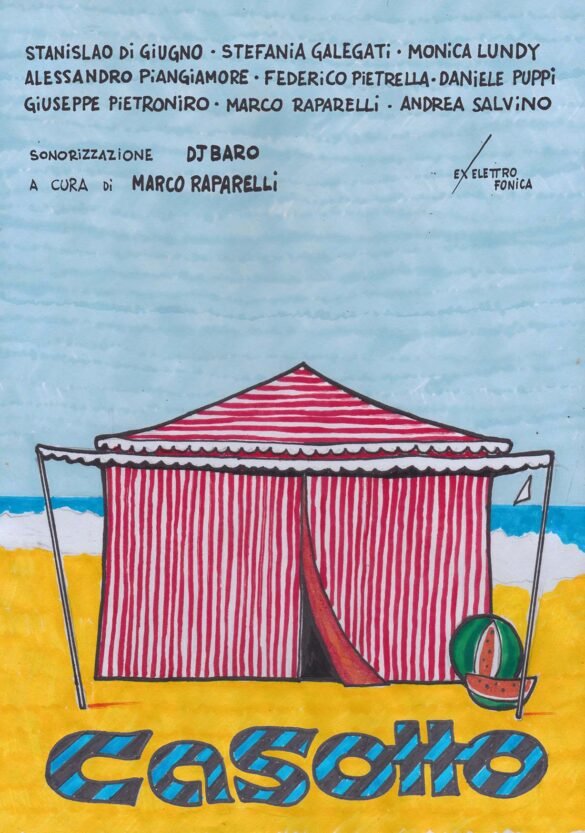
Casotto, the group exhibition curated by Marco Raparelli, opens on Friday, October 16, 2026 at the Ex Elettrofonica gallery, at Vicolo di Sant'Onofrio 10, at the foot of the Janiculum, and can be visited until Sunday, December 20, 2026. The opening is Friday, October 16 from 18:00 to 21:00. On the following days the gallery is open Tuesday to Friday from 15:00 to 19:00. Nine artists are showing: Stanislao Di Giugno, Stefania Galegati, Monica Lundy, Alessandro Piangiamore, Federico Pietrella, Giuseppe Pietroniro, Daniele Puppi, Marco Raparelli and Andrea Salvino. On opening night, from 22:30, the exhibition continues with a party at the Alcazar in Trastevere, at Via Cardinale Merry del Val 14. You reach the gallery by bus to Piazza della Rovere, a few steps from the alley, or by Metro Line A to Ottaviano and a walk of some 20 minutes through Borgo. For admission conditions and for any information the gallery answers at 06 64760163 and at info@exelettrofonica.com. The text of the exhibition is on the official Casotto page.
Casotto at Ex Elettrofonica in brief
Casotto is a group exhibition of nine Italian artists, curated by the artist Marco Raparelli, which opens the gallery Ex Elettrofonica's season and lasts two months, from October 16 to December 20, 2026.
The essential facts
- Title: Casotto, a group and participatory exhibition.
- Curator: Marco Raparelli.
- Artists: Stanislao Di Giugno, Stefania Galegati, Monica Lundy, Alessandro Piangiamore, Federico Pietrella, Giuseppe Pietroniro, Daniele Puppi, Marco Raparelli, Andrea Salvino.
- Dates: from October 16 to December 20, 2026.
- Opening: Friday, October 16, from 18:00 to 21:00. Party at the Alcazar from 22:30.
- Hours: Tuesday to Friday, from 15:00 to 19:00.
- Venue: Ex Elettrofonica, Vicolo di Sant'Onofrio 10, 00165 Rome.
Watch the hours
The hours given cover weekdays, Tuesday to Friday, and the afternoon only. Anyone who can come only on the weekend should write or call the gallery before setting out: no regular opening is listed for Saturday and Sunday. The weekday afternoon, besides, is the best moment to see a research gallery: few people, time to look, often someone available to talk about the works.
Two months, not one evening
Unlike many one-day events the gallery hosts during the year, Casotto is a long exhibition, which runs through the whole Roman autumn. You can go to the opening for the atmosphere and come back on a November afternoon to look at the works calmly: it is the best way to experience it.
What you see in Casotto
Casotto brings together in a single gallery drawing, painting, photography, video, installation and other forms of research: nine different practices that the curator relates to one another without looking for a common denominator.
A gallery like a casotto
The exhibition text starts from an image: the gallery as a casotto, a temporary and collective space where nine artists meet to build the photograph of a community that has shared a path for over 20 years. The gallery works as a device: it doesn't impose a single narrative, it relates individualities and languages.
A group portrait
Casotto declares that it doesn't want to reconstruct a scene or offer a historical reading of contemporary Italian art. It is a collective portrait, a group photo in which different experiences coexist in the same space and the same time. The shared story emerges precisely from the distance between the practices: that of artists who have often built their own places of exchange on their own, with occasions for meeting, collaborations and projects born outside the established institutional circuits.
The curator's words
Marco Raparelli explains that, when he was offered the chance to curate an exhibition at Ex Elettrofonica, he had no doubt about inviting these artists, whom he considers deserving of attention and recognition. In the official text he specifies that the exhibition doesn't claim to offer an exhaustive survey of Italian art from the early 2000s to today: too many fundamental figures would be left out. It wants rather to fix in time the self-portrait of a generation that has made collaboration and friendship a practice capable of producing culture.
From the gallery to the dance floor
The project doesn't end inside the gallery. On opening night, from 22:30, Casotto continues at the Alcazar in Trastevere, at Via Cardinale Merry del Val 14, with a party curated by WeLoveRadio: at the decks DJ Baro and Marco Raparelli himself, who as a DJ signs as Cot Rock. The music, in the exhibition's intentions, extends its spirit: an open and shared space where the relationships built over the years meet again.
Our opinion
Generational group shows always risk the yearbook effect, one name next to another for no reason. Casotto openly declares its criterion, friendship and shared work, and this frankness is its strength. It doesn't promise a canon: it offers a map of relationships. For anyone who wants to understand how art was made in Rome over the last 20 years, away from the museums, it is a more useful exhibition than many official surveys.
The title: Casotto by Sergio Citti
The exhibition's title recalls Casotto, the film directed by Sergio Citti and released in Italian theaters on October 28, 1977: a provisional, popular place, crossed by a crowd of stories, encounters and situations.
The film
Casotto is set in a large collective beach cabin at Ostia, on a hot Sunday in August. It is occupied, in turns or all together, by a women's volleyball team with its coach, a solitary English priest, two awkward friends chasing girls, two women determined to seduce a bigoted insurance man, a mature couple of lovers, two narcissistic conscript soldiers and an elderly couple with a pregnant granddaughter. A sudden downpour sends everyone back to the city. In the deserted cabin only the voyeur played by Ninetto Davoli remains.
An ensemble cast
The film has an ensemble cast in which Ugo Tognazzi, Gigi Proietti, Franco Citti and a very young Jodie Foster, fresh from Taxi Driver, stand out. For the role given to Tognazzi, Marcello Mastroianni had at first been chosen. Catherine Deneuve was also in the cast. The producer Gianfranco Piccioli said in 2010 that the actors had worked for free, with the exception of Foster.
The two faces of the word
The film's title plays on the ambiguity of casotto: the beach cabin for collective use, and at the same time, in slang, confusion, the tangled and comic situation. The exhibition takes the word in both senses: a shared and slightly messy space in which different people live together. The film was restored in 2023 by the Cineteca Nazionale and presented at the Torino Film Festival: anyone who wants to prepare for the exhibition has an excellent reason to watch it again.
Who is Marco Raparelli, the curator of Casotto
Marco Raparelli is a Roman visual artist, born in 1975, who works with drawing, video, installation and music: he is a draftsman, videomaker and DJ, and teaches at the Accademia di Belle Arti in Urbino.
His training
After studying at the Accademia di Belle Arti in Rome, Raparelli specialized in video animation at Loughborough College of Art, in England, and in painting at the Académie des Beaux Arts in Brussels. He lives and works in Rome.
Drawing without sketches
His work focuses on a drawing free of academic schemes, almost instinctive: no sketches, no preliminary tests, and the mistake becomes an integral part of the work. His characters, made of a synthetic black line, are born from everyday life and move among funny and unreal situations. They also come to life in animated short films such as Abandoned Dog from 2008, the surreal day of an abandoned dog, and Everything changes from 2010, about the change brought by the passing of time.
From the sheet to the wall
In 2006 Raparelli begins drawing directly on walls, with Bef Kitchen at the BastArt gallery in Bratislava. In 2008 he makes My Social Awareness, a drawing on a sheet 20 meters long that catalogs countless human types with an anthropological eye. In 2010 at the Fondazione Giuliani in Rome he paints The Wall, a fake hole in the wall complete with rubble on the floor, and redraws a reading room at the Nomas Foundation. During a residency at the American Academy in Rome he portrays the people passing through the academy and hangs the portraits in the bar like an old picture gallery.
The Roman exhibitions
In 2012 Raparelli signs, with Giuseppe Pietroniro, now among the artists of Casotto, Né qui né altrove at the Museo Andersen: a parallel museum of fake works, fake captions and fake services, an ironic reflection on the state of museums. The same year he presents L'elefante scomparso at Palazzo Baldassini, devoted to the white elephant given by the king of Portugal to Pope Leo X, takes part in Re-Generation at the Macro Testaccio and holds at Ex Elettrofonica the solo show Look Mommy, I scribbled, tied to his book of the same name. In 2019 he returns to the gallery with Tutto quello che si muoveva intorno a noi era il vento and publishes with Ex Elettrofonica and NERO the book Human is a State of Mind. Among other exhibitions, Dodici Stanze at the Castello Colonna in Genazzano in 2015 and La scrittura degli Echi at MAXXI.
The artists of Casotto
The artists of Casotto belong to the same generation and have shared, according to the exhibition text, field experiences, independent projects and moments of exchange. Some of them have already worked together.
Stefania Galegati
Stefania Galegati was born in Bagnacavallo, in the province of Ravenna, in 1973. She studied visual arts at the Accademie di Belle Arti in Bologna and Milan with Alberto Garutti, and in the late 1990s she was part of Via Fiuggi, a group of young artists who lived together in Milan. She first exhibited in 1994 at Viafarini. In 2003 she moved to New York with the International Studio Program of PS1 MoMA, then lived with no fixed base between New York, Buenos Aires, Tanzania and Europe. Since 2008 she has lived in Palermo, where she teaches Painting at the Accademia di Belle Arti. She is a cofounder of the collective Isola delle Femmine Project, created with the goal of buying the islet off the coast of Palermo, and of the Palermo Summer School of Contemporary Art. In 2024 she won the BPER prize at ArteFiera and the 13th Italian Council.
Daniele Puppi
Daniele Puppi was born in Pordenone in 1970 and has lived in Rome for almost 30 years. His work with video and space was the focus of a solo show at the Accademia nazionale di San Luca, in Rome.
Giuseppe Pietroniro
Giuseppe Pietroniro shared with the curator the project Né qui né altrove at the Museo Andersen, in 2012: a concrete sign of the network of collaborations that Casotto wants to tell.
Stanislao Di Giugno and the others
Stanislao Di Giugno and Stefania Galegati were already among the 29 artists of the project There's No Place Like Home, one of the independent Roman initiatives of recent years. The group is completed by Monica Lundy, Alessandro Piangiamore, Federico Pietrella and Andrea Salvino: drawing, painting, installation, photography and video alternate in the rooms, following the formula of an exhibition that doesn't look for a single language.
The Ex Elettrofonica gallery, home of Casotto
Ex Elettrofonica is a contemporary art gallery opened in Rome in 2009 at Vicolo di Sant'Onofrio 10, which presents itself as a place of interaction between the visual arts and architecture.
A recognizable line
In over 15 years the gallery has worked mostly with young Italian and foreign artists, offering exhibitions designed to dialogue with the space. The artists differ in age, origin and language, but share the idea of art as a process. The recurring themes are landscape, the transformations of the environment, and political and social identity.
Recent projects
Among the artists followed by the gallery are Agostino Iacurci, Elena Mazzi, Arianna Marcolin and Margherita Moscardini. In May 2026, during Contemporanea, the Roma Gallery Weekend, Ex Elettrofonica presented the group show Strutture Impermanenti. At the beginning of October it hosted for one evening The Unsilent Fragility by Alberto Podio. The link with Raparelli is a long one: the gallery devoted solo shows to him in 2012 and 2019.
Why here
An exhibition that presents itself as a casotto, a provisional space where different presences live together, finds in the Sant'Onofrio gallery the right setting: an intimate place, used to exhibitions that are born for the space and change how it is perceived. It is worth looking at the installation too, at how nine such different works share the walls.
Around Casotto: Vicolo di Sant'Onofrio and the Janiculum
Vicolo di Sant'Onofrio is at the foot of the Janiculum, where Borgo, Trastevere and the hill's promenade meet. A few minutes uphill is the complex of Sant'Onofrio al Gianicolo, a 15th-century church and convent.
One of the oldest climbs
The Salita di Sant'Onofrio was opened in 1446 to reach the church, begun in 1439 next to the hermitage founded in 1419 by Nicola da Forca Palena, and was paved in the 17th century. The church's inscriptions recall the road ordered by Sixtus V and the paving ordered by Clement VIII.
The church and the cloister
The church is preceded by a grassy forecourt and a small portico with Domenichino's Stories of Saint Jerome in the lunettes. Inside, the apse has frescoes of the Stories of Mary on a design by Pinturicchio and Baldassarre Peruzzi, and in the first chapel on the left is the funerary monument of Torquato Tasso. The 15th-century cloister preserves the lunettes with the stories of Saint Onuphrius by the Cavalier d'Arpino and his school.
Toward the city
From the complex starts the promenade of the Janiculum, which leads to the terrace over the city and then toward the Acqua Paola Fountain. In the opposite direction, toward the Tiber, you reach Santo Spirito in Sassia and Castel Sant'Angelo. The St. Peter’s Basilica is 10 minutes away. To the south, Via della Lungara leads to the Villa Farnesina and the Botanical Garden.
How to get to Casotto at Ex Elettrofonica
The Ex Elettrofonica gallery, at Vicolo di Sant'Onofrio 10, is most easily reached by the buses that stop at Piazza della Rovere, on the Lungotevere, a few steps from the alley.
By bus
Piazza della Rovere is served by several city lines that run along the Lungotevere or climb toward the Janiculum. To pick the right one from your starting point, the route planner of Rome's transport company is useful, with Vicolo di Sant'Onofrio as the destination.
By metro
The nearest station is Ottaviano, on Line A. You head toward Piazza Risorgimento, cross Borgo along Borgo Santo Spirito or Via di Porta Castello and arrive at the Lungotevere: some 20 minutes at an easy pace.
On foot
From Trastevere you just walk back up Via della Lungara toward the north: a quarter of an hour on the flat from Piazza Trilussa. From San Pietro you go down toward the river along Borgo Santo Spirito. On an autumn afternoon it's the way of arriving I prefer.
By car
Between the Lungotevere, Borgo and the Janiculum parking is difficult and the gates of the limited traffic zone are close. Anyone who comes by car anyway finds paid parking in the San Pietro and Janiculum area. For an afternoon visit the car remains the least convenient solution.
The Casotto party at the Alcazar in Trastevere
On the evening of October 16, from 22:30, Casotto moves to the Alcazar, at Via Cardinale Merry del Val 14, in Trastevere, for a party curated by WeLoveRadio with DJ Baro and Marco Raparelli at the decks.
A former cinema
The Alcazar is a former cinema in Trastevere turned into a space for concerts, DJ sets, theater and comedy, which keeps the red velvet seats of the hall. On the ground floor are the stage and the bar, on the first floor an Italian and Mediterranean kitchen. A party in an old cinema is a fitting finale for an exhibition that takes its title from a film.
From the gallery to the Alcazar
Between the two venues there are about 20 minutes on foot: you go down Via della Lungara, pass through Piazza Trilussa and cross Trastevere toward Viale di Trastevere, where Via Cardinale Merry del Val opens. Between the gallery closing at 21:00 and the start of the party at 22:30 there is just the right time for dinner.
How to organize the visit to Casotto
Casotto can be visited Tuesday to Friday from 15:00 to 19:00: an afternoon that combines well with a walk on the Janiculum and dinner between Trastevere and Borgo.
The ideal afternoon
It's best to get to the gallery around 16:00, stay as long as you need, then climb to Sant'Onofrio and walk the Janiculum promenade at sunset. In October the sun sets between 18:30 and 19:00, in November and December much earlier. In the shorter months it's best to reverse the order: first the hill with the light, then the gallery until closing.
Where to eat
Heading south you enter Trastevere, described in our guide on what to see in Trastevere, with Roman trattorias, pizzerias, osterias and seafood places. To the north Borgo offers trattorias and restaurants on quieter streets, frequented mostly by people who work in the area. On Friday evening in Trastevere it's always better to book.
Accessibility
For wheelchair access and for any special need it's best to contact the gallery first. The alley and the Salita di Sant'Onofrio have sloping stretches and uneven paving.
With children
A group show with drawings, videos and installations suits a visit with curious kids, especially if they are used to comics and animation: Raparelli's characters, for example, speak an immediate language. Private galleries are intimate spaces: with the little ones it's best to pick a quiet weekday afternoon.
A curiosity about Casotto at Ex Elettrofonica, October 16 to December 20, 2026
The tastiest curiosity of Casotto concerns the film it is named after. Sergio Citti shot his ensemble comedy on the beach at Ostia with a top-tier cast, and the producer Gianfranco Piccioli said in a 2010 interview that almost all the actors had worked for free. The only one paid was Jodie Foster, then 15 and fresh from Taxi Driver, called almost on a bet and who accepted to everyone's surprise. Catherine Deneuve received from the producer a Bulgari ring, which she is said to have lost during the filming of the scene in which she slaps Gigi Proietti.
The story of a cast of big names brought together almost out of friendship, without pay, in a beach cabin, curiously resembles Raparelli's project: nine artists who meet in a small gallery to build a collective self-portrait, held together by 20 years of relationships even before a critical thesis. The title, in this sense, is more precise than it looks. The film was shot between the Ostia coast, Campello sul Clitunno, the Parco della Valle del Treja and the De Paolis studios. The exhibition stays put on Vicolo di Sant'Onofrio, but its spirit, like the film's, is that of a place of passage where everyone brings their own story.
Something nobody tells you about Casotto at Ex Elettrofonica, October 16 to December 20, 2026
What isn't said about Rome's research galleries is that long exhibitions, like Casotto, are the best chance to walk in without feeling intimidated. During the opening the gallery is packed, conversation prevails over the works, and anyone who doesn't know anybody risks feeling out of place. On a weekday afternoon in November, instead, you ring the bell, go in, and often there is someone willing to talk through the works calmly. It is a very different experience from a museum, and a more instructive one.
The second thing that is said little is that Vicolo di Sant'Onofrio is one of the least trodden corners of the center, despite being 10 minutes from San Pietro. The tourist flows run along the Lungotevere and Via della Conciliazione and rarely climb toward the convent where Tasso died. A visit to Casotto is also a pretext to discover this side of the Janiculum. Better not to stop at the alley: climb up to the forecourt of Sant'Onofrio, even just to look out over the city. That's 10 minutes that change how you see the area.
My advice for visiting Casotto at Ex Elettrofonica, October 16 to December 20, 2026
The most concrete advice is to go twice. The first time at the opening on Friday, October 16, from 18:00 to 21:00, to breathe the air of a community of artists meeting again, and maybe continue to the Alcazar party from 22:30. The second time on a weekday afternoon, Tuesday to Friday between 15:00 and 19:00, to really look at the works. A group show of nine artists with such different languages takes time: drawing and video aren't read at the same speed, and an installation has to be walked around.
The second piece of advice concerns preparation. Before going, watch Casotto by Sergio Citti: 90 minutes of comedy that explain the title better than any critical text and give the key to the spirit of the exhibition, the cheerful disorder of a shared space. The third is practical: check the hours before setting out, because the weekend is not listed among the regular opening days and private galleries can close for installations or fairs. A phone call to the gallery avoids the closed door.
Another well-known fact, yet rarely mentioned
That Torquato Tasso died at Sant'Onofrio, a few steps from the gallery, is recalled by almost all guidebooks. Less often is it explained why he was in Rome. The poet arrived from Naples with Pope Clement VIII's promise that he would be crowned poet on the Campidoglio, as had happened to Petrarch. The ceremony never took place: Tasso died in the convent on April 25, 1595.
Since then Sant'Onofrio became a destination for traveling writers. Goethe frequented it and speaks of it in the Italian Journey. Chateaubriand was a guest of the convent. Giacomo Leopardi climbed up there in Tasso's footsteps and wrote to his brother Carlo that he had wept over his tomb, the first and only pleasure, he said, he had felt in Rome. Two plaques recall the visits of Goethe and Chateaubriand. It is a small literary pilgrimage that few make today. An exhibition that tells of a community of artists, made of friendships and encounters, finds in this hill of passing writers a fitting neighbor: here too culture was made through frequenting one another, before it was made through institutions.
The right photo to take at Casotto at Ex Elettrofonica, October 16 to December 20, 2026
Inside the gallery, the right photo is not the reproduction of a single work: these are works to be seen in person, and before photographing it's best to ask. If the gallery allows it, the photograph that tells Casotto is an overall view of the room, with the works of different artists side by side: the group photo that the exhibition itself says it wants to be. At the opening, the truest photo is the one of the people, the artists and friends meeting again: the casotto of the title, crowded and alive.
Outside, the photo worth the afternoon is made while climbing toward Sant'Onofrio. The grassy forecourt of the church, with the small portico frescoed by Domenichino, is an intimate and little-known framing. A little higher, from the Janiculum promenade, the view opens over the city with the dome of San Pietro very close. In October the best light comes around 18:30. In November and December it's best to climb earlier, around 16:00, and go down to the gallery afterward. Anyone looking for a detail can photograph, on the opposite side of the street from the convent, Tasso's oak, dry and turned into a monument.
Some important events that happened here in history
The history of this side of the Janiculum begins in 1419, when Nicola da Forca Palena founded a hermitage by buying the land with alms. In 1437 Pope Eugene IV approved the foundation. In 1439 construction of the church of Sant'Onofrio began and in 1446 the climb was opened. In 1517 Leo X established the cardinal deaconry, raised to a presbyteral title by Sixtus V in 1588, the year the church was completed.
On April 25, 1595 Torquato Tasso died in the convent. For the Jubilee of 1600 the Cavalier d'Arpino, Vespasiano Strada and Claudio Ridolfi painted the lunettes of the cloister. In the early 17th century the church was frequented by Artemisia Gentileschi. Saint Philip Neri brought his penitents here, and his congregation set up a small theater for pious entertainments, still used for open-air performances.
In 1849, during the defense of the Roman Republic, Giuseppe Garibaldi saved the smallest of the church's bells, called the Tasso bell. Between 1865 and 1868 the Janiculum promenade was laid out. In 1945 Pius XII assigned the complex to the Equestrian Order of the Holy Sepulchre of Jerusalem, and in 1946 custody passed to the Franciscan Friars of the Atonement, who had come from the United States. In 2009, at the foot of the climb, the Ex Elettrofonica gallery opened, which in 2026 hosts Casotto.
Who has passed through Casotto at Ex Elettrofonica, October 16 to December 20, 2026
Through the climb and convent of Sant'Onofrio, a few steps from the gallery's alley, have passed some of the greatest names of European culture. Torquato Tasso spent his last days there. Goethe frequented the convent, Chateaubriand was its guest, Leopardi climbed up to weep over Tasso's tomb. Before them had come Saint Philip Neri, with his spiritual walks, and Artemisia Gentileschi. In 1849 Garibaldi arrived.
In the church worked Pinturicchio, Baldassarre Peruzzi, Antoniazzo Romano, Domenichino and the Cavalier d'Arpino. By Annibale Carracci is the Madonna di Loreto in the second chapel on the right. Next to Tasso's monument are the tomb of the poet Alessandro Guidi and the monument of Cardinal Giuseppe Gasparo Mezzofanti.
In the gallery on Vicolo di Sant'Onofrio, since 2009, artists such as Agostino Iacurci, Elena Mazzi, Arianna Marcolin, Margherita Moscardini and Marco Raparelli himself have passed through, with the solo shows of 2012 and 2019. With Casotto arrive together Stanislao Di Giugno, Stefania Galegati, Monica Lundy, Alessandro Piangiamore, Federico Pietrella, Giuseppe Pietroniro, Daniele Puppi and Andrea Salvino: the group photo of a generation, taken on one of the most literary streets in Rome.
Casotto and the autumn of contemporary art in Rome
Casotto opens Ex Elettrofonica's season at the moment when Rome picks up the rhythm of openings: mid-October is the period when galleries and museums present their autumn programs.
Museums and galleries
Anyone who wants to widen the view on Italian art of recent decades can combine the visit to Casotto with MAXXI, where Tragicomica, prospettive sull'arte italiana dal secondo Novecento a oggi is on, and with MACRO, the contemporary art museum of Roma Capitale. The comparison between a large institution and a small gallery, over the same years, is instructive.
The season
Two months of opening, from mid-October to a few days before Christmas, carry Casotto through the Roman autumn: the still mild days of October, the rains of November, the lights of December. In a city that empties of its summer tourists in autumn, an afternoon in the gallery and a walk on the Janiculum are among the best ways to experience it.
Frequently asked questions about Casotto
When can you see the Casotto exhibition in Rome?
The Casotto exhibition is open at the Ex Elettrofonica gallery from October 16 to December 20, 2026. The opening is Friday, October 16 from 18:00 to 21:00. On the following days the gallery is open Tuesday to Friday, from 15:00 to 19:00. For the weekend it's best to ask the gallery.
Where is the Ex Elettrofonica gallery?
The Ex Elettrofonica gallery is at Vicolo di Sant'Onofrio 10, 00165 Rome, at the foot of the Janiculum, near Piazza della Rovere. It is a few minutes on foot from Borgo, from Castel Sant'Angelo and, along Via della Lungara, from Trastevere.
Which artists show in Casotto?
Nine artists show in Casotto: Stanislao Di Giugno, Stefania Galegati, Monica Lundy, Alessandro Piangiamore, Federico Pietrella, Giuseppe Pietroniro, Daniele Puppi, Marco Raparelli and Andrea Salvino. The exhibition is curated by Raparelli himself and brings together drawing, painting, photography, video and installation.
Why is the exhibition called Casotto?
Casotto takes its title from Sergio Citti's 1977 film, set in a collective cabin on the beach at Ostia. As in the film, the gallery becomes a provisional and shared place, crossed by different stories: the portrait of a community of artists tied together by 20 years of shared work.
What happens on the evening of the Casotto opening?
On the evening of the Casotto opening, Friday, October 16, after the opening at the gallery from 18:00 to 21:00, the exhibition continues from 22:30 at the Alcazar in Trastevere, at Via Cardinale Merry del Val 14, with a party curated by WeLoveRadio and with DJ Baro and Marco Raparelli at the decks.
How do you get to Ex Elettrofonica by public transport?
Ex Elettrofonica is reached by the buses that stop at Piazza della Rovere, a few steps from Vicolo di Sant'Onofrio. By metro you get off at Ottaviano, on Line A, and continue on foot for some 20 minutes through Borgo. From Trastevere you arrive on foot along Via della Lungara.
Who is Marco Raparelli?
Marco Raparelli, curator of Casotto, is a Roman artist born in 1975: a draftsman, videomaker and DJ, he teaches at the Accademia di Belle Arti in Urbino. He trained in Rome, Loughborough and Brussels, and has exhibited at, among other places, the Macro, the Museo Andersen and MAXXI.
Final advice on Casotto
Casotto is a small exhibition in size and a big one in ambition: to fix the face of a generation of artists who built their own spaces on their own. It's best to go to the opening for the atmosphere, then come back on a November afternoon, with Citti's film still in mind, to look at the works one by one. And on the way out I would climb to Sant'Onofrio: few places in Rome tell better how art is born from encounters.
Article written by the editorial team of Tour Leader Pro, contact them for Private/Corporate/V.I.P. Tours and Experiences.
Planning a trip to Rome? The English-language guides for visiting the city are on ItalyPlanner.com.