Published on · updated on
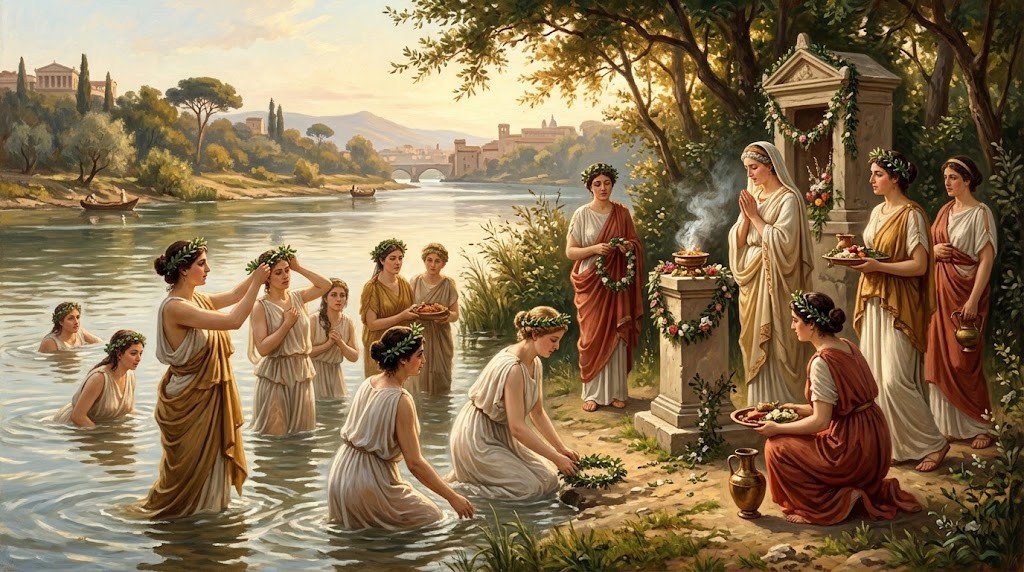
For the Romans, April 1 was the day of the Veneralia, the festival of Venus and of women. Matrons and women of modest standing honored two deities, Venus Verticordia and Fortuna Virilis, with baths, myrtle crowns and offerings.
- Date: April 1
- Deities: Venus Verticordia and Fortuna Virilis
- Symbol: myrtle
- Main source: Ovid, Fasti IV 133-162

The matrons’ rite
Ovid tells us that the women took the jewelry off the statue of Venus, washed it, dried it and placed a crown of flowers on it. Then they bathed themselves in turn, wearing a myrtle crown, and sipped a drink of milk, honey and poppy.
Venus Verticordia
The name means “she who turns hearts.” The cult is said to have been introduced in 114 BC after a scandal involving some Vestal Virgins, on the advice of the Sibylline Books: the goddess was to turn women’s hearts from licentiousness to chastity. The tradition, handed down by authors such as Valerius Maximus, should be treated as just that, a tradition.
Fortuna Virilis
Women of more modest standing prayed to Fortuna Virilis in the men’s baths. Ovid explains that the incense and the bath served to hide the flaws of the body from the men. Scholars still debate the epithet “virilis.”
Where it took place
The cult of Venus in Rome was also tied to the Murcia valley, between the Aventine and the Palatine, near the Circus Maximus. The exact location of the individual women’s cults of April is debated. To get your bearings in the area, see our Circus Maximus page.
Frequently asked questions
What was celebrated on April 1 in Rome?
The Veneralia, the festival of Venus Verticordia and Fortuna Virilis, tied to the world of women.
Why myrtle?
It was the plant sacred to Venus. The women wore crowns of it during the ritual bath.
Are the Veneralia the origin of April Fools’ Day?
No. There is no evidence of a link between the two observances.
This festival is part of the calendar of ancient Roman festivals and the mos maiorum, where you will find all the other observances.
Sources
- Ovid, Fasti IV 133-162
- Valerius Maximus, Memorable Deeds and Sayings VIII 15
- Pliny the Elder, Naturalis historia XV 119
The illustrations are generated with artificial intelligence for evocative purposes.