La Vela
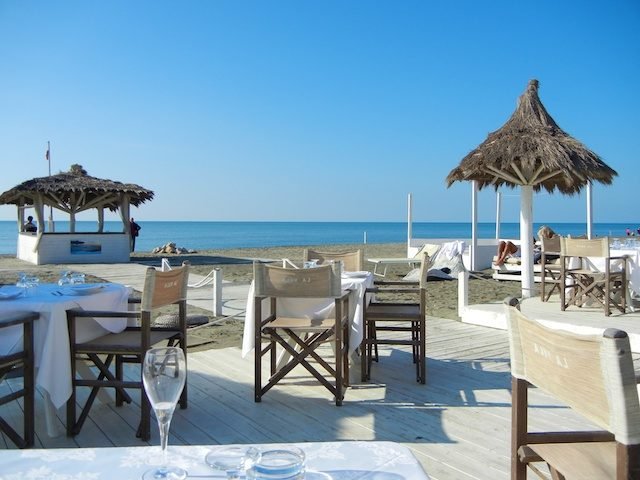
La Vela is a beach club on the beach of Fregene, on the northern coast of the province of Rome, within the comune of Fiumicino. The address that appears in the listings is Via Francavilla Al Mare, while the contacts published by the management indicate Lungomare di Levante 250, with bathing concession number 136, postal code 00054 Fregene. It is not a lido of umbrellas alone: there is the equipped beach with sunbeds and a view of the open sea, there is a restaurant with a veranda overlooking the water, there is a bar that also serves right under the umbrella, and there are the evenings with music that in Fregene are as much a part of the landscape as the sand. The definition the management uses of itself, and which comes back identical in all the listings in circulation, is that of a historic beach club of the Roman coast where you spend the whole day, from relaxing on the beach to the aperitivo with music through to the night, with lounge music in the background and the possibility of eating at a restaurant table or having the dish brought to your sunbed without having to get dressed again.
I am writing on September 18, 2026, that is, at the exact moment of the year when the coast of Lazio changes skin. The full beach season is over, the beach clubs of Lazio are taken down between the second half of September and the first days of October, and whoever arrives in Fregene now finds a different place from the one in August: fewer lines on Via Portuense, free parking, wide sand because at this time of year the sea withdraws from the shoreline instead of gnawing at it, and a light that at six in the evening makes everything look longer and lower. Opening hours, the days the restaurant is in service and the calendar of evenings in this stretch of the calendar change from week to week and depend on the weather more than on any programming: a phone call to the beach club remains the quickest way to know if the kitchen is working today, if the sunbeds are still in rows or already stacked under the shed awaiting winter.
What I can say with confidence is that La Vela worked in the 2026 season: the beach club's listing on the umbrella booking circuits shows as updated in mid-July 2026, with bookable spots, voucher refund conditions and the full list of services. It is no small news, on a coast where every year some concession changes hands, some sign disappears and some other reopens with a new name and the same umbrellas.
Where La Vela Is and How to Get There
The Address, the Seafront, the Bathing Number
Fregene has a geography that is simple to understand and very easy to get wrong the first time. The town is built on a strip of sand and pine forest a few kilometers long, cut in two by the point where the road coming from the interior runs into the sea. To the left of that point, looking at the water, the Lungomare di Ponente begins. To the right the Lungomare di Levante begins. The two seafronts are not symmetrical in length or in character, and anyone who just types Fregene into the navigator risks ending up two and a half kilometers from the beach club they were looking for, with sand in between and the sun in their face.
La Vela is on the Levante side, that is, the one that points north, toward Maccarese and toward the mouth of the Arrone. The official street number the management gives is 250 of Lungomare di Levante. The address that circulates in the lists of summer offerings is instead Via Francavilla Al Mare, one of the side streets that in Fregene carry names of seaside places, as happens throughout the town where the street naming draws from the repertoire of Italian coastal towns. The two indications are not in contradiction: the side streets of Fregene arrive perpendicular to the seafront and each beach club is identified indifferently by the street number of the seafront or by the side street that leads you in front of it. If you have to set a navigator, the most solid datum is Lungomare di Levante 250.
The third way of identifying the place, and it is the one used by lifeguards and the people of the coast, is the concession number: bagno 136. On the Lazio coast the beach clubs are numbered progressively along the shore and that number, printed on the sign at the entrance and on the documents of the state-property concession, is the identifier that does not change even when the commercial name and the colors of the umbrellas change. Asking for bagno 136 in Fregene always works, even with someone who has never heard the name La Vela.
By Car, Which Is How Almost Everyone Goes
From Rome you reach Fregene in three ways, and all three converge on the last piece of road. The first is the Roma Fiumicino motorway, exit for Fregene, then Via Castel San Giorgio and Via Portuense up to the junction that climbs toward the town. The second is Via Aurelia to Torrimpietra, then down toward Maccarese and from there along the road that runs beside the reclaimed fields to Fregene. The third, the slowest and the most beautiful, is Via Portuense proper, which follows the course of the Tiber and crosses the countryside of Ponte Galeria before entering the plain of Maccarese. In normal conditions it takes between 40 minutes and a good hour from the center of Rome. On weekends in July and August, with traffic lined up over the last kilometer, that calculation has to be redone from scratch and generally doubled.
Parking is the variable that decides the mood of the day. In the hot months Fregene has paid parking areas run by the concession holders, blue lines on the seafront and a quantity of free spots in the inner side streets that fill up by 10 in the morning. In late September the problem simply does not exist: you pull up almost in front of the entrance, and one of the reasons I recommend this period to those who don't like confusion is exactly this. A warning that always holds: the side streets of Fregene are narrow, many are one-way and the signage changes from one year to the next with the summer ordinances of the comune di Fiumicino. It is best to read the signs instead of trusting the memory of the year before.
By Public Transport, Which Is More Doable Than You Think
Fregene without a car is not unreachable, but it requires counting on a change. The regional railway line for Civitavecchia has a stop at Maccarese Fregene, in the middle of the reclaimed countryside, and from there connecting buses leave that in about 10 minutes take you to the town and the seafront. The train from Roma Termini or from Roma Ostiense takes between 20 and 30 minutes depending on the run. The connecting bus has different frequencies between summer and winter and thins out a lot on holidays. Anyone going in the evening for a dinner or a music night must reckon with the last useful run, which in the dead season is early, and with the fact that Maccarese Fregene station at 11 at night is a very quiet place.
There is also the direct road link from Rome, which in the summer seasons is reinforced with runs dedicated to the coast. The stops on the Lungomare di Levante are a few dozen meters from one another and serve all the beach clubs in a row, so getting off at the right stop is less important than getting off in the area: from the road you can see the bathing number on every gate and you find your way by eye walking along the sidewalk.
By Bicycle, Along the Reclamation
There is a way of getting to Fregene that very few Romans have tried and that is the most beautiful thing you can do on this piece of coast: start from Maccarese by bicycle and cross the reclaimed plain. They are straight farm roads, with drainage ditches at the sides, the stables of the agricultural company, the rows of eucalyptus planted a century ago to dry the ground, and on the horizon the dark barrier of the pine forest. Then the pine forest opens and there is the sea. It is not a bike route equipped along its whole length and it must be done with the caution used on roads where tractors pass, but whoever has done it once understands in 10 kilometers almost everything there is to understand about how this piece of Lazio was built by man, meter by meter, within a few decades.
What La Vela Is: The Beach, the Restaurant, the Evenings
The Beach
The beach part is the classic one of the Lazio coast: umbrellas in rows parallel to the shoreline, sunbeds and deck chairs, passageways toward the sea, showers, cabins and the lifeguard services required by the ordinances of the harbor master's office. The difference between one beach club and another in Fregene is never made by the umbrellas, which are the same everywhere, but by three things: how close you are to the water, how wide the beach is in front of you and what you have behind you. La Vela has a position on the Levante that, in the seasons when the sand holds, leaves a good breathing space between the last row of umbrellas and the shore.
The sand of Fregene is dark, fine, of volcanic origin mixed with the sediment the Tiber has carried for millennia. It heats up a lot and in July at noon walking on it barefoot is a test of endurance. In September the opposite happens: the sand stays warm until late and in the evening it is wonderful to sit on the shore even when the air has already begun to change. The seabed in front of the Levante of Fregene slopes gradually for the first meters and then drops more decisively. It is a sea that with the libeccio raises short, close waves, and indeed on this stretch of coast there is a small but stubborn community of surfers who wait for the seasonal storms.
The flag of the lifeguard service and the signs on sea conditions must be read, always, and not only as a formality. The coast north of the Tiber has rip currents that form near the rocks and the groynes, and it is not a detail to underestimate when swimming far from the supervised area. The most banal advice in the world is also the one that saves days: if the sea is rough and the flag is red, the right choice is the water's edge, not heroism.
The Restaurant
The restaurant is the part that distinguishes La Vela from the beach clubs that live on umbrellas alone. There is a veranda overlooking the sea, which is the thing everyone cites when they describe the place, and a kitchen that follows the classic approach of the Roman coast: fish, fried dishes, seafood first courses, and the possibility of eating on the beach as well, with the dish brought directly to the sunbed. In practice this changes the structure of the day: there is no moment when you have to get up, get dressed and go look for something to eat elsewhere, and for those with children or those who simply don't feel like moving it is a concrete advantage.
The management also declares a vocation for private events: ceremonies, weddings, graduation parties, anniversaries. It is a specialization widespread along the whole northern coast, where many beach clubs have understood that the veranda on the sea earns much more in September with a reception than in July with 100 covers at lunch. As an occasional customer it is worth knowing for a practical reason: on low-season weekends it can happen that the space is taken by a closed event. A phone call before leaving Rome avoids the disappointment.
On prices I don't write figures. They change from year to year, they change between lunch and dinner, they change between the veranda menu and the one that reaches the sunbed, and any number written here would age within a season. The general criterion for the Fregene coast is that the price range is that of the seafood restaurants of the province of Rome, with the implicit surcharge of the view.
The Evenings
The formula La Vela declares is that of the beach club that doesn't close at sunset: lounge music in the afternoon, aperitivo with music when the light drops, and evenings that carry on. It is the same approach as a good part of the Levante of Fregene, a stretch of coast that for decades has worked as a nighttime alternative to the city for those who don't feel like staying in Rome in August.
I don't write names of DJs, dates or programs, for the very simple reason that the calendar of evenings on this coast is built week by week and changes even after the season has started. Whoever wants to know what is happening on a precise night has two reliable ways: the beach club's social channels, which are updated with the individual events, and the phone. Everything else, including the flyers that bounce around in the groups, must be verified before getting in the car.
A note of common sense, given that we are talking about a place that serves cocktails and stays open late: Fregene is reached by car and the road back to Rome at night is dark, with single-carriageway stretches and wildlife crossings in the reclamation area. Whoever drives has one more reason to drink water, and whoever organizes the evening in a group does well to decide beforehand who takes everyone home.
A Curiosity About La Vela
The curiosity concerns the name, and it is more interesting than it seems. In Fregene the beach clubs are almost all called with names that evoke the sea or the voyage: the sail, the ship, the lighthouse, the wave, the pier. It seems like an advertising banality and instead it is the residue of a precise choice made when this coast was invented from scratch, in the years between the two wars and then above all in the postwar period. Fregene is not a fishing village grown slowly around a port: it is a piece of coast that for centuries was marsh, scrub and pine forest, without permanent inhabitants, and that became a vacation place in very little time, when the reclamation made the plain behind it habitable. When a place is born like this, all at once, the names too are chosen all at once, and they are chosen to tell the Roman arriving from the city that here something else begins. The sail is the object that more than any other says sea to someone who sees the sea three months a year.
The second layer of the curiosity is that this name, on the Levante of Fregene, has also had a literal reason. The stretch of sea in front of Fregene and Maccarese was for decades one of the most frequented regatta fields of the Roman coast, with the sailing clubs of Fiumicino and of the Idroscalo bringing the dinghies out here on days of good wind. Whoever sits on the sand on a mistral afternoon, even today, sees the sails passing offshore in single file. It is not a romantic detail invented after the fact: it is something that happens and that can be verified by looking at the horizon, which, for a curiosity, is already much more than can be said of most of the curiosities you read around.
The third layer, and perhaps the most curious of all, is that in Fregene the wind has a name that almost nobody uses in Rome. The ponentino, which in the city is the evening breeze that arrives from the sea and makes July nights bearable, here is simply the wind that turns after four in the afternoon and completely changes the character of the beach: first still and heavy, then moving and clean. The local people wait for it and organize the day around it. The beach clubs of the Levante, which are more exposed, get it full on. If you happen to be under the umbrella on an afternoon when everyone at a certain point turns in the same direction, you have witnessed that moment.
Fregene Before Fregene: The Rospigliosi Pine Forest and the Reclamation
A Pine Forest Planted by Hand
Here is the piece of history that makes Fregene a different place from all the others on the Roman coast, and that almost nobody tells when describing a beach club. The pine forest of Fregene is not a natural wood. It is an artificial plantation, sown and cultivated by man starting in the 17th century at the will of the Rospigliosi family, who acquired this estate and decided to plant stone pines along the coastal strip. The reason was not aesthetic: it was agricultural and sanitary. A barrier of pines in front of the sea slows the salty wind, keeps the sand from invading the inland fields and creates a transition band between the dune and the countryside. In addition, the stone pine produces pine nuts, and the pine nut was a real cash crop, harvested and sold, not a souvenir.
That pine forest has been widened, tended, cut and replanted for three centuries. It accompanied the history of the estate through changes of ownership, went through wars and building speculation, shrank when vacationing ate up land, and today it is the stretch of landscape that more than any other defines the identity of Fregene. When people say that in Fregene you feel good even when the sea is ugly, they are talking about this: they are talking about the possibility of walking in the shade of the pines 200 meters from the shoreline, with the sound of the cicadas and the smell of resin mixing with that of the salt air. It is a sensation that on the Lazio coast is found in few places, and the others are the Castel Fusano pine forest south of the Tiber and the wooded strips of the coast farther north.
The pine forest also has a function that nobody sees until it is missing: it holds the dune together. The roots of the pines and the low vegetation that grows underneath are the reason the dune ridge does not crumble at the first storm. Where the pine forest has been removed to build, the dune has disappeared, and where the dune has disappeared the sea has come closer. We will see this better later, when I talk about erosion, but the link is direct and worth keeping in mind while lying on a sunbed: the shade behind you and the sand under you are the same story.
The Marsh, the Malaria, the Reclamation
Behind the pine forest, up to a century ago, there was not the orderly countryside you cross today arriving from Maccarese. There was a pond. The plain between the Tiber and the Arrone was a vast wetland, with still waters, reed beds, semi-wild buffalo and a seasonal population of farmhands who came down from the mountains for the harvest and went back up right after, because staying meant catching malaria. It is a story that holds for the whole Lazio coastal strip, from the Agro Pontino to the marshes of Maccarese and Ostia, and that for centuries kept empty one of the potentially most fertile territories in Italy.
The full reclamation arrives in the 1920s and 1930s. The drainage canals are dug, the pumping stations that lift the water and push it toward the sea are installed, eucalyptus and pines are planted to dry the ground, the farmhouses and rural villages are built. At Maccarese the agricultural company is born that is still today one of the largest in Italy by extent, with the stables, the fields, the silos you can see from the road. Families of settlers arrive from the north, above all from the Veneto and Romagna, and settle in a landscape they are building while they live in it. The surnames of those families can still be read today on the doorbells and on the shop signs of Maccarese and Fregene.
The direct consequence of that reclamation is the coast as we know it. Only when the plain stopped being malarial could the strip of sand in front become a vacation place. Fregene as a seaside town is born from there, and it is born fast: first the villas scattered among the pines, then the first beach clubs, then the real boom. Every time you walk into a beach club in Fregene you walk into a place that exists because someone, a century ago, drained a marsh. It is no small detail.
The Villaggio dei Pescatori
On the Ponente side, on the other side of the town from La Vela, is the piece of Fregene that has made more history than any other: the Villaggio dei Pescatori. It was born in the 1960s as a settlement of low houses among the pines, built largely of wood, very close to the beach, in an era when that way of building seemed the very definition of the modern vacation. In very little time it became the vacation place of a part of the world of cinema, television and Roman culture, with a density of famous names per square meter that, for a little village of wooden cottages, is striking.
The Villaggio is also the place where Fregene risked losing everything. In the summer of 2022 a fire went through the area, destroying homes and an important part of the surrounding pine forest, on one of those days of wind and extreme heat that on the Lazio coast have become a constant. The reconstruction and the restoration of the greenery have been the subject of years of discussion among owners, the comune di Fiumicino and higher authorities, and whoever passes that way today still sees the marks. I mention it because it is part of the recent history of the place and because those who come to Fregene for the first time often hear the Villaggio named without knowing what is being talked about.
Something Nobody Tells You About La Vela
What nobody tells you is that in Fregene the beach club is not a building: it is a concession. And a concession is a piece of beach given in use for a period, with a number, a fee and an expiry. This has practical consequences that completely change how it is worth looking at a lido on the Roman coast.
The first consequence is that the identity of a beach club is more fragile than it seems. The structures on maritime state property are largely removable by law: platforms, cabins, verandas, pergolas have to be put up at the start of the season and taken down at the end, except for the parts authorized as permanent. It follows that the place you remember as yours, with that counter, that platform, that arrangement of tables, is literally built and destroyed every year. Photographs of the same sign five years apart can show two completely different venues, without anything substantial having changed in the management.
The second consequence is that commercial names migrate. On the Lazio coast it is perfectly normal for a concession to change its sign and for the same sign to move a few hundred meters, or even to another comune. This generates a considerable information chaos: reviews that talk about managements ended years ago, lists that carry old addresses, maps that point to the wrong bagno. In the case of La Vela, for one, two different indications circulate for the same place, Via Francavilla Al Mare and Lungomare di Levante 250, and it is not an error: it is exactly the way this coast describes itself, with a formal address and one for use.
The third consequence, the one that more than any other explains why prices and hours are not written here as if carved in stone, is that the regulatory framework of Italian beach concessions has been in motion for years. The extensions, the tenders, the deadlines, the compensation to outgoing concession holders are the subject of a long dispute involving government, municipalities and European institutions, and every settlement trickles down to the single bagno 136 of Fregene. It is not an abstract question for jurists: it is the reason why a lido you have frequented for 10 years can, within a season, have a different manager, a different price list and a different philosophy. Looking at a beach club knowing this makes it a more interesting and less taken-for-granted place.
Then there is a fourth thing, concerning the order of the square meters. In a beach club the value is not distributed uniformly: the first row costs more than the last, the sea front earns more than the back, and the part where the afternoon sun beats has a different public from the one where the shade arrives early. Whoever books without asking anything gets what is there. Whoever phones and says they prefer a back row, or on the contrary the shore, almost always gets what they ask for, because it is in the managers' interest to fill the space according to real preferences instead of order of arrival. It is a banality that nobody says, and that at the end of the day makes the difference between having had a good time and having simply been at the beach.
The Advice I Give You for Visiting La Vela
The main advice is only one and concerns the time: go in the late afternoon, not in the morning. It is the exact opposite of what the majority of Romans do, who leave at eight to get a spot, arrive at nine 30, roast until three and leave when the best part of the day begins.
The reason is meteorological before it is aesthetic. On the Fregene coast the sea breeze turns in the early afternoon, the air clears, the haze that in summer sits on the horizon lifts, and the sea goes from that milky gray of noon to a blue that at six in the evening becomes deep. The sun, going down, comes to light the beach from the side: the sand takes on relief, the waves can be seen, people stop being blobs and become figures. And above all, from five on the beach empties, the aisles between the umbrellas free up and the ratio between the number of people and the available space turns upside down.
To this is added the structure of the place itself. La Vela is a beach club designed for the long time band, with the restaurant opening, the music starting softly and the day sliding toward evening without a clean break. Arriving at four 30 in the afternoon means getting three things in one: the last good sun for swimming, the sunset that on this stretch of coast falls practically straight in front of the shore, and dinner without having to move. Arriving at nine in the morning means taking the most tiring part and missing the one the place is built for.
The second tip is about timing, and it applies especially in these days of mid-September. The beach season in Fregene ends between the second half of September and the first days of October, with dates that depend on municipal ordinances, the weather and the convenience of the individual operators. In the closing week something worth it happens: the shoreline is empty again but the services are still up and running, the water is at its warmest of the whole year because the sea stores heat with a two-month delay compared to the air, and the light has an angle you never see in August. For anyone without school-calendar constraints, it is simply the best time.
Third tip, practical and not very romantic: call first. It matters in the low season because opening hours get shorter, it matters on weekends because the veranda may be taken by a private event, it matters on days of strong wind because the beach service is sometimes reduced. The call takes 30 seconds and saves you an hour of wasted driving.
Fourth, and here I'm talking to anyone coming with children: the beach at Fregene has a seabed that slopes gradually for the first few yards and then gets serious. The safe stretch exists, but it isn't endless, and the lifeguards' supervision covers the area of the beach club during service hours, not beyond. Anyone who stays on the beach late, and with the format of this place it's very likely to happen, has to keep in mind that after a certain hour there is no more supervision and swimming in the dark is a bad idea even with a flat sea.
Fifth, on what to wear. In Fregene the temperature changes sharply in the evening, much more than in Rome. The ponentino, the sea breeze that is a blessing during the day, turns truly cool after sunset, with the humidity rising from the sand. A sweatshirt or a light shirt in your bag is the difference between staying to watch the sea and leaving at 21:00 because you're cold. I'm telling you because it's the mistake everyone makes, every year, including people who have been coming for 20 years.
The Shoreline on the Move: Erosion, Groins, Beach Nourishment
Why the Beach at Fregene Is a Political Problem
Anyone arriving in Fregene on an ordinary day sees a beach and thinks it has always been there. It hasn't, and it is perhaps the most important thing to know about this stretch of coast. The shoreline between the mouth of the Tiber and the Arrone has been eroding for decades, seriously in some stretches, and today's shoreline is much farther back than the one Romans remember from childhood vacations.
The causes are multiple and they add up. The first is the Tiber: for millennia the river carried enormous amounts of sediment to the sea and distributed it along the coast thanks to the currents, literally building the coastal plain and pushing the shore ever farther out. The hydraulic works, weirs, dams and quarries along the course of the river and its tributaries have drastically reduced that supply. Less sediment arriving means that the sea, which keeps working as always, takes apart more than it receives.
The second cause is building on the dune. Where construction went all the way to the waterline, the sand reserve that for decades served to rebuild the beach after storm surges was removed. The dune works like a savings account: the sea withdraws in winter and gives back in summer. Without a dune there is nothing to withdraw, and the storm surge hits the low walls, the roads and the cabins directly.
The third cause is the port and the rigid structures. Every structure that juts into the sea intercepts the longshore sediment transport and piles up sand on one side, taking it away from the other. It is a zero-sum game on a local scale, and on this shoreline the breakwaters, jetties and groins have rewritten the distribution of the sand more than once.
What Has Been Done and What You Can See
The responses put in place over the years have basically been two. The first is beach nourishment: bringing in sand from elsewhere, usually from underwater deposits or from quarries, and rebuilding the beach. It is a solution that works right away and has to be repeated, because the added sand is worked by the sea exactly like the natural sand. The second is defense structures: groins perpendicular to the shore, submerged barriers parallel to the coast, emerged breakwaters. Anyone looking at the sea at Fregene sees these structures in several places and understands at a glance that this landscape is a managed landscape.
The consequence for beachgoers is concrete. The width of the beach in front of a given beach club can change noticeably from one season to the next, and it happens that two neighboring beach clubs have, in the same year, very different conditions. It doesn't depend on the skill of the operator: it depends on where the current runs and where the last structure was placed. In the case of Levante di Fregene, recent seasons have seen works and maintenance that changed the profile of the shore in several places.
There is also an aspect you only notice at the end of the season, and it's one of the reasons September is instructive as well as pleasant. When the umbrellas start to disappear and the beach is stripped bare, you see the true shape of the shore: the steps left by the storm surges, the slope, the points where sand has built up and those where it has gone away. It's a reading you can't make in summer, with everything covered by rows of umbrellas.
The Arrone, the Mouth, the Protected Strip
North of Fregene, toward Maccarese, the Arrone river reaches the sea after crossing the reclaimed plain. The area of the mouth and the wetland around it are part of a system of protected areas on the northern Roman shoreline, with dune vegetation, reed beds and wildlife that includes resident and migratory waterbirds. Anyone who leaves the umbrellas and walks north along the shore arrives, on a walk that is not very short but doable, at a landscape completely different from that of the beach clubs: open sand, dunes, low shrubs bent by the wind, and silence.
I recommend that walk to anyone coming to Fregene with more than half a day available, because it is the most immediate way to understand what this coast was before it became a row of numbered gates. The dune vegetation is fragile and grows very slowly: you walk on the firm sand near the water or on the walkways, not in the middle of the bushes. Anyone who wants to see the same landscape in an even more intact version, but on the other side of the Tiber, can look at the stretch of the spiaggia di Capocotta, which is the piece of Lazio coast where the dune and scrub system has been best preserved.
Another Well-Known Fact, Yet Rarely Mentioned
The well-known fact is that Fregene is the seaside of Italian cinema. Everyone knows it, it gets repeated everywhere, and it's true. What is almost never added is the why, and the why is much more prosaic and much more interesting than the legend.
Fregene becomes the shoreline of cinema because of its distance from Cinecittà and the film studios, the availability of cheap land right after the reclamation, and a precise geographic feature: it is the piece of coast closest to Rome that has, all at once, the open sea, the pine forest and no pre-existing historic center. For people shooting films this means being able to have, within 20 minutes by car, a beach with no billboards, a woodland, a dirt road, an isolated house among the pines, and the possibility of setting up and striking without asking permission from a village of 2,000 inhabitants that has lived there for 8 centuries. Fregene was, in essence, a ready-made set with no constraints.
Everything else comes from there: the homes of directors, actors, screenwriters and producers who buy a villa among the pines because they are already there for work, the dinners that turn into production meetings, the Villaggio dei Pescatori that fills with people who go back to the studio on Monday morning. Federico Fellini is the name that comes up most often, and rightly so: he had a house in Fregene, spent long periods here, and the landscape of this coast, with the pine forest, the wide sand and the low buildings, returns in his imagination in ways that scholars of his cinema have examined at length. But the same goes for a good number of other figures of Italian cinema, television and culture of the second half of the 20th century.
The rarely mentioned part is the third. When you move from cinema to television and then to pop music, Fregene remains the place where that world goes on vacation, and the beach clubs of the shoreline become the physical place where that social life happens. Not in living rooms: under the umbrellas, at the veranda tables, at the evening events. The reason the beach clubs of Fregene have had a nightlife soul for decades, one that other Lazio shorelines have never had to the same degree, is exactly this legacy. Anyone who sits today on a veranda on the Lungomare di Levante and finds music, tables and a crowd that stays late is not watching a recent trend: they are watching the contemporary version of a habit that on this kilometer of coast is 60 years old.
Last detail, and perhaps the most underrated: the proximity of Fiumicino airport. The big airport is a few kilometers away, beyond the plain and the mouth of the Tiber, and its presence has redrawn the economy of the whole area since the 1960s. For Fregene this has meant having, half an hour by car, a pool of workers, hotels, international passages. And it has also meant a visual detail that first-time visitors notice immediately and then stop noticing: the planes on approach that on clear evenings pass high over the sea, with their position lights on, while the music starts on the beach.
The Right Photo to Take at La Vela
The right photo at La Vela is not the plate on the table with the blurred sea behind it, which is the photo everyone takes and which works very poorly because the camera, focusing close, turns the horizon into a characterless gray strip. The right photo is another one, and there is only one: the late-afternoon backlight from the shore, with the wet waterline acting as a mirror.
I'll explain how, because the point here is technical. On this coast the sun sets practically in front of the beach, and in the half hour before it touches the water the light becomes low and warm. You stand on the waterline, where the wave pulls back and leaves a film of water on the sand: that film reflects the sky and doubles everything above it. You get down with the camera or the phone very low, almost at sand level, frame the shot leaving at least half of the frame to the reflection, and wait for the moment when the wave has just pulled back and the water hasn't yet evaporated. It's about 3 seconds for each wave, and that's why it's worth staying there 10 minutes instead of shooting and leaving.
The second photo I recommend is the closed umbrella. It seems odd, but at this time of year it's the most honest photograph you can take of a Roman shoreline beach club: rows of umbrellas closed and tied, crooked poles, sand flattened by the wind, empty sea. It tells the seasonality of this place better than any summer image, and it has the advantage of being almost impossible to get wrong, because the repeated lines of umbrellas in a row create a composition that holds up on its own.
The third is from the top of the veranda platform, looking toward the sea with people seated in the foreground seen from behind. Figures from behind give depth and don't require asking anyone's permission for a portrait, which in a space with paying customers is a matter of manners before law. If recognizable people are visible in the frame, it's always better to ask, and it's better to remember that a beach club is a property held in concession, so for shooting with tripods, drones or bulky equipment you ask the management. The drone, in particular, has to be taken seriously in this area: we are a few kilometers from an international airport, and the airspace around airports has precise rules that don't allow improvisation.
Fourth and last: the pine forest, not the beach. 200 meters inland is enough to find yourself under the umbrella pines, and in the middle hours of the day the light filtering through the crowns creates sharp beams in the humid air. It's the photograph nobody brings home from Fregene and yet it tells the most characteristic thing about the place, because sand is the same all over Lazio while a pine forest planted in the 1600s and reaching all the way to the sea is not a common thing at all.
Some Important Events That Happened Here in History
The Estate and the Pine Forest, from the 1600s On
The first event is the one already mentioned and it's the most remote: the planting of the pine forest by the Rospigliosi, starting in the 1600s, on a coastal strip that until then was scrub, dune and swamp. It is the founding act of the Fregene landscape. Without that decision, taken for agricultural reasons by a family that owned the estate, there would be an ordinary beach here today with warehouses behind it.
There is an even older background, worth naming: the name Fregene comes from a settlement of the Roman age, Fregenae, a colony founded on the conquered Etruscan coast, which the ancient sources mention and whose precise location has long been debated by archaeologists. The shoreline here has shifted many times over the centuries, between river deposits and retreats, and this makes the search for remains particularly complicated. The interesting point, for anyone sitting on this beach, is that the name on the road sign is more than 2,000 years old while the town that bears it is less than 100.
The Land Reclamation of the 1900s
The second big event is the integral reclamation of the Maccarese plain, in the 1920s and 1930s: canals, pumping stations, farm roads, farmhouses, the arrival of settler families, the birth of the agricultural company. It is the operation that turns a malarial and almost uninhabited area into one of the most productive farming districts in Lazio and that, as a side effect, makes vacationing on the coast possible. Everything that is in Fregene today descends from there, beach clubs included.
The War and the Postwar Years
The coast north of the Tiber went through the Second World War in an awkward position: close to the airport, close to the river port, inside the coastal defense system. Along the Lazio shoreline there remain the bunkers and positions of that period, some swallowed by the sand, others ending up in the water because of the retreat of the shore. In the immediate postwar period the reclaimed plain returns to production and the coast begins its second life, the seaside one, which explodes in the 1950s.
The Boom, the Cinema, the Villaggio
The fourth event is the boom of the 1950s and 1960s, when Fregene becomes the favorite vacation place of a substantial part of the Roman middle class and, together with them, of the film world. Villas are built among the pines, beach clubs open along both seafronts, the Villaggio dei Pescatori is born. It is in this phase that the shoreline takes the form it still has today, with the rows of numbered gates on the seafront and the inner side streets with the names of seaside localities.
Fiumicino Becomes a Municipality
The fifth event is administrative and seems bureaucratic, but it changes everything: in 1992 the municipality of Fiumicino was born, splitting off from Rome, and Fregene became part of it together with Maccarese, Focene, Isola Sacra and the other localities of the shoreline. From that moment the beach ordinances, the concessions, the beach use plans and the decisions about the coast passed to an administration that has the sea as its main issue and not as a peripheral appendix of a capital. Beach club regulars notice it in the details: signs, hours, parking rules, management of seasonal openings.
Erosion and the Fire
The sixth event has no date, because it's a process: the retreat of the shoreline, with seasons of storm surges that carry away yards of beach and nourishment projects that put them back. It's the story that has occupied more town councils, more assemblies of beach operators and more local news articles than any other on this coast over the last 30 years.
The seventh, unfortunately, has a recent date: the fire of summer 2022 that hit the Villaggio dei Pescatori and the pine forest around it, destroying homes and part of the woodland. It was a watershed in how Fregene sees itself, because it made evident how vulnerable a settlement built inside a pine forest is in a climate that has changed. The discussions on reconstruction, prevention and care of the greenery that began that day are not over yet.
Who Has Been to La Vela
Here I have to be honest about the kind of answer I can give, because it's the only way to be truly useful. There is no visitor register for a beach club, and there is no reliable source listing who sat at a table of a Fregene beach club on a given evening. What can be said, and what is documented, concerns the type of public that frequents this shoreline and for how long it has done so.
At La Vela, as at the neighboring beach clubs of the Lungomare di Levante, there has been for decades the Roman public that chose Fregene as its nearby seaside: families with seasonal subscriptions who return to the same umbrella for generations, groups of young people who arrive in the afternoon and stay for the evening, couples who come for dinner with the veranda over the water, and the working population of the Fiumicino area, which is very large here, for whom the shoreline is the place to unwind after the shift.
Then there is the component that makes Fregene different from Ladispoli or Torvaianica: the entertainment world. It's not a gossip-magazine flourish, it's a structural feature that comes from what I described earlier, that is, from the choice of this shoreline as a summer residence by directors, actors, authors, musicians and producers starting in the 1950s. Federico Fellini had a house here and worked and shot in Fregene. With him, over the decades, a very large part of Italian cinema spent its summers among these pine forests. That presence left a habit that survives: the beach clubs of the Levante, with the formula of the musical evening and the restaurant that closes late, are direct children of that way of being at the sea.
As for who exactly sat at the tables of this beach club in this or that summer, the names circulating in beach gossip are many and I report none of them, because the difference between an anecdote and a piece of news is the possibility of verifying it. What can be verified, and what matters most, is that this is a beach club that presents itself as historic for the Roman shoreline, that is, one that claims a long continuity in a context where the signs change often. In a place where everything is set up and taken down every year, continuity is the rarest thing there is.
How to Build the Day, and What Is Around
The Typical Day I Recommend
Leave Rome after lunch, arrive in Fregene between 15:30 and 16:00. You leave the car on an inner side street, go in, take the umbrella in the row you prefer. Swim between 16:00 and 17:30, which is the window when the water is at its best temperature of the day and the sun is no longer aggressive. Around 18:00 you get out of the water, the breeze has already turned, and the best part begins: the beach empties, the light drops, the sea darkens. At 19:30 the sun touches the water in front of the shore. Then dinner on the veranda, and those who want to stay, stay. Whoever drives heads back toward Rome with a clear road, which after 23:00 is something else compared to the afternoon.
This structure works from May to September with shifts in timing, and at this time of year it has to be moved up by a good hour because the sun sets much earlier. In mid-September in Fregene the sunset falls around 19:15 and by 20:00 it's already dark: whoever arrives at 16:00 gets exactly the same day, compressed.
The Rest of Fregene
If the day is long, there are three things nearby worth the detour. The first is the Lungomare di Ponente, the opposite side, with the Villaggio dei Pescatori and the thickest stretch of pine forest: it's a 20-minute walk from the center of town and shows the historic Fregene, the one of low little houses among the pines. The second is the center of town, with the shopping streets that stay open late in summer and shrink to a few signs in the low season: small, unpretentious, but with a real town life that survives beyond the beach months. The third is the countryside of Maccarese, with the village, the castle and the reclaimed plain: half an hour by car and you go from the sea to a large-scale farming landscape that is rare in central Italy.
Anyone who wants to make comparisons along the shoreline has, a short distance away, the lido di Maccarese just to the north, with a wider and less built-up beach behind it. Farther north still, along the same coast, there are the spiaggia di Santa Severa with its castle on the sea and the spiaggia di Santa Marinella. South of the Tiber, instead, the landscape changes and you enter the Ostia system, with the borgo di Ostia Antica, the excavations of Ostia Antica and the historic pine forests of Castel Fusano. They are three different ways of being on the Lazio coast and it's worth trying them all before deciding which one is yours.
What to Put in Your Bag
Little and sensible: high sun protection, because the glare off the light sand on the Lazio shoreline is strong even when the sky is hazy. A bottle of water, because a long day at the beach dehydrates you more than you realize. Flip-flops, because the dark sand of Fregene at noon really burns. A sweatshirt for the evening. And a bag to take your own trash away, which on an eroding beach is not moralizing but maintenance. If you bring a camera, factor in the wind, which on the Levante waterline lifts fine sand that gets in everywhere.
A Word on Respecting the Place
A beach club is a space where people who differ in age, habits and expectations share a few square meters for 8 hours. It works if you keep two or three basic things in mind: the volume of your personal music under the umbrella, which in a space without walls carries 20 rows away. The use of the aisles, which are for passing through and not for storing bags. And the fact that the beach is a place where everyone undresses as they like and nobody should feel watched or commented on. This applies to customers among themselves and, all the more, to those who arrive with a camera. Said once, no need to repeat it.
Frequently Asked Questions about La Vela
Where is La Vela?
La Vela is on the Lungomare di Levante in Fregene, at number 250, bagno 136, with a working address on via Francavilla al Mare. Fregene is built on a strip of sand and pine forest north of Rome, and the Lungomare di Levante is the stretch that runs to the right of the point where the road from the interior meets the sea.
What does La Vela offer?
La Vela combines an equipped beach with umbrellas and lounge chairs, a restaurant with a veranda on the sea, a bar with service to the lounge chair as well, and a music program that accompanies the afternoon and the evening. In the 2026 season it operated regularly, with umbrella booking available through the official channels.
When is the best time to go to La Vela?
The best time for La Vela is late afternoon, not morning: the sea breeze in Fregene changes direction over the course of the day, and this makes the middle hours less pleasant than the window between 16:00 and 18:00, when the water is at its best temperature and the sun is no longer aggressive.
Why is the beach club called La Vela?
The name La Vela follows a widespread custom in Fregene, where beach clubs almost all have names tied to the sea or to travel, such as the sail, the ship, the lighthouse or the wave. It is the residue of a choice made when this shoreline was invented from scratch, between the two wars and especially in the postwar period.
Why is the pine forest around Fregene so special?
The pine forest surrounding La Vela is not a natural woodland but an artificial planting, sown and cultivated starting in the 1600s at the will of the Rospigliosi family, owners of the estate, on a coastal strip that until then was scrub, dune and swamp.
How do you get to La Vela?
La Vela is on the Lungomare di Levante in Fregene, reachable by road from the interior to the point where it meets the sea, then continuing along the seafront to number 250. The available dossier does not specify direct public transport connections from Rome to this stretch of the shoreline.
Before You Go, and Two Useful Addresses
To sum up the things that matter: La Vela is on the Lungomare di Levante in Fregene, at number 250, bagno 136, with the working address of via Francavilla Al Mare. It has an equipped beach, a restaurant with a veranda on the sea, a bar with service to the lounge chair as well, and a music program that accompanies the afternoon and the evening. In the 2026 season it operated regularly, with umbrella booking available through industry channels. Hours, restaurant opening days and the calendar of evenings change throughout the season, and in this period of late September they depend on the weather: calling remains the right way not to set out for nothing.
Anyone organizing a day on this shoreline often slots it into a longer trip, between Rome, the coast and the interior, and at that point you need different tools than a page on a single beach club. For anyone preparing a complete Italian itinerary, with realistic travel times, seasonality and choices of priority, a useful reference is Italy Planner, which works exactly on that level: building a trip that holds together the cities, the coasts and the days available without promising the impossible. For those on the other side, that is, who accompany groups for a living and need materials, logistics and professional tools to lead people around Italy, the right place is Tour Leader Pro, designed for people who tell the story of the territory for a living and have to do it with data that holds up. They are two different worlds, the traveler and the guide, and knowing both helps even just to understand how a day at the sea half an hour from Rome works.
Contact Information
Via Francavilla Al Mare,
Fregene Fregene (RM), Mare vicino Roma, Vicino Roma