Fuochi sul Tevere. Kanutas Ruseckas at Castel Sant’Angelo, through November 22, 2026
In short. Fuochi sul Tevere: Roma attraverso gli occhi di Kanutas Ruseckas is open at Castel Sant'Angelo, Lungotevere Castello 50, 00193 Rome, from July 1 to November 22, 2026, in the Castellan's apartment.
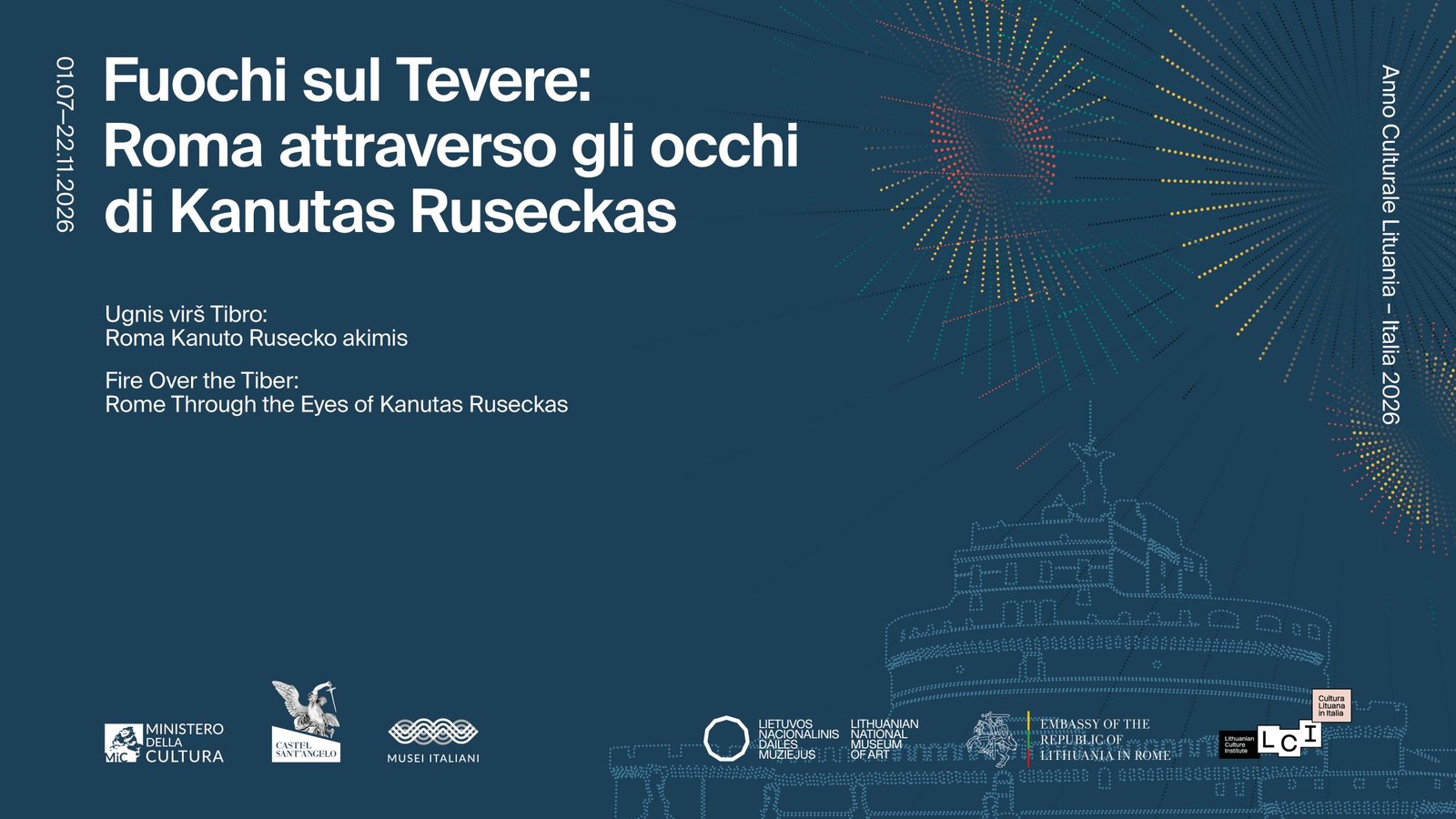
Fuochi sul Tevere: Roma attraverso gli occhi di Kanutas Ruseckas is open at Castel Sant'Angelo, Lungotevere Castello 50, 00193 Rome, from July 1 to November 22, 2026, in the Castellan's apartment. The museum is open Tuesday to Sunday from 9:00 to 19:30, with last entry at 18:30, and is closed on Monday. The exhibition is part of the castle's museum route: ticket prices are published on the official website of the Direzione Musei nazionali della città di Roma, and tickets are bought on the official portal of the state museums indicated by the museum. The castle is on the right bank of the Tiber, in front of Ponte Sant'Angelo, a short distance from the Vatican. To choose the most convenient bus and stop, use the ATAC route planner with Lungotevere Castello as the destination.
It's a small exhibition, the kind you discover almost by chance on the way up to the Angel's terrace, and that's exactly why it deserves a planned detour. A 19th-century Lithuanian painter looks at Rome and chooses to paint the Girandola, the great fireworks show that started from the castle. His canvases now return to the place they depict, in dialogue with the museum section dedicated to the Girandola itself. It's one of the smartest ideas of the season: an exhibition that shows the monument through the eyes of someone who admired it from the other bank, two centuries ago.
Fuochi sul Tevere at Castel Sant'Angelo: the essentials
The exhibition is open until November 22, 2026 in the Castellan's apartment and is included in the visit to the Castel Sant'Angelo national museum.
Dates
The exhibition opened on July 1, 2026 and closes on Sunday, November 22, 2026. At the end of September, that leaves almost two months, with all the weekends of October and November. The exhibition has no calendar of related events published on the official pages: you visit it during the museum's normal hours.
Hours
Castel Sant'Angelo is open Tuesday to Sunday from 9:00 to 19:30. Last entry is at 18:30. The museum is closed on Monday. If you want to go up to the terrace and stop at the exhibition, allow at least two hours.
Tickets
The works are part of the museum route, so you see them with the castle admission ticket. Updated prices and any reductions are published by the museum. Tickets are bought at the ticket office or on the official portal of the state museums. For information the museum gives the number 06 6819111.
Who is behind it
The exhibition is promoted and produced by Pantheon e Castel Sant'Angelo, Direzione Musei nazionali della città di Roma, in collaboration with the Lithuanian National Museum of Art, and is part of the program of the Lithuania Italy Cultural Year 2026.
What you see in Fuochi sul Tevere
The exhibition presents a selection of paintings by Kanutas Ruseckas from the Lithuanian National Museum of Art in Vilnius, placed in the castle's route dedicated to the tradition of the Girandola.
The Girandola
The heart of the exhibition is the Girandola of Castel Sant'Angelo, the fireworks show held every year on June 29 in honor of Saints Peter and Paul. Since the Renaissance, the museum explains, this show has helped build the imagery of Rome, fascinating travelers, artists and visitors from all over Europe. Ruseckas paints it as a direct witness.
The point of view
The painter observes the castle from a place that no longer exists: the Porto Leonino, built by Pope Leo XII in 1827 on the right bank of the Tiber, near the Vatican. From there he sees the fountains of fire rising from the castle into the night sky. The museum stresses the force of the effect: looking at the canvas, you almost seem to hear the roar of the fireworks.
The Colosseum and the ruins
Alongside the Girandola, the works on display tell of the painter's view of ancient Rome: among the subjects the museum cites the Colosseum and the Capitoline remains. It's the Rome of the Grand Tour, seen by an artist who came from northern Europe and was determined to train on the monuments.
Where it is
The exhibition occupies the Castellan's apartment, in the upper rooms of the castle. The works are in dialogue with the museum route dedicated to the Girandola, already part of the castle's installation: so it's an insertion into the museum rather than a separate exhibition.
Who Kanutas Ruseckas was
Kanutas Ruseckas, in Polish Kanuty Rusiecki, was born on February 10, 1800 in Stebėkiai, Lithuania, then part of the Russian Empire, and died in Vilnius on September 2, 1860. The museum presents him as one of the most important Lithuanian artists of the 19th century and one of the main representatives of Romantic painting.
Training in Vilnius
Born into a family of the Polish-Lithuanian lesser nobility, the son of a magistrate, Ruseckas entered Vilnius University in 1816. He began with law and mathematics, then in 1818 moved to art studies, with the masters Jan Rustem and Kazimierz Jelski. During his university years he was a member of the Philomaths, a secret society of Polish students.
Paris
With letters of recommendation and his father's financial support, and after a marriage celebrated in secret, Ruseckas left for Paris. Between 1821 and 1822 he attended the École des Beaux-Arts, as a student of Guillaume Guillon Lethière, one of the most esteemed Neoclassical painters of the time.
Rome
From Paris he moved on to Rome, where he spent a year at the Accademia di San Luca, working with Vincenzo Camuccini and frequenting the sculpture workshop of Bertel Thorvaldsen. In Rome he was the informal point of reference for the Polish artistic community and organized an exhibition of Polish Romantic painters. The Castel Sant'Angelo museum remembers him among the founders of the community of Lithuanian and Polish artists living in Rome, and reports his conviction that this land, full of ancient glory and traces of heroism, should be a guiding star for them. Between one period of study and another he traveled a lot in Italy, painting portraits and landscapes.
The return and teaching
From 1831 Ruseckas gave private drawing lessons in Vilnius. Three years later he became a professor at the city's Institute for the Nobility and taught there until his death. In 1856, with Wincenty Dmochowski and Kazimierz Jelski, he tried to found an independent art school. He painted altarpieces and restored frescoes in many small churches in Lithuania and in Vilnius Cathedral.
The works and their fate
Many of his paintings belonged to private collections that were later dispersed, and today they are hard to trace. Most of the known works are the ones left in his studio at his death, kept by his son Bolesław, also a painter, and then left to museums in Poland, Lithuania and present-day Belarus. Among his best-known paintings is the Lithuanian Girl with Willows, from 1847. Seeing a group of his canvases in Rome, arrived from Vilnius, is a rare opportunity.
A curiosity about Fuochi sul Tevere. Kanutas Ruseckas at Castel Sant'Angelo, through November 22, 2026
The curiosity is the place from which Ruseckas painted the Girandola: the Porto Leonino. Pope Leo XII had it built in 1827 on the right bank of the Tiber, near the Vatican, and today it no longer exists. Whoever looks at the canvas therefore sees a Rome that has vanished twice over: that of the 19th-century Girandola and that of the river port from which it was watched.
The detail helps to understand something that is easily forgotten: until the 1800s the Tiber was a living waterway, with landings, ports and boats, and the city looked at it up close. The castle, which today is seen from high up on the embankments, was then seen from the water, at river level. It's also the reason the Girandola was such a powerful show: the fountains of fire were reflected in the Tiber, and the public gathered along the banks.
Before entering the exhibition, it's worth leaning out from the castle's ramparts toward the river and trying to imagine the painter's point of view, moving your gaze toward the Vatican. Then go in and compare. It's an exercise that takes two minutes and makes the canvas much more eloquent.
The Girandola of Castel Sant'Angelo, yesterday and today
The Girandola of Castel Sant'Angelo is the fireworks show held on June 29, the feast of Saints Peter and Paul, patrons of Rome. The museum notes that the tradition dates back to the Renaissance.
A European show
For centuries the Girandola was one of the most recognizable images of Rome, on a par with the ruins and the basilicas. Travelers, painters and engravers who came from all over Europe described and depicted it: Ruseckas's canvas is one of the testimonies to this fascination, seen by an artist from the Baltic.
The route in the museum
Castel Sant'Angelo devotes a section of its museum route to the Girandola, and that's where Ruseckas's works have been placed. The curatorial idea is simple and happy: putting a pictorial document in the place it documents. Anyone who only knows the modern Girandola finds its history here.
One thing nobody tells you about Fuochi sul Tevere. Kanutas Ruseckas at Castel Sant'Angelo, through November 22, 2026
What nobody says is that this exhibition is up high. The Castellan's apartment is in the upper rooms of the castle: to get there you have to walk through a large part of the monument, between courtyards and papal apartments, uphill toward the terrace. Anyone who comes in intending to see only the exhibition still has to do a large part of the climb. It's not a flaw, quite the opposite: the exhibition fits into a story of the monument, and you arrive with the castle's history already in your head.
The second thing is about the light. The castle's upper rooms get natural light in a different way during the day, and an autumn afternoon is the nicest moment for the terraces. But for the canvases, which depict a night scene, it's better to arrive rested and unhurried, not in the last 20 minutes before closing.
Third thing: the exhibition is small, and anyone who comes specifically for it risks being disappointed if they expect dozens of works. The point is in the dialogue with the place. Better to visit it as part of a complete visit to the castle, not as an exhibition on its own.
Castel Sant'Angelo: the monument that hosts the exhibition
Castel Sant'Angelo, also called Hadrian's Mausoleum, is on the western bank of the Tiber in front of Ponte Sant'Angelo, in the Borgo district, and is connected to the Vatican by the fortified corridor of the Passetto.
Hadrian's mausoleum
It all begins in 135 AD, when the emperor Hadrian has a mausoleum built for himself and his family, modeled on that of Augustus but gigantic in size. The architect is Demetrianus. The works were completed by Antoninus Pius in 139. The mausoleum was connected to the Campus Martius by a bridge built for the purpose, the Pons Aelius. It had a square base clad in Luna marble, a drum, an earthen mound planted with trees and statues, and on top a bronze quadriga driven by the emperor.
The imperial burials
Hadrian and his wife Vibia Sabina, Antoninus Pius and Faustina the Elder, Lucius Aelius Caesar, Commodus, Marcus Aurelius, Septimius Severus and Julia Domna, and their sons Geta and Caracalla were laid to rest in the mausoleum. Inside, a helical ramp, lit by light wells, climbed slowly to the funerary chamber.
From tomb to fortress
In 403 the emperor Honorius included the building in the Aurelian Walls, and the tomb became a stronghold, a bulwark beyond the Tiber defending Rome. For centuries it was a fortress of the noble Roman families, then of the popes, who used it as a refuge, archive, treasury, court and prison.
The popes' residence
Nicholas V created the first papal residence there, Alexander VI Borgia fortified it with Antonio da Sangallo the Elder and had an apartment frescoed by Pinturicchio, now lost. In 1542 Paul III had the castle renovated by Raffaello da Montelupo and Antonio da Sangallo the Younger, and entrusted the decorations to Perino del Vaga. The pentagonal bastioned wall was begun under Paul IV.
The museum
After Italian unification the castle was a barracks, then a museum. On February 13, 1906 the Museum of Military Engineering was inaugurated there. The restorations of 1933-1934 restored the moats and bastions and laid out the Parco della Mole Adriana. Today the castle is managed by the Direzione Musei nazionali della città di Roma and is among the most visited museums in Italy.
My advice for visiting Fuochi sul Tevere. Kanutas Ruseckas at Castel Sant'Angelo, through November 22, 2026
My advice is to do the visit in two parts: first the castle, then the exhibition, then the river. Go in in the morning, walk calmly through the courtyards and papal apartments and reach the Castellan's rooms with the history of the monument already in your head. After the exhibition go up to the terrace. Then go out and walk along the Tiber toward the Vatican: that is the direction of the Porto Leonino, the spot from which Ruseckas painted the Girandola. Looking at the castle from below, with the canvases still in your eyes, closes the circle.
Avoid Saturday afternoon, when the Borgo area and the bridge fill up. A Tuesday or Wednesday morning, at 9:00, are the moments when the castle is quietest. In autumn, if the sky is clear, save the terrace for last: the view over Rome from above is worth the climb on its own.
One last thing: take the time to read the panels of the section on the Girandola. The exhibition works because it is in dialogue with that story, and without it Ruseckas's canvases remain beautiful views. With that story they become documents.
The Lithuania Italy Cultural Year 2026
Fuochi sul Tevere is part of the Lithuania Italy Cultural Year 2026, a program that connects the cultural institutions of the two countries. The museum states the goal of enhancing cultural relations between Italy and Lithuania and of offering a new key to reading the history of Castel Sant'Angelo and of Rome, and the fascination that the monument and the city have exerted on European artists over the centuries.
The Lithuanian National Museum of Art
The works come from the Lithuanian National Museum of Art, the national art museum of Lithuania, which collaborates on the exhibition. It's thanks to this loan that the Roman public can see paintings that are otherwise in Vilnius.
A community in Rome
Ruseckas was not an isolated traveler. The museum remembers him among the founders of the community of Lithuanian and Polish artists who lived in Rome, and the exhibition also gives back this collective story: Rome as Europe's school, where artists from every country came to train.
Another well-known fact, yet rarely cited
Everyone knows the castle takes its name from the angel that crowns its top. Less often cited is the story from which that name comes. According to tradition, in 590 Rome was scourged by a serious plague and Pope Gregory the Great organized a penitential procession. While crossing the Pons Aelius, the pope saw the archangel Michael on top of the Mole Adriana in the act of sheathing his sword: it was interpreted as the sign of the end of the epidemic. From that moment the mausoleum was called Castel Sant'Angelo, and on the summit a church dedicated to the archangel was built and, in the 1200s, a statue of the angel sheathing his sword.
Even less known is a detail kept outside the castle: in the Capitoline Museums there is a circular stone with footprints that tradition attributed to the archangel, who stopped there to announce the end of the plague. And the bridge itself changed its name because of the castle: after Pope Clement IX, between 1667 and 1669, had 10 marble angels placed on it, the Pons Aelius too began to be called Sant'Angelo.
For the exhibition the story matters, because the Girandola was born precisely from the top of that fortress under the protection of the angel: fireworks and celebration above the place of the vision.
The right photo to take at Fuochi sul Tevere. Kanutas Ruseckas at Castel Sant'Angelo, through November 22, 2026
The right photo isn't in the gallery but outside, and it repeats the painter's point of view. Leave the castle and walk along the Tiber embankment toward the Vatican, on the right bank, that is, toward the area where the Porto Leonino stood. Turn toward the castle and frame it with the river in the foreground: it is, with some approximation, Ruseckas's view on the night of the Girandola. If you can, come back at blue hour, right after sunset, when the sky is still light and the castle begins to light up.
The second photo is from the terrace. From the top of the castle, under the statue of the angel, you see the city: frame toward the bridge and the opposite bank, where the public gathered for the Girandola. It's the same scene, reversed: from the point where the fireworks started to the point from which they were watched.
In the gallery, before photographing the works, ask the staff if it's allowed: the canvases are on loan and may have different rules from the permanent collection. Better one well-made shot of the river than 10 crooked reproductions.
How to get to Castel Sant'Angelo
Castel Sant'Angelo is at Lungotevere Castello 50, on the right bank of the Tiber, in front of Ponte Sant'Angelo and a short distance from the Vatican.
By public transit
Many bus lines serve the area between Borgo, Prati and the Tiber embankment. To choose the most convenient line and stop from your starting point, use the ATAC route planner, entering Lungotevere Castello as the destination.
On foot from the center
The most beautiful way to arrive is on foot from the historic center, crossing Ponte Sant'Angelo with its marble angels. Arriving this way, with the castle ahead of you, is the best introduction to the exhibition.
From the Vatican
If you're coming from St. Peter's, you can walk through the Borgo district along the route of the Passetto, the fortified corridor that connects the Vatican to the castle. The combination of the Vatican and Castel Sant'Angelo in one day is a classic and it works.
By car
The area is very busy and parking is difficult. My advice, for once without nuance, is to leave the car and get around on foot or by public transit.
Around Castel Sant'Angelo: Borgo, Prati and the center
The castle is a hinge between the Vatican, the Prati neighborhood and the historic center on the other side of the Tiber.
Ponte Sant'Angelo
The bridge, the ancient Pons Aelius built by Hadrian to connect the mausoleum to the Campus Martius, is decorated with the 10 angels placed by Clement IX. Crossing it is an integral part of the visit.
St. Peter's
From the castle you can walk to St. Peter's Basilica, passing through the Borgo district. If you have time, you can do both visits on the same day, starting with the castle in the morning.
The historic center
Across the bridge you enter the Ponte district and head toward Piazza Navona and Palazzo Altemps, home of the Museo Nazionale Romano with its ancient sculptures. For anyone who loves ancient Rome, the combination of Hadrian's mausoleum and the classical collections makes sense.
Some important events that happened here in history
135-139 AD: Hadrian has the mausoleum built, completed by Antoninus Pius. It is connected to the Campus Martius by the Pons Aelius.
403: the emperor Honorius includes the mausoleum in the Aurelian Walls. The tomb becomes a fortress. It saves the Vatican area during the sacks of 410 and 455. To defend themselves, the Romans even hurl statues at the attackers, and one of them, the Barberini Faun, will be found in the moats.
590: according to tradition, Pope Gregory the Great sees the archangel Michael sheathing his sword on the Mole: the name Castel Sant'Angelo is born.
932: Marozia celebrates her wedding to Hugh of Provence in the castle. During the wedding lunch her son Alberic II seizes power and Hugh flees.
1367: the keys of the castle are handed to Pope Urban V to urge his return from Avignon.
1527: thanks to the fortifications of Alexander VI, Clement VII holds out for seven months against the siege of the Landsknechts during the Sack of Rome.
1542: Paul III has the castle turned into a true papal residence, with decorations by Perino del Vaga.
1667-1669: Clement IX has 10 marble angels placed on the bridge.
1827: Pope Leo XII has the Porto Leonino built on the right bank of the Tiber, the spot from which Ruseckas will paint the Girandola.
1906: on February 13 the Museum of Military Engineering is inaugurated in the castle.
1933-1934: the restorations restore the moats and bastions and create the Parco della Mole Adriana.
July 1, 2026: Fuochi sul Tevere opens, as part of the Lithuania Italy Cultural Year.
Fuochi sul Tevere with children
Castel Sant'Angelo is one of the monuments in Rome that children love most, and the exhibition fits well into a family visit.
The story of the fireworks
A fireworks festival painted by a painter who came from far away is a subject kids understand right away. Tell them before going in what the Girandola was and ask them to find it in the painting: the fountains of fire, the river, the crowd.
The castle as an adventure
The prisons, the courtyards, the ramparts and the terrace with the angel make the castle a lively visit. Keep the exhibition for the middle of the route, as a quiet pause, and finish on the terrace.
Time
With children, count on a good two hours. The route includes many stairs: if you come with a stroller, ask at the ticket office before you start.
Accessibility at Castel Sant'Angelo
Castel Sant'Angelo is a monument of Roman origin turned into a fortress for centuries, with ramps, stairs and level changes. The route that leads to the upper rooms, where the Castellan's apartment is, includes significant climbs.
Before the visit
Anyone with mobility difficulties or special needs should contact the museum at 06 6819111 or at the address of the Direzione Musei given on the official website, to find out about the accessible routes and the aids available.
Who has passed through Fuochi sul Tevere. Kanutas Ruseckas at Castel Sant'Angelo, through November 22, 2026
Few buildings in the world have seen as many figures pass through as Castel Sant'Angelo. The first is Hadrian, who wanted it as his tomb, and with him the emperors who were buried there: Antoninus Pius, Marcus Aurelius, Commodus, Septimius Severus, Caracalla. In the Middle Ages Theophylact, Marozia and her son Alberic lived there, then the Crescenzi, who gave it the name Castrum Crescentii, and the Orsini. In 1424 Cyriacus of Ancona, one of the precursors of archaeology, drew the castle and correctly recognized it as Hadrian's Mole.
In the Renaissance came the popes and their artists: Pinturicchio for Alexander VI, Antonio da Sangallo the Elder and the Younger, Raffaello da Montelupo, Perino del Vaga for Paul III. And the prisoners came. Between 1538 and 1539 Benvenuto Cellini was held here, who escaped by lowering himself on a rope made of sheets, broke a leg, was recaptured and shut up in the dungeons. In 1789 Giuseppe Balsamo, Count Cagliostro, was imprisoned here, in a luxury cell that still bears the name Cagliostra today. The humanists Platina and Pomponio Leto, Beatrice Cenci, Giordano Bruno and the patriots of the Risorgimento also passed through the cells.
The castle has also entered opera: the third act of Puccini's Tosca is set in its prisons and on its ramparts. In the 1800s, among many European painters, came Kanutas Ruseckas, who looked at it from across the river on the night of the Girandola. Today his canvases return inside the walls they depict.
How to organize the morning at Castel Sant'Angelo
The museum opens at 9:00. Here is the sequence I recommend.
First part
Go in at opening time and walk through the courtyards and papal rooms. Stop in the section on the Girandola and then in the exhibition, in the Castellan's apartment.
Second part
Go up to the Angel's terrace for the panorama. Come down and head out toward the Tiber embankment, walking in the direction of the Vatican to find the painter's point of view again.
The afternoon
The afternoon can be devoted to St. Peter's or, crossing the bridge, to the historic center. A whole day among castle, river and basilica is one of the most beautiful that Rome can offer in autumn.
Where to eat near Castel Sant'Angelo
The area around the castle offers many options, of very variable quality.
Borgo
The Borgo district, between the castle and St. Peter's, is full of places designed for Vatican tourists. Moving a few streets away from the main roads helps you find more honest trattorias.
Prati
The Prati neighborhood, behind the castle, is a residential and office area, with restaurants, pizzerias and bars frequented by Romans. More reasonable prices and more reliable cooking.
Across the bridge
Crossing Ponte Sant'Angelo you enter the historic center, toward Via dei Coronari and Piazza Navona, with a wide offering and downtown prices.
Rome in October and November: the exhibition period
The exhibition closes on November 22, and autumn is the best season for Castel Sant'Angelo. The October days are still bright and you can enjoy the terrace without the summer heat. In November the light is low and the city, seen from above, takes on the warm colors of sunset. It's also the period when the tourist flow drops compared to summer, and the castle is quieter again on weekdays. Anyone who can choose should choose a clear mid-October morning.
Frequently asked questions about Fuochi sul Tevere at Castel Sant'Angelo
Until when is Fuochi sul Tevere open at Castel Sant'Angelo?
Fuochi sul Tevere: Roma attraverso gli occhi di Kanutas Ruseckas is open at Castel Sant'Angelo from July 1 to November 22, 2026, in the Castellan's apartment. The museum is open Tuesday to Sunday from 9:00 to 19:30, with last entry at 18:30, and is closed on Monday.
Do I need a separate ticket for the Ruseckas exhibition?
The exhibition on Kanutas Ruseckas is part of the Castel Sant'Angelo museum route and is visited with the castle admission ticket. Updated prices are published on the website of the Direzione Musei nazionali della città di Roma. Tickets are bought at the ticket office or on the official portal of the state museums.
Who was Kanutas Ruseckas?
Kanutas Ruseckas (1800-1860) was a Lithuanian painter, one of the main representatives of Romantic painting in his country. He studied in Vilnius, in Paris with Guillon Lethière and in Rome at the Accademia di San Luca with Camuccini, and was among the founders of the community of Lithuanian and Polish artists in Rome.
What can you see in the Fuochi sul Tevere exhibition?
Fuochi sul Tevere presents a selection of paintings by Ruseckas from the Lithuanian National Museum of Art, with views of Rome such as the Colosseum and above all the Girandola of Castel Sant'Angelo, painted from the Porto Leonino. The works are in dialogue with the museum section dedicated to the Girandola.
What is the Girandola of Castel Sant'Angelo?
The Girandola of Castel Sant'Angelo is the fireworks show held every year on June 29, the feast of Saints Peter and Paul. According to the museum it dates back to the Renaissance and for centuries contributed to the European imagery of Rome, attracting travelers and artists.
How much time do I need to visit Castel Sant'Angelo with the exhibition?
For Castel Sant'Angelo with the Fuochi sul Tevere exhibition, allow at least two hours: the Castellan's apartment is in the upper rooms, and to get there you walk through a large part of the monument, between courtyards and papal apartments. Add the time for the terrace.
How do you get to Castel Sant'Angelo?
Castel Sant'Angelo is at Lungotevere Castello 50, in front of Ponte Sant'Angelo, a short distance from the Vatican. From the historic center you get there on foot by crossing the bridge. For buses and stops, use the ATAC route planner.
The final advice
Go on an October morning, do the whole castle, stop in front of Ruseckas's Girandola and then go out to look for his point of view along the river. It's a small exhibition that teaches you how to look at a huge monument: in our judgment it's the best excuse of the season to come back to Castel Sant'Angelo.
Article written by the editorial team of Tour Leader Pro, contact them for Private/Corporate/V.I.P. Tours and Experiences.
Planning a trip to Rome? The English-language guides for visiting the city are on ItalyPlanner.com.