La Rambla
In short. La Rambla is a beach club on the beach of Maccarese, the coastal district of the Municipality of Fiumicino that stretches between the mouth of the Tiber and Fregene, less than 30 kilometers from Rome.

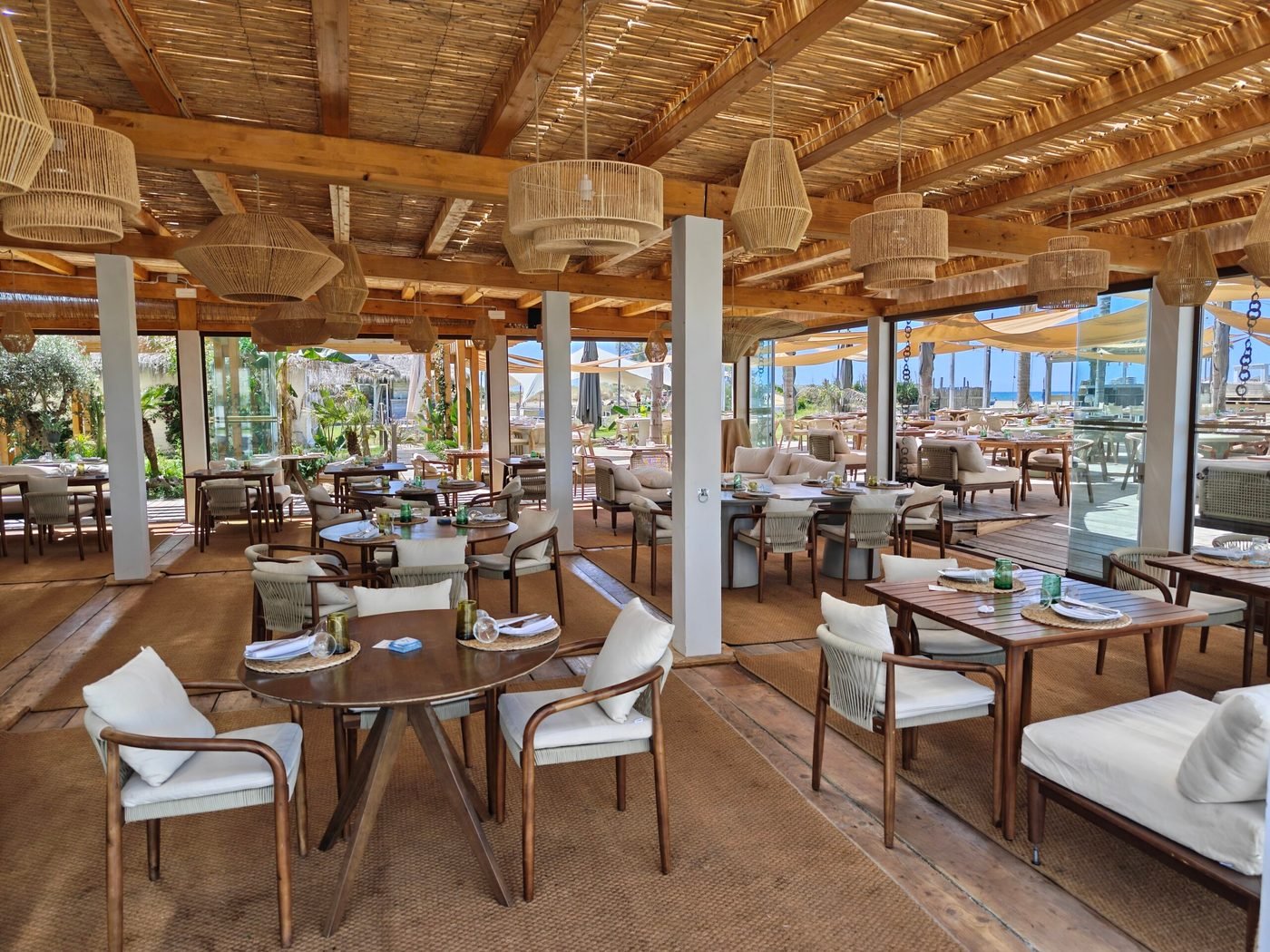
La Rambla is a beach club on the beach of Maccarese, the coastal district of the Municipality of Fiumicino that stretches between the mouth of the Tiber and Fregene, less than 30 kilometers from Rome. The address is Via di Praia a Mare, in the stretch of shore that Romans simply call "the Maccarese lido", and the venue joins under the same umbrella three different souls: the bathing establishment with cabins and sunbeds, the restaurant overlooking the water, and the cocktail bar that in the evening, in the warm season, offers DJ sets and sunset aperitivi. The project is signed by Carlo Del Buono, who shaped its general concept taking the beach clubs of the island of Ibiza as a model, while the venue's two bars, one inside and one facing the sea, are entrusted to Matteo Razzetti and Alessandro Livulpi. For those arriving from outside the area, La Rambla is one of the names that come up most often when talking about aperitivo by the sea north of Rome, but it's also, more simply, a good starting point for understanding what the Maccarese coast is like today, a long, regular strip of sand, born from a 20th-century land reclamation, that lives to a double rhythm: agricultural and quiet for nine months of the year, packed with Roman bathers on summer weekends. To get your bearings on the whole coastline, it's best to keep at hand the pages devoted to the Lido di Maccarese and the Fregene beach, the two places that bound this stretch of coast to the north and the south.
Where La Rambla Is and How You Really Get There
Maccarese is not a town in the traditional sense, and this has to be said right away so you don't arrive disoriented. It's a district of the Municipality of Fiumicino, split between an inhabited core a few kilometers from the sea and a shoreline, the one where La Rambla is located, that lives almost only in summer. The postal code is 00054, the same as the whole area managed by the Municipality of Fiumicino together with the districts of Focene, Fregene and Passoscuro. La Rambla is located right on the shore, on Via di Praia a Mare, the road that goes down from the state road to the water's edge, crossing the band of bathing establishments lined up along this stretch of coast.
By Train: The Maccarese-Fregene Station
The most convenient rail connection is the FL5 Roma-Civitavecchia line, which has a dedicated stop right here, the Maccarese-Fregene station, run by RFI and served by Trenitalia with regional trains that leave from Roma Termini and also stop at Roma Ostiense and Roma San Pietro along the urban stretch. From the station to the sea it's a few kilometers, covered by taxi, with your own vehicle or, in the summer months, with shuttles that some establishments organize on peak weekends: it's best to find out beforehand, because the service changes from season to season and isn't guaranteed every day. Anyone traveling with the idea of stepping off the train and finding themselves under an umbrella in 10 minutes is almost always disappointed: the station serves the whole Maccarese and Fregene area, not the single establishment, and the last stretch has to be factored in.
By Car: Aurelia, A12 and the Roma-Fiumicino
Coming from Rome you have two main roads. The first is Via Aurelia, which runs parallel to the coast and from which the provincial road to Maccarese branches off. The second is the A12 Roma-Civitavecchia motorway, with a dedicated exit for Maccarese-Fregene, very convenient for those starting from the northern side of the Grande Raccordo Anulare. A third option, often the fastest for those arriving from the airport or from the southwest neighborhoods of the city, is State Road 296 of Via Portuense, which can be combined with the Roma-Fiumicino connector. In normal traffic conditions the trip from the Raccordo Anulare takes less than 40 minutes. On July and August weekends, between 10:00 and noon, the line at the Maccarese-Fregene exit is a classic to allow for, especially if the goal is a booked lunch.
Useful distances: about 12 kilometers from Leonardo da Vinci airport in Fiumicino, between 30 and 35 kilometers from central Rome depending on the starting point, some 20 from Ladispoli and Cerveteri heading north along the coast. If you land at Fiumicino with a few free hours before your flight, you'll find here one of the beaches closest to the airport on the entire Lazio coast, a detail that in recent years has also brought a share of international travelers with long layovers to discover this stretch of coast, usually frequented almost exclusively by Romans.
Focene, Fiumicino and Passoscuro: Maccarese's Neighbors
The coast that runs from the mouth of the Tiber to Fregene is divided into a sequence of small separate districts, each with its own identity: Fiumicino, grown up around the fishing port and today the main center of the municipality of the same name. Focene, a residential strip developed during the building boom years between the town and the sea. Maccarese, with its shoreline of bathing establishments among which La Rambla. And farther north Fregene and Passoscuro, which close the stretch toward Ladispoli. They're names easily confused by anyone who doesn't know the area well, but they mark administrative boundaries and real differences in atmosphere: Fregene has a historic protected pine forest and a more urban seafront, Maccarese a more open, less built-up shore, Focene a more residential and less touristy character. Knowing which of these districts you're in helps quite a bit with getting your bearings when you look for an address on a map, and avoids the common mistake of typing simply Fregene into the navigator when the destination is actually farther south, on the beach of Maccarese.
All these districts belong to the same Municipality of Fiumicino, established as an autonomous body in 1992 after the split from the territory of Rome: a relatively young administration, which finds itself managing a very long and heterogeneous coastline, from the historic fishing port to beach club establishments like La Rambla, by way of the intercontinental airport and one of the largest farming estates in Lazio.
By Bus and on Foot
Local public transport links the inhabited core of Maccarese to the shoreline with Cotral runs and lines of the Municipality of Fiumicino, but frequency drops noticeably off-season and in the evening hours, when La Rambla puts on its DJ sets. For those without their own vehicle, the most reliable solution remains a taxi or a rental car with driver booked in advance, especially for the return at the end of the night: the Maccarese coast is not served by a night service comparable to that of central Rome, and on this point it's best to organize before leaving, not at midnight with the club closing.
What La Rambla Really Is: A Bathing Establishment with a Beach Club Vocation
The point has to be clarified right away because it often causes misunderstandings among people looking up the venue online: La Rambla is not an indoor disco, and it's not just a traditional bathing establishment with lined-up umbrellas and nothing else. It's a hybrid formula, very widespread in recent years on Italian coasts and drawn directly from the model of Spanish beach clubs: by day an equipped beach, cabins, sunbeds and a restaurant that works at lunch with seafood cuisine. In the late afternoon the aperitivo, with live music or a DJ booth and the tables shifting toward the bar on the sand. In the evening, in the central months of summer, dinner and then themed nights with DJ sets that go on until late. It's in this continuous passage among the three souls of the venue that you recognize the declared inspiration from the beach clubs of Ibiza: not a single service, but a whole day organized around the sea.
Management is led by Carlo Del Buono, who shaped the overall concept of the venue, while the two bar points, the one inside the restaurant and the one that faces the water's edge directly, are run by Matteo Razzetti and Alessandro Livulpi. The success of the formula at Maccarese led, in 2022, to the opening of a second facility in Terracina, on the Pontine coast, which replicates the same model adding a campground of about 70 pitches, a pizzeria and a beach club of its own: an expansion that says something about the scale the brand has reached in a few years, starting from a single stretch of Roman beach.
The Beach Club Look and the Ibiza Reference
The explicit nod to the beach clubs of the Spanish island concerns not only the name of the venue, but also the layout of the spaces: light wood furnishings and natural materials, cabins and sunbeds arranged to favor the view of the open sea, a bar on the sand designed to work as a gathering point more than as a simple service for drinks. It's a model that in recent years has spread along many Italian coasts, from Versilia to Puglia, and that on the Roman coast has found in places like this one of the first complete examples, able to hold together in a single space the daytime bathing component and the evening entertainment one without a break.
Kitchen and Food Offering
The kitchen follows the line that is by now almost a standard at beach clubs of this stretch of coast: seafood dishes, raw preparations and simple cooking at lunch, a more elaborate offering at dinner, with a declared focus on fresh ingredients and a line the managers themselves describe as halfway between Roman tradition and openness toward more international cuisines. Service is split into two distinct moments of the day: lunch on the beach, more informal, designed for those who spend the whole day under the umbrella and want a light meal without leaving the sunbed, and dinner, served in the actual restaurant area, with a more structured menu and a service closer to that of a city restaurant overlooking the sea. As with any seasonal venue, menus, prices and kitchen opening hours change every year and should be checked directly when booking: anyone showing up with a menu read online months earlier always risks a surprise, one way or the other.
The late-afternoon aperitivo deserves separate mention, because it's probably the moment of the day when the venue best expresses its identity: tables moved toward the water's edge, music gradually rising in intensity, light changing quickly on the sea facing west. It's the handover between the clientele of the beach day and that of the evening, and anyone who wants to live both moments without a break does well not to give up the sunbed too early.
The Beach of Maccarese and the Coastline Around La Rambla
The shore of Maccarese is one of the most regular and longest stretches of the Roman coast, a strip of light sand that runs almost without interruption from Fregene nearly to the mouth of the Tiber, alternating establishments under concession and stretches of free beach. As along all of Italy's maritime public domain, the water's edge always remains walkable and access to the sea cannot be barred to anyone: umbrellas, sunbeds, cabins and services within a concession, like the one on which La Rambla stands, are paid for, while the free stretches remain free and are to be found at the ends of the equipped coastline or in the openings between one establishment and the next.
The seabed along this stretch of coast slopes gradually, a condition common to much of the coastline north of the Tiber and appreciated by those who bring small children. The quality of the bathing waters is monitored by ARPA Lazio under the European bathing water directive, with monthly sampling from April to September and a classification built on four consecutive seasons of data, not on a single sample: the updated figure for the Fiumicino monitoring point can be consulted on the agency's portal, which remains the source to use before a swim after days of heavy rain or after a major weather event, when the Municipality is more likely to issue a temporary swimming ban.
How La Rambla Differs from the Other Establishments on the Stretch
On a coastline that counts dozens of concessions, what sets La Rambla apart from the average of traditional establishments is the evening component: many Maccarese lidos close with the last bather of the afternoon, while here activity continues with the aperitivo and, on warm-season weekends, with themed nights run by DJ sets. It's a formula that over the years has drawn a different audience from the classic day bather, younger and more oriented toward evening socializing, and that has made the venue's name a recurring one in Roman roundups devoted to summer nightlife on the coast.
The Dune, the Wind and the Exposure of the Beach
Like much of the Lazio coast north of the mouth of the Tiber, the shore of Maccarese faces west and takes the full wind that in the afternoon, especially in the central months of summer, tends to strengthen with the classic coastal thermal breeze. It's an element to factor in when choosing the time of your visit: in the morning, before the wind picks up, the sea is almost always flatter and the beach quieter, while in the late afternoon, precisely in the hours when La Rambla lights up the aperitivo, the breeze helps make the heat of July and August pleasant, no small detail for those who stay until evening between one drink and the next. Behind the shore there also runs a dune ridge, in some stretches still well preserved, which on this coastline performs the same function it performed before the land reclamations and 20th-century urbanization: natural protection of the land behind from the sea's ingress, today protected where it hasn't been erased by the vehicle access roads to the establishments.
A Curiosity About La Rambla
The name itself tells the venue's vocation better than any description. La Rambla explicitly recalls the famous pedestrian boulevard of Barcelona, the Rambla in fact, the historic city axis linking Plaça de Catalunya to the old port and for centuries a synonym of strolling, market and open-air life. Choosing this name for a Roman bathing establishment is not a random detail: it's the statement of intent of a venue that wants to be, on its own scale, a piece of Spain transplanted onto the Lazio coast, with the same idea of sociability spread across the whole day, from breakfast to late at night.
There is then a more concrete curiosity, tied to the geography of the area on which the venue stands. The Maccarese coast has not always existed in the form we see today: until the early 20th century this stretch of shoreline was largely marshy and malarial, part of that Agro Romano which for centuries had discouraged permanent settlement. The sand on which dozens of establishments now stand, La Rambla included, is the result of a full land reclamation carried out through the 20th century, which transformed one of the most inhospitable areas around Rome into one of the most frequented seaside destinations of the capital.
A third curiosity, this time on a much smaller scale: the river that crosses the whole Maccarese estate before flowing into the sea a few kilometers from here is called the Arrone, a watercourse that few bathers know by name but that for centuries shaped the entire hydrography of the area, to the point of being one of the technical protagonists of the 20th-century reclamation, with its flow regulated precisely to make cultivable the land you see driving the provincial road toward the sea.
Padel and the Other Services at La Rambla
Alongside the beach and the restaurant, the complex also hosts padel courts, a sport that in recent years has grown very rapidly all over Italy and that at the beach clubs of the Roman coast has naturally joined the classic bathing activities: a match in the cooler hours of the morning, followed by a day at the sea and an aperitivo, has become one of the most requested combinations among the groups of friends who frequent these venues on summer weekends. The presence of regulation courts, listed in the circuits that catalog the facilities of the area, places La Rambla among the establishments of the Roman coast that have chosen to diversify the offering beyond the simple umbrella, aiming at an audience looking for sport and socializing in the same afternoon.
The venue also organizes private events, from weddings to birthdays to company parties, making use of the beach location and the double soul of restaurant and beach club for offerings ranging from ceremonial lunch to evening party with DJ sets. As with all bookings of this type, conditions, capacity and availability for the summer months should be agreed directly with the facility, with a lead time that in peak months, June and July above all, can reach several weeks.
For corporate groups, the combination of beach space, padel courts and restaurant room allows day formats that join a morning sports tournament to a working lunch and, if wanted, a closing aperitivo: a scheme that in recent years has found growing space among companies in the Fiumicino area, helped also by the proximity of the airport for those organizing events with participants arriving from outside Rome.
Something Nobody Tells You About La Rambla
Anyone arriving in Maccarese thinking they'll find a single big equipped lido is often thrown off by the real fragmentation of the coast: the shoreline is divided into dozens of distinct concessions, each with its own name, its own style and its own clientele, and going from one establishment to the next means changing atmosphere completely within a few hundred meters. La Rambla, with its beach club setup and the evening component, speaks to a specific audience, more oriented toward aperitivo and music than toward the quiet family day at the sea: those looking for the latter will find a more suitable offering at other establishments on the same stretch of coast, perhaps a few hundred meters away. It's worth finding out about the style of the venue before booking, instead of choosing by hearsay. Anyone looking instead for a middle ground, with background music but without the full evening atmosphere, would do well to aim for the early-afternoon aperitivo, when the volume is still contained and the atmosphere stays closer to that of an ordinary bathing establishment with a good bar.
The second thing that is rarely said clearly: the evening logistics of this stretch of coast are not designed for those without their own vehicle. Public connections toward the Maccarese shoreline thin out after dinner, and anyone attending a DJ set until late at night has to organize the return in advance, with their own car, an arranged ride or a private transport service booked before leaving home. Arriving without a plan for the return, counting on finding a taxi on site at midnight in the middle of summer, is one of the most common mistakes among people visiting the evening venues of this coastline for the first time.
My Advice for Visiting La Rambla
The most useful advice concerns timing. If the goal is a quiet day at the sea, it's best to arrive in the morning, by 10:00, when parking is still easy and the beach hasn't reached full swing. If instead your interest is the aperitivo and the evening side of the venue, better to plan your arrival for the late afternoon, when the atmosphere changes and the crowd turns over. Trying to combine the two in a single August weekend, arriving at noon and hoping for a table at aperitivo time without a reservation, is the surest recipe for a day of waiting.
The second piece of advice concerns reservations, which for a venue with this setup are not an optional detail in the peak months: tables, sunbeds on the busiest days and above all spots for the themed nights have to be locked in ahead of time, typically through the venue's direct contact channels, phone or messaging. Anyone who arrives without a booking on a Saturday in July risks finding everything taken, while the same venue on weekdays or in the first weeks of the season offers much more room. In our judgment, if the goal is the night with a DJ set, book as you would for a sought-after restaurant in central Rome, not as for an improvised day trip out of town.
A third piece of advice, less obvious but just as useful: if the day's plan includes both the sea and archaeology, it's best to reverse the intuitive order and do the cultural part first, when the heat is less intense and the archaeological sites of the area, Ostia Antica first among them, are less crowded, and then close the day on the beach just at the hour when La Rambla lights up the aperitivo. The opposite route, sea in the morning and archaeology in the early afternoon under the highest sun, is the one that tires you most and turns a visit to the historic sites into a chore instead of a pleasure.
Maccarese, the Estate and the Land Reclamation: The Context That Explains the Place
To truly understand what the beach where La Rambla stands is, you have to take a step back from the single venue and look at the history of the whole Maccarese area, which is one of the most significant agricultural stories of 20th-century Lazio. Until the 1920s this coastal band was largely a marshy plain, unhealthy and sparsely populated, part of the great system of uncultivated land that surrounded Rome under the name of Agro Romano, with two small coastal lakes that made the area hard to inhabit permanently and favored malaria. Ownership of the estate had passed through several families over the centuries, until it became, in the modern era, the land on which one of the most ambitious full reclamations of the period was tried.
From Medieval Origins to the Mattei Family
The traces of human presence in this area go back very far, to the Copper Age, between 3400 and 2200 BC, a fact that shows this coastal band was already inhabited in prehistoric times, despite environmental conditions that were anything but favorable. In the Middle Ages the territory passed to the Normanni family, and in that very period, around 1300, the core we now know as the castle of Villa San Giorgio was built, one of the fortified points that marked control of the territory along this band of the Agro Romano.
In the 16th century the Mattei family brought under a single ownership the several holdings scattered across the area, building an estate of about 3,000 hectares which in extent was already then one of the largest in the Roman countryside. The property then passed to the Rospigliosi family, who kept it until the decisive turn of the 20th century, when the whole area entered the great reclamation program promoted at the national level.
The 1925 Land Reclamation and the Settlers from the Veneto and the Province of Mantua
The great reclamation of Maccarese began in 1925, promoted by private investors who intended to turn into farmland one of the last large marshy zones left so close to Rome. The works involved building a dense network of drainage canals and hydraulic works meant to dry the land around the two coastal lakes and to regulate the course of the local waterways, among them the Arrone river, which crosses the whole Maccarese area before flowing into the sea a few kilometers south of the stretch where La Rambla now stands.
Despite the economic difficulties of the 1930s, which slowed the program several times, the reclamation continued with the arrival of many settlers from the Veneto and the province of Mantua, called to farm the new fields and run the livestock operations that sprang up on the newly drained land. It's a little-told chapter of the history of internal migration, but essential for understanding why so many surnames of Veneto and Mantuan origin still recur today among the families living in the hinterland of Maccarese, a few kilometers from the beach where people go on vacation in summer.
From Federconsorzi to the Benetton Ownership
For much of the second half of the 20th century the Maccarese farm remained tied to the system of national agricultural consortia, with industrial-scale management that continued to produce grain, fodder and dairy products on one of the largest estates in the Roman countryside. The most recent turn came in 1998, when the Maccarese farm was privatized and passed to the Benetton family, which still holds ownership through its agricultural holdings: a chapter that ties, perhaps unexpectedly, one of Italy's great industrial groups to a piece of Agro Romano history whose roots go back to the Middle Ages.
It's a detail few bathers know when they park the car to reach the beach: the sand on which they spread their towels is the seaward end of a farming estate that continues for kilometers inland, still among the largest and most productive in Lazio, with fields of arable crops alternating with pastures and livestock operations almost to the gates of Fiumicino airport.
From Reclamation Zone to Mass Seaside Destination
The passage from agricultural territory to frequented seaside destination happens mostly in the postwar period, when mass motorization and the expansion of Rome made the coast reachable by car in less than an hour from the city center. Bathing establishments multiplied along the shore starting in the 1950s and 1960s, following the same pattern seen along the whole Lazio coast in that period: state-property concessions assigned along the shoreline, first simple structures, then gradually more elaborate ones, up to today's multifunction venues, able to offer beach, dining and evening entertainment in a single space, as La Rambla does.
One last element, little known but significant, concerns the scientific vocation the area has kept alongside the agricultural and seaside ones: since 2001 Maccarese has hosted the headquarters of an international institute devoted to plant genetic resources, today part of the Bioversity International network, which works on conserving agricultural biodiversity globally. It's proof that the agricultural vocation of this estate, born with the 1925 reclamation, has not at all run out with the arrival of beach tourism, but still coexists, a few kilometers from the beach, with scientific research of international scope.
Another Well-Known Fact That Is Rarely Cited
That Maccarese is a seaside destination for Romans, everyone knows. What tends to be forgotten is how much this coast is geographically and historically tied to the mouth of the Tiber and, as a consequence, to the port history of Rome. A few kilometers south of Maccarese, toward the mouth of the river, lie the remains of the two great ports built by the Roman emperors, that of Claudius and that of Trajan, the complex now known as Portus: the system that for centuries brought grain to Rome from Egypt and Africa, and that made the capital dependent on a constant flow of ships arriving on precisely this stretch of coast.
This means that the Maccarese area was never, in the historical sense, a marginal territory relative to Rome: it was, on the contrary, one of the most delicate nodes in the survival of the ancient city, the point where sea and river met to bring Rome what the capital of the empire needed. The port of Claudius, begun in the 1st century AD, and that of Trajan, a hexagonal basin dug at the start of the 2nd century to ensure a safer landing than the hazards of the old harbor, together formed the largest port complex of the ancient Mediterranean, able to receive the big cargo ships loaded with the grain that fed the public distribution of bread in Rome, the annona. The connection with the city ran through the Tiber itself and through artificial canals, in a logistical system that for technical complexity has few comparisons in the ancient world.
The 20th-century reclamation gave this coastal band back an agricultural productive function, and in recent decades a tourist and seaside one, but the proximity of the archaeological area of Ostia Antica, a little farther south along the same coastal axis, recalls how close the bond between Rome and this stretch of sea has always been. Anyone who visits Ostia Antica in the morning and closes the day with an aperitivo on the beach at Maccarese is, without knowing it, retracing the same route that 2,000 years ago linked the capital of the empire to its main outlet to the sea.
The Right Photo to Take at La Rambla
The photo that best tells the story of this place is not the close-up of the cocktail at sunset, even though it's the image that circulates most on social media in the summer months. It's the wide shot, taken from the water's edge looking toward the venue in the golden hour that precedes sunset, when the raking light ignites the sand and the profile of the structures on the beach stands out against a sky that on this stretch of coast, facing west over the Tyrrhenian, tends toward very saturated colors in the warm months. It's the moment when the passage from the day at the sea to the evening at the bar becomes visible in a single frame: the last bathers heading back, the bar tables starting to fill, the light changing.
Technically it's best to work in the last hour before sunset, when the sun is still high enough not to create excessive backlight but already low enough to color the sand. A standard focal length, without extreme wide angles that distort the line of the coast, better conveys the sense of breadth of the Maccarese shore, which here is particularly regular and linear compared with other stretches of the Roman coastline. Anyone who prefers a more intimate image can concentrate on the details of the bar on the sand, with the sea out of focus in the background: it's the framing that best conveys the beach club idea declared from the venue's very concept.
Some Important Events That Happened Here in History
The first great event concerning this area, in the broad historical sense, is the reclamation of the Maccarese plain carried out through the 20th century: an infrastructure project that turned a marshy, malarial zone into one of the most productive farms in Lazio, opening at the same time, decades later, the way for the seaside development of the coast. Without that reclamation, the entire shoreline where La Rambla now stands simply wouldn't exist in its present form.
The second key moment is the birth and multiplication of bathing establishments along the shore starting in the postwar period, in parallel with the growth of Rome and the spread of the private car, which made the Maccarese shoreline reachable from the capital in times compatible with a day trip. It is in this period that the stretch of coast stops being exclusively agricultural land and becomes, for the first time, a mass vacation destination.
The third event, much more recent, concerns the venue directly: the birth of La Rambla as a beach club with its present setup, under the guidance of Carlo Del Buono, which brought to this stretch of beach a management model inspired by the great Spanish beach clubs, until then little spread on the Roman coast in its most complete form, with beach, dining and evening entertainment integrated in a single facility. The fourth, finally, is the opening of the brand's second location in Terracina in 2022, a step that marks the moment when La Rambla stops being a local phenomenon tied to a single stretch of Roman beach and becomes a brand with several facilities along the Lazio coast.
Who Has Passed Through La Rambla
La Rambla is, first of all, a venue born in recent years and tied to the summer season, so it has no decades of history behind it comparable to those of other older destinations on the Roman coast. Its audience is mostly the Romans, very many on summer weekends, who choose Maccarese as their regular seaside destination, and those who look specifically for the aperitivo and the night with a DJ set on this stretch of coast. The venue's nights regularly appear in the roundups and event calendars that the main Roman outlets devoted to nightlife and summer venues publish in the warm months, a sign of a constant presence in the circuit of evening events on the coast north of Rome.
More generally, the coast of Maccarese and the shoreline immediately to the south, toward the mouth of the Tiber, were for centuries an obligatory point of passage for those arriving in Rome by sea: ships loaded with grain headed for the ports of Claudius and Trajan passed right in front of this stretch of coast, in a maritime traffic that for ancient Rome was as vital as the air routes that fly over the same area every day to land at Fiumicino airport, a few kilometers away.
In the 20th century, with the reclamation and the arrival of the Veneto and Mantuan settlers, the stretch of coast changes function but doesn't stop being a place of passage and work: the fields you see from the car driving the provincial road toward the sea are the direct consequence of that agricultural colonization, and the same families who arrived in the 1930s often went on, in the postwar period, to work in the beach tourism that developed on the very coast where their grandfathers had farmed the newly reclaimed land. It's a continuity rarely told, but one that explains well why Maccarese was never just a beach: it was always, before that, a place of work.
When to Go to La Rambla and When to Avoid It
June and September remain, here as along most of the Roman coast, the months with the best balance between quality of experience and crowds: temperatures already pleasant or still pleasant, less traffic at the highway exit, and an easier time finding a table without booking weeks ahead. July works well on weekdays, while August weekends are the absolute peak in attendance along the whole Maccarese coast, with lines at the entrance and parking lots full by late morning.
For those looking specifically for the venue's evening side, with DJ sets and aperitivo, the useful period is the full summer season, typically June to September. But the exact schedule of the evenings changes every year and should always be checked through the venue's own channels before planning the night, rather than relying on information read months earlier. Off season, as at most beach clubs on this stretch of coast, activity drops sharply or stops, and the shoreline goes back to being the quiet, little-visited one that characterizes Maccarese for most of the year.
Off season, in fact, Maccarese shows a completely different face from the summer one: the streets that are clogged in August with cars looking for parking go empty again, the fields of the agricultural estate return to the rhythm of the harvest seasons, and the beach, stripped of its umbrellas, gives back its natural shape of a long, regular, wind-swept stretch of sand. A winter walk on this stretch of coast, with a rough sea and the low afternoon light, tells the story of a very different place from the one you see on a Saturday in July, and it's an experience worth trying at least once for anyone who knows Maccarese only in its crowded version.
La Rambla with children
The venue's formula, with its strong evening and entertainment side, makes it a better choice for groups of adults than for families with small children, especially in the evening hours. During the day, however, the beach works like any other beach club on the coast, with a seabed that slopes down gradually and the basic services guaranteed by the concession. For families who mainly want a day at the sea, without the nighttime side, the general information on Maccarese and the neighboring beach clubs remains valid.
Parking and access
As on most of the Roman coast, parking near the Maccarese beach clubs becomes the real bottleneck on summer weekends: the roads that run from the provincial road down to the sea, Via di Praia a Mare included, aren't sized for the peak traffic of an August Saturday, and arriving after 10:00 in the morning almost always means a longer search for a parking spot, by several minutes if not a few dozen. Many beach clubs, La Rambla included, have parking areas that are under agreement or reserved for customers, but availability should always be checked when you book, because it changes from season to season and is never guaranteed for those who arrive without booking.
On access, the Maccarese shoreline is generally flat, a feature shared by the whole coast from Fregene to the mouth of the Tiber, and this makes it easier to reach the edge of the beach. The provision of walkways on the sand and of services for people with mobility difficulties varies from one concession to another, though: it's always best to ask the facility directly before planning the visit, especially if you're traveling with a wheelchair or with people who have difficulty walking on soft sand.
What's around La Rambla
Within a few kilometers, the coast offers alternatives and complements worth knowing. To the north, past the mouth of the Tiber if you ideally keep following the coast, you reach the Fregene beach, the historic Roman seaside destination with its protected pine forest and a much wider choice of beach clubs. A little farther north, the Lido di Maccarese completes the picture of the area's beach offering, with a more traditional character than the beach club approach of La Rambla.
To the south, along the same coastal route, you reach in a few minutes by car the archaeological area of Ostia Antica, one of the best preserved Roman cities in the world, an almost obligatory stop for anyone who wants to combine a day at the sea with a bit of history without going far from the coast. In the same radius, toward the mouth of the Tiber, you also find the archaeological areas of the imperial ports of Claudius and Trajan, less known to the general public than Ostia Antica but of great interest for anyone who wants to truly understand the maritime history of Rome.
For those with more time who want to push north, the coast continues toward Ladispoli and Cerveteri, with the natural wetland of Torre Flavia and, a little farther north, the WWF Oasis of Macchiagrande, one of the last portions of natural coastal environment to survive on this shoreline, a testimony to what the Lazio coast was like before the land reclamation and the beach development. Those who stay in the immediate surroundings of Maccarese find the historic pine forest of Fregene, one of the best preserved green lungs of the whole Roman coast, planted artificially in the 19th century to fix the coastal dunes and today a shady refuge appreciated by residents and passing tourists alike in the hottest hours of the day.
Quick questions about La Rambla
Where exactly is La Rambla?
On Via di Praia a Mare, on the Maccarese beach, a coastal hamlet of the Municipality of Fiumicino, less than 30 kilometers from Rome and a few kilometers from Leonardo da Vinci airport.
What kind of place is La Rambla?
A beach establishment with a beach club approach: equipped beach by day, restaurant and aperitivo in the late afternoon, DJ sets and themed nights in the summer months.
Who runs La Rambla?
The overall concept is signed by Carlo Del Buono. The venue's two bars, the indoor one and the one on the beach, are run by Matteo Razzetti and Alessandro Livulpi.
Does La Rambla have other locations?
Yes, in 2022 a second facility with the same brand opened in Terracina, on the Pontine coast, which adds a campsite of about 70 pitches to the beach, restaurant and pizzeria.
How do you get to La Rambla from Rome?
By car from the Grande Raccordo Anulare, via Via Aurelia or the A12 highway with the Maccarese-Fregene exit, in under 40 minutes in normal traffic conditions. By train, the nearest station is Maccarese-Fregene on the FL5 Rome-Civitavecchia line.
Are there padel courts at La Rambla?
Yes, the complex has padel courts, which add to the beach services and to the dining and evening entertainment offering.
Can you book a private event at La Rambla?
Yes, the venue hosts private events such as weddings, birthdays and company parties, with conditions and availability to be agreed directly with the facility.
Is La Rambla suitable for children?
During the day the beach works like a normal beach club, suitable for families. The evening side, with aperitivo and DJ set, is designed mainly for an adult audience.
What is the best time to go to La Rambla?
June and September offer the best balance between weather and crowds. August weekends are the time of peak attendance along the whole Maccarese coast.
What is there to see near La Rambla?
Nearby you find the Fregene beach, the Lido di Maccarese, the archaeological area of Ostia Antica to the south and, to the north, Torre Flavia, Ladispoli and Cerveteri.
Why is the Maccarese coastline so straight and regular?
Because it's the result of a full land reclamation begun in 1925, which turned a marshy plain of the Agro Romano, with its two coastal lakes, into farmland and, on the sea side, into a seaside shoreline.
How far is La Rambla from Fiumicino airport?
About 12 kilometers, one of the stretches of coast closest to the intercontinental airport of Lazio, convenient for anyone with a long layover or a few free hours before a flight.
Who owns the Maccarese agricultural estate today?
Since 1998, after the privatization, the ownership of the farm has belonged to the Benetton family, who still manage thousands of hectares of arable land and livestock in the hinterland behind the beach.
Is it windy in Maccarese in the afternoon?
Yes, the coast faces west and in the summer months it gets the classic afternoon thermal breeze, which cools the air right in the hours when the venue offers aperitivo.
How do you get back to Rome in the evening after a night at La Rambla?
Public connections to the coast thin out after dinner: it's best to arrange ahead your own car, a ride or a private transport service, without counting on a taxi found on the spot at midnight.
The overall verdict, after reconstructing the history of this stretch of coast from the 1925 land reclamation to the opening of the venue, is that La Rambla should be considered above all for what it is: a modern beach club, born to offer sea, aperitivo and music in a single day, on a beach with a much longer and more layered history than the venue's sign suggests. Those looking only for the traditional, quiet, family umbrella will probably find an atmosphere different from the one they imagined. Those who instead want the idea of a continuous day, from the morning swim to the evening DJ set, in a setting rooted in one of the most important agricultural land reclamations in Lazio, find here one of the most coherent offerings on the whole Roman coast.
Frequently asked questions about La Rambla
Where exactly is La Rambla?
La Rambla is on Via di Praia a Mare, on the Maccarese beach, a coastal hamlet of the Municipality of Fiumicino, less than 30 kilometers from Rome and a few kilometers from Leonardo da Vinci airport. Maccarese isn't a town in the traditional sense, but a shoreline that lives almost only in the summer.
What kind of place is La Rambla?
La Rambla is a beach establishment with a beach club approach, a hybrid formula that has spread in recent years along the Italian coasts and is mediated by the model of the Spanish beach clubs: by day an equipped beach, cabins and sun loungers with a restaurant, in the evening aperitivo, DJ sets and themed nights. It is neither an indoor nightclub nor a traditional beach club.
Does La Rambla have padel courts?
Yes, next to the beach and the restaurant, La Rambla also has padel courts, a sport that has grown extremely fast in Italy in recent years and that, at the beach clubs of the Roman coast, has naturally joined the classic beach activities. A morning match followed by a day at the sea is one of the most requested combinations.
When is the best time to go to La Rambla to avoid the crowds?
June and September remain, here as along most of the Roman coast, the months with the best balance between quality of experience and crowds at La Rambla: pleasant temperatures, less traffic at the highway exit, and an easier time finding a table without booking weeks ahead. August weekends, instead, are the period of peak attendance.
What is near La Rambla?
To the north of La Rambla, following the coast past the mouth of the Tiber, you reach the Fregene beach, the historic Roman seaside destination with its protected pine forest and a much wider choice of beach clubs. A little farther north is the Lido di Maccarese, which completes the picture of the area's beach offering.
How do you get to La Rambla?
You reach La Rambla by following the Maccarese coast, less than 30 kilometers from Rome and a few kilometers from Leonardo da Vinci airport in Fiumicino, which makes it convenient both for those leaving from the city and for those arriving or departing by plane. My advice is to arrive in the morning, by 10:00, when parking is still easy.
Why is it called La Rambla?
The name La Rambla explicitly recalls the famous pedestrian boulevard of Barcelona, the historic axis of the city that links Plaça de Catalunya to the old port and that for centuries has been synonymous with strolling, markets and outdoor life. Choosing this name for a Roman beach club is a precise statement of its beach club vocation.
Article written by the editorial team of TourLeaderPro, contact them for Private/Corporate/V.I.P. Tours and Experiences. For an organized day on the coast north of Rome, with a licensed tour guide, start from the TourLeaderPro contact page. Tour operators who build itineraries on the Roman coast will instead find the consulting service in the section dedicated to tour operators.
Planning a trip to Rome? The English guides to visiting the city are on ItalyPlanner.com. For those who think in terms of days out of town there is the guide to the best day trips from Rome, while those who want to understand how Italy's free beaches really work, concessions included, will find the explanation in the guide to free beaches in Italy.