Contemporary Women Artists at Casa Andersen. Il corpo come dimora, the Exhibition in Flaminio, September 29 to November 22, 2026
In short. The exhibition Artiste contemporanee a Casa Andersen. Il corpo come dimora is open at the Casa Museo Hendrik Christian Andersen in Rome from September 29 to November 22, 2026, at Via Pasquale Stanislao Mancini 20, in Flaminio: 42 women…
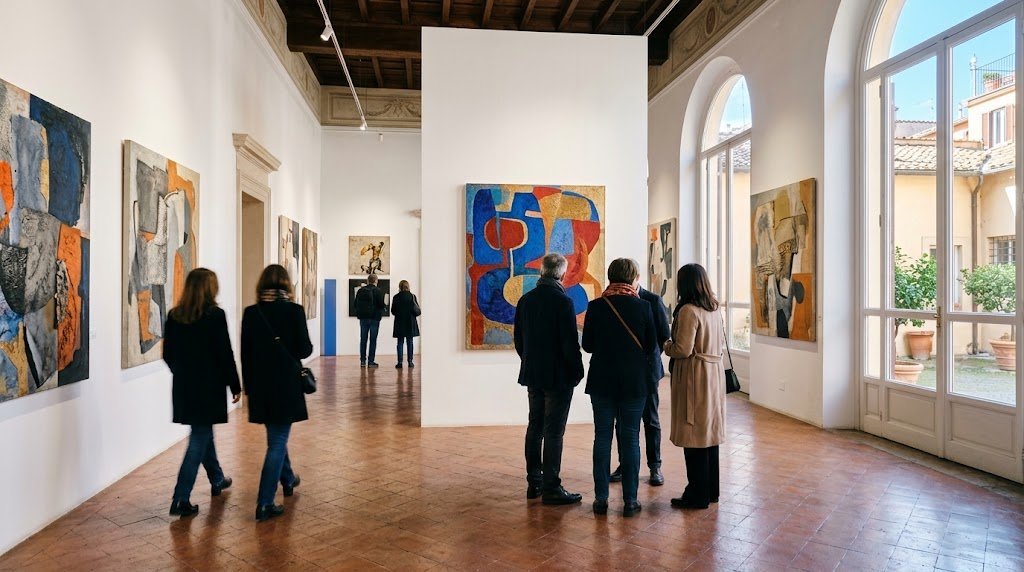
The exhibition Artiste contemporanee a Casa Andersen. Il corpo come dimora is open at the Casa Museo Hendrik Christian Andersen in Rome from September 29 to November 22, 2026, at Via Pasquale Stanislao Mancini 20, in Flaminio: 42 women artists and about 60 works among painting, sculpture, photography, performance, installation and conceptual research, in dialogue with Andersen's sculptures. The museum is open Tuesday to Sunday from 9:30 to 19:30, with last entry at 18:45. It is closed on Monday. You get there by metro line A, Flaminio stop, or by tram 2, Flaminio stop, and then a few minutes on foot. Prices are published by the Direzione Musei nazionali della città di Roma on the museum's official page. The ticket is bought on site or on the official portal of Italian museums. For information the museum answers at 06 3219089.
Il corpo come dimora at Casa Andersen: Dates, Hours and Information
Il corpo come dimora stays open almost two months, from September 29 to November 22, 2026, during the museum's regular hours. It is an exhibition that occupies the whole house: the ground floor, the rooms of the first floor and the exhibition space on the second.
Hours
Tuesday to Sunday, 9:30-19:30, last entry at 18:45. Closed on Monday. The long days let you choose at leisure: early morning and lunchtime are the quietest moments, Saturday and Sunday afternoons the busiest.
Who Organizes It
The exhibition is curated by Nicoletta Castellaneta, Luisa Catucci and Giuseppe Simone Modeo, and was conceived and organized by the Associazione Ars Nova for the Casa Museo Hendrik Christian Andersen. The museum is directed by Maria Giuseppina Di Monte and falls under the Istituto Pantheon e Castel Sant'Angelo, Direzione Musei nazionali della città di Roma, headed by Luca Mercuri.
Contacts
Phone 06 3219089, email dms-rm.museoandersen@cultura.gov.it. The museum is also present on the main social networks under the name Casa Museo Andersen.
The Exhibition Project: Andersen's Ideal Body and the Bodies of the Women Artists
Il corpo come dimora starts from a precise comparison. On one side is Hendrik Christian Andersen, a sculptor who devoted his life to an ideal human figure, monumental and universal, influenced by the classical tradition and Michelangelesque monumentality. On the other are 42 women artists of the second half of the 20th century and of today, for whom the body has become matter, language and experience.
The Body as a Measure
For Andersen the body was measure, balance, tension toward a higher order. Art was an instrument of individual and collective elevation. His sculptures, which still fill the salons of the house, give back a harmonious image of the human figure.
The Body as Experience
The artists in the exhibition have instead made the body a space from which to question presence in the world, identity, individual and collective memory, vulnerability, desire, transformation. Next to Andersen's idealized body appear bodies shaped by experience. The result, in the words of the project, is a temporary and plural city, in which works, bodies and gazes enter into relation with the architecture of the house.
A Research Program
The exhibition is part of a broader program devoted to women's artistic production in the second half of the 20th century and in the contemporary era, which through exhibitions and talks puts different generations, languages and practices in dialogue.
The 42 Women Artists in the Exhibition
The official list includes: Renee Adams, Lidia Bachis, Vanessa Beecroft, Barbara Boekelman, Louise Bourgeois, Rosemarie Castoro, Valeria Catania, Giulia Cenci, Valentina De'Mathà, Paola Di Bello, Annalaura di Luggo, Marlene Dumas, Tracey Emin, EVA & ADELE, Esther Ferrer, Leonor Fini, Sylvie Fleury, Maike Freess, Valentine Hugo, Silvia Iorio, Martha Jungwirth, Natalia LL, Catherine Long, Sarah Lucas, Loren MacIver, Eva Marisaldi, Elisabeth Masé, Monica Mazzone, Veronica Montanino, Meret Oppenheim, ORLAN, Gina Pane, Elizabeth Peyton, Loreal Prystaj, Carol Rama, Pipilotti Rist, Miriam Schapiro, Nora Schultz, Kiki Smith, Annegret Soltau, Iv Toshain, Claudia Virginia Vitari.
The Historic Figures of the 20th Century
The historic core brings together names that changed the history of art of the last century: Louise Bourgeois, Carol Rama, Meret Oppenheim, Leonor Fini, Valentine Hugo, Gina Pane, ORLAN, Esther Ferrer, Natalia LL, Miriam Schapiro, Rosemarie Castoro, Loren MacIver. They are artists who worked on the body when the subject was considered marginal or scandalous, through surrealism, performance, feminist art, body art.
Today's International Protagonists
Alongside them are some of the best-known artists of the contemporary scene: Vanessa Beecroft, Tracey Emin, Pipilotti Rist, Sarah Lucas, Marlene Dumas, Kiki Smith, Elizabeth Peyton, Sylvie Fleury, Martha Jungwirth, and the duo EVA & ADELE. It is rare to find these names gathered in a Roman house museum, and that alone justifies the visit.
Italian Artists and the Younger Generations
The route includes Italian artists of different generations, among them Giulia Cenci, Eva Marisaldi, Paola Di Bello, Lidia Bachis, Valeria Catania, Valentina De'Mathà, Annalaura di Luggo, Silvia Iorio, Monica Mazzone, Veronica Montanino, Claudia Virginia Vitari. The curators' choice holds together those who are already in museum collections and those who are building their path now.
Different Languages
The roughly 60 works range from painting to sculpture, from photography to performance, from installation to conceptual experimentation. The body, then, does not appear as a single, definitive image but as a mobile space, which each artist inhabits in her own way.
The Route Through the House: Three Floors and Andersen's Sculptures
Il corpo come dimora unfolds on three levels of the Casa Museo: the ground floor, the rooms of the first floor and the exhibition space on the second. The artists' works are not isolated in neutral rooms but placed in relation with the spaces and with Andersen's monumental sculptures, which stay where they are.
The Ground Floor: The Gallery and the Studio
The ground floor is the sculptural heart of the house. The first room, with its Venetian-style floor and coffered stucco ceiling, was the reception room in which Andersen showed finished works and illustrated his world city project with drawings framed in walnut, still hanging on the walls. Next to it opens the studio, the actual workshop, lit by a large skylight, with the cabinet of the sculptor's work tools and the monumental plasters for the Fountain of Life.
The First Floor: The Residence
On the first floor was Andersen's home. On the stucco frame of a door you can read the inscription World Conscience, the name the sculptor had given to a center with humanitarian aims. The stuccoes change from room to room, with garlands, shells and intertwined dolphins. One room opens onto the terrace, above the studio's skylight.
The Staircase and the Second Floor
Going up you meet stuccoes of garlands of flowers and fruit in soft colors and a window with glass painted with butterflies that looks onto the studio below, full of statues. The second floor hosts the exhibition space for temporary shows. The house is equipped with an elevator.
A Curiosity About Artiste contemporanee a Casa Andersen. Il corpo come dimora, the Exhibition in Flaminio, from September 29 to November 22, 2026
Il corpo come dimora is not the first time Andersen's house has opened to women artists. In 2016 the current director, Maria Giuseppina Di Monte, published with Emilia Ludovici the volume Femminile e femminino. Donne a casa Andersen, devoted precisely to the female presences in these spaces. And it is a story that runs deep in the sculptor's biography. Andersen's mother was named Helene Momsen, the same name as the villa, and she is portrayed by her son in a colored marble bust of 1910 that can be seen in the first room. In the house lived for a long time his sister-in-law Olivia Cushing, widow of his brother Andreas, who lived with Hendrik in Rome from 1903 and kept diaries from 1882 to 1917, now preserved in the museum's archive. His adoptive sister Lucia posed for three dancing female nudes and, at the sculptor's death, held the usufruct of the house until 1978: only then did the donation to the State become effective. In the studio, even the family funerary monument holds the mother and the sister-in-law. An exhibition of 42 women artists inside this house, then, is not an intrusion: it is the continuation of a story of women that Villa Hélène has always kept, even if the name on the door is a man's.
Who Was Hendrik Christian Andersen
Hendrik Christian Andersen was born in Bergen, Norway, on April 17, 1872 and died in Rome on December 19, 1940. A sculptor, painter and urban planner, he emigrated as a child with his family to Newport, Rhode Island, the year after his birth. In 1893 he left for Europe to study art and ended up settling in Rome for the rest of his life.
The World City
Much of his work was conceived for a utopian project: a world city full of art, able to push humanity toward a harmonious order. In 1913 he published with the architect Ernest Hébrard Creation of a World Centre of Communication, an enormous volume, weighing over five kilograms, sent to heads of state and institutions around the world. The city had a checkerboard and ring-shaped plan, with an Olympic Center, an Art Center, a Science Center and a Tower of Progress over 300 meters high.
The Fountain of Life
At the center of the Art Center Andersen imagined the Fountain of Life, a composition of terraces, hemicycles, stairways and basins with monumental sculptures devoted to the phases of the day and to the themes of love, brotherhood, the joy of living and progress. Many of the plasters and bronzes displayed in the house, such as Il Mattino, La Sera, La Notte, Il Giorno, La gioia di vivere, were born for that fountain that was never built.
Criticism and Anticipations
The project was criticized by the urban planners of the time for political naivety and excessive monumentality. And yet Andersen's faith in the power of art and architecture to transform society anticipates ideas that Le Corbusier would develop later in his Contemporary City.
Andersen and Fascism
In 1926 Mussolini guaranteed the availability of land at Fiumicino for the world city. In 1938, with the planning of the EUR, Andersen again claimed the idea of a satellite city stretching from Rome toward the sea. In 1929 he made a plaster titled Il Concordato, for the agreement between the Italian State and the Church. Nothing of the world city was ever built.
Villa Hélène: The House-Studio Turned Museum
Villa Hélène was built between 1922 and 1925 to a design by Andersen himself, as a small villa with an attached sculpture studio. It was not only a residence: in the sculptor's plan it was part of the broader vision of the world city.
The Architecture
The elevations are in neo-Renaissance style and bear heads portraying Andersen's relatives, on the facades on Via Mancini and Via Pisanelli. On the terrace, a weathervane in the shape of a ship, halfway between Columbus's caravel and a Viking vessel, points toward the Tiber.
From Bequest to Museum
At his death, in 1940, Andersen left to the State the house, the studio, the documents and more than 400 works. The donation was formalized in 1978, at the death of his adoptive sister Lucia. The building passed to the Genio Civile, then to the Soprintendenza. The Galleria nazionale d'arte moderna had custody of it, and the museum opened to the public on December 19, 1999. From 2014 it was managed by the Polo museale del Lazio, and since 2019 by the Direzione Musei statali di Roma.
The Archive
The house preserves Andersen's archive: letters, autographs, diaries, flyers, photographs, books. Among the documents is the typewritten transcription, made by Andersen himself, of the letters he received from Henry James between 1899 and 1915. The originals were sold in 1954-55 by Lucia Andersen through Sotheby's in London.
One Thing Nobody Tells You About Artiste contemporanee a Casa Andersen. Il corpo come dimora, the Exhibition in Flaminio, from September 29 to November 22, 2026
The thing nobody says is that this exhibition is best seen in two passes, and that the second pass is the one that counts. The first time your gaze inevitably goes to the famous names, Bourgeois, Emin, Beecroft, Rist, Lucas, and to Andersen's enormous sculptures that dominate the salons. Then it's worth going back and doing the round again, looking at the relationships between the works and the house: a work next to an idealized nude, a photograph in front of a plaster of the Fountain of Life, a piece installed in a living room with the shell and dolphin stuccoes. That is where the title, Il corpo come dimora, takes on meaning. A second detail that the presentations don't underline: the museum already has a contemporary work that anticipates this dialogue. In front of the door of the ground-floor gallery is Yinka Shonibare's work dedicated to Henry James and Hendrik C. Andersen, two headless mannequins in printed-fabric clothes, made for the museum for his first Italian solo show and then acquired. Look for it: it is the key to understanding that Casa Andersen is not only the tomb of a utopia but a place that for years has had Andersen talk with today's art. Finally, a practical warning: some press sources speak of 43 artists. The official list of the exhibition counts 42.
Tickets and Visiting the Casa Museo Andersen
The ticket for the Casa Museo Hendrik Christian Andersen is bought on site, at the museum's ticket office, or online on the official portal of Italian museums. Prices and the free admissions provided by law are published by the Direzione Musei nazionali della città di Roma.
How Much Time You Need
To see the exhibition and the permanent collection with attention you need an hour and a half, two hours. If you want to do the double round I suggest below, allow a full two hours.
When to Go
On weekday mornings the museum is quiet and natural light enters from the large windows of the salons. Avoid arriving after 18:30: last entry is at 18:45 and the exhibition occupies three floors.
The Advice I Give You for Visiting Artiste contemporanee a Casa Andersen. Il corpo come dimora, the Exhibition in Flaminio, from September 29 to November 22, 2026
It's best to start from the studio, not from the artists' works. Go in, cross the reception room and stop for five minutes in the great workshop with the skylight: look at the plasters of the Fountain of Life, the athletes, the rearing horses, the dancing nudes, the tool cabinet. You'll understand who Andersen was and what he thought of the human body. Only then go up and begin the route of the exhibition. The dialogue the curators have built works if you have the term of comparison in your eyes, and the term of comparison is that ideal, heroic body, full of muscles and faith in progress, that Andersen modeled for 40 years. The works of Louise Bourgeois, Carol Rama, Gina Pane or Tracey Emin, seen right afterward, become a sharp counterpoint. Second piece of advice: go in the morning, on a weekday. The house is small compared with Rome's big museums and the feeling of intimacy, which is half the charm, is lost when the rooms fill up. Third: combine the visit with a walk on the Lungotevere or to Piazza del Popolo, a few minutes away. Flaminio in autumn, with the first leaves on the avenues, is the right neighborhood for a slow morning devoted to art.
How to Get to the Casa Museo Andersen
The Casa Museo Hendrik Christian Andersen is at Via Pasquale Stanislao Mancini 20, in Flaminio, a few steps from Piazzale Flaminio and Piazza del Popolo.
By Metro
The nearest stop is Flaminio, on line A. From there the museum is reached on foot in a few minutes.
By Tram
Tram 2 stops at Flaminio, the same hub as the metro, and connects the area with the rest of the Flaminio neighborhood toward the north.
By Train
At Piazzale Flaminio there is also the station of the Roma Nord railway, useful for those arriving from the Tiber valley.
By Car
The area between Piazzale Flaminio and the Lungotevere is regulated by paid parking and lies at the edge of the limited traffic zone of the historic center. It's best to arrive by public transport.
Another Well-Known Fact, Yet Rarely Mentioned
That Hendrik Andersen was a friend of Henry James is known to those who love literature. Less often cited is how much that relationship left concrete traces in this very house. The two met in Rome in 1899, at the home of the Howe Elliotts in Palazzo Rusticucci, in Borgo. James was about 30 years older than Andersen. The bond lasted until the writer's death, in 1916, and produced a dense and affectionate correspondence, whose nature is still debated by scholars. In 1907, during a short stay of James in Rome, Andersen modeled the plaster bust of him that can be seen in the first room. James's letters were typed up by the sculptor and the transcription is still in the museum's archive. In Italy they were published by Marsilio in 2000 under the title Amato ragazzo, edited by Rosella Mamoli Zorzi. The Irish writer Colm Tóibín, in the novel The Master of 2004, told the beginnings of that relationship. For those who visit Il corpo come dimora it is a detail that matters: the theme of the body, of affection and of desire runs through this house well before the contemporary women artists arrive.
The Neighborhood Around Casa Andersen: Flaminio
Flaminio is the neighborhood that stretches north of Piazza del Popolo, between the Tiber and the hills of the Parioli. It is a piece of 20th-century Rome, with major cultural institutions a short distance from one another.
Piazza del Popolo
A few minutes' walk away is Piazza del Popolo, with the Flaminio Obelisk at its center and the twin churches on the side of the Tridente. It is the historic gateway into Rome from the north.
Villa Borghese, Villa Giulia and the Galleria Nazionale
Going up toward the east you enter Villa Borghese. On the side of Viale delle Belle Arti are the Etruscan Museum of Villa Giulia and La Galleria nazionale, which for years had custody of Andersen's collections. A day between Casa Andersen and the Galleria nazionale has a precise logic.
The MAXXI and the Auditorium
Farther north, along Via Flaminia, you reach the MAXXI, the national museum of the arts of the 21st century, and the Auditorium Parco della Musica. Tram 2 is the most convenient way to cover the neighborhood.
Milvian Bridge
At the end of the Flaminia is Milvian Bridge, with its evening life. It is the destination for those who want to end the day with an aperitivo.
The Right Photo to Take at Artiste contemporanee a Casa Andersen. Il corpo come dimora, the Exhibition in Flaminio, from September 29 to November 22, 2026
The right photo at Casa Andersen is the one of the studio from above. Going up the stairs toward the first floor there is a window with glass painted with butterflies that looks onto the great workshop below: from there you see the room full of statues, lit by the skylight, with the monumental plasters of the Fountain of Life arranged like a motionless crowd. It is the image that tells Andersen's utopia best, and during Il corpo come dimora it gains an extra meaning, because the viewpoint is that of someone in the house looking at the sculptor's work. Before photographing, check the museum's rules and the notes on individual works on loan: in temporary exhibitions with works from different collections it happens that some cannot be photographed. Outside, the second photo to take is the facade on Via Mancini, with the heads of Andersen's relatives set into the neo-Renaissance elevations. If you go up to the terrace, if it is open, look for the ship-shaped weathervane pointing toward the Tiber: a detail that almost nobody notices and that says a lot about the visionary spirit of the master of the house.
Where to Eat Near Casa Andersen
Flaminio offers options for every budget, especially along Via Flaminia and around Piazzale Flaminio.
A Quick Break
The neighborhood's bars and bakeries are the solution for a quick lunch between the visit and a walk. The first floor of the house has hosted a museum cafe, carved out of the service area: ask at the ticket office if it is open.
A Dinner
For a sit-down dinner it's best to head up toward Ponte Milvio or down toward the Tridente, where the choice of trattorias and restaurants is wide.
Some Important Events That Took Place Here in History
The history of Casa Andersen can be read in a sequence of dates. In 1913 Andersen publishes with Ernest Hébrard the project of the World Centre of Communication. Between 1922 and 1925 he builds Villa Hélène in Flaminio. In 1926 he receives a visit from the Indian poet Rabindranath Tagore with his son: a photograph of the meeting is still displayed in the reception room. In the same year Mussolini guarantees him the availability of land at Fiumicino for the world city. In 1928 he portrays in plaster the explorer Umberto Nobile, with whom he had a dense correspondence. In 1929 he makes Il Concordato. In 1933 the great bronze statue L'Angelo della Vita, cast in Geislingen in Germany and shown at the Paris Salon in 1914, is removed from the tomb of his brother Andreas in the Non-Catholic Cemetery because of serious damage. It will remain abandoned for years until 1947, when it arrives at Villa Hélène. In 1938, with the planning of the EUR, Andersen again claims his city. On December 19, 1940 he dies and leaves everything to the State. In 1978 Lucia Andersen dies and the donation becomes effective. On December 19, 1999, exactly 59 years after the sculptor's death, the museum opens to the public. On September 29, 2026 Il corpo come dimora begins.
Accessibility and Visits with Children
The Casa Museo is spread over several floors and is equipped with an elevator. For particular needs it's best to call 06 3219089 beforehand.
With Children
Andersen's giant sculptures, the rearing horses, the athletes and the ball players fascinate the youngest. The exhibition contains works about the body, including the nude, and some of an intense nature: with small children it's best to look at the rooms in advance and choose the route.
For Schools
For high school classes the exhibition is a concrete introduction to women's art from the 20th century to today, with a direct comparison with the classicist sculpture of the early 1900s.
Who Has Passed Through Artiste contemporanee a Casa Andersen. Il corpo come dimora, the Exhibition in Flaminio, from September 29 to November 22, 2026
Villa Hélène and the atelier that preceded it have seen figures pass through who now belong to the history of international culture. Henry James posed for Andersen in Rome in 1907, and his plaster bust is in the first room. Rabindranath Tagore, Nobel laureate in literature, visited the sculptor in 1926 with his son. Umberto Nobile, the explorer of polar airships, was portrayed in 1928. The American writer Julia Ward Howe was portrayed in terracotta in old age, a guest of her daughter Maud Howe. Flora Whitney took sculpture lessons from Andersen in New York in 1900, and her portrait is in the collection. In the studio on Via Margutta, before the house in Flaminio, passed the young count Alberto Bevilacqua Lazise, portrayed in terracotta. In the family, his mother Helene, his painter brother Andreas, his sister-in-law Olivia Cushing and his adoptive sister Lucia lived and posed among these rooms. More recently, Yinka Shonibare entered the museum, with his first Italian solo show and the work dedicated to James and Andersen. Now come Louise Bourgeois, Carol Rama, Meret Oppenheim, Tracey Emin, Vanessa Beecroft, Pipilotti Rist, Sarah Lucas, Kiki Smith and the other women artists of Il corpo come dimora: different presences, who enter the house through their works.
In Andersen's Footsteps Beyond Flaminio
Those who leave the exhibition wanting to go deeper can complete the route at the Non-Catholic Cemetery of Rome, next to the Pyramid of Cestius. There Andersen is buried in the family tomb that he himself had designed right after the death of his sister-in-law, with polychrome decorations, gilded bronze and a mosaic dome. The plaster model of the tomb is displayed in the house's studio.
The Inscription on the Tomb
On the tomb an inscription recalls the dream of a city for all nations as the hope and prayer of a lifetime, and says that the dreamers sleep there. It is the most moving summary of Andersen's utopia.
Frequently Asked Questions About Il corpo come dimora at Casa Andersen
When is the exhibition Il corpo come dimora open in Rome?
The exhibition Artiste contemporanee a Casa Andersen. Il corpo come dimora is open at the Casa Museo Hendrik Christian Andersen from September 29 to November 22, 2026, Tuesday to Sunday from 9:30 to 19:30, with last entry at 18:45. The museum is closed on Monday.
Where is the Casa Museo Andersen?
The Casa Museo Hendrik Christian Andersen is at Via Pasquale Stanislao Mancini 20, in the Flaminio neighborhood, a few minutes' walk from Piazzale Flaminio and Piazza del Popolo.
How do you get to the Casa Museo Andersen by public transport?
The Casa Museo Andersen is reached by metro line A, Flaminio stop, or by tram 2, Flaminio stop. From there the museum at Via Mancini 20 is a few minutes' walk.
How many women artists exhibit in Il corpo come dimora?
Il corpo come dimora presents 42 women artists and about 60 works, including Louise Bourgeois, Carol Rama, Meret Oppenheim, ORLAN, Vanessa Beecroft, Tracey Emin, Pipilotti Rist, Sarah Lucas, Marlene Dumas, Kiki Smith and Giulia Cenci.
Who curated the exhibition at Casa Andersen?
The exhibition at Casa Andersen is curated by Nicoletta Castellaneta, Luisa Catucci and Giuseppe Simone Modeo, and was conceived and organized by the Associazione Ars Nova for the Casa Museo Hendrik Christian Andersen, directed by Maria Giuseppina Di Monte.
Where do you buy the ticket for the Casa Museo Andersen?
The ticket for the Casa Museo Andersen is bought at the museum's ticket office or on the official portal of Italian museums. Prices and free admissions are published by the Direzione Musei nazionali della città di Roma.
How much time do you need to visit the exhibition?
For Il corpo come dimora and Andersen's collection you need about an hour and a half or two hours. The exhibition occupies the ground floor, the first floor and the exhibition space on the second floor of the Casa Museo.
Is the Casa Museo Andersen accessible?
The Casa Museo Andersen is spread over several floors and is equipped with an elevator. For specific needs it's best to contact the museum before the visit at 06 3219089 or at the museum's email address.
My Opinion on Il corpo come dimora
It is one of the autumn exhibitions I recommend without reservation, for a simple reason: rarely in Rome do you see Louise Bourgeois, Carol Rama, Tracey Emin and Pipilotti Rist together, and even more rarely in a place so charged with personal history as Andersen's house. Go in the morning, start from the studio, do the round twice. And if you have time left, end the day at the Non-Catholic Cemetery, in front of the tomb of the dreamers.
Article written by the editorial team of Tour Leader Pro, contact them for Private/Corporate/V.I.P. Tours and Experiences.
Planning a trip to Rome? The English guides for visiting the city are on ItalyPlanner.com.