Andrea Doria Club
In short. Sports club, club and summer concert venue, on the Tiber riverbank at Tor di Quinto.
Via del Baiardo, 26
Rome
Sports club, club and summer concert venue, on the Tiber riverbank at Tor di Quinto. Put like that it sounds like a phone book definition, and yet inside those few words is one of the strangest and most beautiful things that can happen to anyone going out at night in Rome: getting to the speakers by crossing a five-a-side pitch.
Even in the longest and most honored clubber careers, it rarely happens that you have to cross a five-a-side field, with an immediate urge for a five-on-five, to reach the DJ booth. The same goes for the toilets inside the locker rooms: you walk in with a glass in your hand and find yourself facing a row of metal lockers, a worn wooden bench, that particular smell of chlorine, rubber and industrial detergent that anyone who played soccer as a kid recognizes even before having brought it into focus.
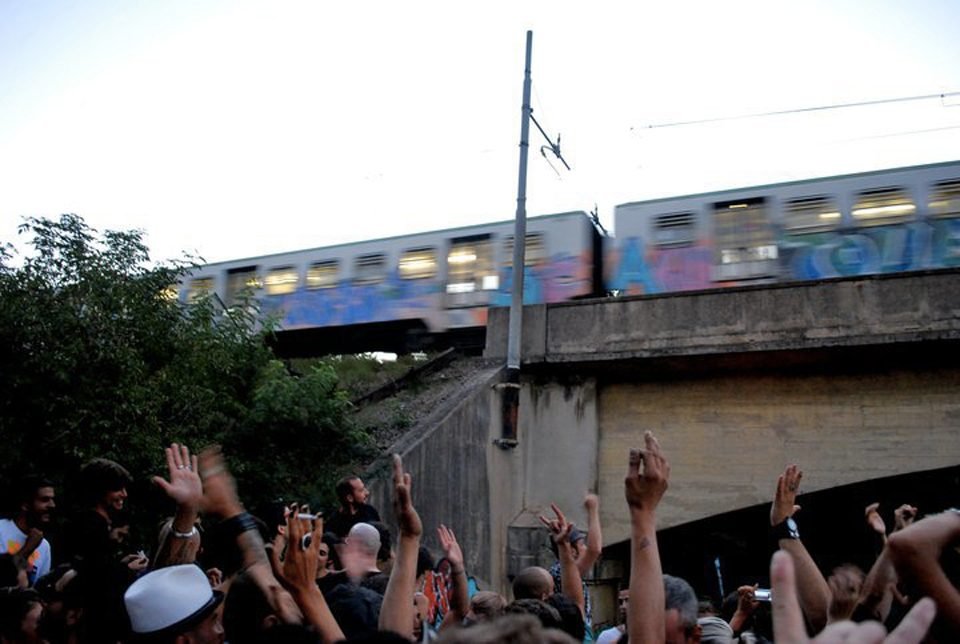
It happens at the Andrea Doria, a sports club in the northern part of Rome, along whose tree-lined riverside promenade, for some years now, big nights and concerts are held in summer. The end of hostilities is decreed by the first train that passes on the bridge that serves as the backdrop to the DJ booth. But that is already history, and like all stories it deserves to be told slowly, from the beginning, because the place has many more layers than you see when you walk in through the gate.
I had the address in a message, Via del Baiardo 26, and in my head the vague idea that Tor di Quinto was that thing you see from the window as you race up the Flaminia northward, a succession of fences, car dealership signs, lit tennis courts and low warehouses. From the parking lot it takes only 40 meters on foot to find yourself in another movie: tall trees, gravel under your shoes, the air changing by two degrees because you have come down toward the water, and the noise of the city coming off you like a coat you take off at the entrance.
This is the first fact to make clear. The Tiber in Rome, inside the walls, is a river hemmed in between very high embankment walls, a river the city decided to stop looking at after the floods of the 19th century. To the north, past Ponte Milvio, the relationship changes: the banks get lower, the vegetation takes back ground, and for a few kilometers the river becomes something you can have next to you at eye level instead of 10 meters below. The sports clubs lined up on this bank built their identity exactly there, in that strip of land between the levee and the road, and the Andrea Doria belongs to this family.
Now I'll tell you everything properly, because around this address there is much more than what you see from the parking lot.
Where it is and how I get there
Via del Baiardo is a side street of the network that unwinds between Viale di Tor di Quinto, Via Flaminia and the right levee of the Tiber. It is not a street you cross by chance: you get there because you have to get there, and this is already a filter. The surrounding neighborhood is made of low villas, clubs with green netting, sports facilities that by day teem with kids with gym bags and at night almost all go dark except the ones that have decided to stay lit.
If you arrive by car, the logic is simple: the backbone of the whole area is Via Flaminia, which starts from Piazza del Popolo, leaves the walls at Porta del Popolo, runs north, crosses the Tiber at Ponte Milvio and from there continues toward the countryside and toward the Adriatic. Everything in this quadrant gravitates on that axis, including the clubs along the river. The other reference is Corso Francia, the big viaduct that cuts the area from west to east and that in the mental geography of Romans divides the world of Parioli from that of Vigna Clara and Tor di Quinto.
Parking, and here we have to be honest, is a delicate matter. On nights of heavy turnout the surrounding streets fill up fast and you find yourself going the long way around, with that creeping patience that in Rome you learn around age 20 and never lose. The practical advice is to arrive early, not because the concert starts early, but because the first 20 minutes of looking for a parking spot are the ones that decide the mood of the evening. If you arrive by scooter, instead, the problem doesn't exist: here the spaces are there and the asphalt is wide.
Anyone who doesn't drive has a couple of options and none is perfect. The area is served by the Roma Nord railway, the line to Civita Castellana and Viterbo, which has a stop right at Tor di Quinto: it is a regional railway run by Atac, with schedules that thin out a lot in the evening, so it has to be checked before going out and not after. Then there are the buses that run along the Flaminia and Viale di Tor di Quinto, which at night have the frequencies of a Roman night, that is, long ones. The method, when coming back late, is to arrive in twos or threes and split the ride: Ponte Milvio is a short distance away and is a hub where buses and taxis are easier to find than here.
One thing worth knowing: the distance between this part of the bank and Milvian Bridge is short and can be walked without drama, along the river or along the road depending on how the route is that evening. It means you can build the evening in two parts: aperitivo and dinner in the bridge area, which has plenty of places, and then a move to the club when the music really starts. It is the way evenings here work best, and it is what everyone who knows the area does.
One last note on geography. Across the river, facing this bank, is the Foro Italico with the Olympic Stadium, and further up, behind it, rises the green ridge of Monte Mario with its observatory. If on a summer evening you happen to be on the tree-lined promenade with the sky still light, raise your eyes toward the west: that dark line closing the horizon is the highest hill in Rome. Nobody notices, because at that hour everyone is looking toward the DJ booth.
The Tiber at Tor di Quinto, the bend and the clubs
To understand why a sports club here can become a concert venue you have to understand how this bank is made. The Tiber, coming from the north, draws a series of wide bends before slipping into the historic city. Tor di Quinto occupies the right bank of one of these curves, at a point where the river also meets the trickle of the Aniene, which is its main tributary within the city limits. The result is a strip of flat, alluvial land, historically too wet and too prone to flooding to be built on like the rest of the city.
This apparent bad luck turned out to be the quadrant's good luck. Flat, wide land, unsuited to apartment blocks but perfect for fields: that is why the bank filled up with sports facilities instead of residential blocks. Tennis, soccer, five-a-side, swimming, rugby, rowing, horseback riding. The green you see walking along the river is not a park designed by an urban planner, it is what remains of a countryside the city couldn't eat all the way up, and it is kept alive by the clubs that put their nets and their locker rooms on top of it.
Until the 1930s and 1940s Tor di Quinto was considered practically outside the city. The last urban outpost was the piazzale of Ponte Milvio, from which a tram left, line 101, which Romans affectionately called er tranvetto and which went as far as the terminus at Via dei Due Ponti. Those who lived here were largely country people: the vignaroli, small market gardeners and farmhands who worked exactly the land where today there are houses, clubs and paved roads. There was no continuous urban fabric, there was a scattered village that ran from what is now Corso Francia to Via dei Due Ponti.
The neighborhood as an administrative entity was born late: it was officially defined on March 1, 1954, when the old suburb of Parioli was divided into two districts and Rome's quarter number 18 was born. The place name, on the other hand, is very ancient and comes from a tower that stood at the fifth mile counted from Porta Ratumena, one of the oldest gates of the city. Fifth mile, Tor di Quinto. Roman toponymy has this extraordinary quality: it preserves measures and distances from 2,000 years ago inside the name of a bus stop.
The great expansion came in the 1950s and 1960s, on the wave of growth of all north Rome. Even in the early 1970s, though, the area was considered truly peripheral: near Via Monterosi flocks could be seen grazing, and after the rains marshy pools remained that recalled the Roman countryside of a century earlier. Anyone looking at the buildings and avenues today struggles to imagine it, but two generations are enough to completely transform the perception of a piece of city.
In the midst of this transformation the clubs have remained. They are structures with a precise sociology of their own: born as after-work clubs, as neighborhood sports associations, as clubs for local families, they have gone through decades changing skin and widening the offering. Many added the pool in the 1960s, the restaurant in the 1980s, the summer camp for children in the 2000s. Some, and here we come to the point, added music.
A curiosity about Andrea Doria Club
The curiosity I like best is the double life. A sports club has a rigid, predictable daily cycle: it opens early, fills with people in sweatsuits, lives on hourly bookings, courses, club tournaments, parents waiting outside the field. At eight in the evening, normally, this kind of facility empties and shuts down. The field lights dim, the bar closes, the caretaker makes his round and pulls down the shutter.
Here, in summer, at eight in the evening the second shift begins. The same square meters that at six hosted a game between office colleagues, at 11 host a crowd that dances. The tree-lined walkway that in the afternoon is the route from the locker room to the field becomes the entrance corridor to a party. It is a transformation in plain sight, without scenery: nothing is hidden, the fields stay fields, the nets stay nets, and the audience crosses the whole thing as if it were the most natural thing in the world.
The detail that makes anyone laugh the first time they come is the bathrooms. In a normal club the bathroom is a cramped, badly lit space, with a door that doesn't close well and a line that reaches the bar. Here the bathrooms are the locker room ones: big, with showers at the back, numbered coat hooks, benches. The first time you go in during the evening you feel a light sense of disorientation, like when as an adult you find yourself in the corridor of your old elementary school. Then you get used to it, and it becomes one of the reasons you tell friends about the place.
There is another curious thing, and it concerns the five-a-side pitch. Crossing it to get to the music sets off in anyone who has played soccer an immediate conditioned reflex: the eyes look for the goal, the foot looks for something to kick, and for two seconds the idea really does cross your mind of organizing a five-on-five right there, right now, in the wrong shoes and with a drink in your hand. It doesn't appear that it has ever really happened, but sooner or later it might.
The subtler curiosity, though, is another: the double life is not a disguise, it is a coexistence. The Roman clubs that open to music in summer don't stop being clubs. The day after the party the fields go back to being fields, and the kid who arrives at nine in the morning for the tennis lesson walks on the same path where eight hours earlier people were dancing. This double use of spaces is one of the smartest things Rome knows how to do with its own assets, and it does it almost always without declaring it, out of pure practical necessity.
Via del Baiardo, the name of the street and the horses
Here is a story I like very much and that almost nobody connects with the place where they are dancing. Via del Baiardo takes its name from Baiardo, the mythological horse of Rinaldo in Ludovico Ariosto's Orlando furioso: a legendary, very fast horse, which in the poem has a personality of its own and crosses half of Europe and half of the East in the service of its knight. It is not a name chosen at random by a clerk at the land registry: it belongs to a precise family of place names.
Why horses, in this corner of Rome? Because Tor di Quinto was for decades the equestrian capital of the city. Along Viale di Tor di Quinto there are still old structures from the Umbertine era where the cavalry arm trained and where equestrian tournaments of national and international level were held. The Salvo D'Acquisto barracks today houses the national selection and recruitment center of the Carabinieri and the Fourth Mounted Carabinieri Regiment. The barracks named after Captain Camillo Sabatini is the seat of the Eighth Cavalry Regiment Lancieri di Montebello. And one of the streets in the area bears the name of Federico Caprilli, the officer who revolutionized the technique of modern riding by inventing the forward seat in show jumping.
Put the pieces together and the picture composes itself: an area that for a century meant horses, cavalry, riding schools, horse shows and barracks, and a street-naming scheme that consequently draws freely from the equestrian repertoire, from historical riders to literary horses. Walking on Via del Baiardo to go to a concert means, technically, walking along a street named after the steed of a Carolingian paladin. It is one of those overlaps that only Rome can produce without even noticing.
There is also a piece of cinema in this story. In 1936, inside the equestrian facilities of Tor di Quinto, some sequences of the film Cavalleria were shot, directed by Goffredo Alessandrini, with Amedeo Nazzari, Elisa Cegani, Enrico Viarisio, Mario Ferrari, Silvio Bagolini and, in the cast, also Anna Magnani. It means that this piece of riverbank, before being the place where people dance in summer, was a set. It is not a curiosity you will find written on the gate, but it is documented, and it is the kind of thing that makes an evening slightly different if you carry it in your pocket.
And the name of the club? Andrea Doria immediately calls up two things in anyone's head: the 16th-century Genoese admiral and the ocean liner that bore his name, launched in 1951 and sunk in July 1956 off Nantucket after the collision with the Stockholm, one of the most famous and debated shipwrecks of the 20th century. Where exactly the club's name comes from I don't know for certain, and I prefer to tell you so instead of building a legend on it: in Rome the name Andrea Doria is extremely common, there is a Via Andrea Doria in Prati with its historic market, there are sports societies that have carried it for generations. The suggestion of the ship remains beautiful and, for a place built on the edge of the water, almost too perfect. Let's leave it as a coincidence, which is often the most elegant form of a story.
One thing nobody tells you about Andrea Doria Club
Nobody tells you that here the deciding factor is not the lineup, it is the air. An outdoor space on the edge of a river, in September as in June, has a physics of its own that completely changes the evening, and learning to read it makes the difference between going home happy and going home chilled and in a bad mood.
The Tiber, at night, cools. Not a little: a lot. On the levee, with the sun set a couple of hours earlier and the humidity rising from the water, the perceived temperature drops sharply compared with the same hour in the center, where the asphalt and the walls give back all night the heat stored during the day. In July it's exactly what you're looking for: you're in a T-shirt and it feels like you've found the only breathable corner of the city. In late June or in September the matter changes, and anyone who arrives dressed for the historic center starts to cross their arms around one in the morning. The golden rule is only one: always bring something to put on top, even if when leaving home it seems absurd.
The second thing nobody tells you: mosquitoes. Riverbank, vegetation, humidity, standing water in the side ditches. It is not a folkloric detail, it is a factor that can ruin two hours for you. Those who frequent the clubs on the Tiber know it and get organized, those who arrive for the first time discover it midway through the evening when it is already too late. A spray in your bag weighs 20 grams and is worth a whole evening.
Third thing, and this is the most interesting from the listening point of view: sound outdoors near water behaves differently. There are no walls to reflect, there is no ceiling, and so the short reverb that inside a club fills your chest simply does not exist here. The low frequencies spread out and get lost, the highs stay crisp, and the overall sensation is drier, cleaner, less enveloping. People coming from a closed-club listening culture are sometimes thrown for the first half hour, because it seems to them that something is missing. Nothing is missing: it is a different kind of listening, and once you get into it it is wonderful, because it lets you hear details that in a closed room get eaten by the reverb.
Fourth thing: the best place to stand is not at the front. In an open space the front row is only useful if you want to see the hands of the person playing. The right spot is about 15 meters from the front, slightly off center, where the speakers add up instead of canceling out and where you still have room to move. And if the evening is one of the crowded ones, the side strip near the trees is pure gold: you hear well, you breathe, and you have a way out toward the bar that doesn't force you to slalom among 200 people.
Fifth and last: the ending. Here the evening doesn't end when the DJ decides, it ends when the structure of the hours and of the neighborhood decides. You're in a residential area, next to inhabited houses, inside a club that reopens the next day for its courses. This means the closing moment comes and comes for real, without that long wagging of the tail that in closed clubs can last another hour. Knowing it changes how you manage the evening: if you arrive very late, you have little left.
The advice I give you for visiting Andrea Doria Club
The advice is only one and I'll say it in one line: arrive early and look at the place with the light still on it. Then I'll explain why, because the explanation is worth more than the advice.
Most people arrive on the wave of the concert time, that is, when it is already pitch dark outside and the only thing you see is the stage lights and the silhouettes around. In those conditions the place stays in your head as a generic outdoor space with trees, interchangeable with 10 others. If instead you arrive while the sun is still going down, you see everything: the gravel, the row of trees, the nets of the fields, the curve of the river, the profile of the bridge in the background, the colors changing on the water. It costs you an hour and it gives you the place.
Second piece of advice, a practical one: eat before or eat there with judgment, but decide in advance. The Ponte Milvio area, a short distance away, is full of places where you can eat well and fast, and the walk to the club is short. Arriving already fed lets you fill the evening's time with music instead of with the line. If instead you choose to stay inside the whole time, take your moment early, when the bar is not yet under pressure.
Third: shoes. Gravel, packed earth, grass, lawn near the fields. It is not terrain for a smooth sole and it is not terrain for a heel. Every summer I see someone arrive dressed for a place in the center and spend the evening checking where they put their feet. Closed shoe, sole with a minimum of grip, and you forget the problem completely.
Fourth: manage the return before leaving home. This is the part people underestimate most. North Rome at night is not served like the center, and finding yourself at three in the morning on Viale di Tor di Quinto watching the taxi app spin empty is an experience I advise you to avoid. The solutions are three: a car with a designated driver who stays sober, a scooter, or an organized group that splits a ride. The fourth solution, walking to Ponte Milvio and leaving from there, works well and is the best, because that stretch of road at night, with the river beside you, is one of the most beautiful walks in the city.
Fifth: if you go in a mixed group, that is, with someone who loves dancing to the last minute and someone who after an hour is already tired, this place is perfect. The presence of side areas, benches, shady spots and areas where you can talk without shouting lets two different speeds coexist in the same evening. In closed clubs this is almost impossible: either you're inside or you're outside. Here there is a whole range of intermediate positions, and they are the reason even people who normally wouldn't go out feel at home here.
Sixth and last, the least practical and most important advice: at some point in the night take 10 minutes and go toward the river. Not to dance, not to drink, not to talk. Just to watch the water pass in the dark, with the bass reaching you muffled from behind. It is the thing this place knows how to give and that almost nobody takes, and it is free.
The railway bridge behind the DJ booth
We have to talk about the train, because it is the detail that everyone who has been here takes home. The DJ booth has a bridge behind it, and on that bridge runs the railway. When the last track of the night is running out and the sky begins to lighten just slightly toward the east, the first train of the morning crosses the backdrop of the evening with its metallic noise and its row of lit windows. Those who had stayed to dance raise their heads. Those who were sitting on the benches turn around. And it's over: the end of hostilities is decreed by the train, not the DJ.
The railway in question is the Roma Nord, the line that connects the capital to Civita Castellana and Viterbo, with a stop right at Tor di Quinto. It is a railway with a long history: before being what it is today, between 1906 and 1932, the area was served by a stop of the Rome-Civita Castellana tramway, run by the Società Romana per le Ferrovie del Nord. That is: on this bank of the Tiber the tracks have run for more than a century, and their presence has shaped the neighborhood as much as the roads.
That train is perhaps the most honest thing of the whole evening. In a closed club the ending is a convention: the lights come on, the music goes down, the staff begins to collect glasses, and everyone pretends not to have understood for another 10 minutes. Here the ending comes from outside, from a public vehicle that does its job and doesn't even know it has become the closing theme of a party. It is a perfect form of urban punctuation, and nobody wrote it.
There is also a purely scenographic aspect worth noting. A railway bridge seen from below, at night, lit by headlights and with its metal structure standing out against the sky, is a backdrop no set designer could build with that degree of authenticity. The trusses, the piers, the horizontal line cutting across the field of view: it is industrial architecture used as a theatrical backdrop, and it works because it wasn't designed to work. The best things about Roman nighttime places almost always have this quality of unintentional reuse.
It is worth remembering that there are several bridges along this stretch and each tells an era. Ponte Milvio is very ancient, first mentioned in 207 BC and rebuilt in masonry by the censor Marcus Aemilius Scaurus between 110 and 109 BC. The Ponte Flaminio, monumental and white, was begun at the end of the 1930s and completed only in 1951. The Ponte di Tor di Quinto was built on the occasion of the 1960 Rome Olympics. Three bridges, three different centuries, all within a few kilometers of the tree-lined promenade where people dance in summer.
Another well-known fact, yet rarely cited
The well-known fact is that Rome moves outdoors in summer. Everyone knows it, everyone says it, it is the founding principle of the city's whole summer programming. What is cited far less is the corollary: the outdoor spaces Rome uses in summer are not spaces built for performance, they are spaces built for something else and lent to performance. Parks, courtyards, cloisters, villa gardens, archaeological clearings, riverbanks and, precisely, sports clubs.
This has a consequence that almost nobody spells out and that instead explains a great deal. It means that every Roman summer is, technically, an enormous exercise in adaptation: sound systems set up where there were no outlets, stages built on ground that wasn't leveled for it, audience flows managed through gates designed for 20 people at a time. The result is that none of these places is perfect from the technical point of view, and that all of them have a character that spaces designed for music will never have.
The second corollary concerns money and survival. A sports club has fixed costs that don't stop in summer: maintenance of the fields, staff, utilities, insurance. Summer is also the period when ordinary sports activity slows, because the leagues are paused and many members are on vacation. Opening to music in the warm months is not just a cultural choice, it is an economic strategy that allows the facility to hold up. When you see a club that transforms in summer, you are also looking at a budget trying to balance.
The third corollary is the most interesting and concerns the audience. Lent places bring in people who would never have entered that place. The 20-year-old who comes for the music had no idea that behind that gate there was a club with tennis courts, and for one night he crosses it. The member who plays five-a-side on Tuesday discovers that on Saturday his field serves as a corridor for 300 people. This friction between different populations of the same space is one of the things that keep a city alive, and in Rome in summer it happens in dozens of places at once without anyone telling the story.
The fourth and last corollary is geographic. The big Roman summer festivals tend to concentrate on the river, and not by chance: the Tiber is the only natural infrastructure that crosses the whole city and offers linear meters of usable public space. In the central stretch this produces the festivals between the historic bridges, like the one that occupies the quays between Ponte Sublicio and Ponte Sisto, at the level of the Tiber Island. In the northern stretch it produces exactly the phenomenon of clubs open to the night. It is the same river doing two different jobs depending on how deep the trench is in which it flows.
The right photo to take at Andrea Doria Club
The right photo is not the one of the DJ booth. I say it right away because 90 percent of people take out their phone and frame the stage lights, and that photo has already been taken a million times in a million identical places. The lights of a stage at night are the same everywhere: colored dots on a black background, a silhouette in the center, and tomorrow you won't even remember where you took it.
The right photo is the bridge. You stand with your back to the music, far enough back to have the space full of people in front of you, and you compose the frame putting the structure of the bridge at the top and the heads of the audience at the bottom. In that photo there is everything: the industrial backdrop, the crowd, the dark, and the sense of a place that occupies a precise point of the city and not just any place. If the train passes while you shoot, you have a photograph you will never redo the same.
Second option, and perhaps the best of all: the time slot photographers call the blue hour, that is, those 20 or 30 minutes after sunset when the sky is not yet black but a deep, saturated blue, and the artificial lights begin to come on. At that moment you simultaneously have a readable sky, the trees backlit, the first lighting of the place and enough ambient light so the phone doesn't go crazy. It is the technical reason why the advice to arrive early is not only aesthetic: if you arrive late, you have missed the blue hour and it doesn't come back.
Third idea, the one I recommend to those who love details more than panoramas: contrast. Photograph a sports object inside a night setting. The field net with blurred lights behind. The number on a locker room door. The wooden bench. The white line drawn on the ground that disappears into the dark two meters from the lens. These are images that tell the double nature of the place much better than any panorama, and they are almost always the only photos that, looked at again months later, still have an effect.
Fourth idea, for those with patience: the river. At night, from the levee, with a long exposure resting the phone on a parapet or on a bag, the water becomes a smooth surface and the lights of the opposite bank stretch into vertical streaks. It is the least party-like photo you can take home from an evening, and it is the one that ends up framed.
One recommendation, though, and I make it in the friendliest tone possible. In an enclosed space with limited numbers, with people dancing and having a good time, a phone held up for 20 minutes straight is rude. Take your four photos, take them well, then put it in your pocket. The rest of the evening look at with your eyes, which have better resolution and a battery that lasts longer.
Some important events that happened here in history
If you widen your gaze from the gate of the club to the whole stretch of bank and plain that surrounds it, the historical density of this quadrant becomes impressive, and almost nobody who comes in the evening realizes it.
The first event, in chronological order and in weight, concerns the road. Via Flaminia, which passes a few hundred meters from here, is one of the great Roman consular roads, the axis that led from Rome toward the Adriatic. Anyone leaving the city bound north necessarily passed through Ponte Milvio, because that bridge is the axial continuation of the Flaminia on the other side of the Tiber. From the Flaminia two minor routes also branched off, the Clodia and the Veientana, which connected the Roman holdings in northern Lazio with the capital. It means that this piece of riverbank was for centuries the bottleneck through which armies, goods, ambassadors, pilgrims and anyone with reason to leave Rome toward the north passed.
The second event is documented and deserves a note of its own. The first mention of Ponte Milvio dates to 207 BC, in connection with the return from the battle of the Metaurus during the Second Punic War. At that time the bridge must still have been of wood, and its construction is attributed to a Molvius, belonging to the gens Molvia attested by the sources. The masonry version came a century later, between 110 and 109 BC, with the censor Marcus Aemilius Scaurus. Of the Roman bridge the three central arches remain today, and it is one of the oldest things still in daily use in the city.
The third event is one of those that changed the history of Europe. In the year 312 AD, in the countryside around Ponte Milvio, the battle between Constantine and Maxentius was fought, the one that tradition links to the vision of the cross with the inscription in hoc signo vinces and to the later adoption of Christianity by the victorious emperor. That countryside is, geographically speaking, the plateau and the banks that extend on this side of the river. Dancing on a levee a kilometer and a half from the point where the religious destiny of the Roman Empire was decided is one of those disproportions that in Rome become normal through habit.
The fourth block of events is 20th-century and military. The cavalry barracks of Tor di Quinto went through the whole first half of the century. The Eighth Cavalry Regiment Lancieri di Montebello, stationed here, was a protagonist, along with other Italian units present in the capital, of the very violent clashes against the Germans that followed the political and military collapse of September 8, 1943. The officer after whom the barracks is now named, Captain Camillo Sabatini, was decorated with the gold medal for military valor posthumously for those very events. It is not abstract memory: it happened a few hundred meters from here, in days when Rome was gambling everything.
The fifth event is earlier and concerns the Great War. At the end of Corso Francia, toward the city center, there is a monument to the fallen of Tor di Quinto made in 1924, with the Latin inscription victores victuri. The monument bears the names of 52 fallen of the neighborhood during the First World War, and in the 1960s it was sectioned and moved from its original location because of the road widening works on Corso Francia, and then rebuilt where it stands today. 52 names from a village of vignaroli: to grasp the weight of that number you just have to imagine how many families that was.
The sixth event is from 1960 and permanently changed the face of the quadrant. The Rome Olympics brought infrastructure, bridges and facilities here: the Ponte di Tor di Quinto was built on precisely that occasion, and a little further south, on the other bank, the Foro Italico and the Olympic Stadium became the heart of the Games. The north Rome we see today, with its viaducts and its fast roads, is largely the child of that season of construction sites. Even the fact that this bank is so densely occupied by sports facilities has to do with the athletic vocation the quadrant took on in those years.
The seventh and last event is slow and has no date: it is the building of the neighborhood itself. The administrative definition in 1954, the building boom of the 1950s and 1960s, the arrival of families leaving the center, the gradual disappearance of pastures and marshes, the transformation of farmland into playing fields. It doesn't make news like a battle, but it is the event that more than any other explains why tonight you can find yourself here, on a tree-lined promenade, with loud music and the river 10 meters away.
Who has passed through Andrea Doria Club
I answer in a somewhat sideways way, because the question of who has passed through a place like this can be taken in two ways, and the less interesting one is the list of names on stage.
Let's start with who really passes through, every day, all year. Through a neighborhood sports club pass entire generations: six-year-old children brought by their parents to their first course, teenagers discovering doubles in tennis, adults who on Tuesday and Thursday play five-a-side with the same nine friends for 15 years, gentlemen who come to walk, families who in summer put their towel by the pool. This is the base population of any Roman club, and it is what gives the place its real consistency. The music evenings are the event, they are the structure.
Then there is the summer population, which is something else entirely. Boys and girls from the northern neighborhoods, but also people arriving from the other side of the city because they are following a name on the bill. Groups who arrange to meet on the forecourt. Couples on their third date. Gangs of colleagues who have decided to end a heavy week in a memorable way. Tourists who ended up here by chance or on someone's advice, who find themselves dancing in a setting no guidebook had described to them. It is a mixed audience, and the mixing is exactly why the evenings here have a different atmosphere from those of the clubs in the center.
On the front of names on the bill I prefer not to make a list, and the reason is simple: the seasons of the Roman clubs change a lot from one year to the next, the programming is built in the months before summer, and any list written today risks describing the wrong summer. The criterion is to look at the current season's programming and not trust the memory of two years ago. The type, that yes, is stable: electronic music, DJ sets, club nights, outdoor live shows, with a clear prevalence of what works in a wide space and under the sky.
There is then a third way of reading the question, the historical one, on which there is solid material instead. A good deal of history has literally passed through this stretch of bank. Armies headed north along the Flaminia passed through. Constantine and Maxentius passed through with their men in 312. The lancers and the mounted carabinieri passed through, who for decades trained on the fields of Tor di Quinto and made this quadrant the seat of the most important equestrian tournaments in Italy. A film crew also passed through in 1936, when among these facilities some sequences of the film Cavalleria by Goffredo Alessandrini were shot, with Amedeo Nazzari, Elisa Cegani, Enrico Viarisio and Anna Magnani in the cast.
And passing through, in masses and for decades, were ordinary Romans: those who took the tranvetto from the piazzale of Ponte Milvio to come and work the vegetable gardens, those who in the 1950s bought a house in a neighborhood that looked like countryside, those who in 1960 came to see the Olympic construction sites, those who in the 1980s and 1990s enrolled their kids in swimming courses. If you're looking for a list of celebrities, this is not the place. If you're looking for a place crossed by so many ordinary people that its walls are soaked with them, then yes, you've found it.
How to organize an evening here
Here is a scheme that works well even for people coming from outside Rome.
Afternoon: if I'm in the area with time to spare, I take a stroll at Milvian Bridge when the sun begins to go down. The old bridge with its Roman arches, the piazzale, the view of the river toward the north. From there, if there is still time and desire to walk, you can go up toward the riverside road and look at the opposite bank with the profile of the Foro Italico.
Early evening: a quick dinner in the bridge area, with no ceremony and no impossible reservations. The goal is not the meal of a lifetime, it is to get to the club with your stomach settled and without hurry.
Entry: early, with the light still in the sky, for the reasons already explained. First walk around the place, identifying the bar, the bathrooms, the exits, the spot where the sound arrives best. Five minutes of reconnaissance worth the whole night.
Night: music, obviously, but with the 10 minutes on the levee I was talking about before. And a moment sitting down, around two, when the legs begin to beg for mercy and the nervous system needs a reset. The locker room benches, in this, are a blessing.
Return: planned beforehand, never improvised. A walk toward Ponte Milvio if I'm in company, otherwise the car of whoever hasn't drunk. The first train on the bridge, when you hear it, is a nice way to close, but it is also a warning: from there on the city is already waking up and you are still on your feet.
What to see nearby, if you stay in the area
The north Rome around this address lends itself well to being stretched by a few hours, and not only at night. If you are in the area by day, or if you want to build a whole day that ends here, there are a couple of directions I really recommend.
Uphill there is the Monte Mario reserve, which is the highest relief in the city and a large park little visited by tourists, with trails, pine groves and scenic points from which Rome is seen in its entirety. At the top is the observatory, which is both a scientific site and a viewpoint. These are places that in summer give their best in the late afternoon, when the heat loosens its grip and the light becomes low and golden.
To the east, across the Salaria, is Villa Ada, one of the biggest parks in Rome, with the little lake, the dirt paths and a long tradition of summer festivals. It is the kind of park where you go in for half an hour and come out after three.
Toward the center, following the river, you reach in a short time the Parco della Musica area and the Ponte della Musica, which connects the Flaminio to the Foro Italico and is one of the few modern and successful pedestrian crossings of the Tiber. From there, always staying at the water's edge, you go down toward Piazza del Popolo and toward Villa Borghese, and at that point you are officially back in postcard Rome.
The beauty of this geography is its continuity: from the club on the river to the monumental square there is a single line, made of levees, bridges and avenues, that you can follow by bicycle or on foot with a bit of leg power. North Rome is often described as a characterless residential suburb, and instead it is a system of places connected by water that few take the trouble to read as a whole.
A few honest notes before I say goodbye
Two or three things that are right to say, because no enthusiastic description is of any use if you then arrive unprepared.
The summer programming of the Roman clubs is built year by year and changes a lot: dates, formats, hours and entry arrangements are not stable elements over time, and the only reliable source is the official channel of the current season. Before heading out, always check that the evening you have in mind really exists in the form in which it was described to you.
The venue is a sports club, not a place born for music. This brings some concrete consequences: hours that respect the neighbors, defined capacities, accesses that may change depending on the event, and periods of the year in which the evening activity simply isn't there, because it is a warm-season thing and not a 12-month one.
The weather matters more than elsewhere. An outdoor space on the bank of a river is wonderful with a clear sky and complicated when one of those Roman summer thunderstorms arrives, short and violent. An eye on the forecast the same morning is a minimal investment.
And one last thing, which counts as a declaration of affection. Places like this are fragile. They live on subtle balances between the neighbors, the rules, the costs and the will of those who run them. The best way to make them last is to frequent them with a minimum of respect: don't shout on the way out in residential streets, don't leave glasses on the lawn, don't treat a sports club as if it were a nightclub in the center. It sounds like rhetoric, and instead it is the reason some of these spaces survive and others don't.
Frequently asked questions about Andrea Doria Club
Where is the Andrea Doria Club?
The Andrea Doria Club is on Via del Baiardo, a side street in the network of roads between Viale di Tor di Quinto, Via Flaminia and the right levee of the Tiber, in Rome. The surrounding neighborhood is made of low villas and sports clubs, at a point where the river draws one of its wide bends before entering the historic city.
What kind of venue is the Andrea Doria Club?
The Andrea Doria Club is a sports club with a double life: by day it works on the rigid cycle of a sports facility, open early and full of people in sweatsuits, hourly bookings and club tournaments. On the evenings when it hosts live music, that same space turns into a concert venue on the edge of the river.
Is the Andrea Doria Club open only in summer?
The music programming of the Andrea Doria Club, like that of many Roman clubs on the Tiber, is built year by year during the summer season, and dates, formats and hours change from one edition to the next. For this reason the only truly reliable source before heading out remains the official channel of the current season.
Is it worth arriving early at the Andrea Doria Club?
Yes, according to the advice of those who frequent it, it is worth arriving early at the Andrea Doria Club and looking at the place with daylight still on it, before dark falls. Those who arrive only at concert time see only the stage lights and the silhouettes around, and take home a generic idea of the space.
Is it cold in the evening at the Andrea Doria Club?
Yes, it can be cold: the Andrea Doria Club is on the edge of the Tiber, and the river, at night, cools the surrounding air a lot. On the levee, with the sun set a couple of hours earlier, the perceived temperature drops noticeably compared with the rest of the city, so it is best to bring something heavier than a simple T-shirt.
What can you see or hear that is special at the Andrea Doria Club?
Behind the DJ booth of the Andrea Doria Club runs a railway bridge, and whoever stays until late sees the first train of the morning cross the backdrop of the evening, with its metallic noise and the row of lit windows, while the sky begins to lighten toward the east.
Before closing
If this part of Rome has made you curious and you want to build something around it that is more than one evening, there are two useful places for organizing a trip or a day properly. The first is tourleaderpro.com, useful when you need a professional hand to line up visits, guides and logistics without losing three afternoons chasing reservations. The second is italyplanner.com, which is the right place when the reasoning widens to the whole of Italy and the question becomes how many days it takes, in what order, and what you can really see without spending the vacation inside a train.
The rest is done by the place. A five-a-side pitch, a tree-lined promenade, the river passing in the dark, a railway bridge as a backdrop and a train that at a certain point arrives and tells everyone it's time. Few things in this city manage to be so unstaged and so memorable.