Published on · updated on
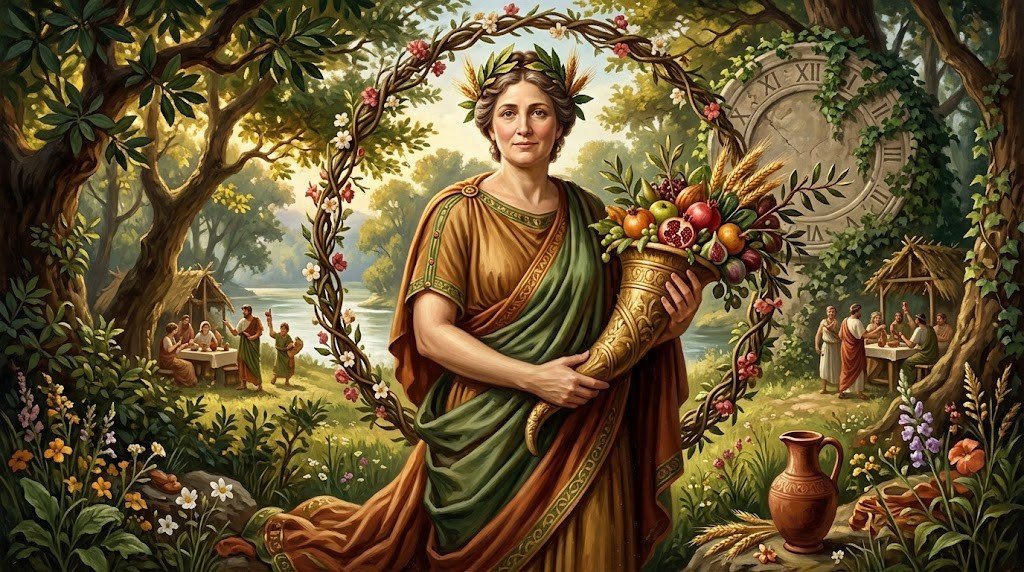
On the Ides of March, the 15th, the Romans celebrated Anna Perenna, the goddess of the returning year. Today the date mostly recalls the assassination of Caesar, but for centuries it was first of all a folk festival, with picnics, wine and songs, in a sacred grove along the Tiber.
- Date: March 15 (the Ides of March), the first full moon of the ancient year
- Deity: Anna Perenna, personification of the yearly cycle
- Place: a sacred grove at the first mile of Via Flaminia
- Main source: Ovid, Fasti III

An outdoor New Year
In the oldest Roman calendar the year began in March, and the Ides coincided with the first full moon. Ovid describes the crowd camping on the grass in huts of branches or in the open air, drinking and praying to live as many years as the cups they emptied. He adds that people sang bawdy verses and danced, a trait that made the festival one of the merriest in the calendar.
Who Anna Perenna was
The name recalls annus and perennare, meaning “to last all year.” The ancients, however, proposed very different identifications: Ovid reports Dido’s sister who arrived in Latium, a nymph, the Moon, and an old woman who tricked Mars. The fact that so many versions circulated suggests that not even the Romans had a single tradition.
Where it was celebrated
Ovid places the grove at the first mile of Via Flaminia. In 1999 excavations at Piazza Euclide, in the Parioli district, uncovered a spring with offerings, oil lamps and tablets bearing curses, which archaeologists connect to an Imperial-era sanctuary of Anna Perenna. The identification with Ovid’s grove is a hypothesis, not a certainty. For an itinerary in this area of the Campus Martius, start from our Ara Pacis page.
The day of Caesar
On March 15, 44 BC, Julius Caesar was killed in the Senate. The coincidence with such a popular festival proves nothing about the conspirators’ intentions, but it explains why the day stayed in memory.
Frequently asked questions
What was celebrated on March 15 in Rome?
The festival of Anna Perenna, goddess of the year, with picnics, wine and songs on the Tiber.
Was it really a New Year?
In the oldest calendar the year began in March, and the Ides fell on the first full moon. The reform that moved the start to January 1 came later.
Where is the spring of Anna Perenna?
The remains discovered in 1999 lie under Piazza Euclide, in the Parioli district of Rome.
This festival is part of the calendar of ancient Roman festivals and the mos maiorum, where you will find all the other observances.
Sources
- Ovid, Fasti III 523-696
- Macrobius, Saturnalia I 12
- Studies on the sanctuary discovered at Piazza Euclide, Rome (1999)
The illustrations are generated with artificial intelligence for evocative purposes.