Published on · updated on
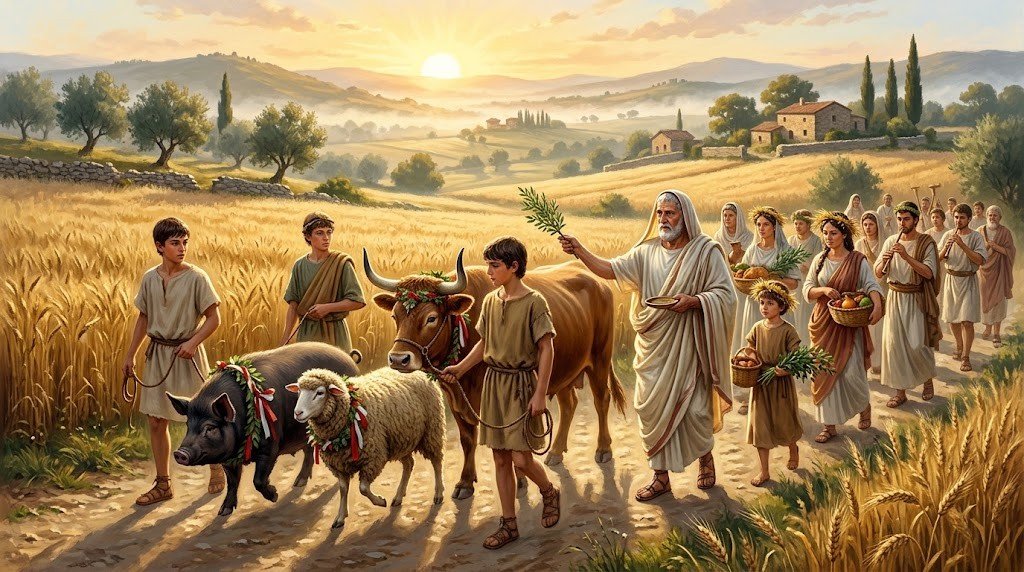
The Ambarvalia were the procession in which Roman farmers purified their fields in late May, leading a pig, a sheep and a bull around the boundaries to be sacrificed. It was a movable festival, announced every year, and at its center was a simple request: that the wheat ripen safe from disease and storms.
- Date: late May, movable (a “conceptive” festival, set year by year)
- Deities invoked: Ceres and Mars, according to the sources
- Victims: pig, sheep and bull (suovetaurilia)
- Sources: Virgil, Georgics I. Cato, De agri cultura 141
What Ambarvalia means
The name is linked to the verb ambire, “to go around,” and to arva, the fields. It was a lustratio, a purification carried out through a ritual procession around the boundaries of the farm.
The suovetaurilia sacrifice
Cato the Censor, in his 2nd-century BC farming manual, records the formula in which the owner had a pig (sus), a sheep (ovis) and a bull (taurus) led around the estate, praying to Mars Pater to keep away disease, drought and ruin. The technical term for this triple sacrifice is suovetaurilia.
Virgil’s description
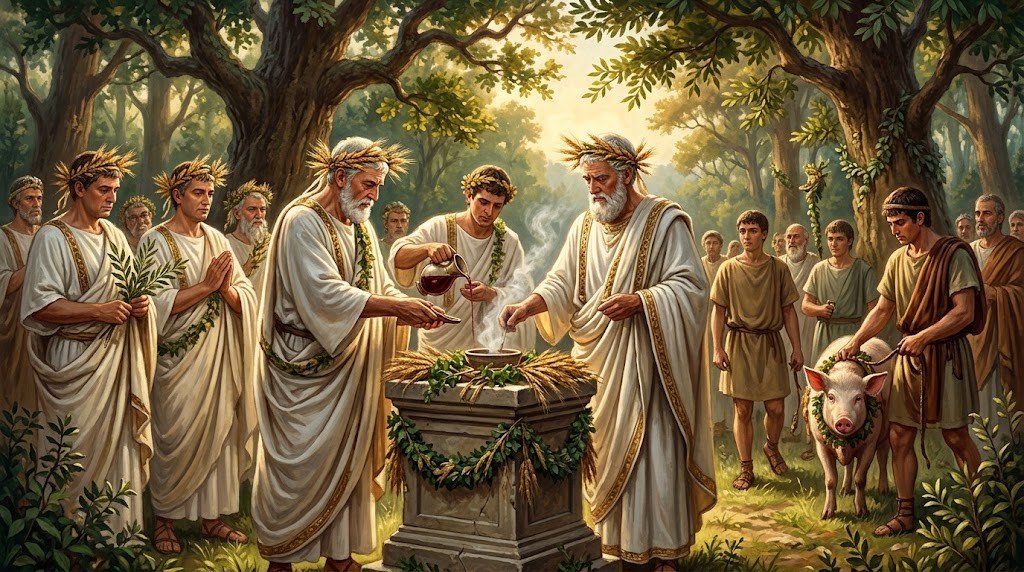
In the Georgics Virgil pictures the farmers who, once the procession is over, offer honey and wine to Ceres while the bull is led three times around the wheat. It is a poetic scene, but it follows a real rite of the countryside.
Not to be confused with the Arval Brothers
The Fratres Arvales, a priestly college that honored the goddess Dea Dia, had a separate cult, fixed at a set time in May. The similar name comes from the shared root arva.
Where to see these rites
Sacrifice scenes with the suovetaurilia appear in reliefs. A famous example is the one in the Louvre, which came from Rome. For an itinerary through the Forum, where the great public rites were held, start from the Roman Forum page.
Frequently asked questions
What are the Ambarvalia?
A Roman farming festival in late May in which the fields were purified with a procession and a sacrifice.
What is the suovetaurilia?
The sacrifice of a pig, a sheep and a bull, used for ritual purifications.
Did the Ambarvalia have a fixed date?
No. They were movable festivals, and the day was set every year.
This festival is part of the calendar of ancient Roman festivals and the mos maiorum, where you will find all the other observances.
Sources
- Cato, De agri cultura 141
- Virgil, Georgics I 338-350
- Tibullus, Elegies II 1
The illustrations are generated with artificial intelligence for evocative purposes.