Published on · updated on
Every June 29 Rome traditionally comes alive to celebrate the city’s patron saints!
St. Peter’s Square fills up for the Pope’s solemn Mass, while parks and restaurants crowd with Romans and tourists who have come for the big day of city celebration.
Peter and Paul are certainly the most beloved saints in the Christian tradition, the two princes of the apostles portrayed together since the beginning of Christianity.

June 29 – Who are Peter and Paul?
“Peter was the first to confess that Jesus is the Christ, the Son of God. Paul spread this message in the Greco-Roman world. And Providence willed that both of them should come here to Rome and shed their blood here for the faith. For this reason the Church of Rome became, immediately, spontaneously, the point of reference for all the Churches scattered throughout the world. Not through the power of the Empire, but through the strength of martyrdom, of the witness given to Christ!”
(Pope Francis)
St. Peter (Simon), a fisherman from Galilee who was waiting for the coming of the Messiah preached by the prophets and declared imminent by John the Baptist, was the first apostle of Jesus.
Jesus asked him if he could get on his boat to preach, and, blessed with a miraculous catch of fish, Simon decided to leave everything, even his own name, and follow Jesus, declaring himself a fisher of men.
Around the year 50, he came to Rome to preach the message of Christ until he was arrested during the persecutions of the emperor Nero.
According to legend, Peter at first managed to escape arrest, but on Via Appia Jesus Christ appeared before him, convincing him to repent and turn back to accept martyrdom as a sign of faith. So he was crucified in Nero’s circus in the year 67 AD, crucified upside down by his own choice, since he did not consider himself worthy of receiving the same execution as Christ.
Peter, who had denied his Master three times after the arrest, became the point of reference for the other apostles and for all the disciples. It would be he who started the preaching of the Good News, after the descent of the Holy Spirit upon them all at Pentecost. It would be he who took into his own hands all the duties of the Vicar of Christ on Earth.
A chapel was built over his tomb, then Constantine’s Basilica, which was replaced by St. Peter’s Basilica only in the 16th century.

June 29, Feast of Saints Peter and Paul: the patron saints of Rome
St. Paul (Saul) was born in Tarsus (present-day Turkey) to a Jewish family. A proud legionary and persecutor of Christians, he converted to Christianity after an apparition on the road to Damascus. From then on he became a tireless messenger of the words of Jesus, until he was arrested in Jerusalem.
He was transferred to Rome in 61 AD for a “fair trial”, as a Roman citizen, and served several years in prison, then got out and was arrested again in the Christian persecutions, again ordered by Nero.
Legend has it that he was jailed in the same cell as Peter and was beheaded (because as a Roman he deserved a less painful death) in the year 67 AD on Via Laurentina in an area known as Aquas Salvias.
Legend has it that his head, falling to the ground, bounced three times and as many springs of water gushed from those spots, around which three churches were built that are today part of the complex of the Cistercian Abbey of the Three Fountains (run by Trappist monks).
Paul’s body was buried outside the Aurelian walls, on Via Ostiense, and is today kept under the altar of the current Basilica of St. Paul Outside the Walls, while his head is venerated in the Basilica of St. John Lateran.
According to legend, Peter and Paul were executed on the same day.
Since the Church celebrates the solemnity of the princes of the apostles Peter and Paul on June 29, this day is a holiday in Rome.
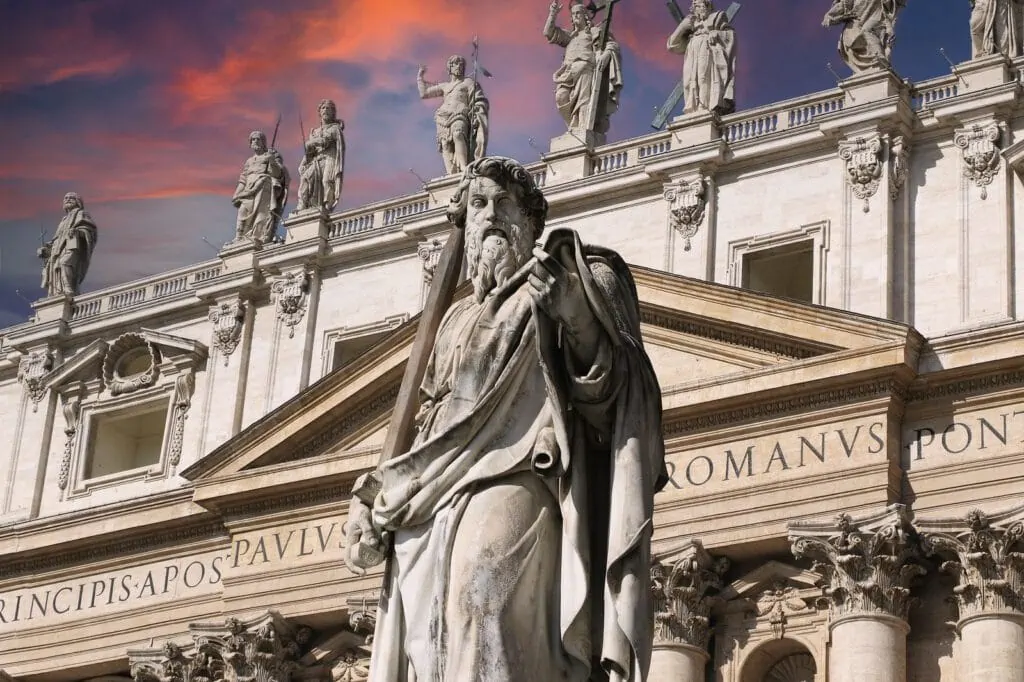
Statue of St. Paul in St. Peter’s Square at the Vatican – made by Adamo Tadolini
Every year in Rome, on June 29, the centers of the celebrations of the Feast of Saints Peter and Paul are all the Catholic churches, above all St. Peter’s Basilica in the Vatican and the Basilica of Saints Peter and Paul in EUR.
In Italy, June 29, the day of Saints Peter and Paul, was a concordat public holiday until 1976, but the holiday was abolished in March 1977, remaining only as a patron saint’s day for the city of Rome.
Already on the evening of June 28 the Pope blesses the palliums. The next morning, the “fisherman’s creel” is hung on the central gate of the Vatican basilica, to recall Peter’s humble trade, while at the same time in the Lateran basilica the reliquaries containing the heads of St. Peter and St. Paul are displayed.
The area in front of St. Peter’s Square is traditionally decorated with images made of petals, the so-called “Infiorata“, organized by the Pro Loco of Roma Capitale.
At 10:00 in the basilica only a few of the faithful can attend the papal Mass in person each year, which is in any case broadcast live also on the big screens set up for the occasion in St. Peter’s Square.
For the occasion the Vatican Museums are closed every June 29 (while the other state museums are generally open).
In the church of San Pietro in Carcere, after a sacred celebration, you can visit the prison where the apostle was held after his arrest.
In the prayers of Vespers the hymn Decora lux aeternitatis auream is recited or sung.
In addition to the celebrations in St. Peter’s Basilica, in recent years other events have followed one another in Rome:
16:00 the canoe regatta on the Tiber, near the Ponte Margherita, which connects Via Cola di Rienzo with Piazza del Popolo.
20:00 in Piazza del Popolo: Carabinieri Band and Flag-wavers of the 7 contrade of Orte (VT)
21:00 the recent fireworks show on the Pincio, which takes its name from the ancient “Girandola”. The fireworks can be seen very well from Piazza del Popolo.

Why are Saints Peter and Paul celebrated precisely on June 29?
No, June 29 of 67 AD is actually not the exact date of the martyrdom of St. Peter and St. Paul.
It’s absolutely not certain that the two martyrs were killed on the same day. Rather, there are several texts that speak of different dates, ranging from between July 18 and 27 of 64 AD, after the great fire of Rome, to June and July of 67.
So why was June 29 chosen for this commemoration?
As with other Christian festivals, that particular date was chosen to overshadow other traditional pagan festivals, in this case the Quirinalia in honor of Romulus and Remus (moved to June 29 by Augustus).
Since ancient times, in fact, and until 258 AD, on the Quirinal Hill people honored the deeply revered Sabine deity Quirinus, associated with Romulus and therefore with the origin of the city.
So it was that the Catholic Church, during the Christianization of the Roman Empire, decided to replace the famous pagan festival with another that could become even more deeply felt.
As we said, Peter and Paul are certainly the most beloved saints in the Christian tradition, the two princes of the apostles portrayed together since the beginning of Christianity.
The god Quirinus, for his part, was for the Augustan poets Romulus himself, deified after his death.
It came naturally to replace the day of the celebration of the god and founder of Rome with that of the founder of the Roman Church, Peter, and to keep the imagery of duality associated with Romulus and Remus, Paul was chosen to be paired with Peter, in a sort of twinning of their martyrdom, by convention occurring on the symbolically most important day for the city of Rome and for Roman citizens.
Peter and Paul would therefore be celebrated together to replace Romulus and Remus with a pair of saints with an equally powerful evocative force.
Around the middle of the 5th century AD, in one of his sermons (no. 82), Pope Leo the Great invited the faithful to “reflect on the profound difference in meaning that a festival celebrated on the same day could take on for a pagan and for a Christian.
While in the eyes of a pagan there appeared the grim vision of the walls that Romulus had stained with the fraternal blood of Remus, to Christians there now appeared the comforting image of the love that united Peter and Paul for the good of the community entrusted to them, in the hope of a happy and eternal future life.”
Peter and Paul do not erase classical Rome, they bring it to fulfillment.
Tourists come to Rome to see the ruins of the Forums and the great basilicas, the Pantheon and Piazza Navona, the Colosseum along with Michelangelo, Raphael, Caravaggio and the Baroque.
But while Romulus kills Remus, Paul, though at times in dispute with Peter, returns to communion with him.
For both of them the heart of existence is not their own life, but the witness that there is a valid reason to live and that life is not a deception. Both understood this by meeting a man who claimed to be himself “the life”.
Rome after Christ gathers the legacy of law, philosophy, literature, Greek and Latin art, but adds mercy to it.
On the cross a love greater than hatred appeared, a forgiveness greater than enmity, the God of mercy stronger than the devil.
And starting from that love it also purified Rome of its demonic furies, like the gladiator games, which survive today only in the form of the bullfight, but no longer as a man killing his brother.
Here too with errors and sins, but always in the light of that light.
The paradox is that pagan Rome, by unjustly killing Peter and Paul, accomplished with their martyrdom the most significant event of its own history: it made the two new brothers co-founders of the city together with Romulus and Remus, attesting to their love and their witness as indicators of a truth that no longer feared death, because it had been defeated.
By killing Peter and Paul, classical Rome refounded itself and placed them as the new foundations of its own history.
In the years of the Risorgimento there was a partisan attempt to set those two Romes against each other, the one of Romulus and Remus and the one of Peter and Paul.
But time has been a gentleman and has shown that the Church could only rejoice at the restored autonomy of civil Rome and secular Rome could only take pride in having the seat of Peter at its heart.
Among other things, if you read the texts of the Enlightenment thinkers on tolerance, equality and freedom, it’s evident that they derive this legacy not only from classical antiquity, but even more from the Gospel itself, starting with Locke.
This is Rome.
Given by time and history and not artificial, not built at a drawing board.
Rome was thus founded twice.
In continuity: Romulus and Remus, Peter and Paul.
This is the identity of Rome.
Why did the feast of Saints Peter and Paul begin precisely in 258?
The persecution of Valerian was raging then, and it’s not absurd to think that the Christians, since the imperial edict forbade every ceremony at the tombs of the Apostles, sought to honor them in a non-cemetery location and found this location at the third mile of Via Appia, in a place where the names of Peter and Paul had already become fixed, in the tradition of their shared dwelling.
Rome was thus founded twice.
In continuity: Romulus and Remus, Peter and Paul.
This is the identity of Rome.
Legends and Traditions of June 29 for Saints Peter and Paul

June 29 – Saints Peter and Paul – The Girandola of Castel Sant’Angelo
For many centuries Saints Peter and Paul have been considered the patron saints of the city of Rome, and as you can easily imagine, many traditional rites repeat every year on June 29 to celebrate the saints in the city.
Among all the age-old rites held in honor of Rome’s protectors, the most spectacular is certainly the Girandola of Castel Sant’Angelo, which was an unforgettable fireworks show, with a famous final fountain that gushed over the whole monument…
According to tradition, the show was devised in the 15th century by Michelangelo Buonarroti for the celebrations of Saints Peter and Paul, founders of the Church and patrons of the city of Rome.
The Girandola was nothing other than a firework studied in the drawings of Michelangelo Buonarotti and perfected by the Cavalier Bernini (cf. Onorato Castani, Observations on Sicily, p. 23), who took his cue from the eruptions of the volcano Stromboli “that vomits flames and fire”. The fantastic genius of the great Neapolitan Architect transformed this deluge of rockets, flashes and bolts of fire into a design of unsurpassable colors and art. Soon word spread of this phantasmagorical spectacle and Rome became a destination for visitors from all over Europe. On a medal of Pius IV Castel Sant’Angelo can be seen set ablaze by fireworks
- (cf. Cose meravigliose di Roma 1625, and Grandezze di Roma 1678)
The spectacular Girandola of Castel Sant’Angelo was set off for the first time on June 29, 1481 to exalt the Pontificate of Sixtus IV.
In 1769 it was described in the book “Voyage d’un François en Italie” by the astronomer
Jérôme Lalande as one of the most beautiful things of its kind he had ever seen.
This is how Gioacchino Belli immortalized the Girandola of Castel Sant’Angelo in poetry:
“Explaining what the Girandola was, and what it represented for more than 300 years, is extremely hard, just as it would be very reductive to define it as a simple firework.”
The Girandola of Castel Sant’Angelo was an event that drew spectators from all over Europe, an appointment where outsiders of every rank and social class converged, a moment when Rome shone again, regaining, if only for brief moments, the splendor that in the past accompanied this beacon of culture and civilization that Rome indeed was.
Only from the brainchild of the divine Michelangelo, the greatest Renaissance artist, could such a grand, sumptuous and flaming spectacle be born to magnify the Roman night of Saints Peter and Paul.
An event that gave the Romans back their pride, a festival that, through the whims of time and memory, has been lost, forgotten among a thousand secrets that our city still hides in its libraries and in the old stories handed down.
The Girandola of Castel Sant’Angelo took place, in fact, at Castel Sant’Angelo (later moved to Piazza del Popolo), but in the last century the ancient girandole have never been used again, only an ordinary pyro-musical show with aerial effects.
In fact the show at Castel Sant’Angelo, sometimes considered too dangerous by the Italian authorities, was interrupted in 1886, probably because of the death of the person who was to continue the tradition, who disappeared without leaving specific instructions about it, and so it could no longer be reworked.
From Michelangelo on, the secret lay in the colors and not in the bangs as we are used to hearing today. It is said that 4,500 rockets were used, fired in a very particular sequence, and that the “Flumina Lucis“, the rivers of light so called by Bernini, had to be no fewer than 60 and no more than 80, so that the sensitive human iris would not be confused by the succession of colors.
What is certain is that the study of the mixtures that had to create certain types of color was the baggage of a chosen few. Those who engaged in these studies were not simple craftsmen, much less occasional figures.
Only since 2020 have real girandole reappeared for the whole duration of the fireworks show dedicated to Michelangelo’s girandole, highlighting its particular and surprising nature in the June 29 event in the central square of Cinecittà World.
The historic fireworks show was recreated at Cinecittà World with authentic ancient contraptions more than 6 meters tall, on which the girandole were hoisted, wheels of fire and other pyrotechnic mechanisms that dance in time to music using effects long impossible to find.
This reenactment is titled: Le Girandole di Michelangelo.

June 29 – Saints Peter and Paul – The Boat of St. Peter
A rural tradition widespread in the regions of central and northern Italy has it that on the night between June 28 and 29 you fill a glass bottle (or a carafe, or a glass) halfway with cold water and then, carefully, pour an egg white into it.
This glass bottle must then be left all night in the garden (or on the windowsill).
The morning dew will help form whites that look like the sails of a boat, and if you want to see it that way, a real sailing ship inside the bottle.
According to legend, that night the apostle himself creates the little boats for all those who respect the tradition, in memory of the time when he was a fisherman, before being an apostle.
According to Christian tradition the effect that appears on the night of June 29 (due to the heat rising from the base toward the surface, carrying the egg white with it) is a sign of the affection of St. Peter, who in this way shows closeness to his faithful.
Looking at the boat inside, if the sails of the boat appear closed then bad weather would come (for some, a rainy season in general), while sails spread would mean a sunny day (for some, the arrival of drought or in any case a generally dry season).
This tradition was more or less elaborate depending on the family, the town and the region: for some, in fact, the look of the boat gave indications about the health and finances of the family, but also about weddings to come.
In some areas of Italy, if these sails appear spread, it means the year’s harvest will be abundant, otherwise it will be rather meager.
In the Bergamo area the shape of the ship is interpreted differently, namely full sails indicate a husband for single girls or a baby on the way for married women.
In some towns in northern Italy a proverb is common that says: “If it rains on the day of St. Peter & Paul, it will rain all year!”

June 29 – Saints Peter and Paul – The other legends
On June 29 in many cities Saints Peter and Paul are celebrated, and the popular traditions, different from one another, often go beyond the religious content…
Many believe, however, that by tradition on June 29, through the intercession of St. Peter, the rains will fall abundantly, putting an end to the drought.
Depending on the region of Italy this legend is completely turned upside down: for other seafaring communities, on the contrary, that night the seas will be particularly full of fish (perhaps because of the first ones who don’t go out to sea?).