Rome Botanical Garden
In short. There are places in Rome that behave like a service door: you walk past a thousand times, you ignore them, and the day you finally go in you realize that behind that discreet gate half a city was hiding.
There are places in Rome that behave like a service door: you walk past a thousand times, you ignore them, and the day you finally go in you realize that behind that discreet gate half a city was hiding. The Orto Botanico di Roma is exactly this. It's at the end of a quiet largo in Trastevere, a stone's throw from the Tiber and the din of Porta Settimiana, and as soon as you cross the threshold the noise switches off as if someone had turned down a knob. 12 hectares of hill, more than 3,000 plant species, plane trees with four centuries on their shoulders and a Baroque staircase that climbs toward the Janiculum as if going to fetch the view. The reaction of visitors is always the same: first amazement, then the inevitable question, "but how can it be empty?".
Orto Botanico di Roma: 12 hectares of green on the slopes of the Janiculum
Let's start with the numbers, because here the numbers already tell a story. The Orto Botanico di Roma occupies about 12 hectares on the northeastern slope of the Janiculum, the hill that closes Trastevere to the west and which, technically, is not one of the seven canonical hills of Rome: one of those toponymic injustices that Romans stopped contesting long ago. 12 hectares means 120,000 square meters, that is an area comparable to 17 soccer fields, all uphill, all planted, all walkable in a morning if you don't stop every three meters to read the labels. Which you will do, because the labels are the most fun part.
The shape of the terrain is the first relevant botanical fact, well before any plant. The lower area, the one stretching in front of the mass of Palazzo Corsini, is flat, wide, exposed to the sun for much of the day: there are the palms, the big lawns, the water basins, the beds of the simples. From a certain point the ground rears up and becomes real hill, with a difference in height that exceeds 50 meters from the entrance to the top. That slope faces northeast, that is it gets little direct sun and stays cool and damp even in August. The result is that within the same enclosure two different climates live together: below you can grow Mediterranean, sun-loving things, above you can afford ferns, bamboo, mosses and undergrowth. It's a geographic stroke of luck that botanists have known how to exploit with a certain boldness.
The structure today belongs to the Department of Environmental Biology of Sapienza, the University of Rome, and this is a detail that changes everything. It's an open-air scientific laboratory that by courtesy lets us in too, and not a public park, a municipal villa or an ornamental garden. The plants are not where they are for aesthetic reasons but for taxonomic, ecological, teaching reasons. If it seems to you that certain beds have a mysterious order, you're right: that order exists, it's called systematics, and once you understand the criterion the Orto Botanico di Roma stops being a beautiful place and becomes an open book.
Why the Orto Botanico di Roma is not just any garden
The difference between a garden and a botanical garden is the same as between a library and a decorative bookcase. In a garden plants serve to look good. In a botanical garden they serve to be studied, conserved, multiplied and, if necessary, saved. In here there are collections that have the value of a gene bank: specimens of rare, threatened or even extinct-in-the-wild species, kept alive so that one day they can return to where they came from. It's a function no sign shouts, but it explains why certain corners are fenced off and certain plants have labels with codes that look like license plates.
Then there's the teaching function, which is imposing and almost invisible to the Sunday visitor. Every year hundreds of school groups pass through here, with guided routes built for the purpose, and courses, lectures, exhibitions and symposia are held. If you happen to come on a spring weekday and find the Bambuseto invaded by a line of children in fluorescent vests, you're not witnessing an invasion: you're witnessing the main job of this place. The tourist, here, is a welcome guest but is not the primary audience, and this is precisely the reason the experience remains so little tamed.
How to get to the Orto Botanico di Roma: Largo Cristina di Svezia 24
The address is Largo Cristina di Svezia 24, and the address alone is a story. The largo opens behind Via della Lungara, the straight street that Julius II had laid out at the start of the 16th century to link the Vatican to Trastevere: one of the first operations of rectilinear urban planning of modern Rome, conceived so that carriages and cardinals could travel comfortably. Walking it today you pass in front of Agostino Chigi's Farnesina, then in front of the Regina Coeli prison, then in front of the main door of Palazzo Corsini. Three buildings that tell three different Romes: that of the Renaissance bankers, that of the 19th-century State, that of the collector princes. And at the end of this trio, behind a gate, is the Orto Botanico di Roma.
Anyone arriving on foot from the center does the most sensible thing: cross the Tiber at Ponte Sisto, slip into Via di Ponte Sisto, come out in Piazza Trilussa and continue north to Porta Settimiana, that narrow and severe arch that marks the old wall boundary of the rione. Past the gate you're already on Via della Lungara, and from there the entrance is a matter of two minutes. It's a walk of barely 10 minutes from Campo de' Fiori and 20 from Piazza Navona, all flat except the moral step of having to tear yourself away from the shop windows.
Anyone coming down from above, that is from the Janiculum, arrives with the opposite approach, the recommended one. From Piazzale Garibaldi or the Fontanone dell'Acqua Paola you see the Orto from above, like a compact green patch between the roofs of Trastevere and the river, and you immediately understand its extent, which from the inside is hard to perceive. Watch out, though: from above you don't enter. There is only one entrance, at the bottom, and anyone who tries the descent by eye ends up circling the perimeter wall for 20 minutes cursing the topography. I say it from other people's experience, of course.
The Trastevere rione around the Orto Botanico di Roma
The piece of Trastevere where the Orto Botanico di Roma stands is not the Trastevere of postcards. There's no Santa Maria in Trastevere with its golden mosaics, there are no alleys with tables outside and little lights. There is instead a narrow and somewhat austere strip between the river and the hill, made of convents, historic hospitals, noble palaces, the very long wall of Regina Coeli and a few streets, like Via dei Riari or Via Corsini, that have kept an almost provincial, secluded air. It's the Trastevere that makes no noise, and for this reason it's also the one where you breathe best.
I recommend walking Via dei Riari at least once, which runs along the southern side of the Orto. It's a little-trodden street, with the wall of the Orto on one side and low houses on the other, and above the wall poke the tops of bamboo and plane trees. In spring, when you pass by with the windows open, you hear the sound of leaves on the other side and it seems absurd that something so big can hide behind such an ordinary wall. Rome often plays this trick: it puts wonders behind the most anonymous plaster it can find.
The origins of the Orto Botanico di Roma in the papal gardens of the Simples
The history of the Orto Botanico di Roma begins long before Trastevere, and begins in the Vatican. The recognized ancestor is the Simpliciarius Pontificius Vaticanus, that is the papal garden of simples, a garden of medicinal plants already attested under the pontificate of Boniface VIII, so straddling the 13th and 14th centuries. The "simples", for those who don't chew the medieval lexicon, were the medicamenta simplicia: the healing substances in the pure state, that is the plants from which remedies were drawn before the apothecary combined them into compounds. Every monastery worthy of the name had one, because every monastery had to know how to treat its own monks.
At the end of the 13th century an inscription now kept on the Capitoline mentions a Pomerius wanted by Pope Nicholas III on the Vatican hill. It wasn't yet a botanical garden in the modern sense: it was agricultural land, vineyard, orchard and alfalfa, meant to supply the papal court on the site now occupied by the Vatican Gardens and palaces. But the principle is already the one that matters: the papacy considers cultivated greenery a function of the State, not a luxury. From this idea, along a thin and stubborn line, descends the place where today we buy the ticket.
The leap in quality comes in the 16th century. The first true Roman botanical garden was wanted by Alexander VI, the Borgia pope, and then rebuilt by Pius IV, who also assigned it a keeper with guide functions: which, if you think about it, makes that anonymous custodian the oldest documented guide in this city. Pius V enlarged the garden further and entrusted it to a real botanist, Michele Mercati. Then, as happens in Rome, a period of neglect. Then the rebirth under Alexander VII.
The meaning of the word "simples" in the Orto Botanico di Roma
The word deserves a moment of attention, because in the garden you'll find it written and it's worth understanding. Ancient and medieval medicine distinguished between simplicia and composita. The first were the single ingredients supplied by nature: a root, a bark, a flower, a leaf. The second were the mixtures prepared by the apothecary. Cultivating the simples therefore meant owning the raw material of pharmacy, and whoever controlled the garden controlled, to a large extent, the health of the community. It wasn't gardening: it was health infrastructure.
This also explains why the first European botanical gardens almost all arose inside universities, and precisely inside the faculties of medicine. Padua and Pisa contend for the primacy around 1544 and 1545, Florence follows close behind. They served to teach medical students to recognize plants, because getting a leaf wrong could mean killing a patient. The botanical error was, literally, a clinical error. From this practical and severe need was born the discipline that today has us strolling among the beds with a contemplative air.
The Simpliciarius Pontificius Vaticanus and the first gardens of the popes
It's worth stopping on Alexander VII Chigi, because he is the pope who, more than any other, has to do with our story. He reigned from 1655 to 1667, was the patron of the colonnade of Saint Peter's and one of the great protectors of Bernini, and sincerely loved botany. Under him the Vatican botanical garden became one of the main ones in Europe, and it managed to do so for a very concrete reason: water. Paul V had restored the ancient Trajan aqueduct, bringing water from Bracciano to the Janiculum, giving rise to what we call Acqua Paola. A botanical garden without abundant water is a collection of dead plants. With Acqua Paola, instead, you could dare.
In 1660 Alexander VII gave the University the first land intended for this use, still called at the time the "garden of simples". He carved it out by taking it from the orchard of the convent of San Pietro in Montorio, on the Janiculum, just below the Fontanone. It's a date worth keeping in mind because it marks the handover: from that moment the garden stops being a private property of the pontiff and becomes a university structure. Botanical knowledge leaves the Vatican walls and enters the classroom.
It was needed, because until then the situation was paradoxical. The first university chair of botany in Rome had been established in 1513, so well ahead of half of Europe, and students and teachers could use the Vatican garden for their observations. But that garden remained, as the sources say with a delightful expression, "most private": you entered by concession, not by right. Having a chair without having a garden was like having an anatomy course without having a table.
Botany gets its name in the Orto Botanico di Roma
There's a curious detail that almost nobody knows. The director of the Vatican garden from 1601 to 1629 was Giovanni Faber, a physician and naturalist of German origin, member of the Accademia dei Lincei and friend of Galileo. According to studies on the history of the institution, he was the first to call his subject "Botany". That is: the word we use so casually today to indicate an entire science would have begun its career in this city, in the garden that is the direct ancestor of the Orto Botanico di Roma.
Faber, by the way, is also the man to whom we owe the spread of another word we all use: it was he, in 1625, who proposed the term microscopium for the instrument Galileo had built. A gentleman who in his life christened botany and the microscope deserves a better memory than the one he has. When I walk in the Giardino dei Semplici I always think we owe him a plaque, and maybe a bench in the shade.
Michele Mercati, Andrea Cesalpino and Giovanni Faber: the directors of the papal gardens
The list of directors of the papal botanical gardens is short but very weighty. Michele Mercati opens it, holding the post from 1566 to 1593. He was from San Miniato, a student of Cesalpino at Pisa, personal physician to several pontiffs, and above all a man of encyclopedic curiosity that led him to found the Vatican Metallotheca, a collection of minerals and fossils. He was among the very first in Europe to suspect that the so-called "thunderstones", the chipped flints that peasants found in the fields and attributed to lightning, were in fact tools made by very ancient men. He was right three centuries ahead of his time, and nobody listened to him.
After him, in all probability, comes Andrea Cesalpino, between 1593 and 1600. Here the name is one that truly carries weight: Cesalpino is the author of the De plantis libri XVI, published in 1583, the first organic attempt to classify plants by rational criteria, based on the structure of the fruit and the seed rather than on medicinal use or alphabetical order. Linnaeus called him "primus verus systematicus" and dedicated the genus Caesalpinia to him. He was also, in another parallel life, one of the precursors of the theory of the circulation of the blood. In Rome he was the physician of Clement VIII and, precisely, the director of the garden.
Closing the sequence is Giovanni Faber, from 1600 to 1629. With him the papal garden enters the orbit of the Accademia dei Lincei of Federico Cesi, that is, that laboratory of minds that was literally inventing the modern scientific method. It was Faber who took care of the zoological part of the Tesoro Messicano, the monumental work on the natural products of the New World that the Lincei took decades to publish. The thread joining these three men is clear: the botanical garden of Rome was born as a cutting-edge research tool, not as a pleasure garden. The roses will come, but later.
Why These Names Still Matter Today at the Botanical Garden of Rome
Walking among the orderly beds of the Garden of Simples, you see at work, without knowing it, the legacy of Cesalpino. The idea that plants should be grouped by kinship and not by use was born there, and it made everything else possible: Linnaeus's binomial nomenclature, systematics, and ultimately genetics. Every label you read, with the Latin name divided into genus and species followed by the name of the author, is the direct great-grandchild of that way of thinking.
Keep in mind that the label is not bureaucracy: it is the identity document of the plant and it is valid all over the world. A Japanese botanist and a Chilean one, in front of the same label, understand exactly the same thing. It is one of the very few universal language systems that humanity has managed to build and keep working for almost three centuries, and it is written on metal tags stuck in the soil of a garden in Trastevere.
From Via Panisperna to the Janiculum Hill: The Botanical Garden of Rome in 1883
Before arriving here, the university garden moved several times, with the nonchalance of a chronically evicted Roman tenant. After the donation of Alexander VII it changed location repeatedly, and in the 19th century it was on Via Panisperna, on the Viminal, in the area that a few decades later would become famous for entirely different scientific reasons. There it had a winter garden, that is, a greenhouse, built on purpose.
The turning point comes with the Unification of Italy and with the new capital. In 1883 the State acquires the property of the garden of Villa Corsini alla Lungara, and the Botanical Garden of Rome finally lands in the size and location it still has today. Of the vast Riario-Corsini property, about 12 hectares pass to the Botanical Garden and the remaining four or so to the City. It is a typical operation of those years: the liberal State lays its hands on the great noble and ecclesiastical estates and converts them into public institutions. An art collection becomes a national gallery, a private park becomes a university botanical garden.
The first director of the new site was Pietro Romualdo Pirotta, professor of botany at the University of Rome from 1883. He oversaw the transfer of the collections from Via Panisperna, adapted the old winter garden, which is the present historic greenhouse, and had two more built. Above all, he greatly expanded the stock of species. Pirotta was not a bureaucrat: he was a member of the national academy of sciences known as the XL from 1910, a member from 1913 of the first ministerial commission for the creation of the Abruzzo National Park, and in 1924 he founded the Annali di Botanica, a journal that still exists.
The Move of the Plants, an Undertaking Nobody Talks About
Moving a botanical garden is one of the most absurd operations you can imagine, and it deserves a pause. You are not moving paintings or books: you are moving living organisms, many of them rooted for decades, which after the trip have to start growing again in a different soil, with a different exposure, different humidity and different bed neighbors. Losses are inevitable, timelines are measured in seasons and not in days, and the result shows 20 years later.
Pirotta, however, inherited an enormous advantage: the Corsini garden was not virgin ground but an already structured park, with centuries-old trees, walls, fountains, stairways and working channels. In practice, he took a decayed Baroque garden and rewrote it in scientific language, keeping its skeleton. That is why the Botanical Garden of Rome does not look like a botanical garden designed at a drafting table, all rectangles and sectors: it has the irregular and surprising layout of a noble park, with the logic of a laboratory grafted on top. This double nature is exactly its appeal.
Villa Corsini and the Garden That Houses the Botanical Garden of Rome
The palace overlooking the Garden, and clearly visible from the entrance, is Palazzo Corsini alla Lungara. It was born in the 15th century as the residence of the Riario, the very powerful family of Cardinal Raffaele Riario, nephew of Sixtus IV. It then changed hands several times until in the 18th century it came to the Corsini, the Florentine family that had just given the Church Pope Clement XII. Cardinal Neri Maria Corsini commissioned the architect Ferdinando Fuga to transform the old residence into a modern palace, and the works took place between 1736 and about 1754.
Fuga ran into a problem that Roman architects know well: there was no space. Via della Lungara is narrow, the facade couldn't be set back, and so the palace developed in length rather than depth, with a very long facade and a thin body. But behind it, toward the hill, there was the garden, and that's where Fuga could cut loose, designing a system of terraces, staircases, fountains and perspectives that climbed the flank of the Janiculum and turned the slope from an obstacle into a spectacle.
Today the palace houses the Galleria Nazionale d'Arte Antica di Palazzo Corsini and the Accademia Nazionale dei Lincei, the same Academy founded by Federico Cesi in 1603, of which Giovanni Faber was a member and to which Galileo Galilei belonged. The circle, if you think about it, closes in an almost cheeky way: the academy that hosted the first papal botanists now has its seat in the palace whose garden became the Rome Botanical Garden. Rome is a city that loves to rhyme with itself.
The Palazzo Corsini garden before the Rome Botanical Garden
You have to imagine it differently from how it is today. On the flat part in front of the palace there was an Italian garden, with geometric flower beds and trimmed hedges, though by the mid-1800s no reliable documentation of it remained. Eighteenth-century taste also included many potted collections, citrus above all, which were sheltered in the lemon houses in winter. The variety of species was, by today's standards, rather poor: a noble garden was there to amaze guests, not to document biodiversity.
After the mid-1800s and until the transfer to the State, the garden was essentially left without maintenance. Those who saw it in those years described a romantically decayed park, with silent fountains, paths overgrown with grass and holm oaks grown out of all proportion. Paradoxically, that neglect saved the best part for us: no one touched the woodland at the top of the hill, which has come down to us as the last relic of evergreen Mediterranean woodland on the Janiculum. Sometimes, to preserve something, the best solution is to forget about it for 50 years.
Christina of Sweden, the queen who lived and died where the Rome Botanical Garden is today
The square onto which the entrance opens bears the name of Christina of Sweden, and it's no random courtesy of street naming: the queen really did live in this palace, and she died here. Her story is among the most extraordinary of 17th-century Europe, and it's worth telling in full because it explains why a Lutheran sovereign from the North ends up as the guardian spirit of a garden in Trastevere.
Christina was born in 1626, the only child of Gustavus II Adolphus of Sweden, the great Protestant commander of the 30 Years' War. Her father died in battle at Lützen in 1632, when she was six, and the little girl became queen. She was educated like a male prince: Latin, Greek, philosophy, fencing, riding, the military arts. She summoned Descartes to court, and he had the terrible idea of accepting: lessons were held at five in the morning in the middle of the Swedish winter, and the philosopher fell ill with pneumonia and died in Stockholm in 1650. Christina, with unintended efficiency, is one of the very few people in the world who can be accused of having killed a philosopher with a schedule.
In 1654, at 27, she did something Europe never entirely forgave her for: she abdicated. She gave up the throne of Sweden, converted to Catholicism (an absolute scandal, since she was the daughter of the champion of Protestantism) and in 1655 entered Rome in triumph through Porta del Popolo, through the gateway that Alexander VII had Bernini decorate for the occasion. The inscription still visible today on the inner arch, "felici faustoque ingressui", was carved for her. Few people can say a city gate was altered in their honor.
Christina of Sweden's court where the Rome Botanical Garden stands today
She finally settled in Palazzo Riario alla Lungara, that is, the future Palazzo Corsini, and made it one of the liveliest intellectual centers in Europe. She gathered a huge library there, a collection of paintings of the very first order, manuscripts, coins, ancient statues. Writers, musicians, scientists and artists gathered around her: Alessandro Scarlatti and Arcangelo Corelli played for her, and Gian Lorenzo Bernini was a frequent guest and a sincere friend. The academies she inspired gave rise after her death, in 1690, to the Arcadia, the most influential Italian literary institution of the 18th century.
She wasn't an easy woman. She stubbornly refused marriage, dressed in ways judged scandalous, spent more than she had, tried several times to get herself elected queen of Naples and even of Poland, and in 1657 had her own squire Gian Rinaldo Monaldeschi executed at Fontainebleau, in an obscure episode that cost her the sympathy of the French court. But she publicly defended the Jews of Rome, opposed the persecution of alleged heretics and funded artists and musicians with reckless generosity.
She died on April 19, 1689 in this palace, at 62. She was buried in the Vatican Grottoes, one of the very few women granted that, and Carlo Fontana designed her monument in St. Peter's. When you walk along the palm avenue of the Rome Botanical Garden, you're treading, more or less, on the garden where the queen strolled while discussing philosophy. The fact that bamboo and sequoias grow there now takes nothing away from the scene: if anything, it adds to it.
Ferdinando Fuga and the Staircase of the 11 Fountains of the Rome Botanical Garden
If I had to name a single architectural element to see in here, I'd have no doubts: the Staircase of the 11 Fountains. It's the showpiece of the surviving 18th-century furnishings of the Corsini garden, it's attributed to Ferdinando Fuga and his workshop, and it climbs the flank of the hill in a series of flights lined with basins and jets. 11 fountains, precisely, fed in a cascade: the water descends from one basin to the next following the slope, and the sound it makes accompanies the climb along its whole length.
The principle is that of the Baroque gardens of Rome and Lazio, and it has an illustrious ancestor in the Avenue of the 100 Fountains at Villa d'Este in Tivoli. The idea is that water isn't an added ornament but the connective tissue of the garden: it guides the route, fills the silence, cools the air and sets the rhythm of your steps. In the case of our staircase, the difference in height is used to create an apparent perpetual motion, with the water seeming to chase the visitor as they climb. Anyone who walks it in July understands immediately that Roman Baroque had discovered the air conditioner three centuries early, and without using any electricity to boot.
The style is late Baroque shading into Rococo, with a taste for moving surfaces, for fake rusticity, for effects of surprise. Fuga was a Florentine transplanted to Rome, an absolute protagonist of the first half of the 18th century: the facade of Santa Maria Maggiore is his, so is Palazzo della Consulta on the Quirinal, and so is the Coffee House of the papal palace. He had a particular talent for making things built in little space look grand, which is exactly the talent the Lungara required.
How to climb the Staircase of the 11 Fountains of the Rome Botanical Garden
My advice is to climb it slowly and to stop at least three times to turn around. The view that opens downward, with the palace shrinking and the treetops spreading, changes radically every 10 steps, and it's clearly designed to do so. Baroque gardens are optical machines: they are designed to be walked in one precise direction and to reveal their geometry one piece at a time.
It's a narrow, shady staircase, largely taken back by vegetation over the centuries, far from the monumentality of Trinità dei Monti. Moss, maidenhair and ferns have colonized the basins and the edges, and in some spots the stone is green with algae. An orthodox restorer would suffer, and yet it's perfect like this, because in a botanical garden it's right that the plants have the last word on the architecture.
A practical warning: wet steps are slippery, especially in winter and in the early morning hours when the night's humidity hasn't yet evaporated. Wear shoes with a decent sole, keep a hand free for the handrail where there is one, and don't rush. There is nothing less elegant than a tumble in an 18th-century garden.
The Nymphaeum and the Fountain of the Tritons of the Rome Botanical Garden
At the top of the hill, set against the slope, is the large niche that closes the garden's perspective at the upper end. It's the element that in the Italian garden tradition is called a nymphaeum: an architectural structure in the form of an exedra, often with niches and statues, conceived as the symbolic dwelling of the nymphs and, in practice, as the scenic end point of the climb. It closes off the view, frames it, and tells the visitor that the garden ends there.
Inside the Garden there is also a fountain with figures of tritons, traditionally linked to Bernini's circle. I deliberately use this cautious formula, "circle", because it's the one used when attribution to a workshop is plausible but the direct hand of the master is not documented. Tritons, sea gods with a human torso and a fish tail, children of Poseidon and Amphitrite, are a subject that Bernini made famous in Rome with the Fontana del Tritone in Piazza Barberini, finished around 1643, where the triton kneeling on shells blows water from a conch.
The detail that makes the Bernini connection credible is, if you like, biographical: Bernini visited Christina of Sweden in this very palace, and the idea that someone from his circle left a work in the queen's garden is not far-fetched at all. But it remains a traditional attribution, to be taken as such: an elegant probability, not a certified fact. Guides who pass off hypotheses as certainties do their listeners a disservice.
Why nymphaea are everywhere in Roman gardens
The nymphaeum is an ancient invention that the Renaissance revived with enthusiasm. The Romans built monumental nymphaea around springs and the water towers of aqueducts, both in the city and in villas: they were at once places of worship, summer dining rooms and machines for coolness. Anyone who has visited Hadrian's Villa in Tivoli or the grottoes of Sperlonga knows what I'm talking about. When 16th-century architecture rediscovers ancient models, the nymphaeum comes back forcefully as the obligatory element of every villa worthy of the name.
In Rome the phenomenon explodes because the city has, literally, excess water. The great aqueducts restored between the 16th and 17th centuries, the Acqua Vergine, the Acqua Felice and the Acqua Paola, brought enormous flows into the city, and the pope handed out water concessions to nobles the way licenses are handed out today. Having a gushing fountain in your garden meant having a privileged relationship with papal power. Roman Baroque is also hydraulics applied to politics.
The Fontana dello Scoglio and the waters of the Rome Botanical Garden
Another piece of water that deserves a stop is the so-called Fontana dello Scoglio, named for the shape of its basin, modeled in imitation of a natural rock. It expresses a typically Baroque taste, that of the artificial rustic: the architect builds in stone something that pretends not to have been built at all, and the pretense is all the more appreciated the more obvious it is. An intellectual game, not a stylistic mistake.
Around the basin the vegetation has done its job. Ferns thrive in the cracks, moss covers every surface that stays damp long enough, and in spring small communities of wild plants form that no one planted there. If you stop for a few minutes in silence you'll see blackbirds, great tits, perhaps a robin in winter, and with a bit of luck one of the water turtles that live in the basins. They aren't an exotic detail: they're part of the ecosystem the Garden has unintentionally created inside the city.
All the irrigation of the Rome Botanical Garden, and the small streams that feed the aquatic plantings, depend on the Acqua Paola aqueduct that runs above the hill. It's the same principle that in the 17th century made Alexander VII's great Vatican botanical garden possible. That is: after four centuries, the technical reason this place works is still exactly the same. The science changes, the plants change, the water stays.
The Acqua Paola: the aqueduct that quenches the Rome Botanical Garden
It deserves a few more lines, because without it this garden would not exist. The Acqua Paola takes its name from Pope Paul V Borghese, who between 1608 and 1612 had the ancient Trajan aqueduct restored, built in AD 109 to bring to Rome the waters of the Bracciano area, from the northwest side of the lake. The ancient work ran for about 60 kilometers and served mainly the right bank of the Tiber, that is, Trastevere and the Janiculum itself, which the other aqueducts reached poorly.
The monumental terminal of the Acqua Paola is the famous Fontanone, that is, the Fontana dell'Acqua Paola on the Janiculum, inaugurated in 1612 to a design by Giovanni Fontana and Flaminio Ponzio, with later interventions by Carlo Fontana. It's the one everybody recognizes for its enormous basin and for the view from the square in front of it, and it's a few hundred meters as the crow flies from the top of the Garden. The quantity of water that came out of it was such that the Romans, always quick with a joke, renamed it for its abundant displays of water compared with its quality, judged inferior to that of the Acqua Vergine.
For a botanical garden this abundance is everything. Many of the collections you see here, the ferns, the bamboos, the aquatic plants, the tropicals in the greenhouse, are thirsty species that in a Mediterranean climate with three-month dry summers wouldn't survive without constant irrigation. The fact that the water arrives by gravity from a 17th-century aqueduct rather than from an electric pump is, besides being fascinating, ecologically sensible. It's the oldest working infrastructure of this garden.
The basins and aquatic plants of the Rome Botanical Garden
In the lower part of the garden the water collects in basins where the aquatic plant collections grow. Water lilies above all, with their summer bloom ranging from white to pink to yellow, but also marsh plants, reeds, water irises, papyrus. Papyrus, by the way, is an excellent pretext for a little lesson: Cyperus papyrus is the plant with which the ancients made the scrolls on which a large part of classical literature was written, by cutting the pith of the stem into thin strips, overlapping them in crossed layers and pressing them.
Water lilies have another teaching merit: they are the textbook example of adaptation to aquatic life. The floating leaf has its stomata, the pores for gas exchange, on the upper side rather than the lower as in almost all other plants, for the obvious reason that underneath there is water and not air. It's one of those details that make evolution tangible even for those who have never opened a botany book. With children it always works.
The monumental plane trees of the Rome Botanical Garden
In the upper part of the garden, where the ground rises and the vegetation thickens, there are trees that deserve to be looked at with the respect owed to things older than we are. The centuries-old plane trees and holm oaks of this area are credited with an age between 350 and 400 years. Let's do the math together: it means that when they were planted, or began to grow on their own, a 17th-century pope was reigning, Christina of Sweden had not yet arrived in Rome and Bernini was working on the colonnade of St. Peter's.
The Oriental plane, Platanus orientalis, and its very widespread hybrid Platanus × acerifolia, have a trait that makes them immediately recognizable even to those who can't tell an oak from a poplar: the bark flakes off in irregular plates, leaving light patches on a dark background, so that the trunk looks painted in camouflage. It isn't a defect but a strategy: the plane tree grows quickly in girth and the bark, not very elastic, can't keep up with the expansion, so it peels off. It's also an effective way of shedding deposited pollutants, which is why plane trees tolerate city air better than almost any other tree.
Anyone who walks under their canopies in the height of the Roman summer understands what the word "shade" really means. The perceived temperature under a mature plane tree can be several degrees lower than that measured 20 meters away in full sun: the canopy intercepts direct radiation and leaf transpiration cools the air by evaporation. A big tree is, literally, a cooling machine that runs on solar energy and produces oxygen as a by-product.
How the age of a tree is measured in the Rome Botanical Garden
The question always comes up, and the answer is more interesting than you'd think. The canonical method is dendrochronology, that is, counting the annual growth rings, which on a living tree is done with a Pressler borer: a hollow cylinder that extracts a core of wood a few millimeters in diameter without damaging the plant. Each ring corresponds to a year, and its width tells how that season went: wide rings for rainy, mild years, narrow rings for drought and cold.
On monumental specimens, however, the borer is used sparingly, and often the age is estimated with formulas that relate the trunk circumference measured at chest height to the species' average growth rate in those conditions. It's an estimate, with margins of error that can exceed a decade. That's why serious sources speak of "350 to 400 years" and not a precise date: whoever gives you the exact year of birth of a centuries-old tree is, almost always, improvising.
Then there's a moving aspect. The rings of these plane trees contain, recorded with precision, the climates of four centuries of Rome: the scorching summers, the freezing winters when the Tiber iced over, the great droughts. It's a meteorological archive written in wood, far older and more reliable than any instrumental record, standing there in the middle of a garden and which almost no one thinks to question.
The palm avenue of the Rome Botanical Garden
From the entrance, the most natural route leads along the central avenue lined with palms, which is probably the most photographed image of the whole Rome Botanical Garden. It's an exotic 19th-century planting, consistent with the taste of the time: the second half of the 1800s was the era when Europe fell in love with palms, and every city that wanted to look modern and cosmopolitan planted dozens of them along seafronts and in public gardens.
The collection includes species of very different origins, and it's worth looking at the labels because the differences are striking once you know what to look for. There are palms with a single columnar trunk and clumping palms that send up several stems from the base. There are palmate leaves, that is, open like a fan with the segments starting from one point, and pinnate leaves, that is, arranged like the barbs of a feather along a central axis. Chamaerops humilis, the only native palm of the western Mediterranean basin, is palmate and clumping. The Phoenix, that is, date palms and their relatives, are pinnate.
A clarification that surprises almost everyone: palms are not trees. Botanically they are monocots, much more closely related to grasses, lilies and orchids than to oaks. They have no true wood and no cambium producing annual growth rings. The trunk, correctly called a stipe, grows in height but doesn't thicken after it forms. That's why a cut palm shows no rings and why a palm damaged at the top, where the single growing point sits, never recovers.
The red palm weevil and the palms of the Rome Botanical Garden
Anyone who has lived in Italy for 20 years has seen an impressive number of palms die, and the reason has a name: Rhynchophorus ferrugineus, the red palm weevil, a curculionid beetle native to southern Asia that reached the Mediterranean around the 1990s and Italy in the early 2000s. The female lays her eggs in the crown of the palm. The larvae, which can exceed five centimeters, dig tunnels inside the stipe, devouring the tissues of the growing point. By the time the symptoms are visible from the outside, the plant is already largely destroyed.
The collections of botanical gardens have suffered as much as urban tree lines or more, and the issue is far from closed. The fight is carried out with pheromone traps, targeted treatments, monitoring and, in desperate cases, by cutting down and destroying infested specimens to prevent the spread. It's a story that shows the less idyllic side of the garden: a botanical garden is also a line of plant-health defense, and the people who work in it fight wars the public knows nothing about.
The Bamboo Grove of the Rome Botanical Garden, among the richest in Europe
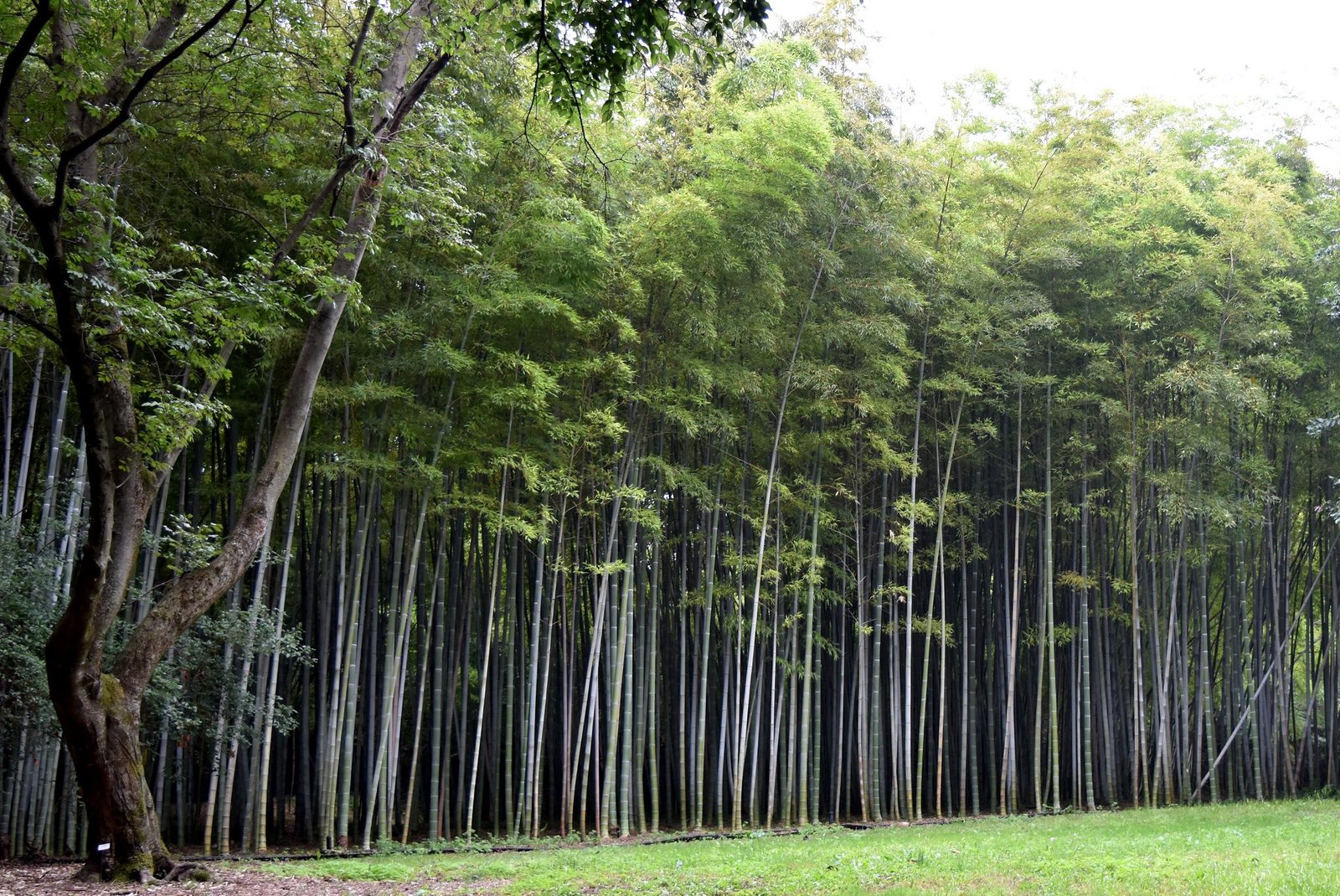
If there is one place in here capable of making you completely forget which city you're in, it's the bamboo grove. The bamboo thickets of the Rome Botanical Garden are considered among the richest in Europe for number of species, and walking through them is a sensory experience even before it's a botanical one: the light turns green and filtered, the noise of the city disappears entirely, and the culms creak softly when the wind moves them, with a sound that seems made to calm the nerves.
Bamboo is a grass, and here the surprise is even bigger than with palms. It belongs to the family Poaceae, the grasses, that is, the same as wheat, rice, corn and your lawn at home. It's simply a grass that decided to become gigantic and to lignify its stems, which are called culms and are hollow with cross partitions at the nodes. Some tropical species exceed 30 meters in height and 20 centimeters in diameter, which means that there are grasses taller than a 10-story building.
The most famous trait of bamboo is its growth rate, which in the fastest species can exceed, in optimal conditions, half a meter a day, with record peaks measured in the laboratory that are higher still. The secret is that the culm doesn't grow only from the tip like a tree: each segment between two nodes lengthens at the same time thanks to an intercalary meristem, as if a telescopic ladder extended from all its elements together. The final diameter of the culm, however, is already set when the shoot comes out of the ground: a bamboo never thickens. It comes out already as wide as it will ever be.
Bamboo flowering and its mystery
Then there is the phenomenon that fascinates even professional botanists: gregarious flowering. Many bamboo species flower at very long intervals (depending on the species we're talking about cycles ranging from a few decades to intervals of more than a century) and they do it in a synchronized way all over the world. That is: plants propagated by dividing rhizomes and transplanted onto different continents, in different climates, flower in the same period, because they are clones of the same individual and carry the same internal clock.
After flowering, in many species, the plant dies. It's a reproductive strategy that biologists call monocarpy or semelparity: the organism invests all its resources in a single, colossal reproductive event, and then shuts down. In the Asian regions where bamboo is food and building material, these mass flowerings have historically caused famines and sudden population explosions of rodents attracted by the enormous quantity of seeds. A botanical phenomenon that becomes a historical and economic fact.
Thinking about it in the Trastevere bamboo grove, with the traffic of Via della Lungara 200 meters away, makes a nice contrast. People look around with a new expression: they've stopped seeing a nice green place and started seeing organisms with a biography.
Ken Nakajima's Japanese Garden in the Rome Botanical Garden
In the upper part of the garden is what for many visitors is the twist of the visit: a Japanese garden designed by the architect Ken Nakajima, the same author as the garden of the Japanese Cultural Institute in Rome, on Via Antonio Gramsci at the edge of Villa Borghese. Nakajima was one of the great designers of Japanese gardens outside Japan in the second half of the 20th century, and his signature on this space is not a decorative detail but a guarantee of correct grammar.
Because a Japanese garden has a grammar, and an iron one. Nothing is random: the position of the rocks, the layout of the path, the point where the water falls, the opening or closing of the view. The guiding principle is shakkei, "borrowed landscape", that is, the deliberate integration of elements outside the garden (a hill, a distant tree, a skyline of roofs) into the internal composition. The designer doesn't fence in the world: he enlists it.
Another principle is studied asymmetry. In the classical European garden order is expressed through symmetry, axes, geometry: two identical rows, a fountain in the center, an obelisk at the end of the perspective. In the Japanese garden order is expressed through the dynamic balance between elements that differ in size, shape and visual weight. Three rocks will never be identical or aligned. They will form a scalene triangle that the eye perceives as natural but that has been calculated with millimeter precision.
How to look at the Japanese Garden of the Rome Botanical Garden
The practical suggestion is simple: slow down. A Japanese garden is not crossed, it's walked in stages, and each stage corresponds to a designed viewpoint. If you walk at a normal pace looking straight ahead, you'll come away with the generic impression of a pretty place with a little pond. If instead you stop at the points where the path changes direction (and note that it changes direction more often than necessary, and not by chance) you'll discover that each bend was put there to force you to turn your head toward a precise scene.
Pay attention also to the water and its voices. In a well-designed garden the water makes different sounds in different spots: the low gurgle of a slow stream, the sharper noise of a little waterfall, the periodic thud of a shishi-odoshi where there is one. The composition is as much sound as sight, and this is a dimension that European gardens, with their fondness for big jets of water, have explored much less.
The best moment, if you can choose, is spring, when the ornamental cherries bloom and the Japanese maples put out new leaves. But autumn deserves a special mention, when the Acer palmatum go from green to red and orange with that gradualness the Japanese have codified in a dedicated practice, momijigari, the hunt for red leaves. It's one of the few activities in the world that literally consists of watching trees change color, and it's a civilization that has understood something.
The Rose Garden of the Rome Botanical Garden and the municipal rose garden on the Aventine
The rose garden too is in the upper part, and contrary to what many expect it isn't an ornamental rose garden but a collection, that is, a set organized to document the history and diversity of the genus Rosa. There are botanical roses, the wild species from which everything began, and the cultivated varieties that derive from the species through centuries of selection and hybridization. Looking at a dog rose next to a modern hybrid tea is like looking at a wolf next to a poodle: same origin, 4,000 years of human intervention in between.
Rome has an ancient relationship with roses and another place dedicated to them, the Roseto Comunale on the Aventine, which overlooks the Circus Maximus with one of the finest views in the city and which opens to the public in the flowering season, roughly between spring and early summer, hosting the international "Premio Roma" competition for new varieties. That ground, before becoming a rose garden, had been the city's Jewish cemetery, and in memory of this the flower beds are laid out in a design that recalls the menorah, the seven-branched candelabrum. It's a detail very few Romans know and that says a lot about how this city layers its memories.
The difference between the two places is sharp and worth explaining. The Aventine is the show: thousands of plants, an overwhelming first impression, one month of glory a year. The Rome Botanical Garden is the study: fewer plants, but chosen to tell the genealogy of the rose. If you have time for both, visit both, in whatever order you prefer. If you can see only one, choose according to what you're looking for, emotion or understanding.
A bit of rose history to tell in the Rome Botanical Garden
The roses we buy from the florist today descend largely from one precise and relatively recent event: the arrival in Europe, between the end of the 1700s and the early 1800s, of the repeat-flowering China roses. Until then European roses (gallica, damask, alba, centifolia) bloomed once a year and that was it. The roses of China carried a precious genetic trait, the ability to bloom again several times in the season, and the cross between the two groups produced the repeat-flowering hybrids and then, in 1867 with the variety "La France", the first hybrid tea, which conventionally marks the beginning of the era of modern roses.
There is a price, though, and growers know it well: in the race toward repeat blooming, the perfect bud shape and new colors, many modern varieties have lost much of their scent. Old roses, which bloom for three weeks and then rest until the following year, smell incomparably more intense. If in May you happen to pass a damask rose, close your eyes and sniff: you're breathing exactly what the Persian gardens breathed a thousand years ago, and what still ends up, distilled, in rose water and in half the perfumes of the world.
The Garden of Simples of the Rome Botanical Garden
In the lower part, in the area bordering Via dei Riari, a garden of simples has been created on the model of historical ones, gathering the main species containing active principles. It's the conceptual heart of the whole Rome Botanical Garden, because it's the point where the garden goes back to being what it was at the origin: a living pharmacy ordered by use.
The flower beds are geometric, delimited, cataloged, and it's a philologically correct choice: medieval and Renaissance gardens of simples were organized in regular squares, often in symbolic number and arrangement, to make it possible to find the right plant quickly and to grow it in the conditions it needed. It was a working environment, and the work consisted of not making mistakes: the overall look didn't matter.
Walking among the squares you come across names that changed the history of medicine. Foxglove, Digitalis purpurea, from which the cardioactive glycosides still used in cardiology today are extracted, and which in doses just higher are a deadly poison. The willow, Salix alba, whose bark contains the salicin from which acetylsalicylic acid, that is, aspirin, derives. Artemisia, from an Asian species of which artemisinin is obtained, the antimalarial principle that earned the Nobel Prize in Medicine in 2015. They are ordinary plants, which you could trample without noticing, and without which many more people would have died.
Poison and medicine: the lesson of the Garden of Simples
The right sentence for this area is from Paracelsus, the 16th-century Swiss physician and alchemist, and it goes more or less like this: the dose makes the poison. There are no good substances and bad substances. There are appropriate quantities and lethal quantities. The same foxglove that saves an arrhythmic heart stops it if you get the measure wrong, and this holds for most of the medicinal plants grown here.
From this comes a recommendation I make with some insistence, because the theme of "natural therefore harmless" is one of the most dangerous contemporary misconceptions. Some of the most toxic known substances are of plant origin: the ricin of the castor bean, the aconitine of aconite, strychnine, the hemlock with which Socrates died. A garden of simples is fascinating precisely because it doesn't make this comforting distinction: it puts together, in the same squares, what heals and what kills, and leaves it to human knowledge to tell them apart.
For this reason, by the way, in a botanical garden you don't touch or pick the plants. Besides the respect due to a scientific collection, some of these specimens are seriously toxic even on contact or if small quantities are ingested. Look, read the label, take photos. The rest we leave to the pharmacologists.
The Garden of Aromas of the Rome Botanical Garden and the Braille labels
Next to the garden of simples is the Garden of Aromas, which is perhaps the thing this place can be proudest of, and which almost no guide mentions. It was designed for blind and visually impaired people: the plants are arranged so they can be reached and touched, the paths are designed to be followed with a cane, and the labels carry Braille inscriptions next to the printed ones.
The underlying idea is simple and brilliant at once. A botanical garden is traditionally a visual experience: you look at shapes, colors, proportions. But aromatic plants speak to another sense, and they do it in a violent and immediate way. Rub a leaf of rosemary, mint, sage, lavender, helichrysum between your fingers and a piece of information hits you that no visual description could match. For a person who can't see, this garden offers a complete visit, in a different language.
It's worth explaining where those smells come from. They are essential oils, that is, mixtures of volatile organic compounds (terpenes, for the most part) that the plant produces in specialized glands on the leaf surface. It doesn't make them to please us: they serve to repel herbivorous insects, to inhibit the germination of competing plants, to protect tissues from excess solar radiation and, in some cases, to attract pollinators. The whole repertoire of Mediterranean cooking is, from the plant's point of view, a chemical defensive arsenal that we decided to find delicious.
Why the Garden of Aromas is a model of accessibility
Anyone working in cultural accessibility knows that the easiest and most mistaken road is the reduced version: the same experience, but simplified, for those who can't fully enjoy it. The hard and right road is universal design, that is, building spaces that work well for everyone through different channels. The Garden of Aromas belongs to the second category, and that's why it works for sighted people too: anyone who passes through ends up touching and sniffing, something no one would dare to do in an ornamental garden.
I recommend it with particular conviction to those who bring small children, and to those who accompany elderly people with memory problems. Smell has a known anatomical privilege: its nerve pathways reach the limbic system, seat of emotional memory, more directly than any other sense. That's why a smell can bring back a whole childhood memory in an instant. In a garden of aromas this mechanism is triggered continually, and people sometimes get moved in front of a sage bush for reasons that had to do with their grandmother's kitchen and not with botany.
The greenhouses of the Rome Botanical Garden: the Serra Corsini and the Tropical Greenhouse
In the lower area you come to the greenhouses, which are both a piece of the history of iron architecture and an active scientific infrastructure. The historic greenhouse of the Rome Botanical Garden is that "winter garden" built for the old site on Via Panisperna and readapted here by Pirotta after 1883, to which two more greenhouses were added in the following years. Monumental iron and glass greenhouses are a 19th-century architectural genre in their own right, a child of the industrial revolution, of the availability of low-cost glass and of the passion for exotic plants.
The tropical greenhouse is, for most visitors, a small climate shock. You go in and the temperature rises, the humidity rises even more, your glasses fog up and for a few seconds you feel you've changed continents. It's exactly the intended effect: those conditions recreate the rainforest environment in which the plants housed there live, where relative humidity stays permanently very high and the temperature almost never drops below 20 degrees Celsius.
Inside you see things that don't grow outdoors in Italy: aroids with enormous perforated leaves, tree ferns, epiphytic plants that in their original environment live clinging to tree branches without being parasites, simply to be closer to the light that never reaches the forest floor. The aerial roots you see dangling aren't looking for soil: they're absorbing moisture directly from the air. It's one of the most elegant evolutionary shows you can watch without getting on a plane.
How a greenhouse works and why it isn't trivial
The principle of the greenhouse is well known but often told badly. Glass lets short-wave solar radiation through, which heats the interior surfaces. These re-emit heat in the form of long-wave infrared, to which glass is much less transparent. The heat, in part, stays trapped. To this is added the equally important fact that the enclosure prevents mixing with the outside air, eliminating losses by convection.
Running a botanical greenhouse, however, is a very complicated job that visitors don't imagine. You have to control temperature, humidity, ventilation and shading for species that come from different climates and live together in the same volume of air. You have to fight pests in a hot, humid environment that is their paradise, and often do it with biological control, that is, by introducing predatory insects, because chemical treatments in a closed space full of rare plants are a risk. Whoever works in the greenhouses of a botanical garden does a job halfway between gardener, meteorologist and intensive-care nurse.
The orchids of the Rome Botanical Garden
Among the collections housed in the greenhouses, the orchid one deserves a chapter of its own. The Orchidaceae are one of the two or three richest plant families on the planet, with a number of species estimated well beyond 25,000, and they are also one of the most evolutionarily sophisticated families there are. If someone tells you that plants are passive organisms, take them in front of an orchid and leave them there for a quarter of an hour.
The masterpiece of orchids is pollination. Many species produce no nectar and offer nothing in exchange: they just deceive. Orchids of the genus Ophrys, which also grow wild in the meadows of Lazio, have flowers that imitate the look, the fuzz and above all the sex pheromones of the females of certain species of hymenopterans. The male arrives, tries to mate with the flower, gets covered in pollen and flies off toward the next deception. The plant gets pollinated without paying a single gram of sugar.
Then there is the story I never fail to tell, because it's the finest demonstration of the predictive power of evolutionary biology. In 1862 Charles Darwin received from Madagascar an orchid, Angraecum sesquipedale, whose nectar spur was about 30 centimeters long, with the nectar accumulated only at the bottom. Darwin deduced that there had to exist, on that island, an insect with an equally long proboscis, and he wrote it down. He was ridiculed. In 1903, 21 years after his death, a sphinx moth from Madagascar with a proboscis of suitable length was described, and it was named Xanthopan morganii praedicta: "the predicted one". Direct confirmation of the pollination came much later, with photography and video. Darwin was right, and he was right starting from a flower.
Why orchids are hard to grow
Many orchids are epiphytes, that is, they live clinging to tree bark, and their roots are adapted to an airy, well-drained environment, not to compact potting soil. That's why the gift orchid that then dies at home almost always dies from too much water and root rot, not from thirst. The roots have a spongy, whitish tissue called velamen that absorbs moisture quickly and then has to be able to dry.
There is a second, deeper reason, and it's why orchids are so rare in nature even though they produce seeds in astronomical quantities, up to millions per capsule. Those seeds are tiny, little more than dust, and have no nutrient reserves. To germinate they need to meet a specific fungus that enters into symbiosis with them and feeds them in the first stages of life, a relationship called orchid mycorrhiza. Without the right fungus, no orchid. That's why pulling a wild orchid out of a meadow is a doubly destructive act, and why growing them in a botanical garden requires in vitro germination labs.
The succulents of the Rome Botanical Garden
Next to the greenhouses are the collections of succulent plants, which are the exact reverse of the tropicals: where those live in water up to their necks, these have built an entire body architecture around the problem of not having any. Succulent simply means "fleshy", and indicates a plant that stores water in specialized tissues of leaves, stems or roots.
The most interesting thing about this collection is not the bizarre look of the plants, though there is fun to be had, but the fact that it documents one of the most elegant phenomena of evolution: convergence. Cacti, family Cactaceae, are native almost exclusively to the Americas. The African succulent Euphorbias belong to a completely different family, more closely related to the poinsettia than to a cactus. And yet certain African euphorbias look like cacti so convincingly that they fool almost everyone: green, fleshy stem, columnar shape, ribs, spines, no leaves.
The reason is that they didn't copy each other: they solved the same problem with the same physical tools. Reducing the leaves eliminates the surface from which water is lost. Thickening the stem creates a tank. The ribs let it swell and shrink like an accordion as water reserves change. The spines defend the tank from thirsty herbivores and cast a bit of shade. How do you tell them apart, then? The trick I always teach: cactus spines grow from characteristic structures called areoles, small felty cushions, while euphorbias have no areoles and, if cut, produce an irritating white latex. A practical rule: if it bleeds white, it's not a cactus.
The night breathing of succulents
There is one last detail worth knowing because it's splendid. Succulents have largely adopted a particular metabolism, called Crassulacean acid metabolism, or CAM from the English acronym. Normal plants open their stomata by day to absorb carbon dioxide while they photosynthesize, but lose water through transpiration right in the hottest hours. A suicide, in a desert.
CAM plants reverse the schedule: they keep their stomata closed during the day and open them at night, when the air is cool and humid, storing carbon dioxide in the form of organic acids. By day, with stomata sealed, they release that reserve and use it for photosynthesis in the sunlight. Result: they photosynthesize by day while breathing at night, and save an enormous amount of water. It's like doing the grocery shopping at three in the morning so as not to go out at 40 degrees Celsius. A solution no engineer would have designed better.
The cycads and the plants that come from far away in the Rome Botanical Garden
Among the collections of the Rome Botanical Garden, the cycad one has a special status, because it isn't a collection of plants but a collection of living fossils. The Cycadales are a very ancient order of gymnosperms, which appeared in the Paleozoic and became dominant in the Mesozoic, to the point that paleobotanists called that period "the age of cycads". That is: when dinosaurs walked on Earth, the plant landscape was largely made up of plants like these.
At first sight a cycad looks like a palm, with a stocky trunk and a crown of rigid pinnate leaves. It has nothing to do with palms. Palms are angiosperms, flowering plants, that is, the evolutionarily most recent and by far the largest group. Cycads are gymnosperms, like conifers, and produce naked seeds borne in structures called cones or strobili, not enclosed in a fruit. The resemblance is another case of convergence, which this time separates groups divided by over 200 million years of evolutionary history.
They have two other notable peculiarities. The first is that they are dioecious: there are male individuals and female individuals, with cones of different shape, and both are needed to get seeds. The second is that they live in symbiosis with nitrogen-fixing cyanobacteria, housed in special roots called coralloid roots that grow upward instead of downward. In practice they make their own fertilizer, taking nitrogen from the air. It's a technology that human agriculture has learned to imitate, in the form of rotation with legumes, only in the last few centuries.
The conservation of rare species in the Rome Botanical Garden
Many cycads are today among the most threatened groups of plants in the world, victims of habitat destruction and collecting. This is where the least visible and most important function of a modern botanical garden comes into play: serving as a gene bank for endangered species and, where possible, helping spread them again. It's not about keeping specimens alive in a showcase, but about conserving genetically diverse populations, exchanging seeds with other institutions through the international catalogs that botanical gardens have swapped for centuries, and, if needed, supplying material for reintroduction projects in the wild.
This exchange of seeds has a technical name, index seminum, and it's one of the oldest and least known scientific traditions there is: European botanical gardens have for centuries published the list of seeds they have available and sent them free of charge to colleagues who request them. It's a worldwide cooperation network that has gone through wars, revolutions and changes of regime without ever being interrupted. When you walk in here, you're passing through a node of that network.
The Bosco Romano of the Rome Botanical Garden
In the upper part of the hill the original tree structure has been preserved, left as an evergreen Mediterranean woodland. The area is called the Bosco Romano, and from the clearings among the centuries-old holm oaks and plane trees panoramic glimpses of the city open up that are worth the climb on their own. It is, in all likelihood, the last relic of the evergreen Mediterranean-type woodland that originally covered the Janiculum hill completely.
Let's pause a second on this sentence, because it's more important than it seems. Rome is a city continuously inhabited for almost three millennia, and its territory has been deforested, cultivated, urbanized and rebuilt dozens of times. Finding, inside the walls, a patch of vegetation that preserves the structure of the original woodland is as rare as finding an intact building from the first century. It's a historical document that isn't made of stone but of living organisms, which renew and replace themselves while remaining recognizable as a community.
The protagonist is the holm oak, Quercus ilex, the evergreen oak par excellence of the Mediterranean. It has leathery, small leaves, glossy above and felty below, with margins that are sometimes spiny on young specimens and smoother on the high branches (an adaptation against herbivores that the plant drops when it grows enough to be out of reach). That leaf structure, called sclerophyll, is the evolutionary answer to the dry summer: it reduces transpiration, withstands intense radiation and lets the plant stay green all year, making use of autumn and spring rains instead of going dormant in winter like the deciduous broadleaves of Northern Europe.
The undergrowth and its inhabitants in the Rome Botanical Garden
Under the holm oaks the light reaching the ground is little, and the vegetation adapts accordingly. You find laurel, strawberry tree, viburnum, ivy climbing the trunks, butcher's broom (the one with the flattened false branches that look like leaves and the red berries that decorate nativity scenes) and in spring the quick blooms of geophytes, that is, plants that spend the year underground as a bulb or rhizome and exploit the window of light that opens before the canopies close again.
The fauna, then, is richer than you'd imagine. Blackbirds, blackcaps, great tits, blue tits, robins in winter, serins, starlings. Great spotted woodpeckers, which you hear drumming in spring. Magpies and hooded crows, which in Rome are by now dominant. Peregrine falcons and kestrels passing over the hill, and swifts in summer. At sunset, bats. A 12-hectare urban woodland, with running water and no free-roaming dogs, is a precious ecological island in a built-up fabric like that of Trastevere.
My advice, in this area, is to stand still and quiet for five minutes. It's the only naturalist observation technique that really works and the only one nobody ever applies. Five minutes of stillness in a clearing of the Bosco Romano yield more wildlife than an hour of fast walking, and they yield something else too: the exact perception of the point where the noise of the city starts again.
The fern glen and aquatic plants of the Rome Botanical Garden
On the shady, damp slope opens the fern glen, an environment that in a city with a Roman summer shouldn't exist and yet does, thanks to the lucky combination of a northeast exposure, the shade of the trees and the constant water of the Acqua Paola. It's one of the coolest corners of the whole garden and, on July days, one of the most crowded for reasons that have nothing to do with botany.
Ferns are very ancient plants, which appeared long before flowering plants, and they have a trait that makes them irresistible for teaching: they don't produce seeds. They reproduce by spores, tiny grains formed in structures called sporangia, grouped in little clusters called sori, those regular dark dots you see on the underside of the fronds and that many visitors mistake for a disease or a pest attack. Those dots are, literally, the plant's reproductive system.
The fascinating part is that the spore, when it falls, doesn't directly produce a new fern. It produces a small green heart-shaped organism, a few millimeters wide, called a prothallus, which lives independently and on which the sexual organs form. Fertilization requires liquid water, because the sperm has to swim to the egg cell, and only from that meeting is born the fern we know. Ferns thus live two alternating lives, and their dependence on water for reproduction explains why they thrive only in places like this glen and why they never conquered the deserts.
The conifers of the Rome Botanical Garden: sequoias, metasequoia and Wollemia
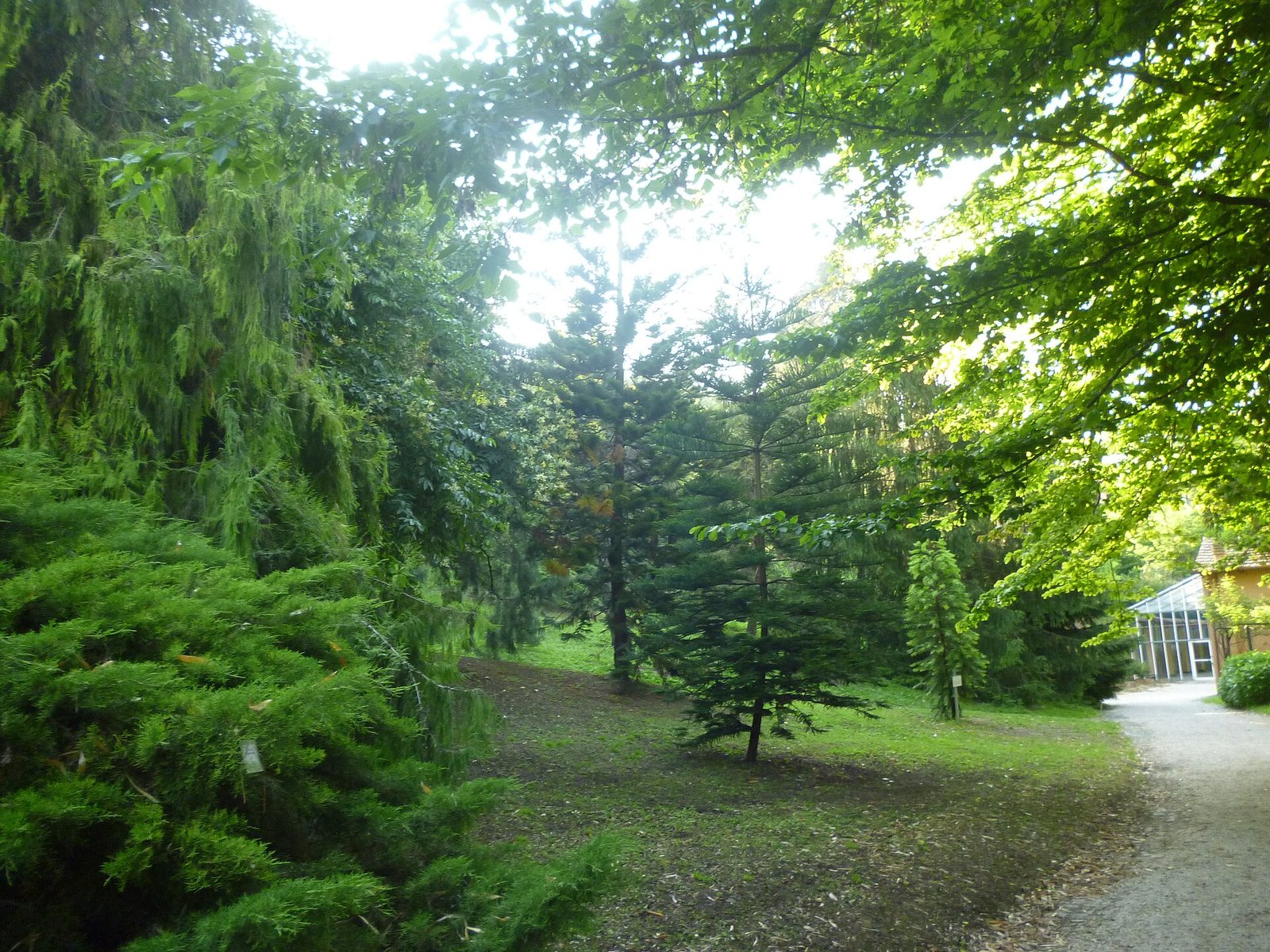
Below the wooded area, toward the palace, the conifer collection is installed, and here the Rome Botanical Garden allows itself some notable satisfactions. There is an Australian Araucaria with its relatives Wollemia and Agathis. There is an American giant sequoia, Sequoiadendron giganteum. There are at least four coast redwoods, Sequoia sempervirens, that is, the other living species of the group. There is a Chinese metasequoia, Metasequoia glyptostroboides, also called water fir. And there are some Taxodium, the distichum, the mucronatum and the Mexican forms.
Every name on this list has a story. The two sequoias are the giants of the planet: the Sequoia sempervirens of the California coast holds the height record among all living organisms, with specimens exceeding 115 meters, while the Sequoiadendron giganteum of the Sierra Nevada holds the record for mass, with individuals weighing thousands of tons and living more than 3,000 years. Seeing them young, in a garden in Trastevere, is an exercise in imagining time: those trees, if no one disturbs them, will still be there in 10 generations.
The metasequoia is perhaps the finest story. It was known only as a fossil, described in 1941 from remains dating back millions of years, and it was thought to have been extinct since time immemorial. A few years later, between 1943 and 1946, living trees belonging to that same species were found in a remote valley of central China, where the farmers knew them very well and called them "water firs". Seeds collected in that valley were distributed in the following years to botanical gardens all over the world, and practically every metasequoia growing in the West today descends from that expedition. A species that came back from fossils to life in less than a decade.
The Wollemia, the tree rediscovered in 1994
If the metasequoia is the finest story, Wollemia nobilis is the most recent and perhaps the most incredible. In 1994 an Australian park ranger, exploring a deep and inaccessible canyon in Wollemi National Park, a little over 100 kilometers from Sydney, came across trees he couldn't identify. They were conifers belonging to a genus thought to have been extinct for millions of years, related to the araucarias, with a bubbly bark that looks like dark chocolate and a wholly anomalous branch architecture.
The known wild specimens are only a few dozen, in a locality whose exact position remains secret and protected to avoid the introduction of pathogens and collecting. The conservation strategy adopted was brilliant in its simplicity: propagate the plant and sell it all over the world, so that millions of cultivated specimens would make the commercial value of the wild ones irrelevant. Being able to see a Wollemia in a Roman garden means touching with your own hand the fact that the planet still has secrets, and that it hides them well.
Sapienza and the scientific function of the Rome Botanical Garden
It's worth remembering clearly: the Rome Botanical Garden depends on the Department of Environmental Biology of Sapienza, and this dependence is not an administrative detail but the very reason for its existence. Its declared functions are teaching, environmental education and scientific research: exhibitions, courses, conferences and symposia are held here, and almost 100,000 visitors pass through every year, with an intense school activity measured in hundreds of guided visits.
A line of research particularly suited to this place concerns the ecology of the urban environment, the discipline that studies how organisms live inside cities. It's a field of enormous relevance: cities are anomalous ecosystems, with temperatures higher than the surrounding countryside because of the heat island phenomenon, compacted and sealed soils, night lighting that alters biological cycles, atmospheric pollutants and communities of species deeply reshuffled by humans. Studying all this from inside a 12-hectare green island surrounded by Trastevere is, methodologically, an ideal condition.
Italian cities are full of scientific institutions that nobody visits because nobody knows they can be visited. University botanical gardens are the most striking case: they are open to the public, they are inexpensive, they are beautiful and they are almost empty, while 200 meters away people stand in line for two hours under the sun. It's not a criticism of the line: it's an invitation to take advantage of an asymmetry that, frankly, is entirely to our advantage.
What it means that the Rome Botanical Garden is a living museum
The expression "living museum" recurs often in the literature on these places and it's more precise than it seems. A traditional museum preserves objects that don't change, and its task is to prevent them from changing: restoration fights time. A botanical garden preserves organisms that grow, age, get sick and die, and its task is to accompany their cycle while guaranteeing the continuity of the collection. If a painting is lost, it's lost forever. If a plant dies, another can be replanted from the same provenance, as long as someone has kept the seeds.
This radically changes the perception of the informed visitor. The garden you see today is not the one Pirotta saw in 1885, nor the one your grandchild will see in 40 years. Some trees are the same (the centuries-old plane trees, the holm oaks) and act as anchors, but everything else is a flow. Visiting a botanical garden several times over a lifetime is the only way to realize this, and it's one of the reasons I always suggest going back in different seasons.
Porta Settimiana, Via della Lungara and the Trastevere of the Rome Botanical Garden
Leaving the Rome Botanical Garden and turning south you reach Porta Settimiana in a minute, which is the oldest object in the immediate neighborhood. It opened in the Aurelian Walls, the circuit built between AD 271 and 275 by Emperor Aurelian to defend a Rome that, after three centuries of security, had suddenly rediscovered itself as vulnerable. The gate was later rebuilt by Alexander VI Borgia around 1498 and touched up under Pius VI in the 1700s, taking on its present look with the battlements and the turret.
From Porta Settimiana starts Via della Lungara, the straight axis that Julius II had opened at the beginning of the 1500s. Its name comes precisely from its length, unusual for the time: it was one of the longest streets in the city and connected, almost without curves, the Vatican Borgo to the heart of Trastevere. In a Rome of winding alleys grown over the ruins, a straight street was a political manifesto even before being a convenience: it meant the pope could cross the city in a straight line.
On the other side of the street, almost opposite the Garden, stands Villa Farnesina, built between 1506 and 1510 by Baldassarre Peruzzi for the Sienese banker Agostino Chigi, the richest man in Rome. Raphael and his workshop worked inside, as did Sebastiano del Piombo, Il Sodoma and Peruzzi himself. It's one of the places where the Roman Renaissance reaches its greatest lightness, and it's literally on the other side of the roadway from our gate. Combining the two visits in one morning is among the best things you can organize in this city.
Regina Coeli and the wall nobody looks at
Walking along Via della Lungara toward the north you skirt, for a very long stretch, a high continuous wall interrupted by a few barred windows: it's the Regina Coeli prison, still in operation. It began as a convent of Carmelite nuns, founded in the 1600s, and was turned into a penitentiary after the Unification of Italy, going into operation in 1881, that is, practically in the same years in which the Botanical Garden took possession of the Corsini garden.
There's a Roman saying worth knowing: "Whoever hasn't tried Regina Coeli doesn't know what Rome is." It's not an encouragement to break the law. It's the claim, typically Roman and rather disillusioned, that you only really know a city through its reverses. The fact that a university botanical garden, a prison and a Renaissance villa frescoed by Raphael stand in the same 500-meter stretch of street is, if you think about it, the most concise summary possible of what this city is.
The Janiculum above the Rome Botanical Garden
The hill you climb inside the Garden is the same one that, a few hundred meters higher up, hosts one of the places Romans love most. The Janiculum takes its name from the god Janus, the two-faced one who looked forward and backward at the same time, and for the ancients it wasn't part of the city proper: it was the sentinel on the right bank, the point from which Etruscan danger could be seen coming.
On Piazzale Giuseppe Garibaldi stands the equestrian monument to the Hero of Two Worlds, inaugurated in 1895, and a little further on the monument to Anita Garibaldi, from 1932, under which the woman is buried. The hill is dense with Risorgimento memory because here, in the spring and summer of 1849, the defense of the Roman Republic was fought against the French expeditionary corps sent to restore papal power. Villa Corsini, on the summit (not to be confused with the palace on the Lungara, though it belonged to the same family) was the center of one of the bloodiest clashes on June 3, 1849 and was destroyed. The marble busts of the Garibaldians lining the promenade are the faces of that generation.
Then there's the cannon. Since 1904 a blank shot has been fired from the Janiculum every day at noon, to give all of Rome a single time signal: before then the church bells rang noon each on its own, with chaotic results. If you're in the Rome Botanical Garden at 12 o'clock sharp you hear it perfectly, and it's one of the most Roman ways there is of knowing what time it is. The right tone, when it happens, is that of someone who doesn't flinch: Romans stopped hearing that shot a century ago.
The Rome Botanical Garden with children
Let me say upfront: if you have kids under 10 and you're in Rome for three days, this place will save you at least half a day, and maybe your marriage too. The reasons are simple, and they apply above all to families on the verge of a nervous breakdown.
The first is space. After two days of saying "don't touch", "stay close", "watch out for the scooter", 12 fenced hectares without traffic are a physiological relief for everyone. The second is variety: the bamboo grove is a forest to play in, the fern glen is a cool and mysterious place, the basins have fish and turtles, the staircase of the fountains is an obstacle course provided by art history. The third, and the most underrated, is that here children can make noise without anyone striking them dead with a look, something that never happens in a basilica or a museum.
The Garden of Aromas deserves a special mention from the family angle. Touching and sniffing is exactly how small children get to know the world, and here it's allowed and in fact expected. The game that always works is the smell riddle: you rub a leaf, have them sniff it with their eyes closed and ask what it smells like. Everybody guesses mint, rosemary and lemon. Sage and bay laurel create fierce debates. They come out with a notion of applied botany they won't forget, which is more than can be said for many guided tours meant for adults.
The rules to explain before going in
Few and clear, and better said at the gate than shouted afterward. No picking flowers, leaves or fruit: some specimens are rare and some are toxic. No climbing trees, especially the monumental ones, whose bark is more fragile than it looks. No walking into the flower beds: soil compacted by footsteps suffocates the shallow roots, and it's one of the most serious and least visible damages a garden suffers. No feeding the fish and turtles.
It's then worth explaining, in words suited to their age, why these rules exist. A child you tell "you can't" obeys reluctantly. A child you tell "that tree is 400 years old, it has seen popes in carriages, and if we climb it we hurt it" becomes the strictest guardian of the garden and will spend the rest of the visit scolding the others. It's a transformation that repeats every time, and it's fun to watch.
The Rome Botanical Garden in summer, in the shade
Let's be frank: Rome in July and August is hard. The historic center has almost no trees, the travertine and the cobblestones store heat all day and give it back until night, and the great squares we admire in photographs are, at two in the afternoon, frying pans. Knowing where the real shade is, in summer, is the most useful skill a visitor can have.
The Rome Botanical Garden is one of the best answers, for measurable reasons. A mature woodland lowers the perceived temperature substantially compared with the surrounding urban environment, both by intercepting direct solar radiation and by cooling the air through evapotranspiration: the leaves release water vapor and every gram evaporated removes heat. Add the running water of the fountains and streams, the fact that the main slope faces northeast and that the paths are packed earth and not asphalt, and you get a microclimate that in the rest of the district simply doesn't exist.
The summer strategy that works is this: go in at the first morning opening slot, when the night air is still held under the canopies, spend the first hours in the upper, wooded part, which is the coolest, and come down toward the flat part and the greenhouses as the sun rises, keeping the water areas for last. Bring a bottle and fill it at the nasoni you meet along the way. And resign yourself to one fact: after an hour and a half in here, stepping out onto Via della Lungara will be a thermal shock that will make you regret every life choice.
The seasons of the Rome Botanical Garden
A botanical garden is the only monument in Rome that changes completely four times a year, and that is the reason it's worth going back. The Colosseum in January and in June is the same Colosseum. This garden is not.
Spring is the season with the most blooms and the most crowded, though here "crowded" means something very different from what it means elsewhere. Between March and May come the blooms of the ornamental cherries in the Japanese garden area, of the wisterias, of the Judas trees with their violent pink on still-bare branches, of the roses in the rose garden, and of the countless herbaceous plants that fill the beds of the simples. It's also the time when new leaves have that light, translucent green that lasts a few weeks and then doesn't come back until the next year.
Summer is the season of shade, as said, and of aquatic blooms: the water lilies in the basins do their best just when everything else suffers. Autumn is the best season and the most underrated of all: the Japanese maples turn red, the plane trees and deciduous trees go yellow and ocher, the light lowers and turns slanting, the air is still mild and the garden is almost deserted. Winter, finally, strips the structure bare: with the leaves gone, you see the architectures of the branches, the trunks, the staircase of the fountains without its green veil, and the view over the city from the upper part opens up as it does in no other period of the year.
The bloom calendar in the Rome Botanical Garden
An honest warning: bloom dates are not a train timetable. They depend on the climate trend of the year, and in recent decades they have moved progressively earlier in a measurable way, so much so that phenology (the discipline that studies precisely the timing of seasonal biological events) has become one of the most used indicators for documenting global warming. Almond trees bloom in Rome earlier than they did 50 years ago, and it's not an impression of the grandparents: it's a recorded fact.
This, if you think about it, gives a botanical garden an additional and unexpected role. Its collections have been observed and annotated for decades, with dates, measurements and notes, and those archives are now precious material for understanding how the urban climate is changing. Plants have no opinions on the climate: they have answers, and they record them punctually by opening their buds. They are the most reliable witnesses we have, because they can't lie and have no interests to defend.
Hours, tickets and practical information for the Rome Botanical Garden
Here I'll be deliberately cautious, and I'll explain why. Hours and access conditions for the Rome Botanical Garden vary with the season (winter openings are shorter than summer ones) and are subject to changes linked to events and maintenance. Ticketing conditions also change over time and include discounts and free admission for certain categories. Fixing figures and hours once and for all means guaranteeing someone a closed door six months from now. Always check before leaving on the official channels of the university institution that runs it.
What I can tell you with certainty concerns everything else. Wear closed shoes with a lugged sole: the paths are packed earth, gravel and stone, often on a slope, and after rain they become muddy and slippery. Allow at least two hours for a visit that isn't a sprint, three if you really want to read the labels, and an indefinite time if you bring a book and decide to sit down somewhere, which I warmly recommend.
On the matter of mobility accessibility, it has to be said honestly that the garden is built on a slope and that the upper part involves stairs and steep paths. The flat area in front of the palace, with the palms, the simples, the aromas, the basins and the greenhouse area, is much easier and is already a rich visit in itself. Those who have difficulty walking can therefore still enjoy a good half of the experience without tackling the climb, and the accessible part moreover includes some of the most interesting collections.
What to bring and what to avoid at the Rome Botanical Garden
Bring water, especially in summer. Bring a hat for the flat area, which is sunny. Bring, if you have one, a pocket magnifying glass: it sounds like a 19th-century naturalist's affectation, but it transforms the visit, because almost everything interesting in a plant (the structure of a flower, the sori of a fern, the velamen of an orchid, the areoles of a cactus) sits on a scale of a few millimeters. Bring a notebook if you're the type.
Avoid heels, for obvious topographic reasons. Avoid scheduling the visit at the tail end of an already full day: this place should be approached with leftover energy, otherwise it becomes a generic walk in a park and you miss 90 percent of what's there. And avoid, if you can, coming in pouring rain: not so much because of the mud, but because the upper part becomes impassable and the water areas, paradoxically, lose all their appeal when it's raining on them too.
What to see near the Rome Botanical Garden
The location is one of the best in Rome for building a sensible day without ever taking transport. On the other side of Via della Lungara is Villa Farnesina, with the Loggia of Cupid and Psyche and Raphael's Galatea, and I don't think I need to add anything else. In Palazzo Corsini itself, at the entrance on Via della Lungara, is the Galleria Nazionale d'Arte Antica with the Corsini collection, one of the very rare cases in Italy of an 18th-century picture gallery preserved in its original arrangement, with the paintings hung close together from floor to ceiling as was done then.
Going down toward the heart of Trastevere you reach in a few minutes Santa Maria in Trastevere, with its 12th-century apse mosaics and those by Pietro Cavallini from the late 1200s, and a little further on Santa Cecilia in Trastevere, with Cavallini's Last Judgment in the nuns' choir and the statue of the saint by Stefano Maderno from 1600. Toward Tiber Island you come to San Bartolomeo all'Isola, and toward the north, past the river, you're already in sight of Castel Sant'Angelo.
Going up instead, the Janiculum promenade leads to the Fontanone dell'Acqua Paola, to Piazzale Garibaldi with its panorama and to Bramante's Tempietto in the cloister of San Pietro in Montorio, which is perhaps the single most influential building of Renaissance architecture relative to its ridiculous size: a few meters in diameter that rewrote the way the West thought about domes for the next three centuries. All of it lies within a 20-minute walk from the gate of the Rome Botanical Garden.
A curiosity about the Rome Botanical Garden
The finest curiosity concerns a word, already hinted at, that deserves to be told properly. Giovanni Faber, the Bavarian physician who directed the papal botanical garden from 1600 to 1629 and who is one of the direct ancestors of this institution, is said to have been the first to call his subject "Botany". Before him people spoke of the history of plants, of herbals, of the science of simples. With him the discipline takes the name it still bears today in all European languages.
The same Faber, in 1625, proposed to his colleagues of the Accademia dei Lincei the term microscopium for the instrument Galileo had built and which was then called in several clumsy ways, among them "occhialino". The word took hold, and we still use it today in every laboratory in the world. One man, in one decade, gave a name to a science and to an instrument that would become the symbol of that science.
I find this says something important about the era and the place. At the beginning of the 1600s, in this city, a group of men was literally building the vocabulary with which we would think about nature for the next four centuries. They didn't have the words and made them as they went, like explorers drawing the map while they walk. And the place where they walked, in a very concrete sense, is the ancestor of the garden where you buy your ticket today.
Something nobody tells you about the Rome Botanical Garden
Nobody tells you that this garden is, in fact, the result of neglect. After the mid-1800s and until the transfer to the State, the Corsini garden was left without any maintenance. No one pruned, no one weeded, no one redid the paths. By ordinary logic it's a disaster. In the long-term logic it was our luck, because that disinterest saved from redesign the upper part of the hill, which has come down to us as the last relic of the evergreen Mediterranean woodland that probably covered the whole Janiculum.
If someone, in those decades, had had the money and the desire to put the garden back in order according to 19th-century taste, today in place of the Bosco Romano we would have an English-style park with lawns, artificial clearings and exotic tree lines. It would certainly have been pretty and completely without scientific value. The fact that the Corsini were, in those years, little interested or short of cash has given us an ecological document that no amount of money could rebuild, because a woodland of centuries-old holm oaks can't be bought: you wait for it for four centuries.
There's a moral I gladly extend to the whole city. Rome is full of things that survived not because someone protected them but because nobody bothered to destroy them. The Pantheon is standing because it was turned into a church. The Colosseum lost half its cladding because it was used as a quarry, but the rest remained because they stopped needing stone. The Bosco Romano of the Rome Botanical Garden belongs to the same category: it came down to us through distraction, and now we guard it on purpose.
The advice I give you for visiting the Rome Botanical Garden
The main advice is counterintuitive: don't start from the entrance, start from the top. As soon as you're in, ignore the temptation of the palm avenue, keep to the right and climb right away toward the upper part, taking the Staircase of the 11 Fountains or the woodland paths. There are two reasons. The first is physical: the climb is much better tackled with fresh legs and, if you came early in the morning, with the air still cool. The second is dramaturgical: going down is lovelier than going up, because the garden opens progressively beneath you and every bend reveals something.
The second piece of advice concerns time. Allow at least two and a half hours and don't schedule anything rigid right afterward. This is a place that punishes haste in a particularly cruel way: if you cross it in 40 minutes you'll leave saying it's "nice", which is the most mortifying verdict you can pass on 12 hectares of natural history. If instead you sit for 20 minutes in the bamboo grove doing nothing, you'll leave telling about it for years.
The third piece of advice is to choose the time of day consciously. The first hour after opening is the best by far: raking light, almost total silence, active birds, minimum temperature and the few visitors concentrated around the entrance. Late afternoon is the second choice, with a golden light that does remarkable things in the upper part. The middle hours are the worst in summer and the most anonymous in the rest of the year. And if you can choose the day, choose a weekday out of season: you'll have the feeling, not entirely unjustified, that someone opened the garden just for you.
Another well-known fact, yet rarely cited
The fact is this: the Rome Botanical Garden is not a public park, it's a university department, and almost none of its visitors draw the consequences. People come in, walk, take photos and leave with the idea of having been in a nice garden, without realizing they passed through an active scientific infrastructure where research is done, threatened species are conserved, students are trained and seeds are exchanged with institutions all over the world.
The practical consequence is that the priorities of this place are not those of a tourist attraction, and this explains many things that would otherwise look like flaws. It explains why certain sectors may be closed or under reorganization, why there isn't the redundant and reassuring signage of commercial parks, why some areas look less cared for than others and why every so often you come across crates, stacked pots, tarps and tools. It's not neglect: it's a permanent work site, like every laboratory.
The second consequence is of a moral order, and I say it without rhetoric. The ticket you pay here is not the fee for entertainment: it's a contribution, however small, to the upkeep of a scientific collection with almost four centuries of history behind it and which survives on constantly insufficient public resources, like all institutions of this kind in Italy. Visiting university botanical gardens is one of the most efficient ways I know to get some money to those who keep alive things that, once lost, don't come back.
The right photo to take at the Rome Botanical Garden
The photograph everyone attempts is the palm avenue, and it's understandable: it's symmetrical, exotic and recognizable. But it's also the hardest to render well, because at noon the light is flat and the contrast between the blown-out sky and the dark fronds throws any sensor into crisis. If you want to take it, take it in the first hour of the morning or the last of the afternoon, putting the low sun behind you or to the side, and crouch down a couple of meters to make the lines converge.
The photo I really recommend is another one, the Staircase of the 11 Fountains shot from below looking up, on a slightly overcast day or in the hours when the slope is in shade. The diffused light holds together the greens of the moss, the gray of the stone and the white of the water without blowing anything out, and the succession of flights creates a telescoping perspective that immediately gives the depth of the garden. With a long exposure, if you have a stable support, the water becomes a continuous thread and the scene takes on an air of 18th-century engraving, which is exactly what that place is.
The third framing, the one nobody takes and which tells the place better than any other, is the juxtaposition. Climb to the upper part, find a clearing in the Bosco Romano from which you can see together the treetops and, behind them, the domes and roofs of Rome. In a single frame you'll have the Mediterranean woodland and the Eternal City, the two things this hill has held together for 2,500 years. No caption will be needed.
A detail not to neglect when you photograph
Photograph the labels. It sounds like advice from a land registry clerk and yet it's the most useful of all: when you get home and look at the images, you won't remember the name of that absurd plant that struck you, and the label photographed just before or just after solves the problem forever. It's the method botanists have used in the field since digital cameras existed, and it's the only way not to turn the visit album into a collection of beautiful anonymous objects.
And devote at least a few shots to the small: the plated bark of a plane tree, the sori on the underside of a fern frond, the cross-section of a bamboo culm, the spines of a euphorbia. Detail photographs age better than panoramas, because everybody takes panoramas and they're always the same, while a well-seen detail is something you saw yourself.
Some important events that took place here in history
The first event that marks this place is the death of a queen. Christina of Sweden passed away in this palace on April 19, 1689, after spending here a large part of the 34 years of her Roman exile. It was an event that all of Europe recorded, because with her disappeared a figure who had been at once sovereign, apostate, patron, collector and permanent scandal. Her collections, scattered after her death, ended up in half of Europe: part of the manuscripts in the Vatican Library, part of the paintings in Spain and France, including some masterpieces now in leading museums. The garden in which she strolled stayed where it was, and we are the ones walking in it now.
The second event is the great 18th-century building project. Between 1736 and 1754 or so, Cardinal Neri Maria Corsini, nephew of Pope Clement XII, entrusted Ferdinando Fuga with the transformation of the palace and the layout of the garden. From that work site come the staircase of the fountains, the large niche at the top of the hill, the system of terraces and the whole scenic layout that still structures the visit today. It's the moment when the garden takes on the form that, beneath the present scientific vegetation, we continue to walk.
The third event is 1883. With the Unification of Italy and with Rome as capital, the State acquires ownership of the Villa Corsini garden: 12 hectares go to the university botanical garden, the remaining four or so to the Municipality. It is the birth certificate of the Rome Botanical Garden in the form we know, and it coincides with the arrival of Pietro Romualdo Pirotta, professor of botany from the same year, who transfers the collections from Via Panisperna, adapts the old winter garden as a greenhouse and has two more built.
The years of scientific transformation
Pirotta's work in the decades after 1883 was not a simple move but a refounding. He enormously increased the number of cultivated species, bringing it toward those thousands of units that still characterize the collection today, and placed the Garden inside the international network of botanical institutions. His scientific stature is also measured outside these walls: member of the National Academy of Sciences called the XL from 1910, from 1913 a member of the first ministerial commission charged with creating the Abruzzo National Park, founder in 1924 of the Annali di Botanica.
The chronological coincidence matters: while a modern botanical garden was being built in Trastevere, in Italy the foundations of nature conservation as public policy were being laid. It's no accident. The same men, the same scientific culture and the same decade. The creation of the first Italian national parks in the 1920s and the maturing of the university botanical gardens are two branches of the same tree, which is the idea that nature must be studied and protected because it's a collective heritage.
The fourth event, less datable and more spread out in time, is the opening to the public and the transformation into a place of environmental education. A garden that begins as extremely private (the popes' garden, "extremely private" is what the sources say) becomes university property in 1660, state property in 1883 and, over the course of the 20th century, accessible to anyone who pays a ticket and wants to understand something. Four centuries to go from the pontiff's enclosure to the school group in fluorescent vests. Put that way, it's one of the most encouraging stories this city has to tell.
Who has passed through the Rome Botanical Garden
The most imposing name is that of Christina of Sweden, and not only because the square at the entrance bears her name. She lived here for most of her very long Roman exile and died here in 1689, and around her a considerable portion of 17th-century European intelligence passed through this palace. Gian Lorenzo Bernini frequented her and was her friend, reciprocated with an esteem the queen did not grant easily. Arcangelo Corelli and Alessandro Scarlatti made music for her. The former, in particular, dedicated to her his first collection of trio sonatas, published in Rome in 1681, and under her protection helped define the form of the concerto grosso.
Before her, and in the direct line leading to this institution, passed the botanists of the papal gardens: Michele Mercati, who directed from 1566 to 1593 and who intuited, three centuries early, the prehistoric nature of chipped flints. Andrea Cesalpino, in all likelihood director between 1593 and 1600, author of the De plantis and first rational classifier of the plant kingdom, whom Linnaeus would honor by dedicating a genus to him. Giovanni Faber, in office from 1600 to 1629, a member of the Lincei, friend of Galileo, the man who gave the name to botany and the microscope.
To the popes, then, this place owes its material existence. Boniface VIII, under whose pontificate the Vatican garden of simples is mentioned. Nicholas III with his Pomerius. Alexander VI and Pius IV, who founded and refounded the first true Roman botanical garden. Pius V, who enlarged it by entrusting it to Mercati. Paul V, who brought the Acqua Paola to the Janiculum, making every cultivation on this hill possible. And above all Alexander VII Chigi, who in 1660 donated to the University the first ground intended for this use, taking it from the orchard of San Pietro in Montorio.
The more recent and the side presences
In the 18th century the scene belongs to the Corsini: Pope Clement XII, who brought the Florentine family to the top of the Church, and his nephew Cardinal Neri Maria Corsini, cultured, ambitious and a collector, who called Ferdinando Fuga here. The Florentine architect, who left in Rome the facade of Santa Maria Maggiore and Palazzo della Consulta, is to all intents and purposes the hand that drew the landscape we walk in.
In the 19th and 20th centuries the botanists pass through, starting with Pietro Romualdo Pirotta, and the generations of Sapienza students who in this garden learned to recognize plant families. It's an anonymous and imposing crowd: if you line up everyone who has prepared a systematic botany exam here from 1883 to today, you get the population of a provincial town.
Finally there is a contemporary presence worth naming: Ken Nakajima, the Japanese architect who made the Japanese garden of this Garden and that of the Japanese Cultural Institute in Rome. He is the only designer living in recent times to have left a recognizable authorial signature in here, and he did so by importing a grammar of landscape completely foreign to the Roman tradition and managing, which is not at all a given, to make it coexist with a Baroque garden without either language losing its dignity. In a place where 17th-century holm oaks, Asian bamboos, Californian sequoias and cycads that saw the dinosaurs already live together, one more dialogue between cultures was, after all, exactly what was needed.
Quick questions about the Rome Botanical Garden
Where is the Rome Botanical Garden and how do you get there?
The entrance is at Largo Cristina di Svezia 24, in Trastevere, behind Via della Lungara. On foot from the center you cross the Tiber at Ponte Sisto, pass Piazza Trilussa and Porta Settimiana, and from there it's two minutes. From Campo de' Fiori it's barely 10 minutes, from Piazza Navona 20. Careful if you're coming down from the Janiculum: you can't enter from above, there is only one entrance and it's at the bottom.
How much time do you need to visit the Rome Botanical Garden?
Allow at least two hours for a visit that isn't a sprint, three if you're interested in reading the plant labels. It's about 12 hectares, largely uphill, with a difference in height exceeding 50 meters from the entrance to the summit. It's best not to schedule rigid commitments right afterward and to climb to the upper part first, with fresh legs, and then come down calmly toward the greenhouses and basins.
Is the Rome Botanical Garden good for children?
Yes, it works very well with children. It's 12 fenced hectares without traffic, with the bamboo grove, the fern glen, the basins with fish and turtles and the staircase of the fountains. In the Garden of Aromas touching and sniffing the plants is expected. Explain the rules at the gate: no picking flowers, leaves or fruit, no climbing trees, no walking into the flower beds and no feeding the animals.
Is the Rome Botanical Garden accessible for people who have difficulty walking?
In part. The garden is built on a slope and the upper part involves stairs and steep paths. The flat area in front of the palace, with the palms, the simples, the aromas, the basins and the greenhouses, is much easier and is already worth a good half of the visit. The Garden of Aromas is designed for blind and visually impaired people, with paths to follow with a cane and Braille labels.
What is the best time to go to the Botanical Garden?
The first hour after opening is the best: raking light, silence and few visitors. Late afternoon is the second choice, the middle hours are the worst in summer. Between March and May you find most of the blooms, in autumn the Japanese maples turn red and the garden is almost deserted. Hours and tickets change with the season: check them before leaving on the official channels of the university that runs it.
What is there to see near the Botanical Garden?
On the other side of Via della Lungara you find Villa Farnesina with Raphael's Galatea, and in Palazzo Corsini itself the Galleria Nazionale d'Arte Antica. In a few minutes you reach Santa Maria in Trastevere. Going up, the Janiculum promenade leads to the Fontanone dell'Acqua Paola, to Piazzale Garibaldi and to Bramante's Tempietto. Everything lies within a 20-minute walk from the gate.
Article written by the TourLeaderPro editorial team, contact them for Private/Corporate/V.I.P. Tours and Experiences.
Planning a trip to Rome? The English guides to visiting the city are on ItalyPlanner.com.
Contact Information
Largo Cristina di Svezia, 24
Roma Roma Città, Roma Città