Mormon Temple in Rome
In short. There are places in Rome you win only with effort, among crowds and turnstiles, and places nobody contends with you.
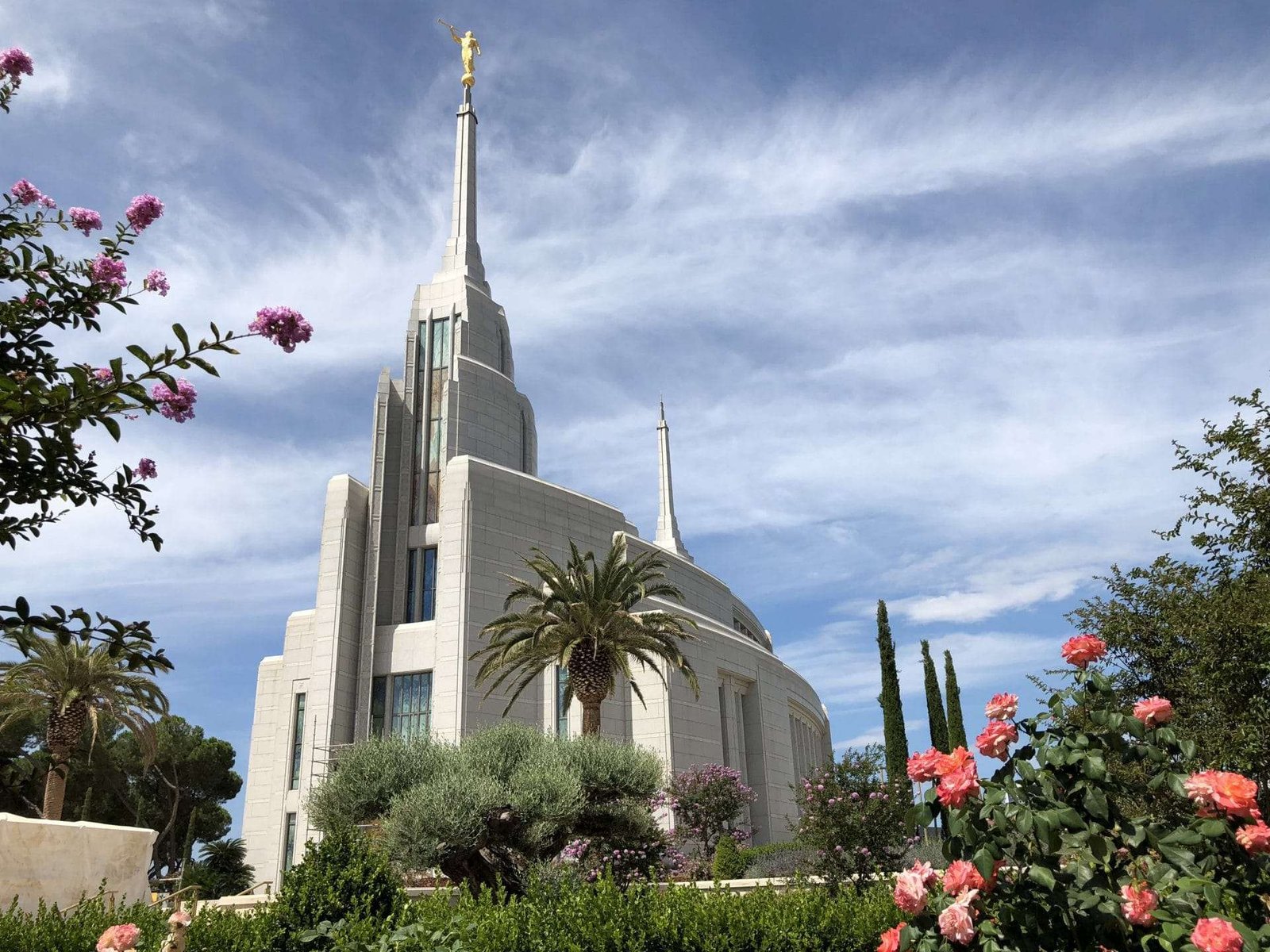
There are places in Rome you win only with effort, among crowds and turnstiles, and places nobody contends with you. The Mormon Temple in Rome belongs to the second category, and that's already a small scandal in itself: because we're talking about one of the most imposing religious construction projects carried out in the capital in the last 50 years, a complex of six hectares with spires almost 50 meters tall, with 13 Carrara marble statues reproducing the masterpiece of a sculptor who lived in Rome for 40 years. And yet, if you ask a Roman from the center where it is, nine times out of 10 he looks at you as if you had named a city in Norway.
The reason is geographic even before it's cultural. The complex stands on the northern edge of the city, along Via di Settebagni, in that strip of Rome between Fidene, Castel Giubileo and the Grande Raccordo Anulare: an area tourists cross only by mistake or in a taxi on the way to the Urbe airport. But it's precisely this marginality that makes the visit interesting. No lines, no assault, no selfie-stick vendors. Just an enormous English lawn, an avenue of transplanted olive trees, an elliptical marble plaza and, if you choose the right hour, a silence that in Rome is a rare commodity.
Here is everything you need to know: what this place really is, what you can see and what you can't (because there is a clear line, and it needs to be explained precisely and without malice), where it comes from, what it means for the community that wanted it, and why even a secular visitor, curious, maybe even skeptical, can spend an hour here and leave with something in their pocket. I'll warn you right away: it's not a guidebook stop, it's not "the fifth museum of the day." It's something else, and it has to be approached with different expectations.
What the Mormon Temple in Rome is
Let's start with definitions, because here imprecision generates a chain of misunderstandings. The complex on Via di Settebagni is not a church in the sense a Roman understands the word. It's a temple: in the theology of the Church of Jesus Christ of Latter-day Saints, the most sacred building of all, dedicated to specific rites that don't coincide with ordinary Sunday worship. Sunday worship, the kind open to anyone who wants to come in, takes place elsewhere: in the chapels, which in the Church's jargon are called meetinghouses. One of these chapels sits right inside the Roman complex, a few meters from the temple, and it's a completely different building in function, in accessibility and, if you look closely, even in architectural language.
The temple was dedicated in March 2019 and is the first ever built in Italy. In the Church's official count it is the 162nd operating temple in the world and the 12th in Europe. It serves a vast district that includes Italy, Malta, Greece, Cyprus, Albania and a portion of Romania: it means that worshippers who have traveled for days, with a suitcase, arrive here, and that for many of them the trip to Rome is the religious event of a lifetime. This detail explains why, inside the complex, there is also a guest house with rooms to host people who come from far away. It's not a hotel: it's a lodging designed for those making a pilgrimage.
The number worth keeping in mind is another: the members of the Church in Italy are a few tens of thousands, around 25,000 according to the press releases circulated at the time of the opening, out of a population of 60 million. It's a tiny minority, statistically irrelevant, which has nonetheless built here one of the most expensive and best-kept religious infrastructures in contemporary Rome. The relationship between the size of the community and the size of the work is, by itself, a fact worth telling: it says something about how this Church conceives its temples, which are not weekly meeting places but rare nodes in a worldwide network, toward which people travel.
Temple, chapel, visitors' center: three different things
I'll give you the mental map right away, because you'll need it for the rest of the visit. Inside the enclosure on Via di Settebagni there are four main buildings arranged around a plaza: the temple proper, the visitors' center, the guest house and the meetinghouse (the ward chapel, with the family history center attached). Of these four, the temple is the only one the general public cannot enter after the dedication. The other three, in particular the visitors' center and the gardens, are open to anyone, free of charge, without a ticket and without a reservation.
It isn't a hierarchy of courtesy: it's a theological distinction. In the Church's thinking, the temple is "the house of the Lord," a space consecrated to ordinances performed in conditions of recollection and privacy. There is nothing mysterious in the esoteric sense, nor any wish to exclude: there is the idea, entirely consistent with the religious history of humanity, that some spaces are reserved. If you find it hard to accept, consider that the same logic governed for centuries the choirs of abbeys, monastic enclosures, the Holy of Holies of the Temple of Jerusalem and, to stay in Rome, the inner sanctums of quite a few ancient temples where access was limited to the priesthood. The difference is that here the rule is alive, not archaeological.
Where the Mormon Temple in Rome is
The temple's address is Via di Settebagni 376. The visitors' center, which is the front door for the public, is at number 354. We're in the north quadrant of Rome, inside the Grande Raccordo Anulare but a step from its edge, in the territory of Municipio III, in the strip the place names call Fidene on one side and Castel Giubileo on the other, with Settebagni a little farther up along the Salaria. If you look at a map, the complex appears as a compact, regular green patch in the middle of a fabric of warehouses, 1970s apartment buildings, shopping centers and interchanges. It's a brutal contrast, and it's part of the experience.
The place name Settebagni derives, in all likelihood, from the Latin Septem Balnea, "seven baths": a memory of ancient bath structures that drew on the waters of the area, along the line of Via Salaria. The name is older than the borgata, which began as farmland and was urbanized only in the 1900s, and it has that rustic flavor that in Rome stubbornly survives even when the landscape is now made of roundabouts. Not far away, Castel Giubileo keeps in its name the memory of a holy year and in the subsoil something much older, which I'll tell you about further on because it's one of the keys to understanding this piece of the city.
The location is not random. The Church bought the land in the late 1990s: an agricultural estate with a villa, an olive grove and some farm buildings. At first it had only a portion of the area. Over time it managed to put together the whole property, reaching about six hectares, a surface that in the official materials is compared, with a touch of pride, to that of Temple Square in Salt Lake City, which is noticeably smaller. Six hectares in Rome, inside the Raccordo, in a single piece: anyone who has tried to buy a parking space in this city understands this is no small detail.
The landscape around it: where Rome ends and the countryside begins
If you arrive from the south along the Salaria, you first cross the Rome of established neighborhoods, then that of the borgate that grew in the boom years, then a belt of warehouses and car dealerships, and finally, suddenly, you find yourself in a landscape that still resembles the Agro Romano. Low hills, dark earth, vine rows, farmhouses. A little farther east stretches the Marcigliana Nature Reserve, one of the least visited and most authentic green lungs of the municipality of Rome, where the agricultural landscape of Lazio survives almost intact. It's exactly the landscape that the painters of the Grand Tour painted believing they were portraying eternity: hills, pines, ruins, slanting light.
This matters, because the temple's architecture openly dialogues with that landscape. The olive trees, the stone pines left where they stood, the low hedges, the pale marble reflecting the afternoon light: whoever designed the complex tried to make the whole look less "American" and more Mediterranean than the building type, in itself, would suggest. The result is hybrid, and the aesthetic judgment remains subjective, but the effort is evident and deserves acknowledgment.
How to get to the Mormon Temple in Rome
I'll tell you the truth with no beating around the bush: here the car is convenient. The complex has a free, roomy parking lot inside, which in Rome is the equivalent of a minor Marian apparition. You get there from Via Salaria or from the Grande Raccordo Anulare, taking the exits toward Salaria and Settebagni, and from there the signage is clear because the bulk of the spires acts as a beacon: when you see them, you're there. Drivers only have to allow for the Salaria traffic at rush hour, which is one of this city's great collective liturgies and forgives no one.
By public transport the matter takes a bit of planning but is entirely doable. The FL1 regional rail line, the one that links Orte to Fiumicino Airport via Tiburtina, has a stop at Settebagni: from there the complex can be reached with a short stretch, which can be combined with a city bus or a walk depending on your starting point. I advise you to check the schedule the same day, because on these lines the frequency changes a lot between weekdays and holidays, and because the final stretch is designed for people who live here, not for those arriving from outside.
One last practical note that is worth more than 10 sets of directions: this is not a place you land in by chance while passing through. You don't run into it while walking from the Pantheon to Piazza Navona. You have to decide to go. And since you have to decide to go, you might as well organize the morning or afternoon sensibly, maybe combining the visit with something else in the north of the city (I'll tell you more about that further on), instead of running back and forth from the historic center with two hours of transfers on your back.
How much time you need
For the visitors' center and the gardens, an hour and a half is the right measure. If you take the guided tour, if you stop in front of the statues, if you go up to the family history center and then walk the outer loop of the plaza to the point where the temple is reflected in the water of the fountain, you easily get to two hours. If you're in a hurry and only want the rotunda with the Christus and the 12 Apostles, 40 minutes is enough, but it would be like walking into San Luigi dei Francesi, looking at the Caravaggios by phone flashlight and leaving without having looked up at the ceiling.
The right name: "Mormons" and the official name
I have to stop here for a moment, because it's a matter of respect and precision together, and the two only go well together when they stay close. The official name of the denomination is Church of Jesus Christ of Latter-day Saints. The term "Mormons" is a historical nickname, born in the 1800s and derived from the Book of Mormon, one of the Church's sacred texts along with the Bible. For a very long time the Church itself used it without problems, even in public communication campaigns.
In August 2018, however, the Church's presidency publicly asked to return to using the full name, and in October of the same year the then president Russell M. Nelson devoted an address at general conference to the subject, titled, precisely, "The Correct Name of the Church." The argument is not about marketing, and it's important to understand that: the request rests on the idea that removing the name of Jesus Christ from the name of the Church means obscuring its center. The style guide circulated at the time says to use in full, on first reference, "The Church of Jesus Christ of Latter-day Saints," and afterward shortened forms such as "the Church," "the Church of Jesus Christ" or "the restored Church of Jesus Christ." It asks instead to avoid "Mormon Church" and "LDS Church" as official names.
Why then use the colloquial term too? For a practical and honest reason: because that's how almost everyone in Italy calls this place, and it's how almost everyone searches for it. Calling it only by the full name would mean writing a page nobody finds. But the right thing to do, when you get there and talk to someone, is to use the name they prefer. It costs nothing, and for the people you're talking to it means a lot. They're small courtesies that tell a visitor from a tourist.
What the Church of Jesus Christ of Latter-day Saints is not
It's worth clearing the field of a couple of recurring confusions, because they circulate with a tenacity that defies the centuries. The Church does not practice polygamy: the practice was officially abandoned at the end of the 1800s and anyone who practices it today is excluded from the Church's communion. The groups that still practice it in the United States are schismatic and have no institutional relationship with the Church of Jesus Christ of Latter-day Saints. Confusing them is like confusing the Catholic Church with some sedevacantist brotherhood: a factual error, even before a discourtesy.
Nor is it, as people carelessly say, "an American sect" in the dismissive sense the expression carries in Italian. It's a Christian denomination with over 16 million adherents worldwide, a global structure, a vast apparatus of humanitarian works and, in Italy, established legal recognition. You can share its theology or not, which presents substantial differences from historical Christianity and which Catholic and Protestant theologians have discussed for decades: it's a legitimate and serious discussion. But the vocabulary of insult helps no one understand anything, and on a page that sets out to tell about Rome it has no place.
What you can and can't visit at the Mormon Temple in Rome
This is the question everyone asks, and it's right to answer with the greatest clarity possible, without reticence and without rhetoric. After the dedication of March 2019, the interior of the temple is reserved for members of the Church who hold a temple recommend. It's not a matter of booking, price or hours: it's a requirement of membership and eligibility. A non-member visitor, however respectful and curious, does not enter the temple. Period.
That said, and this is the part almost nobody tells, all the rest of the complex is open to anyone, free of charge. The visitors' center is public and requires no ticket or reservation. The gardens are public. The plaza is public. The family history center is public and anyone can use it to do genealogical research on their own family, with no obligation or pressure. You can photograph the exteriors, you can sit on a bench, you can stroll among the olive trees. Put differently: the portion of the complex that isn't accessible is only one, and the accessible portion is large, well kept and, this has to be said, surprisingly generous for a contemporary place of worship.
I'll add a clarification that avoids disappointment. Of the temple you'll still see a great deal: the mass, the two spires, the granite cladding, the gilded angel at the top, the stained glass seen from outside, the oval profile that at certain hours cuts the sky like a ship. And, inside the visitors' center, you'll find a sectional model of the temple showing the interior rooms: it's a clever museum device that solves the problem elegantly. Whoever wants to understand what it's like inside can. Whoever wanted to "peek" is left empty-handed, but had formed the wrong idea from the start.
The three weeks when everyone could go in
There was one exception, and it was extraordinary. Before the dedication, as happens for every temple of the Church in the world, the so-called open house was held: a period in which the building, not yet consecrated, was open to anyone who wanted to visit it. In Rome it ran from January 28 to February 16, 2019, with free guided tours every day except Sunday, and with reservations available starting the previous October. Those who went walked in the baptistery, in the ordinance rooms, in the sealing rooms. Those who didn't will not have that chance again for this building.
The logic of that window is fascinating, if you think about it. Sacredness, in this tradition, is not an intrinsic property of the stones: it's conferred by a precise ritual act, the dedication, with its prayer and its cornerstone ceremony. Before that act the building is, so to speak, a magnificent empty container, and can be shown to everyone. After, it's something else. The moment the door closes is not arbitrary: it's a liturgical boundary. I find it one of the most elegant ideas in all of contemporary religious architecture, and it's worth understanding even if you don't share it.
The visitors' center of the Mormon Temple in Rome
The visitors' center is the building you have to look for if you come from outside, and it's the one that makes the visit worthwhile for a non-denominational audience. It's at 354 Via di Settebagni, has free admission, free parking and, which always surprises, requires no reservation. There are volunteers, almost all members of the Church, often young missionaries or older couples, who accompany visitors if they wish. But you can also wander alone, in silence, without anyone sticking to your elbow. I still advise you to accept at least part of the accompaniment: they're informed, kind people and, almost always, very good at answering awkward questions without batting an eye.
The heart of the building is a rotunda, a circular double-height room with floor-to-ceiling glass walls that frame the temple from outside. It's a very skillful staging device: while you look at the statues, the temple is right there, a few dozen meters away, framed between one figure and the next. The design of the room doesn't hide its ambition: to replicate, in scale and in another context, the experience of one of the most famous sculptural installations of European neoclassicism, that of the Church of Our Lady in Copenhagen.
The stained glass and the paintings
The artistic stained-glass windows are the work of an American studio led by Tom and Gayle Holdman, with a team of about 25 artists, and they aren't generic decoration: they contain over 100 visual references to the life of Christ and the Gospel parables, and display about 40 of them recognizably. It's a work you read, literally: you can spend 20 minutes finding the lost sheep, the sower, the 10 virgins, the good Samaritan. If you have a smattering of Christian iconography, you have fun. If you have a bored kid with you, it's the best treasure hunt available within 10 kilometers.
Above the statues runs a mural by Joseph Brickey depicting an Italian landscape (olive trees, cypresses, hills) with 12 breeds of lambs symbolizing the tribes of Israel. It's a very literary idea, which could have been precious and instead works, because it moves the setting of the Gospel story from Palestine to a landscape that the viewer recognizes as their own. It's exactly what Italian painters of the 1400s did when they set the Annunciation in a Tuscan cloister: an operation of cultural translation, not of geographic ignorance.
The family history center
On the upper floor is the family history center, and it's the main reason to come all the way up here. Genealogical research is, for this Church, a religious practice: baptisms for the dead by proxy (I'll say more about them further on) require knowing the names of ancestors, and from this has grown, over a century, the largest enterprise of collecting and digitizing civil records ever attempted in the world. Parish registers, civil records, draft lists, military enlistment rolls, ship passengers: billions of records, searchable free of charge.
The practical consequence is that anyone, member or not, can sit at a workstation and look for their great-grandfather. Many Italians discover this way that the family surname appears in an 18th-century parish register, or that a branch of the family emigrated to Argentina in 1904. Nobody asks you to believe anything to use the service, and it's a fact that needs saying clearly: the center is open also to those who come in out of pure genealogical curiosity. If you have an hour and the patience to read 19th-century handwriting, you leave with something no museum would have given you.
The Christus and the 12 Apostles: Thorvaldsen returns to Rome
If I had to choose a single reason why a secular visitor should come all the way up here, I'd choose this room. In the rotunda of the visitors' center are 13 marble statues: the Christus at the center and the 12 Apostles arranged around it, each about three meters tall, sculpted in Carrara marble. They're reproductions of the originals by Bertel Thorvaldsen, the great Danish neoclassical sculptor, made for the Church of Our Lady, the Vor Frue Kirke, in Copenhagen.
Now, the point that makes this surprising for those who love Rome is this: Thorvaldsen wasn't a Danish artist working in Denmark. He was a Danish artist working in Rome. He arrived in the city on March 8, 1797, young and penniless, with a scholarship from the Copenhagen Academy, and stayed for over 40 years. He celebrated that date as his own "Roman birthday," and in Rome he built a career that made him, together with Antonio Canova, the most famous sculptor in Europe: he had his studio and workshop in the artists' quarter between Via Sistina and Piazza Barberini, received commissions from half of Europe, and for a time was president of the Accademia di San Luca.
The Christus, modeled in the early 1820s and translated into marble in the following decade, is thus born in the air of Rome. It's the image of a risen Christ who opens his arms with palms turned forward and head slightly bowed: not the Pantocrator who judges, not the Crucifix who suffers, but a figure who welcomes. It has had a boundless iconographic fortune, so much so that it became, in a curious historical reversal, the image of Christ most used by the Church of Jesus Christ of Latter-day Saints throughout the world. Seeing a Carrara marble copy of it a few kilometers from the studios where the model was conceived has, if you think about it, the circularity of a return.
Why there are 12 and who's missing
There's an iconographic detail many miss and that, once noticed, you never forget. The apostles depicted are 12, but Judas Iscariot isn't there: in his place appears Paul of Tarsus. It's a choice Thorvaldsen made for the Copenhagen series, and it has impeccable narrative logic: the traitor leaves the picture, and in his place enters the one Christianity considers the apostle par excellence despite never having known Jesus in life.
For the Church that hosts these copies, the presence of the 12 also has a specific doctrinal value. The Church of Jesus Christ of Latter-day Saints has a governing structure that includes a Quorum of the 12 Apostles, and sees in that structure the continuation of an organization established by Christ himself. The statues, then, aren't only beautiful: they're a statement. A Church leader explained it plainly at the time of the opening, stressing that the whole shows that Christ "organized a church" and "called 12 Apostles," and that today the Church still has 12. You may or may not share the argument, but the room is built to say it, and recognizing that helps you read it.
How to look at them
A tip: don't look at them in a row. Stand in the center of the rotunda, with your back to the Christus, and turn slowly in place. Then move in on just two or three figures, and look at the feet, the hands, the drapery. Neoclassicism is judged there: in the tension between the smoothness of the surface and the underlying anatomical construction, in that thoroughly 19th-century way of making a marble that seems cold and is instead full of calculation. Then go back to the center and raise your eyes to the stained glass. At that moment the room does exactly what it was built to do.
The plaza and gardens of the Mormon Temple in Rome
The plaza is the real invention of the complex, and it's also the part a Roman reads best. The four main buildings aren't scattered in a park: they're arranged to enclose a central open space, following a principle the architect has openly said he borrowed from the Italian tradition. Niels Valentiner, of the American firm that signed the design, explained he wanted to "create the concept of an Italian piazza": four built fronts, a void at the center, and life taking place in the void.
Does it work? Largely yes, with a caveat. The historic Italian piazza is born of stratification, of accident, of compromise between buildings built in different centuries by patrons at odds with each other. This one is born all at once, from a single patron, following a unified design. It therefore has the perfection and at the same time the slight unreality of piazzas designed at the drafting table: it resembles an ideal Renaissance city piazza more than Campo de' Fiori. But it's an ontological limit, not a flaw in execution, and in the context, an agricultural lot turned into a religious citadel, the choice is as coherent as it is legitimate.
The centuries-old olive trees and the Roman pines
The greenery deserves a paragraph of its own. In the design of the plaza some centuries-old olive trees were placed, four specimens of estimated age between 400 and 500 years, transported from northern Italy, and dozens of other transplanted olive trees. It's an operation whose cost, in money, permits and anxiety, anyone who knows the trade understands: moving a five-century-old olive tree is like relocating an elderly cardinal, it requires care, long timelines and the hope that the new environment pleases him.
Even more interesting is the opposite choice: the stone pines already on the land weren't moved or replaced, but kept where they were, on either side of the temple. The result is that the newest building in the north quadrant of Rome is flanked by trees that were there before the construction site, and that immediately give it an air of belonging to the place. If you have an eye for these things, it's the smartest design detail in the whole complex: the stone pine is the tree that says "Rome" faster than anything else, Respighi's soundtrack included.
The fountain and the descending water
On the side of the temple toward the visitors' center, a stepped marble fountain descends. The water starts at the top, near the temple, and flows downward, toward the rotunda where the Christus stands. It's not a decorative whim: it's an image, that of living water, which runs through the whole Gospel of John and which here is rendered in hydraulic terms. In a city that has made fountains its signature, from the Acqua Vergine to the monsters of Piazza Navona, this is a fountain modest in size but perfectly understandable in its language. And, I'll add, it's one of the spots where photography works best.
The architecture of the Mormon Temple in Rome: the ellipse and eternity
Look at the temple from above, or look at the plan reproduced on the panels of the visitors' center, and you'll immediately notice what makes this building different from almost all the other temples of the Church in the world: it isn't rectangular. It's built on an oval geometry, and the oval isn't a facade affectation but the generating principle of the whole organism. The walls curve, the stairs curve, the baptismal font is elliptical, the floors follow oval layouts, and even the furniture was custom made to fit walls that have no right angle.
The stated reasons are two, and sit well together. The first is symbolic: an oval has no beginning or end, and so becomes a figure of eternity, an idea that in a city called "eternal" for 2,000 years acquires a resonance no designer would have let slip. The second is historical-artistic: the oval is the distinguishing sign of Italian Baroque architecture, and of Rome in particular. Whoever designs a religious building in this city and chooses the ellipse is making a precise statement of belonging to a context.
The debt to Roman Baroque
It's worth being concrete on this point, because otherwise it remains a brochure sentence. The ellipse enters Roman architecture as a revolutionary tool between the 16th and 17th centuries. Vignola uses it at Sant'Anna dei Palafrenieri and at Sant'Andrea in Via Flaminia. Bernini makes it his absolute masterpiece with Sant'Andrea al Quirinale, where the oval is placed transversely so that whoever enters finds themselves immediately in front of the altar. Borromini bends and twists it until it becomes, in San Carlo alle Quattro Fontane, a geometry that seems to breathe. And then there's the mother of all Roman ellipses: Saint Peter's Square, with the colonnade opening into two semicircles and drawing an immense oval, the two arms that, in Bernini's own words, embrace whoever arrives.
The presentation materials for the Roman project have cited now one, now the other of these sources: some have cited the oval of Michelangelo's Capitoline Hill, whose star-patterned pavement is perhaps the most famous floor ellipse in Europe, and some have referred instead to Borromini's churches. The interesting point isn't to establish which citation is more literal, but to note that an American client, having to build in Rome, asked its architects to study Rome. The result isn't a Baroque pastiche (the proportions, the cladding and above all the two spires remain unmistakably North American), but it's a serious attempt at grafting, one you can see and appreciate.
How hard it is to build an oval
An anecdote that Church leaders told several times at the time of the opening deserves to be reported, because it's the kind of detail that makes a work human. Building an oval building is extremely complicated. Each cladding panel has a slightly different curvature from the others, every frame is a unique piece, every piece of furniture has to be designed for its niche. The architect stated bluntly that an undertaking of this kind "will probably never be repeated," because it's too complicated to carry out. One of the Church's elders commented with irony that if someone is looking for a difficult building project, they'd do well to build something oval-shaped.
It's exactly the kind of sentence Borromini's master builders might have uttered, and it makes this building far more Roman than its silhouette suggests. In Rome, difficult things have always been done because they were difficult, and the cost of geometric whim is a most respectable local tradition, practiced with enthusiasm by popes, cardinals and noblemen for at least three centuries.
Stones, marbles and glass of the Mormon Temple in Rome
The exterior cladding is Bianco Sardo granite, a light stone with gray grain quarried in Sardinia, widely used in construction precisely for its resistance and for the way it stands up to time without yellowing. It's a choice you appreciate especially on low-sun days, when the granite takes on a warm tone and the panels reveal the texture of the cut. From a distance, the building reads as a light block against the sky. Up close, the surface is anything but uniform.
Inside, the protagonist is instead marble, and in particular Perlato Svevo, an Italian marble with a beige background and darker veining that has notable use in contemporary religious architecture. To this are added stones of different origins (Italy, Spain, Turkey, Brazil) used in the inlays and floor designs. It's a choice that industry technicians recognize immediately: a building like this is, among other things, a reasoned catalog of what the international stone market can do today.
Then there's the glass. The artistic windows of the complex are hundreds of panels, with motifs that recur obsessively around one theme: the olive tree. The olive is the biblical plant par excellence, a symbol of peace and covenant, but it's also (and not by chance, on this lot that was an olive grove before it was a temple) the plant that was already here. In a single decorative motif, then, scriptural citation and memory of the ground coexist. It's the kind of coincidence architects love very much and that, when authentic, works very well.
The angel Moroni on the spire
At the top of the tallest spire stands a gilded figure: an angel blowing a trumpet, facing outward. This is the angel Moroni, a central figure in the Church's founding narrative, who according to doctrine appeared to Joseph Smith and showed him the plates from which the Book of Mormon was translated. The statue was placed on the spire on March 25, 2017, and is roughly four meters tall, made of gold-covered composite material and weighing a couple of hundred kilograms.
The placement is the canonical one for the Church's temples, and has a precise function: the sound of the trumpet represents the proclamation of the Gospel to all nations. From the ground the figure looks small because the main spire exceeds 45 meters, and the best way to see it is to look for it in the light of late afternoon, when the gilding lights up. Whoever arrives from the Grande Raccordo Anulare spots it from far away even before recognizing the rest of the complex: it is, literally, a signal.
I'll add an observation that counts double in Rome. The temple's spires are two, of different heights, and their silhouette has nothing to do with the repertoire of Roman bell towers, from the Romanesque of Santa Maria in Cosmedin to the Baroque of Sant'Andrea delle Fratte. This is where the building declares its cultural origin without pretense: it's an American temple built in Italy, which takes from the local tradition the geometry and the stone but not the profile. Whoever expected total mimicry will be thrown off. Whoever appreciates explicit grafts will find it more honest than a disguise.
How the Mormon Temple in Rome came to be: the chronology
The story of this complex begins well before the bulldozers. In the late 1990s the Church acquired the agricultural estate on Via di Settebagni, with its villa, its olive grove and its rural outbuildings. At first the entire estate wasn't available, only a portion. With patience and later negotiations, they came to control all six hectares. Anyone who knows the Roman real estate market knows that this part of the story, though it has no epic quality, is the hardest.
The public announcement came on October 4, 2008, during the Church's semiannual general conference, from then president Thomas S. Monson. For the Italian community it was a moment of enormous emotional weight: after a century and a half of intermittent and minority presence in the country, the first Italian temple would rise in Rome itself. The laying of the first stone took place two years later, on October 23, 2010, again in Monson's presence, and from there began a construction project that would prove much longer than expected.
A construction project lasting eight and a half years
From 2010 to 2019 the time elapsed is considerable even by Italian standards, and the reasons are many: the geometric complexity of the building, the permitting procedures, the custom fabrication of almost every component. Before laying the first stone it was also necessary, as the regulations on archaeological protection prescribe, to probe the ground with a systematic grid of trenches: in this part of Rome any excavation can intercept ancient strata, and oversight is mandatory. In this case the test excavations yielded no significant remains, and the work could proceed.
The later stages tell of a building growing in layers. In the summer of 2015 the scaffolding comes down from the towers after about three years. In the fall the structure of the eastern spire is erected, completed in November. In 2017 the statue of the angel arrives at the top. In the fall of that same year work goes into installing the stained-glass windows, which altogether amount to several hundred panels. At the start of 2018 the north and south fronts are freed of scaffolding, and at that point Rome finally sees the building for what it is.
In October 2018 free reservations open for the open house. From January 28 to February 16, 2019 the temple can be visited by anyone. On March 9 the meeting with Pope Francis takes place in the Vatican, which I'll talk about shortly. From March 10 to 12 the seven dedication sessions are held. On March 19, 2019 the temple begins operating for ordinances. In six weeks, between late January and mid-March, this corner of the Roman periphery lived the most intense season of its recent history.
The dedication of March 2019
The dedication of a temple, in the Church of Jesus Christ of Latter-day Saints, is the liturgical act that turns a building into "house of the Lord." In Rome it took place in seven sessions spread over three days, from March 10 to 12, 2019: three on Sunday, two on Monday and two on Tuesday. Presiding was the then president of the Church, Russell M. Nelson, who gave the dedicatory prayer. The sessions were directed by Elder Massimo De Feo, an Italian leader of the 70, whose presence in that role was no irrelevant detail for the national community.
The most photographed moment was the cornerstone ceremony, held on Sunday morning. It's a rite simple and ancient in form: the stone marking the completion of the building is symbolically sealed with mortar. Some children also took part, including a seven-year-old girl from Monterotondo, Elena Malara, who had the honor of putting a bit of cement in the joint and who, questioned by reporters, said only that she was happy to have put the mortar in the stone. It's the kind of sentence worth a thousand press releases.
Nelson himself, with the dry humor everyone credited him with, commented on the operation by telling those present that they would put a little cement in the cracks but that, to be honest, someone would later have to erase their work and redo it from scratch. The dedicatory prayer, for its part, invoked blessings on the civil and religious officials who had made the work possible, recalled the ministry of Peter and Paul in Italy and asked that religious freedom continue to be protected in the country.
15 apostles at once
There's a record that specialists consider the real historic fact of those days, and that escapes anyone who doesn't know the structure of the Church. In Rome, in March 2019, all the members of the First Presidency and all the members of the Quorum of the 12 Apostles were present at the same time: 15 men who, in the hierarchy of this denomination, represent the absolute summit. It had never happened before that the entire group gathered in a single place outside the United States.
To grasp the symbolic scope, try to transpose it: it's as if the entire voting college of cardinals moved en bloc outside Europe for a single ceremony. The choice of Rome for this absolute first was not accidental. In the Church's official rhetoric, Rome is the city where Peter and Paul preached, the point from which Christianity spread through the ancient world: building here, and gathering here, had an obvious value as a statement. A leader spoke explicitly of Rome as a "junction" of history. Share the theological reading or not, the communications choice was impeccable.
It was also, it must be said, an event handled with a certain discretion. There were no processions, no street closures in the historic center, no controversy. The city barely noticed, and that says a lot about how Rome absorbs even the most extraordinary religious events: a capital that has hosted the headquarters of a worldwide Church for centuries has a rather high threshold of astonishment.
What happens inside the Mormon Temple in Rome
Since you won't be able to go in, it's only right that you at least know precisely what takes place there, and that you know it from an accurate description and not from urban legends. In the temple the ordinances are performed: rites the Church considers necessary for salvation and that, by their nature, are performed only in a consecrated building. There are essentially three families of rites that distinguish a temple from a chapel.
The first is baptism by proxy on behalf of the dead. A living member is baptized by immersion in the name of a person already dead, usually an ancestor identified through genealogical research. The doctrinal logic is that baptism is necessary and that those who lived without knowing of it must still have the opportunity to receive it. The ordinance is considered an offer, not an imposition, because doctrine holds that the deceased is free to accept or reject it in the afterlife. The baptismal font, in the Church's buildings, traditionally rests on 12 sculpted oxen, in reference to the "bronze sea" described in the Bible for Solomon's Temple.
The second is the endowment, a rite of instruction and covenant that marks a fundamental stage in the believer's individual path. The third is the sealing, which unites husband and wife, and with them the children, in a bond that doctrine considers valid not only "till death do you part," but for eternity. This, more than anything else, is the reason families travel for days to reach a temple: because a marriage celebrated here has, for those who believe, a duration no civil ceremony can confer.
The temple recommend
Access to the interior requires a document called a temple recommend. It can't be bought or booked: it's obtained at the end of two interviews, one with the bishop (who in the Church's structure is the head of the ward, the local community) and one with a stake leader, that is, of the higher jurisdiction. In the interviews they verify membership, faith in Jesus Christ, observance of certain principles of conduct and honesty in family and social relationships. The recommend has an expiration and must be renewed periodically.
I'm giving you this detail not out of procedural curiosity, but because it clarifies a point often misunderstood. The line separating the public from the temple doesn't run between "initiates" and "the profane" in an esoteric sense: it runs between those who have taken on certain commitments within a community and those who haven't. A Church member without a currently valid recommend stays outside exactly like you. The criterion, from the inside, is one of consistency, not secrecy.
It's also worth saying that the ordinances aren't "secret" in the sense that nobody can know what they are: the Church publishes descriptions of them, explains their meaning, openly discusses their theology in materials accessible to anyone. What is protected is the privacy of the ritual experience, with an attitude that anthropologists know well and that recurs in very many religious traditions. The formula members often use is that these things are "sacred, not secret." It's a subtle distinction, and you can argue over it, but it's the one they make and it's correct to report it.
The chapel, the guest house and the offices
Next to the temple, and in open contrast with it, is the meetinghouse: the ward chapel where Sunday worship is held. It's a lower, simpler building, with a functional architectural language, and it's open to anyone who wants to attend. If you want to understand how this community concretely lives (what is sung, how people speak, who gives the talks, how children behave during the service), that's where you should go, not to the temple's front door. The Sunday meetings are public, and visitors are welcomed without formality.
The difference between the two buildings is, in miniature, the whole theology of this Church. The chapel is ordinary, weekly, communal and open. The temple is extraordinary, rare, individual and reserved. In most Christian denominations the two functions coincide in the same building: you go to the parish for Sunday Mass and get married in the same parish. Not here: the separation is sharp and has a dedicated physical space. Noticing it helps you understand why it was necessary to build a complex and not a church.
The guest house, then, is the element that strikes you most on a first visit to the complex. It's a lodging with rooms, designed for worshippers who arrive from far away (from Greece, Albania, Romania, Malta, Cyprus) and who have to stay a few days. It has the clean sobriety of a good-quality hostel. But what it represents is more interesting than the furnishings: it means this place is conceived as a travel destination, and that whoever designed it had in mind families with suitcases, tired children and multi-day schedules. It's a modern pilgrimage, with all the logistical implications of a pilgrimage.
The Mormon Temple in Rome and the Vatican
The day before the dedication, Saturday, March 9, 2019, something happened that none of those present expected to see in their lifetime. At the Vatican, Pope Francis received in formal audience the president of the Church of Jesus Christ of Latter-day Saints, Russell M. Nelson, accompanied by M. Russell Ballard, acting president of the Quorum of the 12, and by the Italian leaders Massimo De Feo and Alessandro Dini Ciacci. It was the first formal papal audience ever granted to a president of that Church: in the history of relations between the two denominations, an unprecedented event.
It wasn't a doctrinal meeting, and nobody pretended it was. They talked about religious freedom, human suffering, joint humanitarian work (the two organizations have collaborated for years on relief projects in different parts of the world), and the importance of religion in an increasingly secularized society. They also talked, very concretely, about the temple that would be dedicated the next day, its facilities, the guest house, the visitors' center.
On the way out, Nelson uttered a sentence worth reporting because it's the most effective summary of that meeting: the doctrinal differences, he said, are real, but they are "not even remotely as important" as the shared concern for human suffering and for religious freedom. He described the Pope as a humble, capable and warm man. Ballard, for his part, recounted that the two seemed like old friends after a minute of conversation.
Why that meeting matters more than it seems
Anyone who knows the history of relations between the Catholic Church and the denominations born of the American religious awakening of the 1800s knows that the ground has long been anything but serene. For decades the Catholic position on the Church of Jesus Christ of Latter-day Saints was one of sharp doctrinal distance: in 2001, for example, the Congregation for the Doctrine of the Faith established that baptism administered by that denomination could not be recognized as valid, because of substantial differences in the conception of the Trinity. These are real divergences, which no courtesy meeting erases and which neither party ever pretended to overcome.
Precisely for this reason the 2019 audience was significant: it showed that it's possible to recognize each other as interlocutors on practical ground (freedom of worship, poverty, emergencies) without resolving the theological differences and without downplaying them. It's the model of interreligious dialogue that has taken hold in recent decades, and Rome, which is the world capital of interreligious dialogues, was its natural setting.
For the Italian community, finally, that meeting had a value that goes beyond diplomacy. Being received at the Vatican, in the country where you're a microscopic minority and where the term "Mormon" still evokes in the collective imagination a mix of cartoons and legends, meant being recognized as legitimate interlocutors. Those who were present in those days say that it was that, more than the dedication itself, the moment when many Italians in the Church felt they were finally "at home" in their own country.
The Church of Jesus Christ of Latter-day Saints in Italy
To understand why building this temple carried such emotional weight, you need to know that the history of this Church in Italy is almost two centuries old, and that it's a history of very long interruptions. It begins on June 25, 1850, when the apostle Lorenzo Snow (who would later become the Church's fifth president) landed in Genoa with some companions to open the Italian mission.
Snow had no luck in the cities. He found a hearing instead in Piedmont, among the Waldensian communities of the Occitan valleys, a French-speaking Protestant world that after centuries of persecution had just obtained civil rights with Charles Albert's Letters Patent of 1848. The first Italian convert, Jean Antoine Box, was baptized in Torre Pellice on October 27, 1850. It's a detail that says it all: the first door that opened in Italy to this denomination was that of another religious minority, the only one in the Kingdom of Sardinia with experience of what it means to believe in something different from the majority.
Within a few years three small congregations were formed, and about 50 members emigrated to the United States following the migration flow toward Utah. Outside the Waldensian valleys, however, missionary activity met insurmountable obstacles, and attempts to reopen a mission around 1900 were rejected by the authorities. The presence thinned until it almost disappeared.
The 1966 restart and growth
The real return came only in the 1960s. In 1965 authorization arrived from the Italian authorities, and in 1966 the Italian mission was officially reorganized: it counted 66 members spread across nine localities. From there growth was steady: at the end of 1978 members numbered over 7,000, divided among four missions. The first Italian stake (the territorial unit that corresponds roughly to a diocese) was organized in Milan on June 7, 1981, and at the start of the 1990s members numbered about 14,000.
Today the faithful in Italy number in the tens of thousands, with communities in all the main cities and a particularly rooted presence in Lombardy, Piedmont, Lazio and Sicily. In the Italian religious landscape, these numbers place this Church among the substantial but small minorities: larger than some historic communities, far less than others. Over the years it has obtained established legal recognition, and in 2012 an agreement under Article 8 of the Constitution was signed with the Italian State, the instrument by which the Republic regulates relations with denominations other than the Catholic one.
The temple on Via di Settebagni is, in this story, the final chapter: the moment when a community that for 160 years had to travel to Switzerland (where the nearest European temple stands, dedicated in 1955 in Zollikofen near Bern) or to other countries to perform its most important rites saw a temple built in its own home. And not in just any city: in Rome.
Fidenae, the Salaria and the ground under the Mormon Temple in Rome
Now we come to the part no brochure will give you, and it's the reason this visit becomes truly Roman. The land on which the complex stands lies a stone's throw from one of the oldest and most forgotten places in the entire municipal territory: Fidenae, the ancient Latin city that occupied the height now called Castel Giubileo, on Via Salaria, roughly at the eighth kilometer.
Fidenae was a Latin center of great strategic importance, because it controlled the ford of the Tiber and the initial stretch of the Salaria, the salt road, one of the oldest commercial routes in Italy. Because of its position it was long contested between Rome and Etruscan Veii, which lay on the other bank, and Roman historiography, Livy first among them, tells of repeated wars, betrayals, reconquests. In the end Fidenae entered definitively into Rome's orbit and became a second-rank municipium, the classic small hinterland town nobody mentions anymore.
Until the day when one of the greatest civil catastrophes of antiquity happened there. In AD 27, under Tiberius, a freedman named Atilius had a wooden amphitheater built there to stage gladiatorial games. Tacitus, in the Annales, relates that the man had neither the means nor the competence: he skimped on the foundations and on the load-bearing structure. When the crowd, which had flocked in from Rome, where Tiberius had limited spectacles, filled the stands, the building gave way and collapsed on itself, inward and outward, burying the spectators. Tacitus speaks of 50,000 people dead and injured. Other ancient sources reduce the figure, but nobody doubts it was a massacre of enormous proportions.
The legal consequences were immediate and surprisingly modern. The Senate established that nobody with assets under 400,000 sesterces could organize gladiatorial shows, and that amphitheaters had to be built on solid, verified ground. It is, to all effects, one of the first public-safety building regulations we know of: born of a disaster, like almost all safety regulations in human history. Atilius was exiled.
The landscape of memory
Why am I telling you this while you visit a 21st-century temple? Because in these hills lies one of the most beautiful paradoxes of Rome. The visitor who arrives on Via di Settebagni thinks they've landed in a periphery with no history, an appendix of warehouses and roundabouts devoid of any interest. In reality they're walking on ground that saw Rome's first wars, the 1,000-year-old traffic of the salt road, a massacre that changed the building law of the Empire, necropoleis, rustic villas, tombs along the consular road. The stratification here is not visible: it's below, and it's the reason why before building anything you have to dig control trenches.
There is, then, a symmetry unplanned but perfect. A religious community that makes the search for ancestors a practice of faith has built its Italian sanctuary on ground where the ancestors of Rome, the anonymous ones, the ones without a name in the registers, have lain buried for 26 centuries. Nobody had designed it that way. But if there's a place where the idea of tracing the dead so as not to let them slip into oblivion sounds coherent with the landscape, it's precisely this hill above the Salaria.
The Mormon Temple in Rome in the city's religious landscape
Rome is, statistically, the city with the greatest concentration of places of worship in the world, and not only Catholic ones. It's a fact Romans take for granted and visitors struggle to bring into focus, because the weight of Saint Peter's Basilica crushes everything else in the standard tourist narrative. But the Rome of religious minorities is very rich and, for those who care to look, remarkably instructive.
There's the Synagogue on the Lungotevere, with its square dome, in a Jewish community that is the oldest of the Western diaspora, continuously present for over 2,000 years. There's the Mosque of Rome at Monte Antenne, designed by Paolo Portoghesi and inaugurated in 1995, among the largest in Europe. There are the Waldensian and Methodist evangelical churches, Anglican ones like All Saints on Via del Babuino and St. Paul's Within the Walls with its Burne-Jones mosaics, the Orthodox communities of half of Eastern Europe, the Buddhist places of worship, the Hindu temple, the Pentecostal churches of migrant communities in dozens of converted premises on the outskirts.
The temple on Via di Settebagni enters this geography as one of its most recent elements and, in terms of investment, most imposing. And it's interesting to note that, like the Mosque, it rises in the north quadrant and not in the historic center: the Rome of contemporary non-Catholic religions has settled where there was space, that is, outside the established perimeter. It's an urban-planning reading that says a great deal about the real city, the one that lives outside the postcards.
A possible itinerary
If the idea tempts you, the north quadrant of Rome allows a small themed itinerary that no agency offers and that gives you an unusual day. The Mosque of Monte Antenne, set in greenery and open to visitors on set days. The Catacombs of Priscilla on the Salaria, one of the oldest Christian burial complexes, with frescoes of extraordinary importance. And finally the temple on Via di Settebagni with its visitors' center. Three places, three different religions or denominations, a single road axis, the Salaria, linking them all along the route Romans used to take to go buy salt.
It's the kind of day worth more than 10 crowded museums, because it forces you to think instead of photograph. And it has the advantage, not negligible in this city, of taking place almost entirely away from crowds.
Visitor etiquette at the Mormon Temple in Rome
There are places where it's enough to buy the ticket and behave civilly, and places where civility requires a bit more attention. This is the second case, and not because there are strict rules (there are almost none) but because you're entering a space that for some people is both home and sacred. The following pointers are simple common sense, but they spare you the embarrassment of finding them out on the spot.
Clothing is not subject to a code posted at the entrance of the visitors' center, but decorum is appreciated and returned. You don't need a jacket: you need that minimum of measure you'd use entering a church. Voice volume, inside the rotunda, is what visitors get wrong most often: the space is circular, it reverberates, and a normal conversation becomes noise that disturbs someone praying a little farther along.
Photographs of the exteriors, the gardens and the plaza are generally welcome. Inside the visitors' center it's best to ask: in most cases the answer is yes, but the courtesy of asking completely changes the tone of the encounter. If a volunteer is accompanying you and you want to photograph them, asking is a must.
On questions and conversations
The volunteers who welcome you are, almost always, missionaries: young people in their twenties who dedicate 18 months or two years of their lives to this service, often very far from home, or retired couples who have chosen to spend a period here. They won't pounce on you, but their role also includes sharing their faith. If you're not interested, saying so kindly is perfectly acceptable and will be respected: "thanks, today I'd rather just look at the art" closes the matter without offending anyone.
If you do have questions, ask them. Even difficult ones (about the Church's past, about 19th-century polygamy, about relations with other denominations, about the condition of women, about economic organization) usually get answers more articulate and more honest than you'd expect. The point is how you ask. A serious question gets a serious answer. A provocation gets a polite smile and nothing more. It's the rule that holds in any conversation between adults, and here it's no exception.
Last point, the most important and the simplest: don't ask to enter the temple. It's not shyness on your part or rigidity on theirs. It's a request that puts the other person in the position of having to say no to you for the umpteenth time that day. Knowing in advance where the line runs, and not trying to move it, is the most elegant way to be a guest.
When to go to the Mormon Temple in Rome
Light, in this place, decides everything. The complex is designed around light surfaces (granite, marble, water) that react in completely different ways depending on the hour. At midday in summer the white blinds, the plaza turns into an oven and there isn't a scrap of shade to stop in. Late afternoon, on the other hand, lights up the granite in a warm tone and lengthens the shadows of the pines in a way that is pure 18th-century painting.
Roman spring, between late March and mid-May, is the best season of all: the gardens are in bloom, the temperature is right for being outside, and the light still has that sharpness that summer heat takes away. Fall, between October and early November, is the second choice and in some ways the most evocative, because the low light works wonderfully on the building's curved volumes. Winter has the advantage of absolute emptiness and of clear days after the north wind, with the drawback of short days.
On the day of the week: on Sunday the complex has its own day of worship, and the presence of families going to the chapel radically changes the atmosphere. It's not a problem (in fact, it's interesting to see the place lived in) but if you're after the meditative silence of the gardens, a weekday is preferable. The visitors' center keeps wide, continuous hours throughout the week, with free admission and no reservation. I still recommend checking the updated hours on the center's official site before leaving, because they can change for holidays or internal events.
If you have little time in Rome
I'll give you the unpopular advice an honest guide has to give. If it's your first time in Rome and you have three days, this is not the place to put on the schedule. First come the Colosseum, the Pantheon, the Vatican Museums, the historic center, Trastevere: not out of snobbery but out of simple order of priority. The temple is a destination for a second or third trip, or a long stay, or a day when you feel like seeing a Rome you don't expect.
If instead you live here, or you're in Rome for work with a few free afternoons, then it's exactly the kind of place I recommend you go see. It's close, it's free, it needs no reservations, it has no lines, it has a parking lot. In a city where every visit is a small logistical undertaking, this combination is almost moving.
The Mormon Temple in Rome with children
It works better than you'd imagine, and I'll explain why. Kids in Roman museums get bored for a structural reason: almost everything is behind a glass case, in dim light, in silence, and nobody can touch anything. Here instead there are huge open spaces, lawns, avenues, a fountain that descends in steps, and a circular room with 13 figures three meters tall that, to a child, have the effect of a circle of giants.
The stained glass is the real ace up the sleeve. It contains dozens of Gospel scenes, and turning them into a treasure hunt is immediate: find the sheep, find the boat, find the lamp, find the tree. Even a child with no religious education happily plays at recognizing the figures, and in the meantime, without noticing, learns to read an image, which is the most useful skill you can acquire in a city like this.
The family history center, then, is a mine for kids from 10 up. Looking up your great-grandfather's name in a digitized register and seeing it appear with the date and town of birth is an experience that strikes even the most reluctant teenagers, because it puts them in direct relation with something that is theirs and that they didn't know they had. You see kids spend an hour in front of a screen for a search like that, the same ones who at the Roman Forum ask how much longer until the exit after 11 minutes.
What to see around the Mormon Temple in Rome
Once you've come all the way up here, it would be a waste to turn back right away. The north quadrant has a handful of places that tourism ignores completely and that, put in a row, make up a day of excellent quality for anyone who has already seen the center.
The Marcigliana Nature Reserve is the biggest surprise: almost 5,000 hectares of protected Roman countryside, with farmhouses, croplands, vine rows and trails, a few minutes by car from the complex. It's the landscape the northern painters of the Grand Tour painted believing they had found Arcadia, and that today survives almost only here and on the Appia Antica. On clear spring days it's one of the most beautiful places in the municipality of Rome, and you find nobody there.
The Catacombs of Priscilla, on Via Salaria near Villa Ada, are instead one of the city's great underground visits, and stay outside the mass circuits that concentrate on Via Appia. There you find frescoes of capital importance for the history of early Christian art, including one of the oldest known Marian depictions. Also along the Salaria, Villa Ada is the second park in Rome by size, with a small lake, a bunker and an atmosphere that at the end of the day is priceless.
Anyone interested in contemporary architecture can also head toward the Flaminio, where within a few blocks you find the Auditorium Parco della Musica by Renzo Piano, the MAXXI museum by Zaha Hadid and the Ponte della Musica. Three works that, together with the temple on Via di Settebagni, tell how Rome has tried to build in the 21st century: with debated results, but with an ambition the city hadn't had for decades.
Frequently asked questions about the Mormon Temple in Rome
Do you have to pay for a ticket?
No. The visitors' center, the gardens and the plaza are free admission, and the parking is free too. There is no ticket office, no mandatory donation, you won't be asked for money in any form. If that seems strange, consider that the economic model of this Church is based on the tithe paid by members, and that visitors' centers are conceived as tools of public presentation, not as sources of income.
Do you need to book?
For individuals and families, no: you arrive and walk in. For organized groups, for school classes or for anyone wanting an in-depth guided tour in a specific language, it's reasonable to contact the center in advance, as you would with any other cultural institution.
Can I go in if I'm not a believer?
Absolutely yes, and you won't be asked what you believe in. The visitors' center welcomes everyone, of any faith or none. The only closed door remains that of the temple, and it applies to everyone alike, believers included, if they don't have the recommend.
How long does the visit take?
From 40 minutes to two hours, depending on how long you linger. The measure I recommend is 90 minutes: enough for the rotunda, the stained glass, the model of the temple, a full loop of the gardens and a stop at the family history center.
Is it suitable for people with mobility difficulties?
The complex is recent and the outdoor paths are flat or gently sloped, with regular surfaces. The visitors' center is spread over several levels but has vertical connections. Anyone with specific needs does well to mention them on arrival, so that the reception can arrange the best route.
A curiosity about the Mormon Temple in Rome
The curiosity I like best concerns the olive trees, and it has the merit of being verifiable by anyone with an eye for trees. When the plaza was designed, it was decided to place four centuries-old olive trees in it, with an estimated age between 400 and 500 years, brought in from northern Italy. Dozens of other olive trees were transplanted around them, but those four have a different role: they are the patriarchs of the plaza, and they stand there to say that the place has roots older than the building around it.
The curious thing is that to do it a technically very delicate operation had to be carried out. Moving a five-century-old olive tree means digging an enormous root ball around the root system, drastically pruning the crown to rebalance the plant, transporting it on special vehicles and then accompanying it for years with calibrated irrigation, hoping it takes. It's an intervention with a failure rate far from negligible, and specialized nurserymen approach it with the same caution as a surgeon. Each tree of that kind has an economic value that comes close to that of a luxury car, and a symbolic value that is priceless.
Then there's an even lovelier detail, which you notice only if you linger. The stone pines flanking the temple weren't brought from anywhere: they were already there, and were left exactly where they were, adapting the design of the complex to their position rather than the other way around. On a construction site where every granite panel was cut to measure and every piece of furniture designed for a curved wall, the choice to bend the project to the position of some pre-existing trees is, in its way, a small declaration of humility. And it works: it's precisely those pines that tell anyone arriving that they're in Rome and nowhere else.
One thing nobody tells you about the Mormon Temple in Rome
Nobody tells you that the family history center is, by far, the most surprising part of the visit for any Italian, and that it's open to anyone without any condition. Everyone concentrates on the statues and the closed building. Almost nobody goes up to the floor where the workstations are, and almost nobody knows that in there you can look up your ancestors free of charge in a digital archive that is, in terms of volume, the largest in the world for civil-record documentation.
The story behind that archive deserves to be told because it's one of the most impressive cultural undertakings of the 1900s, and in Italy it's almost unknown. Starting in the 1930s, the Church launched a systematic campaign of microfilming parish and civil registers in dozens of countries, obtaining agreements with state archives, dioceses and municipalities. The films are kept in a vault carved into the granite of a canyon in Utah, designed to withstand natural disasters and conflicts. In the last 20 years that heritage has been digitized and made searchable online, and it keeps growing.
The reason for such effort is religious: without the names of ancestors, the ordinances on their behalf can't be performed. But the side effect is exquisitely secular, and concerns everyone. Historians, demographers, amateur genealogists and millions of ordinary people searching for their roots use daily material gathered for a theological reason they don't share. It's one of the clearest cases in which a motivation of faith produced a universal public good, and it's an excellent argument against the idea that other people's religious convictions concern nobody else.
If you come from an Italian family, the probability that your great-grandparents appear in the registers is very high. Bring a couple of names, two approximate dates and the town of origin: that's enough to start. And get ready for the strange feeling of reading, on the screen of a visitors' center on the north edge of Rome, the handwriting of a parish priest who in 1873 recorded the birth of someone from whom, by winding paths, you descend.
My advice for visiting the Mormon Temple in Rome
The advice is as simple as it is counterintuitive: start from the outside, not the inside. Almost everyone parks, heads straight to the visitors' center, goes in, looks at the statues and leaves. Do the opposite. As soon as you arrive, walk the full loop of the plaza on foot, clockwise, without going in anywhere. It takes a quarter of an hour, and it completely changes your understanding of the place, because it lets you see how the four buildings look at each other and why the central void was designed before the solids.
During that loop, stop at least three times. The first on the side where the temple presents itself in foreshortening and the curvature of the oval is most evident: from there you understand that the building has no main facade in the traditional sense, but a continuous profile. The second next to the pines, where the eye brings together in a single glance a Roman tree and an American spire. The third at the bottom of the stepped fountain, where water and marble work together and where, incidentally, you get the best photographs.
Only then go into the visitors' center, and accept at least the start of the accompanied visit. Then, when you've grasped the structure of the route, politely ask to be allowed to stay alone for a while in the rotunda. It's not rude: it's the request anyone with hospitality experience expects and that everyone gladly grants. 10 minutes of silence in that room, seated, with the temple framed by the windows between one statue and the next, are worth the whole trip.
Last suggestion, about timing: aim for the two hours before sunset. The granite takes on color, the angel's gold lights up, the rotunda receives raking light through the windows and the shadows of the pines lengthen across the plaza. It's the only moment of the day when this complex, which was born North American, seems completely and naturally Roman.
Another well-known fact, yet rarely cited
That the Christus is the most widespread image of Christ in the Church of Jesus Christ of Latter-day Saints, many people know. That its author was an artist who lived and worked in Rome for over 40 years, however, almost nobody mentions. And it's worth insisting on, because it's the fact that ties this complex most firmly to the history of the city.
Bertel Thorvaldsen arrived in Rome on March 8, 1797 with a scholarship from the Copenhagen Academy, and stayed in that city until the end of the 1830s. He considered that date his second birth and celebrated it every year as his "Roman birthday." Here he became the rival and at the same time the heir of Antonio Canova, here he had his workshop and his pupils, here he took commissions from the European courts, here he was a central figure of the international artistic colony that gravitated around Via Sistina, Piazza Barberini and the Caffè Greco. Rome was not for him a study stay: it was his entire professional life.
The model of the Christus was born in the early 1820s in those studios, for the Church of Our Lady in Copenhagen, together with the series of the 12 Apostles. That today 13 Carrara marble copies of those sculptures stand in a rotunda on the north edge of Rome means, strictly speaking, that a figurative invention conceived in this city and made famous elsewhere has come back to where it started, by a very long and entirely unpredictable road: through Lutheran Denmark, 19th-century America, the iconographic choice of a Church born on another continent, and finally an agricultural lot on the Salaria.
There's one last irony that completes the picture. The marble the copies were made from comes from Carrara, that is, from the same quarries that supplied Michelangelo, Canova and Thorvaldsen himself. The material, in short, never moved: it has always been Italian. Only the design moved, and it took two centuries to come home.
The right photo to take at the Mormon Temple in Rome
The photograph almost everyone takes is the frontal one of the temple from the center of the plaza, with the two spires rising toward the sky. It's a correct, tidy and completely useless photo, because it's identical to the one you'll find in any official press release and tells nothing you saw with your own eyes.
The right photo is another one, and it must be sought at the level of the stepped fountain that descends from the temple toward the visitors' center. Get low, almost at the height of the water's surface, and use the sheet of water as foreground and mirror: in the upper part of the frame comes the mass of the temple with the spire, in the lower part the same mass frays in the reflection. If you have late-afternoon light, the granite turns golden, the reflection doubles it, and you get an image that has depth and meaning instead of a postcard.
The second shot I recommend is the one that pairs old and new: position yourself so that one of the pre-existing stone pines enters the left or right edge of the frame, with its umbrella crown, and the temple stays in the background. It's the photograph that explains, with no need for a caption, the relationship between this building and the landscape that hosts it, which is the real architectural theme of the whole operation.
Inside, if you get consent, the photograph to look for is not the isolated Christus, which has been shot a million times. It's the reverse angle: stand behind one of the apostle statues and shoot through the window, including in the frame the marble shoulder in the foreground and the real temple, outside, in the background. It's exactly what the architect wanted the visitor to perceive, and until you see it in an image you don't realize how well thought out it was. Oh, and turn off the flash: on a polished marble surface it does nothing but flatten everything.
Some important events that happened here in history
The first event is the announcement itself, on October 4, 2008. In a general conference broadcast around the world, the then president of the Church Thomas S. Monson announced that a temple would be built in Rome. For the Italian members it was news of enormous scope, after 150 years of minority and discontinuous presence in the country. For outside observers it was the signal that this denomination now considered Mediterranean Europe stable ground and not an outpost. The laying of the first stone, on October 23, 2010, marked the concrete start of the work.
The second event is March 25, 2017, when the gilded statue of the angel Moroni was hoisted onto the tallest spire. In the emotional calendar of a construction project like this, the placing of the statue is the moment when the building stops being scaffolding and becomes recognizable from a distance. From that day, anyone driving the Grande Raccordo Anulare in that stretch saw the golden profile standing out over the countryside: that was when part of Rome noticed something was happening.
The third event is the three weeks of the open house, from January 28 to February 16, 2019. For the only time in the history of this building, anyone could go in: the curious, neighbors, journalists, architecture scholars, simple passersby. The tours were free and guided, reservations had been opened the previous October, and lines formed of people who had no relationship with this Church. It was a deliberate and well-devised exercise in transparency, which left a precise memory in many Romans.
The fourth and most important event is the dedication, between March 10 and 12, 2019, with its seven sessions and the cornerstone ceremony presided over by the then president Russell M. Nelson, and with the presence, unprecedented outside the United States, of the entire First Presidency and the entire Quorum of the 12 Apostles. The day before, March 9, the first formal audience ever granted by a Pope to a president of this Church had taken place at the Vatican. On March 19 the temple went into operation for ordinances. In 10 days, this corner of the Roman periphery lived three events that in the history of the denomination all hold the rank of absolute firsts.
Who has passed through the Mormon Temple in Rome
The name that opens the list is that of Russell M. Nelson, then president of the Church, who in March 2019 gave the dedicatory prayer and presided over the cornerstone ceremony. A cardiothoracic surgeon by training, with a leading medical career behind him, he had taken over leadership of the Church a little more than a year earlier, and his presence in Rome represented the symbolic culmination of the operation. Next to him was M. Russell Ballard, acting president of the Quorum of the 12, who also took part in the audience at the Vatican.
Before them, Thomas S. Monson had passed through this ground, announcing the temple in 2008 and presiding over its laying of the first stone in 2010. In March 2019 the complex also hosted at the same time all the members of the First Presidency and of the Quorum of the 12 Apostles, 15 men who, for the first time in the Church's history, found themselves gathered in a single place outside the United States. Among them David A. Bednar, who in those days publicly explained the meaning of the oval as a figure of eternity in a city called eternal.
Then there are the Italians, and they are the ones who count most in this story. Massimo De Feo, Roman leader of the 70, directed all seven dedication sessions and was among the very few present at the audience at the Vatican: the fact that an Italian held that role, in that place and at that moment, had for the national community a value that no foreign chronicle has managed to convey fully. With him Alessandro Dini Ciacci, also an Italian leader. And then Elena Malara, seven years old, from Monterotondo, who at the cornerstone ceremony put her handful of mortar in the joint and told reporters, with the simplicity only children can afford, that she was happy to have done it. In the collective memory of that day, her sentence has held up better than many speeches.
Those who never physically passed through here but without whom this place would not exist should also be remembered. Bertel Thorvaldsen, who lived in Rome for 40 years and who is the inventor of those 13 figures. Lorenzo Snow, who in 1850 landed in Genoa to open the Italian mission and who could not have imagined where that sowing would end up. And the thousands of ordinary people (Italians, Greeks, Albanians, Romanians, Maltese, Cypriots) who every year reach Via di Settebagni with a suitcase, sleep in the guest house and leave again. They are, in the end, the true flow of this place: not the dignitaries of the ceremonies, but the travelers who keep arriving from one end of the Mediterranean to the other, exactly as people have been doing in Rome for 2,000 years.
Article written by the editorial team of TourLeaderPro, contact them for Private/Corporate/V.I.P. Tours and Experiences.
Planning a trip to Rome? The English-language guides to visiting the city are on ItalyPlanner.com.