Published on · updated on
The catacombs of Rome are ancient underground burial areas built by both the Jewish and the Christian communities in the suburbs of the city of Rome starting from the end of the second century.
The catacombs of Rome are made up of a network of tunnels dug into the rock (mostly tuff), sometimes arranged on several stacked levels, with loculi for burials cut into the walls and, less often, burials dug into the floor.
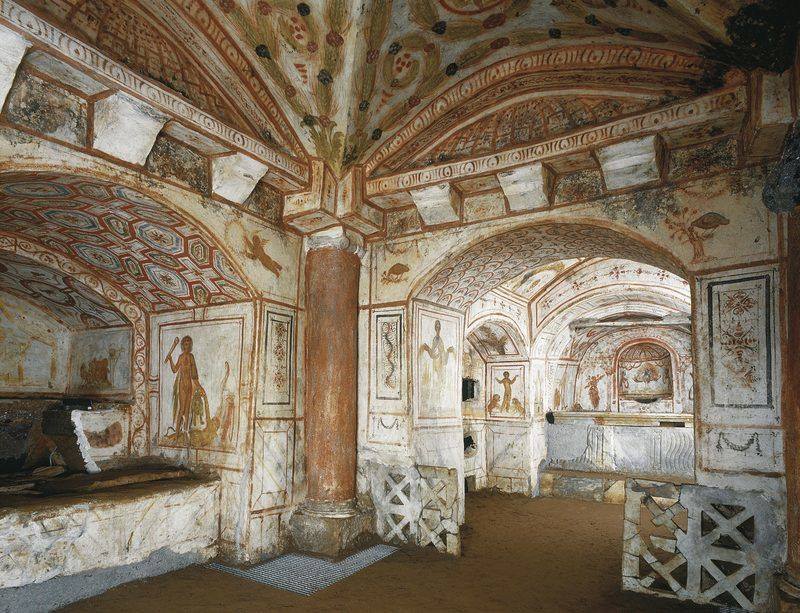
Along the burial tunnels, openings occasionally lead to private chambers called cubicula, often decorated with frescoes and meant for wealthier families or groups.
The Jewish catacombs have a few distinctive features, such as kokhim (oven-shaped tombs).
Underground burial areas similar to catacombs but smaller were also built by pagans. They are generally called hypogea, or hypogea under private law, because they were built by one or more private citizens and not by religious communities.
For this reason, for some minor catacombs with no historical or epigraphic documentation, it is not possible to say for certain whether or not they belonged to the Christian community.
Beneath Rome there are more than 50 catacombs with about 150 km of tunnels.
The Roman catacombs that certainly or probably belonged to the Christian community are under the custody and authority of the Pontifical Commission for Sacred Archaeology, in accordance with what was established in 1929 by the Lateran Pacts between the Italian State and the Holy See.
The largest catacombs in Rome, with 20 kilometers of tunnels spread over about 30 hectares, are the Catacombs of San Callisto, but new ones are constantly being found under the foundations of present-day Rome.
Many have included places like the hypogeum found in Pigneto under Bar Necci, as well as the Hypogeum of Via Dino Compagni (visitable only on request) and the Catacombs of Santa Tecla, in a tour that includes the more famous Capuchin Friars Museum and Ossuary Crypt, or the well-known Catacombs of Priscilla, Catacombs of San Sebastiano, Catacombs of Generosa and Catacombs of Commodilla, among the many found beneath Rome.

Buy the best tours offered by official tour operators here at the best price through Viator, the service offered by TripAdvisor.
At your disposal, the best licensed tour guides and tour leaders in Rome and the surrounding area
Help the tourism industry and the Italian economy restart!
The catacombs of Rome
The Roman catacombs, about 50 in the suburbs, were built along the consular roads, following the customs and laws that required burial outside inhabited areas for reasons of hygiene.
The list that follows picks out the underground cemeteries of Rome that can be attributed with certainty or probability to the Jewish and Christian communities of Rome, divided by the roads they belong to, starting from the Vatican Hill and going counterclockwise.
For each catacomb, the accessibility status as updated to 2021 is also given.
The list of catacombs is followed by a list of so-called hypogea under private law, meaning those not attributed to members of the Jewish or Christian community, found in the suburbs of Rome.
The term hypogeum also appears among the underground cemeteries with Christian features, where the cemetery has a very limited spatial development.

Via Aurelia
- Anonymous Catacomb of Sant’Onofrio al Gianicolo, inaccessible
- Anonymous Catacomb of Villa Pamphili, accessible for study purposes
- Anonymous Catacomb of Vigna Franceschini, accessible for study purposes
- Catacomb of Calepodius, accessible for study purposes
- Catacomb of the Two Felixes, not identified
- Catacomb of Saints Processus and Martinian, not identified
Via Vitellia
- Catacomb of San Pancrazio (or of Octavilla), visitable
Via Portuense
- Catacomb of Pontianus, accessible for study purposes
- Catacomb of Monteverde (Jewish), accessible for study purposes
- Catacombs of Generosa, visitable on request
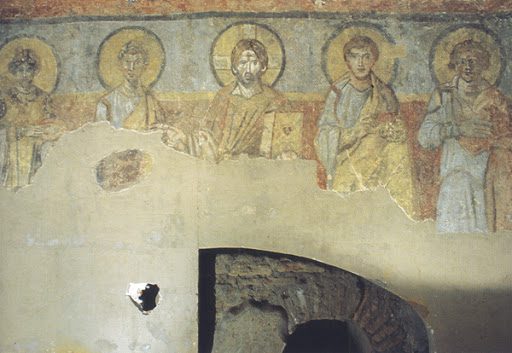
Via Ostiense
- Catacombs of Commodilla, visitable on request
- Catacombs of Santa Tecla, visitable on request
Via Ardeatina
- Catacomb of Balbina, accessible for study purposes
- Catacomb of Saints Mark and Marcellian (or of Basileus), accessible for study purposes
- Catacomb of Domitilla, visitable
- Anonymous Catacomb of the Nunziatella (or Annunziatella), accessible for study purposes

Via Appia
- Catacombs of San Callisto, visitable (the core known as the Catacomb of Vigna Chiaraviglio is visitable on request)
- Hypogeum of Vibia (mixed), visitable on request
- Catacomb of the Holy Cross, accessible for study purposes
- Catacomb of Praetextatus, visitable on request
- Anonymous Catacomb of Vigna Randanini (Jewish), visitable on request
- Anonymous Catacomb of Vigna Cimarra (Jewish), accessible for study purposes
- Catacombs of San Sebastiano, visitable
Via Latina
- Catacomb of Saints Gordian and Epimachus (or of Acqua Mariana), accessible for study purposes
- Hypogeum of Trebius Justus (possibly syncretic), accessible for study purposes
- Catacomb of Apronianus, accessible for study purposes
- Anonymous Hypogeum of Via Dino Compagni (possibly syncretic), accessible for study purposes
- Anonymous Catacomb of Via Latina, accessible for study purposes
- Catacomb of Tertullinus, not identified

Via Labicana
- Hypogeum of the Aurelii (possibly Gnostic), visitable on request
- Catacomb of San Castulo, inaccessible
- Anonymous Catacomb of Vigna Apolloni (Jewish), inaccessible
- Catacomb of Saints Marcellinus and Peter (or ad duas lauros), visitable
- Catacomb of San Zotico, accessible for study purposes
Via Tiburtina
- Catacomb of San Lorenzo (or of Cyriaca), visitable on request
- Catacomb of Novatian, accessible for study purposes
- Catacomb of Sant’Ippolito, accessible for study purposes
- Catacomb of Santa Sinforosa (now in the territory of Tivoli), inaccessible
Via Nomentana
- Catacomb of San Nicomede (or of Villa Patrizi), inaccessible
- Anonymous Catacomb of Via dei Villini, accessible for study purposes
- Anonymous Catacomb of Villa Torlonia (Jewish), accessible for study purposes
- Catacomb of Sant’Agnese, visitable
- Greater Cemetery, visitable on request
- Lesser Cemetery, accessible for study purposes
- Catacomb of Sant’Alessandro, visitable on request
Via Salaria nova
- Catacomb of Santa Felicita (or of Maximus), visitable on request
- Catacomb of Thraso, accessible for study purposes
- Catacomb of the Giordani, accessible for study purposes
- Catacomb of Sant’Ilaria, accessible for study purposes
- Anonymous Catacomb of Via Anapo, visitable on request
- Catacombs of Priscilla, visitable

Via Salaria vetus
- Catacomb of San Panfilo, visitable on request
- Anonymous Hypogeum of Via Paisiello, accessible for study purposes
- Catacomb of Sant’Ermete (or of Bassilla), visitable on request
- Catacomb ad clivum Cucumeris, not identified
Via Flaminia
- Catacomb of San Valentino, accessible for study purposes
- Tomb of the Nasoni in the archaeological area of Saxa Rubra, discovered in 1674. It has suffered several misfortunes, but because of its size, its stuccoes and the richness of its mythological scenes, it remains a testimony of great importance from the Antonine age.
- Tombs of Fadilla (second century), discovered in 1923, keeps its interior decorations practically intact, from the floor mosaic to the wall and ceiling paintings.
Hypogea under private law
The Hypogeum of Via Livenza is excluded from the list that follows because it has no funerary character.
Family hypogeum tombs (such as the Hypogeum of Villa Glori, the Hypogeum of the Octavii, the Tomb of the Nasoni and the Tomb of Fadilla) are also excluded because they lack the typical tunnels with loculi.
Via Aurelia
- Anonymous Hypogeum of Villa Pamphili
Via Vitellia
- Hypogeum of Scarpone
Via Appia
- Hypogeum near the Tomb of the Scipios (in the Park of the Scipios)
- Hypogeum of the Hunters
- Anonymous Hypogeum of Via Appia Antica 81
Via Labicana
- Hypogeum of Villa Cellere (or of Vigna del Grande)
- Hypogeum of Centocelle
Via Prenestina
- Hypogeum of Acqua Bullicante
- Hypogeum of Villa Gordiani
Via Tiburtina
- Hypogeum of Piazzale del Cimitero del Verano
Via Salaria
- Hypogeum near the Mausoleum of Lucilius Peto
Via Trionfale
- Catacomb of Sant’Onofrio in Campagna (or of Sant’Agata)
Buy the best tours offered by official tour operators here at the best price through Viator, the service offered by TripAdvisor.
At your disposal, the best licensed tour guides and tour leaders in Rome and the surrounding area
Help the tourism industry and the Italian economy restart!
The catacombs of Rome | The History
The oldest cores of the Roman catacombs date back to the end of the second century (the Catacomb of San Callisto, and the arenarium area in the Catacombs of Priscilla, which uses a pre-existing quarry).
Previously, Christians were buried together with pagans, without any particular distinction of belief.

Religious and social causes behind the catacomb phenomenon in Rome
The practice of burying the dead in underground spaces was nothing new for Roman civilization, since the custom had been widespread for many centuries both in Italy and in other regions of the Mediterranean basin (among the Sardinians since the late Neolithic, among the Etruscans from the seventh century BC. Among Roman hypogeum tombs, we can recall the Tomb of the Scipios from the early third century BC).
In the earlier examples, however, the hypogea were meant for single individuals or, alternatively, for one or more family groups tied together by kinship.
The catacombs extended the practice of underground burial by dedicating it to a vast community of individuals bound together by a shared religious faith, and they developed as true underground necropolises, with a breadth and complexity never reached before.
The causes of the catacomb phenomenon are first of all religious, because the Christian religion and, in part, Judaism as well professed the doctrine of the resurrection of the flesh, which states that at the end of time bodies will rise and be reunited with their souls for the last judgment. This doctrine seemed incompatible with the traditional Roman practice of cremation, which implied the destruction of the body by burning (and which, even among pagans during the second century, was gradually being replaced by burial).
Since open-air cemeteries were insufficient to hold the unburned bodies of the growing mass of believers, building underground cemeteries seemed a natural solution to guarantee a dignified burial for the faithful awaiting the resurrection, which in the first centuries of Christianity many considered imminent (see in particular the heresy of Montanism).
The very word cemetery (in Latin coemeterium, from the Greek κοιμητήριον [koimētérion], from the verb κοιμάω [koimáō], meaning “to sleep”, “to rest”), originally used to refer to the catacombs, alludes to a place of temporary rest.
Further motives that led to the building of the catacombs in the suburbs of Rome were based on solidarity, because, especially during the long economic crisis that came out of the military anarchy of the third century, many individuals and families belonging to Christianity and Judaism found themselves in absolute poverty and unable even to arrange a burial on their own.
Christian and Jewish ethics therefore required the communities to help their destitute fellow believers by providing low-cost burials.

Buy the best tours offered by official tour operators here at the best price through Viator, the service offered by TripAdvisor.
At your disposal, the best licensed tour guides and tour leaders in Rome and the surrounding area
Help the tourism industry and the Italian economy restart!
The catacombs in Rome | Third and fourth centuries
When the community grew larger, the building of collective cemeteries increased, some above ground in the modern way, some dug underground, taking advantage of how easy the local tuff is to work.
The cemeteries were located within the boundaries of land bought by the community or, more often, donated to it by wealthy members.
In the third century, 25 cemeteries were counted in the suburbs of Rome, some of which were owned by the Church and administered directly by it (for example the Catacomb of San Callisto, since Hippolytus of Rome writes in his Philosophumena that Pope Zephyrinus appointed the deacon Callistus, not yet pope, custodian and administrator of the catacomb).
In the first half of the third century, moreover, Rome was divided into seven ecclesiastical regions, and each of them was assigned places of worship and different catacombs for the burial of its faithful.
In 313, Christianity was recognized as a legitimate religion, and in the following years mass conversions exploded. The catacombs kept expanding and in some cases going deeper, with several stacked levels connected by stairs.
During the second half of the fourth century, the habit of being buried in the catacombs slowed down sharply, with the sole exception of burials near the tombs of the martyrs (ad sanctos or retro sanctos), which the faithful especially sought. The phenomenon was caused by the spread of devotional worship of the martyrs buried in the catacombs, encouraged by the work of Pope Damasus I, who commissioned restoration works on the catacombs and the monumentalization of the venerated burials to encourage visits by the faithful.
The catacombs in Rome | From the fifth to the ninth century
In the fifth century, the use of the catacombs for new burials became rare, but they continued to be a destination for pilgrims out of devotion.
In the sixth century, in the years following the fall of the Western Roman Empire, the Gothic Wars and the many sieges Rome was subjected to encouraged the depopulation of the ancient capital and the looting and abandonment of early Christian sites in the suburbs, including the catacombs.
Between the eighth and the ninth century, following continuous looting, the sanctuaries outside the city were gradually abandoned and the sacred relics of the martyrs were transferred to the churches of the city.
The catacombs in Rome | From the Late Middle Ages to the 15th century
Once the relics were moved inside the city, the catacombs were completely abandoned. Their entrances were blocked by vegetation and landslides, and the sanctuaries and cemeteries fell into oblivion.
During the Late Middle Ages, every trace of their location was lost.
The only catacombs that were still remembered were those of San Sebastiano, San Lorenzo (or of Cyriaca) and San Pancrazio.
The catacombs in Rome | The Modern Age
In the modern era they were accidentally rediscovered in the 16th century and began to be explored, first by Antonio Bosio (1575-1629, with his posthumous book Roma Sotterranea of 1634) and above all through the research of Giovanni Battista de Rossi (1822-1894).
Since the 1950s, many catacombs have been found and identified near Rome.
Buy the best tours offered by official tour operators here at the best price through Viator, the service offered by TripAdvisor.
At your disposal, the best licensed tour guides and tour leaders in Rome and the surrounding area
Help the tourism industry and the Italian economy restart!
The catacombs of Rome | Description
The Christian cemeteries of Rome were usually divided into an outer part (technically called sub divo coelo, “under the light of the sky”) with individual burials and mausoleums, not unlike modern cemeteries.
Below it stretched the network of tunnels (ambulacra) dug by skilled workers called fossores, using tools such as the pickaxe (dolabra). The underground cemetery was reachable from outside by one or more staircases.
Because of the limits imposed by Roman law, which extended property rights to the subsoil as well, when digging the tunnels the fossores were required not to go beyond the boundaries of the land owned by the religious community, often acquired through bequests or donations.
Precisely to commemorate such acts of public generosity, as also happened with the first Christian tituli (places of worship), several catacombs were originally named after their benefactors. This is the case, for example, of the Catacomb of Priscilla or the Catacomb of Octavilla, which later changed its name to Catacomb of San Pancrazio, after the most illustrious martyr buried inside it.
In the larger catacombs it is possible to recognize distinct cores, often originally independent and only later connected to each other to form a single vast burial area.
The cores of the Roman catacombs are usually called regions (for example the region of the cathedrae in the Coemeterium Maius).
Sometimes light shafts were made in the tunnels. They ensured air circulation inside the catacomb, improved lighting and made it easier to remove the waste material from the digging of the loculi and from the extension works on the network of tunnels.
Some tunnels were also covered with white plaster to increase the light produced by the torches and oil lamps, which were placed in niches or set on shelves at regular intervals.
Types of burials
The loculi, generally arranged in vertical rows (pilae), were closed on the outside with reused materials such as roof tiles, bricks and architectural fragments, or with marble slabs. On these, the name of the deceased and other information such as age, trade, and date of death or burial were often carved or painted (for religious reasons tied to the commemoration of the dies natalis
in the Christian sense, that is, the day of birth into new life through death), sometimes accompanied by Christian or Jewish symbols.
Rarely, objects that had belonged to the deceased (for example gold glass) were set with mortar around the loculi.
In some cases, Christian inscriptions or symbols were carved with a stalk or pressed into the mortar that sealed the loculi on the outside.
A more monumental type of burial is the arcosolium (arcosolium), made up of an arched niche inside which a slab was placed horizontally to close the burial, accessible from above (the solium sub arcu).
The arcosolium too could be simple (that is, for one person only) or multiple, able to hold the burials of an entire family.
Along the corridors, cubicula (cubicula) are not uncommon. These are burial chambers of square or polygonal shape, containing several loculi or arcosolia meant for small groups, members of the same family or of related families. The larger cubicula are called crypts (cryptae), the best known of which is the Crypt of the Popes in the Catacomb of San Callisto.
The generic term crypta, however, was also used in Latin to refer to tunnels.
The cubicula can also hold terracotta or marble sarcophagi.
Finally, for reasons of space, some tombs were also dug into the floor of the tunnels and cubicula (formae).
In the Jewish catacombs there is a type of burial common in Palestine, the oven-shaped tombs (kokhim), almost entirely absent from the Christian catacombs.
Burials ad sanctos
Starting from the fourth century, burials ad sanctos (sometimes more correctly retro sanctos) became widespread, that is, new burials piled up in the immediate vicinity of (or behind) the venerated tombs of Christian martyrs.
The phenomenon was encouraged by the work of Pope Damasus I (366-384), who was the first great promoter of the cult of the martyrs, also carrying out restoration, consolidation and expansion works inside the catacombs to encourage visits by the faithful.
Among Damasus’s initiatives, it is worth remembering in particular the placing of inscribed marble slabs containing poems in honor of the martyrs, which he composed and which were transcribed in particularly elegant lettering by the calligrapher Furius Dionysius Filocalus.
The wish to be buried in the catacombs close to a venerated burial was based on the belief that spatial closeness to the saint would encourage his intercession on behalf of the deceased, at the moment of receiving divine judgment after death.
A privilege “quod multi cupiunt et rari accipiunt” (“which many desire and few obtain”), as a famous inscription of 382 states explicitly (ICUR, I 3127).