Published on
The Seven Churches Pilgrimage is a spiritual walk and pilgrim route practiced in Rome as far back as the Middle Ages (7th century), revived and formalized in 1552 by St. Philip Neri, still today a deeply felt tradition practiced by Christians and non-Christians alike.
“Doing the tour of the Seven Churches” in Rome is both a saying and a spiritual tourist itinerary with a centuries-old tradition, which consists of visiting the holy places of Christian memory in Rome.
In its original form the Seven Churches Pilgrimage was a loop route of about 20 kilometers (today about 40 kilometers) that touches the main churches of Rome at the time St. Philip Neri lived, the first four of which are the Major Papal Basilicas:
- Basilica of St. John Lateran
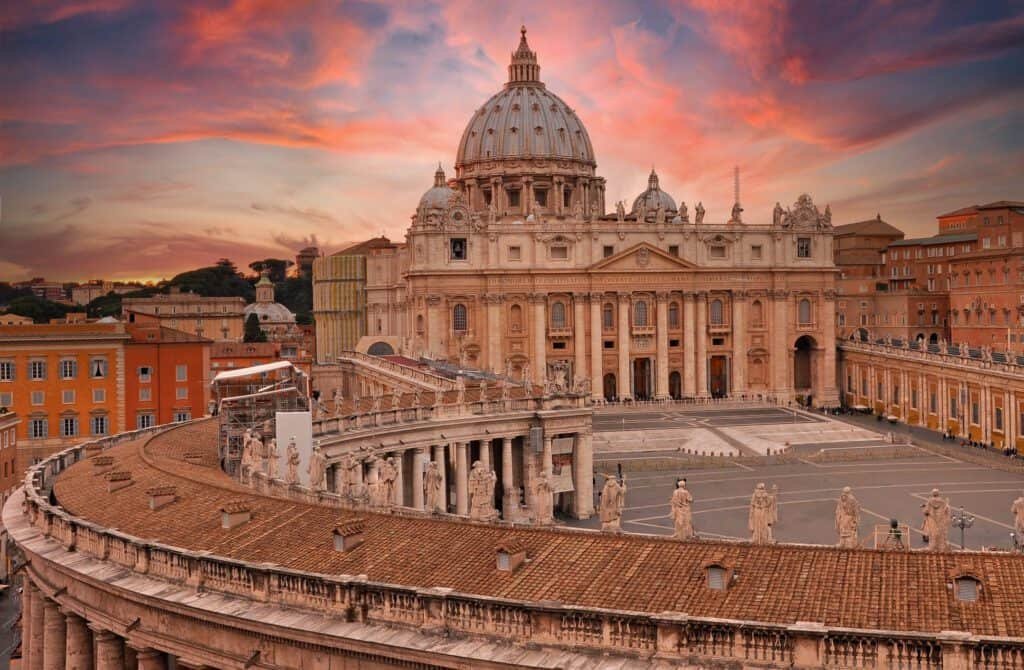
- St. Peter’s Basilica in the Vatican
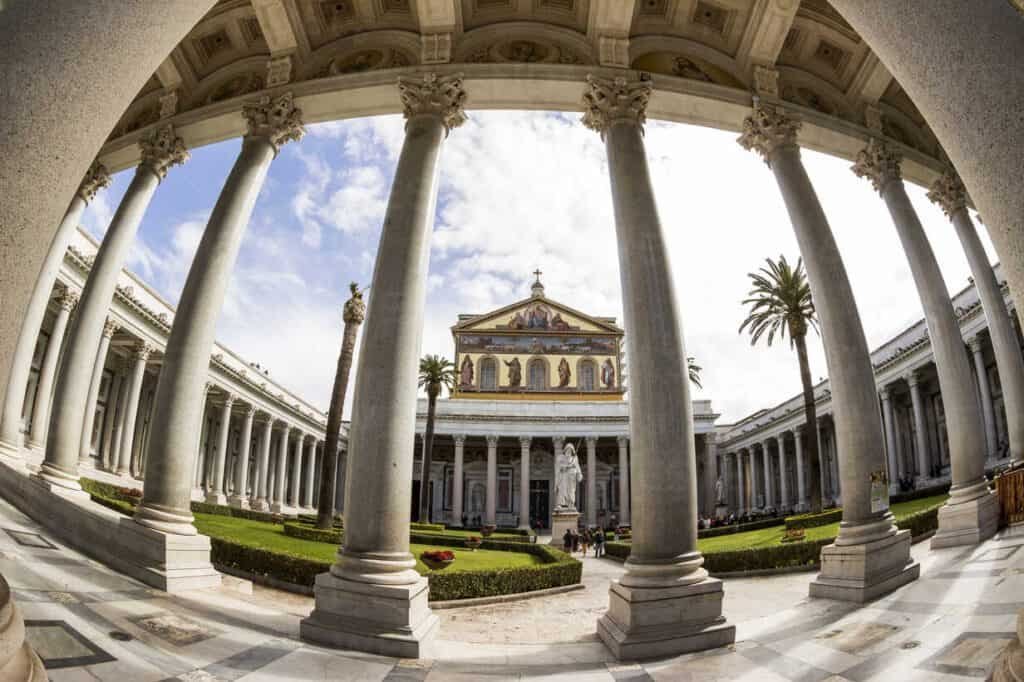
- Basilica of St. Paul Outside the Walls
- Basilica of Santa Maria Maggiore
- Basilica of St. Lawrence Outside the Walls
- Basilica of Santa Croce in Gerusalemme
- Basilica of St. Sebastian Outside the Walls (since the Jubilee of 2000, also replaced by the Sanctuary of Our Lady of Divine Love )
Given the length of the route, pilgrims often walk it over two days.
Originally it took a whole day to complete the tour, from first Vespers to early the next day.
Later the visit was done over two days, devoting the first only to St. Peter’s Basilica and the second to the other six, starting from the Basilica of St. Paul Outside the Walls, heading north and counterclockwise, and ending at the Basilica of Santa Maria Maggiore.
Via delle Sette Chiese, formerly known as Via Paradisi, covers a route rich in historical evidence of the early years of Christianity, with its many catacombs, connecting Via Ostiense and Via Appia between the Rupe of St. Paul near the Ostiense Basilica and San Sebastiano (a former jubilee church built over the catacombs of San Sebastiano), such as the catacombs of Commodilla, of Domitilla and of San Callisto.

The Seven Churches Pilgrimage today
Today the Seven Churches Pilgrimage takes place as a group, at night, twice a year, in September and in May, shortly before the feast of St. Philip Neri, led by a Father of the Congregation of the Oratory of St. Philip Neri.
The Seven Churches Pilgrimage is also considered an act of devotion typical of the “time of the Passion“, and by tradition it takes place in very many places where there is a Catholic presence.
According to the Christian faith, each stage of the pilgrimage to the seven churches has a deep meaning for the Christian-Catholic religion: each visit, in fact, represents one of the journeys of Jesus, from the night he was captured to the crucifixion.
From this perspective, the pilgrimage of the seven churches is not only a way to touch the places of faith, but also to accompany Jesus himself.
In particular, during the Easter Triduum (from the evening of Holy Thursday, through all of Good Friday, and a large part of Holy Saturday), the tradition is to visit seven churches, pausing to pray near the Blessed Sacrament placed on the Altar of Repose and/or the dead Christ. For this reason too it is customary (improperly) to call this tour the visit of the sepulchers.
The first stage recalls the journey from the Upper Room, where the Last Supper is celebrated, to the Garden of Gethsemane, where he prays and begins to sweat blood.
The journey from there to the house of Annas, where he is questioned and slapped, is represented by the second stage.
The third stage stands for the suffering and insults of the journey to the house of Caiaphas.
The fourth stage marks the first appearance of Jesus and his accusation before Pilate.
The fifth, the appearance before King Herod and his guards.
The sixth, Jesus again before Pilate, when he is crowned with thorns and condemned to death.
The last stage, finally, recalls the journey from Pilate’s house to Mount Calvary
that Jesus makes carrying the cross on his shoulders, his death and the resurrection.
The expression “doing the tour of the seven churches” has also taken on a negative meaning in everyday speech. Depending on the area, it can mean wasting time wandering without a purpose or anxiously looking for someone who will listen.

Seven Churches Pilgrimage | The History
So when St. Philip Neri began to undertake his own personal pilgrimage, the tour of the seven churches was probably alive as a popular practice, but in any case we have no precise documentation of it.
The first historians of this special pilgrimage, led by Onofrio Panvinio, assure us that the saint merely gave new shine to a very ancient tradition.
The first news of the cult of the Seven Churches in Rome goes back at least to the 7th century, when St. Begga, returning to live as a hermit in her own country after her pilgrimage to Rome, wanted to build six other oratories besides her own, which gave their name to the monastery of “Sept-Eglises”.
The evidence, however, is late and not always clear, and the seven churches never appear as a devotional itinerary on their own, always mixed with other itineraries.
It’s likely that this religious practice goes back to the Pope’s custom of celebrating the sacred offices in the stational churches of Rome according to the liturgical calendar of the time, these later being reduced to the seven considered main ones, cited by Onofrio Panvinio, who added to the 5 patriarchal churches the two of Santa Croce in Gerusalemme and San Sebastiano Outside the Walls. It also can’t be ruled out that the cult is connected to the Seven Churches of Asia Minor mentioned in the Apocalypse, following a number that recurs very frequently in Sacred Scripture and indicates perfection and completeness.
In any case, it is with the institution of the Jubilees starting in 1300 (when Boniface VIII had indicated the stops the devout traveler had to make once arrived in the Holy City of the apostles and martyrs), and in particular from the second half of the 14th century, that the lists of indulgences name the seven basilicas where these could be gained. This consolidated a custom that would be taken up by St. Philip Neri when renewing this cult and giving it other, new religious meanings in line with the trends of the Counter-Reformation then underway: during the pilgrimage he had the seven penitential psalms recited (6, 31, 37, 50, 101, 129, 142) to invoke forgiveness for the seven deadly sins and ask for the seven virtues opposed to them, and meditated on the seven main stages of Jesus during the Passion, the seven sheddings of Christ’s blood, the seven words of Christ on the cross, the seven gifts of the Holy Spirit, the seven sacraments and the seven works of mercy.
We have to get to 1360 to find an itinerary for pilgrims that collectively calls the seven basilicas “royal churches”, because popes and emperors had founded them and enriched them with treasures.
We have to get to February 25, 1552 for the pilgrimage to become a stable, organized practice. With the growing number of participants, Philip Neri decided to dedicate a fixed day of the year to the pilgrimage: Fat Thursday.
Philip chose this date to counter the pagan-leaning festivities of the Roman carnival with devotion to the holiest places in Rome, and meditation on the Passion.
But although his was a devotional proposal as an alternative to a playful moment greatly awaited by the Roman population, it was still very successful, because we have to remember that, more than a procession, the pilgrimage of the seven churches was born as a great moment of conviviality, a real country outing, which combined moments of prayer with others of leisure.
His real great invention was therefore to make the “visit” a collective practice, a moment of spiritual gathering and inner renewal, just when carnival seemed to push the thought of penance and Christian life itself out of life.

In every church, except St. Peter’s and St. Paul’s, the group listened to sermons, and along the way it sang hymns and psalms, in particular the “Song of Vanities” attributed to Giovanni Animuccia, one of the saint’s first companions: “Vanity of vanities, / everything is vanity / the whole world and what it holds: / everything is vanity”.
The practice soon won wide consensus and a flow of pilgrims, to the point that Sixtus V included it in the
bull Egregia populi romani pietas of February 13, 1586, in a broader plan of penitential practices, which however, because of the pontiff’s early death, were not observed by his successors.
Via delle Sette Chiese
Via delle Sette Chiese is a street in Rome that connects Via Ostiense, at the level of the Rupe of St. Paul, to Via Appia Antica, near the Basilica of San Sebastiano, crossing Via Cristoforo Colombo and Via Ardeatina through the Ostiense district (Garbatella area) and the Ardeatino district (Tor Marancia area).
The current route was already known with this devotional function from the end of the 16th century, and its name dates at least to the mid-17th century, along with the earlier Via that goes from San Paolo to San Sebastiano or more simply Via di San Sebastiano, and in the Middle Ages it went by the name Via Paradisi.
Given the presence of some paved stretches, it most probably follows an ancient Roman diverticulum of prehistoric origin, and it owes its name to the practice of the pilgrimage of the Seven Churches, which traditionally took on particular fervor starting in 1552 with St. Philip Neri.
The long road (more than 3 kilometers), which runs west to east and directly connects the Basilica of St. Paul Outside the Walls on Via Ostiense to that of San Sebastiano on Via Appia, crossing Via Ardeatina near the Fosse Ardeatine, passes through an area with the most important catacombs of the first centuries of Christianity.
The Jubilee Churches
Each of the four Papal Basilicas in Rome (St. Peter’s in the Vatican, St. John Lateran, Santa Maria Maggiore and St. Paul Outside the Walls) has a Holy Door.
These are jubilee churches, where you go on pilgrimage to obtain the indulgence by fulfilling the required conditions.
The Basilicas of the Holy Land are also traditionally jubilee churches.
In the rest of the world, the jubilee churches are to be considered the church and any shrines in which each local Ordinary has arranged the opening of a Door of Mercy.
In the case of Rome, to the four Papal Basilicas are added the three churches that, together with them, make up the traditional itinerary of the “seven churches”, namely San Lorenzo Outside the Walls, Santa Croce in Gerusalemme and San Sebastiano Outside the Walls.
The importance of the pilgrimage on the occasion of the Jubilee suggests rediscovering and practicing this penitential itinerary left to the Romans by St. Philip Neri in the 1500s.
Therefore, the pilgrimage to each of these churches will also be an occasion to live the jubilee indulgence.
The Diocese of Rome also hosts many other important churches and shrines, pilgrimage destinations for many of the faithful, who always find priests there ready to welcome them in the mercy of the Father.
During the Holy Year, the Sanctuary of Our Lady of Divine Love and the church of Santo Spirito in Sassia, also known as the “Shrine of Divine Mercy“, will also be jubilee churches, where you go on pilgrimage to obtain the indulgence.
Finally, the churches that already stably enjoy the privilege of the indulgence for the faithful who devoutly fulfill the required conditions will continue to be places where the indulgence can be obtained during the Jubilee of Mercy as well, according to what is already determined for each of these places.
