Cieloterra
In short. Cieloterra is a night space that lives in the eastern belly of Rome, on that stretch of Via di Portonaccio where the city stops describing itself with postcards and starts speaking the language of sheds, high walls, lowered shutters and…
Via di Portonaccio, 23
Rome
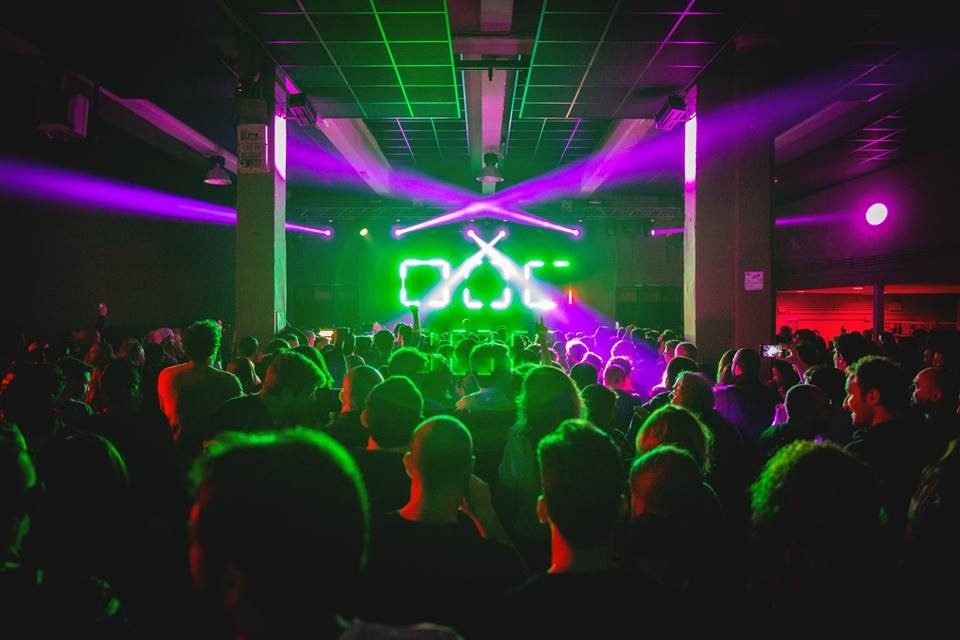
Cieloterra is a night space that lives in the eastern belly of Rome, on that stretch of Via di Portonaccio where the city stops describing itself with postcards and starts speaking the language of sheds, high walls, lowered shutters and the railway tracks that run just a bit farther on. It's not a place that comes to meet you. You have to look for it, and when you find it you understand that this is exactly the point. An old depot converted, an ex-industrial space, or post-industrial, or archaeo-industrial, whatever you prefer to call it, which lends itself like few others to hosting strobes, sound systems and a lot of people dancing in the hours when the rest of the city sleeps or pretends to sleep.
To the sharpest, and the least forgetful, this address will sound familiar. At this stretch of Via di Portonaccio, in the same cubic meters, the late Animal Social Club did its best for years, and it's one of those names that, if you say it to a certain age group of Romans, you see their eyes light up. Cieloterra lives in that shell. It doesn't imitate it, it doesn't disown it, it simply reuses it. And in the nightlife of this city, where clubs are born and die at the speed of fireworks, the reuse of an address that has already worked is never an accident.
The format, in substance, is straightforward. Weekends only, small hours only, kick drum strictly four-on-the-floor. You go in when elsewhere they're already closing, you come out as the sky starts to lighten over the rooftops of Tiburtino, and you go home on the first public transport of the dawn, when the streets are still empty and the Roman air has that clean smell that lasts half an hour and then disappears under the traffic. It's a liturgy, and like all liturgies it works precisely because it's repetitive.
This is a place for people looking for somewhere to dance without ending up in an anonymous container with red LEDs and reserved tables. I'll tell you what to expect, what not to expect, what's around, why that piece of the city is the way it is and not otherwise, and how to get home without turning a good night into a problem. Because the most underrated part of an evening is always the return.
Where Cieloterra Is, and Why the Address Matters
Via di Portonaccio is one of those Roman streets with no intention of pleasing you at first glance. It runs through the eastern quadrant, in the middle of a geography made of railway, interchanges, workshops, warehouses, depots, sheds converted to a thousand different uses, and residential buildings that have squeezed into the leftover spaces. Historically it's a street for work, not for strolling. And that's exactly why at night it changes skin with an ease you don't find elsewhere.
Number 23 is a big door that tells you nothing by day. You walk past and see a low, wide structure, industrial in layout and in logic. At night, though, that same door becomes a funnel: a knot of people at the entrance, people arriving on foot from the direction of the station, people getting out of cars parked in the side streets, people smoking on the sidewalk and arguing with that intensity typical of two in the morning, when every topic seems vitally important.
The thing to say right away is that the perceived distance here doesn't match the real distance. Portonaccio looks far from everything when you look at a map from the center, and yet it leans against the biggest railway hub of eastern Rome. Tiburtina station is right there, a stone's throw away as the crow flies, with everything that comes with it: trains, metro, intercity buses, taxis, people arriving and people leaving at any hour. This closeness is the structural reason why a place like this can work at hours when other neighborhoods shut down.
Then there's the matter of the overpass. The Portonaccio bridge is one of those structures Romans hate and use every day, a road bridge that crosses the bundle of tracks and connects two worlds that would otherwise stay separated by the railway. When you drive over it you see beneath you a sea of rails, yellow lights, parked freight cars, switch cabins. It's a purely industrial view, the kind that in other cities ends up on record covers. In Rome nobody ever photographs it, and that's a mistake.
What Cieloterra Is, Said Without Beating Around the Bush
It's a space for dancing at night carved out of a former depot. Period. Everything else is a consequence of that sentence.
Consequence number one: the volume of air. An industrial depot has high ceilings, wide spans, few interior load-bearing walls. That means the room doesn't close in on you like in converted basements, and the sound has room to breathe instead of bouncing back in the dancers' faces. Anyone with an ear hears it immediately: it's not the same thing to put a sound system in a box 2.70 meters high or in a shed that is easily twice as tall.
Consequence number two: the surfaces. Concrete, metal, exposed brick, load-bearing structures left where they were. Nobody tried to hide the origin of the place under drywall and velvet. This choice, which at first sight looks merely aesthetic, has concrete effects: reverb, temperature, perception of the space. And it has an even stronger psychological effect, because the audience understands right away that they've entered a place that wasn't born for them, and this generates a different kind of attention than in a venue built on purpose.
Consequence number three: the light. The strobe, in an environment like this, isn't a decorative effect, it's a measuring instrument. In the full dark of a shed the flash gives you back the depth of the room intermittently, and lets you understand how many people are really around you. It's a feeling that doesn't exist in small venues, because there you see the whole space at once and it no longer surprises you.
Consequence number four: the hours. A place like this makes sense only in the window when the neighborhood has no residents to wake up on every square meter and when the audience has already done something else beforehand. That's why the format is the small hours on weekends, and not the 19:00 aperitivo with a cutting board.
A Curiosity About Cieloterra
The real curiosity concerns the name. Cieloterra puts together two words that in an industrial shed seem to contradict each other: sky, which in a depot you never see because above your head you have a roof, and earth, which is always there, in the form of a concrete floor that returns every vibration to your ankles. And yet the contradiction is only apparent, because whoever leaves a place like this at first light lives exactly that passage: from the earth pounded by the bass to the sky opening up just outside the door, above the tracks.
In the nighttime place-naming of Rome over the last 20 years, venue names have followed different paths. There was the season of English names, that of vaguely exotic names, that of incomprehensible acronyms, that of ironic names. A compound Italian name, dry, with two natural elements stuck together with no space, belongs to a more recent and more spare taste, one that prefers to evoke rather than explain. I'll tell you the truth: it works. It's a name you remember after hearing it only once, and that's the first requirement of any place that wants to build an audience without spending a fortune on communication.
Second curiosity, related: the address itself. Via di Portonaccio number 23 is a street number that in certain Roman circles is used as a synonym for the place, exactly as happened with some historic addresses of European clubbing. When a street number becomes a proper name it means the place has moved beyond the level of a venue and taken on the status of a reference point. It's too early to say if it will really happen, but the mechanism has already started: people say the number and others understand.
Third curiosity, for those who love urban details: Portonaccio as a place name belongs to that family of Roman names that derive from old farmsteads and suburban estates, when out here there were fields, vineyards and paths toward the Tiburtine countryside. The name has survived everything, the railway, industry, the bombings, the reconstruction, mass motorization, the interchanges. Today it indicates a quadrant that has nothing rural left, but the place name stays there, stubborn, to remind you that before the city there was something else here.
The Quadrant: Portonaccio, the Freight Yard, Tiburtina
To understand Cieloterra you have to understand where it puts its feet. And where it puts its feet is one of the most interesting and least told pieces of Rome: the strip that runs between the railway, Via Tiburtina and the Aniene river.
Here modern history begins with the tracks. The Roman railway development between the nineteenth and twentieth centuries drew this sector of the city as a fan of track bundles, freight yards, depots, maintenance workshops, sorting warehouses. Where there are tracks, goods arrive. Where goods arrive, warehouses are born. Where there are warehouses, small factories, workshops and laboratories are born. And where there are factories and workshops, the people who work in them arrive, and they have to live nearby because nobody, in those days, could afford to cross the city twice a day.
That's how the quadrant between Portonaccio, Tiburtino and Pietralata filled up: not through an elegant plan drawn up at a desk, but by stratification, by necessity, by pressure. The official and the spontaneous borgate, the public housing lots, the apartment buildings put up when it was possible and as it was possible. A working-class piece of the city in substance, even when the worker in the strict sense became a minority.
Then, in the second postwar period and especially from the 1970s onward, the great transformation arrived: production moves out, depots become uneconomical, workshops close or move to the sheds of the Roman countryside where a square meter costs a tenth. The containers remain. Big, solid, built to last, suddenly without a function. All over Europe this is the raw material of nightlife for the last 40 years: Berlin, London, Milan, Barcelona built whole imaginaries on emptied factories. Rome got there later and in a messier way, but it got there.
Today's Tiburtino is the sum of all these layers. You find the new station, inaugurated in 2011, which changed the scale of the neighborhood with its footbridge suspended above the tracks. You find the university and the research centers a little farther on. You find the wholesale trade, the car dealers, the body shops. You find the longtime residents and those who arrived yesterday. You find the night venues. All together, all overlapping, without anyone ever putting it in order. And that's why it works: order, at night, is almost always the enemy.
Pietralata, the Movies and the Memory of a Piece of the City
A few minutes beyond the door on Via di Portonaccio begins Pietralata, and it's a name that deserves a stop, because it is one of the strongest literary and cinematic places of twentieth-century Rome.
Pier Paolo Pasolini frequented this quadrant in his first Roman years, when he taught in the periphery and walked the borgate gathering the human material that would become his novels and his films. Pietralata appears in his writing and his cinema with a precision that is never folklore: the boys, the low houses, the river, the fields at the margins, the poverty that isn't prettified. Anyone who has read those pages and then walks these streets does a strange exercise, because the geography has changed almost completely, but the social structure of the quadrant, the feeling of being in a piece of the city that made itself, is still perfectly readable.
I'll tell you why this matters for those who go dancing. Because the night in the periphery is never only music. It's also the relationship with a territory that has a dense history and doesn't wait for you with open arms. Whoever comes here for the first time is sometimes thrown by the contrast: inside there's a system of thousands of watts and a crowd moving together, outside there's a silent industrial street, a few streetlights, the distant noise of trains. That contrast is half the experience. Take it away and all that's left is a discotheque.
Something Nobody Tells You About Cieloterra
What nobody tells you is that in a place like this the evening begins much earlier than you think, and I don't mean the opening time. I mean the logistics.
A night venue in an industrial zone works by different rules than a neighborhood venue. You don't have the bar next door where you wait for it to fill up. You don't have the row of places to fall back on if the evening doesn't convince you. You don't have the open tobacco shop, you don't have the pizza-by-the-slice place on the corner, you don't have the spontaneous flow of passersby who come in because they were walking past. Here, after a certain hour, there's the venue and there's the industrial dark around it. That means everything you need you have to bring with you or get beforehand: phone charge, cash for any eventuality, a sweatshirt for the exit at dawn, when even in July the Roman air before sunrise is cooler than you expect.
The second thing nobody tells you concerns the body. Dancing in a shed for three, four, five hours straight is real physical effort, and most of the evenings that end badly end badly for completely banal reasons: dinner was skipped, no water was drunk, you stayed in the middle of the floor without ever going out for air. Water is the most underrated thing in all of nightlife. The concrete floor, then, is less forgiving than parquet: if you plan to stay on your feet until dawn, the wrong shoes will make you pay around four, with Swiss precision.
Third thing nobody says: the trip home has to be decided beforehand, not afterward. At 6:00 in the morning, tired and with your ears ringing, nobody is in the best condition to organize anything. If you already know how you're getting back, the night is all downhill. If you don't, you'll spend the last hour solving a problem instead of enjoying the end of the evening. This is the difference between those who've been going out at night for years and those who are just discovering it, and I assure you it's visible to the naked eye at the exit.
Fourth thing, less practical and more subtle: in a former depot sound behaves unevenly. There are spots in the room where the bass grabs your sternum and the voices disappear, and others, usually toward the sides or under the structures, where you hear the details much better. Whoever knows the place moves around during the night instead of planting themselves in one spot. It's a small trick that completely changes the perception of an evening, and it costs nothing.
My Advice for Visiting Cieloterra
The main advice is one and I put it at the top: decide how you're getting home before you leave the house. It's not a textbook recommendation, it's the thing that separates a good night from a complicated one. Rome at night has the network of night buses, it has taxis, it has Tiburtina station a short distance away that starts moving again at dawn, it has friends with a car. Whatever your solution is, choose it while sober, and if the solution is the car, establish beforehand who drives and make sure that person doesn't drink. It's not moralism, it's arithmetic: an entire night can be ruined by 10 minutes of bad driving.
Second piece of advice: arrive calmly and not too early. In a place that lives on the small hours, showing up at opening almost always means finding a still-empty room, with the sound running at half volume and the atmosphere yet to light up. There's no prize for whoever arrives first. The moment these spaces become themselves comes later, when the room fills and the volume of air starts to work.
Third piece of advice: dress for the shed, not for the photo. Closed, comfortable shoes, light layers you can take off, nothing valuable you don't want to lose. In a room like this you move a lot, you sweat a lot, and the temperature swing between the floor and the courtyard is considerable. A light sweatshirt in your backpack is the best investment of the evening.
Fourth piece of advice: eat first. It sounds trivial, but in the quadrant, at that hour, you don't have the culinary parachute of Trastevere or the center. A real dinner before going out changes the whole endurance of the night, and also changes how your body reacts to everything else.
Fifth piece of advice: drink water regularly, and go out for air at least once an hour. The two things together make the difference between leaving at 6:00 happy and leaving at four wrecked. If the evening involves alcohol, keep it a conscious and measured choice, always alternate with water, and remember that whoever drives doesn't drink. That said, I guarantee that nobody in that room will ever notice what you have in your glass: what matters is if you're dancing or not.
Sixth piece of advice: respect the street. This is a neighborhood where people live and work. The volume of voices outside the door, the trash left on the sidewalk, cars parked in driveways are the three things that close night venues in the peripheries all over Italy. It's not rhetoric, it's the history of the last 30 years of Roman nightlife. Leaving quietly is the most concrete way to do a favor to the place you liked.
Seventh piece of advice, for those coming from outside Rome: don't try to squeeze this evening in with a museum visit the next morning. It doesn't work. If you've planned a night like this, treat the following day as a slow day, for a late breakfast and a stroll. Whoever tries to do both ends up doing both badly.
Getting Home, Explained Properly
I want to dedicate a whole section to the return, because it's the part everyone treats as a detail and that instead determines the quality of the memory.
Rome has a network of night lines that covers the city in the hours when the metro is stopped, and it has an important hub right next door, Tiburtina, where trains, metro and intercity buses converge. At dawn the system restarts gradually, and the first vehicle of the day is, historically, the natural taxi for those leaving long evenings. Leaving on the first regular bus while the sky goes from blue to light gray is one of the most Roman experiences there is, and anyone who has done it at least once knows it's worth almost as much as the evening.
That said, the practical advice: check the hours of the night service and the first morning service on the day you go out, because they change between weekdays, holidays and times of year. Don't rely on anybody's memory: schedules are the only thing in the Roman night that doesn't forgive approximation.
If you choose a taxi, know that in the area, at that hour, availability is higher near the station than in front of an industrial door. Walking a few hundred meters in the right direction sometimes solves a 20-minute wait. If you choose the car, park so you risk neither a ticket nor the tow truck, and remember that the driveways of a neighborhood of workshops are used for real, even very early in the morning.
And if the evening went longer than expected and you feel wrecked, the best option is still the most boring one: wait, drink water, sit down, and postpone leaving by half an hour. Nobody has ever regretted getting home half an hour later and in better condition.
Another Well-Known Fact, Yet Rarely Cited
The well-known fact is that Rome has a complicated relationship with its nightlife, and that this relationship has a precise geography. Everyone knows it, almost nobody says it clearly: the historic center, which is the most famous piece of city in the world, is also the place where it's hardest to dance, for reasons of residence, protection, noise, space. Result: dance music, the kind with real sound systems and long nights, has moved to where large spaces exist and neighbors are few. That is, exactly in strips like this one, between railway, sheds and interchanges.
The rarely cited consequence is that the nighttime map of Rome is, in fact, the map of its deindustrialization. Where there were railway depots, warehouses, plants, today there are spaces for music, art, events. It happened along Via Ostiense, it happened in the Prenestino quadrant, it happened here. It's not an aesthetic fashion. It's the logical answer to a demand for cubic meters that the center can't meet.
Second well-known and rarely cited fact: this scene lives on short cycles. A space opens, builds an audience, becomes a reference point, then changes management, or changes name, or closes, and in the same shell something else is born. Whoever has frequented the Roman night long enough has learned to think in terms of addresses rather than signs, because the sign changes and the shed stays. The case of Via di Portonaccio 23 is exemplary for exactly this reason: the same shell, different generations of audience, a continuity that passes through the discontinuity of names.
Third fact: the railway, which by day is perceived as a barrier, becomes a resource at night. The bundle of tracks keeps residents away on an entire side, reduces acoustic conflict, and at the same time brings a public transport hub within walking distance. These are the ideal conditions for a night venue, and it's no accident that all over Europe nightlife districts are almost always attached to disused freight yards.
Fourth fact, the most important: peripheral nightlife is a serious thing from a social point of view. In neighborhoods where the places for evening gathering are few, a space that opens its doors and brings together a few hundred people for a few hours does a job no municipal office knows how to do. Then one can argue endlessly about rules, hours and decibels, and it should be argued about, but the starting point is this.
The Right Photo to Take at Cieloterra
I'll tell you right away which is the wrong photo, because it's the one everybody takes: the dance floor from the middle of the dance floor, with flash. It never works. The flash erases depth, flattens the lights, freezes sweaty faces in poses you won't want to see the next day, and above all disturbs the people around you. In a dark shed the flash is the most antisocial thing there is.
The right photo is another one, and for me there are three.
The first is the architecture photo. You stand at the edge of the room, back to the wall, and frame upward, taking in the trusses, the roof structure, the pipes, the beams, and at the bottom a band of heads and raised arms. It's a photo that says you're in a depot, not in just any venue, and that the place has volume. Keep it horizontal, keep the exposure low, let the black stay black and let only the lights pierce it. If your phone offers night mode, turn it off: here digital noise works in your favor, and excessive cleanliness kills the atmosphere.
The second is the strobe photo. It has to be sought, it has to be waited for, and the method is simple: hold the phone steady with two hands, braced against your body, and shoot during the sequence of flashes instead of at random. The strobe freezes bodies in positions you can't see with the naked eye, and the result has that sculptural quality that club photos manage to have one time in 20. If you get a good one, you have the photo of the evening.
The third, and for me the best, is the photo from outside. At the exit, in the blue light of the very early morning, with the industrial street empty, the streetlights still on, the door behind you and maybe the overpass or the silhouette of the sheds in the background. That photo tells everything: the place, the hour, the neighborhood, the feeling of being the last ones awake in a city that is getting up. It's also the only photo you'll be able to look at 10 years from now without embarrassment.
Two rules of good manners, because they matter more than technique. First rule: no one else's face in the foreground without the person knowing. At night people let go and have the right not to end up on a stranger's phone. Second rule: phone in your pocket most of the time. The best evenings are the ones of which three photos and an enormous memory remain, not the ones of which 200 videos remain that nobody will ever watch again.
The Sound: Why the Four-on-the-Floor Kick Works Here
The four-on-the-floor kick, that regular hit on every beat of the bar that has been the backbone of dance music for decades, is not a lazy choice. It's an architectural choice, in the literal sense of the term.
In a large space, with hard surfaces and long reverb, music built on too many irregular rhythmic events turns to mush. The reverb fills the empty spaces between the hits and, if the hits are too many and too varied, the result is an indistinct cloud. The regular kick, instead, gives the reverb a grid to rest on. Every hit arrives when the echo of the previous one is dying away. That's the reason this musical form was born precisely in sheds, warehouses and depots, in America first and in Europe later, and not in concert halls.
Then there's the matter of the body. At a certain volume, you don't hear low frequencies only with your ears: you feel them in your chest, in your legs, in the floor. The concrete of a former depot conducts very well, and this is one of the reasons dancing in a shed is a physically different experience from dancing in a venue with a floating floor. A beautiful sensation, with a serious drawback: the ear gets used to it and stops warning you that the volume is high. That's why earplugs, the good ones that lower the volume without killing the frequencies, are the smartest tool you can slip into your pocket. They're cheap, they don't show, and they're the difference between still dancing at 50 and no longer hearing anything but ringing. People who work with music have always used them, and that's no accident.
Last note on sound: the best listening spot is almost never in front of the console. In front of the console you have maximum pressure and minimum definition. A couple of meters farther back and slightly to the side, where the speaker cones meet, the sound opens up and you start to hear the details the sound engineer put there on purpose. Try it and see.
What's Around, If You Arrive Early or Stay the Morning After
The quadrant is not the historic center, so no rows of monuments within sight. But it has its own substance, and if you arrive early or feel like walking there's material.
There's Tiburtina station, worth a stroll even just for the footbridge suspended above the tracks: it's one of the few points in Rome from which you look at a railway landscape from above, with the city stretching toward the mountains to the east. In the evening, with the lights on, it's a view that has nothing to envy from that of other capitals.
There's Via Tiburtina, which is a very ancient consular road, the one that led toward Tivoli and the Acque Albule. Today it's a commercial and industrial axis, but under the modern crust it remains one of the historic routes out of the city, and it's striking to think that the route is the same for more than 2,000 years.
There's San Lorenzo, a little farther south, a neighborhood of working-class and university history, one of the densest in venues of the city. Whoever wants a long evening often starts there and ends up around here, and it's an itinerary that has its own geographic logic as well as its nighttime logic.
There's the Verano, the great monumental cemetery, which is to all effects an open-air museum of funerary sculpture between the nineteenth and twentieth centuries, with tree-lined avenues and chapels that deserve a daytime, respectful visit. It's not the place to go at the tail end of a night out, but it's one of the most underrated places in Rome.
There's the Aniene river, with its green areas along the banks, a piece of urban nature that the Romans of this quadrant know very well and tourists don't know at all. For a slow morning after a long night, walking near the water is the smartest choice possible.
And there's, simply, the neighborhood: real bars where a cappuccino costs what it should cost, bakeries, workshops, an ordinary commercial fabric that is the most authentic thing a city can offer you. If you want to understand what Rome is really like, the right hour is 8:00 in the morning in a bar in Portonaccio, not noon at Piazza Navona.
Some Important Events That Happened Here in History
Whoever dances in a shed rarely thinks about what happened in those square meters before a sound system was put inside. And yet this quadrant went through some of the heaviest pages of Rome's history, and they're worth telling, because they change the way you look at the street while you wait outside the door.
The first event is the construction of the railway system. It's not a date, it's a long process that between the second half of the nineteenth century and the first decades of the twentieth transformed this eastern sector of the city from suburban countryside into infrastructure. The track bundles, the freight yards, the depots and the workshops drew a grid that still conditions everything today: where you can build, where you pass, where you cross, where the city breaks off. The streets that cross over the tracks with overpasses, like the one at Portonaccio, are scars of that operation.
The second event, the gravest, is the bombing of July 19, 1943. On that day the Allied air force hit Rome for the first time, and the declared target was precisely the railway hub: the San Lorenzo yard, the big freight yard that served the city and the front. The bombs fell on the yard and on the surrounding San Lorenzo neighborhood, causing a very high number of civilian victims and enormous destruction. The Verano cemetery was hit, the basilica of San Lorenzo fuori le mura suffered very serious damage to its facade and portico. It was the day the war came into Rome, and it was the blow that accelerated the fall of the regime, a few days later.
That bombing is not a distant fact for this quadrant. It's the reason whole blocks have the shape they have, the reason certain buildings are postwar reconstructions, the reason the memory of that July is still a living thing in the families of Tiburtino and San Lorenzo. When you walk along these streets at night and hear a freight train pass, it's worth remembering that this bundle of tracks, 80 years ago, was considered a strategic target and that because of it thousands of people living next to it paid the highest price.
The third event is the postwar reconstruction and expansion. Rome grows tumultuously, the eastern quadrant fills up, the borgate are born and consolidated, public housing lots arrive, the city eats the countryside in a few years. It's the season told by cinema and literature, that of Pietralata and of the peripheries that become an artistic subject. It's also the season in which this piece of Rome takes on its working-class and popular identity, which it has never entirely lost.
The fourth event is deindustrialization, between the 1970s and 1990s. Productive activities move away, the depots empty out, the sheds stay standing without a function. It's the moment when, all over Europe, the very possibility of places like this is born: without that emptiness, there would be nothing to fill with music.
The fifth event is the great transformation of the Tiburtina hub, with the new station inaugurated in 2011 and the reorganization of the whole surrounding area. The neighborhood changes scale, new flows arrive, real estate values move, some old functions disappear and others arrive. Nightlife in the area is, in part, a child of this too: a transport hub active almost 24 hours a day makes possible an audience that without it could not arrive.
The sixth event, more recent and smaller, is the one that directly concerns number 23: the birth, the season and the end of the Animal Social Club, and then the return to life of the same space with a new name. On the scale of Rome's history it's a very small thing. On the scale of the history of those who danced here, it's everything.
Animal Social Club, and Why an Address Has Memory
There are venues that leave a trace out of proportion to their duration. The Animal Social Club, at this address, was one of those for a generation of Romans: a name that recurs in stories, in faded photos, in playlists that someone still keeps saved. It isn't worth turning it into a myth, because the myths of the night are always a bit constructed after the fact, but the fact remains: that space worked, built an audience, made Via di Portonaccio a place to go to and not just a place to cross.
When a venue closes, the most common reaction is nostalgia. The most useful reaction, instead, is to look at what remains: the shell remains, the knowledge of how to make that shell work remains, the collective memory of the address remains. These are three concrete assets, and they are the reason reopening where something has already worked is almost always smarter than opening from nothing in a virgin area.
Cieloterra picks up this inheritance without disguising itself as a continuation. The name is different, the era is different, the audience is largely new, the music changes because it changes every five years. But the bones are the same: shed, night, weekend, small hours. It's proof that, in nightlife, architecture counts more than branding.
There's also the flip side, and it's honest to tell it. Whoever lived through the previous season tends to make comparisons, and comparisons in this field are almost always unfair. When you were 20 everything was stronger, the music was better, the nights were longer, and it isn't true: you were simply younger. The advice, for those who danced here 20 years ago and come back now, is to leave the yardstick outside the door. The place is the same and isn't anymore, and that's fine.
Who Has Passed Through Cieloterra
I won't give you the list of names on the console, because lineups change from week to week and anyone who writes you a definitive list today is selling you smoke. I'll tell you instead who really passes through here, which is a much more interesting thing and much harder to find written down.
The historic audience of the quadrant passes through: people from Tiburtino, Pietralata, Collatino, San Lorenzo, Casal Bruciato, who get to a place like this on foot or with 10 minutes of driving and consider it their own home. They're the ones who've known the door from before, who greet three people out of 10 at the entrance, who are usually also the calmest and the least interested in being noticed.
The veterans of the Animal Social Club pass through, recognizable at a glance: they have a few more years, they look at the ceiling instead of the stage for the first 10 minutes, and at some point in the evening they tell someone younger how it used to be. They are an important part of the audience, because they're the ones who hand down the memory of the place, and without them an address is just an address.
The university students and researchers of the area pass through, who in this quadrant are very many between universities, departments, research centers and residences. It's an audience that has had enormous weight in the Roman night of recent decades, because it's the one that brought different listening and that has always pushed the scene not to settle.
Those who arrive by train pass through. It's a specific feature of this area: being next to a railway hub means having an audience that comes from outside Rome for a night and leaves the next morning on the first useful connection. You always meet some, recognizable by the backpack, and they are often the most enthusiastic in the room because they don't have a venue near home.
The night workers pass through, who are a category of their own: those who finish a shift at 1:00 and want two hours of music, those who work in other venues and come here when they clock out, those who do jobs with no human hours. They're the ones who dance best, because they have nothing to prove and very little time.
And inevitably the curious pass through: those who have read something, who have heard about the shed, who want to see what it's like. The advice is the same: come, but come with the right attitude. A place like this is not an attraction to tick off, it's a room where a few hundred people spend a few hours together. If you walk in with a visitor's head, you won't understand anything. If you walk in with the head of someone taking part, you take home one of the best nights of the year.
One last category, the best: those who come back. The difference between a venue and a place is all here. In venues you pass through, in places you come back. Via di Portonaccio 23 belongs to the second family, and it's the reason it's worth writing about it for more than four lines.
The Audience, the Unwritten Rules and Behavior in the Room
Every night space has an etiquette that nobody writes and everybody knows. In a Roman shed the rules are more or less these, and if you respect them you'll do fine anywhere, not just here.
You don't stand still in the middle of the floor looking at your phone. It's the quickest way to become an obstacle and to ruin the flow for the people around you. If you have to answer a message, you move toward the sides or go out.
You don't shout in strangers' ears to make your way through. A hand on the shoulder and a smile work better than any word in a room where nobody hears anything.
You don't comment on anyone's appearance, and you don't insist. This is rule number one of contemporary nightlife and the best thing club scenes have learned in the last 15 years. A no is a no, and whoever doesn't understand it is walked out, rightly.
You pay attention to people who are unwell. If you see someone sitting on the floor who isn't responding well, tell the staff instead of turning the other way. It's the simplest thing in the world and every now and then it saves an evening, or something more.
You drink water and go out for air. It's worth repeating, because it's the single habit that changes the quality of the night the most.
You leave quietly. The relationship between a night space and its neighborhood is decided entirely in the 20 meters outside the door and in the 10 minutes after closing. It's never the music inside that closes venues. It's the noise outside.
When to Go, and in What Season
The format is weekends in the small hours, so the choice of day is simpler than elsewhere. The real dividing line, in Rome, is the season.
In winter a shed is a shed: closed room, temperature rising quickly because of the crowd, exit outdoors that is a cold shower. It's fine, it works, but it requires managing layers. Leave the heavy coat where you can leave it and dress like an onion, because you'll spend the night between 25°C inside and 7°C outside.
In summer everything changes. Rome on July and August nights is a city that moves outdoors, and the competition from open-air arenas, terraces and evenings along the river is very strong. In exchange the dawn exit in summer is unbeatable, because the light arrives very early and the neighborhood, at 5:30 in the morning on a July Saturday, has an unreal quality.
The in-between seasons are the best time: neither the cold of the winter exit nor the sticky heat of August, and a city that has filled up again after the holidays or is waking up after winter. If you can choose, choose October or April.
A warning about the Roman calendar: in the middle months of summer many indoor spaces slow down or suspend, because the audience is all outdoors. In the days around Ferragosto the city empties and reopening makes little sense. These are general dynamics of the Roman night, so before leaving for an evening it's always worth checking the place's official communications: the program of a night space changes faster than any written page.
A Method for Finding Your Way Around the Roman Night, Not Just Here
Here's the method, which works for this address as for any other space in the city.
First: think in terms of quadrants, not individual venues. If you head toward Tiburtino, you already know you'll find sheds, big spaces, long hours and a mixed audience. If you head toward Ostiense you find something else, if you go to Trastevere something else again. Choosing the quadrant is 90 percent of the decision.
Second: always check the evening's program directly at the source, on the same day. In the Roman night, information goes stale in a few hours.
Third: build the evening in two parts. A first part in a neighborhood with street life, where you eat and chat, and a second part in the shed. Going straight to the shed at two in the morning without having done anything beforehand is a choice that works only if you slept in the afternoon.
Fourth: don't chase the place of the moment. The best night is almost always the one where you go where the music you like is, with the people you feel good with, not the one where you go where you have to be seen.
Fifth: plan the return. Again. Always. It's the part of the method nobody remembers and the only one that, if you skip it, ruins your night.
Frequently Asked Questions About Cieloterra
Is it far from the center? In terms of kilometers, less than it looks. In terms of perception, yes, because the landscape changes completely. Keep in mind that the Tiburtina hub is very close, and that this greatly simplifies both the trip there and the trip back.
Can you get there on foot? From the station area yes, with a short walk. At night, as anywhere, better not to do it alone if you don't know the way, and better to keep to the lit streets.
Do I need to book? It depends on the evening, and it's one of those pieces of information that changes constantly. The prudent rule is to check the space's official channels before leaving the house.
What music do you hear? The family is electronic dance music built on the four-on-the-floor kick. Within this family the nuances are infinite and change with the evening, so the advice remains to look at the specific program.
Is it suitable for someone who has never set foot in a place like this? Yes, as long as you have the right expectations. It's not a venue with tables and service, it's a room where you dance in the dark for several hours. If this description appeals to you, you'll do very well. If it scares you, there are a hundred other Roman nights better suited.
What shoes should I wear? Closed, comfortable, ones you can sacrifice. Concrete is unforgiving and the room is not a living room.
Can I go if I have a flight the next morning? Better not, definitely. A night like this ends at dawn, and morning departures the next day are never a good idea.
A Final Thought on This Piece of Rome
You often hear that Rome doesn't have a real nightlife, that compared to other European capitals it's stuck, that places close early and there are too many rules. There's some truth in it, but it's a partial truth, and above all it's a truth about the center. As soon as you move toward the quadrants where large spaces exist, you discover a city that at night has always had its own energy, often messy, sometimes precarious, almost never well told.
Via di Portonaccio 23 is one of the points where this energy shows. A depot that stopped being a depot, an industrial street that changes function after midnight, an audience that holds together the historic neighborhood and those who come from outside, a continuity of address that runs through the signs. If you want to understand what this city is really like, a place like this tells you many more things than an evening loop in the center among the tour groups.
I'll leave you with the same recommendation I'd leave you with if we were really standing in front of that door at two in the morning: have fun, drink water, don't overdo it, keep an eye on your friends, leave quietly and get home safely. The music will still be there the following weekend. It's better that you are too.
Frequently Asked Questions About Cieloterra
Where is Cieloterra?
Cieloterra is on Via di Portonaccio, in the eastern quadrant of Rome, in a geography made of railway, interchanges, workshops and converted sheds, not far from the Tiburtina hub. It's a space for dancing at night carved out of a former industrial depot.
Is Cieloterra far from the center of Rome?
In terms of kilometers, Cieloterra is less far from the center of Rome than it looks. In terms of perception it is farther, because the landscape around it changes completely. The nearby Tiburtina railway hub simplifies both the trip there and the trip back.
How do you get to Cieloterra?
From the Tiburtina station area you reach Cieloterra on foot with a short walk. At night, as anywhere in Rome, it's better not to do it alone if you don't know the way, and it's wise to move in a group or with a direct vehicle.
What music do you hear at Cieloterra?
At Cieloterra you hear dance music built on the four-on-the-floor kick, the regular hit on every beat of the bar that is the backbone of electronic club music. In a large space like a shed, this rhythmic choice keeps the sound from turning into a confused blur.
How do you get home after an evening at Cieloterra?
To get home from Cieloterra it's best to decide on the vehicle before you even leave the house: Rome at night has the network of night buses, taxis and Tiburtina station, which at dawn gradually starts moving again with the first trains and the first metro lines.
What was at Cieloterra's address before?
At this same address on Via di Portonaccio, for a generation the Animal Social Club operated, a name that still recurs in the stories and faded photos of those who frequented the area, even though it's not worth turning it into a myth constructed after the fact.
If This City Is Really Getting Hold of You
If reading this far made you want to look at Rome up close instead of in a rush, here are two useful tools. For those who organize trips and groups and need to work with well-built guides, escorts and itineraries, the reference is TourLeaderPro, which deals with the professional side of the trade. For those instead building their own trip to Italy who want to understand how many days are needed, what to line up and what to skip, the right read is ItalyPlanner. Two different approaches, same basic idea: better a few things done well than an endless list ticked off in a hurry.
Contact Information
Via di Portonaccio, 23
Roma Roma Città, Roma Città