Villa dei Sette Bassi
https://www.estateromana.com/en/rome/trip-planner/villa-dei-sette-bassi-rome/
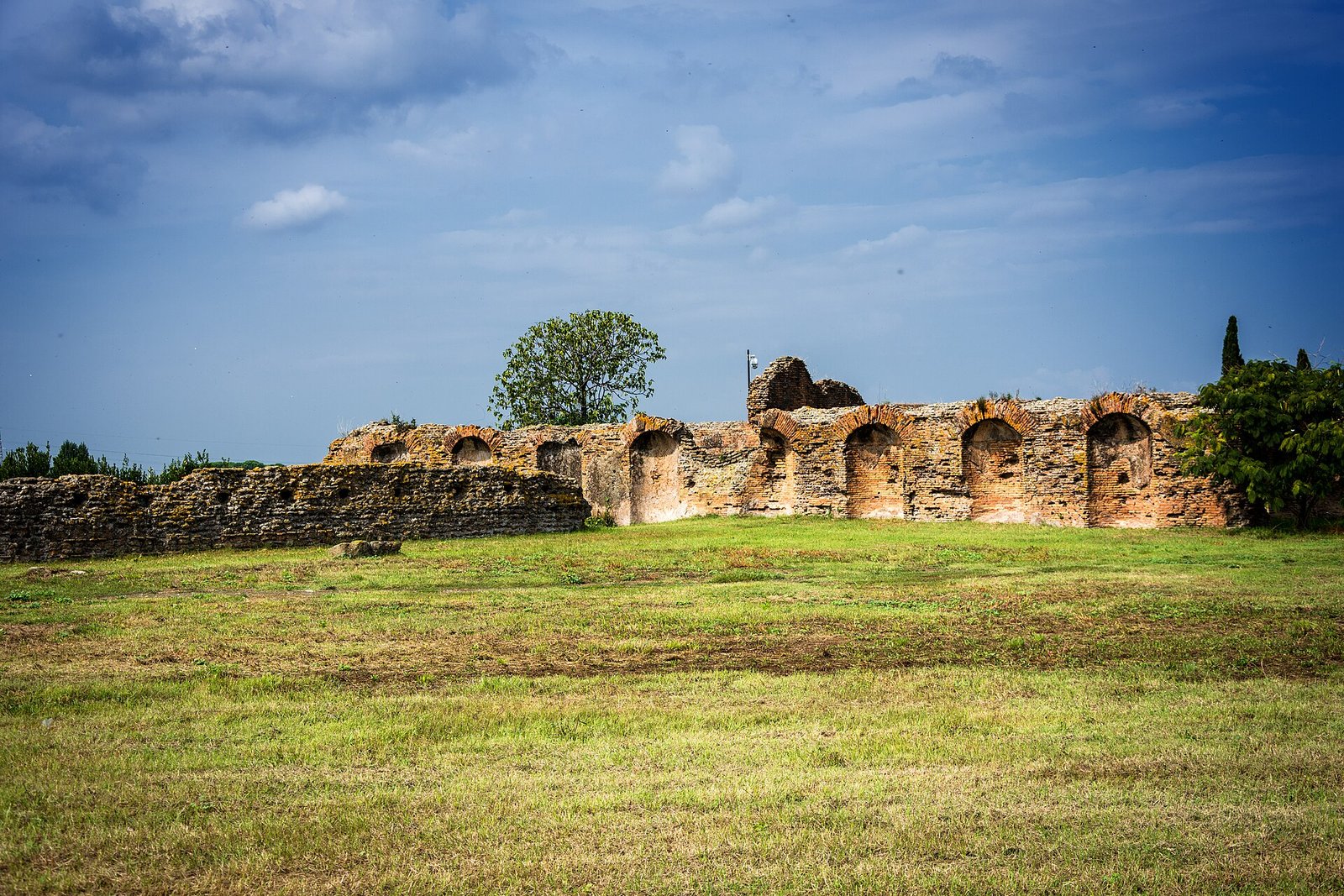
Villa dei Sette Bassi is at Via Tuscolana 1700, in Rome, and is closed to the public on ordinary days. You get in only with the timed visits organized by the Appia Antica Archaeological Park, which manages it for the Ministry of Culture, with reservation required on Musei Italiani portal. The ticket costs €6 full price and €2 reduced, free under 18. Dates and time slots have no fixed calendar: they appear on the booking portal.
What is behind the gate: the remains of one of the largest villas in the Roman suburbs, built in the time of Antoninus Pius, between 138 and 161 AD, at the fifth mile of the ancient Via Latina. Three residential blocks in brick, a huge hippodrome-shaped garden more than 300 meters long, cisterns, a small temple and a bath complex turned in late antiquity into a Christian building with a baptismal font.
Data checked on September 29, 2026 on the Ministry of Culture portal, on the dedicated page of Turismo Roma and on the excavation news published between 2021 and 2026, cited further on in the text. The official website of the Appia Antica Archaeological Park remains the reference for last-minute notices. Before leaving it's best to check the booking portal, because without a confirmed time slot the gate on Via Tuscolana stays closed and the villa can only be seen from outside.
In brief: address, hours, ticket
- Address: Via Tuscolana 1700, Rome, Capannelle area, between Via Tuscolana and Via di Capannelle.
- Operator: Appia Antica Archaeological Park, Ministry of Culture, email pa-appia.settebassi@cultura.gov.it, phone +39 333 618 0565.
- How to enter: only with a timed visit of the Park, reservation required on Musei Italiani portal or app.
- Price: €6 full price, €2 reduced, free under 18. Single Park ticket at €12.
- Hours: no fixed hours, available days and time slots are published only on Musei Italiani portal.
- How to get there: the operator gives no lines for the villa, metro A serves the nearby Parco degli Acquedotti.
- Accessibility: the operator publishes no information on routes, ask by email before booking.
Where it is and what you actually see
The villa occupies a large plateau between Via Tuscolana, the Aqueducts Park and the Lucrezia Romana district, in the Capannelle area, within the territory of Municipio VII. The entrance at Via Tuscolana 1700 opens onto a long tree-lined avenue that leads to a farmhouse built in the early 20th century, when the whole area was an agricultural estate of the Torlonia family. The ruins rise beyond the farmhouse, in the middle of the meadow.
The first block, to the east, is a square building about 50 meters on each side, built at the start of the reign of Antoninus Pius, with a peristyle of about 45 meters. A few years later, between 140 and 150, a second block was added, 45 meters by 25, closed to the south by a panoramic rotunda. The third building, the biggest, came at the end of the reign, with bath halls and large rooms on several floors.
In front of the three blocks stretched the hippodrome-shaped garden, which sources measure slightly differently: the Ministry portal speaks of a peristyle-garden of 320 meters, other reconstructions of 95 by 327 meters. It was terraced and surrounded by a cryptoporticus, with pools, avenues, fountains and statues. Today it's a meadow. To grasp its scale you have to walk into it and look toward the tall walls at the far end.
Farther north, in the agricultural part of the property, is the rectangular brick tempietto of the second century, with barrel vaults, a gabled roof and an internal apse for the cult statue. Around it are the cisterns, one of them on two levels, fed according to reconstructions by the Anio Novus aqueduct. The Archaeological Park dedicates a separate page to the aqueduct that bears the villa's name, still readable in the landscape among the fields.
To the south, toward Lucrezia Romana, is the sector archaeologists call the Dépendance, or Terme dei Tritoni: a bath complex of the second century that became in late antiquity a Christian place of worship. This is where the most recent excavations have concentrated, with the discovery of a stretch of Via Latina in 2021 and of a marine mosaic with a baptismal basin announced in December 2025. It's the part that changes most from one season to the next.
Anyone who arrives expecting a villa preserved in elevation like Hadrian's Villa at Tivoli has to recalibrate. Here what remains are brick walls, some very tall, foundations, cisterns and partly excavated rooms, in an open Roman countryside landscape with the buildings of the nearby districts on the horizon. The strength of the place is exactly this contrast, and the feeling of being in a site still in full research.
The urban context matters. The villa is surrounded by busy roads, by the Lucrezia Romana district and by the streets of the Capannelle area. For this very reason the site has a particular value: it is one of the last big fragments of Roman countryside left inside the built-up city, with the ruins still in the middle of the meadow and not isolated inside a concrete enclosure. The fence protects the area and regulates access.
A curiosity about Villa dei Sette Bassi
The name doesn't mean seven short people or seven ruins. The Ministry portal traces it, in all likelihood, to Settimio Basso, prefect of Rome under Septimius Severus, between 193 and 211. The Latin Septimius Bassus, passed from mouth to mouth for centuries in the Roman countryside, would have become Sette Bassi. It's the same mechanism that produced so many popular place names around the city, often more durable than the ruins they refer to.
The villa, however, was already standing for decades when Settimio Basso could have been its owner. It was built under Antoninus Pius, and the figure who left it his name would have arrived one or two generations later. Who the first owners were doesn't emerge from any published inscription. It's a frequent case among suburban villas: the last famous owner is remembered, and the builder remains anonymous.
A second curiosity concerns a freshly restored piece. In the monumental nymphaeum of the villa, with niches and water features, a curved marble pediment was found with a Triton, a male figure with a fish tail, taming a sea horse among the waves. The frame bears lanceolate leaves, ovules and palmettes. The piece is dated to the late Antonine age, the end of the second century, and its restoration started in January 2026.
The cryptoporticus that surrounded the garden also deserves attention. It was a covered gallery, partly underground, that allowed you to stroll in the shade in summer and under cover in winter, and that supported the garden terraces. The underground parts are often the ones the soil has protected best. During the visit it's best to ask which stretches are accessible and which are still under the ground.
One thing nobody tells you about Villa dei Sette Bassi
Almost all maps and many travel sites present the villa as an archaeological area to visit freely, sometimes with generic hours. It isn't so. The Ministry portal, in the version updated to July 1, 2026, gives the site as closed every day in ordinary hours and open only with timed visits in the slots published on Musei Italiani. Anyone who arrives without a reservation finds the gate closed and an avenue that can't be walked.
The second thing that is said little concerns the two parks. The villa is inside the perimeter of the Parco regionale dell'Appia Antica, the Lazio Region body that protects the landscape, but the archaeological site is managed by the Appia Antica Archaeological Park, an institute of the Ministry of Culture. They are two different bodies, with different sites, phone numbers and rules. For the visit to the villa, the Archaeological Park counts, not the regional body.
Third practical detail: the ministerial notes also give an administrative address, Via Tuscolana 114, with a postal code that corresponds to Frascati. It is not the entry point. The gate for visits is at number 1700 of Via Tuscolana, as the events pages and the Rome Capital tourist portal confirm. If you use a navigator, enter 1700 and check that the destination falls in the Capannelle area.
Our opinion, against the grain of how the villa is presented almost everywhere, is that the formula of the second biggest villa of the suburbs after the Quintili one is the wrong key. It pushes toward a comparison that Sette Bassi loses, because the Villa of the Quintilii has an antiquarium, an equipped route and more legible rooms. Sette Bassi is worth it for something else: a big research site where something new comes out every year.
Settimio Basso or Caracalla: whose villa was it really?
The sources don't agree on the origin of the name. The Ministry portal and Parco degli Acquedotti website give Settimio Basso, urban prefect under Septimius Severus. A second hypothesis, reported in encyclopedia reconstructions, instead ties the name to the emperor Lucius Septimius Bassianus, better known as Caracalla, son of Severus and patron of the Baths of Caracalla. Neither hypothesis is supported by an inscription found on the spot.
The Caracalla hypothesis carries a wider idea with it. According to this reading the emperor would have brought together in a single big imperial estate Villa dei Sette Bassi and the nearby Villa dei Quintili, confiscated after Commodus killed the two Quintilii brothers. It would have been a block of imperial properties along the two axes of Via Latina and Via Appia, southeast of the city. It's a plausible reconstruction, not a documented fact.
What the documents do say is the building chronology. The villa was born in three phases during the reign of Antoninus Pius, the same emperor of the temple dedicated to his wife Faustina in the Roman Forum. It stays inhabited until the fourth century and receives restorations for two more centuries, until the sixth. In the meantime part of the bath rooms changes function and becomes a Christian place of worship with a baptistery.
The Severan dynasty, to which both Settimio Basso and Caracalla belong, left very visible marks in Rome: the enlargements of the imperial palace on the Palatine and the great baths. Seeing the villa within this picture helps to understand it. The suburban properties of the elite were places of residence, agricultural production and display, and they changed hands with the political fortunes of the families that owned them.
A detail that helps read the dates: Antoninus Pius reigned from 138 to 161, in a period of internal peace and great private building activity. The suburban villas of those years, like this one, combined residence, baths, gardens and farm estates in a single complex. The fact that Sette Bassi grew in three close phases, within a few decades, says a lot about the wealth and ambitions of whoever commissioned it.
My advice for visiting Villa dei Sette Bassi
The advice is to book the first available time slot in the morning and to arrive at the gate a few minutes early. The access avenue is long and the visit starts at a precise time. Bring water and a hat: the hippodrome garden has almost no shade, and from May to September the sun on the meadow is felt already by mid-morning. Closed shoes, because the ground is uneven and in winter muddy.
Before going in, it's best to look at a plan of the villa and fix three points: the three residential blocks, the long garden in front and the Dépendance to the south. With this map in your head the walls scattered across the meadow make sense. Without it, you risk seeing only bricks. The Archaeological Park's website and the excavation news published in recent years offer images and diagrams useful for preparing.
If time is short, better to concentrate on the south sector, the one with the recent excavations. Via Latina found in 2021, the mosaic with the marine procession and the baptismal basin are the novelties that set Sette Bassi apart from the other suburban villas. The Park's visits, led by the assigned staff, are the right moment to ask questions about the state of the works and about what will remain visible after the site closes.
A last recommendation concerns the calendar. Openings are few and change from season to season. It's worth following the Archaeological Park's social channels, which announce visits, special openings and festivals, and also checking the Ministry's free Sundays, when in the past the villa opened with visits without a ticket. The combination of a sunny day and a free time slot is rare: when it happens, take it.
Anyone organizing the visit for several people must keep in mind that the portal doesn't publish the maximum number of places per time slot. It's best to write to the villa's email before buying tickets, saying how many people will come, if there are young people under 18 who enter free and if a route without steps is needed. The operator's reply, in writing, avoids surprises at the gate.
How much does it cost and how do you book?
Booking is mandatory and goes through Musei Italiani portal or its app, where the days and time slots of the visits appear. Alternatively the Ministry portal gives the email pa-appia.settebassi@cultura.gov.it and the phone +39 333 618 0565. The Rome Capital tourist portal also gives the number 06 7222568 and the general address pa-appia@cultura.gov.it. The operator doesn't publish a maximum number of participants per time slot.
| Fare | Price |
|---|---|
| Villa di Sette Bassi, full price | €6 |
| Villa di Sette Bassi, reduced | €2 |
| Under 18 | free |
| Park ticket, all sites, full price | €12 |
| Park ticket, all sites, reduced | €2 |
| Park annual pass | €25 |
The ticket is bought only on the official channel: the villa's booking page on Musei Italiani, linked to the Ministry of Culture page. No villa ticket sold by private tourist platforms turns up. Be wary of offers that promise free entry or skip-the-line: the site opens only in the Park's time slots.
The single Park ticket at €12 is worth it if on the same day or in the following days you also want to see the other sites run by the institute, like the Mausoleum of Cecilia Metella, Capo di Bove and Villa dei Quintili. The annual pass at €25 is worth it for people who live in Rome and come back several times to the Park's sites. According to the booking portal the reduced ticket is reserved for European Union young people between 18 and 24.
On some days entry has been free. On November 6, 2022 the villa opened for a free Sunday of the Ministry, with reservation required and time slots at 10:30 and 12:00. On Sunday, February 1, 2026 the Triton restoration site could be visited without a ticket. The Sub_urbem festival of September 2026 had free entry. These are occasions to look for on the Archaeological Park's website, which announces them a few days ahead.
Another well-known fact, yet rarely cited
It is known that the countryside southeast of Rome was crossed by aqueducts. It is less often mentioned that the big suburban villas were privileged users of that water. According to reconstructions Villa dei Sette Bassi drew water from the Anio Novus, one of the two great aqueducts that reached the city above Porta Maggiore. Cisterns, nymphaea and baths were possible only thanks to this connection to the public network.
The most evident sign of this relationship is the so-called Sette Bassi aqueduct, to which the Archaeological Park dedicates a separate page. The landscape of the nearby Parco degli Acquedotti, with the arches of the Claudia and the Acqua Felice, tells the same story on an urban scale. The Acqua Felice, built at the end of the 16th century, reaches the center at the Fontana del Mosè, and shows how long this countryside served the city.
Inside the city the water of these aqueducts continued on new arches. The branch that Nero had built to carry the Acqua Claudia toward the Caelian still passes over the Arch of Dolabella, and the remains of that system can be followed up to the Palatine. Thinking of the villa as a private end point of the same network helps to understand why the richest villas rose right near the aqueducts.
A second rarely cited fact concerns names. Many ruins of the Roman countryside carry popular names born from distortions or wrong attributions. Sette Bassi comes from a deformed Latin name. The so-called Tomb of Nero, on Via Cassia, bears the name of an emperor who has nothing to do with that sepulcher. Reading these names as clues to tradition, and not as proof, is the right rule.
The right photo to take at Villa dei Sette Bassi
The most effective framing is got inside the site, from the far end of the hippodrome garden toward the tall walls of the residential blocks. The meadow in the foreground conveys the length of the ancient space, the bricks at the back give the scale. The best light is early morning or late afternoon, when the raking sun lights up the red of the bricks and draws the shadows of the niches and windows.
A second photo, possible even without going in, is taken from Via di Capannelle, the road that runs along the site and from which, according to Parco degli Acquedotti portal, the remains can be seen. Stay on the sidewalk or in public areas, without climbing fences and without entering the fields. From outside you mostly catch the silhouette of the tallest walls against the sky, with the countryside around and the districts in the background.
During the visits it's best to ask staff if and where the ongoing excavations can be photographed. Sectors with mosaics and newly discovered structures may be covered or off limits for reasons of protection. The restoration site of the Triton pediment, open to the public in January 2026, was designed exactly to be looked at up close: in similar cases the rule is set by the operator, day by day.
A third image, less obvious, is the entrance avenue with the Torlonia farmhouse at the end. It tells another phase of the place's history, that of the agricultural estate of the early 20th century, when the ruins were part of a landscape of fields and pastures. Shot on arrival, before entering the archaeological area, it serves as a natural introduction to a series of photos of the villa and its context.
How do you get there from the center of Rome?
The operator publishes no directions for public transport to the villa. Parco degli Acquedotti portal, which borders the site, gives for that park the Giulio Agricola and Subaugusta stops of metro A and bus lines 559, 590, 650 and 654. For the last stretch to number 1700 of Via Tuscolana it's best to use the ATAC route planner, entering the exact address and the time of the booked slot.
By car the address to set is Via Tuscolana 1700, in the Capannelle area, on the road that leads from the center toward the Castelli Romani and Frascati. Along the way you pass in front of the Cinecittà studios. The operator doesn't say if internal parking is available for visitors: better to ask in the confirmation email, especially if you arrive with a minibus or with several cars.
For those coming on foot from Parco degli Acquedotti, the villa is on the opposite side from Via Lemonia entrance, toward Via Tuscolana and Capannelle. The published information doesn't indicate an internal passage open to the public between the two sites. You leave the park, reach Via Tuscolana and arrive at the villa's gate. Work out the times with a map before booking the slot.
A note for those arriving from Ciampino airport or from the Castelli: the villa is on the side of Rome facing the Alban Hills, and Via Tuscolana is the direct road that connects the area to the city. Anyone sleeping in the Castelli or at Frascati can organize the visit as the first stop of the day toward the center, booking the morning slot and then continuing toward the aqueducts and the Appian Way.
Some important events that happened here in history
Between 138 and 161 AD, under Antoninus Pius, the villa is built in three phases. Between 193 and 211, under Septimius Severus, it would have belonged to the urban prefect Settimio Basso, from whom according to the most common version the name derives. The villa stays inhabited until the fourth century and receives restorations until the sixth. Between the end of the fourth and the beginning of the fifth century the baths of the Dépendance become a Christian building with a baptistery.
Traces of life don't end with antiquity. In the excavations announced in December 2025, signs of fires lit on the mosaic floor in late antiquity emerged and, later, a bread oven and an inhabited space datable around the eighth century. It's the phase in which the big villas become refuges, farms and small settlements, while the Roman countryside empties and reorganizes around the farmhouses.
In the 18th century the area is explored by the Scottish painter and excavator Gavin Hamilton, one of the protagonists of the hunt for antiquities in the Roman countryside. In the early 20th century the property is part of the agricultural estate of the Torlonia, who build the farmhouse at the end of the avenue. In 1937 and 1938 a model of the villa is made for the Mostra Augustea della Romanità, with the contribution of the scholar Nicolae Lupu.
The 20th century also brings destruction. In 1944 the villa suffers serious damage from a bombing by the British air force. A large four-story structure, which had remained standing until then, collapses for good in 1951 during a violent storm. It's a loss that still weighs on the legibility of the site: the earlier photographs and drawings show a building much taller than what remains.
The most recent years are those of gradual reopening. On September 21 and 22, 2019, for the European Heritage Days, the Soprintendenza organizes free visits. In October 2021 a stretch of Via Latina reemerges. On November 6, 2022 the villa opens for a free Sunday. In December 2025 the mosaic with the marine procession is announced, in January 2026 the restoration of the Triton starts, from September 18 to 20, 2026 the Sub_urbem festival is held.
Who has passed through Villa dei Sette Bassi
The first names are those of emperors and officials. Antoninus Pius reigns while the villa is built. Settimio Basso, prefect of Rome under Septimius Severus, leaves it, according to the most accredited version, its name. Caracalla, in the alternative hypothesis, would have made it part of a big imperial estate. Of none of them are visits known that are documented by inscriptions found on the spot: their presence remains tied to the name and to the reconstructions.
Then come the people without a name: the Christian community that between the fourth and fifth century immersed itself in the baptismal basin of the Dépendance, whoever lit fires on the mosaic, whoever baked bread in the eighth-century oven. These are presences that the excavations give back through objects and structures, and that tell the villa better than any famous name. It's the liveliest part of the research under way.
Among scholars, besides Gavin Hamilton in the 18th century, historical reconstructions recall the British archaeologist Thomas Ashby, a great connoisseur of the Roman countryside, and Nicolae Lupu, who contributed to the villa's model for the exhibition of 1937 and 1938. That model, according to encyclopedia sources, belongs today to the collections of Museo della Civiltà Romana at EUR. More recently the villa has been at the center of a project with Sapienza, the University of Salento and Roma Tre.
In the early 20th century the land was an agricultural estate of the Torlonia family, the same that tied its name to Villa Torlonia on Via Nomentana and to many properties in the Roman countryside. The farmhouse at the end of the avenue is the work of that season. Farmers, shepherds and estate managers lived for decades next to the ruins, using them as shelter, enclosure or reference point in the fields.
In recent years less predictable figures have also come through the gate. For Sunday, November 6, 2022, the reenactors of the Legio Secunda Parthica Severiana were scheduled, with military formations, armor and roles of Roman soldiers. In September 2026 the Sub_urbem festival brought to the villa music, workshops, lighting interventions and live shows, with the participation of the actor Giorgio Tirabassi. The site, from a closed place, is becoming a cultural space of the southeast quadrant.
What have the excavations of recent years discovered?
In October 2021, in the southern sector of the villa, near the Dépendance, a stretch of the ancient Via Latina reemerged. The roadway is about 3.80 meters wide, with paving that is disturbed but clearly recognizable at the edges. Ground-penetrating radar surveys, coordinated by Roma Tre University, had indicated where to dig. Before this discovery, among the known stretches of the road in this area there was a gap of more than a kilometer and a half without visible traces.
The 2021 project was coordinated and directed by the Appia Antica Archaeological Park, with Sapienza University of Rome, the University of Salento and Roma Tre. The stated goal was to give back to citizens a site closed for years. Via Latina is the road that left the walls at Porta Latina, passed next to the church of San Giovanni a Porta Latina and ran southeast among tombs, villas and aqueducts.
The structure called Dépendance, where the road reemerged, was originally a bath complex of the second century AD. In a later phase it was reused as an early Christian place of worship. This double use, first the bath and then prayer, is a recurring theme in late antique Rome, where many public and private buildings were adapted to the needs of Christian communities, often keeping existing walls, floors and plumbing.
In December 2025 the specialist press reported a new discovery in the area of Terme dei Tritoni: a mosaic floor with a marine procession, with Poseidon and dolphins, and a Christian building datable between the end of the fourth and the beginning of the fifth century, with a baptismal basin for immersion fitted with steps and a hydraulic system. The excavation, directed by the Park's archaeologist Stefano Roascio, was funded with money from the PNRR Caput Mundi program.
In January 2026 the restoration of the pediment with the Triton began, funded by LoveItaly, Federalberghi Lazio and Fondazione Roma, with a site open to the public on some dates in January and February. On Sunday, February 1, 2026 the visit to the site was free. The press announced that, after restoration, the pediment would be displayed in the center, in Piazza Barberini. Where it is now has to be asked of the operator.
What is documented and what is only tradition?
What the documents and the excavations say: the villa is built in three phases under Antoninus Pius, stays inhabited until the fourth century, receives restorations until the sixth, hosts between the fourth and fifth century a Christian building with a baptistery and, around the eighth, an oven and an inhabited space. The collapse of 1951 and the damage of 1944 are facts of the 20th century, recorded by historical reconstructions of the site.
What tradition says: the name Sette Bassi as a popular deformation of Septimius Bassus, the prefect of Septimius Severus. It's the version adopted by the Ministry, which however presents it with a cautious adverb, probably. No published inscription directly links that figure to the villa. Tradition has the strength of continuity, because the name has reached today in the place names of the countryside.
What remains an unproven hypothesis: the link with Caracalla and the idea of a big imperial estate that would have brought together Sette Bassi and Villa dei Quintili. It's a plausible reading, consistent with the policy of the Severans and with the closeness of the two properties, but it doesn't rest on a document. Even the ranking of villas by size should be taken as an estimate, because a good part of the complex has not been excavated.
How do you read the villa within the system of the Appian Way and Via Latina?
Villa dei Sette Bassi is one tile of a wider landscape, the one protected by the Appia Antica Park. Between Via Appia and Via Latina tombs, villas, catacombs and aqueducts line up, in a band of countryside that from the Aurelian Walls reaches the Castelli. Sette Bassi occupies the eastern side of this system, toward Via Tuscolana, away from the most beaten paths of the Appian Way.
On Via Latina, closer to the city, are other places that help understand the road: the Hypogeum of Via Dino Compagni, with its late antique paintings, and farther on, toward the countryside, the stretches of paving preserved along the ancient route. On the Appian side, the Villa of Maxentius offers the comparison with another imperial residence, later, built with its circus and the family mausoleum.
The most immediate comparison remains the one with Villa dei Quintili, the biggest of the suburbs, which rises on Via Appia a short distance away as the crow flies. The two villas are contemporary for a good part of their history and, in the hypothesis that ties them to Caracalla, would have ended up in the same imperial patrimony. Seeing them on two close days allows you to understand the difference between an equipped site and a site still in full research.
Outside the suburbs, the imperial villas of Lazio complete the picture: the Villa of Livia at Prima Porta, the Villa of Trajan at Arcinazzo Romano and the Villa of Hadrian at Palestrina. Each shows a different choice of landscape and distance from Rome. Sette Bassi is the closest to the city, designed for those who wanted the countryside without really leaving the Urbe.
A last element of the system is the city itself. The villas of the suburbs were connected to Rome by roads, aqueducts and economic interests, and their owners lived between the town residence and the country one. Anyone who visits Sette Bassi after seeing the urban domus, like the Roman Houses of the Caelian, catches well the difference in scale between the house in town and the big property outside the gate.
When is it closed and what shouldn't you expect?
The villa is closed on all days when Musei Italiani portal shows no available time slots. In the ordinary hours published by the Ministry it is listed as closed every day, and openings happen only in the slots given for timed visits. Based on the published information there are no fixed weekly hours. In case of bad weather or works the operator can cancel slots: check the confirmation email the day before.
Don't expect an on-site museum, a ticket office, a cafe or equipped restrooms: the operator lists none. Don't expect extended explanatory panels along the whole route either. The visit works thanks to the Park staff who lead the slot. Anyone looking for an antiquarium with displayed finds should go to Villa dei Quintili, where the visiting route is more structured.
Don't expect, finally, to see everything the press talks about. The mosaic with the marine procession and the baptismal basin are in an excavation area, and the operator decides case by case if and how to show them. The Triton pediment, after restoration, was announced for a display in the center. Before booking it's best to ask by email which sectors are included in the slot.
A last warning concerns the season. The openings of recent years fell mostly on special days: the European Heritage Days of 2019, a free Sunday in November 2022, the Triton site between January and February 2026, the September 2026 festival. The calendar of slots doesn't guarantee openings in every month. If your trip to Rome falls in those months, it's best to write to the operator well in advance and keep an alternative ready, for example Villa dei Quintili or Parco degli Acquedotti.
Eating in the area: what to avoid
The Capannelle area and the outer Via Tuscolana is a residential district, not a tourist area, and the typical traps of the center are less frequent. A few signs remain to recognize here too: menus with photos of the dishes in four languages, the barker on the sidewalk, places open continuously from morning to night with no break in the kitchen, menu items with no price or with the price given orally.
Another sign not to overlook is the menu that differs between the one displayed outside and the one handed over at the table, or fresh pasta rolled out in the window as a show more than as work. The Romans of the area don't go into these places because they know the bill doesn't match what arrives on the plate. To choose with care there is the list of addresses on Google Maps.
What to combine in a day
The most natural pairing is Parco degli Acquedotti, bordering the villa: the arches of the Claudian aqueduct and the Acqua Felice in the meadow tell the same story of water that fed Sette Bassi. A walk there before or after the slot completes the morning. Anyone with energy left can continue toward Via Appia, with the Cecilia Metella complex and the catacombs.
On the Appian Way, the places to line up are the Catacombs of San Callisto, the basilica of San Sebastiano fuori le mura and the little church of Domine Quo Vadis. Toward the city, Porta San Sebastiano houses the Museum of the Walls, with the walkway on the walls. For Via Latina, the Colombari di Vigna Codini offer another example of suburban burials.
Toward the Castelli, Via Tuscolana leads to Frascati and to the archaeological park of Tusculum, the ancient city that gave the road its name. It's a different day, among noble villas and ruins on a hill, but anyone who has already seen Sette Bassi catches well the passage from the suburban villa to the villa of pleasure. In the same direction are Grottaferrata and Marino.
Anyone who wants to follow the water to the city can end the day at Holy Cross in Jerusalem and the Amphitheatrum Castrense, not far from Porta Maggiore, where the Claudian and Anio Novus aqueducts entered Rome. It's a coherent route: from the countryside of the villas to the walls, following the same arches that fed the cisterns and nymphaea of Sette Bassi.
For those who prefer to stay in the east quadrant, another peripheral archaeological area is the Mausoleum of Saint Helena on Via Casilina, with the catacombs of Santi Marcellino e Pietro. Farther away, on Via Prenestina, the area of Gabii shares with Sette Bassi the logic of calendar openings. For more low-cost ideas there is our page on Free Rome.
Frequently asked questions
Is Villa dei Sette Bassi open to the public?
Only in the timed visits organized by the Appia Antica Archaeological Park, with reservation required on Musei Italiani portal or its app. In the ordinary hours published by the Ministry it is listed as closed every day. On some occasions, like the European Heritage Days, the free Sundays or the Sub_urbem festival of September 2026, the site has opened with free visits or dedicated events.
How much does the ticket cost?
The Ministry portal gives €6 for full price and €2 for reduced, with free entry for those under 18. There is also the Park ticket, valid for all the institute's sites, at €12 full price and €2 reduced, and an annual pass at €25. The reduced categories should be checked on the portal at the time of purchase.
Who runs the villa?
The site is run by the Appia Antica Archaeological Park, an autonomous institute of the Ministry of Culture, which also runs Villa dei Quintili, the Mausoleum of Cecilia Metella and Capo di Bove. The area is inside the perimeter of the Parco regionale dell'Appia Antica, a Lazio Region body, but for bookings and information about the visit the reference is the Archaeological Park.
Why is it called Sette Bassi?
The name would derive, according to the Ministry portal, from Settimio Basso, prefect of Rome under Septimius Severus, between 193 and 211. An alternative hypothesis ties it to Lucius Septimius Bassianus, that is, Caracalla. In both cases the Latin name was transformed by popular tradition into Sette Bassi. No inscription found on the spot confirms either version.
Can you see the villa without booking?
From the outside, yes. According to Parco degli Acquedotti portal the remains can be seen from Via di Capannelle, the road that runs along the site. You look from the public road, without climbing fences and without entering the fields. From outside you catch the silhouette of the tallest walls, but not the interior rooms, the mosaics or the structures of the recent excavations.
How do you get there by public transport?
The operator publishes no directions for transport to the villa. For the nearby Parco degli Acquedotti the park's portal gives the Giulio Agricola and Subaugusta stops of metro A and lines 559, 590, 650 and 654. To reach the gate at Via Tuscolana 1700 it's best to work out the route on the ATAC site with the time of the slot.
Is the visit suitable for children?
Yes, for kids used to walking outdoors: the garden more than 300 meters long, the cisterns and the story of the mosaic with Poseidon and the dolphins work well. The ground is uneven, there is little shade and a stroller is impractical. Entry is free under 18. For more ideas there is our page on Rome with Kids.
What was found in the recent excavations?
In 2021 a stretch of Via Latina about 3.80 meters wide, located with ground-penetrating radar. In December 2025 a mosaic with a marine procession and a Christian building of the late fourth and early fifth century with a baptismal basin, in the area of Terme dei Tritoni. In January 2026 the restoration started of a marble pediment with a Triton, found in the villa's nymphaeum.
What is the Sub_urbem festival?
It is a festival that was held at the villa from September 18 to 20, 2026, with free entry, with visits, lighting interventions, workshops and live shows, including the participation of the actor Giorgio Tirabassi. It was announced by the Archaeological Park and listed by the local press among the late-summer events in the southeast quadrant of Rome. A new edition has not been announced yet.
Who wrote this and from what sources
The text comes from the team at Tour Leader Pro, the Rome-based outfit that designs itineraries, visits and cultural events across Rome and Lazio. Fares, hours and booking arrangements given here come from the official sources cited in the text as of the date given at the start: the Ministry of Culture note, Musei Italiani portal, the Turismo Roma page and the excavation news published from 2021 to 2026. Tell us what you find has changed.
Organizing a visit to Villa dei Sette Bassi for a group means working with few time slots, an unpublished number of places and no services on site. It's best to fix the date first with the Archaeological Park, ask by email about parking and visitable sectors, then build the rest of the day on the Appian Way or the aqueducts. A useful resource for those who organize group travel is Tour Leader Pro.
Sette Bassi pays off more inside an itinerary on the Roman countryside than as an isolated outing: aqueducts, imperial villas, catacombs and tombs of Via Appia together tell how Rome used its territory. Anyone with a few days can give one to the Appian Way, one to the aqueducts and one to the Castelli, with Frascati and Tusculum. A useful resource for building a multi-day itinerary is Italy Planner.