The Nutcracker by Balletto di Roma at the Teatro Olimpico, December 17 to 20, 2026
https://www.estateromana.com/en/rome/trip-planner/the-nutcracker-by-balletto-di-roma-at-the-teatro-olimpico-december-17-to-20-2026/
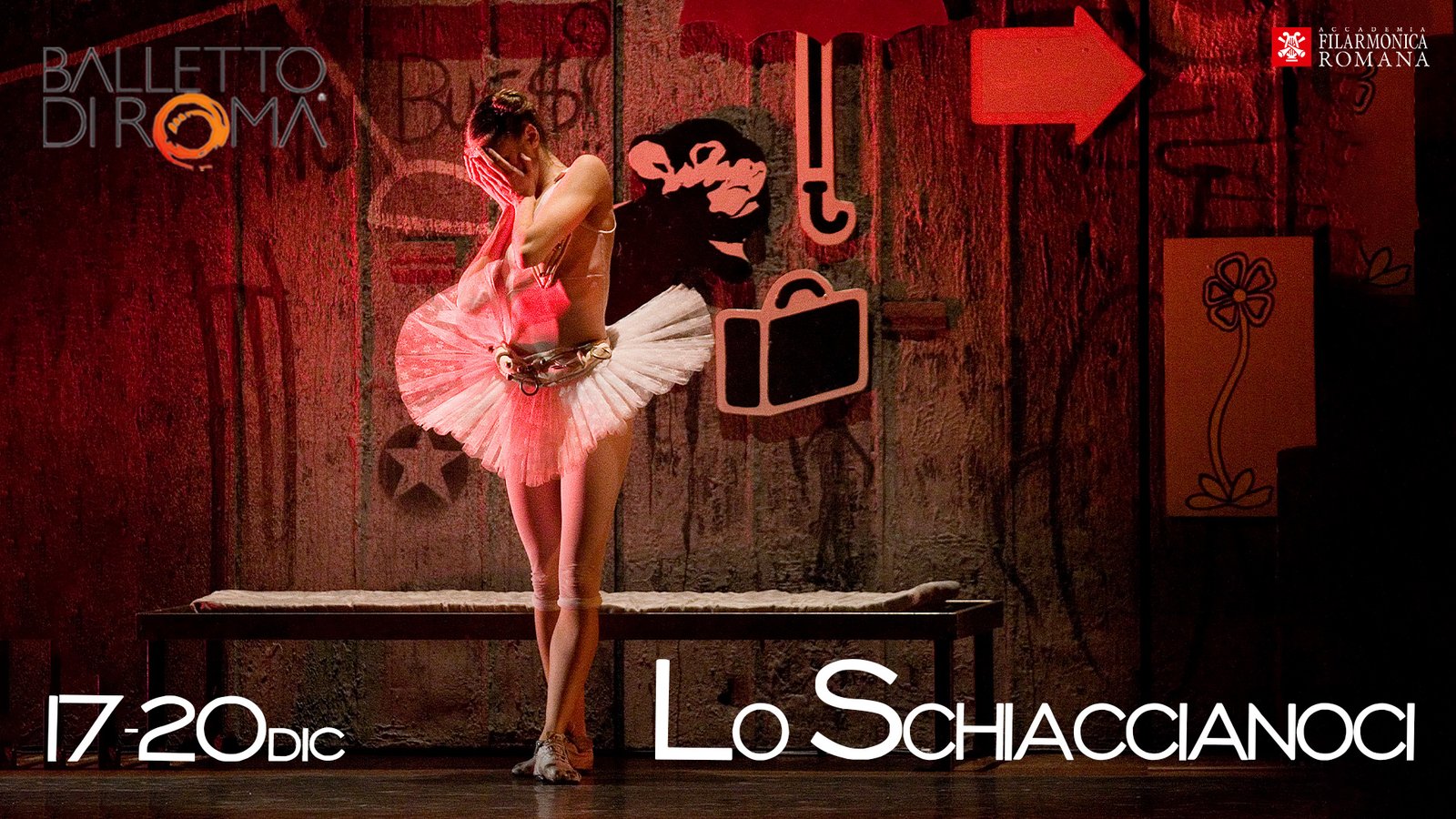
The Nutcracker by Balletto di Roma, in a new production 20 years after its debut, with choreography by Mario Piazza, dramaturgy by Riccardo Reim and Tommaso Stanzani as Drosselmeyer, plays at the Teatro Olimpico, piazza Gentile da Fabriano 17 (00196 Rome), from December 17 to 20, 2026, in collaboration with the Accademia Filarmonica Romana. There are five performances: Thursday, December 17 and Friday, December 18 at 8:30 p.m., Saturday, December 19 at 4:30 p.m. and 8:30 p.m., Sunday, December 20 at 5:30 p.m. The theater is reached by Metro A to Flaminio and then tram 2 to the terminus at piazza Mancini, from where you walk about 500 meters along viale del Pinturicchio, from Termini there is also bus 910 to the Pannini stop. The prices published by the theater range from 25 to 43 euros plus presale fee (from 3.80 to 6.50 euros), that is from 28.80 to 49.50 euros per ticket, with discounts for children under 12 in almost all sections and a 1.50-euro online fee. Tickets are bought on the venue's official website, linked to the theater's box office, or at the box office in piazza Gentile da Fabriano.
Language: opera sung in its original language; no English surtitles are announced, so check with the theater.
The Nutcracker is the Christmas ballet par excellence, and this version has a Roman story: born in 2006, performed 10 years in a row, 160 performances and 120,000 spectators. It now returns rewritten for the present, with digital technology and artificial intelligence in place of the television that dominated the first edition. Below you'll find what you'll see, who signs the show, the story of Tchaikovsky's ballet and of the company, the hall and everything you need to organize the afternoon or evening, also with children.
The Nutcracker by Balletto di Roma: what you see on stage
The Nutcracker by Balletto di Roma is a contemporary reading of Tchaikovsky's ballet, with choreography by Mario Piazza and dramaturgy by Riccardo Reim, returning in a new production 20 years after its debut. The theater presents it as a Nutcracker between tradition and the languages of the present.
A story of growing up
The official presentation insists on one point: the original ballet, often reduced to a Christmas fairy tale, is here returned to its deepest dimension, that of a story of growing up, of passing through childhood and losing innocence, suspended on the threshold of adolescence. Clara is not a little girl dreaming of sweets, she is a girl who is becoming grown up.
From television to artificial intelligence
In the 2006 version the scenic protagonist was the TV set: Clara channel-surfed, and real images broadcast by the television medium entered her adolescent world. In the new production the reference becomes today's technological imagery, with the challenges of artificial intelligence and digital media: the mirror of an adolescence bordering on dependence on technology itself.
A hybrid space
The result, according to the presentation, is a space in which real and virtual, dream and reality blur, and technology is both resource and risk: a tool of connection and isolation, creative stimulus and source of disorientation. It's a reading that speaks directly to the kids in the hall and to the parents who bring them.
Our view
Contemporary rereadings of The Nutcracker are many, and not all hold up. This one has a rare advantage: a first version already tested over 10 seasons in front of a Roman audience. The choice to update its theme instead of redoing it the same is the most honest. Whoever is looking for the tutu and the classic Sugar Plum Fairy will find something else, whoever brings a 12-year-old will find a show that concerns them.
Dates and times of The Nutcracker at the Teatro Olimpico
The Nutcracker by Balletto di Roma plays at the Teatro Olimpico from December 17 to 20, 2026 with five performances: Thursday the 17th at 8:30 p.m., Friday the 18th at 8:30 p.m., Saturday the 19th at 4:30 p.m. and 8:30 p.m., Sunday the 20th at 5:30 p.m. The calendar is the one published by the theater's official box office.
The matinees
The two afternoon performances, Saturday at 4:30 p.m. and Sunday at 5:30 p.m., are designed for families. With children they are the most convenient: you come out at dinner time, and getting home isn't a burden.
The evenings
Thursday, Friday and Saturday evenings at 8:30 p.m. are the performances for the adult audience and for people who work. Thursday, the first date, is usually the quietest for choosing seats.
A date to note
Friday, December 18 is the anniversary of the very first Nutcracker performance, staged at the Mariinsky Theatre in Saint Petersburg on December 18, 1892. For those who love coincidences, it's the evening to choose.
Tickets and prices for The Nutcracker
Tickets for The Nutcracker at the Teatro Olimpico cost from 25 to 43 euros depending on the section, plus a presale fee from 3.80 to 6.50 euros that the theater indicates as always charged, for kids under 12 there are reduced prices in all sections except the poltronissima gold. Online, a 1.50-euro fee per ticket is added.
Sections and full prices
Poltronissima gold: 43 euros plus 6.50 presale, 49.50 in total. Poltronissima laterale: 36 euros plus 5.40, 41.40 in total. Poltrona and balconata: 33 euros plus 5, 38 in total. Balconata with railing: 28 euros plus 4.20, 32.20 in total. Balconata laterale: 27 euros plus 4.10, 31.10 in total. Balconata laterale with railing: 25 euros plus 3.80, 28.80 in total.
Prices for under-12s
Poltronissima laterale: 25.20 euros plus 3.80, 29 in total. Poltrona and balconata: 23.10 euros plus 3.50, 26.60 in total. Balconata with railing: 19.60 plus 2.90, 22:50 in total. Balconata laterale: 18.90 plus 2.80, 21.70 in total. Balconata laterale with railing: 17.50 plus 2.60, 20:10 in total. For a family with two children, the difference is felt.
Where to buy
The main channel is the online box office reachable from the Teatro Olimpico's official website, under buy online, alternatively there is the theater's box office. For information the theater answers at biglietti@teatroolimpico.it. 10 days before Christmas the matinees are the first to fill: if you're coming with children, buy early.
20 years of Nutcracker: Piazza and Reim version
Mario Piazza and Riccardo Reim's Nutcracker debuted in 2006 and stayed on the program for 10 consecutive years, becoming a fixture of the Christmas season in Rome and in many Italian theaters, with 160 performances and 120,000 spectators.
Mario Piazza, the choreography
Mario Piazza signs the movement: a contemporary dance that starts from the structure of Tchaikovsky's ballet and bends it to a modern story. Taking up one's own choreography after 20 years and rewriting it for a new audience is a different job from creating it: you have to know what to keep and what to leave.
Riccardo Reim, the dramaturgy
Riccardo Reim handles the dramaturgy, that is the story that holds the scenes together. In a version like this, where the traditional plot is read as a story of adolescence, the dramaturgy is decisive: it is what shifts the center from the fairy tale to the character.
Tommaso Stanzani, Drosselmeyer
In the new production the artistic direction entrusts the role of Drosselmeyer to Tommaso Stanzani, whom the theater presents for his eclecticism as a central point of reference for Clara and for all the other characters. Drosselmeyer is the mysterious godfather who brings the nutcracker as a gift and opens the door of the dream: he is the character who guides the story, and entrusting him to a performer with strong stage presence is a precise choice. The other roles are danced by the dancers of the Balletto di Roma company.
With the Accademia Filarmonica Romana
The show is produced in collaboration with the Accademia Filarmonica Romana, whose historic concert home is the Olimpico. It's the same collaboration that in September brought to the same stage Astor, the company's show on Piazzolla's music.
Tchaikovsky's Nutcracker, the story of the ballet
The Nutcracker is a ballet with music by Pyotr Ilyich Tchaikovsky, op. 71, composed between 1891 and 1892 and first performed at the Mariinsky Theatre in Saint Petersburg on December 18, 1892, the average running time is about an hour and a half.
From Hoffmann to Petipa
The ballet was commissioned by Ivan Vsevolozhsky, director of the Russian Imperial Theatres. The story comes from Alexandre Dumas père's tale The Story of a Nutcracker, from 1845, itself a reworking of E. T. A. Hoffmann's Nutcracker and the Mouse King, from 1816. Tchaikovsky followed meticulously the indications of the choreographer Marius Petipa, who then entrusted the realization to his assistant Lev Ivanov.
A first night without success
The premiere, conducted by the Italian composer Riccardo Drigo, was not a success. Among the performers was the Italian Antonietta Dell'Era in the role of the Sugar Plum Fairy, Clara was played by a little girl from the Mariinsky ballet school. Success came first for the suite, which Tchaikovsky himself conducted in Saint Petersburg on March 7, 1892 with triumphant result, months before the full ballet.
The celesta
One of the novelties of the score is the celesta, an instrument Tchaikovsky had seen in Paris and wanted in the orchestra at all costs. You hear it in the Dance of the Sugar Plum Fairy: that sound of glass bells that everyone recognizes comes from there.
Arrival in Italy
The Nutcracker arrived in western Europe in 1934, at Sadler's Wells in London, and in Italy in 1938, at La Scala in Milan, in an abridged edition, the full debut at La Scala was on December 31, 1956. In the United States the Christmas tradition was born with George Balanchine's 1954 version for the New York City Ballet.
The best-known music
The Waltz of the Snowflakes closes the first act, in the second come the divertissement with the dances of Chocolate, Coffee, Tea and the Trepak, then the Waltz of the Flowers and the Sugar Plum Fairy's pas de deux with the Prince. It's music that even those who have never been to a ballet have heard a thousand times.
Balletto di Roma, a company born in 1960
Balletto di Roma was born in 1960 from the artistic partnership of Franca Bartolomei and Walter Zappolini, two central figures of Italian dance in the second half of the 20th century, and for over 65 years has produced and spread Italian auteur dance in Italy and abroad.
The founders
Franca Bartolomei was a dancer and choreographer in the main Italian and foreign opera houses. Walter Zappolini was étoile of the Teatro dell'Opera di Roma and for 15 years directed the theater's dance school. The company was thus born within the Roman academic tradition, and from there moved toward contemporary creation.
The 1960 Olympics
In the early years the company's shows were included in the calendar of the 1960 Rome Olympics, with a theater set up in the Nymphaeum of Villa Giulia, a short distance from the Teatro Olimpico along via Flaminia.
Today's direction
The company's current profile is the result of the managerial guidance of Luciano Carratoni, who since the early 2000s has steered its growth. Since 2018 the artistic direction has been by Francesca Magnini. Alongside production, the company runs a training school and is recognized as a historic brand of national interest.
The tours in China
In 2023 Balletto di Roma took Romeo and Juliet to China, in a choreography by Fabrizio Monteverde, receiving the Italian Excellence Award at the China Awards, a second tour followed in 2024 and a third in 2025, the year of the 60-fifth anniversary.
A curiosity about The Nutcracker by Balletto di Roma at the Teatro Olimpico, December 17 to 20, 2026
In Hoffmann's original tale the heroine isn't called Clara. She is called Marie Stahlbaum, and Clara, Klärchen, is the name of her doll. In Dumas's adaptation, from which Petipa drew the libretto, she becomes Marie Silberhaus, in Russian productions, after the First World War, she was often called Masha. The name Clara, by which we all know her, is thus the name of a toy passed to the girl who owns it.
For the Balletto di Roma show the curiosity is not only philological. This Clara is a girl whose world passes through a screen, television in the 2006 version, digital today. The idea of a protagonist who takes her name from her toy reads in a new way when the toy is a device that holds her in its grip.
The second curiosity concerns the first performance: the role of Clara, in 1892, was entrusted to a little girl from the Mariinsky ballet school. It was Alexander Gorsky, in 1919, at the Bolshoi, who passed it to an adult dancer, having Clara and the Nutcracker dance the final pas de deux. From there comes the idea, taken up by many modern versions including this one, of The Nutcracker as a story of growing up and not a fairy tale for childhood.
The Teatro Olimpico, home of dance in the Flaminio district
The Teatro Olimpico in piazza Gentile da Fabriano was born as the Cine-Teatro Olimpico in 1936 and has been the Teatro Olimpico since 1981, it stands on the lungotevere Flaminio, level with the Ponte della Musica, and is the venue of most of the Accademia Filarmonica Romana's concerts.
From cinema to the Filarmonica
The block was built between 1935 and 1936 for the Società Generale Immobiliare, in the years of the Flaminio district and the Foro Italico. Until the 1950s the hall was mainly a cinema, with dressing rooms and theatrical equipment for variety shows. In the postwar period the Filarmonica rented it, and under the presidency of Adriana Panni it became a central place for music in Rome.
1980, the citizens' theater
When the owning company went bankrupt, Adriana Panni promoted a subscription that brought together many citizens in the Teatro Olimpico spa, which in 1980 bought the building. Since 1981 dance has been a permanent part of the program.
The hall and where to sit
The hall has 1,410 seats: 966 in the stalls, arranged in a sloping amphitheater, and 444 in the gallery, horseshoe-shaped. The stage measures about 12 by 10 meters, with a wooden floor. For dance the slope of the stalls is valuable: you see the dancers' feet even from the central rows. The sections with a railing cost less, but the rail cuts off the lower part of the stage, with small children, who see even less, it's best to avoid them.
Something nobody tells you about The Nutcracker by Balletto di Roma at the Teatro Olimpico, December 17 to 20, 2026
What is said little is that The Nutcracker, in Rome, has a long history of versions tied to the training of dancers. Among the versions designed for ballet schools is the one created for the School of Dance of the Teatro dell'Opera di Roma by Pablo Moret and Ofelia Gonzalez, performed at the Teatro Nazionale in 2012 and 2013. Balletto di Roma was born from a founder who had directed that school for 15 years, Walter Zappolini.
The reason is practical. The Nutcracker has many roles, short character dances, a big group scene like the Waltz of the Flowers: it's the ideal ballet for staging an entire company, young people included. That's why it's the title almost all companies and schools stage in December, and why in Rome, in the weeks of Christmas, several versions are seen at the same time.
The resulting advice is simple: don't mix up the shows. In the same season the city offers classic Nutcrackers, versions for children, school adaptations. The one at the Olimpico is a production by a professional company, with a precise contemporary dramaturgy. Read the venue and the company carefully before buying, and choose based on what you're looking for.
My advice for seeing The Nutcracker by Balletto di Roma at the Teatro Olimpico, December 17 to 20, 2026
The advice, with children, is the Saturday 4:30 p.m. performance. You arrive in afternoon light, come out shortly after 6, and have time for a quiet dinner or a stroll among the Christmas lights downtown. Sunday at 5:30 p.m. is just as good, but it's the last performance and fills first.
Second: prepare the kids. This Nutcracker is about technology and adolescence, and 12-year-olds get it right away, six-year-olds, used to the classic version or animated films, might expect toy soldiers and mice. Tell the original plot first and then say this is a Clara of today, with a phone in her hand. Spotting the differences becomes a game.
Third, on site: poltrona or central balconata, 38 euros full price and 26.60 for under-12s presale included. It's the best ratio of view to price, and the balconata gives children a view from above of the pattern of the group dances.
Finally: no car. In mid-December the Flaminio district is busy and parking is rare. Metro A to Flaminio, tram 2 to piazza Mancini, five minutes on foot.
Another well-known fact, yet rarely cited
Everyone knows The Nutcracker is the Christmas ballet. It's less remembered that at the premiere, in 1892, it wasn't a success. The real success came first for the suite, 20 minutes of music that Tchaikovsky drew from the score on invitation, as a preview, when the complete orchestration of the ballet hadn't even begun: he conducted it himself in Saint Petersburg in March 1892, with triumphant result. For years The Nutcracker was heard in concert more than seen in the theater.
The second well-known and rarely cited fact concerns its Christmas fame. The tradition of staging it every December is largely American: it was William Christensen, founder of the San Francisco Ballet, who brought it to the United States in 1944, and Balanchine's 1954 version for the New York City Ballet made it a winter rite. From there the custom came back to Europe.
For those going to the Teatro Olimpico, both facts make sense. The Nutcracker wasn't born as an untouchable fairy tale: it's a work that found its audience slowly, through adaptations and rereadings. A contemporary version like Balletto di Roma's doesn't betray a fixed tradition, it continues one that has always been mobile.
Getting to the Teatro Olimpico
The Teatro Olimpico is reached by Metro A to Flaminio and then tram 2 to the terminus at piazza Mancini, from where it's about 500 meters on foot along viale del Pinturicchio. These are the directions given by the theater itself, the simplest from Termini and the center.
Metro and tram
From Flaminio station on line A take tram 2 in piazzale Flaminio to the terminus at piazza Mancini, then five minutes on foot on viale del Pinturicchio. Whoever arrives by the Roma Nord railway gets off at Flaminio and follows the same route.
Bus
The theater indicates lines 220, 232, 233, 280, 301, 446, 48, 910 and 911, as well as tram 2. The 910 leaves from Termini: get off at the Pannini stop and walk about 300 meters on viale del Pinturicchio. Lines 200, 201, 53 and the night line n24 also arrive at the piazza Mancini terminus.
By car
From the center follow viale del Muro Torto toward piazzale Flaminio, then via Luisa di Savoia and the lungotevere to lungotevere Flaminio, from the north you arrive from the Foro Italico crossing the Ponte Duca d'Aosta. On the weekend before Christmas traffic is heavy: with children, public transport is more relaxing.
The right photo to take at The Nutcracker by Balletto di Roma at the Teatro Olimpico, December 17 to 20, 2026
With the weekend matinees the right photo is taken on the way out, not on the way in. On Saturday the 19th you come out shortly after 6, on Sunday the 20th around 7: in both cases it's dark, and the Ponte della Musica, in front of the theater, is lit. Put the kids in the middle of the bridge with the Olimpico's facade behind them: the entrance light, the travertine base, people coming out in their coats. It's a Roman Christmas photo that looks like no other.
The second shot is from the other side of the bridge, toward Monte Mario and the Foro Italico, with the lights of the hill reflected in the Tiber. You need a phone held steady on the parapet.
Inside the hall, during the ballet, no photos and no videos. With dance the rule matters even more: the glow of a screen disturbs the dancers, who work with the stage lighting. Explain it to the children before going in: it's part of learning theater manners, and the other spectators expect it too.
Some important events that happened here in history
On March 4, 1965 Pierre Boulez conducted at the Teatro Olimpico the Italian premiere of Igor Stravinsky's Abraham and Isaac and the European premiere of his Elegy for J.F.K. In the following years the hall hosted productions that united art, music and dance: the Histoire du soldat with Giacomo Manzù's backdrop in October 1966, Niccolò Castiglioni's Tre misteri with Mirko's sculpture in 1968, Stravinsky's Mass with Corrado Cagli's golden forms in 1975. Those sets are still in the foyer.
In 1980 the Teatro Olimpico spa, born from a citizens' subscription promoted by Adriana Panni, bought the building, and from 1981 dance became a permanent part of the program. Moses Pendleton's Momix debuted here in April 1982 and have become regular guests, the Lindsay Kemp Company brought A Midsummer Night's Dream in February 1989.
In the 1990s the great names of international ballet arrived: Mikhail Baryshnikov with the White Oak Dance Project from October 10 to 15, 1995, the Bolshoi Ballet from September 23 to 26, 1996, then the Béjart Ballet Lausanne in 2004. The Bolshoi is the company that, with the Gorsky and Grigorovich versions, made the history of The Nutcracker in the 20th century: one more link between this hall and the December ballet.
Who has come through The Nutcracker by Balletto di Roma at the Teatro Olimpico, December 17 to 20, 2026
On the stage of the Teatro Olimpico have passed, for dance, Mikhail Baryshnikov, Maurice Béjart, the Bolshoi, Antonio Gades, Joaquín Cortés, Lindsay Kemp and the Momix, for music, Arturo Benedetti Michelangeli, Jessye Norman, Zubin Mehta, Giuseppe Sinopoli, Luigi Dallapiccola and Pierre Boulez. Few Roman theaters can line up a list like that.
Baryshnikov's name deserves an extra line. The most celebrated classical dancer of his generation arrived at the Olimpico in 1995 not with a repertoire title but with a contemporary dance project, the White Oak Dance Project. It's the same trajectory Balletto di Roma follows with this Nutcracker: start from the academic tradition and bring it into today's language.
Balletto di Roma is at home in this hall. In September 2026 it opened the Olimpico's dance season with Astor, on Piazzolla's music, in December it returns with The Nutcracker. In the same week, on December 15, La Sera dei Miracoli, a tribute to Lucio Dalla, plays on the same stage, and after the ballet comes Maccio Capatonda. To this list are now added Tommaso Stanzani, Mario Piazza, Riccardo Reim and the company's dancers.
The Flaminio district around the Teatro Olimpico
The Teatro Olimpico is in the Flaminio district, north of piazza del Popolo, near the Auditorium Parco della Musica, the MAXXI and the Ponte della Musica, all reachable on foot in a few minutes.
The Foro Italico and Ponte Milvio
Crossing the Ponte della Musica you reach the Foro Italico, built in the same years as the theater. Going up the Tiber you reach Milvian Bridge, with its square full of venues, a good destination for dinner after the evening performance.
Villa Giulia and piazza del Popolo
Toward the center, along via Flaminia, you meet the National Etruscan Museum of Villa Giulia, in whose Nymphaeum Balletto di Roma danced during the 1960 Olympics, and then piazza del Popolo. For a December day with children, MAXXI in the morning and the ballet in the afternoon make a complete program in a single neighborhood.
Where to eat before or after The Nutcracker
Around the Teatro Olimpico, between piazza Mancini, via Flaminia and piazza Gentile da Fabriano, there are pizzerias, trattorias and bars frequented by the audience of the theater and the Auditorium, with a neighborhood offer and no tourist pretensions.
With the matinees
On Saturday and Sunday you can have a leisurely lunch and a snack before the performance, on the way out, around 6 or 7 p.m., a neighborhood pizzeria is the simplest way to end a day with children.
With the evening performances
With the 8:30 p.m. start, a quick dinner around 7 or dinner after, at Ponte Milvio. On the weekend before Christmas booking is prudent.
The Nutcracker with children and accessibility
The Nutcracker by Balletto di Roma is suitable for families, with two matinees and reduced prices for kids under 12, the theme of adolescence and technology makes it particularly suited to middle schoolers.
Which age
The theater does not indicate a minimum age. The contemporary version works better from nine or 10 years up, with the youngest it's worth preparing them on the plot.
Accessibility
Those with reduced mobility needs should contact the box office before buying, at biglietti@teatroolimpico.it, to find out suitable seats. The stalls are sloped and the gallery is on the upper floor.
What to bring
In December the evenings along the Tiber are cold: heavy coats, to leave at the coat check. With children, arriving 20 minutes early avoids the rush to the seat.
December in Rome: the Christmas ballet
The five performances of The Nutcracker fall in the week before Christmas, when Rome lights up the center, opens nativity scenes in churches and markets in the squares. It's the period when a Christmas ballet becomes a family ritual, and the Olimpico places it in a program that in the same week goes from singer-songwriter music to comedy.
For those coming from out of town, an afternoon in Flaminio with The Nutcracker is an alternative to the more crowded routes of the center. The Teatro Olimpico has dance, music and comedy scheduled throughout the season.
Frequently asked questions about The Nutcracker by Balletto di Roma
When does The Nutcracker play at the Teatro Olimpico?
The Nutcracker by Balletto di Roma plays at the Teatro Olimpico from December 17 to 20, 2026: Thursday the 17th and Friday the 18th at 8:30 p.m., Saturday the 19th at 4:30 p.m. and 8:30 p.m., Sunday the 20th at 5:30 p.m. The theater is in piazza Gentile da Fabriano 17, in Flaminio.
How much do Nutcracker tickets cost?
Tickets for The Nutcracker at the Teatro Olimpico cost from 25 to 43 euros plus presale, that is from 28.80 to 49.50 euros per ticket. Poltrona and balconata cost 38 euros presale included, 26.60 for kids under 12. Online, a 1.50-euro fee is added.
Are there discounts for children?
Yes, for The Nutcracker by Balletto di Roma there are reduced prices for kids under 12 in all sections except the poltronissima gold, from 20:10 to 29 euros presale included. The afternoon performances on Saturday, December 19 and Sunday, December 20 are the most suitable for families.
Who created this version of The Nutcracker?
The Nutcracker by Balletto di Roma is signed by Mario Piazza for the choreography and Riccardo Reim for the dramaturgy. It debuted in 2006 and stayed on stage for 10 years, with 160 performances and 120,000 spectators, the new 2026 production entrusts Drosselmeyer to Tommaso Stanzani.
Is it a classic Nutcracker?
No, The Nutcracker by Balletto di Roma is a contemporary reading: Clara is a teenager and the story uses the imagery of digital technology and artificial intelligence. The structure and characters of Tchaikovsky's ballet remain, read as a story of growing up.
How do you get to the Teatro Olimpico by public transport?
The Teatro Olimpico is reached by Metro A to Flaminio and then tram 2 to the terminus at piazza Mancini, from where you walk about 500 meters on viale del Pinturicchio. From Termini there is also bus 910 to the Pannini stop, about 300 meters from the theater.
How long does The Nutcracker last?
The running time of The Nutcracker by Balletto di Roma is not given by the theater. Tchaikovsky's original ballet lasts on average about an hour and a half, for the exact finish time it's best to ask the Teatro Olimpico box office.
One last word. You see The Nutcracker for the first time as a child and see it again as a parent, and each time it seems different. This version is designed for the in-between age, the one when you stop believing in fairy tales: bring a 12-year-old, pick the Saturday afternoon and the central balconata, and on the way out ask what they saw in Clara's screen.
Article written by the editorial team of Tour Leader Pro, contact them for Private/Corporate/V.I.P. Tours and Experiences.
Planning a trip to Rome? The English-language guides to visiting the city are on ItalyPlanner.com.