The Nutcracker at Teatro Ghione by Compagnia Almatanz, December 12 and 13, 2026
https://www.estateromana.com/en/rome/trip-planner/the-nutcracker-at-teatro-ghione-by-compagnia-almatanz-december-12-and-13-2026/
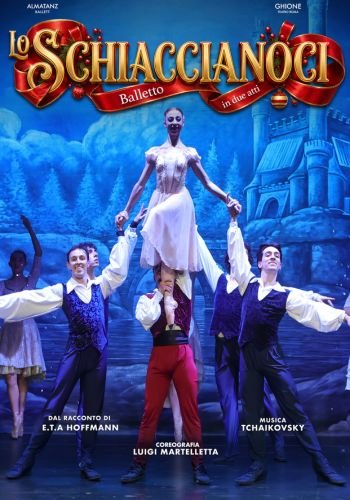
The Nutcracker at Teatro Ghione in Rome, in Compagnia Almatanz's version with choreography by Luigi Martelletta to Tchaikovsky's music, is on Saturday, December 12 and Sunday, December 13, 2026, with two performances a day: Saturday at 16:00 and 19:00, Sunday at 16:00 and 18:15, and the running time is 100 minutes. The theater is at Via delle Fornaci 37, 00165 Rome, a few minutes' walk from Piazza San Pietro, and the nearest station is Roma San Pietro, served by the regional trains FL3 and FL5. According to the show's page on the Ghione's site, tickets cost 34.50 euros in poltronissima di platea, 29 euros in poltrona di platea and galleria, 23 euros in platea with reduced visibility, and a reduced 23 euros for children under 12. They are bought from the purchase button on the official page, which links to the presale network authorized by the organizers, or at the theater's box office, on 06 6372294 or at info@teatroghione.it.
Language: performed in Italian. No English version or English surtitles are announced.
The Roman company directed by Luigi Martelletta, a former principal dancer of the Teatro dell'Opera di Roma, offers a reading of the ballet centered on Clara's growth and her relationship with her mother. Four performances on a mid-December weekend, designed for families.
The Nutcracker at the Ghione: dates, times and prices
The Nutcracker by Compagnia Almatanz is on at Teatro Ghione on December 12 and 13, 2026, with four afternoon and evening performances.
The four performances
On Saturday, December 12 the show is on at 16:00 and 19:00. On Sunday, December 13 at 16:00 and 18:15. The times are designed for families: no performance begins after 19:00, and the two afternoon ones let children get home for dinner.
The prices
The platea poltronissima costs 34.50 euros. The platea poltrona and the galleria cost 29 euros. The platea with reduced visibility costs 23 euros. The reduced price for children under 12 is 23 euros. For a family the choice depends on budget and viewpoint: in ballet, unlike drama, the overall view of the choreography counts as much as closeness to the dancers.
100 minutes
The sheet gives a running time of 100 minutes. With the 16:00 performance you're out around 17:40, and with Saturday's 19:00 one just after 20:40.
Where to buy tickets
Tickets are bought from the purchase button on the show's page on Teatro Ghione's site, which leads to the authorized presale network, or by contacting the box office, open Monday to Saturday from 10:00 to 14:00 and from 16:00 to 20:00, and Sunday from 14:00 to 20:00.
Theater contacts
For information on seats, access and availability Teatro Ghione answers on 06 6372294 and 06 39670340, or at info@teatroghione.it. For the performances of the mid-December weekend, when many families choose a Christmas show, it's best to ask in good time which sections are still free.
What you'll see: Clara, her mother and the stairway to the sky
Luigi Martelletta's Nutcracker is a reading of the ballet entirely focused on the mother and on Clara, in which the story becomes a metaphor for the growth of a girl who in her dream becomes an adolescent, according to the presentation published by Teatro Ghione.
Growth as the theme
The presentation reads The Nutcracker as the story of a passage: the girl who, in her dream, becomes an adolescent. The choreographer portrays this change in a uniform and linear way, without breaks, following Clara along the path that leads her to grow up.
The mother
The novelty of this reading is the mother's role, who stands beside Clara at the center of the story. It's a choice that shifts attention from the fantastic world of toys and enchanted kingdoms to the relationship between a daughter and the woman who accompanies her as she grows.
The symbols
Among the symbols used by the choreography the presentation cites the stairway to the sky, which represents both adversity and elevation. Climbing is tiring, but it leads upward: a simple and strong image for telling growth.
The ending
The final scene, according to the presentation, shows the completed construction of the girl's adult personality, who sets off toward a life aware of herself and her possibilities. The whole conveys, again according to the theater, an absolute serenity.
Dance, sound and word
The presentation of The Nutcracker by Compagnia Almatanz speaks of three expressive genres of theater, dance, sound and word, explored in the space of the choreography.
The body as form and content
The company's text insists on one idea: the body is a container that takes shape through movement, and thus discovers it is form and content at the same time. It's a reflection that goes beyond the fairy tale and says a lot about how Martelletta understands dance.
Italian and foreign dancers
The presentation recalls that Italian and foreign dancers took part in the work, and that for the company and the dancers the production was an exhilarating experience. The names of the performers aren't given in the theater's sheet.
Tchaikovsky's music
The music is Tchaikovsky's. For many children it's the first encounter with ballet music, and listening to it at home beforehand helps them recognize the themes in the hall.
Compagnia Almatanz
Compagnia Almatanz, based in Rome, was founded in 1982 and since 1998 has been led by Luigi Martelletta, a former principal dancer of the Teatro dell'Opera di Roma, according to the history published on the company's site.
The first 15 years
In its first 15 years Almatanz devoted itself to projects of different kinds, among theater, dance, opera and music. Among the productions the company recalls are Scarpette magiche, a national premiere at La Fenice in Venice and at Teatro Argentina in Rome. Allora Allora cosa, a text by Lang presented with dance, acting and singing, filmed and broadcast on Rai 1 in the series Maratona di danza. And Le Corsaire, with choreography by E. Poliakov, a national premiere at the Festival dei due mondi in Spoleto.
The arrival of Luigi Martelletta
In 1998 Luigi Martelletta became president of the company, bringing with him an artistic path begun at the Teatro dell'Opera di Roma and continued in other Italian and European theaters. Since then the company has supported several lines of research, from classical to neoclassical, from contemporary to experimental dance, with the aim of bringing the young, and not only enthusiasts, closer to dance.
The guest stars
Over the years Italian and international artists have taken part in Almatanz's productions: the étoiles Rolando Sarabia and Venus Villa for Carmen. Marjia Kicevska and Boban Kovachevski, principal dancers of the National Ballet of Macedonia, for Clara e lo Schiaccianoci. Letizia Giuliani, principal dancer of the Maggio Musicale Fiorentino, for a tango show. Maria Grazia Galante for Bolero. Monica Perego, principal dancer of the English National Ballet. Angela Kouznetsova, principal dancer of the Teatro dell'Opera di Roma. Nadia Ivanova and Sergey Kuptsov, étoiles of the Kirov. Aneliya Dimitrova, principal dancer of the Sofia Opera, and Clara Pla Ferrer, principal dancer of the Stara Zagora Opera, for Swan Lake.
Luigi Martelletta, from the Teatro dell'Opera to his own company
Luigi Martelletta was a principal dancer of the Teatro dell'Opera di Roma and since 1998 has led Compagnia Almatanz, whose choreographies he signs, including that of The Nutcracker on stage at the Ghione.
A Roman and European career
The company describes his path as a long artistic journey begun in the capital's theater and enriched by many experiences in other Italian and European theaters. It's the training of a dancer raised in the academic repertoire.
The choreographer
In The Nutcracker Martelletta offers a personal reading, centered on the mother and Clara. The presentation speaks of a work that portrays change in a uniform and linear way and uses symbols such as the stairway to the sky: the choice of a choreographer who knows the tradition and bends it to a story of his own.
Bringing the young closer
Among the company's declared goals is bringing the young closer to dance. A Nutcracker in mid-December, with afternoon performances and a reduced price for under 12s, answers exactly this vocation.
A curiosity about The Nutcracker by Compagnia Almatanz at Teatro Ghione, December 12 and 13, 2026
The most interesting curiosity concerns the company's history with this title. Among the productions Almatanz recalls on its site is Clara e lo Schiaccianoci, for which the company hosted Marjia Kicevska and Boban Kovachevski, principal dancers of the National Ballet of Macedonia. Even that production's title put Clara at the center. The version arriving at the Ghione, according to the presentation, puts Clara at the center and, beside her, the figure of the mother.
The second curiosity concerns the choreography's strongest symbol: a stairway to the sky. In the presentation it represents both adversity and elevation, that is, the effort and the goal of growing up. It's an image you remember even after the music has ended.
The third concerns the hall. Teatro Ghione is tied to classic drama and concerts. A classical ballet to Tchaikovsky's music, in a week that at the Ghione begins with A Christmas Carol from Dickens, closes a small Christmas program that crosses literature, music and dance.
Teatro Ghione, the hall on Via delle Fornaci
Teatro Ghione is a hall of about 500 seats at Via delle Fornaci 37, between the Vatican and the slopes of the Janiculum, tied to the name of the actress Ileana Ghione, who bought and reopened it in 1980.
Ileana Ghione
Born in Cortemilia, in Piedmont, on January 15, 1931, Ileana Ghione trained in the 1950s at the Accademia d'arte drammatica, with Sergio Tofano among her teachers. She was a face of television dramas, from Jane Eyre to David Copperfield, from An American Tragedy to Madame Curie, and performed Giacosa's Come le foglie with Tino Carraro. On December 9, 1980 she bought and refitted the old theater on Via delle Fornaci, which has borne her name since.
Platea and galleria
With about 500 seats between platea and galleria, the Ghione is a hall large enough for a ballet with many performers and compact enough for children to see well. The price breakdown, with a platea of reduced visibility, indicates that some seats have a partial view of the stage: for a ballet it's best to take this into account.
A hall for all genres
For decades the Ghione's program alternated classic drama, with Wilde, Pirandello, Shakespeare and Goldoni, with concerts. In recent years tribute concerts, comedy, family shows and dance have arrived.
Something nobody tells you about The Nutcracker by Compagnia Almatanz at Teatro Ghione, December 12 and 13, 2026
What the poster doesn't say is that this Nutcracker is not the version many expect. The presentation doesn't speak of toy soldiers, mice or the kingdom of sweets: it speaks of a girl who grows up, of her mother, of a stairway to the sky. Those who come for the traditional fairy tale will find Tchaikovsky's music and classical dance, but inside a different, more intimate story, centered on growing up.
The second thing concerns the seats. The sheet includes a platea of reduced visibility, at 23 euros, and the reduced price for under 12s costs the same amount. For a ballet a full view of the stage is important: in our judgment, if the budget allows, it's best to choose the galleria or the platea poltrona, at 29 euros, so as not to miss part of the choreography.
The third is practical: on the weekend of December 12 and 13, in Rome, you can see several Nutcrackers in different theaters. The difference of this one is in the Roman company, in the choreographer who comes from the Teatro dell'Opera, and in a reading you don't find elsewhere.
The advice I give you for visiting The Nutcracker by Compagnia Almatanz at Teatro Ghione, December 12 and 13, 2026
The first piece of advice is to tell the children, before going, the key to this version: a girl named Clara who, in a dream, grows up, accompanied by her mother. Knowing what to look for helps the youngest follow a ballet without words.
The second concerns the performance. For families with small children the 16:00 performances on Saturday and Sunday are the most convenient: you're out around 17:40, with time for a stroll to the lit Piazza San Pietro. Those coming without children can choose Saturday's 19:00 performance.
The third concerns the seat: in ballet the overall view counts, and the galleria, at 29 euros, offers a perspective on the choreography that the platea doesn't always give. The fourth: listen at home, in the days before, to a few pieces of Tchaikovsky's music, so the children recognize the themes in the hall.
How to get to Teatro Ghione
The simplest way to reach Teatro Ghione is the regional train to Roma San Pietro station, served by the FL3 and FL5 lines, a few minutes' walk from Via delle Fornaci.
By train
San Pietro station also has a bus stop and a taxi stand. From the station you walk up Via delle Fornaci to the theater. On weekends the regional train times change: it's best to check them in advance.
By bus and metro
The area's buses lead to San Pietro station and Largo di Porta Cavalleggeri. Weekend lines and times should be checked on the Rome transit company's route planner. The nearest stops of metro line A are in Prati, about 20 minutes on foot through Borgo and Piazza San Pietro.
By car
The Ghione's site lists three parking solutions nearby: a free open-air car park, the San Pietro car park and a garage. On December weekends the Vatican area is very busy: better to leave early.
Another well-known fact, and yet rarely mentioned
It's well known that The Nutcracker is the Christmas ballet par excellence, and that in December many theaters put it on their programs. It's less often mentioned how wide the offering in Rome is: in the 2026 season it is presented, among others, by the Teatro Nazionale between late November and early December, by the Auditorium Conciliazione on November 27, by the Brancaccio with Brancaccio LAB from December 4 to 6, and by the Balletto di Roma at Teatro Olimpico from December 17 to 20. The Compagnia Almatanz version at the Ghione, on the 12th and 13th, sits in the middle, with a reading of its own.
A second well-known and little-cited fact concerns the choreographer. It's known that the Teatro dell'Opera di Roma has its own corps de ballet. It's less remembered that from its stage also come figures who later led independent companies in the city. Luigi Martelletta, a former principal dancer of the Opera, has led Almatanz since 1998.
The third concerns the company: among its historic productions is Scarpette magiche, a national premiere at La Fenice in Venice and at Teatro Argentina in Rome, and Le Corsaire, a national premiere at the Festival dei due mondi in Spoleto.
The right photo to take at The Nutcracker by Compagnia Almatanz at Teatro Ghione, December 12 and 13, 2026
The right photo, at a Christmas ballet, is taken at the final applause: the company lined up on the Ghione's stage, the costumes under the lights, the children in the hall clapping. During the show the advice is not to shoot: a flash distracts the dancers, and a lit screen disturbs everyone.
The second photo is taken on leaving the afternoon performances. Going down Via delle Fornaci toward Largo di Porta Cavalleggeri you come to the Leonine Walls, and a few steps farther is Piazza San Pietro. In mid-December the square prepares for Christmas: a photo of the children under the colonnade, after the ballet, closes the day well.
The third is a portrait in front of the theater's entrance, with the poster of The Nutcracker behind: the simplest memento of an afternoon of dance.
Some important events that happened here in history
The area of Teatro Ghione has a long history. Here ran the Leonine Walls, the circuit that protected the Vatican, and Porta Cavalleggeri preserves the coats of arms of the Borgias of Pope Alexander VI. On April 30, 1849 at Porta Cavalleggeri the first attack of the French troops against the Roman Republic was fought, repulsed by the defenders, among whom was the young actor Tommaso Salvini.
In 1894 San Pietro station was opened, on the line to Viterbo. The Vatican railway also departs from here, and the cinema used the station as a set, with Totò, Alberto Sordi and Virna Lisi. On December 9, 1980 Ileana Ghione bought the old theater on Via delle Fornaci and reopened it under her name. On November 25, 1986 George Bernard Shaw's Candida was staged there, directed by Silverio Blasi.
In December 2005 Ileana Ghione, while performing Euripides's Hecuba on her stage, was taken ill and died shortly after. The funeral chamber was set up in the theater. Since then the hall has continued to bear her name, opening over the years also to music and dance.
Who has passed through The Nutcracker by Compagnia Almatanz at Teatro Ghione, December 12 and 13, 2026
Through the Ghione's stage have passed the classics of drama, from Wilde to Pirandello, from Shakespeare to Goldoni, and the face of Ileana Ghione, a student of Sergio Tofano and lead of Come le foglie with Tino Carraro. In the surrounding neighborhood have passed popes and soldiers, the Borgias and Tommaso Salvini, and the cinema of Totò and Alberto Sordi at San Pietro station.
In recent years the hall has welcomed tribute concerts, comedy and dance: FlaMENcos, I Fantastici, Giovanni Cacioppo. In the week before The Nutcracker, the Ghione hosts A Christmas Carol from December 6 to 8 and Leda Moro's Il segreto della felicità on the 10th.
Through the Compagnia Almatanz productions have passed étoiles and principal dancers from all over Europe, from Rolando Sarabia and Venus Villa to Monica Perego of the English National Ballet, from Nadia Ivanova and Sergey Kuptsov of the Kirov to Angela Kouznetsova of the Teatro dell'Opera di Roma. On December 12 and 13, 2026 Luigi Martelletta and the dancers of his company pass through Via delle Fornaci.
The Nutcrackers of Rome in December 2026
The Nutcracker by Compagnia Almatanz is one of several stagings of the ballet on in Rome between November and December 2026.
Before the Ghione
Between late November and early December the ballet is on at Teatro Nazionale, at Auditorium Conciliazione and at Teatro Brancaccio with Brancaccio LAB. Those who have already seen one of these versions can find at the Ghione a different reading, centered on Clara and her mother.
After the Ghione
From December 17 to 20 the Balletto di Roma brings its Nutcracker to Teatro Olimpico. The weekend of December 12 and 13, at the Ghione, therefore falls in the middle of Rome's Christmas ballet season.
Why choose this version
In our judgment the Almatanz version suits those looking for a compact hall, accessible prices and a reading of the ballet that speaks of growing up more than of fairy tale. For families with small children, the afternoon performances in a theater of about 500 seats are a calm way to approach dance.
What to see around Teatro Ghione
Teatro Ghione is between San Pietro, Borgo and the Janiculum, and before or after an afternoon show the surroundings offer many possibilities.
San Pietro and Borgo
Piazza San Pietro is a few minutes' walk away. Between the square and the Tiber stretches the rione Borgo, toward Castel Sant'Angelo.
The Janiculum and Villa Pamphilj
Behind the theater rises the Janiculum, with its terrace over the city. Farther south opens Villa Doria Pamphilj, the large park where children can run in the morning before the show.
Porta Cavalleggeri and the station: a walk before the ballet
Those who reach the Ghione by train or on foot from San Pietro cross a small neighborhood full of history, which can be looked at calmly before going in.
The Leonine Walls
Going down toward Largo di Porta Cavalleggeri you skirt the Leonine Walls. On the gate you can recognize the coats of arms of the Borgias of Pope Alexander VI, and here, on April 30, 1849, the defenders of the Roman Republic repulsed the first French attack.
The cinema's station
Roma San Pietro station, opened in 1894 with the line to Viterbo, is the point from which the Vatican railway departs, and the cinema used it as a set with Totò, Alberto Sordi and Virna Lisi.
How to organize the weekend
The weekend of December 12 and 13 lends itself to combining the ballet at the Ghione with a day between San Pietro and the Janiculum.
Saturday, December 12
With performances at 16:00 and 19:00, Saturday allows a morning at Villa Pamphilj or the Janiculum, a lunch in the neighborhood and the ballet in the afternoon. Those who choose 19:00 are out just after 20:40, in time for dinner.
Sunday, December 13
On Sunday the performances are at 16:00 and 18:15. After the show, a walk to the lit Piazza San Pietro closes the weekend well.
Where to eat before or after the show
Around Teatro Ghione you find pizzerias, trattorias and bars in the streets between Via delle Fornaci, Via Gregorio VII and the slopes of the Janiculum, frequented mostly by people who live in the neighborhood.
Before the afternoon performances
With the 16:00 performances, lunch is taken calmly in the neighborhood or in Borgo. A snack at a bar on Via delle Fornaci before going in is a good idea with children.
After the evening performances
After Saturday's 19:00 performance or Sunday's 18:15 there is time for a pizza in the residential streets around Via Gregorio VII, or in Borgo and Prati. The places on Via della Conciliazione are designed mostly for tourists. On December weekends it's best to book.
Accessibility, children and practical information
Teatro Ghione is listed as accessible to people with disabilities by Roma Capitale's tourism portal, which also indicates a dog-sitting service.
People with disabilities
For those who use a wheelchair or need assistance it's useful to phone the theater before the show, on 06 6372294, to learn how access is organized and where the reserved seats are.
With children
The Nutcracker is a show suited to families, with a reduced price for under 12s. 100 minutes of ballet is a demanding length for children under five: for them the 16:00 performances are the calmest choice. Telling the story of Clara beforehand helps them follow a tale without words.
Arriving on time
With many families in the hall, entry takes a few more minutes. It's best to arrive at least 15 minutes before the time on the ticket.
Frequently asked questions about The Nutcracker at Teatro Ghione
When is The Nutcracker on at Teatro Ghione?
The Nutcracker by Compagnia Almatanz is on at Teatro Ghione in Rome on Saturday, December 12, 2026 at 16:00 and 19:00 and Sunday, December 13 at 16:00 and 18:15. The theater is at Via delle Fornaci 37.
How much are tickets for The Nutcracker at the Ghione?
Tickets for The Nutcracker at Teatro Ghione cost 34.50 euros in platea poltronissima, 29 euros in platea poltrona and galleria, 23 euros in platea with reduced visibility and 23 euros reduced for under 12s, according to the theater's sheet.
Who signs the choreography?
The choreography of The Nutcracker by Compagnia Almatanz is by Luigi Martelletta, a former principal dancer of the Teatro dell'Opera di Roma and head of the company since 1998. The music is by Tchaikovsky.
How long is the show?
The Nutcracker by Compagnia Almatanz at Teatro Ghione runs 100 minutes, according to the show's sheet. With the 16:00 performance you're out around 17:40.
How is this version of The Nutcracker different?
Luigi Martelletta's Nutcracker is a reading centered on the mother and Clara, which tells the growth of a girl who in her dream becomes an adolescent, with symbols such as a stairway to the sky, according to Teatro Ghione's presentation.
Is the show suitable for children?
The Nutcracker at Teatro Ghione is designed for families too, with a reduced price for under 12s and afternoon performances at 16:00. For the youngest children it's best to tell the story of Clara beforehand.
How do you get to Teatro Ghione?
You reach Teatro Ghione with the regional trains FL3 and FL5 to Roma San Pietro station, a few minutes' walk from Via delle Fornaci. The theater also lists three parking solutions in the area.
The final advice on The Nutcracker by Compagnia Almatanz
The advice is to choose a 16:00 performance if there are small children in the family, prefer the galleria or the platea poltrona to the reduced visibility seats, tell the story of Clara and her mother beforehand, and leave the Ghione toward the lit Piazza San Pietro. Luigi Martelletta's Nutcracker brings Tchaikovsky's music into a compact hall, with a reading that speaks of growing up and serenity more than magic. In our judgment it's one of the dance offerings best suited to families in the Roman December, and a chance to see up close the work of a company born in the city more than 40 years ago.
Article written by the editorial team of Tour Leader Pro, contact them for Private/Corporate/V.I.P. Tours and Experiences.
Planning a trip to Rome? The English guides for visiting the city are on ItalyPlanner.com.