The Fayum portraits at Ara Pacis: Il potere del ritratto. Egitto e Roma, November 6, 2026 to May 2, 2027
https://www.estateromana.com/en/rome/trip-planner/the-fayum-portraits-at-ara-pacis-il-potere-del-ritratto-egitto-e-roma-november-6/
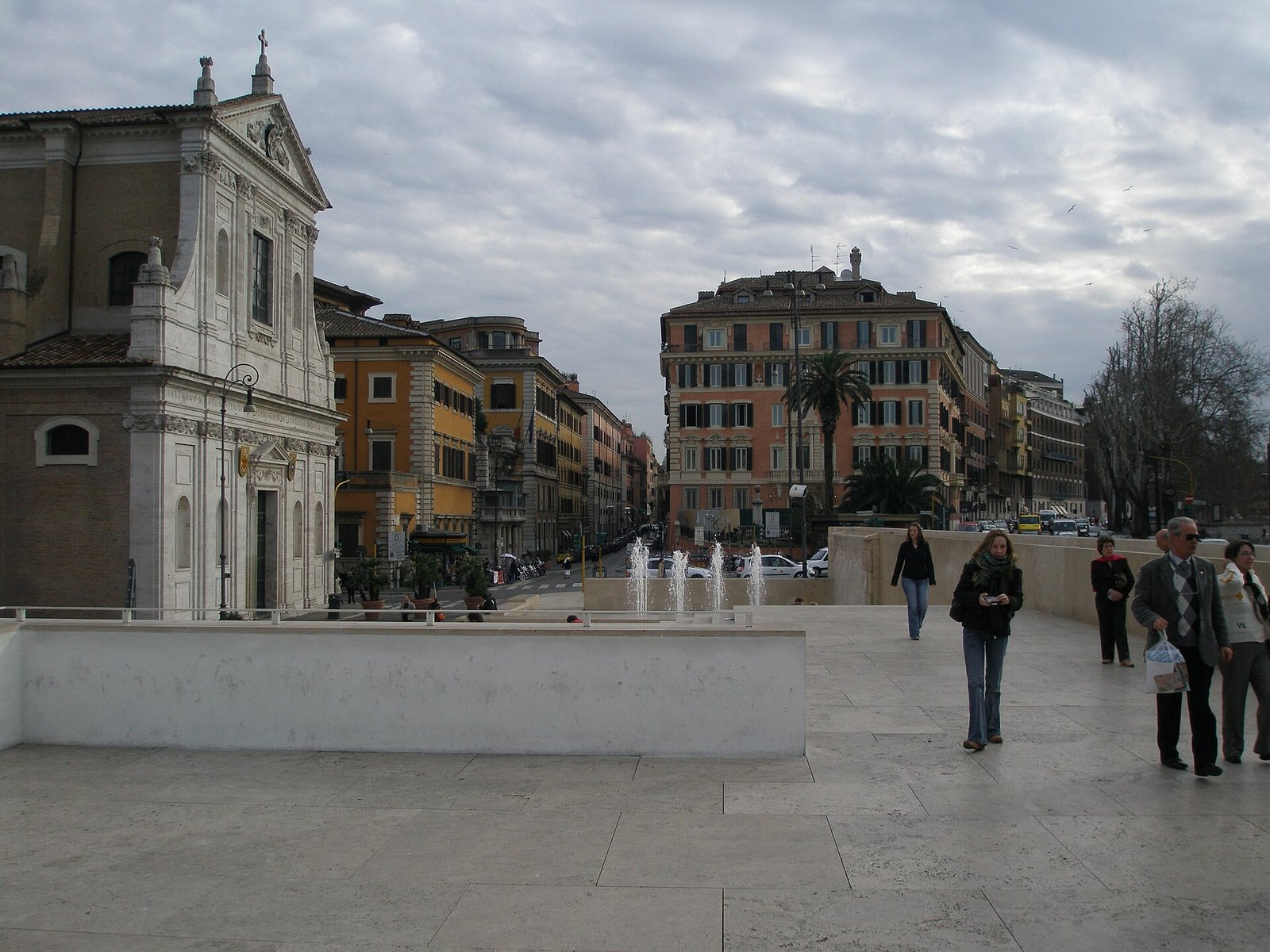 Il Museo dell’Ara Pacis sul Lungotevere. Foto: Council, pubblico dominio, via Wikimedia Commons
The Fayum portraits at Ara Pacis: the exhibition Il potere del ritratto. Egitto e Roma. I volti del Fayum, "The power of the portrait. Egypt and Rome. The faces of Fayum", is held in the exhibition space of the Museo dell'Ara Pacis, on Lungotevere in Augusta, in Rome, from November 6, 2026 to May 2, 2027. The museum website, in a notice published on October 6, 2026, gives November 6 as the first day, while the specialist press, for example Finestre sull'Arte and Cose di Casa, gives November 5: sources disagree, so check the date before you go. The full-price open ticket for the exhibition only costs €17.00, and online presale is already active on the Musei in Comune di Roma network, the city's civic museums, or via the Buy page on the museum website. Opening hours aren't given in the official notice. To get there, use the ATAC journey planner, which shows up-to-date lines and stops. The museum's official website is arapacis.it, and for the venue see our page on the Ara Pacis.
The exhibition in brief
The project brings together more than 110 works: painted panels, shrouds, funerary masks, marbles, plaster casts and ancient goldwork. At the heart of the exhibition are almost 50 Fayum portraits, the body of funerary painting made for the dead of Roman Egypt from the late 1st century BC to the mid-3rd century AD. The curators are Claudio Parisi Presicce and Laura Petacco. It's promoted by Roma Capitale and the Sovrintendenza Capitolina ai Beni Culturali and organized by a partnership including MondoMostre, Civita Mostre e Musei and Zètema Progetto Cultura, while the catalog is published by Allemandi.
The project in numbers
The published figures speak of more than 110 works and almost 50 portraits. Finestre sull'Arte notes that fewer than 1,000 survive worldwide: almost 50 gathered in a single exhibition is a rare share.
The title and its argument
The title puts the emphasis on the function of the image of the face in the Roman world of Egypt, more than on its aesthetics. It's not a detail: in Rome the portrait was both a public and a family act, tied to the memory of ancestors, and in Egypt it met a funerary tradition thousands of years old. The exhibition sets the two worlds in dialogue in the same space.
The context: Egypt under Rome
To understand the exhibition you have to start from a date: Augustus began building his tomb in 28 BC, on his return from Alexandria in Egypt. The link between Rome and Egypt, in the same Campus Martius that now hosts the exhibition, is thus written into the topography of the place from the start: two granite obelisks brought from Egypt adorned the entrance to the Mausoleum, a few hundred meters from the exhibition space.
An Egypt of mixed cultures
Scholars generally conclude that the people portrayed were Egyptians who had adopted Greco-Roman culture. In the Roman period the so-called Greek population was largely made up of Hellenized Egyptians or people of mixed origin, and Roman army veterans of different backgrounds settled in the area, marrying into local families. Egyptian, Greek and Roman names appear in the inscriptions.
Names as a sign of rank
Greek or Latin names were often adopted as status symbols. A portrait with a Roman name therefore says nothing, on its own, about its bearer's origins, which is why the exhibition's title avoids sharply separating Egypt and Rome.
What the Fayum portraits are
The name comes from the Fayum oasis, where most of the portraits were found, but "Fayum portraits" is a label of style more than of place: this kind of portrait was widespread throughout Roman Egypt. They were painted on wooden panels a few millimeters thick and placed over the face of the deceased, inserted among the mummy's wrappings.
A chronology that has narrowed
The portraits span a period from the late 1st century BC to the mid-3rd century AD. The reasons for their end, Finestre sull'Arte notes, aren't known.
Imported wood and gesso
The supports are thin wooden panels, partly imported. The surface could be prepared with a layer of gesso and, in some cases, traces of a preparatory drawing remain beneath the paint.
Encaustic and tempera
There are two main techniques. Encaustic mixes pigments with hot wax and produces intense colors and broader brushstrokes, with an almost impressionistic effect. Tempera, based on animal glue according to Finestre sull'Arte, gives subtler tonal transitions and a more matte, almost chalky palette. In some cases gold leaf appears for jewelry and wreaths. Mixed techniques also exist.
Painted light
Variations in tone show where the light comes from, and modeling with light and shadow gives most of the figures a three-dimensional look. That's why these faces seem to speak with an immediacy almost unmatched in ancient painting.
The exhibition layout
An official room-by-room sequence hasn't been published. Sources say the route is devoted to the portrait in Roman Egypt and to the contact between Egyptian traditions and Roman culture, and that the panels are shown alongside shrouds, funerary masks and other objects tied to burial practices, to widen the discussion beyond the single portrait.
Panels, shrouds and masks
Showing three kinds of objects together illustrates three different answers to the same problem: how to give the dead a face. The funerary mask was already used in pharaonic times, in the Roman period it was made to Greco-Roman canons, and gilded masks were preferred by those who could afford them.
Marbles and plaster casts
The marbles and plaster casts announced among the works bring the discussion to the Roman side. The sculpted portrait, with the features rendered precisely, is the other pole of the comparison, and the exhibition space, a stone's throw from Augustus's altar, offers a natural counterpoint.
Goldwork
Ancient goldwork is listed among the works. In the portraits, with few exceptions, only women wear jewelry, while many men wear gold crowns.
The loans: where the works come from
The exhibition is built on international loans. From the Louvre come 23 works, including painted panels and rare linen shrouds. Other lenders are the Getty Museum, the Metropolitan Museum of Art in New York, the Landesmuseum Württemberg in Stuttgart, Eton College with the Myers Collection, the Lugdunum Museum in Lyon, the Kom Aushim Museum and the Hurghada Museum.
Egypt's contribution
According to Finestre sull'Arte, for the first time Egypt is lending almost all the Fayum portrait panels in its collections. Among the works that have never left Egypt is the Tondo of the Two Brothers, kept at the Egyptian Museum in Cairo and considered one of the masterpieces of ancient painting. The painting was restored in Egypt by Italian conservators as part of the exhibition project.
Italian collections
The Italian lenders are the National Archaeological Museum of Florence, the Capitoline Museums, the Centrale Montemartini, the Giovanni Barracco Museum of Ancient Sculpture, the Museo della Fabbrica di San Pietro, the Archaeological Parks of Pompeii and Herculaneum and the Museo Libero D'Orsi. Three of these museums are in Rome and can be visited separately.
A portrait never shown before
A portrait of a young person, recently discovered in excavations by the Italian archaeological mission of the University of Salento in Egypt, will be shown to the public for the first time. It shows that field research is still active and the corpus keeps growing.
Who the faces are: subjects and function
The subjects are mostly very young, often children, and rarely over 35 or 40, which ties in with the low life expectancy of the time. CT scans of the mummies show that age and sex match between the body and the portrait.
Who could afford them
Not everyone could afford a portrait. Flinders Petrie reported finding a painted panel on only 1 or 2 percent of the mummies he excavated. The patrons seem to have been well-off, including soldiers, officials and religious dignitaries.
Clothes and hairstyles as a clock
Hairstyles follow Roman fashion and serve as a dating tool, especially women's: from the simple center part of the age of Tiberius to the curls of the late 1st century, up to the more elaborate styles of the age of Septimius Severus. In the provinces fashions lasted longer than in Rome, and styles overlap.
Painted in life or after death
It was once thought that the portraits were painted in life, on the Greek model. More recent research suggests instead that they were made after death, partly because of the age and sex match with the mummies. Their religious meaning isn't entirely clear.
The viewer's gaze
The compositions usually show a single person, head or bust, facing forward or slightly turned, against a single-color background, sometimes with decorative elements. Greco-Roman canons prevail over Egyptian ones. The frontal relationship with the viewer recalls later icon painting, though the portraits belong to a broader Greco-Roman tradition.
Discovering the portraits: from Della Valle to Petrie
The story of the rediscovery begins in 1615 with Pietro Della Valle, the first European to record a mummy portrait: at Saqqara-Memphis a merchant secretly sold him a mummy with a painted portrait, for six piastres. He described it in his 1650 travel account, and the two mummies he bought are now at the Albertinum in Dresden.
Theodor Graf and the antiquities market
In the late 1880s Viennese art dealer Theodor Graf found portraits at er-Rubayat and had them published by Georg Ebers. He attributed the panels to the Ptolemaic pharaohs, by analogy with the portraits on coins, a weak theory that nonetheless got wide attention.
Flinders Petrie at Hawara
Flinders Petrie excavated at Hawara, at the entrance to the Fayum depression, next to the pyramid of Amenemhat III, in the late 19th century, and returned in 1910 and 1911. His work remains the main systematic source on the findspots.
The Tomb of Aline
In 1892 the Tomb of Aline was discovered, containing three portraits: the wife and children had painted portraits, while the husband had a gilded three-dimensional mask.
The problem of lost contexts
Most portraits were recovered by explorers and dealers with inadequate methods, and a precise findspot is almost always missing. Petrie's records at Hawara are an exception, but they cover only a small part of the total.
The Ara Pacis: from Augustus's altar to museum
The exhibition isn't housed just anywhere. The exhibition space is part of the Museo dell'Ara Pacis, which holds the altar the Senate decided to build on July 4, 13 BC to celebrate Augustus's return from a three-year pacifying campaign in Spain and southern Gaul. The solemn dedication took place on January 30, 9 BC, a day chosen partly because it was Livia's birthday. The altar stood in the Campus Martius, one Roman mile from the pomerium, the city's sacred boundary.
The altar's reliefs
The best-preserved panel is the Saturnia tellus, an allegory of the golden age with a matronly figure and two infants. Along the long sides runs the procession, with Augustus as pontifex maximus and members of the imperial family, read today more as a political image of the succession than a record of a real procession. On the main side are the Lupercal and Aeneas's sacrifice to the Penates.
Found in pieces
The first fragments came to light in 1568 (in 1536, according to other sources) beneath Palazzo Peretti, on Via in Lucina, and were scattered: the Saturnia tellus ended up at the Uffizi, other pieces at the Louvre and the Vatican Museums. More systematic excavations took place in 1903 and 1905 and then in 1937 and 1938, beneath Palazzo Fiano, with the ground frozen to preserve the structures.
The 1938 pavilion
The Fascist regime chose the site next to the Mausoleum of Augustus as part of the bimillennial of Augustus's birth. The altar was inaugurated on September 23, 1938 together with the pavilion designed by Vittorio Ballio Morpurgo. During the war the glass panels were removed and the altar was protected, and on July 19, 1943 the panels were destroyed in the bombing of the San Lorenzo neighborhood. For more on the monument there's also our page on the video mapping on the Ara Pacis.
Richard Meier's museum
The current museum is by American architect Richard Meier. The project was awarded without a competition, work ran from 2000 to 2006, and the museum opened on April 21, 2006. Of the previous building only the east wall of the base remained, with the inscription of the Res Gestae.
Travertine, glass, steel
The materials used are steel, travertine, glass and plaster. Aluminum surfaces were originally planned, then replaced with travertine after criticism of the building's visual impact.
The controversy
The museum has divided critics. The New York Times called it a failure, Vittorio Sgarbi compared it to a Texas gas station, and critics also included Massimiliano Fuksas, Paolo Portoghesi and Adriano La Regina, while Achille Bonito Oliva defended the project. In 2008 mayor Gianni Alemanno announced plans to move or demolish the museum, but later scaled the plan back.
The Campus Martius around the exhibition
The exhibition space is in the Campo Marzio district, a few steps from the Mausoleum of Augustus and the square named after the emperor. When you leave the exhibition you find a stretch of city where the Augustan age can still be read.
The Mausoleum of Augustus
The Mausoleum of Augustus, begun in 28 BC, has a diameter of 300 Roman feet, about 87 meters, and is the largest known circular tomb. It held Augustus and members of his family, up to Nerva in AD 98, the last emperor buried there. In the 12th century the Colonna family turned it into a stronghold, then it became a garden and, between the 19th century and 1936, a concert hall. It reopened to the public after restoration on March 1, 2021.
The Egyptian obelisks
Of the two granite obelisks that adorned the Mausoleum's entrance, one was discovered in 1519 and moved by Sixtus V in 1587 to Santa Maria Maggiore. Today the two obelisks stand in Piazza del Quirinale and Piazza dell'Esquilino. The Campus Martius thus keeps a trace of Augustus's Egypt, a theme the exhibition takes up from a different angle.
Toward Piazza del Popolo
Continuing north you reach Piazza del Popolo, while in the opposite direction you get to the Pantheon and Piazza di Spagna. A few steps from the exhibition there's also the church of San Rocco all'Augusteo.
Another Egyptian address in Rome
If you want to continue the theme, you can visit the Museum of the Near East, Egypt and the Mediterranean, whose page we refer you to for up-to-date hours and collections.
Practical information
From November 6, 2026 to May 2, 2027 the exhibition is in the Ara Pacis exhibition space, on Lungotevere in Augusta. The full-price open ticket for the exhibition only costs €17.00. Finestre sull'Arte reports a €1 presale fee. For online purchase use the Musei in Comune di Roma network, and the Buy page on the museum website links to the same channels. The MIC Card, which costs €5 and gives a reduced ticket for exhibitions with separate ticketing, is described on the same page.
Hours
According to the press (Finestre sull'Arte, Cose di Casa) the exhibition is open every day from 9:30 to 19:30, with last entry an hour before closing. The official notice on the museum website doesn't give the hours, so confirm them before your visit. Phone for information: 06 0608, as listed by Cose di Casa.
How to get there
For up-to-date public transit connections, use the ATAC journey planner with Lungotevere in Augusta, Rome as your destination.
A curious fact about the Museo dell'Ara Pacis
Of the 1938 building designed by Vittorio Ballio Morpurgo, demolished to make way for Richard Meier's museum, only one element survives: the east wall of the base, which carries the inscription of the Res Gestae in the text edited by Enrica Malcovati. It's the document in which Augustus records his achievements, and it also notes that the Senate had decided to consecrate the Ara Pacis Augustae. So the account the emperor wanted to hand down to history is still written on the wall of the museum that holds the altar.
The Res Gestae elsewhere
The bronze tablets with Augustus's autobiography stood in front of the Mausoleum's entrance and were melted down. A copy survives on the Temple of Augustus and Rome in Ankara: that's why the text is known today.
Something nobody tells you about the Museo dell'Ara Pacis
The altar you see today is partly a hypothetical reconstruction. In 1937 and 1938 the gaps were filled in with few references, including two ancient coins, one Neronian and one Domitianic. For the pieces held abroad, at the Louvre and Villa Medici, casts were used.
Casts, then and now
There's a curious coincidence: in 1938 plaster casts made it possible to complete the altar with the pieces that had ended up far away, and in the 2026 exhibition plaster casts appear among the works too. In this place, plaster has always served to stitch back together what time and collectors had pulled apart.
The damage from the sandbags
After the war it was found that the sandbags used to protect the altar had destroyed the entablature, later rebuilt in plaster. The protection, in short, came at a cost.
My tip for the Museo dell'Ara Pacis
My tip is to book your open ticket online in advance, since presale is already active, and to check the hours on the museum website before you go: the official notice doesn't give them. Inside the exhibition, slow down in front of the details more than the faces as a whole.
What to look for in each panel
Try to recognize the technique: encaustic, with intense colors and broader brushstrokes, and tempera, with subtler, more matte tones. Look for gold leaf in the jewelry and wreaths, traces of drawing beneath the paint, the direction of the light shown by the tonal shifts, and the hairstyles, which let you place the portrait in a period.
A comparison with the altar
Before or after the exhibition, take your time with the altar's reliefs: the procession of the imperial family, in which Agrippa, Livia and Tiberius are identified, shows the official Roman portrait, that of the court. The Fayum faces are its private, funerary flip side.
Another well-known fact, yet one rarely mentioned
The Mausoleum of Augustus, a few steps from the exhibition, was begun in 28 BC on his return from Alexandria in Egypt, and two Egyptian obelisks adorned its entrance. It's a fact known to art historians, but rarely linked to the painted mummies: Augustus has his own tomb built in Rome with Egyptian obelisks at the entrance, and the production of Roman-style funerary portraits in Egypt begins in the late 1st century BC.
An exchange in both directions
The portraits show the meeting of the Roman use of ancestor images and the Egyptian funerary tradition. It's the theme the exhibition's title, Egypt and Rome, states most directly.
The right photo to take at the Museo dell'Ara Pacis
The most interesting photo isn't necessarily inside: outside, the east wall with the Res Gestae inscription brings together Meier's architecture and Augustus's voice in a single shot. Inside the exhibition, check the house rules first: if you can take photos is set by the museum and hasn't been published.
The detail to look at, even without a camera
If photos aren't allowed, it's worth fixing a single detail per panel in your memory: an earring, a gold crown, the gaze. The painted light, which sources point to as the hallmark of these portraits, is best appreciated in person.
Some important events that happened here in history
An essential timeline of the place, with only the dates confirmed by sources.
From the Augustan age to the Renaissance
In 28 BC Augustus begins the Mausoleum. On July 4, 13 BC the Senate decides to build the altar, and on January 30, 9 BC the solemn dedication takes place. In 410, during Alaric's sack, the Mausoleum is stripped and the ashes scattered. In 1568 (or 1536) the first fragments of the altar turn up beneath Palazzo Peretti.
From the 20th century to today
On September 23, 1938 the altar is inaugurated in Morpurgo's pavilion. On July 19, 1943 the glass panels are destroyed in the bombing of the San Lorenzo neighborhood. In 1970 Morpurgo's restoration is reinstated with the help of the Rotary Club. On April 21, 2006 Meier's museum opens. On November 22, 2009 come the first digital color projections on the monument, and on October 14, 2016 the Ara com'era virtual reality project.
Who has passed through the Museo dell'Ara Pacis
The place has a long list of names tied to the altar and its surroundings.
The ancients
The altar depicts Augustus, Agrippa, Livia, Tiberius, Antonia the Younger and the Elder, Germanicus, Julia and other members of the imperial family, according to current identifications. These are scholars' readings, not absolute certainties.
The moderns
In the 20th century Odoardo Ferretti and Vittorio Ballio Morpurgo worked on the altar, and on the current museum Richard Meier, whom mayor Francesco Rutelli commissioned for the project, while mayor Walter Veltroni attended the opening. In the nearby Mausoleum, turned into a concert hall, Toscanini, Mahler, Stravinsky and Mascagni performed.
Frequently asked questions about the exhibition Il potere del ritratto
When is the exhibition Il potere del ritratto on?
The exhibition is in the exhibition space of the Museo dell'Ara Pacis from November 6, 2026 to May 2, 2027, according to the museum's official notice of October 6, 2026. Some outlets, like Finestre sull'Arte and Cose di Casa, give November 5 as the first day: sources disagree, so check the museum website before planning your visit.
How much is a ticket?
The full-price open ticket for the exhibition only costs €17.00, as stated in the official notice on the museum website. Finestre sull'Arte reports a €1 presale fee. MIC Card holders, a card that costs €5, are entitled to a reduction for exhibitions with separate ticketing, according to the museum's Buy page.
Where can I buy tickets?
Tickets are sold online in presale on the Musei in Comune di Roma network, linked from the Museo dell'Ara Pacis website and the Buy page. On the network's page the open ticket for the exhibition is listed as on sale. Alternatively you can call 06 0608, listed by Cose di Casa, for information.
How many works are on show?
There are more than 110 works, including painted panels, shrouds, funerary masks, marbles, plaster casts and ancient goldwork. Of these, almost 50 are Fayum portraits, out of a worldwide corpus Finestre sull'Arte puts at fewer than 1,000. The curators are Claudio Parisi Presicce and Laura Petacco, and the catalog is published by Allemandi.
Which museums are lending works?
The Louvre is lending 23 works. Other lenders include the Getty Museum, the Metropolitan Museum of Art in New York, the Landesmuseum Württemberg in Stuttgart, Eton College, the Lugdunum Museum in Lyon, the Kom Aushim Museum and the Hurghada Museum, plus Italian institutions like the Capitoline Museums and the National Archaeological Museum of Florence. The Egyptian Museum in Cairo is lending the Tondo of the Two Brothers.
What are the Fayum portraits?
They're funerary portraits painted on thin wooden panels, in encaustic or tempera, placed over the faces of mummies in Roman Egypt. They span the late 1st century BC to the mid-3rd century AD. The name comes from the Fayum oasis, where most were found, but this kind of portrait was widespread throughout Egypt.
Who are the curators and who organizes the exhibition?
The curators are Claudio Parisi Presicce and Laura Petacco. The exhibition is promoted by Roma Capitale with the Sovrintendenza Capitolina ai Beni Culturali, and organized by the Sovrintendenza together with the partnership formed by MondoMostre, Civita Mostre e Musei and Zètema Progetto Cultura. The catalog is published by Allemandi Editore, according to Finestre sull'Arte.
What are the opening hours?
The museum's official notice doesn't give the hours. Finestre sull'Arte and Cose di Casa report daily opening from 9:30 to 19:30, with last entry an hour before closing, but these are press sources: before your visit, confirm the hours on the Museo dell'Ara Pacis website or at 06 0608.
Final tip on the exhibition Il potere del ritratto
Go to the exhibition with a simple question: why did the people who had these faces painted want to look Roman? The panels don't give a single answer, but the sequence of techniques, jewelry, hairstyles and mixed names lets you form one. Then head out to the Mausoleum of Augustus, begun on his return from Alexandria: the comparison between those painted faces and the emperor's tomb says a lot about the relationship between the two shores of the Mediterranean. Remember to check dates and hours on the official website before you set out.
Article written by the editorial team of Tour Leader Pro, contact them for Private/Corporate/V.I.P. Tours and Experiences.
Planning a trip to Rome? The English-language guides for visiting the city are on ItalyPlanner.com.