Tenuta del Cavaliere
https://www.estateromana.com/en/rome/trip-planner/tenuta-del-cavaliere-rome/
 Tenuta del Cavaliere
The Tenuta del Cavaliere is the farm of Roma Capitale that occupies the hill and the plain on the left of the Aniene between Via Tiburtina and Via Collatina, just outside the Grande Raccordo Anulare, at the level of Lunghezza and Ponte di Nona. The most convenient access is from exit 14 of the Raccordo, then you take Via della Tenuta del Cavaliere, the road that bears the name of the farm and that also serves the nearby Castello di Lunghezza. By train you get off at the Lunghezza stop of the FL2 line Roma Tiburtina-Tivoli-Guidonia, opened in 1887 together with the railway to Tivoli and downgraded from station to stop on July 9, 2007. From there the countryside begins immediately, but the stretch on foot is long and without a continuous sidewalk, so it's best to get there by bicycle or be dropped off at the entrance. It is not a museum and has no ticket office: it is a working livestock farm, with stables, silos, tractors and animals at pasture, and it is visited when the farm opens its gates for school groups, for educational farm days or for the initiatives of RomaNatura and the associations of the Aniene valley. Hours, calendar of openings and booking arrangements must be asked of the offices of Roma Capitale that manage the farm. From the outer road, instead, the perimeter can be walked freely on foot and by bicycle all year, and that is already a lot.
Anyone who wants to place this piece of countryside within the rest of Rome's green space will find the context on the page dedicated to Parco della Marcigliana, which hosts the second half of the Tenuta del Cavaliere, and on that of the Aniene Valley Nature Reserve, which begins a few hundred meters farther downstream.

What the Tenuta del Cavaliere really is
A premise that almost nobody in Rome considers: the Municipality of Rome is the largest agricultural municipality in Europe. Not as a figure of speech. Within the administrative boundaries of the city, neighborhoods of 100000 residents coexist with arable fields of hundreds of hectares, and part of those fields belongs directly to the Capitoline administration, which runs them as real farms. The Tenuta del Cavaliere is the second of these farms by size, behind only the far larger Castel di Guido Oasis, which alone exceeds 2000 hectares on the opposite side of the city, toward Aurelia and the sea.
Here we are not facing a park designed for leisure. We are facing a business: they milk, mow, make silage, sow, move animals. The landscape you see from the road, with the farmhouse on the ridge and the cows scattered on the meadow, is the visual byproduct of a production cycle, not a stage set. It is the reason the Tenuta del Cavaliere deserves a visit different from the one you reserve for a historic villa: you do not look at a monument, you look at a trade that in the Roman countryside is almost 2000 years old and that here has never been interrupted.
The administrative definition speaks of a common good, and the formula is not rhetoric. A public farm of this size, with a historic building heritage and a strategic position between the built city and the remaining countryside, is worth as a laboratory: education, social inclusion, short supply chain, environmental stewardship on the river. After years in which the Tenuta del Cavaliere remained in a condition of semi-abandonment, with maintenance reduced to a minimum and potential left unexpressed, the open question is exactly this: to make it an active place, networked with agencies, schools and institutions, instead of an asset standing still producing milk and nothing else.
The Tenuta del Cavaliere between Tiburtina, Collatina and the Aniene
Geographically the Tenuta del Cavaliere occupies a wedge of countryside between two consular roads and a river. To the north Via Tiburtina, the road the Romans laid out and paved around 286 BC under the consul Marcus Valerius Maximus Potitus, following a very ancient transhumance route between the central Apennines and the Tiber valley. Beyond Tivoli that same road took the name Via Valeria and continued to Corfinium and the Adriatic. To the south Via Collatina, which owes its name to Collatia, the Latin city that topographers place right around here. In between flows the Aniene, the second left-bank tributary of the Tiber by flow after the Nera: 98 and a half kilometers from the sources in the Simbruini to the confluence at Ponte Salario, with an average contribution of about 31 cubic meters per second.
The bends of the Aniene brush the northern edge of the estate, and they are real bends, wide, drawn on an alluvial plain that the river has shaped for millennia. On the other side the ground rises: a low but very distinct hill, from which the gaze takes in the whole valley and reaches the mountains. On clear days with a north wind, from that hill, you see the Lucretili Mountains with their overlapping profiles, the nearer Cornicolani with their perched villages and, turning south, the long line of the Castelli Romani. It's not a postcard panorama: it's a geographer's panorama, the kind that explains why a city was born in one spot and not another.
An anomaly you can see with the naked eye
Nobody, arriving here, expects 300 hectares of open field. All around is the opposite: the sheds of the new Centro Agroalimentare, the ribbon of the A24 motorway, the big shopping centers grown up at Ponte di Nona in the last 20 years, the residential developments of Lunghezza. The estate is an island, and you can tell it's an island because the boundaries are abrupt: you go from asphalt to alfalfa field within 50 meters.
Yet that island is not a random leftover. The presence of the Castello di Lunghezza a few hundred meters away, the traces of ancient settlements, Roman ones too, incorporated in the oldest buildings of the estate, the system of towers and fortified farmhouses that dots this whole strip of the Roman countryside tell of continuity: people have always lived and worked here. The emptiness you see today is the negative of a full history.
The history of the Tenuta del Cavaliere, parcel by parcel
The Tenuta del Cavaliere, in the form we know it, was not born as a single body: it is the result of the union of three distinct parcels, called Casale Nuovo, Cementara and Palazzetto. Between the 15th and 16th centuries these three plots merge into the possessions of Anastasia Cavalieri, and from that surname, not from an armed knight, comes the place name that the road and the farm still bear today. It's a detail worth keeping in mind when you read the name on the road sign.
The 1500s and the Casale del Cavaliere
The oldest building core, the Casale del Cavaliere proper, dates to the early 16th century. Its position on the top of the hill, dominating the Aniene valley, has led scholars to suppose that the building, or a structure that preceded it on the same spot, performed defense and lookout functions already in the Middle Ages. It's a hypothesis, not a documented fact, and should be taken as such. But it's a reasonable hypothesis, because this whole part of the Roman countryside was organized as a network of high points that watched each other by sight, from the towers along the Nomentana and the Salaria to the fortified farmhouses of the valley.
1640 and the Fatebenefratelli
In 1640 the property passes to the Hospitaller Order of Saint John of God, the Fatebenefratelli. It's not an isolated curiosity. The hospital orders and the great Roman charitable institutions were, for centuries, among the largest landowners of the Roman countryside: the income from the estates outside the city financed the hospitals inside the walls, and the estates were leased to countryside merchants who ran them for wheat and pasture. The Tenuta del Cavaliere enters this circuit and stays in it for a long time.
From the Ospedali Riuniti to the Pio Istituto
From the Fatebenefratelli the estate passes to the Ospedali Riuniti of Rome and, in 1896, to the Pio Istituto, which administers it until its dissolution. It's the period in which the Roman countryside is studied, surveyed, debated in Parliament: the inquiries on malaria, the land reclamation laws, the debate on the latifundium. The Gregorian cadastre of 1783 assigned to the Roman countryside about 206,927 hectares. The reformed cadastre recorded in 1870 357 estates covering almost 198,000 hectares. The Tenuta del Cavaliere is one of those entries, a line in a list that today sounds like the inventory of a vanished world.
The 1900s: the lands enter Rome's property
In the course of the 20th century the lands and buildings, in the layout they still have, become part of the property of the Municipality of Rome, today Roma Capitale. The passage is decisive: from an ecclesiastical and charitable asset the Tenuta del Cavaliere becomes a municipal public asset, with all that implies in terms of intended use, restrictions and responsibilities.
2000 and the restoration of the complex
In 2000 the renovation and restoration works on the entire building complex begin. The result is what you see: the old hamlet has kept much of its original appearance while having changed function, because today it houses the farm's offices and the homes of those who work there. It's a successful conservative restoration, and I say it without indulgence: in the Roman countryside the normal fate of farmhouses is slow collapse or conversion into a wedding restaurant. Here the farmhouse goes on being a farmhouse.

The Casale of the Tenuta del Cavaliere, room by room
The original building has a U-shaped plan around a courtyard. The fourth side, the one that closes the quadrilateral, is not a block of building but a wall with arches, and the entrance opens in the wall. It's a solution typical of the fortified farmhouse of the Roman countryside: inside they put men, tools and livestock in safety, outside stayed the open countryside. Anyone who knows the farmhouses of the Marcigliana or those of the Caffarella valley recognizes the scheme immediately.
The courtyard and the aedicule with the Madonna and Child
Inside the courtyard, on the wall, an aedicule with a fresco of the Madonna and Child is visible. The aedicules of the farmhouses are not decoration: they were the devotional reference point for families who lived hours of walking from the nearest parish, and in front of that image they recited the rosary in the evening, blessed the harvest, entrusted the animals. Look at it carefully: the plaster tells, through layers and repaintings, the history of this place's upkeep better than any archive document.
The little church of Santa Restituta
To the right of the aedicule, still on the courtyard, opens the little church dedicated to Santa Restituta. An estate chapel, small, simple, sized on the number of people who lived here permanently. The dedication is interesting: Restituta is an African martyr whose devotion arrives in Italy by sea and takes root above all in the Neapolitan area and on Ischia, where tradition has it that her body landed. Finding her as titular saint of a chapel in the Roman countryside is less ordinary than it seems, and the reason for the choice should be sought in the affairs of the owners more than in local devotion.
The old stables and the new stable of 2013
The livestock building heritage of the Tenuta del Cavaliere has two ages. One of the old stables, restored, now houses the sheep. The new stable, built in 2013, made it possible to double the covered surface for animals: it is the structure you recognize from afar by its wide roof and low profile, the one that allows so-called animal welfare with loose housing, permanent bedding and natural ventilation. The contrast between the 2013 stable and the 16th-century masonry, a few tens of meters from each other, is the thing that best tells what this place is today.
Barns, sheds and the modern additions
In modern times a longitudinal block for the housing of the farmworkers and other buildings used as barns and shelter for tools and farm vehicles were added to the historic core. They are utilitarian volumes, with no architectural pretensions, and should be read for what they are: proof that the farm has kept working and adapting. A historic farmhouse surrounded by corrugated-metal barns is a living farmhouse. A historic farmhouse surrounded by nothing is a dead farmhouse.
The Tenuta del Cavaliere farm: what is produced
The prevailing activities on the 388 hectares in total, including the 78 of the Tor San Giovanni detachment, are two: raising dairy cattle with modern ecological criteria and growing forage crops and cereals. The rest, from hedges to ditches to surviving tree rows, is agronomic border and habitat.
The Friesian cows of the Tenuta del Cavaliere
The prevailing breed in the stable is the Friesian, the black and white one that worldwide represents the standard of milk production. It's a precise production choice: the Friesian gives volumes that no rustic Italian breed reaches, but demands in return controlled feeding, adequate space and serious health management. Seeing them at pasture on an open meadow, rather than only in housing, is already a clue to how the farm sets up its work.
The sheep, the Maremma sheepdogs and the old fountain
Alongside the cattle there are sheep. Anyone strolling along the perimeter, at the right hours, witnesses a scene one doesn't expect in the city: the flock coming down to drink at an old fountain, with the Maremma sheepdogs that accompany and watch over it. The Maremma-Abruzzo sheepdog is not a herding dog like the border collie: it's a guardian dog, raised with the flock, that considers the sheep part of its own family and anyone approaching a potential problem. A practical and non-negotiable rule: you don't approach the flock, you don't enter the enclosures, and if you have a dog on a leash you change route. It's not excessive prudence, it's the correct way to behave in front of a dog doing its job.
Forage and cereals: how the Tenuta del Cavaliere feeds
The animals' feed consists almost entirely of forage grown inside the estate itself. In the different seasons they produce hay from annual forage crops and from alfalfa. To these is added silage, that is, forage preserved in the absence of oxygen, obtained from triticale and vetch or from corn and sorghum. Put like that it sounds like a technical note. In reality it is the economic and ecological key of the farm. A livestock operation that produces at home almost everything it eats closes the carbon and nitrogen cycle on the spot, reduces transport, doesn't depend on commodity markets. It's the opposite of intensive farming that buys feed from the other side of the world, and it's the reason the 388 hectares are needed: they are not a landscape luxury, they are the stable's pantry.
Alfalfa, in particular, deserves a word. It's a perennial legume that fixes atmospheric nitrogen in the soil thanks to the symbiotic bacteria of its roots: it means that while it feeds the cows it also fertilizes the field. It's cut several times a year, and the alfalfa field stays productive for four or five seasons before being renewed. When you see a brilliant green field at the end of May while everything around is already yellow, that is an alfalfa field.
The milk and cheeses signed Roma Capitale
For years the Municipality of Rome was, to all intents and purposes, a producer of dairy products and meats. Bottled organic milk, cheeses made in a dairy, fillets: products that carried the Roma Capitale brand and that were sold, besides at the estate, in the city's farmers' markets, including the Garbatella one and the one at the Circus Maximus. The milk came from the hundreds of sheep and cattle at pasture here and at Castel di Guido.
In recent years those products have gradually thinned out on the stalls, and those looking for them stopped finding them regularly. Plainly: it was an opportunity badly managed. An administration that owns the farm, the stable, the dairy and the neighborhood markets holds the entire short supply chain in its hands, and a chain like that, in a city of almost 3 million inhabitants, is an enormous political and economic asset. Before buying a new hectare, it would be better to make what already exists work. Those who want to check the current availability of the products must ask directly at the competent offices of Roma Capitale.

The Tenuta del Cavaliere spreads over two distinct areas
Here comes the fact that unsettles anyone who thinks they know the place: the Tenuta del Cavaliere is not all at Lunghezza. Besides the estate proper, on the bends of the Aniene, the farm includes the Casale Lucernari of Tor San Giovanni and the surrounding lands, 78 hectares located geographically inside Parco della Marcigliana, on the other side of the city, on the north side between Salaria and Nomentana. Two hubs separated by about 20 kilometers of Roman traffic, managed as a single farm.
The Casale Lucernari and the seized horses
The Casale Lucernari, at the entrance of the Marcigliana Nature Reserve, on Via di Tor San Giovanni, has two parallel uses. One part is used as barracks and lodging for the Marcigliana park rangers. Another sector is a shelter for horses, and these are not riding-school horses: they are often animals seized because they were used by organized crime, or abandoned or mistreated, which here find a stable, care and an enclosure to finish their days in peace. Next to the stalls there are small crops.
This is the least told chapter of the farm and perhaps the most significant. A public farm that becomes a refuge for confiscated animals is doing something no private operator would do, because it isn't profitable: it's exactly the kind of service that justifies public ownership of an agricultural estate.
The nature trail of the Marcigliana
The Tor San Giovanni area is also the starting point of a nature trail of the reserve, and it can be walked with two elementary precautions: don't approach the animal enclosures and stay on the marked paths. The tower that gives the locality its name dates to the mid-13th century, stands on a tuff spur, originally had Guelph crenellation and communicated by sight with the fortified posts along the Nomentana and the Salaria. In 1564 it became property of the Ospedale di San Giovanni, and next to it it keeps a small church. Inside the same reserve are also the archaeological site of the Latin city of Crustumerium, occupied since the Iron Age between the 9th and 8th centuries BC, the Casale della Marcigliana with its belvedere tower, the basilica and catacombs of Sant'Alessandro rediscovered in 1854 and the medieval little tower of the Bufalotta, dating to the 11th century and once the administrative center of lands managed by the abbey of Farfa.
The wildlife of the Tenuta del Cavaliere and of the valley
The contiguity with the nature reserve and the presence of water, hedges and uncultivated fields make the Tenuta del Cavaliere a reservoir of wildlife inside the municipal boundary of Rome. Among the mammals are reported the badger, the porcupine, the weasel, the vole and the hazel dormouse: a list that read distractedly seems generic, but which for those who know the ecology of agricultural environments says a lot.
Mammals: badger, porcupine, weasel, dormouse
The badger is a nocturnal mustelid, powerful, that digs systems of complex burrows reused for generations: its presence indicates deep soils and limited human disturbance. The porcupine, the largest European rodent, is a protected animal and expanding in Lazio, and its fallen quills are the easiest trace to find along the paths. The weasel is the smallest carnivore in Europe, able to slip into the tunnels of the voles it hunts. The hazel dormouse, a tiny arboreal dormouse with orange fur, depends on the continuity of hedges and bushes: where hedges are razed to the ground, the dormouse vanishes. Having it here means that part of the shrub web has held.
Birds: raptors, woodpeckers, hoopoe, bee-eater
The ornithological chapter is even richer. At the Tenuta del Cavaliere there are many diurnal and nocturnal raptors, the great spotted woodpecker and the green woodpecker, the hoopoe and the bee-eater. The green woodpecker is the voice you hear before seeing the animal, a sharp laugh that crosses the fields. The hoopoe, with its retractable crest and jerky flight, nests in the cavities of old trees and walls, so its presence is tied to the conservation of rural buildings and mature tree rows. The bee-eater, one of the most colorful birds in Europe, digs its nest in horizontal tunnels on sandy walls: on the banks of the Aniene bends it finds exactly what it needs, and the active colony, between May and July, is a spectacle that alone is worth the detour.
Advice from someone who has been several times: bring 8x42 binoculars and stay still for 20 minutes in one spot, instead of walking for two hours. In an open agricultural environment wildlife is seen by staying motionless, not by grinding out kilometers.
The Valle dell'Aniene Nature Reserve and the Aguzzano park
A few hundred meters downstream of the Tenuta del Cavaliere another story begins, worth knowing because it explains where the water that passes here ends up. The Aniene Valley Nature Reserve, part of the system of protected areas run by the regional body RomaNatura, protects the urban course of the river from the Grande Raccordo Anulare to the confluence with the Tiber, over an extent of about 650 hectares, crossing neighborhoods such as La Rustica, Tor Cervara, Tor Sapienza, Colli Aniene, Ponte Mammolo, Casal de' Pazzi, Pietralata and Monte Sacro. Operational management on the ground is entrusted to the association Insieme per l'Aniene, founded in 1999, which has for years taken care of river cleanups, environmental education and monitoring.
What you see along the Aniene
The plant landscape of the reserve is that of river wetlands: papyrus, iris, elder, algae and marsh plants. In the water, besides less noble species, the brown trout holds on, and there are crabs, frogs and the American crayfish, an alien species that in recent decades has colonized half of Lazio. Between the estate and the reserve, therefore, there is an ecological continuum: what is sown and mown here affects what flows farther downstream, and vice versa.
The Aguzzano Urban Park, the most useful neighbor
On the other side of the valley, between Via Nomentana, Via Tiburtina and the Raccordo, the Aguzzano Urban Park has been a protected area since 1989. The name comes from Auzano, the large agricultural property of the gens Acutia: here too, as at the Tenuta del Cavaliere, a place name that preserves the name of a family. The park preserves tree-lined avenues of pines, poplars and plane trees, hosts species such as the green toad, the kestrel and the gray heron, and has as its symbol building the Casale A.L.B.A. 3, called La Vaccheria, restored and now home to the Centro di Cultura Ecologica. Inside the complex operates the Fabrizio Giovenale library, which joined the Rome library system in 2016. On the third Sunday of the month an organic farmers' market is held, and it is, for those looking for the products of the Roman countryside, the most concrete opportunity in the area. A nature trail titled Getting to Know the Park accompanies the visit.
Two steps from Aguzzano, on Via Nomentana, the Museo di Casal de' Pazzi preserves in situ a Pleistocene river deposit with remains of an ancient elephant and stone tools: it's the best way to understand that the Aniene valley was a corridor of life 100000 years before anyone thought of Rome.
Frequently asked questions about the Tenuta del Cavaliere
Where exactly is the Tenuta del Cavaliere?
The Tenuta del Cavaliere is in the eastern part of Rome, outside the Grande Raccordo Anulare, between Via Tiburtina and Via Collatina, along the bends of the Aniene at Lunghezza and Ponte di Nona. You reach it from Via della Tenuta del Cavaliere, leaving at exit 14 of the Raccordo. A second hub of the farm, the Casale Lucernari of Tor San Giovanni, is instead in the north, inside Parco della Marcigliana.
Can you enter the Tenuta del Cavaliere freely?
No, the Tenuta del Cavaliere has no permanent free entrance and no ticket office, because it is a working livestock farm with animals, farm machines and staff at work. Access to the interior spaces is organized, through school visits, educational days and public initiatives promoted by the Capitoline administration that runs the farm.
Is the Tenuta del Cavaliere suitable for an outing with children or with a school?
Yes, school visits are historically the most established way of enjoying the Tenuta del Cavaliere: half an hour by coach from half of Rome, children find real dairy cows, real sheep, cultivated fields and a 16th-century farmhouse. The activities that work best with the little ones concern the stable, the flock and the production cycle of the farm.
When is the best time to see the Tenuta del Cavaliere?
April and May are the absolute best time to visit the Tenuta del Cavaliere, because the alfalfa fields are at their greenest, the bends of the Aniene still have flow and the late-afternoon light cuts the hill at a low angle. It's the most suitable moment for those who want to see the agricultural landscape at its best.
Why is the Tenuta del Cavaliere called that?
The name of the Tenuta del Cavaliere does not derive from a medieval knight, as many imagine seeing the nearby Castello di Lunghezza, but from a family surname: between the 15th and 16th centuries three distinct parcels, Casale Nuovo, Cementara and Palazzetto, merged into the possessions of Anastasia Cavalieri, and from that surname comes the place name that the farm still bears today.
How big is the Tenuta del Cavaliere?
The Tenuta del Cavaliere extends over 388 hectares in total, of which 78 belong to the Tor San Giovanni detachment, geographically inside Parco della Marcigliana and about 20 kilometers from the main body on the Aniene bends at Lunghezza. The prevailing activities are dairy cattle raising and the growing of forage and cereals.
What animals can you see at the Tenuta del Cavaliere?
In the stable of the Tenuta del Cavaliere the prevailing breed is the Friesian, the black and white dairy cow raised with modern ecological criteria. The contiguity with the nature reserve of the Valle dell'Aniene also makes the area a reservoir of wildlife, with mammals such as the badger, the porcupine, the weasel, the vole and the hazel dormouse.
How you really visit the Tenuta del Cavaliere
Let's set expectations clearly, because it's the point on which people are most often wrong. The Tenuta del Cavaliere is a working livestock farm: inside there are animals, farm machines and people at work. There is no permanent free entrance as in a public park, and there is no ticket office. Access to the interior spaces is organized: school visits, educational days, initiatives promoted with the associations of the Aniene valley and with the bodies that deal with urban agriculture. To know what is on the calendar, you have to contact the offices of Roma Capitale in charge of the farm.
What you can do anyway, and for free
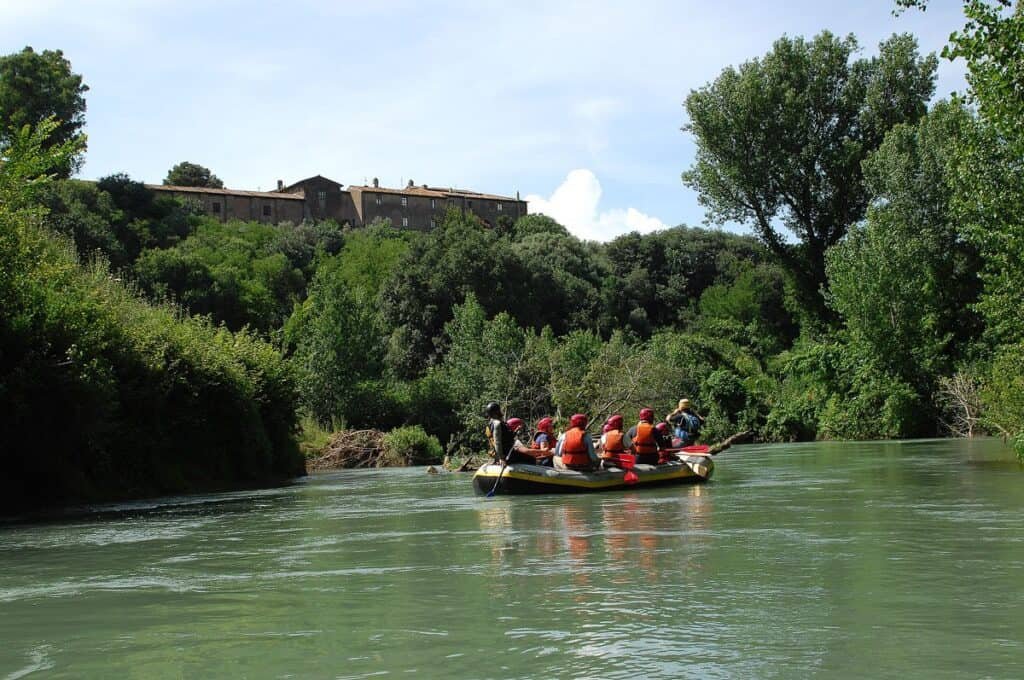
The outer perimeter, instead, can be walked and is worth the trip. You walk along the farm roads and the edges of the fields, you arrive by bicycle following the valley, and on the navigable stretches of the Aniene some people paddle along the bends that brush the estate. Many residents of Lunghezza and Ponte di Nona use the edge of the big meadow where horses and cows graze as a route for daily jogging: it is, in fact, the only running loop on natural ground in the area.
The critical note that must be said
The area adjoining the Tenuta del Cavaliere could and should be better kept. There are points where the roadsides accumulate trash, signs are missing or unreadable, accesses are not marked. It's a shame, because all the content is there: the estate has a natural, historical and productive value that has no equal in the eastern outskirts of Rome, and little would be needed to make it legible to those who arrive. Harmonizing those three potentials, instead of keeping them separate, is the key to its reappraisal. Anyone planning itineraries for groups and wanting to understand in advance what is really accessible can rely on the professionals of TourLeaderPro in Rome, who for this type of peripheral destination work with advance site inspections.
How long it takes
For the outer loop of the Lunghezza sector count a good two hours of walking with stops, three if you stop to watch the animals and take photos. If you add Castello di Lunghezza it becomes half a day. If you want to reach the Tor San Giovanni sector, inside the Marcigliana, allow a full day and a drive: they are two different worlds, and seeing them on the same day is tiring but instructive.
The Tenuta del Cavaliere with children and with schools
School visits are, historically, the most established way of enjoying the Tenuta del Cavaliere, and it's easy to see why: half an hour by coach from half of Rome there are real dairy cows, real sheep, real cultivated fields and a 16th-century farmhouse. For an elementary school class it's more effective than 20 pages of a book.
What works with the little ones
Three things work: the stable, the flock and the forage cycle. The stable because the size of an adult Friesian, in person, is a physical surprise. The flock because the Maremma sheepdogs, observed from a safe distance, are the most immediate way to explain what a working animal is. The forage cycle because it lets you close the circle: the grass of the field becomes hay, the hay becomes milk, the milk becomes cheese. A child who makes that connection once doesn't forget it.
Rules of behavior, non-negotiable
Stay on the indicated paths, don't enter the enclosures, don't feed the animals, don't run near the livestock, keep dogs away from the flock. These are not bureaucratic precautions: a dairy cow weighs six or 700 kilograms, a ram charges, a Maremma defends. Safety on a farm depends on distance.
When to go to the Tenuta del Cavaliere
The recommended calendar, season by season.
Spring
April and May are the absolute best time. The alfalfa fields are at their greenest, the bends of the Aniene still have flow, the bee-eaters arrive and begin to dig, the late-afternoon light cuts the hill at a very low angle. If you have to choose a single day of the year, choose it here.
Summer
From mid-June on the plain becomes an oven and shade is practically absent. Go at dawn or after 19:00, never at noon. The advantage of summer is the haymaking and ensiling operations: seeing a forage harvester at work on a cornfield is an industrial spectacle quite worth seeing.
Autumn
October and November give the best color on the river banks and the clearest air of the year for the view toward the Lucretili. The ground, though, becomes muddy after the first rains: hiking boots, not sneakers.
Winter
The January north wind is the ideal condition for the view: you see the snow-covered mountains behind the countryside and the photograph comes out as in no other season. In exchange the cold on the hill is biting and there is no shelter. Dress as you would in the mountains, not as you would in the city.
What is around the Tenuta del Cavaliere
A visit here combines well with other destinations in the eastern and northern band of the city.
Castello di Lunghezza
The most illustrious neighbor. The Castello di Lunghezza is in the eastern part of Rome, right after exit 14 of the Grande Raccordo Anulare, and includes the noble building, the courtyard gardens and about 3 hectares of park. Today it hosts school visits, events and celebrations, as well as the themed attractions for families that have made it popular among Romans with children. The official website of the managing body, castellodilunghezza.it, gives the updated calendar and access arrangements.
The Aniene valley toward the city
Going down along the river you meet the Cervelletta Park, with its tower-farmhouse and fields still cultivated, and farther downstream the Parco delle Valli, where the Aniene enters the built city for good. They are two tiles of the same mosaic: the Roman countryside that resists inside the urban fabric.
Toward Tivoli and the mountains
Going up the Tiburtina, in 20 minutes by car you reach Tivoli, with Hadrian's Villa at the foot of the town and the Villa Gregoriana Park overhanging the waterfall of the Aniene, about 160 meters high. It's the same river that passes in front of the estate, seen 30 kilometers farther upstream and in an entirely different mood.
The other Roman countryside
For those who take a liking to the Roman countryside, on the north side there is the Nomentum Nature Reserve, to the west the Oasi di Castel di Guido, to the south the urban gardens of Garbatella, which tell the city-sized, small version of the same agricultural vocation. Those who build their own itinerary can save the stops that interest them in the section My Trip.
A curiosity about the Tenuta del Cavaliere
The name deceives almost everyone. Anyone who reads the sign of Via della Tenuta del Cavaliere imagines a medieval knight, perhaps a feudal lord with a manor on the hill, and automatically links the place name to the castle glimpsed not far away. The documentary reality is another and has the flavor of notarial papers: the Tenuta del Cavaliere takes its name from a family surname. Between the 15th and 16th centuries three distinct parcels, Casale Nuovo, Cementara and Palazzetto, merged into the possessions of Anastasia Cavalieri, and from that unified patrimony the estate as a single body was born. The knight of the Tenuta del Cavaliere, in short, is a woman, or rather the family that woman belonged to.
The curiosity grows richer if you look at the mechanism behind it. In the Roman countryside place names were formed almost always this way: the name of the owner, of the farmhouse or of the titular saint of the chapel stuck to the estate and stayed even when the owner changed 10 times. Tor San Giovanni takes its name from the hospital that owned it from 1564. Aguzzano, on the other side of the valley, preserves in the name Auzano the memory of the agricultural property of the gens Acutia, that is, of a Roman family of the republican or imperial age. They are linguistic fossils: they survive the latifundium, malaria, land reclamation, building expansion. The toponymy of the Roman countryside is the only cadastre nobody has ever been able to erase, and the Tenuta del Cavaliere is a textbook example. When you travel the road, know that you are pronouncing the surname of a 16th-century landowner.
One thing nobody tells you about the Tenuta del Cavaliere
That the Tenuta del Cavaliere is not where you think, or rather, not only there. Everyone identifies it with the hill above the Aniene at Lunghezza, and everyone stops at that. But the farm has a second, detached body, located about 20 kilometers away, on the opposite side of the city: 78 hectares around the Casale Lucernari of Tor San Giovanni, geographically inside the Marcigliana Nature Reserve, between Salaria and Nomentana. Of the 388 hectares in total of the farm, those are a good fifth.
And there's more, because that second hub does a job nobody expects from an agricultural farm. Part of the Casale Lucernari is barracks and lodging for the park rangers of the reserve. Another part is a shelter for horses, and they are in good measure animals seized because they were used by organized crime in clandestine races, or abandoned or mistreated and entrusted to public care. A confiscated horse needs a stable, hay, a vet and a paddock for years, and nobody earns a euro from it: it's pure social cost. The fact that it is sustained by a municipal farm, using forage produced in-house, is exactly the kind of thing that justifies public ownership of a rural estate, and that instead always ends up outside the narratives about the Tenuta del Cavaliere.
I'll add the practical detail almost nobody connects: from that same area starts a nature trail of the Marcigliana, and the historical context is first-rate, with the 13th-century tower on a tuff spur, the site of the Latin city of Crustumerium and the catacombs of Sant'Alessandro a few minutes away. Whoever visits only Lunghezza sees half of the farm and a tenth of the history.
The advice I give you for visiting the Tenuta del Cavaliere
The most useful advice I can give you is contrary to what most people do: don't aim for the gate, aim for the hill and the right hour. Anyone who arrives here thinking of entering as one enters a public park goes away disappointed, because the Tenuta del Cavaliere is a working farm and access to the interior spaces is organized, not free. Anyone who instead arrives knowing that the view is played from the perimeter, and does it at the right hour, goes home satisfied.
Operationally: exit 14 of the Grande Raccordo Anulare, car left in a safe spot away from the through lanes, and then on foot along the edge of the fields, climbing toward the elevation of the farmhouse. Go there an hour and a half before sunset in spring or autumn, and plan on standing still. The value of this place is not in an object to photograph: it's in the depth of field, in the fact that from a single point you see at the same time the river, the arable field, the 16th-century farmhouse, the castle, the sheds of the Centro Agroalimentare and, in the background, the mountain. That stratification is the most honest portrait of Rome you can see without entering the historic center.
Second piece of advice, less poetic and more concrete: check the openings first. If your goal is the stable, the dairy or the courtyard with the chapel, the only way is to attach yourself to an organized day, a school visit or an initiative promoted with the associations of the valley. Showing up at random in front of the gate hoping for an opening is the best way to waste an afternoon. Third: bring water. There is no bar, no drinking fountain along the outer route, and in summer the sun here is merciless. Anyone organizing outings for groups or companies who wants serious logistics management of a peripheral destination like this will find a professional reference in the tour leading service of TourLeaderPro.
Another well-known fact, yet rarely cited
That Rome is the largest agricultural municipality in Europe many people know, and it is repeated at every conference on the environment. What is almost never said is the operational consequence: Roma Capitale does not merely own those lands, it runs them. It has farms, stables, head of livestock, tractors, farm employees. It had, for years, a dairy and a brand of its own, and sold bottled organic milk, cheeses and fillets in the farmers' markets of the city, including the Garbatella one and the Circo Massimo one. Put differently: the Municipality of Rome was a producer of dairy products and meats, and the milk came from the hundreds of sheep and cattle at pasture at the Tenuta del Cavaliere and at Castel di Guido.
This fact, however public and verifiable, remains outside the collective imagination of Romans, who think of the Municipality as a body that fixes potholes and collects trash. And it remains outside the imagination of visitors too, who when they think of Rome think of ruins and not alfalfa fields. The consequence is that a public short supply chain, potentially very strong, never had the audience it deserved. In recent years the products with the Capitoline brand have thinned out until they almost vanished from the stalls, and it's a clear loss: because the chain existed, it was truly short, and it concerned a territory that from stable to market doesn't exceed 20 kilometers. Putting it back on its feet doesn't require an invention, it requires a decision.
The right photo to take at the Tenuta del Cavaliere
The photograph that tells the Tenuta del Cavaliere is only one, and it is not a close-up. Position yourself on the slope of the hill, with the Casale del Cavaliere on the ridge to the left or right of the frame, never in the center, and compose so that three planes enter the frame: in the foreground the arable field or alfalfa field with its texture of rows, in the middle ground the plain with the bends of the Aniene and the grazing animals, in the background the line of the mountains. You need a lens of around 35 or 50 millimeters on full frame: the extreme wide angle empties the landscape, the telephoto flattens it and makes you lose precisely the depth that is the real subject.
The hour and the light
The last two hours before sunset, no alternatives. The raking light reveals the furrows of the plowing and the micro relief of the hill, which at noon disappear completely. In winter, with the north wind, the same framing gains crisp mountains in the background and sometimes snow. Avoid the summer noon: flat light, haze, heat that distorts the air above the field.
The other two photos that work
The second is the flock at the old fountain, photographed from far away with a medium telephoto, never getting closer: the Maremma sheepdogs don't like it and they are right. The third is the architecture: the entrance arch in the wall that closes the courtyard, shot head-on, with the aedicule of the Madonna and Child in the background if the visit allows it. A tip about people: if farm workers appear, ask permission before photographing them. It's a workplace, not a set.
One thing not to do
Don't fly drones over the animals. The noise agitates the livestock, frightens the horses, disturbs the nesting of raptors and of the bee-eater colonies on the banks, and near protected areas and infrastructure the flight restrictions must be checked beforehand anyway. A photograph is not worth a stampeding herd.
Some important events that happened here in history
The history of this piece of the Roman countryside is measured in changes of ownership and changes of function, and each of those changes corresponds to a phase of the history of Rome.
From three parcels to a single estate
The first event is the aggregation: between the 15th and 16th centuries Casale Nuovo, Cementara and Palazzetto stop being three parcels and become a single patrimony in the hands of the Cavalieri family. It is the moment when the Tenuta del Cavaliere is born as an entity, and it is also the moment when, in the early 1500s, the farmhouse on the top of the hill is built.
1640: the passage to the Fatebenefratelli
In 1640 the estate enters the ownership of the Hospitaller Order of Saint John of God. It is the year that marks the fate of the estate for the next two and a half centuries and inscribes it in the great Roman charitable economy, the one in which the income from the countryside paid for the beds of the city hospitals.
1896: the Pio Istituto
After the Ospedali Riuniti of Rome, in 1896 the property passes to the Pio Istituto, which administers it until the body's dissolution. We are in the post-unification Rome that debates land reclamation of the Roman countryside and hygienic sanitation, and the great estates become matter for law and parliamentary inquiry.
1887: the railway cuts the valley
A fact external to the estate changes its context forever: in 1887 the railway to Tivoli opens, with the Lunghezza station. The Aniene valley, until then traveled by the consular roads and the drove roads, acquires a modern infrastructure, and the countryside east of Rome enters the daily orbit of the city.
The 20th century and 2000: from church property to restored common good
In the 20th century lands and buildings enter the municipal patrimony, and in 2000 the renovation and restoration works on the entire complex begin, which give back to the old hamlet its historic appearance while giving it the new function of seat of the farm's offices and housing for the farmers.
2013: the new stable
The last relevant event in chronological order is both construction and production: the building, in 2013, of a new stable that doubles the covered surface for animals, while one of the old stables, restored, is assigned to the sheep. It's the signal that the farm, in those years, was investing.
In the background: Collatia, Crustumerium, the manifesto of Lunghezza
Around the estate the history is much older. The 19th-century topographer Antonio Nibby placed here the Latin citadel of Collatia, tied by the literary tradition to the story of Lucretia told by Livy, and some have hypothesized that her tomb lies under Castello di Lunghezza: tradition and hypothesis, not document. Documented instead is the presence of monks: already in papers of the 8th century the abbey of Farfa controlled a rural estate in the area, and between the 13th and 15th centuries the castle belonged to the Benedictines of San Paolo fuori le Mura. At Lunghezza was then drawn up the manifesto contesting the legitimacy of Boniface VIII, one of the most sensational documents of the clash between the pope and the Colonna. On the other front of the farm, at Tor San Giovanni, the 13th-century tower and the nearby site of Crustumerium, inhabited since the Iron Age, lengthen the chronology by another two millennia.
Who has passed through the Tenuta del Cavaliere
A farm doesn't have a guest book like a noble villa, and it would be dishonest to invent one. The names that can be mentioned, though, exist, and they are names that carry weight.
Anastasia Cavalieri and the owners
First is she, the woman who gives the place its name. Into her possessions, between the 15th and 16th centuries, flow the three parcels from which the estate is born. After her pass through here, as owners and administrators, the religious of the Hospitaller Order of Saint John of God from 1640, the administrators of the Ospedali Riuniti of Rome and those of the Pio Istituto from 1896: generations of stewards, farm managers and countryside merchants who for almost three centuries decided what was sown on these hectares.
The monks of Farfa and San Paolo fuori le Mura
In the immediate surroundings, monastic presence is documented much earlier. Papers of the 8th century attest that the abbey of Farfa controlled a rural property in this area, and between the 13th and 15th centuries the Benedictines of San Paolo fuori le Mura were masters of the castle of Lunghezza. On the other hub of the farm, the little tower of the Bufalotta, in the 11th century, served as administrative center for lands again managed by Farfa. People who didn't pass through here: they stayed here, and counted the sheep.
Antonio Nibby and the topographers
In the 1800s the scholars arrive. Antonio Nibby, the topographer who shaped the modern knowledge of the Roman countryside, identified in this area the citadel of Collatia, and with him the host of archaeologists, cartographers and travelers who in the century of archaeology rode across the Roman countryside taking notes. Behind them, the compilers of the Gregorian cadastre and then of the reformed cadastre of 1870, who surveyed 357 estates on almost 198,000 hectares and left the only overall portrait of the Roman countryside before building speculation.
The Colonna and the clash with Boniface VIII
At Lunghezza, a stone's throw from the boundaries of the estate, the manifesto contesting the legitimacy of Boniface VIII was drawn up: an act that involved the Colonna cardinals and had very heavy consequences, with the excommunication and the destruction of Palestrina. For once, the countryside east of Rome was the place where European history was written, not the one where its echo arrived.
And today
Today school classes, livestock breeders, park rangers, volunteers of the associations of the Aniene valley, morning runners and cyclists pass through here. They are not characters for an encyclopedia, but they are the ones who keep the place alive, and on a farm estate that counts more than an illustrious guest.
Quick questions about the Tenuta del Cavaliere
Where exactly is the Tenuta del Cavaliere?
In the eastern part of Rome, outside the Grande Raccordo Anulare, between Via Tiburtina and Via Collatina, along the bends of the Aniene at Lunghezza and Ponte di Nona. You reach it from Via della Tenuta del Cavaliere, leaving at exit 14 of the Raccordo.
How big is the Tenuta del Cavaliere?
The main body at Lunghezza is around 300 hectares. Counting also the 78 hectares of Tor San Giovanni, the farm reaches 388 hectares in total. It is the second farm of Roma Capitale by extent after Castel di Guido.
Can you enter the Tenuta del Cavaliere freely?
No. It is a working livestock farm: access to the interior spaces takes place on the occasion of organized visits, educational days and agreed initiatives. The outer perimeter, with the farm roads and the edges of the fields, can instead be walked on foot and by bicycle.
How much does it cost to visit the Tenuta del Cavaliere?
There is no ticket office and no published entrance price: the conditions depend on the type of initiative and should be asked of the offices of Roma Capitale that manage the farm. The outer loop costs nothing.
Do you need to book to visit the Tenuta del Cavaliere?
For the interior spaces yes, always, through the channel of the initiative you join. For the perimeter no.
How do you get to the Tenuta del Cavaliere by public transport?
The most direct solution is the train: FL2 line from Roma Tiburtina toward Tivoli and Guidonia, Lunghezza stop, opened in 1887 together with the railway to Tivoli and downgraded to a stop in 2007. From the stop the area is served by urban bus lines. The final stretch on foot is awkward and it's worth considering the bicycle.
Can you get there by bicycle?
Yes, and it is probably the best way. The Aniene valley is the natural corridor for reaching the area from the city, and the perimeter of the estate lends itself to a ride on mixed surface.
Can you canoe on the Aniene near the Tenuta del Cavaliere?
On the navigable stretches some people paddle along the bends that brush the estate. Flow and conditions of the river change a lot with the season, so the activity must be organized with someone who knows the waterway and with suitable equipment.
Are animals visible from outside?
Yes. From the edge of the fields you regularly see dairy cattle and horses at pasture and, with a little luck, the flock of sheep with the Maremma sheepdogs.
Can you get close to the animals?
No. Don't enter the pens, don't feed the animals, and don't approach the flock watched over by the Maremma sheepdogs. They are working animals and livestock, not pets.
Is Tenuta del Cavaliere suitable for children?
Very much so, especially with the educational visit: the barn, the flock and the forage cycle work very well with elementary school groups. Outside, watch for traffic on the access roads and wear suitable shoes.
Can you bring dogs?
Yes on the outer perimeter, on a leash and away from the grazing areas. Near the flock and the guard dogs, it's better to change route.
How long does a visit to Tenuta del Cavaliere take?
The outer loop of the Lunghezza sector takes two or three hours with stops. Adding Castello di Lunghezza makes it half a day, and including the Tor San Giovanni site makes it a full day.
What wild animals can you see?
Among the mammals, badger, porcupine, weasel, vole and hazel dormouse. Among the birds, many diurnal and nocturnal birds of prey, the great spotted woodpecker, the green woodpecker, the hoopoe and the bee-eater, which nests in the sandy banks of the river.
What is the best time to go?
April and May for the greenery and the wildlife, October and November for the light and the clear air, January with the north wind for the view of the mountains. In summer only at dawn or after 19:00.
Can you still buy Tenuta del Cavaliere products?
The bottled organic milk, the dairy cheeses and the fillets sold under the Roma Capitale brand used to be sold in the city's farmers' markets, including Garbatella and Circo Massimo, but in recent years their presence has shrunk a lot. Current availability should be checked with the relevant offices.
What is the difference between Tenuta del Cavaliere and Castel di Guido?
Both are farms of Roma Capitale, but on opposite sides: Castel di Guido is in the west, toward the Aurelia, and covers more than 2,000 hectares. Tenuta del Cavaliere is in the east, on the Aniene, and is the second largest.
What is the relationship between Tenuta del Cavaliere and Parco della Marcigliana?
The farm's second site, Casale Lucernari di Tor San Giovanni with its 78 hectares, lies geographically inside the Marcigliana Nature Reserve, which also hosts the park rangers' barracks in the same complex.
Is Tenuta del Cavaliere part of the Valle dell'Aniene Nature Reserve?
No. The reserve, managed within the RomaNatura system, protects the urban stretch of the river from the Grande Raccordo Anulare to the confluence with the Tiber, for about 650 hectares. The estate lies just upstream of that limit, outside the Raccordo.
Is there a bar or a place to eat?
Not along the outer route. Bring water and food from home. The nearest commercial services are those in Lunghezza and Ponte di Nona.
Is it accessible with strollers or wheelchairs?
The surface of the farm roads is dirt, uneven and muddy after the rain. It is not suitable for standard strollers or light strollers. For specific needs it's best to ask the visit organizers in advance which stretches are passable.
Can you take photos at Tenuta del Cavaliere?
From the outside yes, no problem. For people at work you need consent, and drones over the animals are to be avoided in any case.
What is there to visit around Tenuta del Cavaliere?
Castello di Lunghezza a few hundred meters away, Parco della Cervelletta and Parco delle Valli going down along the Aniene, Parco di Aguzzano and Museo di Casal de' Pazzi on the other side, Tivoli with Villa Adriana and Parco di Villa Gregoriana going up the Tiburtina.
Why is it called Tenuta del Cavaliere?
From the surname of the Cavalieri family, whose estates took in, between the 15th and 16th centuries, the three holdings of Casale Nuovo, Cementara and Palazzetto from which the estate was born. No knight in armor.
Is it worth going if you have only a few days in Rome?
If you have three days and have never seen the Colosseum, no. If you're coming back to Rome for the third time and want to understand what the city is like beyond the postcards, yes, without hesitation. To plan your days in the city, the English guides are still useful, such as Rome in 3 days and the selection of the best things to do in Rome.
To close, an opinion: Tenuta del Cavaliere is the right place for anyone who says they know Rome. Not because it is beautiful the way a Baroque square is beautiful, but because it is the only place where you can see at a glance what this city has been for 2,000 years, a capital resting on a countryside that fed it, and what it risks becoming, a periphery that eats that countryside without noticing. Go there an hour before sunset, stand on the hill and stay quiet for 10 minutes. Then tell me if you still feel like calling it the periphery.
Article written by the editorial team of TourLeaderPro, contact them for Private/Corporate/V.I.P. Tours and Experiences.
Planning a trip to Rome? The English guides to visiting the city are on ItalyPlanner.com.
