State Police Car Museum
https://www.estateromana.com/en/rome/trip-planner/state-police-car-museum/
 State Police Car Museum
The State Police Car Museum is at via dell'Arcadia 20, inside one of the surviving pavilions of the former Fiera di Roma, in the Tor Marancia area, right up against via Cristoforo Colombo and a little over a kilometer from the Garbatella station on metro line B. The ticket costs €3 full price and €1.50 reduced, with free admission for Police personnel on active duty or retired, and the proceeds fund the "Marco Valerio" assistance plan, the program with which the Administration supports the minor children of employees suffering from chronic illnesses. The hours given by public sources are in the morning, Monday to Friday from 9 to 13, closed in the month of August. The visit is arranged by phone at 06 5141861 or 06 51606891, or by writing to museoautopolizia@interno.it, and this is the step not to skip: the official tourist information of Roma Capitale currently lists the facility as temporarily closed, so the email or the phone call before you set out is worth more than any hours read online. It's not a civic museum with an automatic ticket office: it's a collection that lives inside a State Police facility, and this changes everything, from the way you book to the way you visit.
Anyone who wants to build a day around it will find the other destinations in this sector of the city on the page about EUR and in the general list of Rome's tourist attractions.
[caption id="attachment_9085" align="alignnone" width="800"]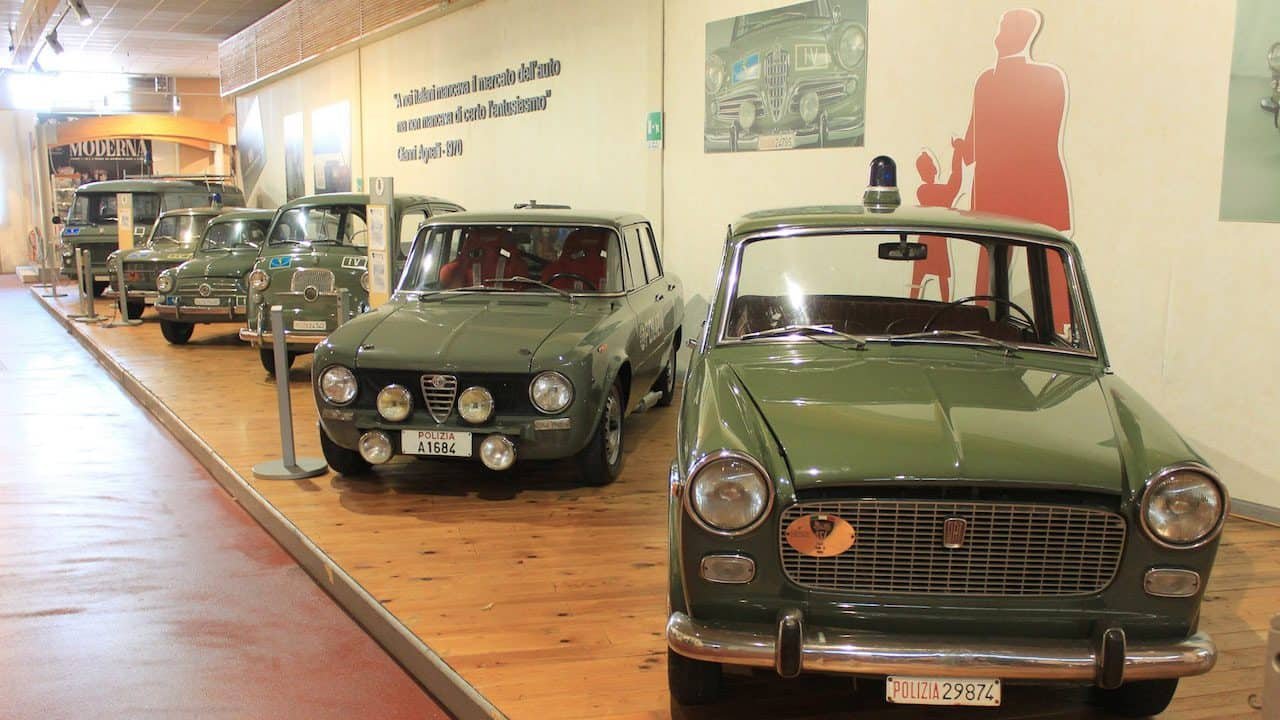 State Police Car Museum[/caption]
Where the State Police Car Museum Is and How to Get There
The address is via dell'Arcadia 20, and the name of the street already says something about this quadrant: the Arcadia was the literary academy founded in Rome in 1690, and the street names of this area draw heavily on literature, with via Pindaro, viale Tirreno and the other streets dedicated to poets and classical places. We are in the stretch of the city that descends from Tor Marancia toward San Paolo, in that triangle between via Cristoforo Colombo, Garbatella and the beginning of the EUR district. The postal code is 00147, not that of EUR proper: a nuance that matters when you set the navigator and discover that via dell'Arcadia is a long street, with street numbers that run past a hundred.
By Metro and Bus to the State Police Car Museum
The most solid reference is metro line B. The coordinates published by the Roma Capitale tourist portal place the museum a little over a kilometer as the crow flies from Garbatella station, that is about 20 minutes on foot on regular sidewalks and slightly uphill in the last stretch. Anyone who doesn't want to walk can use the surface lines that run along via Cristoforo Colombo and get off at the former Fiera: the line numbers change over time and it's best to have them confirmed by the transport company's planner on the same day, because in this sector of the city routes are tweaked fairly often. The practical advice is banal and it works: metro B to Garbatella and then your feet. 20 minutes of walking in a neighborhood nobody visits are worth more than 20 minutes spent waiting for a bus.
By Car, by Motorbike and Where to Park
Here, for once, the car makes sense, and in a museum dedicated to cars that even has an irony of its own. The area is outside the green band of the historic center, the streets are wide, the fabric is that of public housing and offices, and finding a spot along via dell'Arcadia or in the side streets is not the feat it becomes in the center. Coming from the Grande Raccordo Anulare you exit onto via Cristoforo Colombo toward the center and in five minutes you are in front of the complex. Coming from the center you take the Colombo toward EUR. A serious recommendation: the museum is housed in a State Police area, so you leave the vehicle in the public spaces and present yourself on foot at the entrance, without approaching the service gates with the car.
The Entrance and the Former Fiera Complex
The pavilion that houses the State Police Car Museum belongs to the complex that for half a century housed the Fiera di Roma. The Roman sample fair had moved to via Cristoforo Colombo in 1959, in a site born as temporary and left in place for 50 years, until the 2006 move to the new trade-fair complex along the motorway to Fiumicino. When the Fair left, the sheds stayed, and some were reassigned to State administrations. The collection of Police vehicles occupies one of those spaces: high ceiling, free spans, industrial floor. It is exactly the container a car museum needs, and it's not a stroke of luck: a museum of vehicles is made where the vehicles come in and out of a wide gate.
Hours, Tickets and Booking at the State Police Car Museum
The practical side of this visit is played out entirely by phone or by email, and it's worth explaining well, because it's the point where the most visitors are lost. Public sources agree on a morning window, Monday to Friday between 9 and 13, with the museum closed in August. The ticket price, when the facility is open to the public, is €3 full price and €1.50 reduced. The contacts are two landline numbers, 06 5141861 and 06 51606891, and the address museoautopolizia@interno.it. The official tourist portal of Roma Capitale currently lists the museum as temporarily closed: the prudent form, and the only reasonable one, is to treat the opening as something to be confirmed case by case.
How Much the State Police Car Museum Ticket Costs
€3. In the Roman museum landscape, where a full-price admission to a major state collection runs around €12 or €15, the figure is almost symbolic, and there is a precise reason: the museum is not a cultural enterprise that has to stay afloat on ticket sales, it's a service of the Administration that collects a contribution and passes it on to the "Marco Valerio" assistance plan, the program with which the Assistance Fund for State Police personnel supports the minor children of employees struck by chronic illnesses. Knowing where those €3 end up changes the meaning of the gesture: you pay little and you pay for something specific. It's also the first piece of information that strikes students on school visits, much more than the engine sizes.
How to Book a Visit to the State Police Car Museum
You write to museoautopolizia@interno.it stating the desired date, the number of people, a phone number and, if it's a group, the name of the organization or school. Alternatively you phone the museum's numbers during office hours. Those going alone or as a couple generally find availability on short notice. Groups and classes need more margin, because the accompaniment is provided by personnel on duty and has to be fitted around the unit's commitments. A rule for those organizing trips: ask for the written confirmation and bring it with you, together with a valid ID for each participant. At the entrance of a State Police facility the ID is needed, and it's not a formality that can be got around.
Groups, School Classes and Guided Visits
The museum was born with a declared educational vocation, and that is the reason it works better with a guide than alone. Visits for groups and school classes are arranged directly with the museum, which organizes them with its own staff: they are police officers, often with years on the street behind them, and the difference from an audio guide is all there. It's one thing to read the plaque of a 1972 Alfa Romeo, another to hear from someone who worked in one what it was like to sit inside it four to a car with the vest on, the radio crackling and no air conditioning. If you accompany a class, explicitly ask for the historical angle: the risk, when the kids are very young, is that the visit is reduced to a list of models and horsepower. The material to make it a lesson in Italian history is all there.
When to Go to the State Police Car Museum
The window is in the morning, so the real choice concerns the day and the season. The best months are the school months, October to May, with the opposite caveat: they are also the months when classes fill the calendar. Anyone who wants the pavilion almost empty should aim for a midweek morning outside the school-trip periods, avoiding the weeks immediately before the Christmas and Easter holidays. August is excluded because of the closure. And then there is an advantage nobody considers: being an indoor space, heated in winter and sheltered from the sun in spring, it's the right card for a rainy Roman day, when the Forums and the villas turn into an endurance test.
What the State Police Car Museum Really Is
It's best to clear up a misunderstanding. The State Police Car Museum is not a museum of the Italian automobile with a few colorful liveries: it's a museum of institutional history that has chosen vehicles as its alphabet. The cars and motorcycles are the documents, and like all documents they say things that textbooks write badly. A 1946 jeep tells of the public order of a country emerging from the war with broken roads and rationed fuel. A black Alfa Romeo of the early 1950s tells of the arrival of the radio on board and the shift from the police officer on foot to the police officer who arrives in two minutes. An armored sedan of the late 1970s tells of terrorism. An off-road vehicle with chains tells of snow emergencies. Anyone who comes in looking only for handsome chrome noses leaves half happy. Anyone who comes in knowing they are reading 70 years of Italy leaves with a full head.
The Numbers of the State Police Car Museum Collection
Public sources speak of around 70 specimens among cars, motorcycles, scooters, bicycles and special vehicles, with a chronological span running from the 1930s up to recent production. The number varies across the descriptions, and the reason is simple: a collection of vehicles is not a picture gallery, it breathes. Some vehicle goes out for an event, for a vintage car rally, for an institutional celebration. Some other comes in after restoration. It's good to know this before arriving with the list in hand expecting to find it complete. The substance, though, remains: a pavilion ordered chronologically, in which you walk along time instead of along a corridor.
Why the State Police Car Museum Is Unlike Other Museums in Rome
Because it has no ticket office waiting for you, because it's not part of the civic circuits, because it doesn't appear in the ministry's free Sundays, because to get in you need an ID and an agreement made beforehand. And because the staff who welcome you are not a contracted museum-services company, they are the Administration itself. The result is a more personal and drier account than that of a professional guide, less constructed and more anecdotal. Anyone who needs a teaching route laid out to the millimeter won't find it here. Anyone looking for contact with a memory of the trade will. A blunt judgment: it's one of the least touristy and most instructive museums in Rome, and the ratio between what it costs and what it gives back is unbeatable.
The Collection of the State Police Car Museum and the Restorations
Many vehicles arrived here in pitiful condition, recovered from depots, from provincial motor pools, in some cases from demolitions avoided at the last moment. The work of putting them back in order was done with an obsession for original components, which in the world of historic cars is the dividing line between a restoration and a disguise. Putting a 1960s sedan back on the road is relatively easy. Putting it back in the exact configuration it had in service, with the paddle, the right type of siren, the correct radio equipment and the livery of the period, is philologists' work. Looking at the cars carefully you notice the details that give away the service fit-out: the brackets for the flashing lights, the cable runs, the holes in the fenders, the dashboards modified to house the equipment. Those things, not the shiny paint, are the real historical content of the museum.
The Former Fiera di Roma Pavilion and the Neighborhood Around It
It's worth spending a few lines on the container, because it is a piece of urban history that Romans themselves have removed. From the end of the 1950s and for 50 years, the Fiera di Roma was here, along via Cristoforo Colombo: the sample fair, the trade shows, the merchandise exhibitions, the pavilions with neon signs that could be seen from the road. A site born as temporary and then left in place, as so often happens in Rome with temporary things. In 2006 the Fair moved to the new complex outside the city, along the motorway to Fiumicino airport, and this sector suddenly lost its function. Some sheds were demolished, others converted, others reassigned to public administrations.
Tor Marancia, the Colombo and the City You Don't Visit
The neighborhood around deserves a look. Via Cristoforo Colombo is the straight axis opened in the 1930s to connect the center with the area of the 1942 Universal Exposition, the one that would later become EUR: a road conceived for speed and for show, wide and tree-lined, which still works as such today. On its sides, in scattered order, grew the public housing of Tor Marancia, the offices, the large service-sector complexes. It's a Rome without travertine and without postcards, which foreign visitors cross only by taxi on the way to the airport. One of the reasons I recommend this visit is precisely that it takes you into a part of the real city: you leave the museum, walk a quarter of an hour and you are in the middle of a working city.
How to Read the Layout of the State Police Car Museum
The ordering is chronological, and it's the right choice. You start from the oldest vehicles and arrive at the contemporary ones, so that the walk coincides with a linear story: motorization, reconstruction, economic boom, protest and terrorism, the 1980s, technology, today. The suggestion is to walk the pavilion twice. The first time forward, from oldest to newest, to catch the progression. The second backward, looking at one element at a time: first all the flashing lights, then all the radios, then all the liveries. Seeing the same function change shape over time is the exercise that makes a museum of vehicles something more than a tidy parking lot.
The 1930s and the First Motorization of the Police
The oldest section of the route is also the furthest from the common imagination, because it precedes the police officer in a squad car that we all have in our heads. In the 1930s the automobile in public security service is still a rare and precious object, reserved for representation, escort and liaison tasks. The cars are adapted production sedans: reinforced suspension, a few modifications to the bodywork, dark paint, the adjustable searchlight mounted on the pillar. The radio does not yet exist on board, and this determines the whole organization of the service: patrolling is not a dynamic service, it's a route decided in advance, and liaison goes through the barracks' telephones and the fixed posts.
The Italian Sedans of the 1930s
The makers that equip the State in those years are the same ones that fill the roads: Fiat, Lancia, Alfa Romeo, with a few industrial vehicles of other makes. Among the models that trade sources associate with the collection are a Lancia Artena, a mid-size sedan produced from 1931, and an Alfa Romeo 6C 2300, the six-cylinder designed by Vittorio Jano that in its racing version would make the sporting history of the marque. These are cars that today, at an international auction, are treated as dizzying collector's pieces. Here they wear the service livery, and the short circuit is half the pleasure of the visit. Look at them thinking about the roads of the time: uneven surfaces, poor lighting, narrow tires, drum brakes on all wheels. The speed stated in the brochures and the real speed in service were two different things.
The Milizia della Strada, Ancestor of the Traffic Police
The road chapter has a birth date earlier than the Republic. In 1928 the Corpo della Milizia della Strada was established, at the urging of the Royal Automobile Club of Italy, as a specialty of the Voluntary Militia for National Security. In 1932 the corps took the name Milizia Nazionale della Strada. The numbers of that period tell of a country at the beginning of motorization: a few dozen officers, a little over 300 vehicles, the vast majority motorcycles, for a network of about 21,000 kilometers of roads. The uniform was gray-green, and for motorcycle duty a black leather helmet with a padded rim was used. Anyone who visits the museum with a minimum of historical curiosity understands, looking at those helmets, how little they protected and how much they already said about a job done exposed to the weather.
The Early Collection in the State Police Car Museum
The value of this first section is documentary rather than spectacular. There are few vehicles, and anyone arriving with the sirens of 1970s films in mind risks walking past absentmindedly. That would be a mistake. Here you see the birth of a principle that still underpins the whole organization today: the police vehicle is not just any vehicle painted another color, it's a system that integrates vehicle, communication equipment, gear and trained man. Remove one of the four elements and the system doesn't work. In the 1930s the second was missing, and indeed the history of police motorization in Italy really begins the day the radio arrives on board.
The Postwar Period: Jeeps, Reconstruction and the Birth of the Volanti
The postwar section is the one that strikes adult visitors most, because it touches a family memory. The American jeeps left in Italy after 1945 become the public-order vehicle par excellence: sturdy, simple, repairable with next to nothing, able to go on roads that sedans did not tackle. The light off-road vehicle of military derivation enters the collective imagination through newsreels, rallies, union demonstrations, the chronicles of the early years of the Republic. Anyone looking at those vehicles in the via dell'Arcadia pavilion should make an effort of context: in 1946 Italy had collapsed bridges, gutted cities, a decimated vehicle fleet and an industrial capacity to rebuild. A jeep in working order was worth more than a ceremonial car.
The Jeeps and the Mobile Units
With reconstruction came the units intended for public order, the ones public opinion of the time called the Celere, organized around light vehicles and a mobility designed to move small groups of men quickly. The open off-road vehicle, with or without a canvas top, is the symbol of that season. In the museum you see its essential structure: ladder frame, leaf-spring suspension, four-cylinder engine, no concession to comfort. A detail to notice is the folding windshield: it served to reduce bulk and avoid reflections, and tells of a use of the vehicle much closer to the military than to the civilian. The dividing line between the two worlds, in Italy in 1947, was still thin.
The Radio on Board Changes the Job
The real revolution of the 1950s is the radio transceiver. With the radio the patrol stops being a route and becomes a mobile resource: the operations room knows where the vehicles are and directs them where needed. It's exactly the principle of the squadra volante, and from then on the whole history of police vehicles becomes the history of the integration between the vehicle and the control center. At the museum you follow the evolution by looking at the equipment displayed in the section of technical relics, and by observing the dashboards of the cars: the bulk of the 1960s radios, with their tubes and power supplies, was such that it stole space from the passenger compartment and forced improvised mounting solutions, often made in the units' workshops.
The Alfa Romeos of the Squadre Volanti at the State Police Car Museum
If the museum has a backbone, this is it. The history of the Squadre Volanti coincides with the history of Alfa Romeo in uniform, and the pavilion retraces it model by model. The first squad car dates to 1952, with an Alfa Romeo 1900 TI: an upper-segment sedan, twin-cam four-cylinder, sound chassis, performance that in the Italian landscape of the time seemed like science fiction. From then on the Milan marque supplied the Police with one generation after another of sedans, and each generation brings with it a piece of national custom.
The Alfa Romeo 1900 and the Birth of the "Panther"
The nickname is born here. The 1900 in service was black, agile, fast, and the front with the two recessed headlights and the shield-shaped grille recalled the muzzle of a feline: popular imagination, helped by the reporters, christened it "panther". The name has crossed the decades and has become the common way of indicating the Police car, so much so that today it's used even by kids who have never seen a 1900 in their lives. It's one of the few Italian popular nicknames that has survived the change of generations, the change of livery colors and even the change of the vehicles' make. At the museum, in front of the sedan that originated the word, the story writes itself.
The Giulia Super, the Squad Car Everyone Remembers
Then comes she. The Giulia, presented in 1962 and produced in an endless number of variants until the 1970s, is the car that defined the image of the Italian Police for at least 20 years. A boxy sedan with the aerodynamic coefficient that Alfa advertised as studied in the wind tunnel, a light-alloy twin-cam engine, a five-speed gearbox when almost nobody had one, disc brakes. In service it was used from 1964 onward and stayed in the fleet until the 1980s. The Giulia is the squad car of Italian cinema, that of the poliziotteschi shot between Rome, Milan and Turin, the one that in collective memory chases the robbers' cars with the two-tone siren. Looking at it standing still, under museum light, helps you understand how compact it was: we always underestimate how small the cars were that seem enormous in our memories.
The Giulia Promiscua and the Special Versions
Among the curiosities of the collection is the Giulia Promiscua, the station-wagon version fitted out by outside coachbuilders on a sedan base, little seen among private owners and instead useful to the units that needed to carry materials, equipment, barriers, gear for surveys. It's the type of vehicle nobody remembers because it doesn't make a show, and it's exactly for this reason that it deserves attention: logistics is the invisible part of every service, and a museum that displays only pursuit cars tells half the job.
Alfetta, Giulietta and Alfasud: The 1970s and 1980s
The Alfetta, presented in 1972 with the transaxle layout and the De Dion axle, gradually replaces the Giulia in squad car duty and becomes the symbol vehicle of the hardest decade of the Republic. Alongside it come into service the second-series Giulietta and the Alfasud, the compact sedan produced at Pomigliano d'Arco with the boxer engine, which takes police motorization toward a smaller and cheaper size. It's the passage from the special car to the production car: the Police begins to buy what the country buys, and the difference is made by the fit-outs. In the 1980s the Alfa Romeo 33 would arrive, then the 155, and the arc continues up to today's powertrains.
The Liveries and the Number 113
A chapter that reads very well at the museum is the one about colors. Between the 1960s and 1970s the Police cars were green, with the words "Polizia Squadra Volante" on the front doors. From 1976 the livery becomes light blue with white side bands and the two-color lettering, which is the scheme everyone recognizes today. At the end of the 1990s the graphics become rounded and slanted, and with the most recent cars the stylized silhouette of the panther appears on the band, while the number 113 moves to the rear pillars. The 113, the historic emergency number of the State Police, today lives alongside the single European emergency number. Observing the succession of liveries along the pavilion is a small course in institutional communication: you go from camouflage to recognizability, from dark paint to a color that has to be seen from afar.
The Squadre Volanti, 50 Years of Interventions
One figure gives the measure of the phenomenon. In May 1988, by decree of the President of the Republic, the merit of the Squadre Volanti was recognized for the interventions carried out in the 20 years 1968-1988: the official count spoke of more than 52 million on-call interventions. 52 million. Try dividing it by the days and you realize what rapid response was in Italy in the period of greatest social tension of the Republic. The museum displays the vehicles with which that work was done, and the figure should be written large at the entrance.
[caption id="attachment_9084" align="alignnone" width="800"]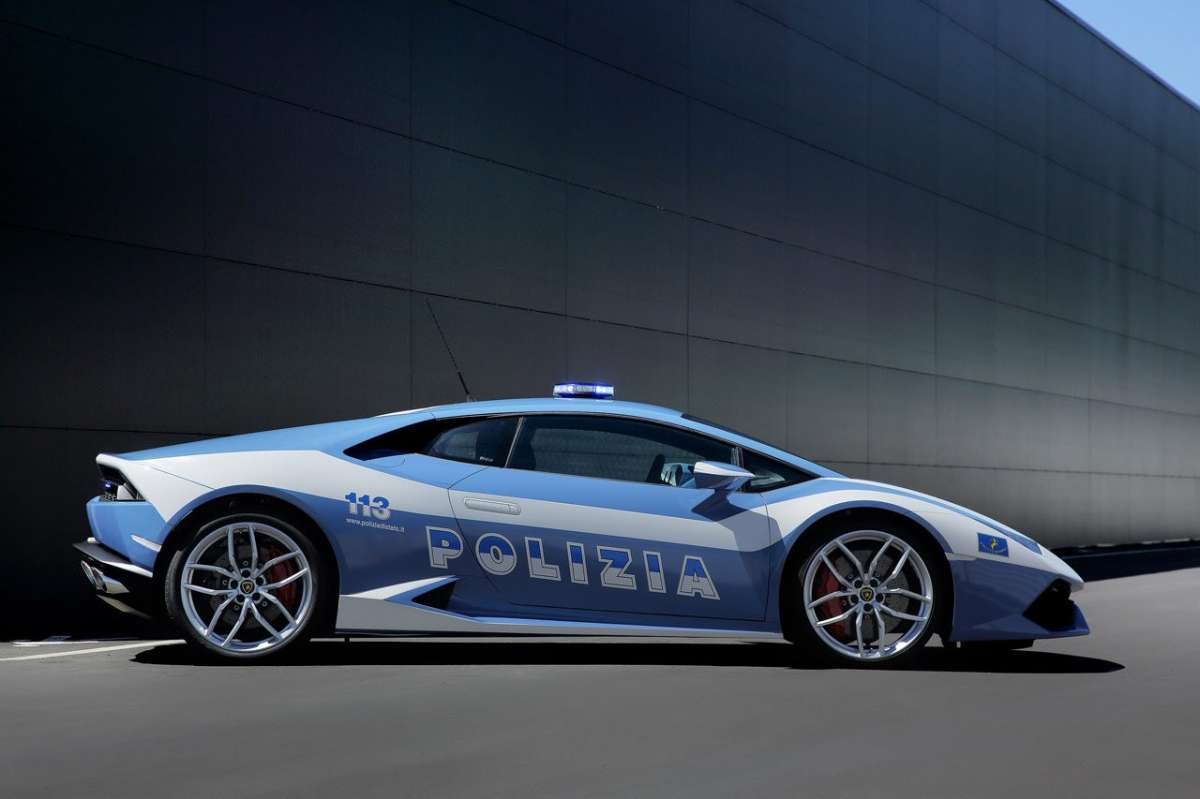 State Police Car Museum[/caption]
The Police Ferrari 250 GTE and Marshal Armando Spatafora
This is the story that makes the Roman chapter of police motorization famous, and it's all documented. At the beginning of the 1960s the capital has a specific problem: gangs of robbers and car thieves who move around in souped-up cars, able to outrun any squad car. The chief of police of the time, Angelo Vicari, asks for a solution. The answer of Marshal Armando Spatafora, a Sicilian from Syracuse, born in 1927, goes into legend for its arithmetic brutality: to catch them you would need a Ferrari. With the endorsement of the President of the Republic Giovanni Gronchi, the Administration orders two 250 GTE 2+2.
Two Ferraris, Only One Survivor
The first car arrives in 1962 and is destroyed in an accident within a few weeks. The second, delivered the following year, becomes Spatafora's car. Under the hood is the three-liter V12 credited with 240 horsepower, the bodywork is Pininfarina, the stated top speed approaches 240 kilometers per hour. To drive it four men are trained, instructed in Modena by the driver Roberto Lippi: you don't put a car like that in just anyone's hands, and in 1963 the difference between a production sedan and a grand tourer from Maranello was abysmal. The car stays in service throughout the 1960s and is then also used for urgent medical transport: the chronicles report a blood transfer between Rome and Naples covered in 50 minutes.
The Trinità dei Monti Staircase, Between Chronicle and Legend
The episode everyone tells is the descent of the Trinità dei Monti staircase in pursuit of a fleeing car. It's the scene that made Spatafora a popular figure, repeated in dozens of versions, enriched at every retelling. Historical prudence requires treating it for what it is: a handed-down tale, which trade sources report while pointing out its legendary character, with the addition that on the underbody of the car the marks consistent with that test would still be visible. It's the kind of story an honest popularizer tells while saying where the document ends and where the myth begins. The myth, in this case, has a professional foundation anyway: four men trained in Modena, a Ferrari with the paddle and flashing lights, and a city that in the 1960s was suddenly discovering it was motorized.
What Happened to the Police Ferrari 250 GTE
Here comes the part almost nobody knows, and which is worth knowing before entering the museum to avoid wrong expectations. The surviving example, chassis 3999 GT, left the vehicle fleet at the end of the 1960s and was sold at auction in the early 1970s for a sum that today makes you smile, a million lire, to a private buyer. Since then the car has belonged to the collectors' world: it has been certified by the historic department of the Maranello maker, retains its original engine and transmission, and has appeared on the international historic-car market through British specialist dealers, besides being displayed at events dedicated to motoring. The Police Ferrari, in short, has not been State property for half a century. The via dell'Arcadia museum tells that season with what it has, and anyone arriving thinking they will find that car there, ready for the photograph, must be warned beforehand.
Why the Ferrari Was Also Called "Panther"
The nickname born with the Alfa Romeo 1900 naturally extended to the later cars used in the same service, from the Giulia Super to the 250 GTE itself. In the Rome of those years the word indicated the car that arrived fast, whatever the badge on the hood. It's a curious linguistic phenomenon: a name coined for the color and shape of a body has outlived the body itself and become a category of everyday language. Few cars can claim a similar lexical descent.
The Years of Lead, the Squadra Mobile and the Armored Cars
The hardest section to walk through is that of the 1970s. In that decade the service car changes function: from a patrol vehicle it becomes a target. Escorts, transfers of magistrates, the protection of public figures and the very activity of the Squadra Mobile take place in a context where the risk is daily. The cars get beefed up, armor appears, driving procedures change, courses in safe driving and evasive driving are born.
The Armored Sedans and the Escorts
Armoring a production car, in the 1970s, meant adding 200 or 300 kilos of steel and laminated glass to a vehicle designed to weigh much less. The result was vehicles slow to accelerate, heavy under braking, hard to drive at the limit, with suspension and tires stressed beyond the design. Anyone looking at an armored sedan from that period at the museum has to imagine it in service: doors that close with a dull thud, windows that don't go down, unbearable heat in summer, a turning radius like a truck's. Among the vehicles that trade sources associate with the collection is an armored De Tomaso from the end of the decade, one of those special fit-outs that testify to how frantic and experimental the search for solutions was.
Via Fani and March 16, 1978
The hardest chapter concerns the via Fani massacre. On the morning of March 16, 1978 the Red Brigades commando attacked in Rome the convoy accompanying Aldo Moro: the Fiat 130 of the president of the Democrazia Cristiana, not armored, and the Alfa Romeo Alfetta of the escort. Five men died: the Carabinieri marshal Oreste Leonardi, the appuntato Domenico Ricci, and the police officers Giulio Rivera, Raffaele Iozzino and Francesco Zizzi. Three of them belonged to the Pubblica Sicurezza, and this is why the story of the service Alfetta, a model the museum displays in its institutional version, has to be told with the respect it deserves. That day changed the doctrine of escorts in Italy: procedures, training, vehicles, armament, everything was revised. A museum of vehicles that stayed silent on this would be a museum of bodywork.
The Squadra Mobile and Operational Driving
Alongside the squad cars in livery, the fleet includes the civilian cars of the Squadra Mobile, the unmarked ones, with retractable flashing lights and hidden radios. They are cars that make less of a show in the collection and tell a great deal: the choice of the most common models, the anonymous colors, the fit-outs designed not to be recognized. Anyone who lived through the 1970s and 1980s in an Italian city knows how recognizable those banal sedans were to street-smart Romans, who spotted them by the antenna and the way they parked. It's the paradox of decoy vehicles: they work until they become a genre.
The Traffic Police, the Motorways and the State Police Car Museum
There is a part of the museum that speaks to anyone who has driven in Italy, and it concerns the specialty that patrols roads and motorways. The Polizia Stradale in its republican form was born with Legislative Decree of the Provisional Head of State no. 1510 of November 26, 1947, as a specialty of the Pubblica Sicurezza. Behind it is the experience of the Milizia della Strada of the 1920s and 1930s, but the leap is political in nature even before being organizational. From that moment traffic safety became a function of the republican State, with its own men, vehicles and skills.
The Autostrada del Sole and Mass Motorization
The context in which that specialty grows is the greatest material transformation of recent Italian history. The first stone of the Autostrada del Sole was laid on May 19, 1956 in the presence of President Giovanni Gronchi, the same man who a few years later would endorse the purchase of the Ferraris for the Police. The Milan-Piacenza stretch opened on December 8 of the same year, the Apennine crossing on December 3, 1960, the Rome-Naples link in 1962, and the work was completed on October 4, 1964 with the stretch between Chiusi and Orvieto, for a total of 760 kilometers built in eight years. In the meantime the country was moving from the bicycle to the small family car. Patrolling a brand-new motorway, where for the first time people traveled at sustained, constant speeds, required vehicles different from city ones: engines able to withstand hours of cruising, range, long-range radio equipment.
The Motorway Patrols and the Vehicles Sources Associate with the Collection
In the pavilion the motorway story is followed through the fast sedans and the motorcycles of the units, with the typical fit-outs of the service: the adjustable spotlights, the variable-message panels mounted on the tailgate, the compartments for emergency signage, the cones, the tools for accident surveys. The distracted visitor looks at the nose. The attentive visitor turns their gaze to the rear tailgate, where all the equipment that turns a car into a workplace is concentrated. Note that the most instructive part of this section is precisely the trunk, and nobody looks at it.
Road Safety Education, the Work That Doesn't Make the News
A function the specialty has carried out for decades concerns road safety education in schools, with campaigns, equipped vehicles and meetings with students. It's the least spectacular chapter and perhaps the most useful, and the museum keeps it in mind in its educational vocation: bringing a class in front of a crashed vehicle or a rescue vehicle and explaining what happens at 90 kilometers per hour against a fixed obstacle is a lesson that kids remember more than 10 hours of theory. If you accompany teenagers who are about to get a moped or a license, expressly ask that the account touch on this theme.
The Motorcycles of the State Police Car Museum
The motorcycles deserve a chapter of their own, because in Italy the motorcyclist in uniform precedes the motorist in uniform and for decades represented the very image of road surveillance. The maker from Mandello del Lario, Moto Guzzi, has supplied the Italian State with generations of vehicles, and its historic models appear in the descriptions of the collection: the small Guzzino of 65 cubic centimeters, the Airone of 250 and above all the Falcone of 500, a horizontal single-cylinder with an external flywheel, the unmistakable sound and the sturdiness of a farm machine.
The Falcone, the Motorcycle Everyone Has Seen Without Knowing It
The Moto Guzzi Falcone is the motorcycle of Italian collective memory: that of official processions, relays, escort duty, the black-and-white photographs with the police officer in boots and leather helmet. Half-liter single-cylinder, pushrod and rocker valve gear, enormous torque at low revs and modest top speed by today's standards, but perfect for service use made of constant speeds and standing starts. Looking at the handlebars you notice the absence of almost everything we take for granted today: no aerodynamic protection worthy of the name, essential controls, single seat. Whoever served on those motorcycles has a back that remembers it.
Scooters, Bicycles and Minor Vehicles
One of the surprises of the collection is the small vehicles: scooters and bicycles. They make you smile, and instead they tell of the capillary organization of territorial control in a country that for decades got around on cheap two wheels. The Pubblica Sicurezza bicycle is an object that today seems a folkloric relic and that in the city of the 1950s was a very serious work tool. With visiting kids it's the piece that opens the most interesting conversation, because it forces them to imagine a city without mass motorized traffic and without phones in their pockets.
The Motorcyclists of the Special Units
The motorcycle story continues with the bikes of the units straddling public order and rapid response, up to the big modern engines used on the motorway and in escort duty. In the route you catch an interesting technical passage: from the slow, tireless single-cylinder you arrive at the twins and fours able to sustain motorway speeds with the full load of equipment, radios, side cases and warning lights. The modern service motorcycle weighs almost twice as much as an equivalent production bike, and anyone who rides it in a column knows it very well.
The Police Supercars: From the Lamborghini Gallardo to the Urus
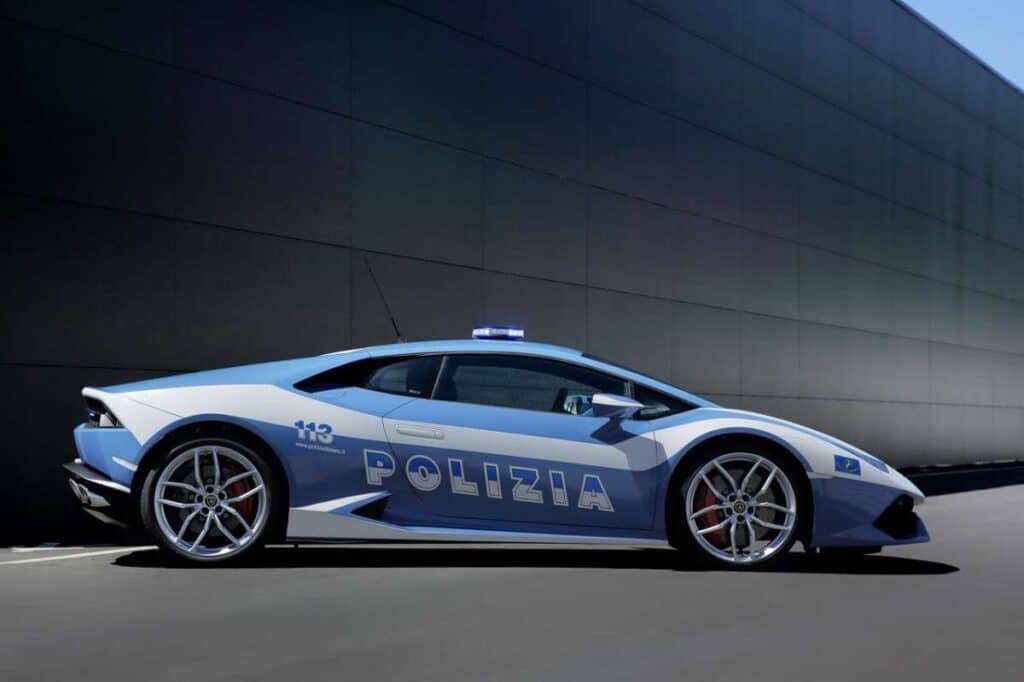
The chapter young visitors wait for is that of the very high-performance cars donated to the State Police by the Sant'Agata Bolognese maker. The collaboration begins in 2004 with a Gallardo assigned to the Rome Traffic Police. The following year a second example goes to Bologna, fitted with a refrigerated compartment for transporting organs. In 2008 a Gallardo LP 560-4 arrives with a defibrillator and refrigerated compartment. Between 2014 and 2017 two Huracáns enter service. In December 2023 an Urus Performante is delivered. In 20 years the maker has made six cars available to the Administration.
It's Not a Showcase: What They Are Really For
Here a commonplace has to be taken apart. These cars don't patrol the motorway chasing offenders: they serve for extremely urgent medical transport, in particular organs and blood bags, in connection with the transplant network, and for road safety education campaigns. The numbers released by the maker speak of more than 200 organ transport missions and more than 1,500 events dedicated to road safety. One cited case concerns the transfer of a kidney between L'Aquila and Turin with a Huracán, which saved the life of a 57-year-old woman. Told like that it sounds like an advertising anecdote. In practice it means that an organ removed in one city can reach a transplant center 700 kilometers away within the permitted ischemia window.
Why the Modern Section Appeals to Kids
Because it's the only point of the route where the mythology of the fast car and public service coincide without contradiction. A teenager who enters the museum thinking about performance leaves having understood that this car exists to carry a kidney to Turin. It's a civics lesson disguised as motors, and it's the reason I recommend this visit to families with children between 10 and 16 far more than certain prestigious collections where kids get bored in 20 minutes.
The Special Vehicles of the State Police Car Museum
The collection reserves a place for vehicles that fall into no ordinary category, and they are often the most interesting because they tell of functions the public ignores. The most cited piece is the tracked piste-grooming vehicle, what the newspapers call a snowcat: it served units engaged in mountain rescue and winter emergencies, and its presence in a Roman pavilion has an alienating effect that is all to the benefit of the story. The State Police doesn't work only in the city: it works on ski slopes, mountain passes, valleys cut off by snowfall, and to do so it needs vehicles nobody associates with a uniform.
Off-Road Vehicles, Rescue Vehicles and Special Fit-Outs
Alongside the tracked vehicles are the off-road vehicles, the vehicles for public-order duty, the fit-outs for carrying men and materials. They are vehicles that age badly and are almost never preserved, because they work until they wear out and then end up struck off the inventory: precisely for this reason a surviving example in presentable condition has a high documentary value. Anyone visiting with a technical eye should note the mounts for chains, the reinforced tailgates, the grilles on the windows, the winches. Every detail corresponds to a real use, and asking your guide what that particular detail was for is the best way to get the person leading you through the visit to talk.
The Vehicles That Come In and Out of the Collection
A little-known aspect of this museum's life concerns loans. The Police's historic vehicles take part in rallies, ceremonies, events dedicated to vintage motoring, institutional celebrations. This means the display is not fixed and that a particularly awaited piece may be absent on the day of your visit. If you have a specific interest in a model, ask for it in writing when you book: it's the only way not to be disappointed, and whoever answers the emails knows it and generally warns people gladly.
Relics, Uniforms and Radio Equipment in the State Police Car Museum
One area of the pavilion is dedicated to equipment: helmets, boots, caps, paddles, transceiver equipment and other gear in use from the 1960s onward. It's the section visitors cross fastest and it's the one that best explains the job. The paddle, for example, is an object of absolute banality and of considerable legal importance: it's the signal with which a public official orders a stop, and its shape, color and reflectivity are regulated. The helmets tell the evolution of personal safety, from the padded-rim leather of the 1930s to the modern full shells. The radio equipment tells of miniaturization: from the tube cabinets of the 1960s, which took up half a trunk, to portable sets.
The Uniforms and the Change of Visual Identity
Anyone who knows the history of the Administration knows that 1981 is a watershed date: the reform law transformed the Corpo delle guardie di pubblica sicurezza, of military organization, into the Polizia di Stato of civilian organization, with the entry of women into operational roles and a new union structure. The change came through colors, uniforms, communication too. Looking at the displayed relics with that date in mind helps you understand how much an institution tells its story through objects, and how much a change of uniform can be a political statement.
What to Look for Among the Relics
Three things, if you are short on time. The first: the radio equipment, looking at where it was mounted in the cars and how much space it took. The second: the motorcycle helmets in chronological sequence, which are a small treatise on ergonomics and safety. The third: the plates and service documentation, when displayed, because they contain the serial numbers, the assignments to units and the dates, that is the documentary skeleton on which everything else rests.
The State Police Car Museum and the Administration's Historical Museum
Many visitors confuse two distinct realities. The via dell'Arcadia museum is dedicated to vehicles. The general historical memory of the State Police, with the documents, uniforms, flags and relics, comes under the Administration's Ufficio storico, which is based together with the Sacrario dei Caduti at the Scuola Superiore di Polizia, at via Pier della Francesca 3, in the Flaminio neighborhood, a few steps from piazza del Popolo. The Sacrario can be visited by phone reservation and keeps its own hours, Monday to Friday for the whole day and Saturday in the morning. They are two complementary places: one tells of the tools, the other tells of the men and the memory of the fallen.
A Two-Stop Itinerary on the History of Institutions
Anyone with a real interest in this theme can build a serious day: in the morning the vehicle pavilion at the former Fiera, in the afternoon Flaminio with the Scuola Superiore and the Sacrario, by reservation. In between, if you like, you can insert a third stop among the museums of the other Armed Forces and State bodies that Rome keeps in great number: the Carabinieri Historical Museum at the Baths of Diocletian, the Military Motorization Historical Museum at the Cecchignola, which is the natural big brother of this one in the number of vehicles, the Infantry Historical Museum at piazza Santa Croce in Gerusalemme and the Communications Historical Museum at EUR. Rome has a network of institutional museums that tourists never see and that is worth more than certain paid exhibitions.
The State Police Car Museum with Children and Teenagers
It's one of the few Roman visits that really works with children. There are three reasons. First: you look at recognizable objects, which little ones identify on their own without any cultural mediation. Second: you walk little, on the flat, indoors, without lines and without crowds. Third: the length is compatible with a child's attention threshold, because a good hour is plenty.
What the Little Ones Like
The sirens, the flashing lights, the motorcycles and the chance, when the staff allows it, to climb on a vehicle for a photograph. The plot twist is almost always the snow tracked vehicle, which no child expects. A practical tip from someone who has seen many visits fall apart: give the children a task. Counting how many different liveries they can spot, or finding the oldest and the most recent car, or looking for all the radios. An observation game turns a passive stroll into a treasure hunt and gives you 20 more minutes of attention.
What to Tell the Older Kids
With teenagers the winning theme isn't performance, which they now find in any video game, but consequences. The section on the years of lead, the history of the escorts, the meaning of the number 113, how the operations room works, the organ transports with the high-performance cars: these are subjects that open real discussions. If you accompany a high school class, ask the museum staff to tie the vehicles to the historical facts. The result is a lesson in contemporary history that no textbook manages to give with the same effectiveness.
How Long the State Police Car Museum Visit Takes and How to Organize It
The pavilion is of contained size and the ordinary visit is over in an hour, an hour and a half for those who read everything and ask questions. With a guide who tells the story, the time easily stretches to two hours, and they are the best-spent two hours. There are no cafes inside, no bookshop comparable to those of the big museums, no luggage storage: show up light. The practical advice is to schedule the visit for early morning, just after opening, and to keep the rest of the day free for the neighborhood and for EUR.
Accessibility and Visiting with Mobility Difficulties
The facility is an exhibition pavilion on a single level, without significant internal stairs, and this in itself makes it favorable to those who move in a wheelchair or with walking difficulties. Since it is a building readapted inside a service complex, however, the access conditions, the routes and the accessible restrooms have to be arranged at the time of booking, indicating the specific needs. Here the recommendation counts double: a phone call in advance solves in two minutes what on site can become a problem.
Photographs, Filming and Rules of the Facility
Photographs for personal use are generally allowed, but the museum is inside a State Police area and the rules are set by the Administration: you ask the staff before you start shooting, you avoid filming entrances, security systems and people on duty, and for any filming intended for publication a formal authorization is needed. It's common sense, as well as respect for the rules of a workplace.
What to See Around the State Police Car Museum
The area is not the one of monuments, and for that very reason it lends itself to a day different from the usual. Going down via Cristoforo Colombo you enter EUR, the district designed for the 1942 Universal Exposition and never inaugurated as such, which today is the most coherent experiment in modern city that Rome possesses: the Palazzo dei Congressi, the Palazzo dello Sport built for the 1960 Olympics, the EUR lake with its Japanese cherry trees, the Museum of Civilizations with its ethnographic and prehistoric collections, among them the Pigorini Museum.
Toward San Paolo and Ostiense
In the opposite direction, a handful of minutes by car or one metro stop away, you reach the Basilica of San Paolo fuori le Mura, one of the four papal basilicas, and farther on the Ostiense district with the Centrale Montemartini, where the ancient sculptures of the Capitoline Museums live alongside the diesel engines and turbines of the old power plant. For those who love converted industrial places, pairing the Centrale with the Police car pavilion makes a day that is coherent from start to finish. Not far away is also the Museum of Via Ostiense, housed in the Porta San Paolo.
Lunch and a Stop in the Neighborhood
Don't expect the trattoria from a food guide: here you eat where the office workers eat, and in many cases you eat well and spend little. The reference areas are Garbatella, with its historic osterie and the public-housing lots of the 1920s that are worth a walk on their own, and the Ostiense district. If you have a car and want to end the day with something unexpected, the Abbey of Tre Fontane is a few minutes away and offers one of the deepest silences you can find inside the Grande Raccordo Anulare.
A Curiosity About the State Police Car Museum
The curiosity I prefer concerns a word, and the word is "panther". Everyone in Italy uses it to mean the Police car, few know where it comes from. It was born in 1952, when the Corpo delle guardie di pubblica sicurezza put into service as its first squad car a black Alfa Romeo 1900 TI. The color, the feline gait of a sedan that for the time was extremely fast and the design of the front, with the recessed headlights and the shield-shaped grille that recalled a muzzle, did the rest: reporters called it a panther and the name stuck. From that moment the nickname detached from the model and became a category: it passed to the Giulia Super, it even reached the Ferrari 250 GTE of the Roman unit, it survived the change of livery from black to green and then to light blue, and it holds out still today when the cars in service have a completely different shape. With the most recent Alfa Romeos the panther has even come back as a graphic sign, stylized in white on the side band.
The value of this story, inside the museum, is that you can touch it with your eyes. The pavilion keeps the cars that generated the word and those that inherited it, in chronological line, and walking along the display you witness the birth and migration of a term of everyday vocabulary. It doesn't often happen that you can date precisely the origin of a word everyone pronounces without thinking. This is one of those occasions, and on its own it's worth the ticket.
Something Nobody Tells You About the State Police Car Museum
That the Police Ferrari has not belonged to the State for half a century. It's the most widespread misunderstanding about this museum: you arrive thinking you will find the black 250 GTE of Marshal Armando Spatafora, the car of Roman legends and of descents down staircases, and you discover that that car has a different story. Of the two 250 GTE 2+2 ordered by the Administration at the beginning of the 1960s, the first was destroyed in an accident very soon after delivery. The second, chassis 3999 GT, served throughout the 1960s and was then struck off and sold at auction in the early 1970s to a private buyer, for a sum that today seems like a joke. Since then it has passed from collection to collection, has been certified by the historic department of the Maranello maker and has appeared on the international historic-car market through specialist dealers.
The second thing nobody says concerns how to get in. This is not a museum with an open ticket office and a turnstile: it's a collection inside a State Police facility, and access goes through an agreement made beforehand, an ID and, in the periods when the facility is listed as temporarily closed, a prior check. It's not rare for families who arrive at via dell'Arcadia on a Saturday afternoon to leave without having seen anything. The difference between a lovely morning and a wasted trip is two minutes on the phone or an email written the week before. Whoever doesn't know it finds out in front of a closed gate.
My Advice for Visiting the State Police Car Museum
Book by asking for the guided accompaniment, and ask for it in writing. It's advice number one, because the value of this collection is in the account of the people who work there, not in the plaques. Write to museoautopolizia@interno.it a few days ahead, say how many you are, ask for confirmation of the opening and specify if you have a particular interest, be it the history of the Squadre Volanti, that of the Traffic Police or the motorcycle section. Whoever answers is Administration staff and is generally well disposed toward those who show a real interest.
Second piece of advice: go early in the morning, midweek, outside the school-trip periods. Third: bring a valid ID for each participant, minors included, and allow for the identification procedure at the entrance. Fourth, and perhaps the most useful: walk through the pavilion twice. The first time in chronological order, to follow the story. The second time going back and looking at one element at a time, the radios, then the liveries, then the flashing lights, then the trunks. That's where a collection of vehicles stops being a parade and becomes a document.
Fifth and last, of a more personal nature: don't treat it as a fallback visit for a rainy day. It works very well as that too, but if you approach it with the right mindset it's a piece of Italian history told in an hour, with the help of objects everyone recognizes. Bring a teenager and you'll see they come out with a few serious questions.
Another Well-Known Fact, Yet Rarely Cited
That the 113 is not just any number, and that behind it there is a precise organizational model. The Squadre Volanti are the rapid-response structure of the State Police: an operations room receives the calls, assesses the urgency and directs the vehicles on patrol to the spot. It seems obvious today, with the phone in your pocket and satellite location, but when the system was born it meant overturning a centuries-old organization, replacing the fixed post and the patrol round with a mobile resource guided from the control center. The figure that should circulate more is this: in May 1988, by decree of the President of the Republic, the merit of the Squadre Volanti was recognized for the interventions carried out in the 20 years 1968-1988, counted at more than 52 million.
Then there is a second thing that everyone knows and nobody places in time: the change of 1981, when the reform law transformed the Corpo delle guardie di pubblica sicurezza, of military organization, into the Polizia di Stato of civilian organization, opening the ranks to women. A museum of vehicles seems the least suitable place to tell the story of a legislative reform, and instead it's the right place: the name on the sides changes, the liveries change, even the way the institution shows itself to citizens changes. Cars are the public face of an administration, and when the face changes it's because something deeper has changed.
The Right Photo to Take at the State Police Car Museum
First the rules, which count more here than elsewhere: you ask the staff before shooting, you photograph the vehicles and not the people on duty, you avoid entrances, equipment and security systems, and for any image intended for publication an authorization is needed. That cleared up, the photograph to take home is not the one everyone takes.
Everyone stands in front of the nose of the Giulia and shoots head-on, getting a flat image, with the flash bouncing off the windshield and killing any depth. The right photo is another one: lower yourself to the height of the headlight, position yourself at the front three-quarter, keep the roof light inside the frame and let the line of the other cars slide out of focus into the background. You get the nose in the foreground and the story continuing behind it. No flash: the light in the pavilion is cold but sufficient, and direct flash on a shiny body produces a white glare that ruins everything. If the shot comes out blurred, rest your elbow on your knee and hold your breath, as people have always done.
The second photograph I recommend is a detail: the paddle, or the dial of a radio set, or the lettering on the side of a 1970s car. One detail says more than 20 whole cars, and in the story you tell on your return it's worth double. The third, if you are with children and the staff allows it, is the one next to a motorcycle: it will be the photograph that ends up in a frame, and nobody will ever look at the others again.
Some Important Events That Happened Here in History
The place has two overlapping stories, and it's best to keep them distinct. The first is that of the container. These pavilions hosted from 1959 the Fiera di Roma, moved here along via Cristoforo Colombo after the years of the sample fair at EUR: for 50 years the exhibition brought to this stretch of the city exhibitors, crowds, merchandise shows and the noise of an economy that was growing. In 2006 the Fair moved to the new site along the motorway to Fiumicino and the complex changed purpose. The second story is that of the museum, opened in the spring of 2004 to collect and preserve the vehicles that the Administration was losing piece by piece through write-offs and demolitions.
Then there are the events the vehicles kept here carry on them, and it's the part that gives you chills. The decade of terrorism, with the armored sedans, the escorts and the morning of March 16, 1978 in via Fani, when five men died, three of them belonging to the Pubblica Sicurezza, Giulio Rivera, Raffaele Iozzino and Francesco Zizzi. The season of the great Roman chases of the 1960s, with the Ferrari purchased on the decision of the chief of police Angelo Vicari and with the endorsement of the President of the Republic Giovanni Gronchi. The natural emergencies handled with the special vehicles. And, in recent history, the organ transport missions with the very high-performance cars donated to the Administration, more than 200 according to the maker's data, among them the transfer of a kidney between L'Aquila and Turin that saved the life of a 57-year-old woman.
If you are looking for a way to explain to kids what contemporary history is, take them in front of these machines and tell those dates. It works better than a textbook chapter, because history, here, has four wheels and a chassis number.
Who Has Passed Through the State Police Car Museum
First of all the thousands of students from Rome and Lazio schools, who are the museum's main public: whole middle-school and high-school classes, accompanied by Administration staff, who leave with their heads full of liveries and street stories. Then the enthusiasts of historic motoring, the members of marque clubs, the collectors who come to see a service configuration that almost doesn't appear in the manufacturers' registers. And the retired police officers, who get in free and who in front of a car recognize their own night shift of 30 years earlier: they are the most interesting visitors of all, and if you meet one, start listening.
But the figures who truly run through this collection are those whose stories are sewn to the vehicles on display. Armando Spatafora, the marshal from Syracuse born in 1927 who drove the Ferrari of the Rome Police and entered the popular chronicles of the 1960s. Angelo Vicari, the chief of police who decided to buy a grand tourer from Maranello to counter the motorized gangs. Giovanni Gronchi, President of the Republic, who endorsed that purchase and who a few years earlier, in May 1956, had laid the first stone of the Autostrada del Sole, the work that would change forever the job of the Traffic Police. Roberto Lippi, the driver who in Modena trained the four men destined to drive the Ferrari. And then the generations of nameless officers who wore out the seats of these cars, intervention after intervention.
There is a category of visitors I am particularly fond of and whom I recommend imitating: the parents who bring their children and take the chance to tell their own memories. Whoever lived through the 1970s remembers the sound of the two-tone sirens, the green of the cars before the light blue, the TV coverage of the via Fani events. Passing on that memory in front of the object is an exercise in oral history that is worth a whole lesson.
Quick Questions About the State Police Car Museum
Where Is the State Police Car Museum?
At via dell'Arcadia 20, in Rome, in a pavilion of the former Fiera di Roma, in the Tor Marancia area, right up against via Cristoforo Colombo and a little over a kilometer from the Garbatella station on metro line B.
How Much Does the State Police Car Museum Ticket Cost?
€3 full price and €1.50 reduced, with free admission for State Police personnel on active duty or retired. The proceeds go to the "Marco Valerio" assistance plan. The rates should be confirmed at the time of booking.
What Are the Hours of the State Police Car Museum?
Public sources indicate a morning opening, Monday to Friday from 9 to 13, closed in the month of August. Since the official tourist information currently lists the facility as temporarily closed, the hours should be checked by contacting the museum before leaving.
Do You Need to Book to Visit the State Police Car Museum?
Yes, and it's the rule that saves the day. You write to museoautopolizia@interno.it or phone 06 5141861 or 06 51606891, stating the date, the number of participants and a contact. Groups and school classes should be arranged with more notice.
Do You Need an ID to Get In?
Yes. The museum is housed inside a State Police facility and visitors are identified at the entrance. Bring a valid ID for each participant, minors included.
How Many Vehicles Are in the State Police Car Museum?
Public descriptions speak of around 70 specimens among cars, motorcycles, scooters, bicycles and special vehicles, with a chronological span from the 1930s to today. The number varies because some vehicles leave temporarily for events and ceremonies.
How Long Does the Visit to the State Police Car Museum Take?
An hour for a normal visit, an hour and a half for those who read everything, up to two hours when there is a guide telling the story. It's a length compatible even with small children.
Is the State Police Car Museum Suitable for Children?
Very. A flat route, all indoors, recognizable objects, sirens and flashing lights, motorcycles and special vehicles. It works well from five or six years old up, and with older kids it becomes a lesson in contemporary history.
Is Spatafora's Ferrari at the State Police Car Museum?
The surviving example of the two Ferrari 250 GTEs ordered by the Police, chassis 3999 GT, left the vehicle fleet and was sold at auction to a private buyer in the early 1970s: since then it has belonged to the collectors' world. The story of that car and of Marshal Armando Spatafora is nonetheless one of the central tales of the visit.
Can You Take Photographs at the State Police Car Museum?
For personal use generally yes, asking the staff first. You avoid filming entrances, security systems and people on duty, and for any image intended for publication a formal authorization is needed.
Is the State Police Car Museum Wheelchair Accessible?
The pavilion is on a single level and flat, a favorable condition. Since it is a building readapted inside a service complex, routes and facilities should be arranged at the time of booking, reporting the specific needs.
Does the State Police Car Museum Take Part in the Free Sundays?
It is not part of the circuit of the state museums of the Ministry of Culture nor of that of the civic museums of Roma Capitale, so it does not fall under the free-admission Sundays. Its symbolic ticket has an assistance destination of its own.
How Do You Get to the State Police Car Museum by Public Transport?
The simplest reference is metro line B, Garbatella station, and then about 20 minutes on foot. Alternatively you use the surface lines that run along via Cristoforo Colombo, checking the updated numbers on the transport company's planner.
Can You Come by Car and Park?
Yes. The area is outside the restrictions of the historic center, the streets are wide and on-street parking is generally possible. You leave the vehicle in the public spaces and present yourself on foot at the entrance.
What's the Difference Between the State Police Car Museum and the Administration's Historical Museum?
The first is dedicated to vehicles and is on via dell'Arcadia. The general historical memory of the State Police comes under the Ufficio storico, which is based together with the Sacrario dei Caduti at the Scuola Superiore di Polizia, at via Pier della Francesca 3, in Flaminio, and can be visited by phone reservation.
Which Alfa Romeos Can You See at the State Police Car Museum?
The route retraces the generations of the Squadre Volanti: from the 1900 of the early 1950s, which gave rise to the nickname "panther", to the Giulia Super and its Promiscua station-wagon version, up to the Alfetta, Giulietta and Alfasud of the 1970s and 1980s.
Are There Police Motorcycles in the Museum?
Yes, and they are one of the richest sections. The descriptions of the collection cite the historic Moto Guzzi models, from the small Guzzino of 65 cubic centimeters to the Airone 250 and the Falcone 500, the single-cylinder that for decades accompanied escort and road surveillance duty.
Is It True There Is a Snowcat at the State Police Car Museum?
Yes, among the special vehicles of the collection is a tracked piste groomer, used by the units for mountain rescue and winter emergencies. In a Roman pavilion it has a curious effect and it's one of the pieces children remember most.
Is There a Lamborghini at the State Police Car Museum?
The very high-performance cars donated to the State Police by the Sant'Agata Bolognese maker number six in 20 years, from the Gallardo of 2004 to the Urus Performante of December 2023, and some have been withdrawn from operational service. Their presence on display may vary, so it's best to ask when you book.
What Are the Police Supercars Really For?
For extremely urgent medical transport, in particular organs and blood, in connection with the national transplant network, and for road safety education campaigns. The maker has reported more than 200 organ transport missions and over 1,500 road safety events in 20 years of collaboration.
Why Are Police Cars Called Panthers?
The name was born in 1952 with the first squad car, a black Alfa Romeo 1900 TI: the color, the speed and the design of the front suggested the comparison with the feline. The nickname then passed to the later models and has entered everyday language for good.
What Is the Number 113?
It is the historic emergency number of the State Police, that of the Squadre Volanti, today alongside the single European emergency number. In the graphics of the cars it has changed position over time, from the sides to the rear pillars.
Is There a Bar or a Bookshop at the State Police Car Museum?
No. It's an essential facility, without commercial services comparable to those of the big museums. For lunch it's best to move toward Garbatella or Ostiense, where you eat well and spend little.
What Can You Visit Near the State Police Car Museum?
EUR with the lake, Palazzo dei Congressi, Palazzo dello Sport and the Museum of Civilizations. In the opposite direction the Basilica of San Paolo fuori le Mura, Centrale Montemartini and the Museum of Via Ostiense. Not far away is also Abbazia delle Tre Fontane.
Is the State Police Car Museum Worth Visiting?
If you are interested in 20th-century Italian history told through concrete objects, yes, and at €3 the ratio between price and content has no rival in the city. If you are looking for a car museum in the strict sense, with big scenographic displays and services, it's better to know beforehand: here the value is in the documentary substance and in the story.
The Verdict on the State Police Car Museum
There is a useful rule: museums that change the way you look at the city are worth more than those that confirm what you already knew. This one belongs to the first category. You leave via dell'Arcadia looking differently at the light-blue and white cars stopped at the traffic light, because you have understood that each of those cars is the last link of a chain that begins with a black sedan of 1952, passes through a Giulia of the 1960s and crosses the hardest decade of the Republic. It's a small, spartan museum, without scenography, with a €3 ticket that goes to the sick children of police officers. Book beforehand, bring your ID, ask to be accompanied and have them tell you about the trunks. And if you have a son or a grandson who spends his afternoons watching videos about motors, bring him: he will leave having understood that a fast car, in the hands of the State, serves to carry a kidney to Turin.
Article written by the editorial team of TourLeaderPro, contact them for Private/Corporate/V.I.P. Tours and Experiences.
Planning a trip to Rome? The English-language guides to visiting the city are on ItalyPlanner.com.