Spazio Fontanella
https://www.estateromana.com/en/rome/trip-planner/spazio-fontanella-rome/
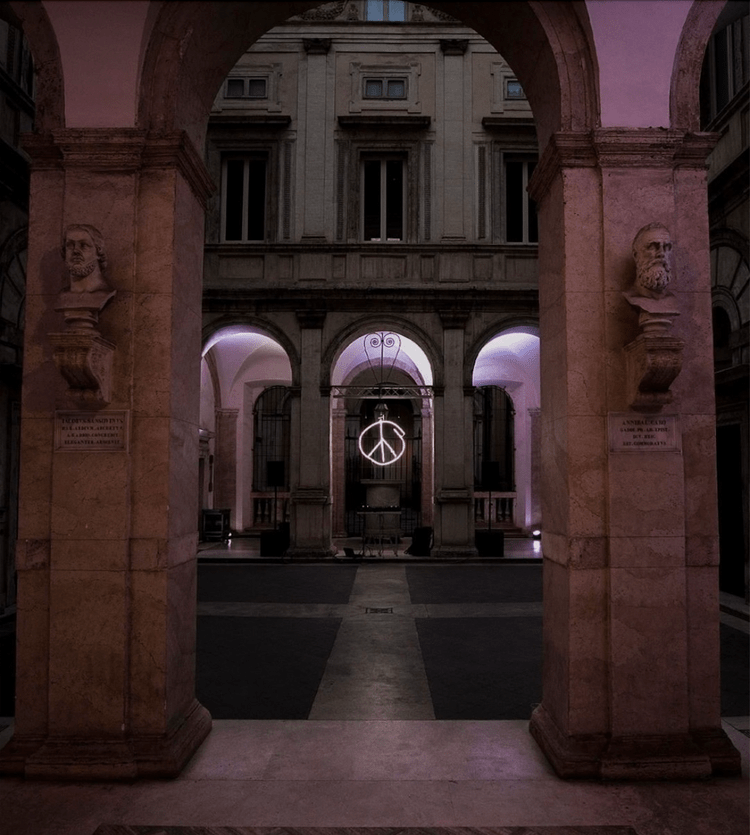 Spazio Fontanella
 is a young co-working space in the center of Rome that also lends itself to organizing custom events, concerts, DJ sets, exhibitions, workshops and pop-ups. It's a way of bringing the city center to life for a young demographic too, outside the more institutional and touristy circuits. Put like that, it sounds like a brochure definition, and yet it's the most concrete thing you can say about a place like this: inside the walls of the rione Ponte, a few dozen meters from the Tiber, a place that works as a shared office by day and, in the evening, when needed, turns into a hall for a presentation, a temporary gallery, a backdrop for a record set.
Let me explain right away why an address like this is worth talking about with some attention. In Rome's historic center, the part enclosed within the ring of the rioni, the spaces that work on a double identity can be counted on the fingers of one hand. The dominant model, for at least 20 years, is another one: a commercial ground floor with a window facing the tourist foot traffic, upper floors converted to accommodation. A place that hosts people working at computers in the morning and opens its doors in the evening to some 50 people who came to listen to music or look at pictures hung on a white wall goes against the main current of the neighborhood. Not as a pose, but for a precise economic reason: whoever runs that kind of business has to justify a city-center rent with a single type of revenue, while accommodation justifies it with a nightly rate.
That's why, when I tell you that Spazio Fontanella deserves a long write-up, I'm not talking only about square meters and desks. I'm talking about a choice of location. Whoever opens a cultural co-working space inside the rione Ponte is making a bet: that there is still a population of Roman 30- and 40-somethings willing to cross the center to go to work, and not just to cross it with a rolling suitcase behind them. It's a nontrivial bet, and the best way to understand it is to look closely at where this place is and what was around it 100, 500, 1,000 years ago.
Where it is, and why that address already tells the whole story
The address is Via dell'Arco della Fontanella 3, postal code 00186, rione Ponte, Municipio I. If you don't know the street, don't feel bad: it's one of those very short streets that exist by the dozens in Rome, as wide as two people passing each other, wedged between better-known axes and completely invisible to anyone walking with their eyes on the map on their phone. The grid you move in is the one between Via del Banco di Santo Spirito, Via dei Banchi Nuovi, Via del Consolato and the lungotevere degli Altoviti: one of the densest and best-preserved fabrics in the whole city.
To get your bearings with landmarks you know: if from the bridge that leads to Castel Sant'Angelo you go down toward the left bank of the river and keep straight along the line that points to the heart of the rione, within a few minutes you enter the Banchi area. From there, Piazza Navona is a walk of six or seven minutes, Palazzo Altemps a little more, and the Museo di Roma at Palazzo Braschi is on the other side of Corso Vittorio Emanuele II. You're inside the perimeter where the density of things to see is the highest in Europe, and precisely for that reason a place that doesn't address passing visitors turns out, in its own way, to go against the current.
An honest clarification before going on. The address given comes from the service listings that catalog the places of Rome, and it is consistent with the official street naming of the rione Ponte: the street exists, it's pedestrian, and it's also recorded in open map databases. That said, before you head out it's always worth checking the space's official channels to make sure it's open and that someone is there: places of this kind change setup with a frequency that no static listing can keep up with. Further on I'll explain why, in this specific case, this advice weighs more than usual.
There's also something the address says on its own, and that gets lost if you read it as a string. Via dell'Arco della Fontanella takes its name from an arch and a little fountain. Not from a church, not from a cardinal, not from a baronial family, as happens with most Roman streets. From a minimal hydraulic structure and a covered passage. It's the way the historic center named itself back when it named things for what people saw when they stepped out of their front door: an arch you walk through, a little fountain you use. The name of the space comes from there, and it's one of the reasons the choice is convincing.
What a co-working space that also runs a cultural program really means
Let's clear up a word that gets used carelessly. Co-working, in its poorest sense, simply means renting a desk by the hour, the day or the month in a space where others do the same. In this minimal version it's little more than an internet point with a coffee machine, and in fact most of the places that called themselves that between 2012 and 2018 have closed or turned into something else. What holds up over time is something different: a place that sells belonging, not surface area.
The difference shows up in three very practical points. The first is who you find next to you. A co-working space that works selects, even without saying so, a community homogeneous enough to generate conversation and varied enough to generate exchange: graphic designers, translators, people who work in event production, photographers, small architecture studios, people who do consulting. The second point is time management: a place like that has peaks and lulls, and a Tuesday morning looks little like a Friday afternoon. The third is the ability to transform, which is exactly what interests us in this case.
Why does a co-working space decide to also run a cultural program? For two reasons that go together. The first is economic: a space in the historic center costs money, and a room that sits dark from 19:00 on is a cost that produces nothing. Opening it to a presentation, to a concert for a few people, to a month-long exhibition turns a fixed cost into a resource. The second reason is about identity: the program is the way a place says who it is. A shared office without events is a service. With events it becomes an address that people name. And in the co-working market, which is crowded and has tight margins, being named is worth a great deal.
There is, however, a third element, a less obvious one, and it's the most convincing. A co-working space that holds events brings into contact two populations that usually don't cross paths: those who work in the center by day and those who go to the center only in the evening. In Rome these two populations are separated by a very sharp fault line. By day, the historic center is administration, professional offices, retail, tourism. In the evening, it's restaurants and strolling. The people who produce culture, and who in most cases live and work outside the center, enter the perimeter only for specific occasions. A space that does both stitches up that fault line, and it does so in the only way that really works: by keeping a door open for 12 hours instead of four.
Let me add a technical detail that usually doesn't get told and that actually explains quite a lot. A cultural program inside a space that was born as an office isn't free in regulatory terms. Hosting 20 people seated for a book presentation is one thing, hosting 80 standing for a record set, with the sound system on above a certain threshold, is another. Every extra step requires different measures: declared capacity, exit routes, managing sound emission toward the outside, hours compatible with city ordinances and with an area where the remaining residents are few but very attentive. In practice, this means that spaces like this tend to work with contained formats, short evenings, controlled numbers. It's not laziness: it's the shape the historic center imposes.
And it's also the reason why the events born in these places often have a more intimate feel than those of the big venues on the Roman outskirts. Where there's a reclaimed warehouse or a green area, the scale is hundreds of people. Here the scale is dozens. Which, if you think about it, brings live music and art back to a dimension that in the Rome of 50 years ago was the norm: the cellar, the neighborhood gallery, the room above the shop.
A curiosity about Spazio Fontanella
The curiosity concerns the name, and it should be taken slowly because it weaves together three different things. The first is that the street the place takes its name from, Via dell'Arco della Fontanella, belongs to the historic list of street names of the rione Ponte, along with a handful of other streets that carry the word arch in their name: Via dell'Arco de' Banchi, Via dell'Arco di Parma, Vicolo degli Amatriciani, Via dei Banchi Nuovi. The rione was, and is, a labyrinth of covered passages carved out under the buildings, and the street names preserve the memory of it much better than today's landscape does, given that several of those arches have been demolished or absorbed.
The second thing is the word fontanella. In Rome it indicates two completely different realities that live together in the same word. One is the minor fountain, the kind with no famous architect behind it that served a stretch of street or a courtyard: in the popular insulae, until not so long ago, a fontanella placed in the courtyard of the building supplied water to the families living on the upper floors. The other is what everyone calls a nasone, that is, the cast-iron column with the curved spout that in Rome delivers drinking water continuously, by gravity, in thousands of examples. The nasone as you know it today is an invention of the city administration of the last quarter of the 19th century, so it's more recent than the street. But the logic is the same: public water, free, with no faucet to open.
The third thing is that all this rests on a technical fact that we take for granted in Rome and that is actually almost unique in the world. The city has running water in abundance because it has aqueducts that have worked by gradient for 2,000 years, repaired and reinvented several times, and because the papacy of the 16th and 17th centuries made restoring the aqueducts a policy of prestige. When you put an aqueduct back into operation, you also have to discharge its water somewhere: hence the flowering of monumental water displays and, in a cascade, of neighborhood fontanelle. The Trevi Fountain is the spectacular terminus of this line of reasoning. The fontanella on the street corner is its domestic terminus. They are the exact same hydraulic system seen from two different heights.
Another curious hook: in the repertoire of minor Roman fontanelle there is one that Romans have baptized with a sentimental name, the Fontanella degli Innamorati. The fact that a column of water earned a nickname and a small city mythology says a lot about how deeply this kind of object has entered people's heads. A co-working space called Spazio Fontanella, on a street called Arco della Fontanella, places itself inside this chain without having to explain it. For a place that wants to belong to the neighborhood and not to tourism, it's a choice of name far more coherent than it seems.
A methodological clarification is needed, though. The name of the street and the name of the space coincide, and the simplest explanation is also the most likely: the place took its name from the street, as happens in half of Rome. Everything else, the aqueducts, the nasoni, the courtyard fontanelle, is the context in which that name has lived for centuries, and it's exactly what is useful for you to know when you walk past and wonder where that word comes from.
The historic center that is emptying out, and why a space like this is rare
Now I'll tell you about the bigger context, the one that makes Spazio Fontanella something more than a shared office. Over the last decades, Rome's historic center has lost residents steadily. It's a documented phenomenon, recognized by anyone who deals with the city, discussed in the city council and at every conference on housing, and visible to the naked eye if you walk the same alley at 20-year intervals. Doorways with 10 buzzers and one surname per buzzer become doorways with a single plate and a key box.
The mechanisms that produce this effect are three, and they act together. The first is price: a property within the perimeter of the rioni has a value per square meter that no ordinary salary can chase, so the generational turnover of residents is interrupted. The children of those who lived inside the walls don't buy again inside the walls. The second is change of use: when an apartment earns more as short-term lodging than as a home rented for a year, the rational owner chooses the short term, and does so without malice, simply doing the math. The third is the disappearance of neighborhood services: when residents fall below a certain threshold, the haberdashery closes, then the hardware store closes, then the grocery closes, and at that point even those who were holding out leave, because living in a neighborhood without bread is exhausting.
The result is a geography you know well even if you've never called it that: a historic center that is beautiful and perfectly preserved in its facades, with an interior progressively emptied of ordinary life. It's not a romantic catastrophe, it's a functioning problem. A city in which the center is only scenery loses the ability to produce new things precisely at the point where it has the highest concentration of history. And this is where the type of place we're talking about comes in.
A co-working space with a cultural program inside the rione Ponte does a simple thing: it brings people who are not tourists back into a perimeter that risks being only touristy. It doesn't solve anything structural, let's be clear, and whoever claims otherwise is telling a fairy tale. But it produces a measurable effect at street scale: 10, 20, 30 people who go through a doorway in the morning, go out at lunch, buy coffee at the bar on the street, go back in, and in the evening maybe stay for an event. For an alley in the center, 30 people a day without a rolling suitcase is a notable transformation.
The rarity of these places is tied to an economic calculation that I can explain to you without made-up numbers. In the historic center, the rental value of a ground-floor unit is formed by looking at two very profitable alternative uses: restaurants aimed at foot traffic and accommodation. Any other use has to compete with those two. A cultural co-working space generates much lower revenue per square meter, so it survives only in three situations: if whoever runs it owns the property, if it pays a rent set many years ago, or if the space is small enough to make the rent sustainable. This is the reason why, inside the walls, these places are few, often tiny, and almost always hidden on side streets. The side street is not a choice of poetics: it's the price they can afford.
If you want to see the opposite of this condition, look at the map of the big Roman cultural venues born in the last 20 years. Almost all of them are outside the historic perimeter, where spaces are large and rents bearable: the former factories, the former depots, the parks. Places like the ex Snia lake or the Casa del Jazz tell of a cultural geography that has shifted outward, for reasons of surface area and cost. Inside the walls the opposite model remains: small, vertical, barely visible from the street. Spazio Fontanella belongs to this second family, and it should be read by that yardstick.
Something nobody tells you about Spazio Fontanella
Here we are at the point that really changes how you go there. The thing nobody tells you is this: a place like Spazio Fontanella is not, first and foremost, a place for shows. It's a workplace that every so often becomes a place for shows. It sounds like a pedant's nuance, and yet it changes everything about how you approach it.
In concrete terms: the ordinary life of this address is the life of an office. People sitting at computers, phone calls, short meetings, the noise of the coffee machine. Events are episodes, not a continuous schedule. This means you can't show up at random on a Thursday evening expecting something to be happening: very often there's nothing, and that's perfectly fine, because that day the space did the job it exists for. If you're looking for a concert or an exhibition, the right way is to check the program announced on the space's channels first, and only then set out.
A second corollary follows, which holds for the whole category and not just this address. Hybrid places have intermittent communication by nature. A theater publishes a season in September and sticks to it until May. A co-working space announces an evening 10 days ahead, sometimes five. It's not disorganization, it's the difference between those who program with a dedicated office and those who program in between one work deadline and the next. So the right way to follow places like these is not the calendar, it's the subscription: follow the channels, and when something comes out, decide.
Third thing, and here I'm speaking to you frankly. Addresses of this type have a shorter average life than institutional places. They open, work for a few years, change management, move two streets over, sometimes close. The historic center is a hostile environment for those who make culture on tight margins, and a change of lease or a contract renewal can decide a project's fate. In this specific case, the website associated with the space in the service listings no longer responds the way it did a few years ago, and that is a signal worth keeping in mind: if you plan to go, first look for a recent, direct confirmation on the channels run by the space, or a confirmation by phone. It's the most useful advice I can give you, and it's not a bureaucratic detail: it's how all independent places are treated, in Rome as elsewhere.
Fourth thing, very practical: the double nature also shows in the furnishings. A space that has to be an office by day and a hall in the evening has light furniture, stackable chairs, deliberately neutral walls, double lighting. If you go in during the day and find it anonymous, it's not because it lacks character: it's because the character is given to it by whoever uses it, and it changes three times a week. It's exactly the opposite of how a museum works, where the space is the protagonist and the content rotates.
The advice I give you for visiting Spazio Fontanella
The main advice, already hinted at, is worth repeating in operational form because it saves you a wasted trip: don't go at random. Check first if something is scheduled, and only then hit the road. It holds for Spazio Fontanella and for any hybrid place in the center. If instead you're interested in the space as a workstation, direct contact is the only sensible route: desk availability, plans and access hours are things that change and that no outside listing can guarantee you.
Second piece of advice: choose the time of day carefully. If you're going for an event, arrive early. In the small venues of the center the capacity is limited and the place fills up fast. 20 minutes early makes the difference between being comfortable and standing next to the door. If you're going during the day instead, avoid the lunchtime rush, when those who work go out and come back in and the place is at its most chaotic.
Third piece of advice, and it concerns how you get there. This part of Rome has no convenient subway stop, and the GPS navigator inside the grid of alleys does what it can. It's best to aim for a big landmark and then walk: the bridge in front of Castel Sant'Angelo on one side, the axis of Corso Vittorio Emanuele II on the other. From either one, the last stretch is on foot and takes a few minutes. If you arrive by car, resign yourself: the rione is a limited traffic zone, largely pedestrian, and parking is a struggle not worth taking on.
Fourth piece of advice, the one I consider the most valuable. Give the visit another half hour. The mistake almost everyone makes is treating an address like this as an isolated destination: I go, do the thing, head back. But the value of this place is also in the grid around it. The rione Ponte is one of the few pieces of the center where you can walk for 20 minutes without running into a line, and where the streets still keep a human scale. Walk out of the space, take a random alley toward the river, and you realize how many things go unnoticed by those who go from Piazza Navona to San Pietro in a straight line.
Fifth and last piece of advice, about manners more than logistics. If you go for an event, remember that above, below and next to it there are lived-in homes. In a neighborhood where the remaining residents are few and under siege, behavior outside the door weighs enormously on the survival of the place that hosted you. Leaving with a low voice, not stopping to chat under the windows, not leaving glasses on the windowsills: they are tiny gestures that decide if in two years that space will still be able to hold evenings.
What a typical day looks like, and what changes when evening comes
Let me describe the rhythm of a place like this, because understanding it helps you choose when to go. Early in the morning the space is quiet: whoever arrives first takes the best spot, the one with the light, and for an hour or two all you hear is the tapping of keyboards. Around midmorning the place fills up, the phone calls begin, someone takes a small room for a meeting. At lunchtime it empties out suddenly, because in the historic center nobody eats at their work desk when there are five bakeries within 200 meters of the door. The afternoon is the most productive and longest stretch, the one in which the place really works. Around 18:00, those with children or those who live outside the Grande Raccordo start to leave.
And this is where the interesting window opens. On the evenings when there's an event, between 18:00 and 19:00 the space changes skin in an almost theatrical way: the desks are moved against the walls or stacked, the chairs arrive, a sound system is set up, someone hangs the works or sets up a projector. Whoever has witnessed this transition at least once immediately understands the nature of the place: it's not a room that hosts work, it's a workplace that takes itself apart to become a room. The physical act of moving the tables is the distinctive sign of the whole category.
The difference from a venue born for music is also heard in the acoustics. An office often has low ceilings, hard surfaces, few sound-absorbing materials. When someone plays there, the result is a close, frontal sound, without church reverb and without the push of a club speaker. For certain genres it's a limit. For others, I'm thinking of intimate electronic sets, solo voices, guitars, listening presentations, it's exactly the right condition. If you like live music at a distance of two meters from the performer, places like this will give you more satisfaction than a big hall.
Exhibitions, too, work in a particular way in this setup. Don't expect exhibition routes with museum-style labels and lighting calibrated to the cent. Expect instead a short selection, often monographic, often by young artists, hung in a setting where the audience is mixed: those who came on purpose and those who were working there that day and found the show right on top of them. This second category is the most interesting audience there is, because it's the one that would never have bought a ticket, and yet stops to look.
Then there's the pop-up format, which in the vocabulary of the place appears alongside events and exhibitions. A pop-up, in a place like this, is a temporary presence that occupies the space for a few days: an independent brand that displays and sells, a publishing project that presents itself, a guest kitchen for an evening. It's the formula that best exploits the characteristic of these addresses, namely the ability to change purpose in a few hours without having to renovate anything. And in the historic center, where opening a permanent business takes capital and very long timelines, the pop-up is often the only way a young project manages to be seen inside the walls.
Another well-known fact, yet rarely cited
The fact is this: the rione Ponte, that is, the neighborhood where this workspace is located, was for centuries Rome's business district. Not a noble residential neighborhood, not a neighborhood of craftsmen, not a neighborhood of priests: the city's financial district. Anyone who has studied Rome knows it, and in fact it's written in the street names, which are the most public source there is. And yet, when people talk about this area, they almost always talk about it as a scenic network of alleys on the Tiber, and the economic part disappears.
Look at the place names, which don't lie. Via dei Banchi Nuovi and Via dei Banchi Vecchi: the banchi are the counters of the money changers and the money merchants. Via del Banco di Santo Spirito: the bank that bears that name is a credit institution tied to the Santo Spirito hospital, and the street owes it its name. Via del Consolato: the consulate of the Florentine merchants. All this street naming describes a function, not a landscape. In the 16th century, the banking houses that financed the papal court were concentrated here, the vast majority of them Florentine and Sienese, and the street that connected the bridge to the city was the obligatory corridor for anyone coming from outside with a deal to make.
The reason for this concentration is purely geographic and beautiful in its simplicity: for centuries Ponte Sant'Angelo was the main crossing toward the Vatican, and therefore toward the power that generated the money. Whoever had to meet the curia, bring a petition, collect a benefice, collect a tithe, passed through there. Putting the bank 50 meters from the mouth of the bridge was, in modern terms, having your office in front of the entrance to the Stock Exchange. The rione formed itself around that flow.
And this is why this rarely cited fact turns out to be useful precisely when it comes to Spazio Fontanella. A shared office in the rione Ponte is not a foreign graft onto a residential fabric: it's the resumption, in a new form, of the neighborhood's original vocation. People have always come here to work. The people who today open a laptop in a shared room do, with different tools, what the brokers and money changers did five centuries ago, that is, use physical proximity to do business. The only difference is that back then the proximity served for whispering, today it serves for meeting.
I'll add a corollary worth keeping in mind as you walk. The rione Ponte you see today is not the one of the 16th century, because in the 19th century it underwent two interventions that changed its shape. The first is the Tiber's muraglioni, the embankment walls, built after the great flood of 1870 to protect the city from flooding: they separated the neighborhood from the river, erased the river ports and the stairways that went down to the water, and turned a daily relationship into a view from a parapet. The second is the opening of Corso Vittorio Emanuele II, a modern cut through the medieval fabric that demolished entire blocks to create a road for vehicles. You walk through an ancient neighborhood, but with two very deep 19th-century scars.
The right photo to take at Spazio Fontanella
I'll tell you right away which one is not the right photo: the facade of the space. In a narrow pedestrian street you don't have the distance to frame a front elevation, the light arrives bounced for a few hours a day, and the result is always the same squashed wall with a door. It's the photograph everyone takes and no one looks at again.
The right photo is one of these three. The first is the arch. In this part of the rione the covered passages under the buildings are still legible, and an arch that frames a piece of lit street at the far end is one of the most effective compositions Rome can offer, because it combines darkness, frame and depth in one stroke. Stand under the arch, expose for the bright part at the end and let the foreground stay dark: you get a spyglass effect that always works.
The second is the water detail. If on your walk you come across a fontanella, a nasone, a minor basin set against a wall, that is the photo that ties the place to its name. Don't shoot it head-on as if it were a monument: get close, focus on the continuous stream and leave the wall behind it blurred. Water running without anyone opening it is the most Roman thing there is, and in an image you read it at once.
The third, and perhaps the best if you go on the evening of an event, is the transformation photo: the desks pushed against the wall, the chairs in rows, a microphone set up where a few hours earlier there was a monitor. It's an image that tells the double identity of the space better than any description, and it's also the kind of photograph the managers appreciate, because it shows the work and not just the result. Always ask permission before shooting, especially if people at work come into the frame: in a shared office the privacy of those who work is a serious matter.
A technical recommendation for the outside: in an alley in the center the best light arrives at midmorning and in the late afternoon, when the sun bounces off the upper facades and comes down diffused. At noon you get harsh contrasts and sharp shadows that eat half the frame. And if you go in the evening, forget the flash: the warm light of the lamps on the plastered walls is a resource, not a problem, and with an exposure a moment longer you get much better images.
Last suggestion, if you want to take home something more ambitious than a single photograph. Make a short sequence along the way: the bridge, the river from the parapet, the mouth of the street, the arch, the door. Five shots that tell the approach are infinitely more interesting than one shot that declares the arrival. It's how people really remember places: not as a facade, but as a route.
Some important events that took place here in history
Let's set out the perimeter, because it's a matter of honesty: the co-working space we're talking about is a recent project, and its own internal history doesn't yet have the depth needed to fill a chapter. What has a very deep history is the place, that is, this piece of rione Ponte squeezed between the river and the Banchi. And that history, if you know it, changes the way you walk down the street. I'll tell it to you in stages.
The first stage is ancient. The bridge we now call Sant'Angelo was built by Hadrian to connect the Campus Martius to his mausoleum, the circular mass that the following centuries turned into a papal fortress. The whole grid of streets that comes out on the left bank of the river at this point was born as a system of approach to that crossing. It's not an archaeological detail: it's the reason why 2,000 years later the streets still run in that direction. The shape of the neighborhood is the imprint of a bridge.
The second stage is 1450, a Holy Year. On Ponte Sant'Angelo, in the middle of the crush of pilgrims returning from St. Peter's, one of the most famous urban catastrophes of medieval Rome took place: the crowd compressed on the deck caused a very high number of deaths, between those crushed and those who fell into the river. The episode had concrete consequences for urban planning, because it convinced the papacy that access to the bridge had to be cleared and widened. From then on, for over a century, papal policy worked on the road network of this area with a stubbornness that is still visible.
The third stage is the early 16th century, the moment of the rione's greatest splendor. It's the period in which Julius II had Via Giulia opened as a straight axis parallel to the river, an operation of modern urban planning inside a medieval city, designed to house the papal courts and magistracies. It's also the period in which the Florentine and Sienese banking houses settled permanently in the Banchi, and in which the banker Agostino Chigi, the most powerful financier of papal Rome, operated a few steps from here, with a wealth that would allow him to have built on the other bank the suburban villa later known as the Farnesina. The money that financed the Roman Renaissance physically passed through these streets.
The fourth stage is brutal and it's 1527, the Sack of Rome. The imperial troops enter the city from the Vatican side, break through toward the bridge, and the rione Ponte is among the first to be hit. The bankers' houses are looted, many merchant families leave the city, and papal Rome suffers an economic and symbolic blow from which it would take decades to recover. Anyone walking these streets today sees nothing of all this, because the reconstruction covered the wounds, but the social structure of the neighborhood changed permanently.
The fifth stage concerns water, and brings us back to the name of the street. Between the 16th and 17th centuries the popes restored the ancient aqueducts and built new ones, giving the city back a water supply it hadn't had for 1,000 years. It's the season in which the great water displays were born and, in a cascade, the fine network of rione fontanelle that served the houses. A street that bears the name of a fontanella belongs exactly to this chapter: when the Romans began calling a street by the name of the water point they found there, it means that water point had become an everyday reference for everyone.
The sixth stage is 19th-century and it's the one that left the most visible marks. In 1870 the Tiber overflowed with a violence that flooded a large part of the center, and the response of the unified State was the construction of the muraglioni, the high masonry embankments that run along both banks. The result, from the point of view of neighborhood life, was drastic: the river ports, the landings, the little stairs that went down to the water disappeared, and with them a whole river economy made of boats, mills, washerwomen and ferrymen. From that moment the rione Ponte has the river next to it, but no longer lives together with it.
The seventh stage is the opening of Corso Vittorio Emanuele II, the great gutting that crosses the center to connect the new bridge over the Tiber with Piazza Venezia. It was an operation of modernization that involved the demolition of entire blocks and that cut in two a fabric that until then had been continuous. Today that corso is for us a natural fact, an axis on which the buses run, and nobody thinks about it. But if you look at a map of earlier Rome you realize that the rione was made in a different way, and that several alleys end abruptly against the corso because the corso cut them.
The eighth stage is the long 20th century, which here is better told with demographics than with events. The rione progressively loses residents, the craftsmen give way to the antiques dealers and then the antiques dealers give way to something else, retail reorients toward passersby. It's the story described a little while ago, which explains why in the present a place of daily work inside the walls is a fact worth noting. Not because it's heroic, but because it has become statistically rare.
A necessary clarification so as not to confuse the levels: all the events listed concern the rione and the bridge, not the building that hosts the co-working space. It would make no sense to attribute to a precise address events that belong to an entire neighborhood. But that is exactly the reason why they're worth telling: when you go in through a door on Via dell'Arco della Fontanella, you enter a stratification that begins with an imperial bridge and ends at a shared desk, and the distance between the two extremes is all within a radius of 300 meters.
Who has passed through Spazio Fontanella
Here I have to be precise about method, because it's a point where it's easy to tell stories. An independent space of this size doesn't publish a roll of honor, doesn't keep a public register of the names that have passed through it, and its program is announced each time on social channels and then disappears into the flow. So I won't give you names of artists or guests, because I'd have no way to vouch for them and because an invented list would be the worst thing I could put in front of you.
What I can tell you with knowledge of the matter is who passes through, in terms of category, a place like this. The typical population of a cultural co-working space in the Roman center is made up of four fairly recognizable groups. The first is that of freelancers in communication and creative work: graphic designers, copywriters, translators, editors, photographers, people who work by commission and who need an address to be somewhere outside the home. The second is that of micro businesses: small studios of two or three people who can't afford an office of their own in the center and who rent a room inside a shared space.
The third group is that of passing nomads, which in Rome has a notable size: people who live elsewhere and who stay in the city for a few weeks, often foreigners, often employed by foreign companies, who look for a decent workstation and a minimum of social life. In the historic center this component is stronger than elsewhere, because those who arrive for a few months look for lodging right inside the monumental perimeter. The fourth group, the most interesting for us, is that of cultural producers: those who organize concerts and series, who curate exhibitions, who do independent publishing, who work in music. They are the people who turn an office into a place for programming, because they use the space first as a desk and then as a stage.
For the audience of the evenings, the discussion is similar. Whoever goes to an event in a place like this almost always arrives by three routes: direct word of mouth, the space's social channel, or the invitation of the performing artist. Rarely by chance, for the simple reason that from the street you can't see anything. This produces a cohesive audience, moderately informed, often made up of people who know each other. It's the great merit and the great limit of these places: you feel at home, and whoever isn't part of the circle has to make a small extra effort to get in. If it's your first time, the only advice you need is to arrive early and talk to whoever opens the door.
If instead you're interested in the historical register and not the contemporary one, then the rione offers you a list of illustrious passages that doesn't need to be invented, because it's been documented for centuries: Florentine and Sienese bankers, merchants, pilgrims of every Holy Year, artists who came to get paid by the court, ambassadors headed to the Vatican, and all the anonymous crowd that crossed the bridge in both directions. Anyone walking on Via dell'Arco della Fontanella today moves on the sediment of that transit. It's a more crowded company than it seems.
How to get there without wasting time
The area has no convenient subway stop, and that is the first thing to know. The rione Ponte is reached on the surface or on foot, and the most efficient means remains the bus along the axis of Corso Vittorio Emanuele II, which serves the whole stretch between Largo di Torre Argentina and the river. Once you get off at the corso, you take the grid toward the north and in five minutes of walking you're inside the streets of the Banchi. The alternative is to arrive from the opposite side, that is, from the lungotevere at the height of the bridge in front of Hadrian's mass, and go down toward the interior.
On foot, if you start from Piazza Navona you need fewer than 10 minutes. From the Pantheon about 15. From Campo de Fiori a little over 10 going by Via dei Banchi Vecchi. From Termini station the walk becomes long and doesn't make much sense: better a surface vehicle or, if you're moving by subway, get off and then connect with the bus. The taxi works, but it has to be calibrated: in the limited traffic zone the driver will leave you at the edge of the pedestrian perimeter, so you'll do the last few minutes on foot anyway.
If you arrive by bicycle or scooter, this part of Rome is one of the most suitable: very short distances, almost no traffic inside the alleys, sampietrini that nonetheless force you to ride carefully. Keep in mind that the historic paving becomes notably slippery in the rain, and that the alleys are narrow even for those on a bike. If you can, leave the vehicle on one of the main axes and do the last stretch on foot: you save time and enjoy the neighborhood, which is the real reason it's worth coming all the way here.
What to see nearby, if you have half a day
The enormous advantage of this address is its position. Within a 10-minute walk you have a concentration of things that elsewhere would take a day of getting around. I'll leave you a reasonable itinerary, designed for those who have three or four hours and don't want to rush.
Start from the river. Cross toward Castel Sant'Angelo, which is at once an imperial mausoleum, a papal fortress, a prison and a museum, and which from the upper terrace offers one of the most complete views of Rome. If you have little time and don't want to go in, at least stop on the bridge to look at the statues of the angels and the profile of the mass: it's one of the most reproduced views in the world and holds up very well even the hundredth time. Nearby, on the same bank, you also find Santo Spirito in Sassia, tied to the hospital complex that gave its name to the bank I was telling you about earlier.
Come back to the left bank and aim for the interior. Piazza Navona opens up to you all of a sudden, as happens with all the great Roman squares, which never announce themselves. If you're interested in understanding why it has that elongated shape, go below: the Stadium of Domitian preserved in the underground is the literal explanation of the plan of the square, and it's one of those visits that change the way you look at the surface. A few steps away you find Palazzo Altemps, with its collection of ancient sculpture in a Renaissance palace, and on the other side of Corso Vittorio the Museo di Roma at Palazzo Braschi, which is the right place to see how the city looked before the muraglioni and the gutting.
If you push south, into the rione Regola, you meet Galleria Spada with Borromini's famous perspective, an architectural box that fools the eye and is worth the detour even for that alone. Continuing toward the river you reach Campo de Fiori, which in the morning is still a market and in the evening becomes something else entirely, and from there, with another 10 or so minutes, the Tiber Island and the Ponte Rotto, which is the surviving stump of the oldest stone bridge in Rome.
If instead you want to close the circle with the theme of water, which gives its name to the street and the space, then take the opposite direction and go looking for the city's great water displays: the Trevi Fountain as the monumental terminus of the Vergine aqueduct, Bernini's Fountain of the Four Rivers in the middle of Piazza Navona, the Barcaccia Fountain at the foot of the Trinità dei Monti staircase. They are three different ways of solving the same hydraulic problem, namely where to put the water that arrives. Looking at them one after another, in an afternoon, is the best way to understand how Rome thought about its water network for four centuries, and to give meaning to the word that brought you here.
Why it's worth keeping an eye on places like this
To close, the underlying reason. In today's Rome, the historic center is the part of the city that needs discovering least and living in most. Every project that brings a daily activity back inside the walls, be it a shared office, an independent bookshop, a rehearsal room or a studio, works against the drift that turns a neighborhood into a stage set. It doesn't do it with proclamations, it does it by opening a door at nine in the morning and keeping it open.
Spazio Fontanella belongs to this family of places, and that is why it's worth following. It has the right size to do things that can't be done elsewhere: an exhibition by a single artist for 10 days, a concert for 40 people seated on the floor, a one-afternoon workshop, a pop-up that lasts a weekend. These are formats that the big cultural system can't produce, because for it they aren't economical, and that instead make perfect sense in a space of a few dozen square meters.
The final suggestion is therefore twofold. If you work for yourself and need an address in the center, check availability and plans directly with the space, because it's the kind of information that changes constantly and that should always be taken from the source. If instead you're interested in the program, keep an eye on the official channels and move when an announcement comes out: in small places, the seats go fast. In both cases, consider the trip part of the experience, because arriving on foot on a street that bears the name of an arch and a little fountain is already half the reason to go.
Frequently asked questions about Spazio Fontanella
Where is Spazio Fontanella?
Spazio Fontanella is at Via dell'Arco della Fontanella 3, postal code 00186, in the rione Ponte, Municipio I, on one of the very short streets of the grid between Via del Banco di Santo Spirito and the neighboring streets of the historic center.
What is Spazio Fontanella?
Spazio Fontanella is a coworking space in the rione Ponte that pairs shared work with a cultural program, with events that are added to the daily shared-office activity without replacing it. It is first of all a workplace that, every now and then, also becomes a place for shows.
How do you get to Spazio Fontanella by public transport?
Spazio Fontanella has no convenient subway stop nearby, so it's best to reach it on the surface or on foot. The most efficient means is the bus along the axis of Corso Vittorio Emanuele II, which serves the whole stretch between Largo di Torre Argentina and the river, from where five minutes of walking gets you to the streets of the Banchi.
Do you need to book to go to an event at Spazio Fontanella?
Yes, it's best to check Spazio Fontanella's program in advance before setting out, because it is not, first and foremost, a place for shows open at every moment. If instead you're interested in the space as a workstation, direct contact with the space is the most sensible way to check availability.
Is Spazio Fontanella open all day?
The typical day at Spazio Fontanella follows a precise rhythm: early in the morning the space is quiet, around midmorning it fills up with phone calls and meetings in the small rooms, and at lunchtime it partly empties. The exact opening hours are not given in the available information, so it's best to check them directly.
What is there to see near Spazio Fontanella?
Near Spazio Fontanella, within a 10-minute walk, is Castel Sant'Angelo, at once an imperial mausoleum, a papal fortress, a prison and a museum, reachable by crossing toward the river. The position in the heart of the rione Ponte lets you concentrate in a small space a number of places that elsewhere would take a whole day of getting around.
If you're building a trip to Rome around these lesser-known places and want to put together an itinerary that takes into account distances, hours and seasonality, on ItalyPlanner you'll find planning tools designed for those who want to go from the generic to the concrete without getting lost in a thousand scattered listings. If instead you work in the sector, accompany groups or organize visits on behalf of others, you'll find the professional side on TourLeaderPro, which gathers materials and services for those who do this job in the field. Two different tools for two different needs, both useful when a tour of Rome stops being a stroll and starts being a program.
Contact Information
Via dell’Arco della Fontanella , 3
Roma Roma Città, Roma Città