Scomodo – The Editorial Office
https://www.estateromana.com/en/rome/trip-planner/scomodo-the-editorial-office/
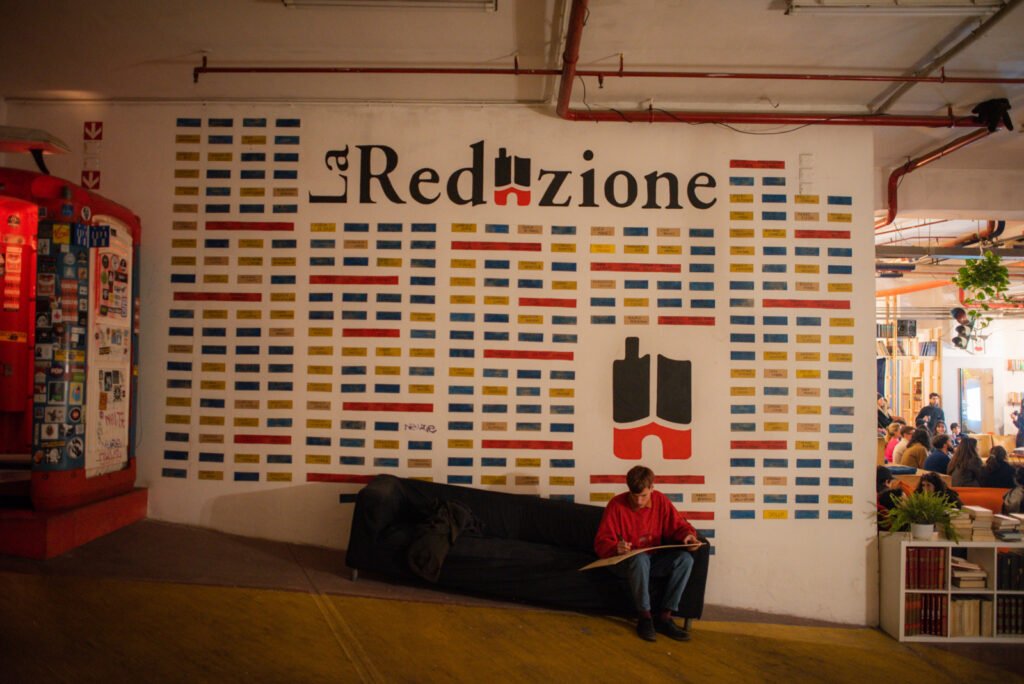 Scomodo – La Redazione
Scomodo is a publishing project born in Rome in 2016 and grown over the years until it became, by the organization's own definition of itself, "a real community" that produces a paper magazine every month and runs physical spaces open to the public in several Italian cities. The historic and best-known seat is in Rome, inside the occupied building known as Spin Time, on Via Carlo Emanuele I, in the area between Piazza Vittorio, Porta Maggiore and the Esquilino district: a place that brings together a newsroom, coworking, library, bar and events hall under the same roof. Anyone arriving expecting to find an editorial office closed behind a door with a nameplate will be thrown off: here you walk in, read, work on a laptop, attend a debate or a screening, often in the same afternoon. To get your bearings in the area it can be useful to also read the pages devoted to Piazza Vittorio and to the underground basilica of Porta Maggiore, both a few minutes away on foot.
What Scomodo really is: a magazine, a community, a physical space
The most common confusion concerns the very nature of the project. Scomodo is not just a newspaper, even though the newspaper remains the most visible product: it is at once a masthead, a cultural association and a container of physical spaces run with participatory criteria. In the official description the project presents itself as born "from the desire to promote social and cultural change", with the declared aim of building "spaces of expression, sharing and growth for the new generations". The magazine, the website, the events and the physical seat in Rome are three faces of the same project, designed to work together rather than as separate initiatives.
The project is commonly presented as one of the largest Italian publishing experiments carried out by a young editorial staff, and indeed the official communication insists a lot on this point, speaking of hundreds of collaborators under 30 involved over time. It must be said honestly that the sources do not agree on a single official age threshold: some presentations speak of editors under 25, others of collaborators under 30 or under 35 depending on the role, from writing to graphics to event organization. What appears more stable, and is confirmed by the official website, is that the editorial staff is made up largely of young people, often Roman university students, who rotate through the editorial roles with a physiological turnover dictated by the age limit itself.
From 2016 to today: the story in brief
The project was born in 2016 in Rome as an independent student magazine, at a time when the landscape of Italian youth publishing was rather poor in structured alternatives. In the first years the activity concentrated on producing the magazine and building a network of collaborators in Roman schools and universities. The leap in quality came a few years later, when the project began to expand outside Rome, opening editorial offices in other Italian cities, among them Milan, Empoli and Bari, and to structure itself as a national network rather than an isolated Roman phenomenon.
The moment that probably marks the most important turning point in the recent history of the project is the opening, in 2020, of the first stable physical space in Rome inside the Spin Time building: a step that the organization itself describes, in its own communication, as the first experiment in the collective building of a physical space dedicated to the community. From that moment the Roman editorial office is no longer just a group of people who meet in different places, but has a recognizable seat where anyone can walk in without an appointment.
Who writes for Scomodo
The magazine gathers texts, illustrations and photographs by editors, artists and creatives who rotate through the community continuously: whoever arrives writes, learns the editorial trade in the field and after a certain number of years makes room for those who come after. According to figures released by the organization, over its history the project has involved more than 700,000 people and about 400 professionals under 35 who collaborated in different ways, from writing to graphics, from photography to event management. These are cumulative numbers, referring to the whole history of the project from 2016 to today, not to a snapshot of the editorial staff at a single moment, and they should be read in that sense.
The name Scomodo and the editorial line
The name chosen for the project tells the original intention well: to present itself as a voice that does not seek compromise with the institutional tones of traditional journalism, but prefers clear positions on subjects that directly concern the new generations, from precarious work to the housing crisis, from the environment to civil rights. The editorial line is built on investigations, reportage and in-depth pieces written by those who live these subjects firsthand, often as students or young workers, more than by an outside observer. This approach, together with the choice of a distribution that favors schools and universities, has contributed over time to building a loyal readership especially among the very young, a segment that most traditional publishing struggles to reach consistently.
Alongside the paper magazine, over the years the project has also developed a structured digital presence, with a website that publishes daily content and an augmented-reading technology designed to link the paper version to multimedia in-depth material. It is a choice that reflects the ambition to speak to a young audience with the tools that audience actually uses, without however abandoning the paper format, which remains central to the project's identity and to its distribution in independent bookshops.
A curiosity about Scomodo - The Editorial Office
Few occasional visitors know that the building housing Scomodo's Roman editorial office was not born to host a magazine or a cultural center. The building on Via Carlo Emanuele I was originally a public administrative seat, then left unused for a long time, and today is better known by the name Spin Time: a bottom-up urban regeneration project that, besides housing hundreds of residents from dozens of different nationalities in a housing emergency, has made part of the common spaces available to cultural groups like Scomodo. Put another way, the editorial office does not occupy an isolated office but shares the building with a much larger residential community: whoever enters to read the magazine or attend an event walks in the same corridors where whole families live. It is a coexistence that makes the space different from any other Italian newsroom, and worth keeping in mind before crossing the threshold with the idea of finding a simple office.
Where Scomodo's editorial office is in Rome and how to get there
The address is Via Carlo Emanuele I 26, in Rome's central municipality, postal code 00185, in a stretch of the city exactly halfway between Piazza Vittorio Emanuele II, Porta Maggiore and the first blocks of the Esquilino district. It is a central position, reachable on foot in a few minutes both by those arriving from Termini station and by those moving from the San Lorenzo area, historically the university and youth district par excellence of the capital.
The address and the neighborhood
The building faces Via Carlo Emanuele I, a residential street of the Esquilino dotted with early 20th-century public housing buildings, a few steps from the intersection with Via Filippo Turati and within walking distance of both Porta Maggiore and Piazza Vittorio, the large covered market and the gardens that bear the name of the last king of unified Italy. Those who already know the area for the new seat of the Esquilino market or for the nearby Alchemical Gate in the gardens of Piazza Vittorio will find the editorial office's entrance very close by, within the same network of streets.
By train and metro from Termini
The distance from Termini station is short, comfortably walkable in just under a quarter of an hour crossing Piazza Vittorio, or an even quicker trip with the surface public transport that links the station area to the Porta Maggiore quadrant. Anyone arriving by train from outside Rome, on either the regional network or high speed, therefore has the busiest station in Italy practically within reach, with no need for complicated changes. The nearest metro stop remains Termini itself, served by lines A and B, or Vittorio Emanuele on line A, both about 10 minutes on foot from the entrance on Via Carlo Emanuele I.
On foot from Porta Maggiore and the Esquilino district
For those already walking in the historic center, the most natural way to arrive is to pass through Porta Maggiore, the ancient gate of the Aurelian Walls absorbed into the railway junction that bears the same name, and from there continue along Via Filippo Turati to the intersection with Via Carlo Emanuele I. It is a walk of a few minutes that crosses one of the least touristy and most authentically Roman stretches of the center, among historic bars, multiethnic food shops and the public housing buildings put up at the turn of the 20th century to house the state employees who arrived in Rome after Unification.
Inside the space: what you find at Scomodo's seat
The space occupies about 2,000 square meters inside the Spin Time building, spread over several levels and organized by function: not a single open room, but a sequence of rooms designed for different uses, from reading to work, from collective events to screenings. It is probably the feature that surprises most those who expect a simple editorial office with a few desks: here you find a newsstand, an internal bar, a quiet study room, a coworking area with shared desks, a cinema room equipped for screenings, a pool table and a ping-pong table, as well as a ramp that makes access usable for those with mobility difficulties too.
The newsstand, the bar and the study room
The internal newsstand sells the paper magazine along with other independent publications, and is often the first point of contact for those who walk in without quite knowing what to expect. Next to it, the bar works as an informal meeting point before and after events, while the study room is designed for those who need a quiet place to work or prepare for an exam, working more like a shared library than a simple cafe with wifi.
The cinema, the pool table and the events hall
The cinema room hosts screenings, themed series and sometimes previews, while the more informal spaces with pool and ping-pong serve to mark free time between one event and the next, in a balance between cultural commitment and sociability that is an integral part of the project's identity. The larger rooms are set up from time to time for assemblies, public debates, book presentations and parties, changing look depending on the calendar.
The history of the Spin Time building: from state seat to residential community
To truly understand the space where the Roman editorial office is located one has to step back from 2016, the year Scomodo was born, and look at the history of the building that now hosts the seat. The building on Via Carlo Emanuele I was born as a public administrative structure, intended for offices, at a historical moment when the Esquilino was consolidating as a working-class district right next to Termini station. Over time the building lost its original function and remained unused for a long time, one of the many Roman public properties left empty while the city faced a growing housing emergency.
The occupation and the birth of Spin Time
The turning point came with the occupation of the building by a group of people in a housing emergency, a phenomenon that in Rome has involved several disused public buildings over the years. From that occupation Spin Time was born, a self-management project that over time gave itself internal rules, common spaces and an organizational structure able to stably house hundreds of residents from dozens of different countries, often families with children, as well as single people looking for a dignified housing solution in a city where the real estate market remains out of reach for many segments of the population.
A residential space that also becomes a cultural space
What makes Spin Time a particular case, and not a simple building occupied for housing, is the choice to open a substantial part of the common spaces to outside cultural groups, turning the building into a place that combines residential life and cultural production. It is in this context that in 2020 Scomodo found its stable physical seat in Rome, sharing the building with the community of residents and contributing, with its events programming, to bringing outside audiences into a space that would otherwise remain visible only to those who live there. The coexistence of the two dimensions, residential and cultural, is not without organizational complexity, but it is precisely this interweaving that makes Scomodo's seat a different case from any other Italian newsroom, closer in form to a self-managed social center than to a conventional editorial office.
Why this matters for visitors
Anyone arriving at Via Carlo Emanuele I without knowing this history risks reading the building simply as a slightly informal alternative venue. Knowing the context instead helps understand why the spaces open to the public are only part of the building, why the management of hours and access follows participatory logics different from those of a museum or a municipal library, and why the editorial office's cultural programming constantly intertwines with themes tied precisely to housing, the right to a home and urban regeneration, subjects that often return in the pages of the magazine and in the debates organized on site.
Something nobody tells you about Scomodo - The Editorial Office
What is rarely told, and what changes quite a bit the experience of those visiting for the first time, is that the space does not work like a museum or a visitor center with a set route: it works as a living place, and its look changes continuously depending on what is on the program that day. One afternoon the big room can host an open assembly on housing themes, the next evening a screening, on the weekend a party with live music. Anyone arriving with the idea of finding fixed hours identical to those of a shop or a state museum risks being disappointed: here the programming is dynamic, communicated mainly through social channels and the official website, and it's always best to check what is planned for the chosen day before organizing the visit. The other little-known element concerns the relationship with the building that hosts the editorial office: Scomodo's spaces coexist with hundreds of homes occupied by residents who live there permanently, and this means that some areas of the building remain private and inaccessible to visitors, while only the zones explicitly intended for the cultural community are open to the public.
My advice for visiting Scomodo - The Editorial Office
The most useful advice, for those who don't yet know the space, is not to show up with the idea of a tourist visit in the classic sense, but rather to choose a moment when an open event is planned, a debate, a screening or a presentation, and use that as the occasion to walk in, look around and understand how the place works. Before leaving it's best to take a look at the calendar published on the official website or on the editorial office's social channels, because the programming changes constantly and an afternoon with no events on the schedule offers a much more limited experience than an evening with something going on. Whoever arrives in the early afternoon on a weekday, when the study room is open and the pace is calmer, probably finds the best moment to chat with the people working in the editorial office without the background noise of an evening event.
Accessibility and practical services for visitors
Those organizing a visit with specific needs, be it reduced mobility or simply the need to work for a few hours with a laptop, find in Scomodo's Roman space some concrete answers, though it is always worth checking the most updated details by contacting the editorial office directly before organizing a visit tied to a specific need.
Mobility and physical access
Among the services listed by the official website is a ramp designed to make access usable for those with mobility difficulties too, a far from obvious feature in an early 20th-century public housing building like the one that hosts the editorial office. Since it is in any case a historic building with a mixed use, those with specific accessibility needs would do well to contact the editorial office in advance through the official channels, to get precise directions on the easiest route to follow once they arrive at Via Carlo Emanuele I.
Working and studying on site
The coworking area and the study room are designed precisely for those who need a place to spend a few hours working or studying, working more like an independent co-working space than like a bar with a few small tables. Those looking for an alternative to the Roman university libraries, often crowded during exam periods, find here a different environment, animated by a community of regulars more than by passing visitors.
Opening hours and how to organize the visit
According to the official website, the Roman space is open Monday to Friday from half past eight in the morning until midnight, while on weekends opening begins later, around noon, and continues until midnight. These are hours designed for a place that works both as a daytime workspace and as a venue for evening events, and so covers a much wider span of time than a traditional office. Since these are hours communicated by a project run in participatory ways, they remain subject to changes tied to the event calendar or to internal organizational needs, so the most prudent choice is always to check the updated situation on the official channels before setting out, especially if the goal is to attend a specific event and not simply to look in at the space.
When it is less crowded
The early hours of the afternoon on weekdays are generally the quietest, with the study room and the coworking populated mostly by university students who use the space as an alternative to the neighborhood libraries. Late afternoon and evening, especially on days when an event is scheduled, bring instead a much larger flow, with the big room filling up ahead of debates, screenings or presentations.
What to expect if you don't know the building
The Spin Time building doesn't look like a conventional cultural venue. The entrance is that of an early 20th-century public housing block, with basic signs pointing to the common areas run by the community. Anyone arriving for the first time can count on a steady presence of people who use the space every day and who will usually gladly point the way to the newsstand, the bar or the event hall if you look lost at the entrance.
Events, workshops and activities open to the public
The public program is probably what sets the Scomodo space apart from a newsroom in the strict sense. According to figures released by the organization, over the course of its history the project has organized more than 4,000 events in total in its spaces, a number that includes training workshops, public assemblies, debates on current affairs, themed festivals, exhibitions, parties with live music or DJ sets, and film screenings. These are cumulative figures for the project's whole national network, not just the Rome location, but they still give an idea of the density of activity that sets this kind of space apart from a cultural venue with a more occasional program.
Assemblies, debates and presentations
Open assemblies and public debates take up an important part of the calendar, often tied to political, social or cultural current affairs that the editorial team also covers in the pages of the magazine. Book presentations, especially nonfiction and fiction on generational themes, are another recurring event, with authors in conversation with the editorial team and the audience in the room.
Festivals, exhibitions and screenings
Alongside the more institutional events there is room for themed festivals organized directly by the community, photography and illustration exhibitions often made by the magazine's own contributors, and film screenings in the dedicated room, with a program that alternates art-house cinema and more recent productions on generational themes.
Scomodo's other locations in Italy
Although this page focuses on the Rome editorial office, understanding how the rest of the network works helps place the role that Via Carlo Emanuele I has played in the project's history. After consolidating the Rome editorial office, Scomodo replicated a similar model in other Italian cities, made up of young contributors, editorial production and, where possible, physical spaces shared with the local community.
Milan
The Milan editorial office is the project's first major expansion outside Rome, in a city with an editorial and university ecosystem very different from Rome's but just as full of potential young contributors. Here too the model follows the same logic: contributors under 30 who rotate through editorial roles, content production for the national magazine and public events designed for the local area.
Empoli and Bari
The Empoli and Bari editorial offices show a lesser-known side of the project: its ability to take root outside Italy's two big metropolises too, in urban settings of different sizes. Empoli, a provincial Tuscan city, and Bari, the capital of Puglia, show how the editorial model born in Rome in 2016 has proved adaptable to very different local realities, keeping the same basic structure of young editors and a cultural program open to the local public.
Another well-known fact, yet rarely mentioned
The fact in question concerns the scale of the project once it left Rome. Many people know Scomodo only as a Roman phenomenon, tied to the magazine founded in 2016 and to the space inside Spin Time, but over the years the project has built a network that includes editorial offices in other Italian cities, among them Milan, Empoli and Bari, each with its own community of contributors and, in some cases, its own physical spaces run on the same participatory model as the Roman one. Via Carlo Emanuele I location remains the one historically best known and the one that served as the model for the others, but reducing the project to its Roman dimension means losing sight of how far the network has grown in recent years, to the point of involving, according to figures released by the organization, more than 700,000 people over its whole history.
The right photo to take at Scomodo, La Redazione
The most representative photo isn't the one of the street entrance, which stays as anonymous as any Roman public housing block, but one taken from inside, in the main room during an open event, with the audience sitting on the floor or on salvaged chairs, the walls covered with posters and flyers piled up over the years, and the often warm light of the stage lamps. It's an image that conveys better than any description the hybrid nature of the place, halfway between a newsroom, a social center and an independent cultural space. A second interesting shot is the one of the internal newsstand, with the magazine displayed next to other independent publications: a small but effective detail showing that here journalism is something you can touch before you even read it online.
The neighborhood around it: Esquilino, Porta Maggiore and San Lorenzo
It's hard to sum up the complexity of this part of Rome in a few lines, because it is one of the areas of the city where historical, social and cultural layers coexist most visibly. Walking for an hour between Piazza Vittorio, Porta Maggiore and San Lorenzo means crossing neighborhoods born in different eras, with different functions and different communities, but held together by a physical closeness that makes them, for anyone visiting Rome with a bit of time to spare, one big walking itinerary.
The editorial office's position, straddling Esquilino and Porta Maggiore, puts within reach a piece of Rome that is little trodden by the classic tourist circuits but full of layered history. Esquilino is the capital's multiethnic neighborhood par excellence, with the large covered market that bears the same name and a population that in recent decades has made this part of the city one of the most international in the center. Porta Maggiore, a few minutes away on foot, is a monumental junction built on the ancient Aurelian Walls, where railway lines, ancient aqueducts and a public transport hub that is still crucial today for anyone moving between the center and the city's eastern districts all converge.
Where to eat nearby
The area around Piazza Vittorio is probably the part of Rome with the highest concentration of international cuisines in the city center, thanks to the Esquilino neighborhood's long multiethnic tradition. Among the stalls of the covered market and the nearby streets you'll find food shops and small restaurants ranging from Chinese to Bangladeshi, from African to South American cooking, a food scene very different from the tourist one of the more trodden historic center. If you want more traditional Roman cooking instead, the places multiply as you continue toward San Lorenzo, a university neighborhood with a long tradition of trattorie and pizzerias frequented mostly by students.
Piazza Vittorio and the market
Piazza Vittorio Emanuele II, the largest porticoed square in Rome by size, holds a public garden at its center where surprising archaeological remains survive, including the so-called Alchemical Gate, tied to 17th-century alchemical legends. Around the square lies the multiethnic commercial district, with the new Esquilino market as the landmark for anyone looking for food products from every corner of the world.
Toward San Lorenzo
Continuing past Porta Maggiore you enter the San Lorenzo neighborhood, historically the heart of Roman university life thanks to its closeness to La Sapienza, and still rich today in independent youth spaces, from the palestra popolare to Container San Lorenzo, as well as summer events such as the San Lorenzo film festival. Anyone who spends time at the Scomodo space thus finds, within a short walk, a concentration of independent cultural venues that is hard to find elsewhere in the capital.
The Mameli library and the basilica outside the walls
If you have more time, you can extend the walk toward San Lorenzo as far as the Goffredo Mameli library, a landmark for the neighborhood's students, or as far as the Basilica of San Lorenzo fuori le Mura, one of Rome's seven Jubilee churches and evidence of a neighborhood that, although it has taken on a strongly youthful and university identity over time, keeps much older roots tied to the cult of the saint it is named after. It's an itinerary that lets you read together, within a few hundred meters, the ancient Rome of the basilicas, the working-class Rome of the early 20th century and the contemporary Rome of independent cultural spaces like Scomodo.
How to become a Scomodo contributor
A not insignificant share of the people who come to the Rome location don't do it as simple visitors, but because they have joined the editorial team or one of the working groups that animate the space. The recruitment model follows an open logic, consistent with the project's general approach: no prior journalism credentials are needed, only a willingness to get involved on a topic, a format or an organizational role, from writing to graphic design, from photography to event management.
The selection process
Anyone who wants to join the editorial team generally starts with an application through the project's official channels, followed by introductory interviews and a trial period in which the new contributor works side by side with people already inside the structure. It's a path designed more to assess motivation and reliability than prior résumé, consistent with a project that explicitly targets people at the start of their professional path.
What being part of the editorial team involves
People who join the editorial team generally commit on a volunteer basis, balancing it with their studies or other work commitments, since the vast majority of contributors under 30 are university students or young professionals just starting out. In return, the project offers on-the-job training that is hard to find elsewhere at the same age: from journalistic writing to running a public event, from curating an exhibition to organizing a festival, skills that many former contributors say they later carried with them into their later careers, inside and outside journalism.
Scomodo in the landscape of Italian youth journalism
Placing Scomodo in the broader context of Italian publishing helps explain why the project is often cited as a reference point when people talk about press written by young people. The landscape of independent journalism aimed explicitly at an audience under 30 in Italy remains relatively small, especially if you consider projects able to combine a print magazine with national distribution, a network of editorial offices in several cities and a stable physical space open every day of the week.
A hybrid model that is rarer than rare
What sets Scomodo apart from many other youth publishing experiences isn't so much the quality of individual pieces as the choice to build around the magazine an ecosystem of physical spaces, events and local community. Other Italian youth publishing projects stay more tied to the digital format alone or to print distribution without a stable physical location open to the public. The combination of magazine, website, events and a physical home shared with a residential community like Spin Time's remains a rather isolated case on the national scene.
The relationship with schools and universities
Free distribution in schools and universities, together with the real possibility of joining the editorial team from high school or the first years of university, has built over time a direct channel between the project and the Roman education world, which sets Scomodo apart from youth publications designed more to be read than to be written directly by their own target audience. This direct channel with Roman schools and universities also explains why the physical location on Via Carlo Emanuele I works as a natural meeting point between different generations of contributors: someone who joins as a high school student finds more experienced editors already there, often still active as volunteers even though they have passed the age limit of the official editorial team, in a handover of skills that is constantly renewed.
How Scomodo magazine works: distribution and editorial model
The magazine comes out monthly and is distributed under a hybrid model: paid in bookshops and independent cultural spaces, free in schools and universities. It's a mechanism designed to ensure wide circulation among the youngest readers, those who would hardly buy a newspaper at a newsstand regularly, without giving up a sales channel in the more traditional independent culture circuits.
Where to find the print magazine
Besides the newsstand inside the Rome location, the magazine can be found in a network of independent bookshops and cultural spaces located mostly in the cities where the project has an active editorial office. The exact number of points of sale changes over time, and it's always best to check through the official channels before going looking for a specific copy in a neighborhood bookshop.
The economic model and the declared figures
According to what the organization reports, over the course of its history the project has distributed about 500,000 copies of the magazine in total. It's a cumulative figure that conveys the scale the project has reached over the years, more than the print run of a single issue, and that places Scomodo among the most widely circulated youth publishing experiences of recent years in Italy.
The financial support of a project on this scale, which combines editorial production, management of physical spaces and organization of hundreds of events, rests on several sources: sales of the magazine in the paid circuits, takings from some events at the location, and in some phases also public funding tied to specific projects, as in the case of the program Transizione digitale organismi culturali e creativi, funded by the European Union under Next Generation EU and cited by the organization itself among the sources that supported the development of the project's digital platform.
When to go to Scomodo depending on the season and the university calendar
Attendance at the space largely follows the Roman academic calendar, given the close link between the editorial team and the city's university world. In the autumn and winter months, with the academic year under way, the study room and the coworking area are generally busier with students looking for an alternative to the university library, while the evening program of debates and presentations probably reaches its greatest density in these very months.
Roman summer and the cultural program
In the summer months, when university activity slows down and many Romans leave the city, the program tends to shift toward evening events outdoors or in air-conditioned rooms, with film screenings and parties that take advantage of the higher temperatures to extend opening hours late into the night, consistent with the midnight closing indicated in the official hours. It's a period when the space fits naturally into the wider calendar of summer events that animates several neighborhoods of the capital, from Piazza Vittorio to San Lorenzo, offering an indoor alternative to the open-air cinema arenas found around the city in the warm season.
Periods with less on the program
As with many independent cultural spaces run on participatory principles, there are periods of the year, typically around the Christmas holidays or in August, when the public program shrinks noticeably, although the coworking spaces and the study room stay open according to the stated hours. Anyone planning a visit in these periods should expect an experience closer to that of a shared workspace than a cultural center with daily events, and adjust their expectations accordingly.
Some important events that happened here in history
The most significant moment in the history of the Roman space remains the opening, in 2020, of the location inside the Spin Time building: a moment that turned Scomodo from a network of contributors with no stable physical place into a project with a recognizable home open to the public every day of the week. Since then the Rome editorial office has hosted thousands of public events, including assemblies, debates, presentations, festivals and screenings, directly contributing to the total of more than 4,000 events that the organization says it has held across the national network over its history. The project's expansion beyond Rome, with the opening of editorial offices in Milan, Empoli and Bari, is the other decisive step, which turned an experiment born in a Roman school or university into an editorial network on a national scale.
Who has passed through Scomodo, La Redazione
Over its history the space has hosted hundreds of editors, artists, creatives and writers under 30, according to the organization's own definition, along with a significant number of outside guests invited for debates, presentations and public assemblies. The natural turnover of the editorial team, tied to the age limit of internal contributors, has meant that over the years hundreds of young journalists, illustrators and photographers have passed through these spaces and then continued their careers elsewhere, taking with them the experience gained inside the Rome editorial office. The sources available don't allow a precise list of names permanently tied to this location, and being wary of lists that are too precise of personalities who supposedly "passed through here" is more prudent than relying on unverifiable sources: what is certain, from the organization's official website, is the overall scale of the phenomenon, with hundreds of professionals under 35 involved in the project's history.
Frequently asked questions about Scomodo, La Redazione
Some questions come up often among people approaching this space for the first time, both online and directly at the location. Gathering the most useful answers in one place helps clear up the most common doubts before you even set out.
Do I need to book to get in?
For a free visit to the common areas, such as the study room, the coworking space or the newsstand, no booking appears to be needed according to the official channels. For specific events, especially those with limited seats like some presentations or screenings, it's better to check in advance if registration is required, information that is generally published along with the announcement of the event itself.
Is it a free space?
Access to the common areas has no entrance fee. Some internal services, such as the bar or buying the magazine at the newsstand, naturally cost money, while taking part in certain events may in some cases involve a contribution, with terms that vary from event to event and need to be checked each time.
Is it suitable for first-time visitors to Rome?
It depends on the kind of trip. Anyone looking only for the capital's great classic monuments will probably find little of interest in an independent editorial office in a public housing building in Esquilino. Anyone who instead wants to pair the more touristic route with a look at contemporary Rome, the Rome of youth movements, independent publishing and urban regeneration from below, will find in this space a vantage point that is hard to replicate elsewhere in the city.
Can you visit with children?
The space isn't designed specifically for families with small children, since it is above all a place for work, study and events aimed at a young and adult audience. There are no formal restrictions on entry, but the program and the overall atmosphere remain geared to a university and post-university audience rather than to families on a tourist visit.
How do I stay up to date on the program?
The most reliable way remains to check the editorial office's official channels, where the updated calendar of events, workshops and public appointments is published. Since the program changes on a weekly basis, relying on information gathered months earlier risks leading you to plan a visit on a day with no events scheduled.
Can I buy the magazine without visiting the location?
Yes, the magazine is also distributed outside the Rome location, through the network of independent bookshops and cultural spaces that sell it for a fee, in addition to the free distribution in schools and universities. Anyone who can't stop by Via Carlo Emanuele I can therefore still get a copy elsewhere, although the newsstand inside the location remains the most immediate and complete distribution point, often with back issues available that are harder to find elsewhere.
Are there other ways to support the project?
Besides taking part directly as a contributor or buying the magazine, those who want to support the project can do so by attending the paid events organized at the location, whose takings generally help sustain the editorial office's activities, or by following and sharing the content published online, something that for an independent publishing project remains as important as direct financial support.
Practical information for planning your visit
Anyone visiting Rome for the first time who wants to add a stop off the most touristy circuits will find in this part of the city, between Esquilino, Porta Maggiore and San Lorenzo, one of the most interesting stretches for understanding the capital's independent cultural life beyond the classic monuments. For those planning a longer stay in the city, with stops to spread over several days, it can be useful to rely on planning tools such as ItalyPlanner, while those who work in organized travel and accompany groups in Italy will find dedicated professional resources on TourLeaderPro. In both cases these are tools designed for people who want to move around more knowledgeably in a layered city like Rome, where an apparently peripheral address like Via Carlo Emanuele I can hide one of the capital's most active independent cultural spaces.
Before leaving, the practical advice remains always the same: check the events calendar on the editorial office's official channels, verify the updated opening hours and, if possible, pick a date when a public event is scheduled, so you can experience the space as it really works and not just walk through it as you would an empty office. It's the most effective way to understand why, in a city with thousands of cultural addresses, this corner of Esquilino keeps attracting thousands of young Romans and others every year.
Anyone arriving in Rome for a stay of several days can fit the stop at Via Carlo Emanuele I into a day already devoted to the area between Termini, Esquilino and San Lorenzo, perhaps combining it with a visit to Piazza Vittorio in the cooler hours of the morning and saving the late afternoon or evening for the Scomodo editorial office, when the cultural program gets going. It's a way to build an itinerary that alternates a large historic green space, one of the liveliest multiethnic markets in the capital and one of Rome's most active independent cultural spaces, without having to cross the city from end to end to link the three stops.
One last practical warning concerns the expectations you bring. If you know institutional cultural venues, with ticket offices, fixed hours and a guided route, you'll find the Rome location of Scomodo works very differently, more like a shared home than a traditional cultural institution. It's precisely in this difference, more than in the visit itself, that the added value of a stop here lies: the chance to see up close how a space works when it is built from the bottom up by a community of young people, inside a building that is at once an editorial office, a home for hundreds of families and a place of independent cultural production.
Contact Information
Via Carlo Emanuele I, 26
Roma Roma Città, Roma Città