Sciroppo di Teatro 2026 at Teatro di Roma, March 21 to December 30, 2026
https://www.estateromana.com/en/rome/trip-planner/sciroppo-di-teatro-2026-at-teatro-di-roma-march-21-to-december-30-2026/
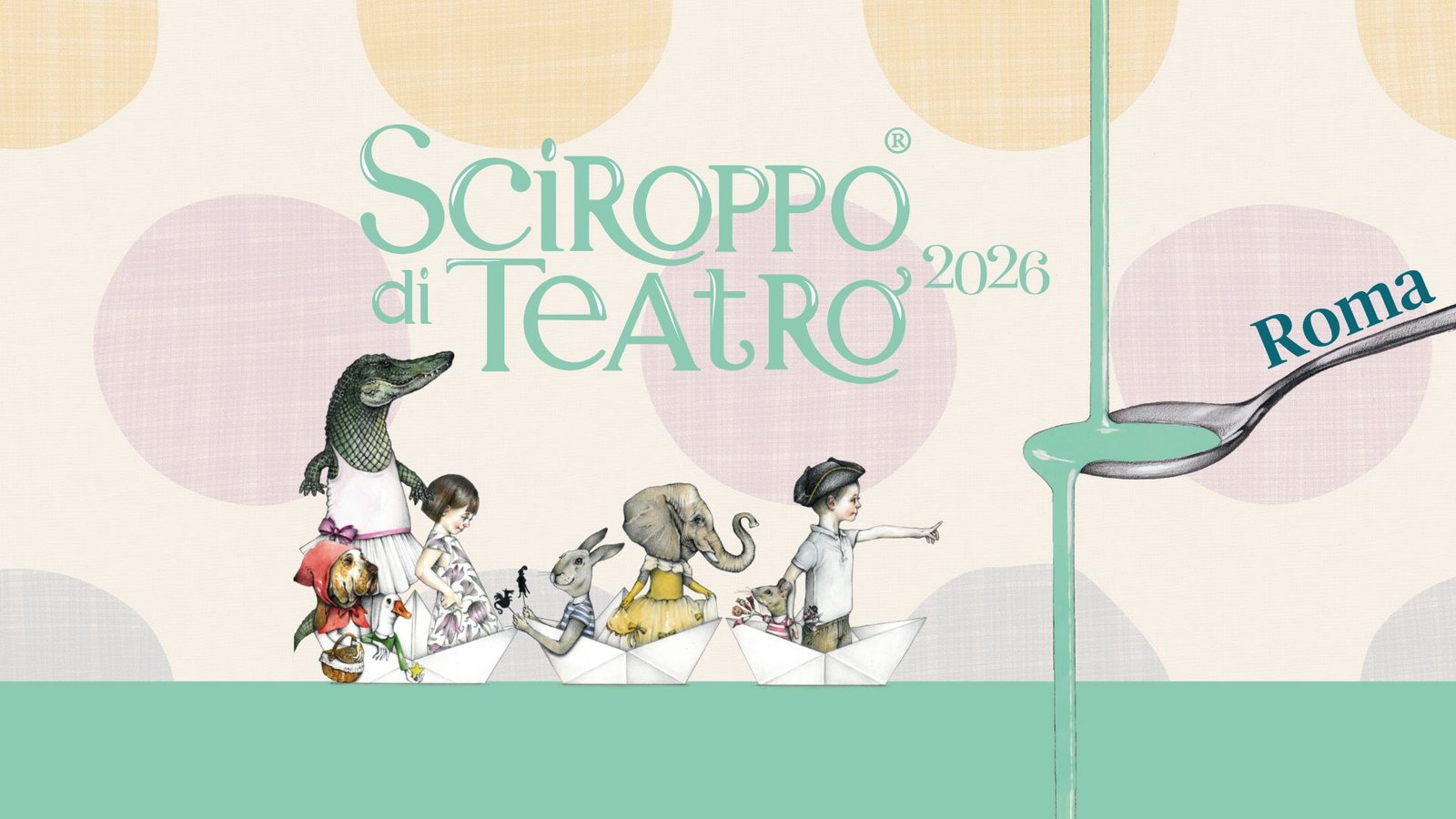
Sciroppo di Teatro 2026, the third edition of the project that brings kids and families to the theater with the pediatricians' prescription, runs from March 21 to December 30, 2026 in the venues of the Fondazione Teatro di Roma: Teatro Argentina at Largo di Torre Argentina 52, Teatro India at Lungotevere Vittorio Gassman 1 and Teatro di Villa Torlonia at Via Lazzaro Spallanzani 1A, plus Teatro Elsa Morante, listed by Teatro di Roma among the project's venues. The mechanism is simple: the family pediatrician, or one of the municipal pharmacies, hands over the Sciroppo di Teatro booklet, with an illustrated package leaflet and 3 prescriptions for 6 vouchers, each valid for one ticket at the symbolic price of 3 euros. Booking is mandatory at the number printed on the booklet. For information Teatro di Roma lists 06 684000382 and the address nuovegenerazioni@teatrodiroma.net. The shows are those of the Teatro Ragazzi program: this fall Ending from November 16 to 23 and Pinocchia from November 27 to 29 at Teatro India. To reach the venues it is best to use the Roman transit company's route planner.
Language: opera sung in its original language; no English surtitles are announced, so check with the theater.
What Sciroppo di Teatro 2026 is
Sciroppo di Teatro is a cultural welfare initiative that allies theater and pediatricians: shows are prescribed to children like a medicine of emotions, with an illustrated prescription. Teatro di Roma presents it as a program of shows able to stimulate creativity, imagination and dreams, and the formula, looked at closely, is less naive than it seems.
Theater and pediatricians
The starting idea is to promote theater among the very young through an unprecedented alliance with the doctors who look after their growth. Pediatricians put the care and well-being of children and families at the center, and the project focuses on the positive effects of theater on the emotional level, on learning and on socialization. It is a way of telling parents that taking a child to the theater is not a luxury, but a part of their health.
The third edition
2026 is the third Roman edition of the project. In Rome Sciroppo di Teatro is a project of Ater Fondazione, in agreement with the Fondazione Teatro di Roma, Teatro Nazionale, and is supported by Roma Capitale. The dates given by the Roma Capitale tourism portal run from March 21 to December 30, 2026.
Who has joined
The initiative has been joined by the provincial Order of Physicians and Dentists of Rome, the Italian Society of Pediatrics, the Italian Federation of Pediatricians, the Italian Society of Pediatricians, the Italian Society of Preventive and Social Pediatrics, the trade union federation CIPe, SISPe, SINSPe, the Cultural Association of Pediatricians and Farmacap, the special pharmaceutical and health-services company of Rome that manages the municipal pharmacies. It is a long list, and says how deeply rooted the project is in Rome's health world.
How Sciroppo di Teatro works: booklet, prescriptions and vouchers
The Sciroppo di Teatro booklet contains an illustrated package leaflet and 3 prescriptions, for a total of 6 vouchers, each valid for one ticket at the price of 3 euros for Teatro di Roma's shows for kids.
Where to get the booklet
You ask for the booklet from your family pediatrician, that is, the child's primary care doctor, or at the municipal pharmacies of Rome, for which Teatro di Roma points to the list published by Farmacap. The practical advice is to ask for it at the first useful visit: many pediatricians keep it in the office, but do not always offer it spontaneously.
The package leaflet
The leaflet, like that of a real medicine, illustrates the benefits of theater on the cognitive and social level. It is the most successful element of the project: a form familiar to every parent, used to explain in a few lines why a show is good for you. Kids, for their part, find the idea of going to the theater with a prescription funny.
Three prescriptions, six vouchers
Each prescription is worth two vouchers, and each voucher corresponds to a 3-euro ticket. In practice an adult and a child can see three shows together spending 18 euros in all, or two adults and a child can go to the theater twice. The regular Teatro Ragazzi price is 10 euros for the adult and 7 euros for the child: the savings are clear.
Booking
Booking is mandatory, at the phone number printed on the booklet. For general information Teatro di Roma lists 06 684000382 and the address nuovegenerazioni@teatrodiroma.net. You do not buy with the vouchers online like an ordinary ticket: it is best to call a few days ahead, especially for weekend performances.
The Sciroppo di Teatro 2026 shows in the fall
From October to December 2026 the Teatro Ragazzi program of Teatro di Roma, which you access with the Sciroppo di Teatro vouchers, offers eight titles among Teatro di Villa Torlonia, Teatro India and Teatro Elsa Morante.
Albert eD io, October 10 and 11
At Teatro di Villa Torlonia, Albert eD io by Francesco Niccolini, with dramaturgy by Flavio Albanese, Marinella Anaclerio and Niccolini, directed by Marinella Anaclerio, with Flavio Albanese. From age 11.
Charlie Gordon, October 24 and 25
Also at Villa Torlonia, Charlie Gordon by Patrizio Dall'Argine, loosely inspired by Daniel Keyes's story Flowers for Algernon, with Dall'Argine himself as puppeteer. From age 6.
I cattivi pensieri, October 24 and November 6
At Teatro Elsa Morante, from October 24 to 30 and from November 3 to 6, I cattivi pensieri, based on Tu non sai di me by Luisa Mattia, by Roberto Gandini and Roberto Scarpetti, directed by Roberto Gandini, a Teatro di Roma production. From age 11.
Ode alla vita, November 14 and 15
At Villa Torlonia, Ode alla vita, written and performed by Manuela Capece and Davide Doro, a project of the company Rodisio. Ages 3 to 8: the fall title designed for the youngest.
Ending, November 16 to 23
At Teatro India, Ending by Roberto Gandini and Roberto Scarpetti, directed by Gandini, with Iulia Bonagura, Edoardo Maria Lombardo, Fabio Piperno, Tiziana Scrocca and Carolina Sisto. From age 12.
Pinocchia, November 27 to 29
At Teatro India, Pinocchia, adolescente di legno, loosely based on Carlo Collodi, text by Gandini and Scarpetti, directed by Gandini, with a cast of 19 performers. From age 6.
Christmas: La mosca Verdolina and Storie di Natale
From December 17 to January 6, at Villa Torlonia, La mosca Verdolina by Giorgio Parisi, adapted by Emanuele Di Giacomo, directed by Davide Doro, with Jacob Olesen, from age 5. From December 22 to January 6, at Teatro India, Storie di Natale from Gianni Rodari, Bernard Friot, Andrea Valente and Roberto Gandini, adapted and directed by Gandini, from age 4. For the January performances, beyond the project's end date given for 2026, it is best to ask at the booklet's number if the vouchers are still valid.
The Teatro Ragazzi season after December
The 2026/2027 Teatro Ragazzi season continues in 2027 with other titles at Teatro India and Villa Torlonia. The validity of the Sciroppo di Teatro vouchers for 2027 should be checked with Teatro di Roma.
At Teatro India
On January 23 and 24 Marmocchio, una specie di Pinocchio di marmo, an animated radio drama by Sacchi di Sabbia, from age 7. On February 6 and 7 Clàssics, a puppet show in seven scenes by Jordi Bertran, from age 5. On April 17 and 18 Il canto della sirena, loosely based on Andersen's Little Mermaid, text and direction by Emma Dante, from age 6. On May 16 the dance Cuor di coniglio, company Dimitri/Canessa, from age 6.
At Villa Torlonia
On January 16 and 17 Petites histoires sans paroles by the company L'Alinéa, from age 5. On February 20 and 21 Ho un pezzettino in gola by Valentina Dal Mas, from age 6. On March 13 and 14 Fare un fuoco by Francesco Niccolini and Luigi D'Elia, inspired by Jack London's Yukon tales, from age 9.
The festival
From April 7 to 11 the Festival Contemporaneo Futuro returns, seventh edition, curated by Fabrizio Pallara, between Teatro India and Villa Torlonia.
A curiosity about Sciroppo di Teatro 2026 at Teatro di Roma, March 21 to December 30, 2026
The loveliest curiosity of the fall program is La mosca Verdolina, on stage at Villa Torlonia from December 17 to January 6. The official program attributes it to Giorgio Parisi, with the dramaturgic adaptation by Emanuele Di Giacomo and direction by Davide Doro. It is one of the most awaited titles of the season for the little ones, from age 5, and falls in the holiday period: with the Sciroppo di Teatro vouchers it becomes a 3-euro Christmas gift, as long as the December performances fall within the project's calendar.
The second curiosity is the language. The project uses the vocabulary of the pharmacy to the fullest: prescription, package leaflet, syrup, a medicine of emotions administered. It is not just marketing: it speaks to parents with words they already know and makes an evening at the theater legitimate in the eyes of those with little time and little budget. And the logo, with the little spoon pouring the syrup, makes even kids smile.
Finally Charlie Gordon, October 24 to 25: a puppet show loosely inspired by Flowers for Algernon by Daniel Keyes, with Patrizio Dall'Argine as the only puppeteer on stage. Recommended from age 6, it brings kids a classic of 20th-century fiction.
The Fondazione Teatro di Roma and Teatro Ragazzi
The Fondazione Teatro di Roma, Teatro Nazionale, runs Teatro Argentina, Teatro India and Teatro di Villa Torlonia, and devotes a specific program to the new generations, Teatro Ragazzi.
A stage for the new generations
The 2026/2027 Teatro Ragazzi season is presented as a stage for the new generations: a path of stories and languages that crosses genres and stages and ranges from scientific inquiry to myth, from civic memory to the poetry of everyday life. Many shows are produced by Teatro di Roma itself, directed by Roberto Gandini.
Regular prices
Without a voucher, a Teatro Ragazzi ticket costs 10 euros for the adult and 7 euros for the child. The TdR card Under14 costs 24 euros and includes 4 admissions to choose among Sala Squarzina of Teatro Argentina, Teatro India and Teatro Torlonia, valid for adults and children, only for Teatro Ragazzi shows.
The Piero Gabrielli workshop
Alongside the shows, Teatro di Roma carries on the Laboratorio Teatrale Integrato Piero Gabrielli, with decentralized workshops in schools, and training projects such as Leggere Calvino and the read-aloud workshops at Teatro Elsa Morante. Sciroppo di Teatro fits into this network devoted to the youngest.
Something nobody tells you about Sciroppo di Teatro 2026 at Teatro di Roma, March 21 to December 30, 2026
What nobody says is that the booklet does not arrive on its own. The project works if the parent asks for it: from the pediatrician, during a visit, or at the municipal pharmacy around the corner. Many families discover Sciroppo di Teatro when the year is almost over and the vouchers go unused. With the closing date given as December 30, those who do not yet have the booklet should ask for it now, to have time to use all three prescriptions.
The second thing is that the recommended ages matter. The fall program ranges from the age 3 of Ode alla vita to the age 12 of Ending. Taking a 5-year-old to a show designed for 11-year-olds is the quickest way to spoil their idea of theater. Teatro di Roma's program lists the age for each title: follow it.
The third is that the venues are far from one another. Villa Torlonia is on the Nomentana, Teatro India on the Tiber near the Gazometro, Teatro Elsa Morante in yet another area. Before booking, look at where the venue is: with kids, an hour of traffic changes the evening.
Teatro Argentina and Sala Squarzina
Teatro Argentina, at Largo di Torre Argentina 52, is the first venue of the Fondazione Teatro di Roma. Its Sala Squarzina is among the spaces valid for the TdR card Under14 of Teatro Ragazzi.
The golden theater of Rome
Teatro di Roma calls it the golden theater of Rome: an Italian-style horseshoe hall, red and gold, with 720 seats among the stalls and six tiers of boxes and a large chandelier with 16 arms. For a child, the first time at the Argentina is an experience that stays.
The name and the history
The name has nothing to do with the South American country. It comes from the tower of the palace of Johannes Burckardt, the Burcardo, papal master of ceremonies from Strasbourg, which in Latin was called Argentoratum. The theater was commissioned by the Sforza Cesarini, designed by Gerolamo Theodoli and inaugurated in January 1732. The neoclassical facade, by Pietro Holl, dates from 1826.
A stage of historic premieres
At the Argentina the premiere of Rossini's Barber of Seville took place in 1816, and Verdi brought I due Foscari there in 1844 and La battaglia di Legnano in 1849. In 1993 Paolo Portoghesi oversaw its restoration. The adult program of the season, from Otello onward, is gathered in the 2026/2027 season of Teatro di Roma.
Teatro India, the former factory on the Tiber
Teatro India, at Lungotevere Vittorio Gassman 1, formerly Lungotevere dei Papareschi, is the second venue of Teatro di Roma, carved out of a former factory and inaugurated in 1999.
The Mira Lanza factory
At the beginning of the 20th century the area housed a chemical products factory, with the first brick buildings designed by the engineer Giulio Filippucci. In 1913 the City acquired it to produce glycerin during the First World War, then soap. The merger with Unione Stearinerie Lanza gave birth to Mira Lanza, which declined with the Second World War and closed in 1952. On the bank of the Tiber today is the Ex Mira Lanza Museum.
A brick theater
The theater has three naves of dark brick, pitched roofs, wood and iron beams, red velvet seats, three halls and modular spaces. The name was chosen by Mario Martone, then director: a state, like Argentina, and a metaphor for travel. From the outdoor space you see the Gazometro. In summer it hosts India Città Aperta.
Why teens like it
A theater in a factory, with exposed brick and the Gazometro behind it, is a place older kids find closer to their world than an Italian-style theater. It is no accident that the shows for teenagers go to Teatro India, such as Ending, from age 12.
Teatro di Villa Torlonia
Teatro di Villa Torlonia, at Via Lazzaro Spallanzani 1A, is the 19th-century theater of the Torlonia villa, designed by Quintiliano Raimondi, reopened in 2013 and today the third hall of Teatro di Roma.
The princes' theater
When Alessandro Torlonia, from 1832, transformed the family villa into a great residence for representation, he entrusted the Theater and the Limonaia to Quintiliano Raimondi. The theater was the place for the family's parties and private shows.
A park around it
Villa Torlonia has been a public park since 1978, with the main entrance at Via Nomentana 70 and other entrances on Via Spallanzani, open from dawn to dusk. For kids it is the decisive advantage of this venue: before the show you play in the park, and the theater becomes the natural end of an outdoor afternoon.
The villa's other wonders
In the park are the Casina delle Civette, with its stained glass, the Casino Nobile, the two obelisks erected in 1842 and the Serra Moresca, reopened in 2021. For a snack there is the refreshment point at the Limonaia.
The advice I give you for visiting Sciroppo di Teatro 2026 at Teatro di Roma, March 21 to December 30, 2026
The advice is to build the fall around the three double vouchers. One prescription for Charlie Gordon at the end of October at Villa Torlonia, from age 6, with an afternoon in the park before the show. One for Pinocchia at the end of November at Teatro India, also from age 6. The last for the holidays, La mosca Verdolina at Villa Torlonia or Storie di Natale at Teatro India, depending on the child's age. Three outings, three different venues, 18 euros in all for an adult and a child.
For the youngest, from age 3, the right title is Ode alla vita, in mid-November. For preteens, Albert eD io on October 10 and 11 and Ending in November are the more serious choices.
And a practical tip: call to book as soon as you have decided. The vouchers are not used online, and weekend performances in small theaters like Villa Torlonia fill up early. Arrive half an hour early: picking up tickets, taking off coats and going to the restroom with two kids always takes longer than expected.
Another well-known fact, yet rarely mentioned
It is well known that theater is good for children: teachers, parents and practitioners say so. It is less often cited that in Rome this conviction has found the formal support of the medical community. The Rome Order of Physicians, the main scientific and trade-union societies of pediatrics and the municipal pharmacies have joined a project that puts theater in the same envelope as prescriptions. It is no small detail: it means the child's doctor becomes the first promoter of their education in the performing arts.
A second fact, known and rarely told: Teatro Argentina, where today even the youngest have access with the Teatro Ragazzi card, is the theater where in 1816 the premiere of Rossini's Barber of Seville was booed, before the opera became a triumph. A child entering the Argentina enters one of the most important places in the history of Italian music.
Finally: the three theaters of Teatro di Roma tell three different eras. An 18th-century theater in the historic center, a private 19th-century theater in a princely villa, a theater carved out of a 20th-century factory. With Sciroppo di Teatro a child can see all three in one year.
How to get to the Sciroppo di Teatro theaters
The Sciroppo di Teatro theaters are in three different areas of Rome: Teatro Argentina at Largo di Torre Argentina 52, Teatro India at Lungotevere Vittorio Gassman 1 and Teatro di Villa Torlonia at Via Lazzaro Spallanzani 1A.
Teatro Argentina
Teatro Argentina is in the historic center, in front of the sacred area of Largo Argentina, and is reached on foot from the Pantheon, Piazza Navona, Campo de' Fiori and the Ghetto. The square is crossed by many surface lines: the best route is calculated with the Roman transit company's app. The historic center is a ZTL, and with a car it is best to leave it outside.
Teatro India
Teatro India is on Lungotevere Vittorio Gassman, on the Gazometro side, between Ostiense and Marconi. Roma Trastevere railway station is a few hundred meters away. The route planner remains the reference for surface lines.
Teatro di Villa Torlonia
Teatro di Villa Torlonia is at Via Lazzaro Spallanzani 1A, along the side of the park toward Via Nomentana. The neighborhood is residential and parking is difficult on weekends. Here too the route planner helps choose among metro, tram and bus.
Teatro Elsa Morante
Teatro Elsa Morante is at Piazzale Elsa Morante. For the performances of I cattivi pensieri it is best to confirm the venue when booking, because the Roma Capitale tourism portal lists it as temporarily closed.
The right photo to take at Sciroppo di Teatro 2026 at Teatro di Roma, March 21 to December 30, 2026
The right photo is the child with the Sciroppo di Teatro booklet in hand, in front of the theater's entrance, before the show. The illustrated prescription, with the syrup spoon and the animal figures in a paper boat, is made precisely for this: it is an object to keep, and in a few years it will be the memory of the first time at the theater.
At Teatro Argentina the photo to take is from the stalls toward the boxes, before the lights go down: the red and gold of the horseshoe hall, seen through a child's eyes, is an image no school book can give. During the show no photos: it is a rule to teach right away.
At Villa Torlonia, on the other hand, the best photo is outdoors, in the park, before going into the theater: the facades of the 19th-century buildings, the obelisks, the greenery. At Teatro India the backdrop is the Gazometro, visible from the outdoor space: a family photo with the great iron structure behind is a less obvious keepsake than it seems.
Some important events that took place here in history
In January 1732 Teatro Argentina was inaugurated, commissioned by the Sforza Cesarini. On February 20, 1816 the premiere of Rossini's Barber of Seville took place there, booed on the first evening and triumphant from the second. In 1822 Donizetti's Zoraida di Granata debuted there. In 1844 and 1849 Verdi brought I due Foscari and La battaglia di Legnano, and according to Teatro di Roma's account it was on the occasion of the latter that the Romans started the demonstrations that led to the Roman Republic.
From 1832 Alessandro Torlonia transformed the family villa on the Nomentana, and entrusted Quintiliano Raimondi with the Theater and the Limonaia. After the years when the villa was Mussolini's residence and the Allied occupation between 1944 and 1947, the complex fell into neglect. The City bought it and since 1978 the park has been public. The Theater was reopened in 2013.
In 1913 the City of Rome acquired the factory on the Tiber that would become Mira Lanza, closed in 1952. On September 7, 1999, according to Teatro di Roma, Teatro India was inaugurated in its buildings, the last theater opened in Rome in the 20th century.
In 2026 the three theaters host the third Roman edition of Sciroppo di Teatro, which links them to the city's pediatricians' offices.
Who has passed through Sciroppo di Teatro 2026 at Teatro di Roma, March 21 to December 30, 2026
Through Teatro Argentina have passed Gioachino Rossini, Gaetano Donizetti, Giuseppe Verdi and Niccolò Paganini, who played there in 1827. Works by Gabriele D'Annunzio and Luigi Pirandello have been staged on its stage, and the theater has been directed, among others, by Luigi Squarzina, after whom the hall hosting part of Teatro Ragazzi is named, by Luca Ronconi and by Mario Martone.
Teatro India carries in its name the choice of Martone, who was its first director. Villa Torlonia is tied to the family of bankers who transformed it in the 19th century, to the architects Giuseppe Valadier, Giovan Battista Caretti and Giuseppe Jappelli, and then, in the 20th century, to Mussolini and the Allied command.
In this season's program for kids come leading names of Italian and European theater: Emma Dante, who signs Il canto della sirena. Francesco Niccolini, author of Albert eD io and Fare un fuoco. The Sacchi di Sabbia. Jordi Bertran with his marionettes. The company L'Alinéa. Roberto Gandini, director of most of Teatro di Roma's productions for kids.
And then there are the real protagonists: the children who, in three editions, have entered these theaters with a pediatrician's prescription in their pocket.
What to see around the theaters with kids
Each of the Sciroppo di Teatro theaters lets you combine the show with a walk suited to kids.
Around the Argentina
In front of the theater is the sacred area of Largo Argentina, where a cat colony looked after by volunteers lives: the cat sanctuary is always a hit with the little ones. In a few minutes' walk you reach the Pantheon.
Around Villa Torlonia
The park itself is the program: avenues, lawns, the Casina delle Civette with its stained glass, the Casino Nobile. For a fall afternoon with kids it is hard to find a better combination of park and theater.
Around Teatro India
Along the Tiber, between Ostiense and Marconi, you stroll on the bank with the Gazometro in the background, and on the shore is the Ex Mira Lanza Museum.
Accessibility and tips for families
Teatro di Roma publishes a page dedicated to the accessibility of its venues. For specific needs it is best to report them when booking with the Sciroppo di Teatro vouchers.
Accessibility
Teatro Argentina is a historic building that does not allow barriers to be removed entirely, but it has elevators and reserved seats in the stalls. For Teatro India and Villa Torlonia, ask for information at 06 684000382 or by email at nuovegenerazioni@teatrodiroma.net.
Age and length
Each show has a recommended age, from age 3 up. The length of each show can be asked when booking.
Schools
Sciroppo di Teatro is designed for families. For classes, Teatro di Roma has a dedicated program and rates: the contacts are the same as the new generations office.
Frequently asked questions about Sciroppo di Teatro 2026
How does Sciroppo di Teatro work in Rome?
Sciroppo di Teatro 2026 works with a booklet that the family pediatrician or the municipal pharmacies hand to families: it contains an illustrated package leaflet and 3 prescriptions for 6 vouchers, each valid for one 3-euro ticket to Teatro di Roma's shows for kids.
Where do you get the Sciroppo di Teatro booklet?
The Sciroppo di Teatro booklet is requested from the child's family pediatrician or at the municipal pharmacies of Rome run by Farmacap. Teatro di Roma points to the list of pharmacies published by Farmacap.
How much does a ticket cost with Sciroppo di Teatro?
With the Sciroppo di Teatro voucher the ticket costs 3 euros. The regular Teatro Ragazzi price at Teatro di Roma is 10 euros for the adult and 7 euros for the child, and the TdR card Under14 costs 24 euros for 4 admissions.
How do you book with the Sciroppo di Teatro vouchers?
Booking with the Sciroppo di Teatro vouchers is mandatory, at the phone number printed on the booklet. For information Teatro di Roma lists 06 684000382 and the address nuovegenerazioni@teatrodiroma.net.
In which theaters is Sciroppo di Teatro used?
Sciroppo di Teatro 2026 is valid in the Teatro di Roma venues listed for the project: Teatro Argentina, Teatro India, Teatro di Villa Torlonia and Teatro Elsa Morante. The shows are those of the Teatro Ragazzi program.
Which shows are on in the fall with Sciroppo di Teatro?
For the rest of the fall Teatro di Roma's Teatro Ragazzi offers I cattivi pensieri at Teatro Elsa Morante, Ode alla vita in mid-November, Ending and Pinocchia at Teatro India, and in December La mosca Verdolina and Storie di Natale.
Until when is Sciroppo di Teatro 2026 valid?
Sciroppo di Teatro 2026 is listed by the Roma Capitale tourism portal from March 21 to December 30, 2026. For the Christmas shows that continue until January 6 it is best to ask at the booklet's number if the vouchers are still valid.
A clear piece of advice: ask the pediatrician for the booklet at the next visit, even if your child has never seen a show. Three prescriptions are three afternoons in theaters that have made Rome's history, at a price with no equal in the city. Few medicines have such good side effects.
Article written by the editorial team of Tour Leader Pro, contact them for Private/Corporate/V.I.P. Tours and Experiences.
Planning a trip to Rome? The English-language guides to visiting the city are on ItalyPlanner.com.