Sacred Music Concerts at Cripta dei Cappuccini, Rome, through December 17, 2026
https://www.estateromana.com/en/rome/trip-planner/sacred-music-concerts-at-cripta-dei-cappuccini-rome-through-december-17-2026/
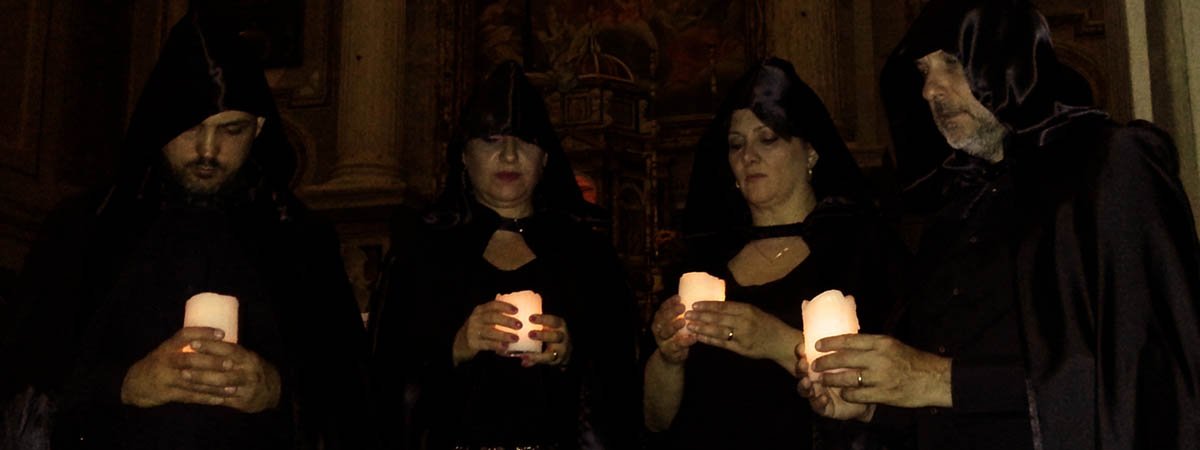
Cripta dei Cappuccini: sacred music is the a cappella concert with a visit to the Capuchin Museum and Crypt on Via Veneto that Roma Opera Omnia offers on Thursday afternoons through December 17, 2026. The next dates published by the organization are Thursday, November 5, 12 and 19, 2026, at 16:45, and the on-site box office opens at 16:15. The place indicated by the organization is the Museo e Convento dei Cappuccini, at Via Vittorio Veneto 21, in Rome, next to the church of Santa Maria della Concezione. You get there by metro A, Barberini stop, a few minutes on foot. The experience lasts 80 minutes. The ticket costs 78 euros (71 euros with the Roma Pass, 10 percent discount for groups) and includes entry to the museum, the concert and the audio guide of the crypt. It is bought on the official site of Roma Opera Omnia or at the organization's number, 388 1975179.
What the sacred music concert at the Cripta dei Cappuccini is
The sacred music concert at the Cripta dei Cappuccini is an afternoon in three parts: an a cappella concert of Gregorian chant and polyphony in the old hall of the Capuchin convent, the visit to the museum with the St. Francis in Meditation attributed to Caravaggio, and the descent into the crypt decorated with the bones of about 4,000 friars.
The organization presents it as a journey through the ways spirituality has expressed itself over the centuries, through music and art. The definition is less rhetorical than it seems: in an hour and 20 minutes you go from the voices of the Roman Renaissance to a place that is one of the most radical meditations on death in Europe. Few places in Rome offer such a coherent sequence.
A small audience
The concert is held for a small group of guests, in a convent hall reserved for the occasion. It isn't a big church with hundreds of chairs: it's a hall where the four voices arrive without any mediation, a few meters from the listeners. For a cappella polyphony it's the ideal dimension.
Also with dinner
Roma Opera Omnia also offers a version of the experience with a traditional Roman dinner after the concert and the visit to the crypt. Those who prefer it will find it among the organization's offers, with dedicated conditions and prices.
The program: the music of the Sistine Chapel composers
The program of the concert at the Cripta dei Cappuccini is devoted to the music of the Sistine Chapel composers, from Gregorian chant to 16th-century polyphony and the Roman 17th century.
The announced pieces
The concert opens with the Gregorian Stabant juxta crucem. Peccantem me by Cristóbal de Morales follows, then two pages by Giovanni Pierluigi da Palestrina: the Kyrie of the Missa Brevis and the motet Sicut cervus. Then come the Ave Maria by Jakob Arcadelt, Pueri Hebraeorum by Tomás Luis de Victoria, O felix anima by Giacomo Carissimi, Benedicta sit Sancta Trinitas by Agostino Agazzari and, to close, Laudate Dominum by Giuseppe Ottavio Pitoni.
A century and a half of Roman music
The program is a small history of sacred music in Rome. Gregorian chant is the root. Palestrina, Morales, Arcadelt and Victoria represent the great polyphony of the 16th century. Carissimi, Agazzari and Pitoni carry the story into the 17th century and beyond. Hearing them in sequence means hearing how writing for voices changes when Renaissance polyphony gives way to Baroque taste.
A cappella singing
Everything is performed a cappella, without instruments: four voices, soprano, alto, tenor and bass. It is the ensemble this music was written for, and the hardest to sustain, because every imprecision of intonation can be heard. The concert is preceded by an introduction to the program in English.
The performers: the Schola Romana Ensemble
The concert at the Cripta dei Cappuccini is entrusted to the Schola Romana Ensemble, a vocal quartet made up of the soprano Paola Alonzi, the alto Micaela Parrilla, the tenor Marco Ciardo and the bass Stefano Sabene, who is also its director.
Stefano Sabene, bass and director
Stefano Sabene leads the quartet and sings its lowest part. In a cappella polyphony the bass is the harmonic foundation on which the other voices rest, and entrusting the direction to the one who sings it is a practical and ancient choice: the director keeps tempo and intonation from inside the sound, not from a podium.
Paola Alonzi, soprano
Paola Alonzi is a fixture in Roma Opera Omnia's productions: the same organization lists her as soprano in the Rooftop Bar Opera Show on the terrace of Palazzo Pamphilj, where she sings Verdi and Puccini. Going in the same week from melodrama to Palestrina requires a versatile technique and a control of the voice that polyphony makes evident in every bar.
Micaela Parrilla and Marco Ciardo
The alto Micaela Parrilla and the tenor Marco Ciardo complete the quartet with the inner voices, the ones that in polyphony do the subtlest work: they hold the harmony together, cross the lines, give color to the chords. In a small hall they can be heard distinctly, and it is a pleasure to follow them.
Who organizes: Roma Opera Omnia
The concert at the Cripta dei Cappuccini is produced by Roma Opera Omnia, a Roman organization of concerts and musical visits based at Viale Aldo Ballarin 16, which uses live music to tell the story of great art venues.
The organization's Roman calendar includes opera concerts at Palazzo Doria Pamphilj al Corso, opera serenades with or without dinner, the opera aperitivo on the Borromini Terrace, the Rooftop Bar Opera Show on the La Grande Bellezza terrace of Palazzo Pamphilj, a rooftop in Trastevere and these sacred music concerts. Outside Rome it offers evenings in Tuscany, in Siena, in Naples, in Genoa and in New York. The formula is always the same: a small ensemble, a strong venue, an international audience, an introduction in English. Here it works better than elsewhere, because the place and the music speak the same language.
Tickets and what is included
The ticket for the concert at the Cripta dei Cappuccini costs 78 euros, reduced to 71 euros with the Roma Pass, with a 10 percent discount for groups.
What it includes
The ticket includes entry to the Capuchin Museum, the a cappella concert in the old convent hall reserved for the occasion, the introduction to the program in English and the visit to the museum and the crypt with an audio guide, available in 13 languages.
Where to buy
The ticket is bought on the official site of Roma Opera Omnia. The site also has a box office dedicated to groups of at least 10 people. For information the organization answers at 388 1975179 and at info@romaoperaomnia.com. The on-site box office opens at 16:15.
Dress code
The organization asks for clothing suited to a sacred place: shoulders and knees covered. It applies to everyone, men included. In November and December it isn't a problem, but it's worth remembering for those traveling with a summer wardrobe.
Dates and times of the concerts at the Cripta dei Cappuccini
The sacred music concerts at the Cripta dei Cappuccini are held on Thursdays, from January 8 to December 17, 2026, starting at 16:45 on the published fall dates.
The fall calendar
The next dates on sale on the official site are Thursdays November 5, 12 and 19, 2026, at 16:45, and the calendar closes on Thursday, December 17. The organization publishes dates as it goes. Those with a precise date in mind should check availability on the site before organizing the rest of the trip.
Duration
The experience lasts 80 minutes in all, between the concert and the visit to the museum and crypt. With the box office opening at 16:15 and the start at 16:45, you come out around 18:05, in time for an aperitivo on Via Veneto or for dinner.
Punctuality
The concert is held in a reserved hall, for a small group. Arriving half an hour early, when the box office opens, is the rule.
Santa Maria della Concezione dei Cappuccini, Urban VIII's church
The church of Santa Maria della Concezione dei Cappuccini, today also called Santa Maria Immacolata on Via Veneto, was built between 1626 and 1631 at the wish of Pope Urban VIII Barberini, near Palazzo Barberini.
The pope and the Capuchin brother
Urban VIII wanted it in honor of his brother, Antonio Barberini, who belonged to the Capuchin order. His tomb is still in the church, in front of the high altar. It's a detail that says a lot: the pope of the most powerful family of Baroque Rome built for his friar brother a church of modest size, with a single nave, in what was then countryside.
The architecture
The church was designed by Michele da Bergamo. It has a small nave with 10 side chapels, five per side, that preserve relics and works of art. Here are the body of Saint Felix of Cantalice and the tomb of Saint Crispin of Viterbo, the tombstone of Cardinal Agapito Mosca and the tomb of Father Mariano da Torino.
The works
Among the paintings of the chapels stands out the Archangel Michael Defeating Lucifer by Guido Reni. There are also the Nativity by Giovanni Lanfranco, the St. Francis Receiving the Stigmata by Domenichino and the Transfiguration by Mario Balassi. The organization also mentions works by Pietro da Cortona, Gherardo delle Notti and Andrea Sacchi. The vault was frescoed in 1796 by Liborio Coccetti with the Assumption of the Virgin.
The tomb that saved the church
To the left of the high altar is the tomb of the Polish prince Alexander Sobieski, who died in 1714, son of John Sobieski, the victor over the Turks at Vienna. The work is by Camillo Rusconi. The presence of this tomb was the only reason that saved the complex from demolition, when there was talk of tearing it down to redesign the whole area. The full page on the church is at Santa Maria della Concezione dei Cappuccini.
The Cripta dei Cappuccini, five chapels of bones
The Cripta dei Cappuccini is an ossuary crypt made up of five small chapels connected by a corridor, decorated with the bones of about 4,000 Capuchin friars collected between 1528 and 1870.
Where the bones come from
The bones come from the old Capuchin cemetery, which was near the church of Santa Croce e San Bonaventura dei Lucchesi, close to the Quirinal. When the order moved here, the remains of the brothers came with it and were placed in the chapels under the church.
One room, one theme
Each of the five chapels is characterized by a part of the skeleton or by a theme: the shinbones, the pelvises, the skulls, the three skeletons, the resurrection. The bones are arranged to form symbols tied to death and time: hourglasses, clocks, butterflies. In the chapels you also see some whole bodies of mummified friars, wearing the Capuchin habit, and on the ceiling the skeleton of a child holding a scale and a scythe.
The meaning of the crypt
At the entrance a plaque reminds the visitor: "What you are now, we once were. What we are now, you will be." The choice to decorate with bones, which may seem macabre, is really a way of exorcising death and of recalling that the body is only the container of the soul: once abandoned, it can be used in another way. After an hour of Palestrina and Victoria, the phrase is read with different attention.
The sister crypts
Ossuaries decorated in a similar way exist in Milan, in the ossuary of San Bernardino alle Ossa, in the Czech Republic, at Sedlec near Kutná Hora, and in Portugal, in the Capela dos Ossos in Évora.
The Capuchin Museum and the Caravaggio
The Capuchin Museum, set up in what was the sacristy, preserves works of art and sacred objects tied to the order, including the St. Francis in Meditation attributed to Caravaggio.
The history of the order
The visit to the museum tells the story of the Order of Friars Minor Capuchin in Rome and the friars' relationship with the city. It is the necessary premise to the crypt: without knowing who those friars were, the five chapels remain a spectacle. Knowing it, they become a community.
St. Francis in Meditation
The painting of St. Francis in Meditation has been attributed to Caravaggio in recent times. Seeing it after the concert, before descending into the crypt, has a precise sense: the meditation of the founding saint prepares the one, turned into architecture, of his friars a few meters below. Also see the page on the Museo dei Frati Cappuccini and ossuary Crypt.
The audio guide
The visit to the museum and the crypt is done with an audio guide available in 13 languages, included in the ticket. It is the right way: the crypt is crossed in silence, and the commentary in headphones respects the place.
How to get to the Cripta dei Cappuccini
The Cripta dei Cappuccini is on Via Vittorio Veneto, at the beginning of the street that climbs from Piazza Barberini, and is reached by metro A, Barberini stop.
By metro
From the Barberini station on line A, the Capuchin church is a few minutes on foot: you exit onto Piazza Barberini and take Via Veneto.
By bus
Several surface lines pass through Piazza Barberini and Via del Tritone. Lines and times should be checked on the public transport company's route planner before leaving.
On foot
From the Trevi Fountain and from Piazza di Spagna you arrive in a 15-minute walk. It's the best way for those who have spent the day in the center: you go up Via del Tritone and arrive in Piazza Barberini, in front of the Triton Fountain.
By taxi or car
A taxi is the most comfortable solution for those arriving from the opposite side of the city. A private car is not advisable: the area is central, parking is scarce and the rules of the limited traffic zones should be checked before leaving.
A curiosity about Sacred Music Concerts at Cripta dei Cappuccini, through December 17, 2026
The finest curiosity about the concerts at the Cripta dei Cappuccini concerns the street they are on. Today Via Veneto is the street of the Dolce vita, and the organization recalls that it was the set of Federico Fellini's film. But when the church was built, between 1626 and 1631, it was in open countryside, in front of a square, with a bell tower and a large convent. Via Veneto didn't exist. It was opened at the end of the 19th century as the main artery of the Villa Ludovisi development, and to make room for it the bell tower was torn down.
The convent had a similar fate. In the 1920s it was demolished to make room for the new Ministry of Corporations, and was promptly rebuilt, next to the church, in 1925. The hall where the concert is held today therefore belongs to a convent that had to move to make room for modern Rome.
And the tomb of Alexander Sobieski, son of the king who defeated the Turks at Vienna, was the only reason the church was not demolished. Every concert of the series, in a certain sense, is owed to a Polish prince who died in 1714.
Something nobody tells you about Sacred Music Concerts at Cripta dei Cappuccini, through December 17, 2026
What nobody says about the concerts at the Cripta dei Cappuccini is that the crypt isn't suited to everyone, and that it's best to know before buying the ticket. Five small chapels decorated with the bones of 4,000 friars, some mummified bodies dressed in the habit, the skeleton of a child on the ceiling: it's a place of great beauty and great intensity, and those who are impressionable, or travel with small children, must decide knowingly.
The second thing concerns clothing. The organization asks for shoulders and knees covered, as in any sacred place, and the request also applies to the concert in the convent hall. Those who arrive in shorts after a day of sightseeing risk being embarrassed.
The third is good news: with the Roma Pass the ticket drops from 78 to 71 euros. Many visitors have the card in their pocket and don't know it's valid here too. It's enough to show it at the time of purchase.
The advice I give you for visiting Sacred Music Concerts at Cripta dei Cappuccini, through December 17, 2026
For the concerts at the Cripta dei Cappuccini it's best to follow the planned order without hurry: first the concert, then the museum, then the crypt, and at the end a few minutes standing still in the church in front of Guido Reni's Archangel. It's a well-designed route, and every stop prepares the next. Those who go down to the crypt in a rush, to take the photo and leave, lose the reason they came.
Choose a date in November or early December: with the start at 16:45 you come out when it's already dark, and a lit Via Veneto, after an hour of polyphony and silence, has a precise effect. If you have time the day before, visit Palazzo Barberini, a couple of steps away. Seeing Urban VIII's family in its palace and then in the church built for its friar brother closes the circle.
And a listening tip: in Palestrina's Sicut cervus close your eyes and follow a single voice, the alto or the tenor. It's the simplest way to understand how polyphony works.
Another well-known fact, and yet rarely mentioned
It's well known that the Cripta dei Cappuccini is decorated with the bones of thousands of friars. It is much less often mentioned that those bones weren't born here. They were collected between 1528 and 1870 and come from the order's old cemetery, near the church of Santa Croce e San Bonaventura dei Lucchesi, close to the Quirinal. The crypt is therefore, first of all, a move: a community that, changing home, took its dead with it and arranged them so that they would speak to the living.
A second little-cited fact concerns the church. It is commonly called Santa Maria della Concezione dei Cappuccini, but today it is also listed as Santa Maria Immacolata on Via Veneto. And two names circulate for the designer: Michele da Bergamo, the most cited, and Felice Antonio Casoni. Even small churches have their archival riddles.
And a third, musical one: the concert's repertoire is that of the composers tied to the Sistine Chapel. To hear it, performed as it was written, for four voices and without instruments, you don't need to go to the Vatican.
The right photo to take at Sacred Music Concerts at Cripta dei Cappuccini, through December 17, 2026
The right photo at the Cripta dei Cappuccini concerts is taken outside, not inside. The facade of the church, with Via Veneto climbing alongside, is the image that tells the place: a 17th-century church left standing while Umbertine Rome grew up around it. Photograph it from the opposite sidewalk, on leaving, with the evening lights.
The second photo is the one of the quartet at the end of the concert, if the artists allow it: four voices in a convent hall, with no stage and no instruments. Always ask first.
The crypt, instead, is to be experienced without a phone. The rules of conduct are those of a sacred place and a burial site, and visitors should ask on the spot about any photographic limits. Better not even to try: the image that counts, the plaque at the entrance, is remembered better without a screen.
Those who still want a visual memento of the afternoon can photograph, on leaving, Piazza Barberini with the Triton Fountain lit up, a few steps from the church. It's the same family, the Barberini, that wanted the Capuchin church and gave its name to the square.
Some important events that happened here in history
In 1626 Pope Urban VIII Barberini started the construction of the Capuchin church, in honor of his brother Antonio, a friar of the order. The works ended in 1631, to a design by Michele da Bergamo. The complex then stood in the countryside, in front of a square, with a bell tower and a large convent.
The friars brought to the crypt the bones of their brothers collected between 1528 and 1870 from the old cemetery near Santa Croce e San Bonaventura dei Lucchesi. In 1714 Prince Alexander Sobieski, son of the Polish king John Sobieski, died and was buried in the church, in a tomb by Camillo Rusconi. In 1796 Liborio Coccetti frescoed the vault with the Assumption.
After the unification of Italy the bell tower was torn down, at the end of the 19th century, to open Via Veneto in the Villa Ludovisi development. In the 1920s the convent was demolished to build the Ministry of Corporations, and rebuilt next to the church in 1925. Sobieski's tomb saved the church from demolition. Later Via Veneto became the set of Federico Fellini's Dolce vita.
Who has passed through Sacred Music Concerts at Cripta dei Cappuccini, through December 17, 2026
Through the Capuchin church passed first of all Urban VIII, the Barberini pope who had it built, and with him his brother, Antonio Barberini, a Capuchin friar, buried in front of the high altar. Here rest Saint Felix of Cantalice and Saint Crispin of Viterbo, Cardinal Agapito Mosca, Father Mariano da Torino and Prince Alexander Sobieski.
Through it passed the painters of the Roman 17th century: Guido Reni with his Archangel Michael, Giovanni Lanfranco, Domenichino, and according to the organization Pietro da Cortona, Gherardo delle Notti and Andrea Sacchi. The sculptor Camillo Rusconi, with the Sobieski tomb. Liborio Coccetti, with the vault. In the museum is the St. Francis attributed to Caravaggio.
And through it have passed, above all, the 4,000 friars who from the 16th to the 19th century lived in the order and who today make up the five chapels of the crypt. Every Thursday, through December 17, the four voices of the Schola Romana Ensemble also pass through, bringing back into the convent the music for which those friars prayed.
What to see around the Cripta dei Cappuccini
The Cripta dei Cappuccini is at the beginning of Via Veneto, between Piazza Barberini and Villa Borghese. Within a quarter of an hour on foot are some of the finest visits in Rome.
Piazza and Palazzo Barberini
At the foot of Via Veneto opens Piazza Barberini, with the Triton Fountain. A few steps away is Palazzo Barberini, the palace of Urban VIII's family, today home of the Galleria Nazionale di Arte Antica.
Via Veneto and Villa Borghese
Going up Via Veneto you reach Villa Borghese, with the Galleria Borghese inside the park.
Trevi and Spagna
Going down Via del Tritone you reach in a quarter of an hour the Trevi Fountain. To the west you reach Trinità dei Monti and Piazza di Spagna. With a concert at 16:45, the morning and early afternoon fit this walk well.
Where to eat after the concert
After the concert at the Cripta dei Cappuccini you come out around 18:00. It's the right time for an aperitivo on Via Veneto or to move toward a trattoria in the center.
Via Veneto
Via Veneto isn't the cheapest street in Rome, but for a seated aperitivo after the concert it has its charm, above all for those who have just heard Fellini mentioned.
Toward Trevi and the Tritone
Going down toward Via del Tritone and the streets around the Trevi Fountain the offer is wide but uneven. One rule applies: avoid venues with the menu in five languages and photos of the dishes, and choose those with a short menu, written in Italian and changed with the season.
Dinner with the concert
Those who want everything organized can choose the version of the experience with a traditional Roman dinner, offered by Roma Opera Omnia among its evenings.
Accessibility and children at the Cripta dei Cappuccini concerts
The concerts at the Cripta dei Cappuccini take place in a historic complex with a raised church and a crypt. Those with mobility difficulties should ask the organization for the access conditions before buying.
Mobility disability
The information published by the organization doesn't describe the routes for wheelchair users. The reference is the Roma Opera Omnia number, 388 1975179, or the address info@romaoperaomnia.com.
With children
The concert lasts less than an hour and a half with the visit, and is suitable for young people used to listening to music. The crypt, however, should be evaluated by parents: for a curious teenager it's an unforgettable history lesson, for a small child it may be too much.
With a group
Groups get a 10 percent discount and a dedicated box office on the official site for at least 10 people. Those organizing a private or corporate outing who want to pair the concert with a guided visit of the district can contact Tour Leader Pro.
The Cripta dei Cappuccini in fall and winter
From November to December the concerts at the Cripta dei Cappuccini fall in the season best suited to the place: short days, the light leaving early, the city returning to its rhythms after the summer.
With the start at 16:45 you go in with the last light of the afternoon and come out when it's already evening. The passage from the convent hall, with the voices of the Schola Romana Ensemble, to the silence of the five chapels, and then to the lit street, follows a rhythm that in summer wouldn't have the same effect. In December, with the last date set for Thursday 17, the concert fits into the Advent period, and a program that closes with the Laudate Dominum accompanies the wait for Christmas.
A practical tip for the season: in November Rome is often rainy, and the concert is held indoors. It's one of the few evening offers in the city that doesn't depend on the weather, and for those with few days, that counts.
How to combine it with the rest of the day
The morning fits the Galleria Borghese or Palazzo Barberini well. The early afternoon, a stroll between Trevi and Piazza di Spagna. At 16:15 you're at the box office. It's a day entirely on foot, without transport, with a coherent thread: the Rome of the Barberini and of the 17th-century popes, from the family palace to the church of the friar brother.
Frequently asked questions about the Cripta dei Cappuccini concerts
When are the sacred music concerts at the Cripta dei Cappuccini held?
The sacred music concerts at the Cripta dei Cappuccini are held on Thursdays through December 17, 2026. The next published dates are November 5, 12 and 19, 2026, at 16:45, with the box office opening at 16:15.
How much does the concert at the Cripta dei Cappuccini cost?
The ticket for the concert at the Cripta dei Cappuccini costs 78 euros, 71 euros with the Roma Pass, with a 10 percent discount for groups. It includes entry to the museum, the concert and the audio guide of the museum and the crypt.
How long does the experience at the Cripta dei Cappuccini last?
The experience at the Cripta dei Cappuccini lasts 80 minutes in all, between the a cappella concert in the old convent hall and the visit with audio guide of the museum and the crypt.
Who sings at the Cripta dei Cappuccini concerts?
The Schola Romana Ensemble sings at the Cripta dei Cappuccini concerts: the soprano Paola Alonzi, the alto Micaela Parrilla, the tenor Marco Ciardo and the bass Stefano Sabene, who directs the quartet.
What music do you hear at the Cripta dei Cappuccini?
At the Cripta dei Cappuccini you hear the music of the Sistine Chapel composers: Gregorian chant, Palestrina, Morales, Arcadelt, Victoria, Carissimi, Agazzari and Pitoni, performed a cappella by four voices.
How do you get to the Cripta dei Cappuccini?
The Cripta dei Cappuccini is reached by metro A, Barberini stop, a few minutes on foot along Via Veneto. The address indicated by the organization is Via Vittorio Veneto 21.
Is there a dress code for the Cripta dei Cappuccini?
Yes, for the concert and the visit to the Cripta dei Cappuccini the organization asks for clothing suited to a sacred place, with shoulders and knees covered.
The final advice: choose a Thursday in November, arrive when the box office opens and treat yourself, after the crypt, to five minutes in the church in front of Guido Reni's Archangel. It is the most intimate afternoon you can spend in Rome in the fall.
Article written by the editorial team of Tour Leader Pro, contact them for Private/Corporate/V.I.P. Tours and Experiences.
Planning a trip to Rome? The English guides for visiting the city are on ItalyPlanner.com.