Rudolf Buchbinder plays and conducts Mozart at Auditorium Parco della Musica, April 29 and 30 and May 2, 2027
https://www.estateromana.com/en/rome/trip-planner/rudolf-buchbinder-plays-and-conducts-mozart-at-auditorium-parco-della-musica-apr/
Rudolf Buchbinder plays and conducts Mozart: three piano concertos with the Orchestra of the Accademia Nazionale di Santa Cecilia on Thursday, April 29, 2027 at 19:30, Friday, April 30 at 20:00 and Sunday, May 2 at 18:00, in Sala Santa Cecilia at Auditorium Parco della Musica Ennio Morricone. The program features Concerto No. 9, K. 271 "Jeunehomme", Concerto No. 23, K. 488 and Concerto No. 22, K. 482, with Buchbinder in the double role of soloist and conductor. The Auditorium is at Viale Pietro de Coubertin 30, 00196 Rome: take Metro A to Flaminio and then tram 2 to the Flaminia/Reni or Apollodoro stops, or bus 910 from Termini. Tickets cost from €23 to €54 in six sections and are sold at the box offices at the Auditorium and at Via Vittoria 6 or on the presale network authorized by the Accademia, linked from the official concert page. Presale for concerts from March to the end of the season opens on January 12, 2027. Concerts start on time: latecomers aren't admitted to the hall.
A pianist who has recorded all of Mozart's major piano works and has spent a lifetime conducting his concertos from the keyboard, as was done in the 18th century. Three concertos chosen, according to the Accademia's presentation, to follow Mozart through different moments of his creative maturity: from the innovative character of K. 271 to the intimate atmosphere of K. 488, up to the contrasts of K. 482.
Buchbinder and Mozart at Santa Cecilia: the dates
Rudolf Buchbinder is at Santa Cecilia for three nights with the same program: Thursday, April 29 at 19:30, Friday, April 30 at 20:00, Sunday, May 2 at 18:00.
The series
The three dates match the symphonic season's three subscription series: Thursday is series G and G1, Friday series V and V1, Sunday series S and S1. Non-subscribers buy a ticket for the night they prefer, while seats last.
Which night to choose
Sunday at 18:00 is the best date if you're coming from outside Rome or with young people: you come out in time for dinner and the trip home. Thursday at 19:30 leaves the evening free after the concert, and Friday at 20:00 is the classic date. The run falls over the May Day long weekend: decide early.
Punctuality
The Accademia warns that concerts start on time: latecomers can't enter the hall and can follow the concert in the listening rooms, while seats last.
Tickets for Buchbinder: prices and where to buy
Tickets for Rudolf Buchbinder's concert cost €54 in Section I, €47 in II, €37 in III, €35 in IV, €30 in V and €23 in Section VI.
Presale
Presale for the 2026 and 2027 season is split into two periods: from September 10, 2026 for concerts up to February 27, 2027, and from January 12, 2027 for those from March to the end of the season. Tickets for Buchbinder, then, go on sale on January 12.
Where to buy
The only authorized sellers listed by the Accademia are the official presale network outlets, the Auditorium box office and the one at Via Vittoria 6, near Piazza del Popolo. Online, you buy from the button under your chosen date on the official concert page. The info line is 06 8082058.
Young people
The Accademia has a page devoted to discounts for young people, linked from its website: for a piano student, three Mozart concertos conducted from the keyboard are a lesson worth the ticket.
The program: three Mozart concertos
The program lines up the Piano Concerto No. 9 in E-flat major, K. 271, the Concerto No. 23 in A major, K. 488 and the Concerto No. 22 in E-flat major, K. 482, three stages of Mozart's maturity.
K. 271, the Salzburg leap
Concerto No. 9 was completed in Salzburg in January 1777. It has a revolutionary idea from the very first bar: instead of a long orchestral introduction, after a two-measure fanfare the piano comes in right away. The slow movement, in C minor, has muted strings and the character of an opera aria, and the finale, a Presto in rondo form, is surprisingly interrupted by a lyrical minuet. Charles Rosen called it Mozart's first fully accomplished piano concerto.
K. 488, the clarinets
Concerto No. 23 was completed in Vienna on March 2, 1786, while Mozart was working on The Marriage of Figaro. Instead of oboes it uses two clarinets, then new instruments in Viennese orchestras, for a softer sound. The Adagio, in F-sharp minor on a siciliana rhythm, is the only movement Mozart wrote in that key, and is considered one of the high points of his output. The Accademia's presentation speaks of intimate atmospheres culminating in the stupendous Adagio.
K. 482, the contrasts
Concerto No. 22 closes the program. The Accademia highlights its surprising contrasts, and presents the sequence of the three concertos as a way to bring out the extraordinary variety of a form Mozart profoundly transformed.
Soloist and conductor
Buchbinder plays and conducts at once, from the keyboard. It's the practice of Mozart's time, when he performed his own concertos as soloist while leading the orchestra, and in the scores of K. 271 and K. 488 Mozart even marked col basso, asking the soloist to double the cello and double bass line with the left hand during full orchestra passages.
Mozart in Vienna: the fortepiano, the academies, the clarinets
K. 488 was born in Mozart's happiest season in Vienna, when the composer lived off his subscription concerts and carried his own instrument from one hall to another.
The fortepiano on the move
In a letter to his daughter of March 12, 1785, Leopold Mozart says that since he'd been in Vienna, his son's fortepiano had been carried at least 12 times from home to the theater or to other houses. Wolfgang had a large pedalboard built, longer than the instrument and extraordinarily heavy, which every Friday was taken to the Mehlgrube, one of the halls where he gave concerts, and also to Count Zichy's and Prince Kaunitz's.
The catalog and the prince
The date of K. 488 is known precisely because Mozart kept a catalog of his works, where he entered it on March 2, 1786. In August he sent Sebastian Winter, chamberlain to the Prince of Fürstenberg in Donaueschingen, a list with the opening bars of 12 recent compositions, and in September the prince chose three symphonies and three piano concertos, including K. 488. Mozart sent the scores with advice about the clarinets.
The manuscript
After Mozart's death his widow Constanze sold about 270 autographs to publisher Johann Anton André of Offenbach in 1799. The K. 488 manuscript later passed to musicologist Charles Malherbe, who left it to the Paris Conservatoire, and since 1942 it has been at the National Library of France. The first printed edition dates from 1800.
A Soviet legend
K. 488 is linked to a story, told among others by Dmitri Shostakovich and never confirmed by historians: Stalin, after hearing it on the radio played by pianist Maria Yudina, supposedly asked for the record, which didn't exist because the performance was live, so the musicians recorded it overnight. The story goes that it was among the last music the dictator heard.
K. 271 and the 1777 journey
K. 271 is the concerto with which Mozart left Salzburg to seek his fortune elsewhere: he took it with him to Germany and France and played it on several occasions.
From Salzburg to Paris
In September 1777 Mozart left with his mother, Anna Maria Pertl, for Munich, Mannheim and Paris, looking for a post away from the court of Prince-Archbishop Colloredo. The first documented performance of K. 271 was on October 4, 1777, in Munich, with Mozart at the fortepiano.
The Black Eagle inn
The concert was held at the Zum Schwarzen Adler inn, Munich's most prestigious: a ballroom with mirrors, 38 rooms and stables for 24 horses. It was frequented by musicians, writers and distinguished travelers, including Goethe and, a few years later, Beethoven.
Written-out cadenzas
In K. 271 Mozart wrote out the cadenzas and even the Eingänge, the short passages leading into the soloist's return, which in the 18th century were usually left to improvisation. It's a sign of how much the composer cared about this score.
Rudolf Buchbinder: biography
Rudolf Buchbinder is an Austrian pianist born on December 1, 1946 in Litoměřice, the old Leitmeritz, in Bohemia. Raised in Vienna from 1947, he's considered one of the great interpreters of Haydn, Mozart and Beethoven.
Studies and early success
He studied at the Vienna Academy of Music with Bruno Seidlhofer. In 1961 he won first prize at the Munich International Competition in the piano trio section, and in 1962 he received the Lipatti Medal. In 1965 he toured the Americas, and in 1966 he won a special prize at the Van Cliburn Piano Competition. He has toured with the Vienna Philharmonic and played as a soloist worldwide, and he taught at the Basel Academy of Music.
Recordings
For the Teldec label he recorded Haydn's complete keyboard music, all of Mozart's major piano works, all of Beethoven's sonatas and variations, and Brahms's two concertos with Nikolaus Harnoncourt and the Concertgebouw Orchestra. With cellist János Starker he recorded Beethoven and Brahms. He has twice recorded Beethoven's concertos conducting from the keyboard: with the Vienna Symphony in 2007 and with the Vienna Philharmonic in 2011, live.
The Diabelli Variations
He's one of the few pianists to have recorded in full the second part of the Vaterländischer Künstlerverein: 50 variations by 50 different composers on the same waltz by Anton Diabelli. He has also recorded Beethoven's Diabelli Variations, which originally formed its first part.
Grafenegg and awards
Since 2007 he has been founder and artistic director of the Grafenegg festival, in Lower Austria. His honors include the Austrian minister's prize for Mozart interpretation in 1970, the Grand Prix du Disque in 1977 for Haydn's complete piano works, the Echo Klassik in 2012 as instrumentalist of the year, honorary membership of the Vienna Philharmonic in 2016 and the Vienna Mozart Prize in 2017.
A curious fact about Rudolf Buchbinder plays and conducts Mozart at Auditorium Parco della Musica, April 29 and 30 and May 2, 2027
The loveliest curious fact concerns the nickname of the first concerto on the program. For more than a century K. 271 was called Jeunehomme, after a mysterious French virtuosa. The name, though, was an invention: in 1912 two scholars, Téodor de Wyzewa and Georges de Saint-Foix, working from the uncertain spellings in the Mozarts' letters, Jenomy, Jenomé, Genomai, coined a "Mademoiselle Jeunehomme" out of thin air, and the mistake passed from book to book. Only in 2003 did musicologist Michael Lorenz establish that the dedicatee was Louise Victoire Jenamy, daughter of the famous choreographer Jean-Georges Noverre. The minuet in the finale has been read as a tribute to her father, a ballet master.
The second curious fact concerns K. 488. In 1786 Mozart, sending it to the court of the Prince of Fürstenberg, wrote that if the court had no clarinets, a skilled copyist should transpose the parts for a violin and a viola. The softest concerto on the program was born from two instruments that, at the time, not every orchestra had.
The third is Roman: in Sala Santa Cecilia, Buchbinder conducts from the keyboard the Accademia's orchestra named after the patron saint of music.
Sala Santa Cecilia
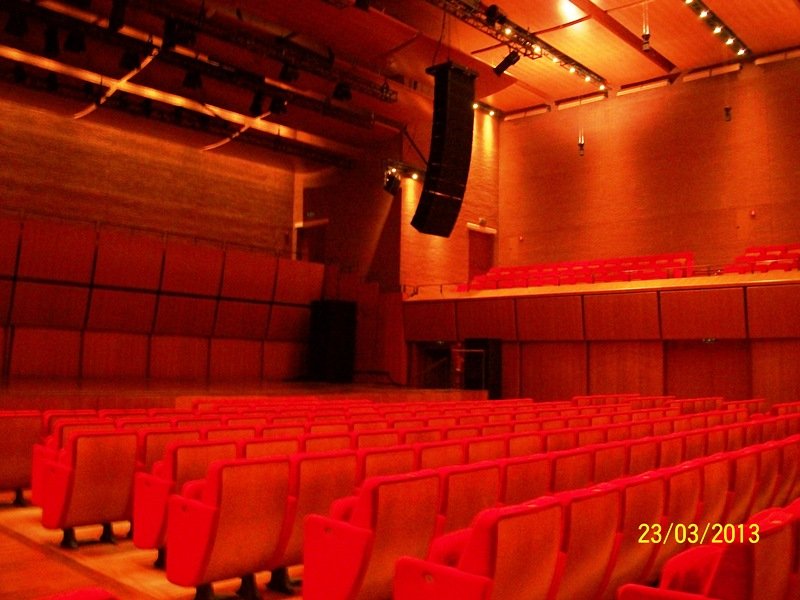
Sala Santa Cecilia is the largest of the three halls of Auditorium Parco della Musica Ennio Morricone, designed by Renzo Piano: 2,756 seats, inaugurated on December 21, 2002 and home to the Accademia's season since 2003.
A big hall for chamber-scale Mozart
Above the orchestra open 26 shells of American cherry wood, each about 180 square meters, and the reverberation is 2.2 seconds. For Mozart concertos the orchestra is smaller than for a Romantic symphony, and the hall brings out the woodwinds: in K. 488 the clarinets and bassoons converse with the piano almost as in a chamber piece.
Where to sit
Regulars notice that sound intensity drops up to the 10th row and then stays constant. For a pianist conducting from the keyboard, seeing the gestures matters too: the gallery behind the stage lets you watch Buchbinder face-on as he turns to the orchestra, while the rear center orchestra and the front gallery give the most balanced sound.
The Auditorium
The three lead-clad volumes rest on a brick base and fan out around the cavea named after Luciano Berio. Piano worked with acoustician Jürgen Reinhold of the Müller-BBM firm and landscape architect Franco Zagari. The full story is on our page about Auditorium Parco della Musica.
Something nobody tells you about Rudolf Buchbinder plays and conducts Mozart at Auditorium Parco della Musica, April 29 and 30 and May 2, 2027
What few say is that the piano Buchbinder will play isn't the instrument Mozart wrote for. The sources for K. 271 speak of cembalo or clavecin, but musicologists have no doubt Mozart had the fortepiano in mind: the crescendo and forte markings, impossible on the harpsichord, prove it. In Vienna Mozart played his own fortepiano, carried each time from home to the hall, with a pedalboard under the instrument to strengthen the bass. On a modern concert grand, the col basso practice, which on that fortepiano blended with the orchestra, is usually omitted today.
The second thing concerns the autograph of K. 488. Unlike most of Mozart's manuscripts, clean and almost free of erasures, this one is full of second thoughts: Mozart had planned oboes and then switched them to clarinets, and the differences in ink still show it. The myth of the genius writing in one go, without hesitation, cracks here.
The third is practical: with three nights and a single program, if one date is sold out you can try the other two, and at the box offices at the Auditorium and Via Vittoria you can ask about remaining seats.
My tip for Rudolf Buchbinder plays and conducts Mozart at Auditorium Parco della Musica, April 29 and 30 and May 2, 2027
My first tip is to choose a seat that lets you watch Buchbinder conduct. A pianist conducting from the keyboard communicates with a glance, a nod, the free hand between two phrases: from the gallery behind the stage you see him face-on, and it's a show within the show.
The second is to listen to the Adagio of K. 488 beforehand. It's the most famous page on the program, and Mozart reused its central theme the following year in the trio "Ah! taci, ingiusto core!" in Don Giovanni: recognizing it live is a small pleasure.
The third is to arrive early. The Accademia's concerts start on time, and latecomers follow the concert from the listening rooms. With security, the coat check and the climb to the hall, 40 minutes early is the minimum. The fourth: if you can, choose Sunday at 18:00, with the afternoon free for MAXXI or a walk in Villa Glori.
How to get to the Auditorium for Buchbinder
Auditorium Parco della Musica Ennio Morricone, at Viale Pietro de Coubertin 30, is reached by Metro A and tram 2 or by buses 910, 53 and 982, and the metro doesn't reach the entrance.
Metro A and tram 2
From Flaminio station tram 2 runs along Via Flaminia to the Flaminia/Reni and Apollodoro stops, and from there it's a few minutes on foot through the Villaggio Olimpico.
Bus
The 910 leaves from Piazza dei Cinquecento, in front of Termini, and reaches the Auditorium with no changes. The 53 comes from Piazza Mancini, the 982 from Viale XVII Olimpiade area. The 168, from Tiburtina, is a weekday line: useful on Thursday and Friday, not on Sunday. May 2 falls on the May Day long weekend, so check holiday schedules on the transit company's journey planner.
By car
The stretch of Viale Pietro de Coubertin in front of the entrance is closed to traffic and the complex's parking has limited spaces, and on concert nights cars spill into the streets of the Villaggio Olimpico.
Another well-known fact, yet one rarely mentioned
It's well known that Mozart wrote his piano concertos to play them himself. Less often mentioned is why: in Vienna, after 1781, Mozart lived as an independent musician, without a court post, and subscription concerts, held mainly in Lent and Advent, when the opera houses were less busy, were his main source of income. In 1784 he gave four subscription concerts, in 1785 10. K. 488 was born that way, for Lent 1786.
Writing for himself, Mozart didn't have to adapt the piano part to other people's abilities, as in Salzburg. The result was a new compositional freedom. Rudolf Buchbinder, conducting from the keyboard, recreates the same relationship between soloist and orchestra: the pianist is also the one keeping time.
There's also a rarely mentioned fact about K. 271: it was one of the few Mozart concertos printed during his lifetime, in Paris in 1778, but not a single copy of that first edition survives. The autograph is now at the Jagiellonian Library in Kraków.
The right photo to take at Rudolf Buchbinder plays and conducts Mozart at Auditorium Parco della Musica, April 29 and 30 and May 2, 2027
During the concert your phone stays off: in Mozart the pianissimos of the muted strings are part of the music. The right photo is taken before the start, with the stage ready, the grand piano at the center and the orchestra's chairs around it: the layout of a concert where the soloist is also the conductor.
At the applause, without flash, you can photograph Buchbinder standing by the instrument, among the musicians. Outside, on Sunday at 17:30 the May light falls slantwise on the lead volumes, and from the cavea the view of the three buildings is the Auditorium's most recognizable frame.
The third photo is taken on the way out, toward Viale Pietro de Coubertin, with the halls lit from inside and the audience coming down the steps.
Some important events that happened here in history
Beneath the Auditorium lies a very old story: during construction the remains of a Roman villa from the 3rd century BC emerged, built on the site of a small archaic farm from the 6th century BC. To preserve them Renzo Piano moved two of the three volumes to the west, and the finds are displayed in a small museum beneath the cavea.
The site's musical history began with a loss. In 1936 the Augusteo, Rome's great concert hall, was demolished, and for more than 60 years the Santa Cecilia orchestra had no hall built for symphonic music. In 1992 the city chose the Villaggio Olimpico site, and in 1993 Piano won the competition.
On April 21, 2002, Rome's birthday, Sala Sinopoli and Sala Petrassi opened, and on December 21 of the same year Sala Santa Cecilia, with the Accademia's orchestra conducted by Myung-Whun Chung. Since 2003 it has been home to the Accademia's season and since 2006 to the Rome Film Festival, and in 2020 the complex was named after Ennio Morricone. Buchbinder's nights fall a week after the 25th birthday of the first two halls.
Who has passed through Rudolf Buchbinder plays and conducts Mozart at Auditorium Parco della Musica, April 29 and 30 and May 2, 2027
Sala Santa Cecilia has seen the Accademia's music directors on its podium, from Myung-Whun Chung to Antonio Pappano and Daniel Harding. Goffredo Petrassi attended the opening of Sala Sinopoli, and Luciano Berio gave his name to the cavea. Evgeny Kissin has been a guest of the Accademia since 1991.
Buchbinder's career includes names that made the history of interpretation: Bruno Seidlhofer, his teacher, Nikolaus Harnoncourt and the Concertgebouw for Brahms, János Starker for the cello repertoire, and the Vienna Philharmonic, of which he's an honorary member, and the Vienna Symphony. In 2009 he was one of the stars of Pianomania, Lilian Franck and Robert Cibis's documentary about a piano tuner, also released in North American theaters.
In the same hall, a few days earlier, Daniel Harding conducts Beethoven's Ninth: late April at Santa Cecilia goes from the Ode to Joy chorus to the most intimate Mozart.
Accessibility and young people
Sala Santa Cecilia is built on a raised level, above the Roman villa, and the galleries have just two elevators: if you have mobility difficulties, arrive well ahead of time.
Conditions
The Accademia's notices describe the conditions for audience members with disabilities and how to book seats. For information the info line is 06 8082058, or biglietteria@santacecilia.it. Don't leave it to the last few days, especially for the long weekend dates.
With young people
Three Mozart concertos conducted from the piano are an excellent introduction to classical music for a young person learning an instrument: the music is clear, the themes are memorable, and watching a pianist lead the orchestra with a glance explains more than a lesson. Sunday at 18:00 is the best time.
The Auditorium neighborhood
The Auditorium covers about 55,000 square meters between Villa Glori, the Villaggio Olimpico, the Corso di Francia viaduct and Viale Maresciallo Pilsudski, in a part of 20th-century Rome where contemporary architecture lives alongside greenery.
MAXXI and the instrument museum
Toward Via Guido Reni, a few minutes' walk away, is Zaha Hadid's MAXXI. Inside the Auditorium the Accademia keeps the Museum of Musical Instruments: before a Mozart concert, seeing old instruments up close helps you imagine the sound of a fortepiano.
Milvian Bridge
A little farther north, Milvian Bridge is north Rome's evening meeting point, with the widest choice of places after the concert.
The patron saint
Saint Cecilia, patron of music and of the Accademia, is venerated in the basilica of Santa Cecilia in Trastevere, a visit to make by day over the long weekend.
Where to eat before or after the concert
Inside the Auditorium there's a bar and café in the foyer and a bar-restaurant also open to the street, handy before the Thursday 19:30 concert.
In the neighborhood
Between the Villaggio Olimpico, Via Flaminia and Piazza Mancini there are pizzerias, trattorias and neighborhood bars. After the concert, Ponte Milvio has the widest choice, and toward Piazzale Flaminio and the Tridente you'll find the pricier options of the historic center.
The long weekend
Friday, April 30 and Sunday, May 2 fall on the May Day long weekend: restaurants in north Rome are full, and booking is essential.
The May Day long weekend in Rome
Buchbinder's three nights span the May Day long weekend, one of the busiest weekends of the year in Rome. The days are long, the evenings mild, and the museums and streets of the center are full of visitors. If you're coming from outside Rome, a Sunday 18:00 concert in the Flaminio neighborhood is a way to end the weekend away from the crowds of the historic center, with MAXXI and Villa Glori a few steps away.
Frequently asked questions about Buchbinder and Mozart at Santa Cecilia
When does Rudolf Buchbinder play in Rome?
Rudolf Buchbinder plays and conducts Mozart with the Orchestra of the Accademia di Santa Cecilia on Thursday, April 29, 2027 at 19:30, Friday, April 30 at 20:00 and Sunday, May 2 at 18:00, in Sala Santa Cecilia at Auditorium Parco della Musica, with the same program.
Which Mozart concertos does Buchbinder play?
Buchbinder's program at Santa Cecilia includes Piano Concerto No. 9, K. 271 "Jeunehomme", Concerto No. 23, K. 488 and Concerto No. 22, K. 482. Buchbinder is both soloist and conductor, from the keyboard.
How much are tickets for Buchbinder?
Tickets for Rudolf Buchbinder at Santa Cecilia cost €54, €47, €37, €35, €30 and €23 depending on the section. They're sold at the box offices at the Auditorium and Via Vittoria 6 or on the authorized network, and presale opens on January 12, 2027.
What happens if you arrive late?
The Accademia di Santa Cecilia's concerts start on time: latecomers aren't admitted to the hall and can follow the concert in the listening rooms, while seats last. Be at the Auditorium at least 40 minutes early.
Who is Rudolf Buchbinder?
Rudolf Buchbinder is an Austrian pianist born in 1946, a student of Bruno Seidlhofer, known for his complete recordings of Haydn, Mozart and Beethoven, artistic director of the Grafenegg festival since 2007 and an honorary member of the Vienna Philharmonic.
How do you get to Auditorium Parco della Musica?
You get to Auditorium Parco della Musica, at Viale Pietro de Coubertin 30, by Metro A to Flaminio and tram 2 to Flaminia/Reni or Apollodoro, or by bus 910 from Termini and lines 53 and 982.
How long is the concert?
The Accademia doesn't publish the length of Buchbinder's concert. K. 271 runs about 30 to 35 minutes and K. 488 about 30: with K. 482 and the intermission it's an evening of about two hours.
Final tip on Buchbinder and Mozart at Santa Cecilia
My tip is to buy early, choose a gallery seat where you can see Buchbinder face-on, listen to the Adagio of K. 488 beforehand and arrive 40 minutes early, because the doors close at the start time. Three Mozart concertos played and conducted from the keyboard by a pianist who has lived with them all his life are, in our opinion, one of the most refined dates in the Accademia's season: an evening when the orchestra becomes a large chamber ensemble and the soloist goes back to being, as in Mozart's time, the one who holds the music together.
Article written by the editorial team of Tour Leader Pro, contact them for Private/Corporate/V.I.P. Tours and Experiences.
Planning a trip to Rome? The English-language guides for visiting the city are on ItalyPlanner.com.