Roma Gospel Festival 2026 at Auditorium Parco della Musica, December 13, 2026 to January 1, 2027
https://www.estateromana.com/en/rome/trip-planner/roma-gospel-festival-2026-at-auditorium-parco-della-musica-december-13-2026-to-j/
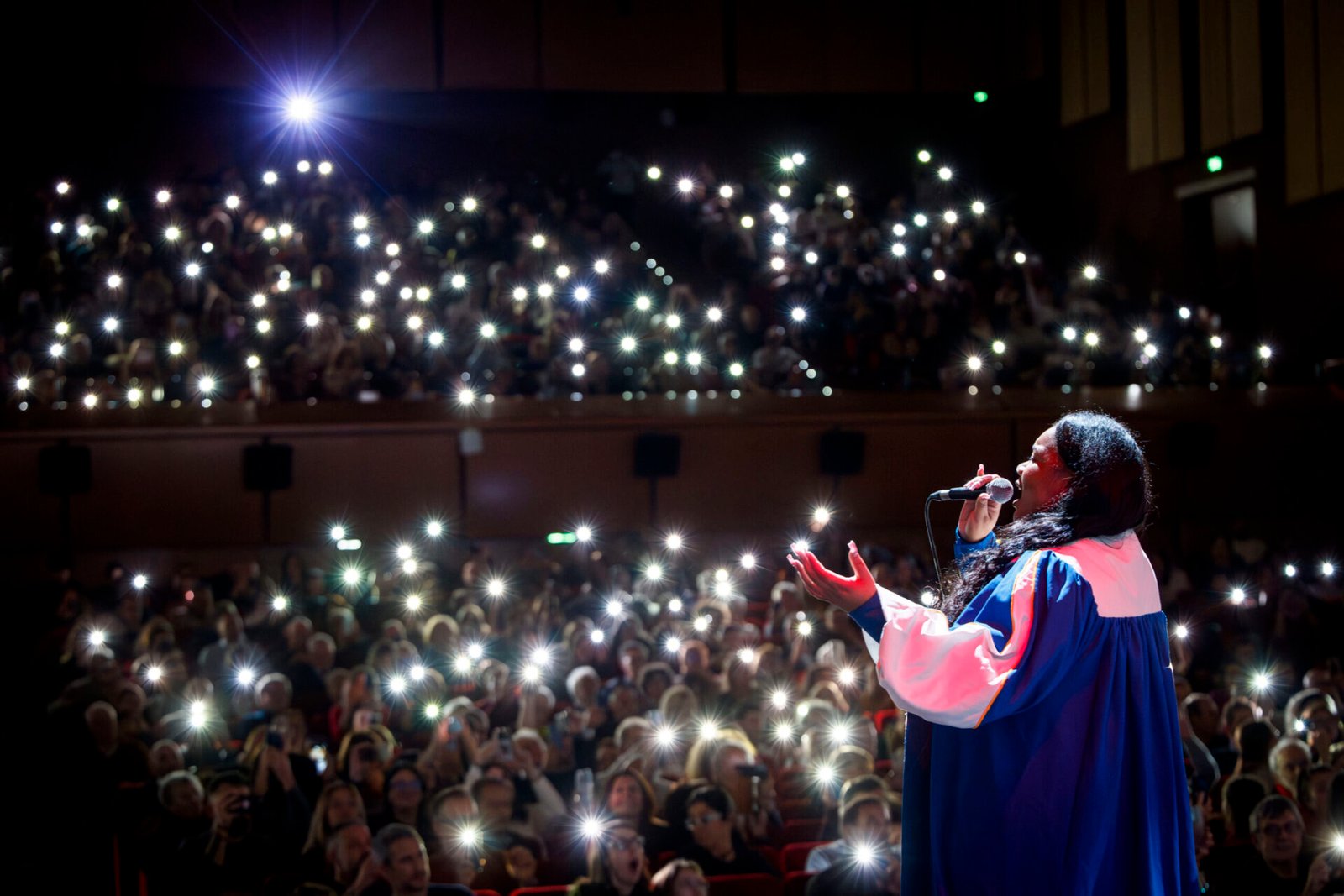
The Roma Gospel Festival 2026 takes place from December 13, 2026 to January 1, 2027 at Auditorium Parco della Musica Ennio Morricone, Viale Pietro de Coubertin 30, with 14 concerts almost all in Sala Sinopoli. It opens on Sunday, December 13 at 18:00 with Melodees From Heaven and closes on January 1 at 18:00 with Vincent Tharpe & Kenosis, after the San Silvestro concert at 22:00. You get there by metro A to Flaminio and then tram 2 to the terminus at Piazza Mancini, or by buses 910 from Termini, 53, 168 and 982, or by the Roma-Nord railway to Piazza Euclide. Tickets start from 25 euros for most evenings, 28 euros for the Harlem Gospel Choir at Christmas, 30 for Vincent Bohanan and 40 for New Year's Eve night. They are bought at the Auditorium box office, open every day from 11:00 to 20:00 (until 21:30 on show evenings), or through the presale network authorized by the organization, reachable from the venue's official website.
Language: a performance based on dance, music or visual acts; no English version is announced, any spoken parts are in Italian.
It is the 27th edition of a series that the Auditorium presents, with a formula it has repeated for years, as the largest gospel festival in Europe. The festival lives inside the Christmas program at the Auditorium and brings to Rome, in the three weeks of the holidays, choirs and groups almost all from the United States: Baltimore, Florida, South Carolina, New York, Atlanta, Memphis. Those who have attended for years know it is not a concert to listen to seated and composed. The audience sings, claps, sometimes stands up from the second song. And that is as it should be: gospel was born in church as music of participation, not of listening.
The full schedule of the Roma Gospel Festival 2026
The program of the Roma Gospel Festival 2026 counts 14 appointments in 20 days, from December 13 to January 1, with 10 different acts. The dates, times, halls and starting prices are those published by Auditorium Parco della Musica in the festival calendar.
The December 2026 dates
- Sunday, December 13, 18:00: Melodees From Heaven, Sala Sinopoli, from 25 euros. This is the festival preview.
- Sunday, December 20, 18:00: Eric Waddell & The Abundant Life Singers, Sala Sinopoli, from 25 euros.
- Monday, December 21, 20:00: Florida Inspirational Singers, Sala Sinopoli, from 25 euros.
- Tuesday, December 22, 20:00: John Lakin & Friends, Sala Sinopoli, from 25 euros.
- Wednesday, December 23, 20:00: The New York City Gospel Choir, Sala Sinopoli, from 25 euros.
- Friday, December 25, 17:30 and 21:00: Harlem Gospel Choir, Remembering Whitney & Tina, from 28 euros. For these two performances the hall is not yet given in the official calendar.
- Saturday, December 26, 20:00: Arthur Gremillion & Friends Community Choir, Sala Sinopoli, from 25 euros.
- Sunday, December 27, 18:00: Arthur Gremillion & Friends Community Choir, Sala Sinopoli, from 25 euros.
- Monday, December 28, 20:00: Arthur Gremillion & Friends Community Choir, Sala Sinopoli, from 25 euros.
- Tuesday, December 29, 20:00: Vincent Bohanan & The Victorious Army, Sala Sinopoli, from 30 euros.
- Wednesday, December 30, 20:00: Emmanuel Pi Djob Feelin's 9 & The Soul Sisters of Gospel, Sala Sinopoli, from 25 euros.
- Thursday, December 31, 22:00: Vincent Tharpe & Kenosis, Sala Sinopoli, from 40 euros.
The January 2027 date
- Friday, January 1, 18:00: Vincent Tharpe & Kenosis, Sala Sinopoli, from 25 euros. This is the closing concert.
The rhythm of the calendar should be read with care. The Sundays and January 1 start at 18:00, convenient for those coming with children or elderly relatives. Weekdays start at 20:00. Christmas has two times, afternoon and evening. San Silvestro begins at 22:00, so the concert accompanies the audience toward midnight. Arthur Gremillion alone occupies three consecutive evenings, from December 26 to 28, and Vincent Tharpe has two straddling the new year. Those who want the widest choice of seats should look precisely at these repeats.
What the Roma Gospel Festival is
The Roma Gospel Festival is the Christmas gospel series of Auditorium Parco della Musica, in 2026 in its 27th edition and part of the Christmas program at the Auditorium. The festival website credits the concept to IMF Foundation, the co-production with Fondazione Musica per Roma and the artistic direction of Mario Ciampà, whom the Roman press has associated with the festival in recent editions too.
A formula built on the United States
The basic idea has never changed: to bring to Rome the spiritual and gospel groups that have a name in the United States, and present them to the Italian public at the time of year when the city is most willing to listen to music about hope. The official presentation of the 2026 edition insists on two words, novelties and exclusives, and on the fact that gospel, traditional or contemporary, rhythm and blues or pop, involves believers and non-believers. It is an honest description. In the hall you find families, parish groups, foreign tourists, soul fans who know gospel from Aretha Franklin's records, couples who chose an evening different from the usual.
Recent editions
In 2023, the 24th edition, the festival ran from December 21 to 31 with nine concerts and a workshop in 10 days, and with some incursions into the squares of the historic center supported by Municipio I. In that edition Reverend Earl Bynum held a workshop at the Auditorium to choose some voices for his choir for the final concert. In 2025 the 26th edition, from December 20 to 31, presented Marquinn Middleton & The Miracle Chorale, Cedric Shannon Rives, the Florida Fellowship Super Choir, the Charleston Gospel Choir, the Harlem Gospel Choir at Christmas, the Florida Inspirational Singers for three evenings, Eric Waddell on the 29th and Marquis Dolford & The Capital Gospel Group to close. The 2026 edition grows longer: it begins a week earlier, on December 13, and crosses the threshold of the new year with the concert on January 1.
The choirs of the Roma Gospel Festival 2026, one by one
The 10 acts of the Roma Gospel Festival 2026 cover almost the whole geography of American gospel, from Maryland to Florida, from New York to Tennessee, with in addition a French and African incursion. The profiles that follow draw on the biographies the Auditorium published for each concert.
Melodees From Heaven, the December 13 preview
Melodees From Heaven was born from the meeting of two projects, The Gospel Harmonettes and The Sweet Inspiration, which share Afro voices of strong personality. Their gospel lets itself be crossed by groove, soul, blues, afrobeat, jazz and Caribbean rhythms. The repertoire holds together spirituals, traditional gospel and modern compositions, with original arrangements of classics such as Oh Happy Day and Amazing Grace and tributes to the great voices of black music. The voices are supported by piano, and the group aims to reduce the distance between stage and audience: it invites you to sing and dance. It is an opening designed to warm up the hall, on Sunday afternoon at 18:00.
Eric Waddell & The Abundant Life Singers, from Baltimore
Eric Waddell & The Abundant Life Singers are one of the most important gospel acts of Baltimore. The choir has grown to about 150 singers and a high-level band, under the guidance of the founder, director and frontman Eric Waddell, trained at the Peabody Conservatory. The group has taken part in the Bobby Jones Gospel, the Gospel Heritage, events at the Kennedy Center and presidential inauguration ceremonies. The discography counts five live works: Put a Praise on It (2012), The Church Sound (2015), The Hour of Power Experience (2018), The Journey (2022) and Live in Rome (2023). The choir has shared the stage with Timothy Wright, Albertina Walker, John P. Kee, Marvin Sapp, Richard Smallwood and Dorothy Norwood. The tie with Italy is long: eight years of tours and almost 200 concerts, from Teatro degli Arcimboldi to the Petruzzelli, from the Bellini to Piazza del Duomo in Florence.
Florida Inspirational Singers, between Orlando and Tampa
The Florida Inspirational Singers bring to Europe the gospel of the American South, a blend of spiritual, soul and contemporary idioms. The 15-member group brings together musicians from Orlando and Tampa and is led by two different figures. Nathan Mitchell is a composer, producer, keyboardist and multi-instrumentalist, known in American smooth jazz: three NAACP nominations for best jazz album, a Grammy nomination as producer and composer, two tracks at number one on the Billboard charts. John Polk is a pastor, musician and entertainer. In 2006 he founded Voices of Life, which became JP & 1Voice in 2012, and he was a backing singer on tours with Donnie McClurkin and Yolanda Adams.
John Lakin & Friends, from South Carolina
John Lakin & Friends come from South Carolina and offer a gospel rooted in tradition and open to the present. Lakin has more than 30 years of experience. He wrote songs such as God Is Great and Created to Worship, which entered the Billboard Gospel charts, and has gathered one Dove Awards nomination and four Stellar Awards nominations. In Rome he brings the concert The Gospel Sound, a path through classics and new compositions entrusted to six voices, piano, bass and drums. Born as a project aimed at young people, the group has shared the stage with Vashawn Mitchell, Tye Tribbett, John P. Kee, Erica Campbell, Tasha Cobbs and Mali Music.
The New York City Gospel Choir and the Christmas repertoire
The New York City Gospel Choir is directed by Mark Anthony Henry, an arranger who was musical director for Cissy Houston, Whitney's mother. The ensemble brings together professional singers active in New York, with experience in concerts, tours, records and musical theater. The repertoire alternates the great hymns, from Total Praise to Oh Happy Day, with choral rereadings of soul, pop and R&B songs. The festival presentation announces a program of Christmas songs for this evening. The choir's members have worked with Stevie Wonder, Whitney Houston, Aretha Franklin, Michael Jackson, Roberta Flack and Hezekiah Walker. The group has performed at the MET Gala, at Madison Square Garden, at the CLIO Awards, in productions for CNN, MTV and Vogue, and accompanied the ring entrance of the boxer Anthony Joshua.
Harlem Gospel Choir, Remembering Whitney & Tina
The Harlem Gospel Choir is the best-known name of the festival and, as tradition has it, occupies Christmas Day with two performances. The choir was founded in New York on January 15, 1986, Martin Luther King's birthday, by Allen Bailey, who had worked with the Commodores, Michael Jackson and Prince. It has collaborated with André Rieu, Diana Ross, Bono, The Chieftains, Simple Minds, Sinéad O'Connor and Gorillaz, and has performed for John Paul II and for Presidents Carter and Obama. The 2026 show, Remembering Whitney & Tina, pays tribute to Whitney Houston and Tina Turner and to the gospel roots of their voices. On stage are eight members between voices and rhythm section.
Arthur Gremillion & Friends Community Choir, three evenings
Arthur Gremillion & Friends Community Choir was born on July 31, 2008 at the wish of Arthur J. Gremillion and brings together artists from different cities of the United States. The choir has shared the stage with Donald Lawrence, JJ Hairston, Tamela Mann, Hezekiah Walker, Ricky Dillard and Jonathan McReynolds. In 2023 it was nominated Community Choir of the Year at the Sound Awards, with four nominations at the Rhythm of Gospel Music Awards and two at the Avidity Awards. In June 2024 it won first prize in the Large Choir category of the American festival How Sweet the Sound. It arrives in Rome with 20 members, 17 singers and three musicians, for three consecutive evenings from December 26 to 28.
Vincent Bohanan & The Victorious Army, from Atlanta
Vincent Bohanan is a choir director and won at the 2025 Stellar Awards. His compositions We Win, I Love to Call Him and Any Day Now entered the Billboard Gospel charts. He has collaborated with Hezekiah Walker, CeCe Winans, Mariah Carey, Donald Lawrence and Ricky Dillard. In 2019 he founded The Victorious Army in Atlanta. In 2022 the group released the single Higher and then the debut album Live in Detroit. It is the largest act of the festival: 26 members, 23 voices with piano, bass and drums. For December 29 the starting price rises to 30 euros, and you can see why.
Emmanuel Pi Djob Feelin's 9 & The Soul Sisters of Gospel
Emmanuel Pi Djob is an artist of Cameroonian origin naturalized French, winner of the French edition of The Voice. His music blends soul, gospel and African rhythms, with lyrics inspired by autobiographical episodes. At the festival he shares the evening with The Soul Sisters of Gospel, that is Suzanne Wognin, Renee Agaya and Maggy Lemoine, accompanied on piano and voice by Elvis Megnè. It is the evening of the program with the most openly European and African matrix, and for that reason the most interesting for those who already know the festival.
Vincent Tharpe & Kenosis, New Year's Eve and January 1
Vincent Tharpe & Kenosis were born in Memphis in 2010. Tharpe, three-time nominee at the American Gospel Awards, leads an ensemble that mixes gospel soul, rhythm and blues, blues and jazz harmonies, with choreography and vocal virtuosity. On the European tour the group counts 12 members between voices and rhythm section. It plays twice: on San Silvestro night at 22:00, with prices from 40 euros, and on the afternoon of January 1 at 18:00, from 25 euros. Those looking for the concert without the pressure of midnight choose the second.
Where the gospel heard at the Roma Gospel Festival comes from
Gospel is the religious music born in the African American churches of the United States, and the name means Gospel, good news. Knowing its history changes the way you listen to the evenings of the Roma Gospel Festival, because many things that look like show in the hall are in fact liturgy.
From spirituals to the churches of Chicago
Gospel has its roots in the choral hymns of African American churches and, before that, in the songs of enslaved workers in the fields of the South. From there comes the call and response structure: a phrase from the soloist, the choir's answer. The spiritual remained simpler, while gospel was enriched over time with the rhythmic bases of blues and rhythm and blues. The recognized father of the modern genre is Thomas A. Dorsey, a pianist who in his youth accompanied Ma Rainey and Bessie Smith under the pseudonym Georgia Tom and who from 1932 was musical director of the Pilgrim Baptist Church in Chicago. His most famous song, Take My Hand, Precious Lord, was recorded by Mahalia Jackson in 1956.
Oh Happy Day, which is not a Christmas song
The song that almost all the festival's choirs end up singing has a curious story. The text dates to 1755 and is by Reverend Philip Doddridge. The modern version is the Edwin Hawkins Singers' of 1969, which became an international hit and won a Grammy in 1970. In Italy it is often mistaken for a Christmas song or a New Year's toast song, above all because of a sparkling wine commercial broadcast from the autumn of 1980. In reality it is a hymn of conversion, sung in Protestant churches for baptism.
Tradition and contemporary
The 2026 program shows well the two souls of the genre. On one side the community choirs, like Arthur Gremillion's or Bohanan's Victorious Army, built on the mass of voices and on the director who leads with the body before the hands. On the other the smaller groups, like Kenosis or Melodees From Heaven, which look to soul, jazz and choreography. In our judgment the former are to be preferred. 20 or 30 voices striking up together in a hall of a thousand seats are a physical experience, and they cannot be repeated in headphones.
Tickets and prices for the Roma Gospel Festival 2026
Tickets for the Roma Gospel Festival 2026 start from 25 euros for 10 of the 14 concerts. The minimum price rises to 28 euros for the Harlem Gospel Choir on December 25, to 30 euros for Vincent Bohanan on December 29 and to 40 euros for the San Silvestro concert. These are starting prices, and the best rows cost more.
Where to buy
Fondazione Musica per Roma sells tickets in three ways. At the Auditorium box office, open every day non-stop from 11:00 to 20:00 and on show evenings until 21:30. Online, through the presale network authorized by the organization, reachable from the purchase buttons on the venue's official website. By phone, through the paid call center 892.101. The advice is to buy from the official website or at the box office and be wary of any other channel: the Auditorium's regulations forbid the resale of tickets for payment.
Discounts for people with disabilities
The Foundation provides a 20 percent reduced ticket for people with disabilities and with Law 104 in a condition of severity, and free entry for the companion when needed. In case of 100 percent invalidity the 20 percent reduction applies to both. Blind people are entitled to a 50 percent discount. Reductions and complimentary tickets are issued only at the Auditorium's central box office, and for information the number is 06 8024 1281.
Refunds and access rules
A refund is due only if the event is canceled or suspended before the intermission, or within 45 minutes of the start if there is no intermission. The reseller's fees are not returned by the organizer. Entry to the hall is normally allowed from half an hour before the start until five minutes before. Once the show has started you cannot enter, unless staff decide otherwise, in which case they indicate seats that may differ from those purchased.
A curiosity about the Roma Gospel Festival 2026 at Auditorium Parco della Musica, December 13, 2026 to January 1, 2027
The most awaited concert of the Roma Gospel Festival, the Harlem Gospel Choir's at Christmas, brings to the stage a choir that in reality never travels complete. The Harlem Gospel Choir counts about 40 members among singers and musicians from Harlem and the New York area, but it is not a mass choir. For tours it splits into reduced formations, normally nine singers and two musicians, keyboards and drums. Each winter the demand from Europe is such that the choir forms two international companies on the road, while a third stays in New York all year. For the 2026 Rome show the Auditorium lists eight members between voices and rhythm section.
The second curiosity concerns the choir's date of birth. Allen Bailey founded it on January 15, 1986, Martin Luther King's birthday, and the link with that date has never been only symbolic. Every year the choir returns to the Children's Museum of Manhattan and to Temple Shaaray Tefila for the Martin Luther King Day celebrations. In New York it performs every Sunday for a gospel brunch at Sony Hall, after 17 years in residence at the B.B. King Blues Club. It was the first American gospel choir to perform in Australia, New Zealand, China, Russia and a long series of Eastern European countries.
And the Auditorium of Rome appears, next to Lincoln Center, Carnegie Hall and the Sydney Opera House, in the list of the great stages of the world on which the choir has performed. For a Roman it is a small source of pride. For those who have to buy a ticket it is practical information: the city press describes the double concert of December 25 as an appointment that every year sells out, and you should plan accordingly.
Sala Sinopoli, where the Roma Gospel Festival plays
Sala Sinopoli is the middle-sized hall of Auditorium Parco della Musica, with 1,133 seats, and it is the home of 13 of the 14 concerts of the Roma Gospel Festival 2026 for which the hall is already given. It bears the name of Giuseppe Sinopoli, conductor and composer, who was among the most tenacious supporters of the need to give Rome an auditorium.
How it is built
Sala Sinopoli has a modular configuration, designed to adapt the space to the number of performers and the type of sound required. The walls are covered with American cherry wood panels, the galleries are in sandblasted brick, and a gallery runs along three of the four sides. Compared with the large Sala Santa Cecilia the interior is more sober, with walls and ceiling on perpendicular planes. The stage is 20 meters wide and 8 deep, and can be set up in an acoustic version, all in cherry, or a theatrical one, with black wings.
Why it is right for gospel
A gospel choir needs two things: a hall that does not disperse the voices and a short distance between stage and audience, because the concert works only if the audience responds. Sinopoli offers both. A thousand seats are enough for the energy of a crowd and few enough that the choir director can see the faces in the last rows. Santa Cecilia, with its over 2,700 seats and an almost central stage, is built for the large symphony orchestra. Petrassi, under 700 seats, would be tight for a choir of 26. Choosing the middle hall is the most sensible.
Where to sit
In the central stalls you hear the choir in a more balanced way. In the side gallery you see better the work of the director and the band, which in gospel is half the show. If the concert is by a large choir, like Bohanan's or Gremillion's, the gallery renders the ensemble of voices better. For small groups, like Melodees From Heaven or Kenosis, it is best to sit close.
Something nobody tells you about the Roma Gospel Festival 2026 at Auditorium Parco della Musica, December 13, 2026 to January 1, 2027
Nobody writes it on the posters, but at the Roma Gospel Festival the repertoire repeats more than you would imagine, and that is not a flaw. Oh Happy Day and Amazing Grace appear in the official presentations of Melodees From Heaven, the New York City Gospel Choir and the Harlem Gospel Choir. Total Praise, Richard Smallwood's hymn, is in the New York choir's repertoire. Anyone buying tickets for three different evenings will almost certainly hear the same song three times, in three different versions. That is exactly where a choir is measured: in the way it treats a classic that everyone in the hall knows.
The second thing that is not said concerns the time. The Auditorium's regulations allow entry until five minutes before the start, and once the show has begun you cannot enter. Staff may seat latecomers in seats different from those purchased, even of a lower category. On December evenings traffic on Via Flaminia and Corso di Francia is heavy, and tram 2 fills up. Anyone arriving late to the 20:00 concert misses the opening, the moment when the choir enters singing and the hall understands what kind of evening it will be.
Third thing: in winter the Auditorium closes early. The winter schedule, from October to March, runs from 11:00 to 20:00, Sundays and holidays included, and the box office extends only until 21:30 on show evenings. The complex stays alive before the concert, though, with the foyer, the bars and the bookshop, and with the Christmas at the Auditorium events that accompany the festival. Arriving an hour early is not time wasted.
Auditorium Parco della Musica Ennio Morricone
Auditorium Parco della Musica Ennio Morricone is the music complex designed by Renzo Piano between the Olympic Village, the Parioli hill and the Tiber, inaugurated in 2002 and managed by Fondazione Musica per Roma. It is the permanent home of the Accademia Nazionale di Santa Cecilia and hosts hundreds of concerts of every genre each year. Our page dedicated to Auditorium Parco della Musica tells the story of its halls and services in detail.
Why Rome waited 60 years
The story begins with a demolition. In 1936, to free the remains of the Mausoleum of Augustus, the Augusteo was torn down, the concert hall where the Orchestra and Choir of Santa Cecilia had played since 1908. For decades the city remained without a true symphony hall. Giuseppe Sinopoli and Vittorio Emiliani were among those who fought hardest to remedy it. In 1993 the city launched an international competition for an area between the Olympic Village and the Flaminio stadium. On July 27, 1994 the project by Renzo Piano and the Renzo Piano Building Workshop won.
The Roman villa under the halls
In November 1995 work stopped: during the excavations the remains of an ancient Roman villa had emerged. The project was modified to integrate it, and two of the three large volumes were moved westward, almost to the Corso di Francia viaduct. The remains are visible from the terrace between Sala Santa Cecilia and Sala Sinopoli, and the finds are displayed in the Archaeological Museum under the cavea. On April 21, 2002 Sala Petrassi and Sala Sinopoli were inaugurated, on December 21 of the same year Sala Santa Cecilia. Since 2020 the Auditorium has borne the name of Ennio Morricone.
Three lead scarabs
The three concert halls are distinct buildings, with a shape recalling that of a scarab, covered with lead sheets and arranged in a radial pattern around the open-air cavea, named after Luciano Berio. Piano conceived them as sound boxes, large wooden instruments protected by a shell. Besides the halls there are the Teatro Studio Borgna, the recording studios, the Museum of Musical Instruments of the Accademia di Santa Cecilia, the exhibition spaces and the hanging gardens named after Claudio Abbado, with an urban vegetable garden and a playground. The Ministry of Culture included the Auditorium in the census of Italian architecture from 1945 to today, recognizing that it met all the required criteria.
A place that lives all year
The Auditorium is not just a hall for Christmas. The Santa Cecilia symphonic season passes through here, along with the Rome Film Festival, which has been held here since 2006, and festivals such as the Roma Jazz Festival 2026, which in November precedes the gospel by a few weeks. On the same evenings at the end of December the Auditorium also hosts Max Gazzè in concert from December 26 to 30, a sign of how full the complex is during the holidays.
The advice I give you for visiting the Roma Gospel Festival 2026 at Auditorium Parco della Musica, December 13, 2026 to January 1, 2027
The advice for the Roma Gospel Festival is simple: choose an evening with a large choir on a weekday, and book it right away. The dates the city knows, that is Christmas with the Harlem Gospel Choir and San Silvestro, are the most requested and the most expensive. But the musical heart of the 2026 festival, the way the program is built, lies elsewhere: in Arthur Gremillion's three evenings from December 26 to 28, with 17 singers who won the Large Choir category of How Sweet the Sound in 2024, and in Vincent Bohanan's evening on December 29, with 23 voices. These are the concerts where you feel what an American gospel choir really is, with the sound that fills the hall and reaches the stomach.
Second piece of advice: do not treat it as a classical concert. Gospel asks for participation, and the directors of these choirs know how to get it. Those who stay stiff in their seat out of shyness miss half the evening. You do not need to know the lyrics and you do not need to be a believer. Just follow the hand clapping that starts from the stage and let the choir lead.
Third: if you travel with children or elderly people, aim for the afternoons. On December 13, December 20, December 27 and January 1 the concerts begin at 18:00, and you get home at a reasonable hour even by public transport. The 17:30 Christmas concert is the most convenient for families who then go to dinner. And for January 1, Vincent Tharpe & Kenosis cost 25 euros instead of the previous evening's 40: same group, same hall, a new year already begun.
Last piece of advice: arrive by public transport. Tram 2 from Piazzale Flaminio drops you a few steps from the hall, and spares you the parking hunt in the streets of the Olympic Village, which fill up quickly on concert evenings.
How to get to the Roma Gospel Festival
Auditorium Parco della Musica, home of the Roma Gospel Festival, is reached by tram 2 from Piazzale Flaminio, where the metro A stop is, or by buses 910, 53, 168 and 982, or by the Roma-Nord railway to Piazza Euclide. These are the directions published by the Auditorium.
Metro A and tram 2
This is the solution I recommend to those coming from the center or from an area served by metro A. You get off at Flaminio, exit onto Piazzale Flaminio and take tram 2, which runs along Via Flaminia to the terminus at Piazza Mancini. From Piazza Mancini area the Auditorium is reached on foot. It is also the easiest route to repeat on the way back.
The buses
The 910 links Termini station with Piazza Mancini and is convenient for those staying near the station. The 53 goes from Piazza Mancini to Largo Chigi, in the historic center. The 168 links Largo Maresciallo Diaz with Tiburtina station, and the 982 goes from Viale XVII Olimpiade to Quattro Venti station, in Monteverde. On holidays, December 25 and January 1 in particular, it is best to check updated schedules on the Rome transport company's website.
The Roma-Nord railway
Those arriving from the neighborhoods north of Rome along Via Flaminia can use the Roma-Nord railway and get off at Piazza Euclide stop, in the Parioli. From there you continue toward the Auditorium on foot or by surface transport.
By car and parking
The Auditorium has two paid car parks, both with spaces reserved for people with disabilities. One open-air in front of the complex, with access from Viale Pietro de Coubertin, and one covered multistory, with access from Viale Pietro de Coubertin and from Viale Maresciallo Pilsudski. They are run by the company Park it. Many spectators find them expensive and prefer to look for a spot in the streets of the Olympic Village, which become difficult on concert evenings. For a concert at Christmas or New Year's Eve the internal parking is the calmest choice.
On foot from Flaminio
For those with time and good legs, the walk from Piazzale Flaminio along Via Flaminia, passing the MAXXI, is the most pleasant way to arrive. Alternatively, from the Foro Italico you cross the Tiber on the Ponte della Musica, for pedestrians and cyclists, and climb toward the Olympic Village.
Another well-known fact, yet rarely mentioned
Almost everyone knows that the Auditorium of Rome is the work of Renzo Piano. It is cited much less for a fact that bears closely on gospel: there is no pipe organ in the Auditorium. Gospel was born in church, and in church the organ accompanies the choir. In Rome instead the festival's choirs play with piano, keyboards, bass and drums. It is not a choice of the groups. It is a limit of the venue.
The controversy is as old as the Auditorium. In 2002, with works still under way, the association Italia Nostra launched an appeal to equip the halls with an organ. The critic Paolo Isotta defined Sala Santa Cecilia as "a living room without a sofa". More than a million euros were allocated for the instrument and a commission of organists was appointed, then dissolved. The conductor and organist Giorgio Carnini has continued to press for the project with the festival Un Organo per Roma. The result, still today, is that Rome is the only European capital without a pipe organ in a concert hall, and that when needed electronic organs are used.
For the gospel audience the consequence is concrete: the sound of the choirs at the Auditorium is that of touring ensembles, with piano and rhythm section, closer to a concert than to a religious service. It is a theater gospel, and should be listened to for what it is.
The neighborhood around the Roma Gospel Festival: Olympic Village, Flaminio, Villa Glori
The Auditorium is in the Parioli, at the western end of the neighborhood, in an area between Villa Glori, the Olympic Village, the Corso di Francia viaduct and Viale Maresciallo Pilsudski. It is an area that bears the marks of the 1960 Olympics and of contemporary architecture.
The Olympic Village and the Flaminio stadium
Not far from the Auditorium is the Flaminio stadium, designed by Antonio Nervi with his father Pier Luigi, built between 1957 and 1958 and inaugurated on March 19, 1959 for the Olympic football tournament. For years it was the home of the Italian national rugby team. Renzo Piano imagined the music park as a single green area that from the hill of Villa Glori embraces the halls, the stadium and the Palazzetto dello Sport as far as Viale Tiziano.
The MAXXI and Teatro Olimpico
A short distance away are the MAXXI and the Teatro Olimpico. Those arriving in the afternoon can combine an exhibition at the MAXXI with the evening concert. In winter, however, it is best to check the museum's hours.
The Ponte della Musica and Ponte Milvio
The Ponte della Musica, named after Armando Trovajoli and inaugurated in 2011, links on foot and by bicycle the Auditorium and MAXXI area with the Foro Italico on the other bank of the Tiber. Farther north, along Via Flaminia, is Milvian Bridge, with its square full of venues. It is the natural destination for those who want to dine or have a drink after the concert.
The right photo to take at the Roma Gospel Festival 2026 at Auditorium Parco della Musica, December 13, 2026 to January 1, 2027
During the Roma Gospel Festival concerts, photographing in the hall is not the best thing to do, either for the person shooting or for the one sitting next to them. The right photo is taken outside, before or after the concert, and has a precise subject: the Auditorium's three halls lit on the winter evening, with the lead shells reflecting the lights and the cavea in the center.
The best spot is the cavea itself, the open-air amphitheater named after Luciano Berio, onto which the radially arranged halls face. From there the three roofs are seen together, and on the evenings of Christmas at the Auditorium the square is animated and lit. Another effective frame is from the terrace between Sala Santa Cecilia and Sala Sinopoli, where the remains of the Roman villa that emerged during the excavations end up in the foreground, with the modern halls behind: 2,000 years of Rome in one image.
For a photo with people, the right moment is the exit from Sala Sinopoli after the concert, when the audience comes out still singing and the foyer fills up. If the choir, as sometimes happens, stops to say hello, it is the chance for a souvenir photo. Inside the hall, at most, one shot of the empty stage before the start: Sinopoli, with its cherry wood and its brick galleries, is beautiful even with nobody on it. During the performance the phone stays in your pocket. Gospel is lived, not recorded.
One last technical suggestion: the December evening light in Rome ends early. Those who want the Auditorium with the sky still blue should arrive around 17:00, in time for the 18:00 concerts of December 13, 20 and 27 and January 1.
How to organize the evening at the Roma Gospel Festival
An evening at the Roma Gospel Festival lasts on average a couple of hours between arrival, concert and exit, and is organized well if you arrive at least half an hour early, which is when the hall opens to the public.
Before the concert
The Auditorium has a foyer shared by the halls, bars, a cafeteria, a restaurant bar with street access too and a large bookshop. You can arrive an hour early, get something at the bar, wander around the complex and look at the Christmas at the Auditorium events. The Museum of Musical Instruments and the exhibition spaces have their own hours, to be checked on the venue's website.
Where to eat nearby
For dining out the most convenient areas are three. The Olympic Village and the surroundings of Viale XVII Olimpiade have neighborhood pizzerias and trattorias, frequented more by residents than by tourists. Via Flaminia, toward Piazza Mancini and toward Flaminio, offers restaurants and bars along the tram route. Ponte Milvio, to the north, is the liveliest area, with many venues open late. On Christmas and San Silvestro evenings many restaurants work only by reservation, and it is best to book a table when you buy the tickets.
After the concert
The 20:00 concerts end around 22:00. Tram 2 takes you back to Piazzale Flaminio, and from there metro A returns toward the center. For those who feel like walking, the descent toward Piazza del Popolo along Via Flaminia passes near the Flaminio obelisk and ends the evening in the center.
The San Silvestro concert
On December 31 the Vincent Tharpe & Kenosis concert begins at 22:00. It is a choice that solves the midnight problem: you dine first, arrive at the Auditorium and welcome the new year with music. The return, late at night, is the hard part. It is best to organize it beforehand and check public transport hours for that night.
Some important events that took place here in history
The history of the place where the Roma Gospel Festival is held begins long before the Auditorium. During excavations for the building site, in November 1995, the remains of an ancient Roman villa emerged. Work stopped and Renzo Piano's project was modified to incorporate it: two of the three volumes of the halls were moved westward. Today the villa is visible from the terrace, and the Archaeological Museum under the cavea displays its finds.
On July 27, 1994 Piano's project was proclaimed winner of the competition. In July 1999 the city founded the company Musica per Roma, transformed in 2004 into the foundation that still runs the complex today. It was the first transformation of a joint-stock company into a foundation allowed by the corporate law reform. On April 21, 2002, Rome's birthday, Sala Petrassi and Sala Sinopoli, the gospel hall, were inaugurated. On December 21, 2002 it was the turn of Sala Santa Cecilia, with the Academy Orchestra conducted by Chung Myung-whun, and in the first months of 2003 the complex went into full operation.
Since then the Auditorium has become one of the most visited cultural centers in Europe. In 2014 visitors were counted at more than 2 million, second in the world only to Lincoln Center in New York. In 2006 the first Rome Film Festival was held here. In 2020, after the death of Ennio Morricone, the city council approved naming the complex after the composer. And inside this history are 27 Christmases of gospel: in 2023 the festival left the halls and took the choirs to the squares of the historic center, with the support of Municipio I.
Accessibility and children at the Roma Gospel Festival
Auditorium Parco della Musica is designed for full accessibility for people with disabilities, with elevators, routes for the blind and reception staff always present to direct the public.
Seats for wheelchair users
Wheelchair users, alone or through associations, can book a seat in the hall by phone at 06 8024 1281, active every day from 11:00 to 18:00. Reserved seats are limited by law, and for the most requested dates of the festival, Christmas and New Year's Eve, it is best to book well in advance. For the reductions provided by Law 104 it helps to send the documentation first, to get the correct price.
With children
Gospel is one of the few live musics that children follow without effort: there is rhythm, there are hands to clap, there are voices you feel in your chest. The Auditorium's regulations provide that minors under 16 enter accompanied by an adult with a ticket, in a ratio of one adult to two minors. For families the right dates are the 18:00 ones and the 17:30 Christmas concert. Before or after, the Claudio Abbado hanging gardens have a playground.
Who has passed through the Roma Gospel Festival 2026 at Auditorium Parco della Musica, December 13, 2026 to January 1, 2027
Sala Sinopoli, where the Roma Gospel Festival plays, has a history of illustrious visitors that begins on the very day of the inauguration. On April 21, 2002 Goffredo Petrassi, already very old, wanted to be present at the opening. In Sala Sinopoli his Ouverture da concerto for orchestra, composed in 1931, was performed in world premiere. A few months later, on December 21, Chung Myung-whun conducted the Santa Cecilia Orchestra in the concert that opened the large hall.
On the gospel front, the names that have passed through the festival in recent years tell its identity well. The Harlem Gospel Choir, founded by Allen Bailey and become an ambassador of African American culture in the world, is the fixed presence of Christmas Day, and the Auditorium of Rome appears in the list of great stages on which it has performed. Eric Waddell and his Baltimore choir, announced for the first time in the festival program in December 2023 with a choir of 150 members, recorded in 2023 an album titled Live in Rome. The Florida Inspirational Singers of Nathan Mitchell and John Polk played in 2023 and 2025 and return in 2026.
In 2023 the festival also saw Reverend Earl Bynum with the Mount Unity Choir of Norfolk, Virginia, who held a workshop to choose Roman voices for the final concert, Ty Morris, an exponent of urban gospel between Chicago and Denver, and Kaylah Harvey with the Bronx Black Kayes, a new voice from the Bronx. In 2025 the program brought Marquinn Middleton & The Miracle Chorale, Cedric Shannon Rives, the Florida Fellowship Super Choir, the Charleston Gospel Choir and Marquis Dolford & The Capital Gospel Group from Washington. In 2026 names such as Vincent Bohanan, who has worked with CeCe Winans and Mariah Carey, and Mark Anthony Henry, musical director for Cissy Houston, leading the New York City Gospel Choir, are added.
The Roma Gospel Festival and Christmas in Rome
The Roma Gospel Festival falls in the weeks when Rome changes pace. From December 13 to January 1 the city passes from the just-ended Immaculate Conception to nativity scenes, from the lights of the center to Christmas Masses, up to San Silvestro night.
A concert inside a wider program
Those coming to Rome for the holidays can build a day around the concert: the morning in the center, among churches and nativity scenes, the afternoon at Flaminio and the MAXXI, the evening at the Auditorium. For ideas on the holiday weeks there is our guide to Christmas in Rome, and for the last night of the year the one to New Year's Eve in Rome. In November, for lovers of African American music, the Roma Jazz Festival is held at the Auditorium and at the Casa del Jazz.
December weather
December evenings in Rome are cool and often damp, and the Auditorium, between the hill and the Tiber, feels the humidity. You need a real coat for the walk from the tram and for any wait outdoors in the cavea.
Frequently asked questions about the Roma Gospel Festival 2026
When does the Roma Gospel Festival 2026 take place?
The Roma Gospel Festival 2026 takes place from December 13, 2026 to January 1, 2027 at Auditorium Parco della Musica Ennio Morricone. There are 14 concerts: the preview by Melodees From Heaven on December 13 at 18:00, then an almost daily series from December 20 to the Vincent Tharpe & Kenosis concert on January 1 at 18:00.
How much do Roma Gospel Festival tickets cost?
Tickets for the Roma Gospel Festival 2026 start from 25 euros for most concerts. The minimum price is 28 euros for the Harlem Gospel Choir on December 25, 30 euros for Vincent Bohanan on December 29 and 40 euros for the San Silvestro concert at 22:00. The best rows have higher prices.
Where do you buy tickets for the gospel at the Auditorium?
Roma Gospel Festival tickets are bought at the box office of Auditorium Parco della Musica, open every day from 11:00 to 20:00 and until 21:30 on show evenings, or online through the authorized presale network, reachable from the Auditorium's official website. There is also the paid call center 892.101.
In which hall does the Harlem Gospel Choir play at Christmas?
The Harlem Gospel Choir plays at the Roma Gospel Festival on December 25, 2026 with two performances, at 17:30 and 21:00, with the show Remembering Whitney & Tina. The Auditorium's official calendar, for now, does not give the hall for these two dates, while all the other concerts are in Sala Sinopoli.
How do you get to Auditorium Parco della Musica by public transport?
Auditorium Parco della Musica is reached by metro A to Flaminio and then tram 2 to Piazza Mancini. Alternatively there are buses 910 from Termini, 53, 168 and 982, or the Roma-Nord railway to Piazza Euclide stop. The Auditorium also has two paid car parks.
Can you go to the Roma Gospel Festival with children?
The Roma Gospel Festival suits children, and the 18:00 concerts and the 17:30 Christmas one are the most convenient for families. The Auditorium's regulations provide that minors under 16 are accompanied by an adult with a ticket, with one adult for every two minors.
What happens if I arrive late to a Roma Gospel Festival concert?
At Auditorium Parco della Musica you cannot enter the hall once the show has started. Entry is allowed from half an hour before until five minutes before the start. If the organizer permits it, latecomers are seated by staff in different seats, even of a lower category, with no refund of the difference.
Are there discounts for people with disabilities at the Roma Gospel Festival?
Fondazione Musica per Roma provides for the Roma Gospel Festival, as for all its events, a 20 percent reduced ticket for people with disabilities and free entry for the companion when necessary. Blind people get a 50 percent discount. Reductions are issued only at the central box office. Information at 06 8024 1281.
We close with a piece of advice for December. The Roma Gospel Festival should not be chosen for the most famous name, but for the evening when the choir is largest and the hall closest. Take a ticket for Gremillion or for Bohanan, sit in the gallery, arrive by tram and a few minutes early. By the second song you will be clapping your hands too.
Article written by the editorial team of Tour Leader Pro, contact them for Private/Corporate/V.I.P. Tours and Experiences.
Planning a trip to Rome? The English-language guides to visiting the city are on ItalyPlanner.com.