Riccardo III by Antonio Latella with Vinicio Marchioni at Teatro Vascello, March 30 to April 4, 2027
https://www.estateromana.com/en/rome/trip-planner/riccardo-iii-by-antonio-latella-with-vinicio-marchioni-at-teatro-vascello-march/
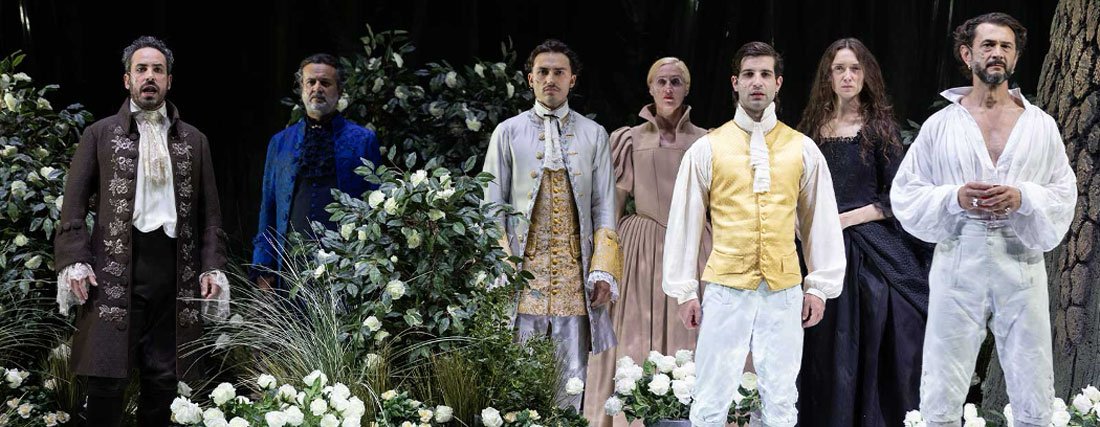
Riccardo III by William Shakespeare, in the staging by Antonio Latella with Vinicio Marchioni in the role of the king, is on at Teatro Vascello in Rome from March 30 to April 4, 2027, at Via Giacinto Carini 78, in Monteverde Vecchio. There are six performances: from Tuesday, March 30 to Friday, April 2 at 21:00, Saturday, April 3 at 19:00 and Sunday, April 4 at 17:00. The show runs two hours and 40 minutes, intermission included. The translation is by Federico Bellini, the adaptation by Latella and Bellini. The production is by Teatro Stabile dell'Umbria and LAC Lugano Arte e Cultura. Vascello is reached by bus 75, which stops in front of the entrance, or by lines 44, 710, 870 and 871. By train, from Ostiense station get off at Quattro Venti, a few steps away. Tickets are bought from the show's official page on the Teatro Vascello website, which links to the authorized presale circuit, or at the theater's box office. Prices are published on the venue's official channels.
Language: performed in Italian. No English version or English surtitles are announced.
Richard III is the last work of Shakespeare's minor tetralogy on English history and, after Hamlet, his longest play. Latella stages it with 11 actors and a precise question: what happens to evil when you take away the alibi of deformity. What follows are dates and times, the cast, the director's vision, the plot, the protagonists, Teatro Vascello and tips for the evening in Monteverde.
Riccardo III at Teatro Vascello: dates, times and running time
Antonio Latella's Riccardo III is at Teatro Vascello for six performances, from March 30 to April 4, 2027, with a running time of two hours and 40 minutes including the intermission.
The calendar
Tuesday, March 30 and Wednesday, March 31, Thursday, April 1 and Friday, April 2 at 21:00. Saturday, April 3 at 19:00. Sunday, April 4 at 17:00. It is Vascello's usual pattern, with the early Saturday start and the Sunday matinee.
The running time
At two hours and 40 minutes it is one of the longest shows of the theater's season. At the 21:00 performances the finish is expected around 20 minutes to midnight: a fact to consider for those going home by public transport.
The production
The show is produced by Teatro Stabile dell'Umbria, the public theater of the region, active since 1985 and one of Latella's longtime producers, and by LAC Lugano Arte e Cultura, the cultural center of the Swiss city.
The cast of Riccardo III: Vinicio Marchioni and 10 performers
Vinicio Marchioni is Riccardo III. With him Silvia Ajelli, Anna Coppola, Flavio Capuzzo Dolcetta, Sebastian Luque Herrera, Luca Ingravalle, Giulia Mazzarino, Candida Nieri, Stefano Patti, Annibale Pavone and Andrea Sorrentino.
The roles
Silvia Ajelli is Queen Elizabeth. Anna Coppola the Queen Mother, Duchess of York. Flavio Capuzzo Dolcetta the Custodian. Sebastian Luque Herrera the Prince of York and Richmond. Luca Ingravalle Prince Edward. Giulia Mazzarino Lady Anna. Candida Nieri Queen Margaret. Stefano Patti Buckingham. Annibale Pavone Clarence, King Edward and Stanley. Andrea Sorrentino Hastings and the mayor.
The creative team
The dramaturg is Linda Dalisi, the sets are by Annelisa Zaccheria, the costumes by Simona D'Amico, music and sound by Franco Visioli, the lights by Simone De Angelis. Alessio Maria Romano is assistant director and handles the movements. Riccardo Rampazzo is volunteer assistant.
A loyal company
Several names recur in Latella's work. Annibale Pavone was already on stage in his Moby Dick of 2007, produced by the same Teatro Stabile dell'Umbria, alongside Giorgio Albertazzi. And with Vinicio Marchioni the director has already signed two shows, as you read further on.
Evil and beauty: Antonio Latella's vision
In the notes published by Teatro Vascello, Antonio Latella explains that he wants to go beyond the exteriority of evil and look for its enchantment: his Riccardo III gives up the alibi of physical deformity, the hump that has marked the character for centuries.
Beyond the hump
The director's reasoning is clear-cut. If evil is represented through a physical sign, the audience accepts and justifies it, feels empathy if not sympathy for the protagonist. Latella asks if in the 21st century this alibi is still acceptable, and recalls that in popular culture people touched the hump for good luck.
The Garden of Eden
In place of deformity there is beauty. The director speaks of a blinding, opulent and deceptive beauty, made of dangerous relationships and games of seduction, and uses the image of the Garden of Eden and the serpent who enchants Eve with words. In his notes he writes that he asked his collaborators to give beauty to evil, and not ugliness.
The battle against the feminine
In Latella's reading Richard's battle is not for the crown but for the subjugation of the feminine, and it is the feminine that checkmates him: it will be the queen mother who delivers a terrible curse.
The word
At the center is the force of the word, its seduction and even its incorrectness. The director observes that in some countries Richard III is taken off the bills because of the theme of physical disability, and defends the work from the risk of a censorship that decontextualizes it.
Federico Bellini's translation and the Custodian
Federico Bellini's translation, according to Latella, makes it possible to play at the start with almost comedic rhythms, which the director calls Wildean, with a nod to Victorian England.
An adaptation faithful to the story
The adaptation gives up some parts of the original text but tries to respect the whole of the story. It is a necessary choice for a play that, by length, is second only to Hamlet in Shakespeare's theater.
The Custodian
Studying the characters, Latella and Bellini expanded an already existing figure and called it the Custodian: apparently a servant of evil and of Richard, who over the course of the story reveals himself to be in the service of the beauty of the place, ready to do anything to guarantee the survival of the Garden of Eden. That anything, the notes explain, is summed up in the text by the word amen.
The plot of Riccardo III
Richard III tells of the rise to the English throne of Richard, Duke of Gloucester, through a chain of deceptions and crimes, up to his defeat and death at the Battle of Bosworth, in 1485, which marks the end of the Wars of the Roses and the start of the Tudor dynasty.
Clarence and Lady Anna
After the Battle of Tewkesbury his brother Edward is king. Richard convinces the sovereign that their brother George, Duke of Clarence, is plotting against him and has him locked in the Tower of London. Then he seduces Lady Anna, widow of the Prince of Wales whose death he himself caused, and convinces her to marry him.
The princes in the Tower
Once Clarence is killed, Richard takes advantage of Edward's death to become Lord Protector of his nephew, still a minor. He locks the young king and his younger brother in the Tower of London, and they soon vanish without a trace. He has Hastings executed and, with Buckingham's help, rises to the throne.
Bosworth
Power crumbles: Buckingham allies himself with Henry, Earl of Richmond. The night before the Battle of Bosworth, near Leicester, the ghosts of his victims appear to Richard. The next day Richmond wins and becomes king with the name Henry VII.
Shakespeare and the real Richard
Richard III was written in all likelihood between 1591 and 1592, at the beginning of Shakespeare's career, as the conclusion of a tetralogy that began with the three parts of Henry VI.
The sources
Shakespeare drew mainly on the chronicles of Raphael Holinshed and, in all likelihood, on Thomas More's History of Richard III, a literary account in which more than a third of the text consists of invented speeches.
A Tudor version
On the throne, in Shakespeare's time, was Elizabeth I, granddaughter of that Henry VII who had defeated Richard at Bosworth. The play reflects the Tudor version of history and exalts their ancestors, painting in dark colors the last king of the House of York.
Famous interpreters
In the twentieth century Richard III was brought to the screen by Laurence Olivier in the 1955 film, by Ian McKellen in 1995 in a version set in a fascist England of the 1930s, and by Al Pacino in the documentary Looking for Richard from 1996.
Antonio Latella, the director
Antonio Latella was born in Castellammare di Stabia on March 2, 1967 and is an actor and director: from 2017 to 2020 he directed the International Theater Festival of the Venice Biennale.
Training
He studied acting at the school of Teatro Stabile di Torino and at the Bottega Teatrale di Firenze founded by Vittorio Gassman. As an actor he worked with Luca Ronconi, Giuseppe Patroni Griffi, Massimo Castri, Elio De Capitani and Gassman himself, with whom in 1992 he acted in Ulisse e la balena bianca.
Shakespeare, Genet, Pasolini
A little over 30, he directs one of the courses of the École des Maîtres. In 2001 he wins the first Ubu Prize for the project Shakespeare e oltre, in 2004 the Gassman Prize as best artist of the year. His stagings include Othello, Romeo and Juliet, Hamlet, the Genet trilogy, Pilade, Porcile and Bestia da stile by Pasolini, Marlowe's Edward II, Waiting for Godot.
Opera, Europe, Testori
In 2004 he makes his opera directing debut in Lyon with Monteverdi's L'Orfeo. In 2007 he stages Moby Dick with Giorgio Albertazzi for Teatro Stabile dell'Umbria. In 2023, for the centenary of Giovanni Testori, he creates the Bottega Amletica Testoriana. He lives and works between Berlin and Italy.
A return to Riccardo III
Latella's list of stagings includes a Riccardo III from 2002, in the years of the Shakespeare project awarded the Ubu. The production on at Vascello is therefore a return to the text after more than 20 years.
Vinicio Marchioni, Riccardo III
Vinicio Marchioni was born in Rome on August 10, 1975 and is an actor and director: he graduated in 2000 from the Libera Accademia dello Spettacolo in Rome, made his theater debut in 1995 and studied with Luca Ronconi at the Centro Santa Cristina in 2005.
The Freddo and cinema
He became popular in the role of the Freddo in Stefano Sollima's series Romanzo criminale, between 2008 and 2010. In 2010 he is the lead in 20 sigarette by Aureliano Amadei, awarded in Venice in the Controcampo italiano section with a special mention for his performance. In 2011 he is nominated for the David di Donatello as best leading actor. He has shot more than 40 films, among them The Place and Supereroi by Paolo Genovese, Siccità and Un altro ferragosto by Paolo Virzì, C'è ancora domani by Paola Cortellesi and Diamanti by Ferzan Özpetek.
Theater
In theater he worked with Luca Ronconi in Itaca by Botho Strauß and Nel bosco degli spiriti, with Arturo Cirillo in Cat on a Hot Tin Roof, and he directed and performed in Uno Zio Vanja, Camus's Caligula and In vino veritas. In 2018 he founded the Anton Art House with Milena Mancini. In 2024 he published his first novel, Tre notti.
With Latella
With Antonio Latella, Marchioni has already performed in Tennessee Williams's A Streetcar Named Desire in 2012 and Edward Albee's Who's Afraid of Virginia Woolf? between 2022 and 2023. Riccardo III, from 2025, is their third encounter.
Teatro Vascello, home of experimental theater in Monteverde
Teatro Vascello was inaugurated on May 4, 1989 on Via Giacinto Carini by Giancarlo Nanni and Manuela Kustermann, with the company La Fabbrica dell'Attore, and has been ever since one of the reference places of contemporary theater in Rome.
From Via Portuense to Monteverde
Before Vascello, in the 1970s, Nanni and Kustermann worked at Teatro La Fede, at Via Portuense 78, within what was called the Roman school, a theater that gave precedence to image over word.
Stabile d'Innovazione
In 1998 the Ministry recognizes La Fabbrica dell'Attore as a Teatro Stabile d'Innovazione. In 2004 the Sala Studio opens. After Nanni's death, in January 2010, artistic direction passes to Manuela Kustermann.
Spring 2027
Riccardo III arrives at Vascello in a season rich in revisitings of the classics, after Carmelo Rifici's Orestea and Testori's Edipus with Sandro Lombardi.
How to get to Teatro Vascello for Riccardo III
Teatro Vascello is at Via Giacinto Carini 78, in Monteverde Vecchio: the most direct bus line from the center is the 75, which stops in front of the entrance.
Bus
Besides the 75, the theater lists lines 44, 710, 870 and 871, which connect Monteverde to Trastevere and the western neighborhoods. For evening times, especially on the way back after a long show, it's best to check the Atac route planner.
Train
From Ostiense station, connected to Metro Line B by the Piramide stop, the metropolitan train arrives at Quattro Venti, a few steps from the theater.
Car
The theater suggests parking along Via delle Mura Gianicolensi, about a hundred meters away. There are paid parking lots at Via Giacinto Carini 43, at Via Maurizio Quadrio 22, affiliated with Vascello if you show your ticket, and at Via Raffaello Giovagnoli 20.
A curiosity about Riccardo III by Antonio Latella with Vinicio Marchioni at Teatro Vascello, March 30 to April 4, 2027
The most interesting curiosity concerns the hump. For centuries Richard III has been the deformed king par excellence: Shakespeare describes him as physically deformed and prone to perversion, and the stage tradition has made the hump the outward sign of his wickedness. Latella removes it. In the director's notes he explains that this physical sign is an alibi: the audience sees the monstrosity and justifies it, ends up feeling empathy if not sympathy for the protagonist. And he adds a detail of theater history: Shakespeare's character is built as a mask body, close to the court jester, the fool, a figure often loaded with outward signs like the hump, signs that over time have taken on ambivalent meanings, grotesque and at the same time propitiatory. In popular culture, the director recalls, people rushed to touch the hump for good luck. The second curiosity concerns Latella's path: among his stagings there is already a Riccardo III, dated 2002, in the years of the Shakespeare project with which he won the first Ubu Prize. The return to the same text after more than 20 years, with an actor like Vinicio Marchioni and a cast of 11 performers, says a lot about how inexhaustible the director considers this play. The third curiosity is Roman: Marchioni was born in Rome, and built his popularity with a character, the Freddo of Romanzo criminale, tied to the city's crime news. An actor the audience loved as a seductive criminal now returns to play the most seductive of Shakespeare's criminals, in his own city.
Something nobody tells you about Riccardo III by Antonio Latella with Vinicio Marchioni at Teatro Vascello, March 30 to April 4, 2027
What the posters don't say is that this Riccardo III is a show of two hours and 40 minutes, intermission included, and that the evening must be organized accordingly. At the four weeknight 21:00 performances you come out around 20 minutes to midnight. From Monteverde, at that hour, public transport runs less often, and it's best to know beforehand how you will get home. The Saturday at 19:00 and the Sunday at 17:00 are, for those who live far away or come from outside Rome, the most convenient options, with dinner after the show and not before. The second thing nobody remembers is that the show, in the director's intentions, is not a costume history drama but a reflection on evil and beauty: anyone expecting the reconstruction of the Wars of the Roses will find a Garden of Eden, a Custodian who in the original text barely exists, an opening rhythm that Latella himself calls almost comedic. It's best to arrive prepared, perhaps rereading the plot: with 11 actors and many doubled characters, those who don't know the story risk confusing the queens and the princes. The third detail is practical: the parking lot at Via Maurizio Quadrio 22 is affiliated with the theater if you show your ticket, a concrete advantage for those arriving by car in the evening. Finally, a matter of sensitivity: the director recalls that in some countries Richard III is taken off the bills because of the theme of physical disability. His choice to eliminate the hump is also a response to this debate.
My advice for visiting Riccardo III by Antonio Latella with Vinicio Marchioni at Teatro Vascello, March 30 to April 4, 2027
My advice is to choose the Saturday, April 3 performance at 19:00. With a show of two hours and 40 minutes, the Saturday time lets you come out around 21:40, with all the time for a dinner in Monteverde or Trastevere, and get home without rushing. If you prefer the afternoon you have Sunday at 17:00: beforehand you can go up the Janiculum, not far away, and look at Rome from above before going into the hall. The second tip is to read the plot before going, or at least to review the main characters: Richard, the brothers Edward and Clarence, Lady Anna, the three queens Elizabeth, Margaret and the Duchess of York, Buckingham, Hastings, Richmond. In Latella's show several actors play more than one role, and knowing who is who helps in following. The third tip concerns the gaze: instead of looking for the monster, it's best to watch how Marchioni builds the seduction, with voice and body, because that is where the director has shifted the center of the drama. Finally, for those who like comparisons, after the show it's worth rewatching at home Laurence Olivier's 1955 film or Ian McKellen's 1995 one: two Richards with the hump, to set beside this one that does without it. Tickets should be bought early: there are only six performances and the cast draws a wide audience.
The neighborhood around Teatro Vascello: Monteverde Vecchio
Monteverde Vecchio is the high, residential part of Monteverde, above Trastevere, between the Janiculum and the great historic villas.
The Janiculum
The Janiculum is very close: the panorama over the city, before the Sunday matinee, is the best way to begin the day.
The villas
Villa Sciarra and Villa Doria Pamphilj are the two great green stops of the area. At the start of April the days are longer and you can enjoy the parks until late afternoon.
The Fontanone
Climbing up the hill, you reach the Acqua Paola Fountain, the Fontanone, with its view over Rome.
Trastevere
At the foot of Monteverde lies Trastevere, the natural destination for anyone looking for dinner after the Saturday performance.
Another well-known fact, yet rarely mentioned
It's well known that Richard III is Shakespeare's villain par excellence, the king who has his nephews killed in the Tower of London, and that his name is a synonym for unscrupulous ambition. It's mentioned less often that this image is in large part the product of propaganda. In Shakespeare's time Elizabeth I was on the throne, granddaughter of Henry VII, that is, of the Earl of Richmond who in 1485 defeated and killed Richard at Bosworth, starting the Tudor dynasty. The play adopts the historical version of the victors: it exalts the queen's ancestors and paints the last sovereign of the House of York in dark colors. The sources Shakespeare drew on, Holinshed's chronicles and in all likelihood Thomas More's History of Richard III, were not neutral: More wrote a literary account in which, according to scholars, more than a third of the text consists of invented speeches, and among his sources were figures hostile to the old regime such as Cardinal John Morton. The character of the vilest scoundrel in English history, moreover, had already been described by other writers before Shakespeare. A second little-cited fact concerns length: after Hamlet, Richard III is the longest play by the English dramatist, and that is why almost all productions, including the one by Latella and Bellini, cut some parts. That the director chose to remove the hump, the most visible symbol of that propaganda, thus takes on a further meaning.
The right photo to take at Richard III by Antonio Latella with Vinicio Marchioni at Teatro Vascello, from March 30 to April 4, 2027
During the show the phone stays off: two hours and 40 minutes of Shakespearean language demand attention, and every lit screen disturbs the actors and your seatmates. Photos are taken outside, and Monteverde offers some good ones. The first is from the Janiculum, a short distance from the theater: in early April, before the Sunday matinee or in the late afternoon on Saturday, the light on the city from the top of the hill is one of the most classic images of Rome, with the domes and rooftops warming toward evening. For a play about the thirst for power, a photo of the Eternal City from above has an almost ironic sense. The second is the Acqua Paola Fountain, the Fontanone, with the view opening up in front of it: it's the most photogenic stop between the theater and Trastevere. The third is the entrance of Vascello, with the poster of the show: the theater sits on a residential street, and a photo in front of the sign, in the evening, has the appeal of the small neighborhood theaters that have hosted experimental stage work for decades. For those who like details, a photo of the ticket next to an edition of Richard III, perhaps the one you read to brush up on the plot, is the simplest memento of the evening.
Where to eat before or after Richard III
Teatro Vascello has an in-house bistro, the Coffee Plant Bistrot, useful for a coffee or a snack before the show. For a proper dinner, the neighborhood and Trastevere offer many choices.
Before 21:00
With a long show, on weeknights it's best to eat early in Monteverde, at one of the trattorias and pizzerias frequented mostly by residents, with lower prices than in Trastevere.
After the Saturday 19:00 show
On Saturday you come out around 21:40. It's the right time to head down to Trastevere, where osterias and trattorias stay open until late. Better to book.
On Sunday
The Sunday, April 4 matinee ends around 19:40. An unhurried dinner in Monteverde is a good way to close the day.
Some important events that happened here in history
The history of Teatro Vascello is told through dates. On May 4, 1989 the hall opens with Qui non ci torno più by Tadeusz Kantor and the Cricot Theatre of Warsaw, an inauguration that declares the venue's vocation for the most radical European stage work. In the early 1990s Raul Ruiz, the Pontedera research center, and American and French contemporary dance come through. In May 1996 the Extraordinario festival presents 16 young companies from all over Italy. In 1998 the Ministry recognizes La Fabbrica dell'Attore as a Teatro Stabile d'Innovazione, and in the same year Vascello co-produces a show with the Berliner Ensemble, the theater founded by Brecht. In the spring of 2001 the co-founder Giancarlo Nanni becomes the first Italian invited to work and teach at the Actors Studio in New York. In 2003 the Premio Valentino Zeichen, dedicated to poetry, is born, and in 2004 the Sala Studio opens. In January 2010 Nanni dies and the direction passes to Manuela Kustermann. For more than 20 years the Romaeuropa Foundation has brought part of its festival to Vascello. In the 2026/2027 season the stage has hosted, among others, Tragudia, Il canto di Edipo by Alessandro Serra and L'orologio americano by Elio De Capitani, who had worked with Latella back when the director was still an actor. From March 30 to April 4, 2027 Richard III arrives.
Who has passed through: Richard III by Antonio Latella with Vinicio Marchioni at Teatro Vascello, from March 30 to April 4, 2027
Many names of contemporary theater have passed through the stage of Vascello and, even earlier, the history of the company that founded it. At Teatro La Fede, the first venue in the 1970s, came the saxophonist Steve Lacy, the composer John Cage, the director Gérard Gelas and the Living Theatre. From that company came Memè Perlini and Giuliano Vasilicò. At Vascello, since 1989, there have been Tadeusz Kantor with Cricot, Raul Ruiz, the Pontedera center, Teatri Uniti, Moni Ovadia, Carlo Cecchi, Giorgio Barberio Corsetti, Societas Raffaello Sanzio, Teatro Valdoca and Pippo Delbono. For dance, Enzo Cosimi, Sosta Palmizi, Virgilio Sieni and Wim Vandekeybus. Among the international masters, Bob Wilson and Peter Brook, who presented Beckett's Happy Days here with Natasha Parry. Manuela Kustermann, actress and artistic director, is the constant presence in this history. In the fall of 2026 Ben Duke also came through with The Last Hamlet, another reworked Shakespeare, and Marta Cuscunà with La medium. From March 30 to April 4, 2027 it's the turn of Antonio Latella and Vinicio Marchioni, with Silvia Ajelli, Anna Coppola, Flavio Capuzzo Dolcetta, Sebastian Luque Herrera, Luca Ingravalle, Giulia Mazzarino, Candida Nieri, Stefano Patti, Annibale Pavone and Andrea Sorrentino, the translator Federico Bellini and the dramaturg Linda Dalisi. And with them, ideally, William Shakespeare, Thomas More, the Tudors and the last king of York.
Accessibility, students and practical information
Teatro Vascello publishes an accessibility section on its website, to be consulted before buying to learn about entrances, reserved seats and services.
With students
Richard III is a classic studied at school and at university: Latella's production is an opportunity to see how a contemporary director reads Shakespeare. The length and some of the themes make it suitable mainly for high school students and adults.
The intermission
The show includes an intermission, counted within the two hours and 40 minutes. It's the moment for a coffee at the theater's bistro.
Early April in Rome
The first days of April bring long days and pleasant temperatures to Rome: the right moment to combine an evening at the theater with a walk between the Janiculum and Villa Doria Pamphilj.
Frequently asked questions about Richard III at Teatro Vascello
When is Richard III with Vinicio Marchioni on in Rome?
Richard III with Vinicio Marchioni is on at Teatro Vascello in Rome from March 30 to April 4, 2027: from Tuesday, March 30 to Friday, April 2 at 21:00, Saturday, April 3 at 19:00, Sunday, April 4 at 17:00.
How long is Latella's Richard III?
Antonio Latella's Richard III runs two hours and 40 minutes, intermission included, according to the official page of Teatro Vascello. At the 21:00 performances the show is expected to end around 23:40.
Who is in the cast of Richard III?
In the Teatro Vascello Richard III, Vinicio Marchioni is the king. With him are Silvia Ajelli, Anna Coppola, Flavio Capuzzo Dolcetta, Sebastian Luque Herrera, Luca Ingravalle, Giulia Mazzarino, Candida Nieri, Stefano Patti, Annibale Pavone and Andrea Sorrentino. Directed by Antonio Latella.
What is different about this Richard III?
Antonio Latella's Richard III gives up the physical deformity of the protagonist, which the director considers an alibi for evil, and focuses on the beauty and seduction of the word. The adaptation also expands the figure of a Custodian, in the service of the beauty of the place.
Where is Teatro Vascello?
Teatro Vascello is at Via Giacinto Carini 78, in Monteverde Vecchio, near the Janiculum. You get there by bus 75, which stops in front of the entrance, by lines 44, 710, 870 and 871, or by train to Quattro Venti station.
Where do you buy tickets for Richard III at Vascello?
Tickets for Richard III at Teatro Vascello are bought from the show's official page on the theater's website, which links to the authorized presale circuit, or at the box office at Via Giacinto Carini 78. Prices are published on the venue's official channels.
Who produced the show?
Richard III with Vinicio Marchioni is produced by Teatro Stabile dell'Umbria and LAC Lugano Arte e Cultura. The translation is by Federico Bellini, the adaptation by Antonio Latella and Federico Bellini, the dramaturgy by Linda Dalisi.
Final advice on Richard III
In our view Antonio Latella's Richard III is one of the most important events of the Roman theater spring: a great director returning to a text he already tackled 20 years ago, a much-loved Roman actor on his third collaboration with him, a cast of 11 performers and a strong thesis, that of an evil that seduces without needing the hump. The advice is to pick Saturday at 19:00 or Sunday at 17:00, brush up on the plot, get to Monteverde with time to climb up to the Janiculum and let yourself be enchanted, like Lady Anne, by a king who doesn't need to look monstrous to be one.
Article written by the editorial team of Tour Leader Pro, contact them for Private/Corporate/V.I.P. Tours and Experiences.
Planning a trip to Rome? The English guides for visiting the city are on ItalyPlanner.com.